My Kind of House Work
The last couple days, I have been in my own personal nirvana. I have spent more time in Home Depot and Lowe’s than in the last two years. We have a new house to work on, need some work contracted, can do some of the work ourselves. It is exciting – and also terrifying. You never really know how an idea will work out.
But this gets my juices going. I love getting my hands on hammers, putting in new closets, figuring out how to upgrade a dated kitchen, painting, even reupholstering. I love the flooring departments, with all the tile samples, wood flooring samples, and carpeting. I love to see what the newest kitchens and baths are using, and to read magazines about what works and what works better. I like a house with a custom feel, something like Susanka’s The Not-So-Big-House, available from Amazon for around $14.46, where quality of space and quality of materials counts for more than square meters.

And I like doing some of it myself. Sometimes in the middle of it all, I stop and think “what am I doing???” but at the end, I usually feel SO satisfied, like I have really accomplished something.
If I had my “druthers”, I would probably buy an older home in good condition and change the floor plans, knock out walls, put in new bathrooms, and have a wonderful time doing it. Meanwhile, I am having a sample of all that “fun” right now. Wooo Hoooooo!
Porn For Women
My son and I were chatting in the Barnes and Noble when he got a weird grin on his face, stood up, and plucked a book from the shelf opposite where we were sitting.
Porn for Women was the title, and the book is authored and published by the Cambridge Women’s Pornography Cooperative and Susan Anderson (Paperback – Mar 1, 2007)
Here is the cover – for all my women friends – isn’t that a total turn on???

I flipped through the book – available through Amazon.com for $11.01, but could you get it through Kuwaiti customs with a title like that? – and found this second shot that nearly made me swoon . . .
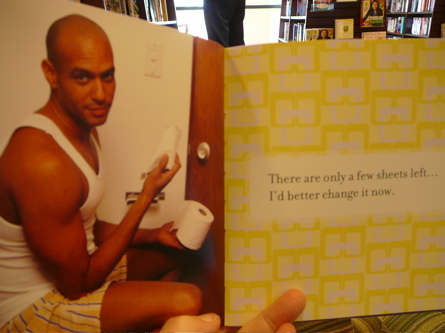
Women are SO clever! And no one knows better than women what turns women on!
Ultrametabolism and Kuwait Diet
I used to be thin. Really thin. Actually, I have been really thin several times in my life, but, *sigh* no longer.
This morning as I was picking up my e-mail, this review on AOL caught my eye. Dr. Mark Hymon is one of the AOL Wellness Coaches, and he has written two books, one called Ultrametabolism, about using your built in genetic strengths to lose weight and maintain the weight loss naturally, and one called Ultraprevention about foods to eat (and not to eat) to contribute to overall wellness and good health.
If you’ve been reading me for a while, you will know that I can be a little cynical.
What I like about Dr. Hymon’s approach is that it makes sense.
Diets that totally eliminate foods you love just aren’t going to work. Give up pasta for the rest of your life? I don’t think so. But what Dr. Hymon asks us to do is to eat mostly non-processed, or minimally processed foods. He says that the processed foods have components that the body doesn’t even recognize as food, and that’s why after eating things like Twinkies, Mars bars, packaged crackers, etc. we still feel hungry – our bodies don’t recognize what we have eaten as food.
Here is what Dr. Hymon suggests (this is from the AOL Health and Fitness section):
How to use what you eat to tell your DNA how to slim you down and live a healthier life.
Day 1. Clean out your cabinets, refrigerator and freezer. Get rid of packaged items filled with processed fats and sugars. Check the lable – if it says “hydrogenated oil” or “high fructose corn syrum” get rid of it.
Day 2. Go shopping for whole foods. Find a farmer’s market in your area for fresh produce and schedule visits in your calendar weekly or biweekly over the next few months. At the grocery, choose items from the “perishable perimeter” of the store, instead of items in the center aisles where processed foods lurk.
Day 3. Change your oil! Throw out old oils, which can become rancid quickly. Replace vegetable oils like safflower and canola with extra-virgin olive oil and make it your primary oil for cooking and salad dressings.
Day 4. Visit a health food sotre. Leave there with 10 new items you’ve never tried before. Bulk-purchase whole grains, legumes and nuts. Look for new whole grain cereals, breads and snacks without processed additives, fats, sugars or preservatives. And remember: just because it’s in a health food store, doesn’t mean it’s good for you. Read the labels of any packaged foods you buy.
Day 5. Choose Eggs! Choose organic eggs farmed with omega-3 fats. Make yourself a spinach omelet for breakfast. Eggs are a good source of protein. You can enjoy as many as eight a week.
Day 6. Become wild about fish. Find a local fishmonger or educate yourself by talking to your local grocer. Or learn more about which fish are best to eat by visiting www. ultrametabolism.com. Print out a primer to bring with you when you shop.
Day 7. Prepare some healthy snacks for when you’re on-the-go. Pack a small zipper bag with a few servings of almonds or walnuts. One handful equals a serving.
Day 8. Don’t go thirsty. By now, you’ve tossed the sodas. Bring out the blender and learn to make high protein, no sugar smoothies. Experiment with crushed ice and fresh fruits. You can even make frozen nut cubes by soaking nuts overnight, blending them and then freezing them with a bit of water or milk in ice cube trays. Your smoothie will be creamy and full of good fats and proteins.
As I did his online mini-seminar, I found myself thinking “everything this Dr. Hymon is recommending is the way Kuwaitis USED TO eat.” And I also found myself thinking what a wealth of opportunity we are living amidst, here in Kuwait, where we can go to any market and buy FRESH fish, really fresh, right off the boats, in the local fish markets. We can buy fresh meats, and fresh vegetables, lots of them grown right here in Kuwait. We can buy fresh eggs. even fresh chicken when not under threat of Avian Flu. Kuwait is a paradise for exactly this kind of diet.
Not only do we have access to fresh, locally grown foods, but the cost is so much less than processed foods on the shelves. He is talking about lentils and grains commonly available here in those big sacks, down in the Souk Mubarakiyya, as well as in the co-ops and the Sultan Centers.
This isn’t anything new, eating low on the food chain, eating fresh, but it does strike me as a diet that particularly works in Kuwait, and a kind of diet that you can live with for the rest of your life, because it doesn’t make changes in your life that you can’t live with. Like he does tell us to give up soda, one of the main contributors to obesity in the world today. As you get older, carbonated beverages aren’t that hard to give up because they also give you heartburn, so just another reason to steer clear of all those unwanted calories the body can’t identify as food.
He didn’t say anything about chocolate . . . but I have ordered both books from Amazon.com hoping that the dark, semi-sweet, barely processed chocolate that I love will also be “just what the doctor ordered.” Meanwhile . . . I hear a spinach omelet calling my name!
Even After All this Time – Latifi
A good book can make your blood race faster. A good book may even require underlines, turned page corners to mark the places you liked the best. A good book may compell you to tell others about it. Above all, a good book is a book you think about long after you have turned the last page.
Some of my best “good books” come to me through Little Diamond, my neice who lives in Beirut. We share a family culture, but even better, we share a wacky sense of humor. There are times we can’t even let our eyes meet in family gatherings, because we are thinking the same thing and can’t afford to laugh out loud.
She recommended this book to me more than three years ago, and I bought it immediately. And then it sat in my “read me soon” pile(s), languishing, unread, until early this year.
Oh, what a treat this book is! Once I picked it up, I could hardly put it down!
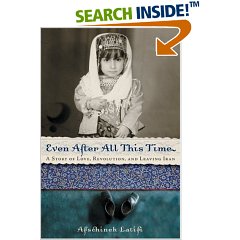
The book is autobiographical, and begins in pre-revolutionary Iran, where Afchineh Latifi’s father is a soldier. You see the early years of her life with her sweet, struggling parents, and you feel like you lived in their home with them, the images are so vivid.
As a military officer, though, her father is suspect once the revolutionaries come into power, and her family’s fortunes fail. Her father is arrested. As Latifi’s mother bravely goes from jail to jail, trying to find her husband, her daughters are often with her. Once she finds him, she brings him comfort items – shaving kit, washcloth, etc. so he can maintain a small amount of dignity while he is being beaten and imprisoned. Latifi’s mother was young when this book opens, maybe in her thirties, with two daughters and two sons, and I am totally blown away by the courage it took to persist as her husband was transferred from prison to prison, increasingly brutalized, and then, immediately after the last visit – shot. So immediately that the family heard the shots.
And then the real nightmare begine. The young mother and her family have no income, and her (now dead) husband’s mother claims her house, even though they bought her a house of her own while her husband was alive. Latifi’s Mom never gives up. She gets her daughters visitor’s visas to Austria and puts them in a convent school, and then gets them to America – again on visitor’s visas – where they are forced to camp – for years – with a relative. Literally, years. Their brave mother eventually manages to get herself and her sons out of Iran, and join them in the US.
Their mother is a pistol. She is brave in the face of obstacles that would deter most of us. She never gives up. I am in total awe of her commitment to the survival – and thriving – of her family.
I love this book for two reasons – the first being the strength and courage of this family, and the second being that they immigrated to America. You will hear a lot of Americans who say terrible things about immigrants, and how they take up scarce resources better meant for “real” Americans. Who are they kidding? We are ALL immigrants, in America, except for the Native Americans! This family, their will to succeed, is the story of us all, and what makes the country great. It is still a country where you can work hard, and succeed, and thrive. It’s an every day story in our country, but a story I never get tired of hearing.
Here are some excerpts from the book:
She looked at me as if I were an alien, which in fact I was. “Yes,” she said, “You get a library card and you can borrow as many books as you want.”
“And it doesn’t cost a thing?” I asked.
“Not a penny,” the woman said. “Unless you bring the books back late. Then we charge you a late fee.”
This was news to me. There were libraries in Tehran to be sure, but we had never frequented them. Mom would come home every two or three weeks with armsful of new books, and we would devour them hungrily. We were much too spoiled to share books with anyone.
The librarian processed my card on the spot. I couldn’t believe it. It felt like the biggest gift of my life. . . . . By the end of the summer I discovered a whole new world. Books. Words. Stories. I got in touch with my inner geek. Reading was not only exciting, it offered escape. When I was reading, my other life didn’t exist. There were days when I didn’t even think of Mom.
Her Mother was still in Iran at this time, and she and her sister are living with relatives who have loud arguments wondering how much longer they will be burdened with these girls. Finally, the two sisters find jobs, as well as going to school, and save every penny, and get an apartment where they live while putting themselves through university. And, one day, their mother and brothers arrive. Life changes. They all live together again.
“It’s almost Norouz,” she said. “Or have you forgotten?”
I had indeed forgotten. She was referring to the Persian New Year, which on the Gregorian calendar falls in late March. About two weeks before the start of Norouz, many Persians take part in something called ‘khane tekani,’ which literally means ‘shaking your house.’ You will see people painting their homes, washing their carpets, sweeping out their attics, cleaning their yards. One could say that it is a form of spring cleaning, but that is only a very small part of it. In Persian ‘no’ means new, and ‘rouz’ means day. The last Wednesday of the year is known as ‘chahar shanbeh suri.’ At dusk, with the cleaning over, people light small bonfires and sing traditional songs, and those who can manage it are urged to jump over flames. Fire, too, is seen as a cleansing, purifying agent: it burns away all the negative things in one’s life – the bad habits, the misfortune, the sorrows. It’s all about cleanliness: clean house, clean soul, new beginnings.
On the “new day” itself, people focus on family and friends, and for the next two weeks there will be much visiting back and forth. In each house, one finds a ‘sofreh eid,’ . . . Laid out on this garment, one will find the ‘Haft Seen’ (Seven S’s) comprised of seven items that begin with the letter S. These are ‘sabzeh’ or sprouts (representing rebirth); samanu, a pudding (for sweetness in life); ‘senjed,’ the sweet, dry fruit of the lotus tree (representing love); ‘serkeh’ or vinegar (for patience); ‘seer’ or garlic (for its medicinal qualities); ‘somaq’ or sumak berries (for the color of sunrise); and ‘seeb’ or red apples (symbols of health and beauty. In addition there are candles laid out on the ‘sofreh eid” one for each member of the household. The lit candles represent the goodness and warmth that enter life with the coming of spring.
(For the first time, this year we are invited to a new year’s celebration, and I thank God that I read this book just at the right time, so I will know even just a little of what this is all about. I am excited to see the ‘haft seen.’ )
Something else happened that November that I will never forget: Our family celebrated Thanksgiving for the first time. We loved the whole idea behind the celebration. It wasn’t about religion, and it wasn’t about gifts; it was about people sitting down to enjoy a meal together and acknowledging everything that they had to be thankful for. And we had a lot to be thankful for.
By the end of the book, all four children have graduated from university with professional degrees. This isn’t a spoiler. The book is about the sacrifice, the hard work and the commitment it took to get them there. Even After All This Time is an inspirational book, a book you won’t soon forget, and a book you will want to share with your friends.
Amazon offers it used from $4.67 and in hardcover around $25.
And Happy New Year to my Persian friends.
Google Earth for Dummies!
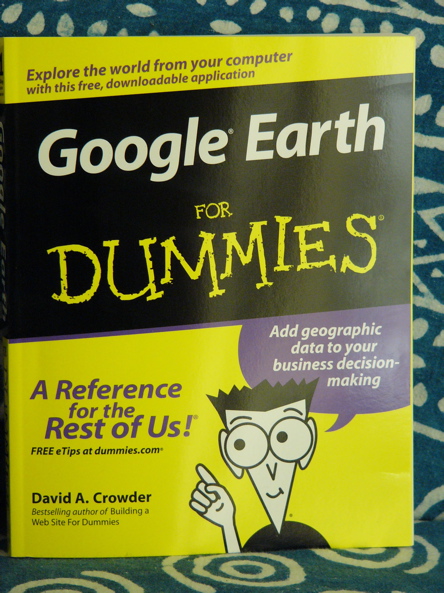
I’ve been on the waiting list at Amazon for months, ever since my nephew, Earthling, wrote me that this book was in the works. (thanks, Earthling!) It arrived this week. Wooooo Hooooo!
Yes, I love GoogleEarth. I soar and swoop, look at my house in Seattle, look at different places in Qatar and Kuwait, go to Florida and visit my son – all via Google Earth. With Google Earth for Dummies, I can now do even more. Like all the Dummy books, the writing is simple, there are a lot of illustrations, and it tells me things I would never otherwise know.
It’s $16.49 through Amazon.com, plus shipping, of course, and you can find it here.
Good Omens
When our son asked me what I might like for Christmas, I told him “find three really good books that I probably wouldn’t buy for myself.” I can trust him to do a great job because:
1. He has alwasy spent a good amount of time hanging out around books.
2. He has a good idea what I buy for myself.
3. He has a whacky sense of humor.
Good Omens, by Niel Gaiman and Terry Pratchett was one of the books he and his bride gave me, and it was a riotous good read.
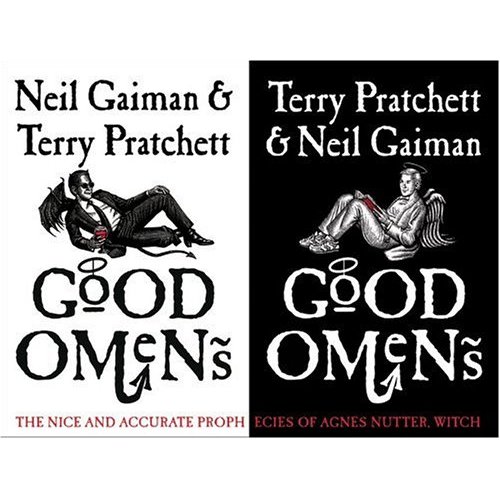
This book is not heavyweight – you can read it on one leg of an airplane trip or two or three nights before falling asleep. It treats a very heavy topic – The End of Days/ the Apocalypse in a very irreverant, very funny way. It treats the characters of good and evil – angels and devils – as real characters. In spite of the lightweight plot, there are some interesting – and hysterical thoughts.
Crowley, the demon/devil who was placed on earth to torment and tempt humans, hopes the end of the world will be a long way off . . . through the centuries, he has grown to rather like people.
Oh, he did his best to make their short lives miserable, because that was his job, but nothing he could think up was half as bad as the stuff that they thought up themselves. They seemed to have a talent for it. It was built into the design, somehow. They were born into a world that was against them in a thousand little ways, and then devoted most of their energies to making it worse. Over the years Crowley had found it increasingly difficult to find anything demonic to do which showed up against the natural background of nastiness. There had been times, over the past millenium, when he’d felt like sending a message back Below saying Look, we may as well give up right now, we might as well shut down Dis and Pandemonium and everywhere and move up here, there’s nothing we can do to them that they don’t do themselves, and they do things we’ve never evey thought of, often involving electrodes. They’ve got what we lack. They’ve got imagination. And electricity, of course.
The Anti-Christ is born, and cosmic events get underway. But . . .this being Earth, and bureacracies being as they are, things get screwed up. I’m not going to get specific; it’s part of the droll fun these authors have with us as they write this book. The Four Horsemen appear, but they ride motorcycles, and Pestilence has been replaced by Pollution.
As the situation heats up and the end of the world as we know it nears, Crowley ends up with an unlikely ally, the angel Aziraphale.
Now as Crowley would be the first to protest, most demons weren’t deep down evil. In the great cosmic game they felt they occupied the same position as tax inspectors – doing an unpopular job, maybe, but essential to the overall operation of the whole thing. If it came to that, some angels weren’t paragons of virture; Crowley had met one or two who, when it came to righteously smiting the ungodly, smote a good deal harder than was strictly necessary. On the whole, everyone had a job to do, and just did it.
Now, throw into the mix an ancient book of totally accurate prophesies that are sufficiently oblique to be disasterously mis-interpreted, The Nice and Accurate Prophesies of Agnes Nutter, Witch. “Nice” in this case refers to its oldest meaning, exact. And, while the prophesies ARE exact, finding out their exact meaning is another hilarious exercise.
All in all, a great read, a lot of fun . . . and underneath the fun, some little pinpricks of thought about human beings, the human condition, and our treatment of our world and one another that needle you long after you finish reading. Son, thanks, you chose a great book.
Book Meme – Too Much Temptation
Friday mornings in Kuwait can be VERRRRRY quiet. Today, I explored Technorati, and found people who have linked to me. One was PearLady and oh, what fun, she published a Book Meme.
I don’t do tags. I don’t do memes. Oh well, she found my weak spot. Here goes. Please read all the way to the bottom.
Hardback or paperback? I prefer paperback, just because I read all the time and paperback is more portable. And because I like to pass it along, and paperback is cheaper. But I buy hard cover when it is brand new from an author I love and I can’t wait.
Amazon or brick and mortar? Hands down Amazon, although if I am in the states, I can’t resist Barnes and Noble, and I always spend money there, and Half Price Books. Both ruin my weight allowance when I come to fly back to Kuwait.
Barnes & Noble or Borders? Either. Both. And all the little independent book sellers, too.
Bookmark or dog-ear? Bookmark is preferable, but occasionally I dogear sections I want to blog about. (Gasp) – occasionally I even underline.
Alphabetize by author, alphabetize by title or random? First by subject, then by author, but not by title.
Keep, throw away, or sell? Part with a friend??? Ah well, sometimes it is necessary. I even keep shelves of books for people to borrow, or to take. I buy multiples of the best ones, and trust that they will find new friends when they depart from my shelves.
Keep dust jacket or toss it? I take it off to read the book, then put it back on and give the book away. Hardcover books are too heavy to ship!
Read with dust jacket or remove it? Oops, see above.
Short story or novel? I love them both. Good science fiction often comes in short stories, stories you can remember years later. And novels – those are the friends that you keep around.
Collection (by same author) or anthology (by different authors)? Collection by the same author, because I am particular and don’t like all authors.
Harry Potter or Lemony Snicket? I prefer Harry Potter. I don’t know why, but I find Lemony Snicket a little creepy.
Stop reading when tired or at chapter breaks? Prefer to stop at chapter breaks, but sometimes I fall asleep and just have to give it up.
‘It was a dark and stormy night’ or ‘Once upon a time’? For me, once upon a time. Love history.
Buy or Borrow? Mostly buy, but sometimes the book I want to read isn’t available for sale, and have to borrow.
New or used? Both. Some books you can’t find new.
Buying choice: book reviews, recommendation or browse? Often look for specific authors, always looking for recommendations and often ask fellow travellers who look absorbed in what they are reading.
Tidy ending or cliffhanger? Tidy endings are nice, and I also find that the ones that end without resolution are the ones I think about the longest.
Morning reading, afternoon reading or nighttime reading? Any time. Usually, I use it as a carrot to make me get work done and projects finished, so normal is later in the day.
Standalone or series? Both. I like the Dickensian continuity of series.
Favourite series? Dorothy Dunnet’s Niccolo series. Fascinating characters and I learn so much. Great, vivid images, takes you back to the mid 1400’s.
tag…you’re all it…show me the meme! (If you don’t have a blog, you are welcome to comment below, or cut and paste.)
Donna Leon: Read and Savor
When I tell you about Donna Leon, I am really introducing you to a friend. I can’t remember when we met, but I can tell you that I seek her out whenever I can. Just listing her books, I realized there were several I hadn’t seen and I ordered them immediately, from the Amazon re-sellers.
“Why the resellers?” you are asking. Donna Leon is not that easy to find, in the United States. Some of the books in her series seem to have been printed only in the UK, which is a pity, because The Donna Leon books really need to be read in order.
While they can be a quick read, they are better read slowly and savored. It’s not that hard. Her humor is subtle, sometimes even sly. Commissario Guido Brunetti, her main character, lives in Venice. He has a family, a sweet wife – Paola, and a daughter and a son. He eats Venetian meals, he lives in an illegal Venetian apartment, he has a glass of wine or two with his lunch. It helps to read the books in order, as his children grow from childhood to teen-agers, and to grow older with him as he solves his cases.
But in Donna Leon’s books, solving the cases is not the goal. As often as not, even while Brunetti solves the case, justice is not served. The books are about the living conditions and social realities of life in Venice, and in Italy. The books are about painful subjects – child prostitution, traffic in women, blood diamonds and African immigrants, and about art fraud and Mafia crime and big business. And the book is about Venetian and Italian interconnections, so that some crimes just disappear, some evidence just disappears, and Brunetti’s dunderhead of a boss tells him to just look the other way.
While each book is deceptively short, and written in clear, simple language, the books are richly complex, weaving a myriad of details into each page.
Thanks to Donna Leon, I know what it is like on a cold, rainy day in Venice, when the water rises and you have to try to walk on raised boards to get where you are going. I know what it is like to have a family emergency and the police vaporetto is in use elsewhere and to try to figure out the fastest way to run home, crossing bridges, grabbing a taxi, complicated by the canal system and tourist infestations in Venice. I know when policement get together for lunch in Venice, you don’t talk business until AFTER you have finished your exquisite pasta with truffles, accompanied by a glass or two of the fabulous house wine. Donna Leon has taken me there.
In Death and Judgement, the book I just finished, Brunetti is called by a police sergeant who has arrested a former police sergeant and wants Brunetti to come to the station. Brunetti’s conversations with the arresting sergeant always require a lot of patience:
(Brunetti) “Did the people in Mestre tell you to make out an arrest report?”
“Well, no, sir,” Alvise said after a particularly long pause. “They told Topa to come back here and make a report about what happened. The only form I saw on the desk was an arrest report, so I thought I should use that.”
“Why didn’t you let him call me, officer?”
“Oh, he’d already called his wife, and I know they’re supposed to get one phone call.”
“That’s on television, officer, on American television,” Brunetti said, straining towards patience.
We’ve all been there. Dealing with those who think they understand, and their understanding is . . . imperfect.
In another part of this book, in which the major issue is the big business of trafficking in women for prostitution, Brunetti is having a conversation with his wife:
Paula pulled gently on his hand. “Why do you use them?”
“Hum?” Brunetti asked, not really paying attention.
“Why do you use whores?” Then, before he could misunderstand, she clarified the question. “Men, that is. Not you. Men.”
He picked up their joined hands and waved them in the air, a vague, aimless gesture. “Guiltless sex, I guess. No strings, no obligations. No need to be polite.”
“Doesn’t sound very appealing,” Paola said, and then added “But I suppose women always want to sentimentalize sex.”
“Yes, you do.” Brunetti said.
Paola freed her hand from his hand and got to her feet. She glanced down at her husband for a moment, then went into the kitchen to begin dinner.
If you are reading that interchange too quickly, too superficially, you will totally miss the significance of the last sentence. If you have been married a long time, you will totally understand that a whole lot happened. This is one of the things I love about Donna Leon.
Death at La Fenice
Death in a Strange Country
Dressed for Death
A Venetian Reckoning
Acqua Alta
The Death of Faith
A Noble Radiance
Fatal Remedies
Friends in High Places
A Sea of Trouble
Willful Behavior
Uniform Justice
Doctored Evidence
Blood From a Stone
Through a Glass Darkly
“Was That Funny?”
When my son was little, he went through a time when he would make up jokes and tell us, and watch our reaction and ask “was that funny?” He wanted desperately to catch on to humor, but humor is a whole new way of thinking, and he was only four or five years old.
We started with riddles, I think, jokes in which words had more than one meaning, and then we moved on to knock knock jokes. But when he first started making jokes, he started with pure nonsense.
Around eight, we introduced him to Shel Silverstein, a brilliant poet, who writes books for kids that are also a joy for adults.

(photo courtesy of Amazon.com.)
Where The Sidewalk Ends
Light in the Attic
Falling Up
We all loved Shel Silverstein. Our son would read the poems aloud to us as we zipped around the back streets of Europe. We never got tired of him. His poems are funny to both children and adults “One Sister for Sale” “The King Who Loved Peanut Butter” . . . and sometimes poignant, or even sad.
Slowly, slowly, our son built up a huge repetoire of humor. Today, he is one of the funniest men I know, albeit most of his wit is very dry, and sometimes . . . I don’t always get it.
And that doesn’t begin to tackle the problem of “what is funny” crossing national and cultural boundaries! I think you have really arrived in a language when you can tell a joke in another language, and the native speakers find it funny.
Stephen King and Hearts in Atlantis
You can be talking with serious people and watch their eyes change when they find you read Stephen King. I refuse to back down. Yep, I read Stephen King. I think he is a brilliant author, some books better than others, but when I am reading, sometimes I can feel my blood move faster through my veins as I wait for a life-threatening situation to resolve itself.
I can trust Stephen King. He taps into who we really are. I can also trust that most of the good guys will still be standing at the end, and most of the bad guys will meet a truly horrible and well-deserved death. I can trust that when bad things happen to good people, other good people will gather round, band together and the gestalt of all that willingness to help one another will prevail against the darkness.
The scariest book I ever read by Stephen King didn’t have any monsters, per se. It didn’t have the Walking Man, or any Wolves of Calla or any great evil, other than the evil that lurks in the human heart. The scariest book I have ever read by Stephen King was Hearts in Atlantis.
Hearts in Atlantis wasn’t even a novel, it was several shorter stories combined in one book. But the title story, Hearts in Atlantis, was about addiction. Not just any old addiction, either, but an addiction I had experienced.
It was my sophomore year in university. I had sailed through the trauma of freshman year with grace, great grades, I felt very confident. That summer, back home, I had taken bridge lessons, and holy smokes – I loved the game. It all made sense to me, and I loved figuring the probabilities and the possibilities, who had what card, how I could finesse that card, how I could WIN. I loved winning.
During the summer after my freshman year, I played a lot of bridge. So it was no wonder, when I got back to school, that I discovered a whole world of bridge players. Early in the morning, before my first class, I would head for the student union and pick up a coffee – and often a game.
The problem was, if I had a particularly good hand, the little devil on my shoulder would whisper “if you skip your class, you can win this hand!” and the bigger problem was – I would listen. I could afford to skip a class here and there, I did the homework. But through the year, I spent more and more time playing bridge and less and less time in the library. At the end of my sophomore year, my grade point average had fallen one full point.
That got my attention. I really wanted academic success. I spent my junior and senior years desperately working to get my grade point average back up to an acceptable level. Once the GPA falls, however, it only inches back up incrementally. It took almost straight A’s to undo the damage I had done to myself the year of bridge playing.
After graduation, I fell back into bridge playing on the duplicate level. But after a while, I noticed that while I travelled from place to place, it was the same smoke-filled room in every new city where we ended up, surrounded by a vampire-like culture that slept a lot of the day and only came alive at night. I also noticed that most of the conversations were about “the one that got away” – how such and such a hand might have been played best. Yawn. Yawn. Yawn. So one day, I just walked away, and never looked back.
Like all addictions, from time to time I hear bridge calling. From time to time I will enter a friendly game – party bridge, but it is no longer irresistable, no longer so seductive, so attractive. Thank God. Reading Stephen King brings back the terror of addiction.
Recent Comments
ExpatAlien on What Country am I Living … intlxpatr on Yellowstone: Old Faithful to C… Michelle on Yellowstone: Old Faithful to C… Cathy on No Grown-Ups in Charge intlxpatr on Waiting for Snow Wikipedia Donate Button

Amazina


Early Voting in Florida


 Here There and Everywhere