Three Market Trends for 2010
From The Peninsula Business Section
Three market trends to watch for in ’10
Web posted at: 12/27/2009 11:51:49
Source ::: LAT-WP
Washington: In case you missed it, Treasury Secretary Timothy F Geithner this week promised America that there won’t be another financial crisis in 2010.
“We’re not going to have a second wave of financial crisis,” Geithner said in an interview with National Public Radio. “We’ll do what is necessary to prevent that. We cannot afford to let the country live again with a risk that we’re going to have another series of events like we had last year.”
Well, there it is. And you wonder why the stock market is at 14-month highs? Anyone who has deep-seated doubts about the financial system’s health may view Geithner’s explicit guarantee as a sign of dangerous government hubris, or simple naivete.
But his promise does address what is for some investors the pre-eminent question about 2010: Can the world avoid another calamity on the scale of what fueled the markets’ meltdown from September 2008 to March 2009?
To put it another way: Your financial planning for the new year would be a lot easier if you knew that the chance of another collapse was remote even if markets were likely to be volatile.
The strongest evidence against a second collapse is that the credit crisis has eased dramatically. That may not be evident in banks’ lending. But by many key barometers, including new issuance of corporate bonds and the rates banks charge each other for short-term loans, credit has begun to flow again worldwide.
If we assume that Geithner is right about the absence of another mega-crisis in 2010, I think there are three important financial trends that either got under way or accelerated in 2009 that also will be critical for investors and savers in the new year:
The Great Deleveraging rolls on. Many Americans piled on excessive debts in the 1980s, 1990s and first half of this decade. On that much, everyone agrees. Now, that total household debt load of $14 trillion is being worked down — voluntarily, as people pay off credit cards, for example, or involuntarily, as banks force foreclosures. Consumer credit excluding mortgages fell for a ninth straight month in October, a record stretch of declines, according to Federal Reserve data.
But debt reduction has a “long, long way to go,” says Ian Shepherdson, chief US economist at High Frequency Economics in Valhalla, New York. The question is whether it can proceed without tipping the economy back into recession.
One ticking time bomb: a jump in 2010 in the number of homeowners with so-called option ARM loans who will see their loan rates reset at higher levels.
An obvious implication of consumers’ need to reduce debt is that people will save more and consume less than before. That will be a continuing drag on the economic recovery. I know we’ve all heard that a million times, but that doesn’t make it less true.
The upshot: no imminent rate relief for savers who now are lucky to earn 1 percent or 2 percent on their cash.
Corporate earnings keep improving. Expectations of a profit recovery helped stoke the stock market’s turnaround in March. Wall Street has been pleasantly surprised since then.
Starting with the current quarter, earnings are forecast to begin rising, albeit from extremely depressed year-earlier levels.
Sales have edged up for many companies this year as the global economy has begun to rebound. But a big part of the profit-recovery story has stemmed from companies’ slashing of their payrolls, driving the US unemployment rate above 10 percent for the first time since 1982.
Many investors keep looking for a middle ground on risk-taking. That means cash probably will keep pouring into bonds — at least until some people discover, to their surprise, that it’s possible to lose money in fixed-income securities, too.
Small investors usually are prone to chasing hot stock markets. Not this year. Even as the US stock market has continued to rally Americans have shunned domestic stock mutual funds. Each week since late August more cash has been pulled from them than has flowed in via new purchases, according to the Investment Company Institute’s data.
Mixed Forecast
Interesting article from today’s Peninsula Business Section on rising mortgage trends in the United States. The views are so mixed; is the economy recovering? Are there going to be buyers for all those houses on the market? Will they find a way to forestall the next round of foreclosures as ARMs come due and new rates kick in?
US mortgages on upward trend
Web posted at: 12/27/2009 11:52:57
Source ::: LAT-WP
WASHINGTON: After hitting an all-time low in early December, the average rate on a 30-year, fixed-rate mortgage rose to 5.05 percent this week and could climb to 6 percent by the end of 2010, if not sooner, according to giant mortgage financier Freddie Mac.
The results are noteworthy because rates have not topped 5 percent since the last week of October, when they reached 5.03 percent, based on the results of this closely watched survey, which polls lenders during the first three days of every week.
Many firms regularly track interest rates and come up with slightly different numbers because they survey different lenders at different times of the day or week. But several have reported the upward trend in recent weeks. They attribute it in part to the effects of the holiday season, when demand for buying and refinancing homes dies down and financial markets coast through the end of the year.
“However, this is also a glimpse of what we’re going to see in 2010,” said Greg McBride, a senior financial analyst at Bankrate.com, a personal finance Web site.
The key catalyst for interest rates going forward will be the end of a Federal Reserve program that buys a sizable chunk of mortgage-backed securities issued by firms such as Fannie Mae and Freddie Mac. That program succeeded in immediately pushing mortgage rates well below the 6 percent mark when it was announced last year.
But the Fed has committed to winding down the program by March. The central bank is betting that by gradually tapering its purchases, private buyers of mortgage-backed securities, who have largely been absent from the market, will return and rates won’t rise much.
But Amy Crews Cutts, deputy chief economist at Freddie Mac, said interest rates are bound to rise to six percent by the end of 2010 because private buyers will demand a higher rate of return on the securities than the Fed did. Lenders may have to raise the rates they charge to consumers in order to make that happen.
“Extraordinary resources have been put into keeping the rates down and supporting the mortgage markets and it’s hard to imagine that the rates can go much lower than they are,” Crews Cutts said. “Anything we get at or below five percent is a gift at this point.”
This week’s Freddie Mac survey found that the 5.05 percent average on 30-year fixed-rate loans (with an average 0.7 point) was up from 4.94 percent the previous week but down from 5.14 percent at the same time last year. The all-time weekly low since the firm started tracking the numbers in 1971 was in the first week of December, when rates fell to 4.71 percent.
Many borrowers have not been able to secure the best rates because they lack the stellar credit scores and hefty down payments that many lenders now demand. Some who have tried to refinance have not been able to qualify because their home prices have plummeted to the point where they now owe more on their mortgages than their homes are worth.
But anyone who can secure a loan should not wait much longer, especially if they are looking to refinance, McBride said. Homeowners are more sensitive to interest rates when they refinance than when they buy a home. “The difference between 5 percent and 5.5 percent could mean the difference between refinancing or not,” he said.
But the interest rate is less critical to people who want to buy a home, McBride said. In that case, price and affordability should trump interest rates.
Christmas in the Doha LuLu
I think many of the shops were waiting to put out Christmas until after the revelry of National Day (Week). Suddenly, this week, things are showing up. There were a few things before, but now, it is the week for CHRISTMAS!
I was early to the LuLu to pick up a few things and ended up with a lot of things, including some wonderful fresh shrimp. The lines at the seafood vendor formed early, and I was glad I got there when I did – I wanted shrimp, bought a kilo, and while I was waiting for it to be cleaned, a couple bought almost all the rest of the shrimp, and also some crab, and I don’t know what else. I wondered if they owned a restaurant.
As I waited, I was able to watch how different people did business. The men setting out the fish do a beautiful job, and they do it with people yelling at them “Three kilos Shari!” “10 Kilos shrimp!” and they ignore everyone and go on with the setting up. They seem to be keeping track of who is waiting, and go for the person who has been there the longest, not the person who has been shouting most imperiously. I can see some people get really upset when their orders are not taken immediately, even though they have been yelling the loudest.
I can’t help but wonder what it is like to work in that environment every day? People all yelling at you and wanting to be first?
After I had taken these photos, a woman approached me and told me the manager had said no photos in the LuLu. Glad he waited until I had three to show you. 🙂



Defense: It’s The Cops Fault; He Was Chasing Me!
Court asks motorcycle rider to pay blood money
Web posted at: 12/19/2009 2:30:29
Source ::: THE PENINSULA
DOHA: A young man who rode a motorcycle and killed a pedestrian in a bizarre crash has been asked by the court to pay QR200,000 as blood money to the family of the deceased.
The court fined the convict QR10,000 for violating traffic law. But how the man was caught by the law-enforcement agencies is quite interesting.
It so happened that the Police Patrol saw two men riding motorbikes with tremendous speed. They gave the duo a chase but in vain. They vanished in think air. But soon the police was informed that a pedestrian was hit by a speeding motorbike.
When a police party reached the spot of the crash it saw a motorbike lying near the body of the victim.
The cops were quick to realize that this was one of the two motorbikes they had given a chase sometime ago.
With help from its registration plate they zeroed in on the culprit and referred the matter to the court after investigation.
The defense lawyer argued in the court that the crash occurred because they motorbike was chased by the cops. The court, however, did not buy the argument and convicted the man.
QR 200,000 sounds like a fortune, but it is $55,000 for taking a man’s life. For a young man who was running from the cops and then tries to claim their chasing him as a defense! This case sounds like a perfect opportunity to give a community service penalty in addition to the blood money; expose this young man to the consequences of motorcycle accidents, and accident victims, allow him to see with his own eyes, and serve, the victims. It could change his life, and change his callous attitude.
Doha unscathed by downturn: PM
He’s the prime minister. I guess I am wrong. I thought I saw a lot of constructions at a stand still. It looked to me like the population of laborers has dropped. People are slipping away, expat management level workers, being let go, heading home. There are some empty units on our highly-sought after compound. Few people at Villagio are carrying shopping bags; most of the bags leaving City Center appear to be Carrefour groceries or Home Center: on sale. Rents are dropping.
It looks to me like something is dragging on the Qatar economy, it looks to me like there may be some empty seats on flights in and out. But I must be wrong.
You can read the entire article by clicking on the blue type below, which will take you to the article in The Peninsula.
Doha unscathed by downturn: PM
Web posted at: 12/8/2009 2:8:12
Source ::: The Peninsula
By Nasser al Harthy
DOHA: The global economic downturn has not affected any of Qatar’s projects, Prime Minister and Foreign Minister, H E Sheikh Hamad bin Jassem bin Jabor Al Thani, said here yesterday.
Addressing the opening of the fourth edition of the International Petroleum Technology Conference (IPTC), Sheikh Hamad Bin Jassem said: “We, in Qatar have overcome the consequences of the crisis with minimum damages and that the crisis has not affected any of our projects being implemented, whether in the oil sector, gas sector or development and infrastructure projects undertaken by other state sectors.”
“We are moving forward with full determination to implement all our ambitious plans which focus on sustainable development in which oil, gas and industry play a basic role and constitute one of its strong pillars,” he added.
The Prime Minister noted that the world economy passed through a difficult period of recession last year leading to a sharp drop in oil and gas consumption in world markets and energy prices in general.
“Why Bank of America Fired Me”
When AdventureMan and I were young, we visited a financial advisor. He gave us some good advice. He also put us in some very bad funds. Well, bad for us – he made a lot of money on up-front charges. We learned a lot from him; we also learned a whole lot more from dealing with him about being responsible for our own money management.
One thing we learned: No one cares about you and growing/investing your money more than you do. Others may care about separating you from your money. Any time a financial institution uses the words “for your convenience” read the fine print. Always, read the customer agreements.
This very brave girl, Jackie Ramos, a former Bank of America “customer assistant” tells us what her “services” really meant. She got fired for taking a stand, but she makes a great video outlining BofA credit card collection policies.
Week of Celebrations For Qatar’s National Day
Wouldn’t you think these celebrations would want lots and lots of observers, helping celebrate? So . . . where and when is the camel dressage? (I really, REALLY want to see that!) Which day is the parade? When are the fireworks?
Announcements like this are tantalizing, and hard information often difficult to come by.
Gala planned for National Day
Web posted at: 12/7/2009 1:27:32
Source ::: The Peninsula
BY HUDA N V
DOHA: Qatar is set to celebrate National Day, which falls on December 18, on a grand scale this time. A series of exhilarating programmes have been lined up for the week-long celebrations starting six days ahead of the landmark date.
Beginning from December 12, various competitions, symposiums, parades and other events meant for family and children would mark the celebrations. The first day would witness two traditional Qatari sporting events — the Masseela Horse Race and Pure bred Arabian Camel Race.
Highlighting the country’s penchant for Arab horse racing and camel dressage, the National Day Masseela Horse Race will take place at the Darb-a-Saai Camp in Rawda Umm Rouman (Al Rayyan).
The horse race will be organised in the traditional Qatari way, whereby pairs of riders will challenge each other in a test of courage with the winning rider advancing to the next round.
The Masseela Horse Race, featuring both Arabian horses and Qatari riders dressed in the traditional attire of the ancestors is an apt way to introduce the young generation to the traditions of their ancestors.
Arabian camels from Qatar’s leading stables will compete in two contests — camel dressage and ‘Best Behaved Camel’. In the dressage, a camel has to complete a routine within a specific time and it is to be judged on the way it has been dressed up.
The ‘Best Behaved Camel’ competition will judge a camel on its ability to overcome obstacles and distractions such as water and food. Other events include a poetry competition for Qatari men and women focusing on their recitation skills. Various Qatari tribes will also showcase the traditional sword dance — Ardha — accompanied by music composition using traditional musical instruments. A symposium will also be held on the occasion.
Al Dawha satellite Channel, which was launched during the National Day in 2008, will be on air again this time with documentaries highlighting the progress, history and culture of the nation. On day, the Corniche will witness a huge military parade and a colourful rally. The 5km stretch of will be bejewelled in light. The grand finale of the week-long celebrations would be marked by a spectacular pyrotechnic.
Qatar University will also celebrate the occasion. Over 500 students have signed up for various activities to be held on December 16. A huge parade showcasing the history of Qatar, the visions of various rulers right from the first to Qatar Vision 2030, some of the greatest events in Qatar such as the Asian Games and the Qatar’s World Cup bid 2022 will also take place.
The Tribal in all of us – Prayers for Rain
I know it is about that time of the year . . . clouds are gathering, you can almost smell rain coming. And yet it holds off. Every year, in Qatar, and also in Kuwait, the national leader gathers with his people and prays for rain.
What country doesn’t need rain? Even in the Pacific Northwest, where jokes are made about the abundance of rain, when the rains fail to fall, people pray for rain.
I remember living in Monterey, California during a drought; it didn’t rain for a couple YEARS. When it rained, people danced in the streets for joy.
There is no sweeter smell on earth, I think, that the smell of the first rain hitting the dusty earth.
From today’s Gulf Times
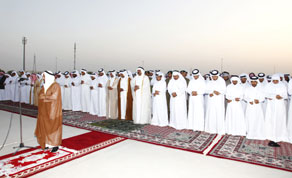
Prayer for rains
HH the Emir Sheikh Hamad bin Khalifa al-Thani joining the worshippers to perform the Istisqa (rain-seeking prayer) at the Al Wajbah prayer ground yesterday morning. The prayer is in line with the Sunnah (sayings and deeds) of the Prophet Muhammad (Peace Be Upon Him), who performed Istisqa prayers when there was a delay in rainfall.
FYI: How Long is a Generation?
So I get on a track and I can’t get off, like a little hamster running on the wheel. I got to thinking about generations, and how long ago is 10 generations and so I had to ask Google the question: How long is a generation? Don’t you love Google? They always have an answer.
Now I know something new. Now I will share it with you. This comes from Ancestry.com
Research Cornerstones: How Long Is a Generation? Science Provides an Answer
How Long Is a Generation?
By Donn Devine, CG, CGI
We often reckon the passage of time by generations, but just how long is a generation?
As a matter of common knowledge, we know that a generation averages about 25 years—from the birth of a parent to the birth of a child—although it varies case by case. We also generally accept that the length of a generation was closer to 20 years in earlier times when humans mated younger and life expectancies were shorter.
In genealogy, the length of a generation is used principally as a check on the credibility of evidence—too long a span between parent and child, especially in a maternal line, has been reason to go back and take a more careful look at whether the evidence found reflects reality or whether a generation has been omitted or data for two different individuals has been attributed to the same person. For that purpose, the 20- and 25-year averages have worked quite acceptably; birth dates too far out of line with the average are properly suspect.
But now, researchers are finding that facts differ from what we’ve always assumed—generations may actually be longer than estimates previously indicated.
Several recent studies show that male-line generations, from father to son, are longer on average than female-line generations, from mother to daughter. They show, too, that both are longer than the 25-year interval that conventional wisdom has assigned a generation. The male generation is at least a third longer; the female generation is about one-sixth longer.
As early as 1973, archaeologist Kenneth Weiss questioned the accepted 20- and 25-year generational intervals, finding from an analysis of prehistoric burial sites that 27 years was a more appropriate interval but recognizing that his conclusion could have been affected if community members who died away from the village were buried elsewhere.
Why Age Matters
In a more-recent study regarding generation length, sociologist Nancy Howell calculated average generational intervals among present-day members of the !Kung, contemporary hunter-gatherer people of Botswana and Namibia whose lifestyle is relatively similar to that of our pre-agricultural ancestors. The average age of mothers at the birth of their first child was 20 years and at the last birth 31, giving a mean of 25.5 years per female generation—considerably above the 20 years often attributed to primitive cultures. Fathers were six to 13 years older than mothers, giving a male generational interval of 31 to 38 years.
A separate study, conducted by population geneticists Marc Tremblay and Hélène Vézina, was based on 100 ascending Quebec genealogies. Researchers found a generational interval, based on the years between parents’ and children’s marriages, to average 31.7 years, and they determined that male generations averaged 35.0 years while female generations averaged 28.7 years.
Biological anthropologist Agnar Helgason and colleagues used the Icelandic deCODE genetics database to arrive at a female line interval of 28.12 years for the most recent generations and 28.72 years for the whole lineage length. Male line lineages showed a similar difference—31.13 years for the recent generations and 31.93 years overall. For a more mathematically appealing average, Helagason and fellow researchers recommended estimating female generational line intervals at 30 years and male generational intervals at 35 years, based on the Quebec and Iceland studies.
Calculating Ideas
What does this mean to the genealogist? When assigning dates to anthropologically common ancestors 50 or more generations in the past, using the “accepted” 20 or 25 years as a conversion factor can produce substantial underestimates of the time interval.
For my own purposes, however, given the imprecision of the various results and my own need for an estimate that lends itself to easy calculation, I decided that three generations per century (33 years each) for male lines and 3.5 generations per century (29 years each) for female lines, might work better when I needed to convert generations into years.
To check the accuracy of my values, I decided to compare the generational intervals from all-male or all-female ranges in my own family lines for the years 1700 to 2000. I was pleasantly surprised to see how closely the intervals agreed with the estimates I was using. For a total of 21 male-line generations among five lines, the average interval was close to 34 years per generation. For 19 female-line generations from four lines, the average was an exact 29 years per generation.
In genealogy, conclusions about relationships are subject to change whenever better evidence is discovered. Similarly, it’s the nature of the physical and biological sciences that current understandings are subject to change as more data becomes available and that data’s interpretation becomes more certain. So, for now, when genealogists want to convert generations to years and create probable date ranges, using an evidence-based generational interval—like Helagason’s 30 and 35 years or one that you’ve developed based on your own family history research—may be the best solution.
Donn Devine, CGSM, CGISM, a genealogical consultant from Wilmington, Delaware, is an attorney for the city and archivist of the Catholic Diocese of Wilmington. He is a former National Genealogical Society board member, currently chairs its Standards Committee, is a trustee of the Board for Certification of Genealogists, and is the administrator for Devine and Baldwin DNA surname projects.
Recent Comments
ExpatAlien on What Country am I Living … intlxpatr on Yellowstone: Old Faithful to C… Michelle on Yellowstone: Old Faithful to C… Cathy on No Grown-Ups in Charge intlxpatr on Waiting for Snow Wikipedia Donate Button

Amazina


Early Voting in Florida


 Here There and Everywhere