Health Services Providers Closed in Doha
Also from today’s Gulf Times . . . . It would be nice if we knew what those institutions were, so we could avoid them in the future, and what the specific complaints were.
For example, it doesn’t bother me for men and women to be in the same waiting room, like when my husband was really sick and needed a procedure done, he really needed me by his side. It would have been agony to have to wait in separate rooms, and, in fact, I have never seen separate waiting rooms in the modern Doha facilities I have visited, except for the hospital where they process all the people trying to obtain residence visas.
But I really want to know who is carrying expired or adulterated medications in their pharmacies, and who is using unauthorized or unqualified medical personnel! Please! In the interest of public safety, name the names.
22 health institutions shut for flouting rules
The Medical Licensing department at the Supreme Council of Health closed down a total of 22 health institutions, which did not comply with the health standards and rules, between November 2008 and September 2009, the department’s report states.
According to the report, which was the first published by the department, the health institutions include private clinics, medical centres, herbs selling outlets, dental clinics and eye-glasses shops.
They were found violating the standards during surprise visits by medical licensing inspectors.
Among the violations listed against the institutions were employment of unlicensed general practitioners and persons banned from practising or blacklisted, shortage of medical staff, selling of drugs that contain internationally banned substances or drugs not registered with the government pharmacy department and improper collation of patients’ data.
While some centres were found operating without proper licences, some were said to be in possession of expired drugs.
The report added that a number of them failed to separate men and women in waiting rooms and that they lack proper hygiene.
NO PARKING!
On my way home, driving along the wall of our compound where they recently installed bright shiny new NO PARKING signs – not one or two, but like twenty; one every thirty feet – there are a whole brigade of big huge trucks, you know, the kind that accompany beginning construction? I am not even sure I can get through, there are so many, like six or seven or eight (it is a small street).
But one of the trucks is orange, and I am hoping hoping hoping, so I grab my camera out of my bag as I inch by, and yes! yes! he has parked right next to one of the signs. I take my shot and keep inching by, and just beyond the last truck on the left is a gaggle of truck drivers, I guess they are trying to figure out what to do about something.
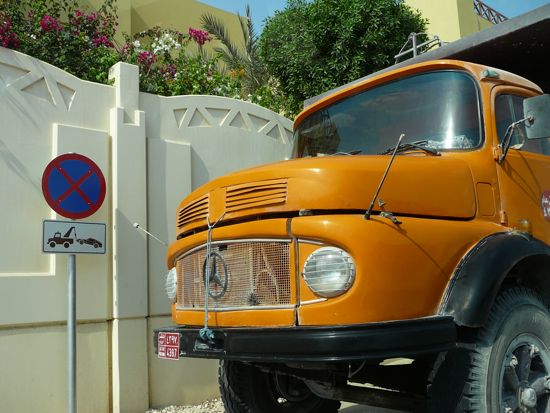
When I get to our gate, I tell them, “there are many trucks parked by the compound wall” (here I point in the direction) “can’t you see them on the security cameras??” and the gate guy says there is a man fixing the camera input right now, but did I get the truck number?
(Did I get the truck number I am thinking??? GO DO YOUR JOB! YOUR JOB IS SECURITY! GO TELL THEM NOT TO PARK THERE!)
I smiled and said “you need to tell them to move their trucks, and not to park right by the compound wall, it is a security risk.” I am a nice lady, yes I am, and so I say this nicely, with a smile, but there is a hint of steel in my voice.
He says “we have people working out there! They will tell them!”
The people out there working are the gardening crew.
I said “No. Your people are about 400 feet away from the trucks, and they are gardeners. They are not going to tell Pakistani truck drivers to move their big trucks.” (The smile is still there, but there is a hardness in my eyes.)
He doesn’t want to go. “Did you get his number?” he asks again. “I say no,” but then I pull out my camera and show him the photo. His eyes widen. The security man comes, and the gate guard shows him and his eyes widen. He assures me they will call the Bolice immediately.
Did they? I don’t know. Honestly, you do what you can. Sometimes it is like knocking your head against a wall, it just feels so good when you stop.
Farewell Dar al Thaqafa
We were sitting in a meeting when two friends rushed in, full of news of the fire down at the Souk al Diraa / Souk al Asseiri, familiarly known as The Fabric Souks. Our friend’s car had been near where the blaze broke out and they had been stuck while the firemen refused to allow her near her car, and finally they moved it out of the way for her, covered with ash and dirty water, but otherwise unharmed.
We all waited breathlessly to hear if the fabric souks were harmed. They weren’t. For such a big blaze, such a long-lasting fire, no lives were lost, no one was hurt, as far as anyone knows.
But in this morning’s paper, I see that while the fire started out a small fire, somehow, it was not contained, and in the clutter and chaos of the older souks, it grew, fed by stacks of stored goods and rubbish.
One of the victims was an old friend of mine – the Dar al Thaqafa. Little Diamond and I would often find treasures there, books you couldn’t find anywhere else. There are other bookstores in this chain, but this one, this Dar al Thaqafa was THE oldest bookstore in Doha, stocking school supplies, children and adult fiction and non-fiction, textbooks and obscure Islamic scholarly works. It was a quiet place, an old fashioned book-store, tucked behind the very tacky toy vender where I once bought both a dancing Osama bin Laden and a dancing Saddam Hussein.
We are sorry to see this old friend go. (They gave me permission to take these photos)

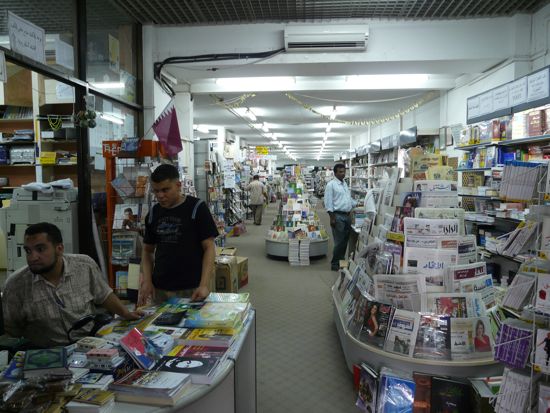
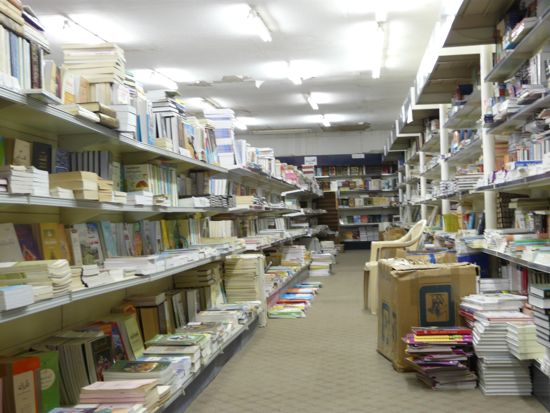
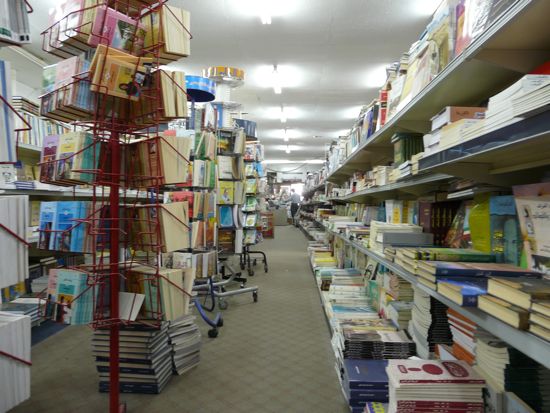
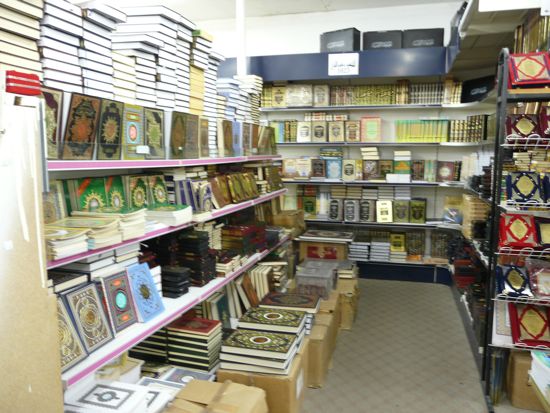

The area was full of small merchants, most of whom I suspect could ill-afford this loss of merchandise and income. I took a photo of an alleyway in the area of the fire (taken in July)

Home Foreclosures: The Storm That’s Yet to Come
This is just an excerpt from a much longer article I found on the AOL Money and Finance Site which you can access to read the entire article, and find others like it, by clicking on the blue type.
Experts are saying that there is a turn-around. I believe it, I also see the improving signs, but the wreckage will remain, and may even get worse, for some time to come in the real-estate markets.
Home foreclosures move up-market as discounting pushes prices down
Lita Epstein
A greater number of foreclosures are hitting the high-end real estate markets in 2009 as price discounting continues to throw more and more properties underwater. It’s like a self-fulfilling prophecy: As some homeowners see their homes’ values drop below the balances due on their mortgages, they give up trying to save their homes.
Zillow’s chief economist, Stan Humphries, found that while high-end markets accounted for only 16 percent of foreclosures in 2006, by July 2009, 30 percent of foreclosures hit the top third of homes. “That means that top-tier homes make up almost twice the proportion of foreclosures as they did just three years ago,” Humphries wrote on his blog.
Foreclosures are no longer a primarily subprime problem. While in 2006 about 55 percent of foreclosures came on subprime loans, in 2009 subprimes represent just 35 percent of foreclosures, another 35 percent are in the middle tier and 30 percent are in the top tier. The primary contributing factor is higher delinquency rates in Prime, Alt-A and Option ARM mortgage products.
According to the Amherst Security Group, this problem won’t go away any time soon, because:
• Loans are transitioning into delinquency/foreclosure at a rapid pace, but moving out at a slow pace;
• Cure rates are low. In other words, fewer people are paying their past-due amounts and getting back on track.
• Loans are taking longer to liquidate. In other words, the length of time between the start of the foreclosure process and the point when the lender gets control of the property is growing.
The Amherst Mortgage Insight report notes that there are currently 7 million homes in a shadow market — homes that are either in delinquency or in foreclosure, but not yet on the market. This number translates into 135 percent of a year of existing home sales, which means that whatever numbers you’re seeing now about homes sales, they don’t truly reflect the storm that’s yet to come.
The Help by Kathryn Stockett

In my book club last year, one of the themes that continued to arise as we read books from many cultures was how we are perceived by the people we hire to help us in our homes. In The White Tiger, a Man Booker Award Winner, the main character lucks into a job working for a family as a driver. We see the people for whom he works from the inside, their sweet acts and all their flaws. We see how callous they can be, and, ultimately, how the driver takes his revenge and becomes his own boss. (Not one of my favorite books, but then again, I’m still thinking about it a year later, so there is something to be said for it.)
In Half of a Yellow Sun we saw an entirely different relationship (in a book I totally loved, BTW) between employer and employee, but it shared with White Tiger the aspect of employer as seen from the eyes of an employee inside the house who sees the family and all its interactions intimately.
The Help, a surprise best seller, does the same to 1960’s era Mississippi. A recent graduate from Ole Miss (University of Mississippi) starts interviewing the maids from local households, any maid that will talk to her. At first, no one will talk with her, but after traumatizing racial clashes, one by one, they share their stories. Just interviewing the maids, just the maids sharing their stories, is enough to bring on serious consequences.
First, the book is riveting. I have a million things I really REALLY need to be doing, and I can’t stop reading. There is something about peeking into your neighbors house, seeing how they behave when they think no one is looking, that appeals to the voyeur in each of us.
Second, these women are taking serious risks. I am on the edge of my chair with each reading, hoping nothing bad happens to them.
Third, there is something that makes you squirm, it is the old “wee giftie” that shows us the worst in ourselves as others might see us; our own hypocrisies, our condescensions, our patronizing acts, how cruel our charitable acts can appear through the eyes of others, and how callous we are in the end towards those who take care of us every day.
It has rocketed onto the best seller list, now the #6 best selling book on Amazon.
If your book club is looking for a book to read that will get you talking and keep you talking for a long time, this is one of the best.
If you have hired help in the house, I double-dog-dare-you to read this book. (OOps, sometimes the little Alaska girl in me pops back out!) Fair warning, though, once you start, you won’t want to put it down.
Jaidah Flyover roadworks finish in five days
From today’s Gulf Times comes news that one of the worst current traffic snarls in town will be history in five days.
Do you believe it?
And now – how is the work on D-ring going? Any news on how soon it will be completed?
By Sarmad Qazi
The road works under the Jaidah flyover are expected to be completed in five days, an official said yesterday.
The busy junction leading to the Corniche and the densely-populated Musheireb area in one direction and to Ramada junction and the Salwa highway on the other was dug up towards the end of September for expansion work.
Read the whole article HERE
New Regulations Enforced for Drinking in Qatar Bars
New bar rules evoke complaints
By Peter Townson/Staff Reporter
From The Gulf Times
A number of residents in Doha have complained about recently introduced regulations requiring them to apply for membership to certain bars and clubs as well as providing ID upon entering such establishments in Qatar.
Due to new national regulations, hotels are enforcing membership rules, ensuring that all visitors have either a valid Qatari ID, their passport, or in many cases a membership card to enter the premises.
The bars now have a published set of rules outside the premises to indicate the necessary entry requirements, and although certain rules change from place to place, the general guidelines are the same throughout.
All applicants for membership must be over 21 years of age and possess a valid Qatari ID card, and the printing of membership cards usually costs a small fee, ranging from around QR30 to QR50 (and QR100 for replacements in some cases).
However, the new rules have meant that many places have substantial queues outside their establishments, and during special events guests can often have to wait for over half-an-hour to have their membership cards of ID scanned by hotel staff.
A representative of one hotel bar in Doha claimed that another major issue with the new membership rules had been the problem of informing their guests of the regulations.
“It seems it has been the hotels who have had to tell people about these new rules, not the people who have instigated them,” he said, arguing that it would have been beneficial to have some information regarding the reasons for the new rules and their specific details.
“I think they brought in the rules to prevent people who are living here illegally from drinking in the bars, and also to stop Qatari ladies from entering any drinking establishments,” he added.
Another hotel representative explained that the introduction of the new membership system had cost the hotel a significant amount.
“It was a big cost to the hotel to get all the necessary software and hardware to create the membership cards and register everyone’s details,” he said, adding: “However, we are trying to keep the cost of membership as low as possible for our guests.”
He pointed out that the new regulations do make it somewhat easier to “control the clientele,” and said that the rules have made life easier for the busier bars in Qatar.
However, a number of Western expatriates who have lived here for many years have become disgruntled at the new rules, claiming that it makes it more difficult for them to enter bars – especially if they have guests visiting from aboard.
Many have reported that visitors have travelled to hotels, only to be informed that they cannot enter without their passport – a document most travellers like to keep safe in their hotel room when abroad.
And other visitors to the bars – especially those who are quite obviously over 21 – resent the need to screen their ID before entering establishments they have been frequenting for years.
Government regulations defining what is appropriate dress and behaviour have also been highlighted by the hotels.
But these have also been bemoaned by customers who have in fact been turned away from places because of the clothes they are wearing.
Government officials were unable to comment, except to confirm that new rules had recently been introduced to all establishments serving alcohol in the country.
Karabaa in Rubble
It’s even worse. Rubble everywhere. It looks like a war zone.
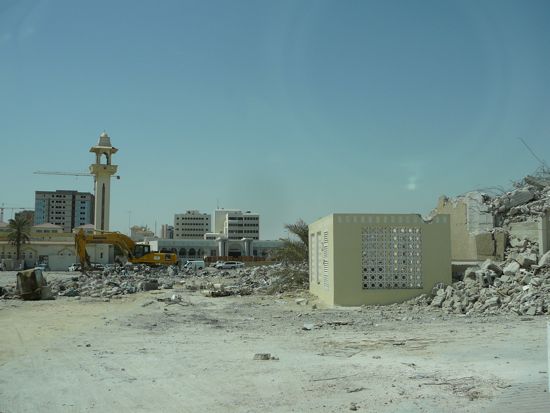
Ripping out the Heart of Doha . . .
Drive to Reduce Traffic Deaths in Qatar
I am a great admirer of Brig Mohamed Abduallah al-Malki. I remember once, when Qatar was much smaller, when he printed his phone number in the paper and told people to call him when they saw drivers misbehaving. What a brave man, a committed man, and a courageous man.
I admire his persistence, his sincere desire to bring down traffic deaths in Qatar.
Yesterday, as I was driving, I noticed most drivers slowing down – when that happens, you know there are new speed cameras set up, and you slow down too. You slow down – or most of us do. There are a visible few who seem to believe that the rules do not apply to them.
There is a persistent rumor that traffic fatalities fell dramatically when the new laws were introduced – and enforced – equally – against all law breakers. As long as laws are enforced equally against ALL nationalities, the death rate will lower.
To me, it is a huge national tragedy that so many young Qatteri men lose their lives, or are seriously physically damaged, in traffic accidents that could have been prevented. It is like a huge national resource, just wasted, all that potential, gone.
This is from today’s Gulf Times
Drive to raise students’ road safety awareness
Traffic department and IBQ officials at the launch of the campaign yesterday
By Riham el-Houshi
The ‘Schools without Accidents’ campaign launched yesterday for the second year running by the Traffic Department is aimed at cutting the number of road accidents in Qatar by half, a top official has said. The campaign aims at raising awareness about road safety among students.
Traffic Department expert and general co-ordinator of the National Campaign for Road Accident Prevention, Brig Mohamed Abduallah al-Malki, said “there has been a decrease in the number of deaths in 2009 but a final picture will emerge only by December.”
The number of road accident deaths in the country fell by 20% in 2008 compared to the previous year. The total number of road accidents last year was 20,455, with approximately 200 deaths, according to the Traffic Department.
The initiative, launched within the framework of the ‘National Campaign for Road Accidents Prevention,’ is a programme to raise awareness on the importance of road safety among students across Qatar.
Al-Malki added that 35% of road accident victims were pedestrians who were usually expatriates.
“Therefore the campaign this year will focus on expatriate schools as well as local ones,” al-Malki pointed out.
The campaign will be funded by the International Bank of Qatar (IBQ), who has given QR500,000 to the Traffic Department. The bank donated QR250,000 to the cause last year. According to al-Malki, the money will be spent on brochures, signboards, and competitions.
“Too many of our young people never have the chance to realise life’s opportunities as their lives are cut tragically short by preventable road accidents,” said IBQ managing director George Nasra.
“We can and must do even more to reduce the number of traffic accidents and fatalities – especially among our youth.”
A recent survey conducted by Gulf Times had shown that 41% of the respondents feel that Qatar was the worst country to drive because of the number of accidents caused by reckless driving.
Recent Comments
ExpatAlien on What Country am I Living … intlxpatr on Yellowstone: Old Faithful to C… Michelle on Yellowstone: Old Faithful to C… Cathy on No Grown-Ups in Charge intlxpatr on Waiting for Snow Wikipedia Donate Button

Amazina


Early Voting in Florida


 Here There and Everywhere