Criminal Justice
One of the great thrills in life is for a moment when you see that your life has had meaning – and many of those come when your children turn out OK. My husband and I wept together at our son’s graduation from high school – not that there was ever any doubt, but it just felt like maybe we had done something right.
Then came graduation from college, and later from law school. We wept for joy. We didn’t weep at all when he chose a sweet, thoughtful and beautiful bride – we danced for joy, and we are still dancing.
We had another of those life moments when we were able to observe our son in court, functioning as a responsible adult. What a thrill.
At the same time, I realized I have never been in a court before. It was sentencing day, and an entire parade of sad sacks paraded before us. These were men who have done bad things – sometimes violent things. None of them looked evil; they all looks shrunken and pathetic in their prison jumpsuits and chained feet. Each one had to answer to the judge – he had already been tried and convicted, and this was the day the prisoner would find out what the penalty would be.
The judge took his time, and also spent time educating those in the courtroom. One question he asked over and over – under what circumstances were you arrested for this crime?
Every prisoner was arrested when being stopped for some traffic infraction. When a crime is committed, even after a sentence is served, many times the prisoners are on probation. If they live without any violations for the probation time, they are free and clear. If they disregard some rule of probation, then the probation is withdrawn, and they have to go back to jail. A warrant is issued for their arrest. The warrant is entered into a computer, and, when the system works, every state in the United States has a record of that warrant.
Each and every prisoner was caught breaking another law, and then imprisoned on earlier violations when run through the computer. Each one had a history of making bad decisions. Not evil decisions – just momentary bad decisions – running red lights, speeding, weaving, having fake license plates on the car . . . each one had a pattern of living as if the laws of the land pertained to everyone else – but not to him.
One man, who was going back to prison because while on probation he had used drugs again, had his wife testify on his behalf. She cried, and said it was her fault, that they had a fight and because of the fight, he had used again. The judge was furious, said that unless she held a gun at his head and forced him to use, it had been his choice and his alone. He would serve his full sentence. This judge is big on personal responsibility, personal accountability.
Some of them were going away (going to prison) for a long time. In the midst of the joy of seeing our son doing good work was a lot of sadness at the waste of lives, as people are warehoused in prison.
But what else can you do with people who persist in breaking the law? How many times can you give them the benefit of the doubt? How many times can you show mercy before they do something truly awful? Is there any alternative to prison that can truly help people to learn to make better decisions and choices?
At one time, as part of my work, I had to go into prisons and deal with prisoners. Many of the people I dealt with were pretty scary. One had stabbed his wife’s girlfriend – like 97 times. I will never forget, at this time of year, hearing the prisoners singing Christmas carols, punctuated by the sound of the heavy gates crashing shut.
It still gives me shivers.
Kuwait Stock Exchange Closing Poll
This is from today’s Al Watan. I think investors all over the world have confused saving with investing. When you know your family is going to need the money, for something like a vacation, a new washing machine, a car – you save. When you have the luxury of a little extra that you can afford to lose, you invest. Smart investors will investigate the investment carefully. If the market goes down, but the company whose shares you bought is still solvent and strong, you hang on – after all, it you didn’t invest anything you can’t afford to lose, right?
Lawmakers alarmed by bourse closure
Attorney lauds court order, says action was necessary
Ghenwah Jabouri
and agencies
KUWAIT: A number of MPs have criticized a Court of First Instance order to halt trading on the Kuwait Stock Exchange (KSE), saying that the court”s move is “the most dangerous decision” ever taken in relation to Kuwait”s economy and bourse.
They explained that closing the bourse has cemented a lack of confidence and will drive the index down further once trading resumes, while rhetorically asking who would bear the consequences of such an eventuality.
They also stressed the need to benefit from the experiences of other countries to strengthen the Kuwaiti stock market.
The MPs also called on the government to take measures to limit damages resulting from the closure of the KSE.
In an exclusive statement to Al Watan Daily, attorney Labid AlـAbdal said the global financial crisis is finding its effects on many strong markets around the globe and that the situation requires Kuwait and other GCC countries to draw up a serious plan to protect its markets.
“Kuwait should choose safe investments and strengthen its reserves of gold at the Central Bank of Kuwait,” he added.
He stressed that most of Kuwait”s active financial and commercial companies are directly and indirectly linked to the international economy and that they will need well supported banking systems to maintain safe credit transactions and protected debt recovery.
“Given the mentioned circumstances, closing the local stock market in Kuwait is a necessity to prevent further losses by registered companies and to protect the citizens from losing any more assets,” he explained.
Kuwait must select very protective measures, especially after the fall of the oil price and the lack of trust in the international financial system,” AlـAbdal concluded.
Last updated on Friday 14/11/2008
What do you think? Do you think closing the Kuwait exchange prevented further losses, or do you think closing the exchange fed the fear that is feeding the rapid decline? Or do you have another opinion totally?
Kuwait Activists Reject MPs” Hijab Ruling
Activists reject MPs” hijab ruling
”Wearing of veil is not prerequisite for ministerial post”
KUWIAT: Political activists have expressed their great disappointment at the Parliament”s Legislative Committee”s decision which stated that the positions held by Minister of Education and Minister of Higher Education Nouriya AlـSubaih and Minister of State for Housing Affairs and Minister of State for Development Affairs Moudi AlـHomoud as female ministers were unconstitutional.
In a symposium entitled “Who protects personal freedom,” eminent activist Najla AlـNaqi said that the committee should have paid attention to more serious issues rather than focusing on marginal issues such as wearing the veil. She urged the committee to reconsider its decision.
Sheikha Dr. Maymouna AlـSabah made the Constitution a point of departure for her argument, stating that it did not distinguish between genders when it came to the qualification of a voter and never mentioned any preference of one over the other. She demanded for the appointment of more female ministers since it is the only way for them to reach the Parliament.
Historian Ghanima AlـFahaid outlined the role of Kuwaiti women and their contribution to society in different fields including defending the State from invaders. She reminded the audience of the brilliant work of both ministers and that they tirelessly endeavor to serve the community in every possible way.
Kuwait University lecturer Dr. Layla AlـSabaan regarded the decisions as regrettable at a time when women should be encouraged and commended for their work. She stressed that the Kuwaiti society believes in equal opportunities for all regardless of gender and that personal freedom should be respected as long as it doesn”t jeopardize the culture and traditions of the society.
Journalists Society consultant Dr. Ayed AlـManna discussed the legality of female ministers, highlighting that gender equality in a country like Kuwait is extremely important. He added that Kuwait is a liberal society in many ways, pointing out that the Constitution does not specifically say that women must wear veils as a perquisite to taking up their ministerial posts.
Meanwhile, political activist Najat AlـHashshash questioned the nature and background of the decision asking if this ruling applied to all female staff working in the Parliament or ministers only.
Last updated on Friday 24/10/2008
“Where You From?”
AdventureMan calls, full of chat, wanting to tell me what he is seeing at the airport. Normally, it’s a good time for a chat, but today, I’m having none of it.
“I just called the police again.” I told him.
(I can hear him thinking “Oh oh.”)
First I dialed the neighborhood police number, and nobody answered – again.
We have accidents in front of our house all the time. Sometimes I can see everyone with their phones out and I don’t call. This time, I called. No answer. I dialed 777. Thank God, they have WOMEN who answer, women who speak a little English, and I speak a little Arabic, and together we figure things out. They are smart, they are competent and they are sweetly polite, not officiously bureaucratic.
I tell her about the accident, tell her the neighborhood.
Two minutes later, my phone rings. He doesn’t speak English.
“Bolice?” I ask.
“Bolice” he affirms, and says my neighborhood.
I start telling him, in Arabic, the block, the street and the cross street. See? I’ve gotten so smart!
“Where you from?” he asks in amazement, and I can hear him grinning.
“I’m from (the neighborhood)” I answer.
He leaves the phone, and he is yelling and everyone is laughing in the background. Someone else comes.
“Where you from?” he asks. He just wants to hear me talk.
I tell him – in Arabic – the block, the street and tell him “CAR CRASH! TOO MUCH TRAFFIC. NEED BOLICE!” He is laughing. He calls someone else.
This guy speaks English.
“Car crash?” he asks.
“Yes!” I respond, glad to be on topic.
“Why you call me?” he asks.
(I didn’t call him. I called 777 {the emergency number here.} They called me!)
“Car crash.” I repeat. “Too many cars” (I say this in Arabic) Need BOLICE!”
He is laughing.
“Where you from?” he asks.
I say I am from the neighborhood.
“You in car?” he asks.
“No, I see from my house.”
“Come to station.” he says.
“No, BOLICE COME HERE!” I say, and tell him again the street, block and cross street – in Arabic.
He laughs and hangs up.
Forty five minutes later, traffic is still snarled up, no one is managing traffic, there are any number of near accidents as a result, and it is just a mess. No BOLICE.
For my non-Kuwaiti readers, the law in Kuwait is that when there is an accident, you cannot move your cars, not even out of the way, until the police have come. Until they come, everything stays as it is except for an ambulance can come and take away someone who is hurt.
Rejected Suitor Rapes Kuwaiti Woman
Al Watan staff
KUWAIT: A young Kuwaiti woman has filed a case against a man who raped her after she rejected his marriage proposal. The woman explained that the young man who asked to marry her had been found out to be a liar. Among other things, he lied about his nationality, claiming to be Kuwaiti when he was not. He also claimed to have huge sums of money when in fact he was not as well off as he initially claimed. After being rejected, the man reportedly waited outside her house and kidnapped her as she walked towards her car. He then drove her to a remote area and raped her.
What incredible courage this young woman has going public. What backing she must have from her family. This is, unfortunately, not a rare occurance. What on earth are these men thinking? Is he trying to ruin her chances of marrying anyone else? Is this rape a punishment?
Bone Mountain by Eliot Pattison
Several times I started Bone Mountain and couldn’t get into it. I love Pattison’s books – they are mysteries, but his mysteries are more about the process of solving the puzzle than it is about the solution. The process is indirect – we travel around Tibet with Shan Tao Yun, Chinese, but who crossed the bureaucracy in his investigation of corruption and ended up exiled in a Tibetan prison camp (Water Touching Stone) where, under the very worst circumstances, he finds a new way of looking at life, as he gets to know and respect the Tibetan monks in prison for their beliefs.

This time, when I started the book, it was as if I had never picked it up before. I picked it up and couldn’t put it down. I kept finding passages I wanted to share – with you, with my other friends – this is an amazing book.
Shan and a a couple monks are on a mission to return a Tibetan relic to the valley from which the Chinese stole it, and are traveling with a group of sheep herders and salt gatherers to disguise themselves. The artifact gets stolen from them, but they continue on to the valley, discovering a hidden passage through the mountains, visiting a destroyed and partially rebuilt monastery, and learning about healing herbs and practices in Tibet, as we see medical practices in a whole new way.
One of the themes in each book has to do with the Chinese bureaucracy, harvesting Tibetan resources relentlessly, timber, minerals, etc. with no regard to the devastation their techniques leave behind, no regard for replenishment.
The other issue is the Chinese hijacking of the Bhuddist religion. The Chinese “re-educate” the monks, bringing Bhuddist thought into alignment with Chinese government goals. The new monasteries are no longer teaching true Bhuddist teachings, but are teaching corrupted and even heretical teachings. The true monks are roaming the country disguised as sheep herders, dung carriers, but are the true carriers of the teachings to the people. The bureaucracy grinds their teeth in frustration as the true monks continually slip through their fingers.
“Has this foreigner been gathering salt too?” he asked Lhandro in Tibetan.
“Just along to enjoy the fresh air,” Winslow quipped in Tibetan, and the monk stared at him, his eyes wide with wonder.
“An American who speaks Tibetan?” he exclaimed, and looked back with intense curiousity, at Lhandro and Shan, as though the news somehow changed his perspective on the party.
As you can imagine, I laughed out loud when I read that passage. We get that all the time, when my husband speaks Arabic and I can follow the conversation. We call it “the dog can talk!” look.
Avoiders. It was part of their particular gulag language, stemming from a teaching given in their barracks by an old monk, in his twenty fifth year of imprisonment, just before he died. Guns were avoiders, he said, and bombs and tanks and cannons. They allowed the users to avoid talking with their enemy, and allowed them to think they were right just because they had more powerful technology for killing. But those who could not speak with their enemies would always lose in the end, because eventually they lost not only the ability to talk with their enemy, but also with their inner deity. And losing the inner deity was the greatest sin of all, for without an inner deity, a man was an empty shell, nothing but a lower life-form.
Pattison hikes us through mountains and valleys, shows us medicinal plants, and talks about how it matters where and when and how they are mixed. We learn of the evil that exists in the best of us, and the good that exists in the worst of us. On our journey to solve a mystery, we gain a wealth of new understanding.
Available from Amazon.com for $10.17 plus shipping. (Yep, I disclose once again, I own stock in Amazon.com. 🙂 )
20% Chance of Rain!
Wooo HOOOO, Kuwait! Look what the next five days have in store for us! On the fifth day – a 20% chance of rain!

I know, I know, it’s only 20% – but it is the first HINT of rain we have seen in lo, these many months. I will rejoice at 20% and hope that rain will come soon, God willing. Kuwait needs rain.
Here is how it looks this morning, as the sun comes up from the horizon:

Yesterday, we had fishing boats, strung from right to left, so beautiful. This morning, we have Coast Guard boats. These guys seem to me to be one of the best equipped and maintained outfits in Kuwait. If I were a young Kuwaiti male, I would join the Coast Guard. They have some really, really fast boats, and some other boats that look like a lot of fun. They get to do testosterone-filled things like interdict people trying to come into Kuwait illegally, and drug runners, rescue picnic-ers and people whose boats catch on fire or fishermen whose boats sink. Wouldn’t that get your blood running a little faster?
Sand Relocation Program
As you are driving along, or stopped in the gridlock of school’s-out traffic, have you noticed the bags of something along the road?
AdventureMan was asking me what that was all about. I said I didn’t know, but I had seen a bunch in front of our place, too. I thought they were full of sand. In Seattle, it might be about getting ready for winter, like sand for when there is a freezing rain or heavy snowfall or something, but that is so not remotely possible in Kuwait.
AdventureMan thought they might be full of trash cleaned off the streets, but they are packed too solidly or it to be trash.
We finally figured it out – it is sand, sand and grit removed from the streets AND, more importantly, from the drains, so that when it rains, the drains will be clear and the water from the (Insh’allah) heavy rainfall will have a way to run back to the sea without puddling in lower areas, as it did several years ago when a couple people actually drowned in Kuwait.
Kudos for the ministry in charge, for anticipating the problem and getting the drains in top condition now, in case it rains. Which ministry, I wonder? Public Works? Highways?
AdventureMan speculated, as he is known to do – what do you think happens to these bags of sand? Are they used as sandbags somewhere? Are they dumped in the desert? What would happen if you could tag a grain of sand, the way you tag an animal, and you could track it through it’s lifetime, where would it take you?
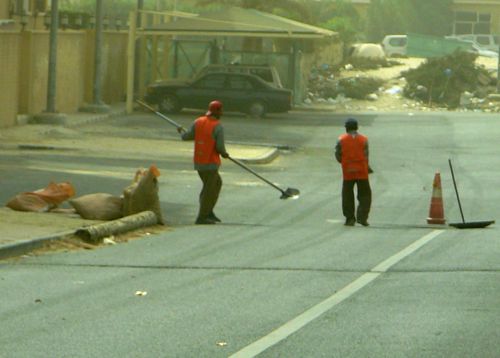
He calls this the government Sand Relocation Project.
Demolish Tariq Rajab Museum?
I am horrified. Blogger Hanan reports that there are rumors that the Tariq Rajab Museum has received a warning to close or be demolished, that they have no permit to run a museum.
This family has two museums, two fine, fabulous museums, and admission to the public is free of charge. It is a bright spot in Kuwaiti Culture. (I thought there was a movement out there to encourage tourism? This is where I take my guests! This is where we tell tourists to go!)
I have no WASTA my friends. First, can you confirm that the museum has indeed been warned? Can you make this go away?
Warning for American Expat Taxpayers
Many American expats working in the Gulf put off filing taxes because they are working so hard they don’t have the time or energy to pull it all together.
We received a bulletin from our tax preparer today saying the following:
IRS CRACKS DOWN ON LATE FILING EXPATS – To receive the FEI exclusion, the IRS requires that you file within 1 year from the original due date of the return (determined without regard to any extensions). The IRS has recently issued guidance to begin enforcing this long overlooked tax rule. If you have not filed your Expat tax returns for 2006 and earlier years, please contact us ASAP to discuss your options. Worse case scenario – if you owe taxes the IRS can disallow your FEI exclusion, even if you have earned it, thus making 100% of all of your earnings taxable without any benefit of the FEI exclusion. Working in a combat zone does not guarantee Expats any relief from the IRS.
Our tax preparer specializes in expat taxes. He has a thriving business, and really knows our unique situation.
Steven Palazzo, CPA
Palazzo & Co, CPA
PO Box 4634
Biloxi, MS 39535
228-396-8800 – Office
866-272-9224 – Toll Free
305-768-0483 – Fax
WWW.PALAZZOCPA.COM
spalazzo@palazzocpa.com
I publish this because the earned income exclusion is probably the best tax deduction most of us will ever have. You don’t want to lose the exclusion, and your hard earned money, by failing to file in a timely manner.
Recent Comments
ExpatAlien on What Country am I Living … intlxpatr on Yellowstone: Old Faithful to C… Michelle on Yellowstone: Old Faithful to C… Cathy on No Grown-Ups in Charge intlxpatr on Waiting for Snow Wikipedia Donate Button

Amazina


Early Voting in Florida


 Here There and Everywhere