Donna Leon: Suffer the Little Children
After reading Zanzibar Chest I decided it was time to give myself a break, and I allowed myself another Donna Leon book, this one Suffer the Little Children. I am currently reading another detective series, recommended by my sister, set in China. What they all seem to have in common is a very tired, sad, jaded view of corruption in society, and particularly among the poorly paid police. Sigh.

In this book, a Doctor and his wife are invaded in the middle of the night by the carabinieri, a kind of police in Venice. I am not sure how the two agencies differ, maybe it is like the difference between state police and local police in the US, but when the paper was faxed over coordinating with Brunetti’s office, it got lost somewhere, and the action was never coordinated, and Brunetti gets a call in the middle of the night.
The doctor and his wife have adopted a child illegally. They bought an unwanted child from an Albanian woman, paid for her pregnancy expenses, paid a huge fee to her, and then had the child taken from them. Here is the saddest part of the story – the child’s mother doesn’t want the child, the illegally adopting parents want him back desperately, but the child is sent to a state orphanage, because of the illegal adoption.
It is a very sad book.
Here is why I read Donna Leon – some of her paragraphs are just brilliant. Memorable. Unforgettable.
“Brunetti’s profession had made him a master of pauses: he could distinguish them in the way a concert-master could distinguish the tones of the various strings. There was the absolute, almost belligerent pause, after which nothing would come unless in response to questions or threats. There was the attentive pause, after which the speaker measured the effect on the listener of what had just been said. And there was the exhausted pause, after which the speaker needed to be left undistrubed until emotional control returned.
Judging that he was listening to the third, Brunetti remained silent, certain that she would eventually continue. A sound came down the corridor: a moan or the cry of a sleeping person. When it stoped, the silence seemed to expand to fill the place.”
When you read Donna Leon, you forget you live anywhere else. For one brief moment, you become Venetian, you live in Guido Brunetti’s shoes. The speak the Venetian dialect, you think like a Venetian. What an escape!
The paperback edition will be out in April for $7.99 at Amazon.com for $7.99 plus shipping.
“So Many Christians!”
My Kuwaiti friend was shaking his head in disbelief. He had been to the old city to pay a condolence call on a Friday, and happened by the Lighthouse compound near the Sheraton circle on a Friday morning, just as some of the services were getting out.
“I had NO idea!” he looked at me in absolute amazement.
I just laughed. When we first got here, we attended church on that compound; our church moved off only months ago, when the road construction work got seriously under way and parking increasingly became a problem. It was the most amazing experience on earth – there were the Indian Men’s Catholic services and the Philipine Evangelical service and the rock-music evangelical service and the staid Anglican services and the family Philipine Catholic services and . . . well, you get the picture. There are an amazing number of expatriate Christians in Kuwait. At any one time on the compound, there are about twelve different services going on, and no sooner does one finish and the participants exit, than the new group is coming in.
Now, churches meet all over Kuwait. They met in villas, they meet in schools, they meet in every neighborhood. Today, in our church, we asked for blessings on Kuwait, on the Emir and his family, and those in leadership positions in Kuwait. We prayed for the leaders of all the countries in our congregation (English, Irish, Scottish, South African, Chinese, Indian, Nigerian, Kenyan, Dutch, Egyptian, Ethiopian, American, Australian {I have forgotten a few, I am sure} . . . lots and lots of blessings!) Most of all, we thank God for the freedom to worship in Kuwait.

(This is not our church in Kuwait. This is the Church of the Holy Sepulcher, in Jerusalem. I was looking for a church that looked more Middle Eastern than Western, and this is what I could find!)
Our pastor also has a blog, q8bridge about which he says “The purpose of this blog is to enable a bridge to be built between Christians and Muslims, especially those living in Kuwait. Through questions and dialogue we hope to promote deep friendships and mutual understanding.”
He examines the beliefs we have in common, and where we differ, and some of the reasons why we differ. I urge you to have a look.
Saudi Men Arrested for Flirting
This is in today’s BBC News.
Saudi men arrested for ‘flirting’
Relations between the sexes outside marriage is against the law
Prosecutors in Saudi Arabia have begun investigating 57 young men who were arrested on Thursday for flirting with girls at shopping centres in Mecca.
The men are accused of wearing indecent clothes, playing loud music and dancing in order to attract the attention of girls, the Saudi Gazette reported.
They were arrested following a request of the Commission for the Promotion of Virtue and Prevention of Vice.
The mutaween enforce Saudi Arabia’s conservative brand of Islam, Wahhabism.
Earlier in the month, the authorities enforced a ban on the sale of red roses and other symbols used in many countries to mark Valentine’s Day.
The ban is partly because of the connection with a “pagan Christian holiday”, and also because the festival itself is seen as encouraging relations between the sexes outside marriage, punishable by law in the kingdom.
You can read the whole article HERE.
I wonder . . . is this what is going to happen in Kuwait? So like they segregate the university. . . then they segregate all the schools, EVEN THE PRIVATE SCHOOLS, so there is no choice. . . then they start patrolling the malls?
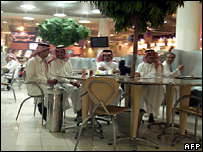
I lived in Saudi Arabia, and I remember the mutawaaeen were NOT police, but sometimes they took on the prerogatives of the police. So I have to wonder, like who made the arrest in the malls? Was it the police? Was it the mutawa hitting the boys with their little sticks? Did they call the boys parents? I have SO many questions!
Keystone Cops
As you all have seen from US Crime tapes, this news story could happen anywhere, but it happened in Kuwait. I would love to see a video of this!
Kuwait Times, 21 Feb 2008
Drunken Man
The operations room received an anonymous call reporting that a drunken man had been dancing in the streets of Fehaheel and terrifying passersby. A police patrol rushed to the scene and managed to arrest the suspect, who initially resisted arrest.
However, after being cuffed and forced into the patrol vehicle for just a couple of seconds, he managed to step out and ran for dear life while police were busy putting some gear into the vehicle’s trunk. A wild goose chase ensued with police hot on his trail, while the man returned to the spot where the vehicle was parked, got in, stepped on the gas and sped to his freedom again. Police later tracked the vehicle that was dumped in a deserted area in Jleeb. A manhunt has been launched to arrest this man.
I commend the writer on the correct use of the plural “passersby.” Bravo.
Your challenge: how many cliche’s did this staff writer use to write this article?
5,000 Real Estate Deeds Missing
The Kuwait Times website seems to be down so I can’t link directly to them, but this is at the top of the crime news on yesterday’s page 5:
5,000 Real Estate Deeds Missing
Kuwait: An owner of a real estate office registered a complaint with the Khaitan police claiming that 5,000 real estate deeds were stolen from his office’s locked-up drawers. However, both the owner and the police were baffled because the thieves could have carried off furniture and other valuable items, but preferred to steal the deeds instead. The case was handed over to special detectives who immediately launched an investigation.
This seems to me like the deeds were the target of the break-in. Aren’t deeds registered somewhere? So like even if these paper copies are stolen, can’t they be replaced? What would somebody gain by stealing these deeds? Can they claim the properties? Can they claim the properties were transferred to them? Can they hid transfers that someone doesn’t want disclosed? This sounds like a great mystery to me!
Aidan Hartley’s Zanzibar Chest

I started Zanzibar Chest in December, and could not get into it. It was interesting, but at first the tone was . . . I don’t know, maybe pompous? Something in the tone put me off, and yet I didn’t put it back on the bookshelves, nor did I give it away. It sat on my bed table while I attacked lesser works, more enjoyable fare. Then, one day, I just knew it was time to try it again, and this time, I could hardly put it down.
Born in Kenya, just before the rebellion, Aidan Hartley spent his life mostly in Africa. He skillfully interweaves three main story lines – the life of his mother and father, the life of his father’s best friend and his own life as a news correspondent.
This is not a joyful book. It is not inspirational. It is a tough, hard look at the people who cover the news, and the toll it takes on their lives. It is a story of drugs and alcohol to numb the pain of what they are observing, the comraderie of gallows humor and surviving the intensity of living through life-threatening moments together.
He covers some truly awful events. He covers the wars in Somalia, and in Rwanda. He covers Kosovo and Serbia. He is sent into some of the most dangerous and awful of places. He pays the price.
In his Zanzibar Chest, he takes us with him.
I will share a couple quotes with you, and if you are sensitive, please stop reading now. This book is not for you. It is almost not for me, except that sometimes I think we need to come face to face with just how awful reality can be to put our own lives right, to set appropriate priorities.
“I can’t put my finger on exactly how death smells. The stench of human putrefecation is different from that of all other animals. It moves us as instinctively as the cry of a newly born baby. It lies at one extreme end of the olfactory register. Blood from the injured and the dying smells coppery. After a cadaver’s a day old, you smell it before you see it. From the odor alone, I could tell how long a body had been dead and even, depending on whether brains or bowels had been opened up, where it had been hacked or shot. A body would quickly balloon up in the tropical heat, eyes and tongue swelling, flesh straining against clothes until the skin bursts and fluids spill from lesions. Flies would get in there and within three days the corpse might stink. It became a yellow mass of pupae cascading out of all orifices and the flesh literally undulated beneath the clothes. The tough bits of skin on the palms of their hands and the soles of their feet were the parts of the body that always rotted away last. As living people, these had been peasants who had walked without shoes and worked hard in the fields. A man who had been dead seven days reeks of boiling beans, guava fruit, glue, blown handkerchiefs, cloves and vinegar. After that he starts to dry out into a skeleton until he’s almost inoffensive . . .
The dead accompanied me long after Rwanda. It was months before I could order a plate of red meat served up in a restaurant. I smelled putrefaction in my mouth, or in my dirty socks, or as sweat on my body. I imagined what people I met would look like when dead. . . “
These guys all suffer from Post traumatic stress syndrome, they deaden themselves with drug and alcohol, and they are totally addicted to the adrenalin rush their job gives them. Living on adrenalin takes a huge toll – on their health, on their mental health, on their relationships, on their belief in goodness. They are the witnesses to the enormity of man’s inhumanity against one another.
In another quote, the author tells us:
“It was impossible for latecomers to comprehend the evil committed here but the British military top brass were still so scared of what their soldiers might see and what it would do to their minds that they sent a psychiatrist to accompany the forces to Rwanda. Bald Sam and I were amazed at that. We laughed about it. A shrink! It seemed extravagant. But the truth is that we stuck close to that man for days. We said it was all for a story, but really it was about us. The psychiatrist, whose name was Ian, told us his special area of interest was the minds of war correspondents. I could see Bald Sam squirming with happiness at all the attention, and I felt quite flattered myself. . . .
. . . for years I did endure some sort of payback. I have to try every day to prevent the poison that sits in my mind to spread outward and hurt the people I love. Sometimes I can’t stop it and I wonder if in some way the corruption will be passed on from me to my children.”
Toward the end of the book, the author tells us how hard it is to give up this adrenalin-news-junky life:
“Whenever I see a news headline to this day I half feel I should board the next flight into the heart of it. I’d love to get all charged up again and I could write the story with my eyes closed. I’m sure the sense that I’m missing out while others get in on a great story will never completely pass. . . The sight of people committing acts of unspeakable brutality against others fills a hole in some of us. The activity is made respectable by being paid a salary to do it, but there is a cost.”
This is not a book I really wanted to read, but it is a book I will never forget. Hartley doesn’t spare himself in the telling of this tale. He takes us with us and shows us all of it, and all of his own warts along with the tale. Would I recommend this book? Not for the sensitive, not for those who don’t want to look at the dark side. Between idyllic sequences on the beaches near Mombasa, in the hills of Kenya and Tanzania, in the dusty deserts of Yemen, there are some very intense and bloody moments. This is non-fiction, it is a documentary, it is a slice of the real life one man has seen, and that to which he has been witness. Read the book, and like him, you pay a price. You carry images in your head that you can’t forget, and a sorrow for our inability to solve our differences peaceably.
(Available in paperback from Amazon.com for $10.88. Disclosure: Yes, I own stock in Amazon.com.)
Dubai Rape Case Update (Two)
In another tiny little article, but high up on page 3 of the Kuwait Times is:
UAE Court Upholds Verdict in Rape Case
Dubai: An appeals court in the United Arab Emirates yesterday upheld 15 year jail terms handed down against two Emiratis convicted of raping a French-Swiss teenager, and AFP journalist said. The judge in Dubai took just a few seconds to announce his ruling after proceedings opened. The defense wanted the sentences pronounced on December 12 to be quashed, and a lawyer for the two men told AFP after Sunday’s ruling that a further appeal would be lodged with the supreme court. Prosecutors had demanded the maximum punishment, which could have meant the death penalty. A third defendant is being tried in a juvenile court. One of the men who raped the European teenager was HIV-positive, but has since been found to be clear of the sexually transmittable disease. The boy’s mother, Veronique Robert, launched a media campaign to publicize the case and gather support for her demand that the UAE recognize homosexual rape in its legal system and set up institutions to treat AIDs sufferers. She protested against the original verdict, saying that “15 years is nothing for someone who knew he had AIDs.”
Comment: Did you read this sentence?:
One of the men who raped the European teenager was HIV-positive, but has since been found to be clear of the sexually transmittable disease.
Can you tell me who has been found to be clear of the disease? One of the men? The teenager?
Comment 2: Bravo, UAE judges!
Corrupt Officials Beware
I don’t usually type out the whole article from the Kuwait Times, but because this one is so small, and buried way down on the page, I am making an exception and typing in the whole thing:
Responding to recent stories published by Al-Rai concerning alleged violations and corruption cases committed by ministers and MPs, HH the Prime Minister Sheikh Nassar Al-Mohammed noted that HH the Amir had instructed them to enforce the law to everybody. “And you can start with enforcing it on me,” the prime minister added.
Sheikh Nassar pointed out that the law would be enforced on everybody, be them (sic) (they) senior or minor officials. He added that he had instructed all concerned law-enforcement authorities to treat everyone equally with no exceptions at all.
Comment: WOOOO HOOOOOOOOO, HH Prime Minister Sheikh Nassar Al-Mohammed and BIG WOOOO HOOOOOOOOOOO to HH the Emir! If I knew how to make red letters, this would be a big RED letter day! WOOOOO HOOOOO law enforcement!
Bulletin: New Kuwait Traffic Laws
From today’s Arab Times:
New traffic law enacted: e-mails
KUWAIT : Several people on Monday received e-mails and SMS messages on the new traffic fines allegedly imposed by the Interior Ministry. Sources at the Ministry refused to deny or confirm the messages but said a new traffic law will be implemented soon.
(Comment: Holy Smokes! Did the bloggers and e-mailers get it right???)
Kuwait Weirdness
This is such a small thing, but just TOO WEIRD! In the tiny little weather forecast in today’s Kuwait Times, it says that today’s weather will reach a high of 48°C and tonight will reach a low of 32°C. Like Weather Underground says 24°C/14° – that’s very different. It was hot today, but much more like 24° than a summery 48°C (118.4°F.)
More weirdness – isn’t there any warning when a major road is going to close, you know, like GULF ROAD??? I was caught in the quagmire today, trying to get home and not able to get on Gulf Road and seeing all the north-south major roads in total gridlock. What is this??? I never saw a word, not in Arab Times, not in Kuwait Times, not in the blogs – did anyone know this was coming?
Recent Comments
ExpatAlien on What Country am I Living … intlxpatr on Yellowstone: Old Faithful to C… Michelle on Yellowstone: Old Faithful to C… Cathy on No Grown-Ups in Charge intlxpatr on Waiting for Snow Wikipedia Donate Button

Amazina


Early Voting in Florida


 Here There and Everywhere