Saint Ephraim, the Syrian
Today the church remembers St. Ephraim, a very good man, a solid contributor to the early church. At a time when many seem to be in fear that Syrians are coming to our shore, I think a reading about Saint Ephraim is timely. He wrote some of the earliest church hymns. He very likely contributed some of the verbiage in our Nicene creed.
I also smile; I remember my Arabic instructors at the Qatar Center for the Presentation of Islam, truly gentle women who knew the bible better than I did, and inspired me to know it better in self defense. While they didn’t expect me to cover, i.e. to wear a scarf over my hair, or to wear an abaya, they could point out to me verses in the bible where women are instructed to cover, and they could show me biblical pictures in which the women were cloaked and their hair covered.
They also pointed out the many places in the Bible where praying was done by prostrating oneself face down before God, as Ephraim instructs in the prayer at the bottom of the reading.
I never felt pressured. They were like my Mormon sisters, my Baptist sisters; they only wanted me to have what they had found, the best way to worship.
EPHREM OF EDESSA
DEACON AND HYMN-WRITER (10 JUNE 373)
 Ephrem (or Ephren or Ephraim or Ephrain) of Edessa was a teacher, poet, orator, and defender of the Faith. (To English-speakers, the most familiar form of his name will be “Ephraim.” It is the name of the younger son of Joseph, son of Jacob (see Genesis 41:52), and is thus the name of one of the largest of the twelve tribes of Israel.) Edessa (now Urfa), a city in modern Turkey about 100 kilometers from Antioch (now Antakya), was a an early center for the spread of Christian teaching in the East. It is said that in 325 he accompanied his bishop, James of Nisibis, to the Council of Nicea. Certainly his writings are an eloquent defense of the Nicene faith in the Deity of Jesus Christ. He countered the Gnostics’ practice of spreading their message through popular songs by composing Christian songs and hymns of his own, with great effect. He is known to the Syrian church as “the harp of the Holy Spirit.”
Ephrem retired to a cave outside Edessa, where he lived in great simplicity and devoted himself to writing. He frequently went into the city to preach. During a famine in 372-3 he worked distributing food to the hungry, and organizing a sort of ambulance service for the sick. He worked long hours at this, and became exhausted and sick, and so died.
Of his writings there remain 72 hymns, commentaries on the Old and New Testaments, and numerous sermons.
Several hymns are available at:
http://www.voskrese.info/spl/XefremSyria.html
Among Orthodox he is best known for a fasting prayer:
THE PRAYER OF ST EPHRAIM THE SYRIAN
O Lord and Master of my life, do not give me the spirit of laziness, meddling, self-importance and idle talk. (prostration)
Instead, grace me, Your servant, with the spirit of modesty, humility, patience, and love. (prostration)
Indeed, my Lord and King, grant that I may see my own faults, and not condemn my brothers and sisters, for You are blessed unto ages of ages. Amen. (prostration)
(Twelve deep bows, saying each time: O God, be gracious to me, a sinner.)
[Translation by Fr James Silver, Drew University; posted on the Orthodox list]
by James Kiefer
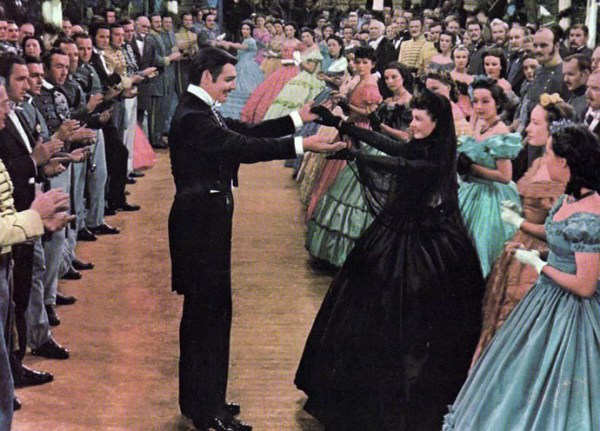
“You Go Into Southern Belle Mode”
I’ve added a new category; I’ve written so many posts in this vein, and it looks like I will continue so to do. Might as well add it as a staple: Stranger in a Strange Land.
Probably the first mention of that phrase in literature is in Genesis; Moses kills an Egyptian and flees to the desert where he meets a nice girl and marries her. He refers to himself as an alien, a stranger in a strange land. Both Jewish culture and Islamic culture put a high value on taking care of the stranger. Our bible is full of references to taking care of the alien.
Here is one of my favorite stories about what my friend Donald Rumsfeld calls those “unknown unknowns. It’s what you don’t know you don’t know that gets you into trouble.
I was at a party, and in a conversation with two women who are widows. We were talking about some of the difficulties, and what has caught them by surprise.
I said I didn’t know how they got through it, that I had a feeling if AdventureMan goes before I go, I’m going to be really really angry, tearing my hair out and shrieking angry, shredding my clothes angry, not wanting to be around other people angry, so so so so angry because if I let myself feel sad I don’t know if I can ever pull myself out of that abyss.
The newest widow just looked at me like I had said something culturally inappropriate, which, it turns out, I had. There was one of those brief silences, you know, it may only be seconds but it feels like it goes on forever because you don’t know what you said.
“If you were from around here,” she said, “You’d know what to do. You go into Southern Belle mode. We’ve all seen it all our lives, so we know how to do it. You pick out your clothes. You smile and shake hands. You put your guests first. You stand and smile until the last guest has gone.”
I was stunned. “You hold yourself together through all that?” I asked.
“Well,” she said with a smile, “You have a plan. You know where you can go with a friend or cousin after the funeral, a place where you are safe and where you can get knee-walking drunk and do your wailing where you need to and no one will ever know.”
She didn’t even have to say “You must not be from around here” but I heard it, loud and clear. There are standards. No weeping and wailing, no public display of emotion, no lack of self-control, oh-my-goodness, I think I must be back in the Middle East. I am in my own country, and still, very much a stranger in a strange land.
“Through You and In Spite of You”
Just a small post on a reading from Father Richard Rohr in today’s e-mail. It gives me great hope:
In the journey of prayer, as you sink into the mystery of God’s perfect love, you realize that you’re nothing in the presence of God’s goodness and greatness, and that God is working through you in spite of you.
LOL, it’s the “in spite of you” that gives me hope 🙂
Anacortes, WA for the Ferry to Sidney
Did I mention the traffic on I-5 in Seattle? Seattle has beautiful highways, a gorgeous freeway build back decades ago when Seattle traffic was a lot lighter, and mostly law abiding. The nature of the Seattle people is noticeably civil, but the traffic has doubled, and doubled again, and the roads are no longer adequate.
They have plans, great plans for better public transportation, more bike friendly routes, more adequate secondary routes, and in the meanwhile – traffic can be gridlocked.
We haven’t experienced any of it. We’ve been so lucky, arriving at a relatively low traffic time, arriving in great weather so there are fewer weather-related slow-downs and accidents. We never had a problem our whole time in Seattle, including this morning, as we arose a little early on a Sunday morning to make the trek from Edmonds to Anacortes. We are on the 0830 ferry going to Sidney, on Vancouver Island. We made our reservation months ago, as advised. We have received texts reminding us of our reservation and the need to be there 90 minutes before departure, so we booked an overnight in Anacortes to be sure to be there.
Early Sunday morning, there was light traffic, and we zoomed up the interstate, arriving with plenty of time to explore before lunch.
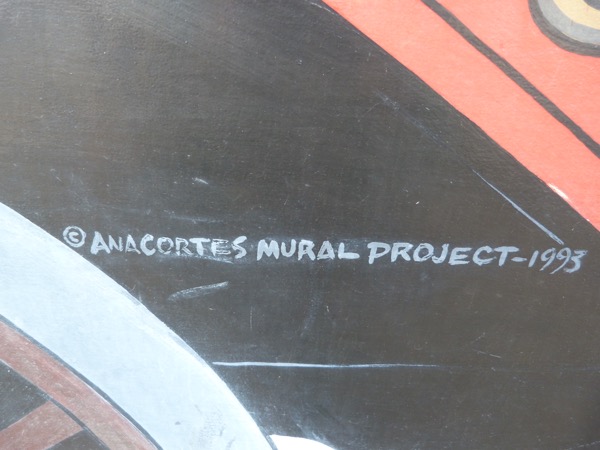
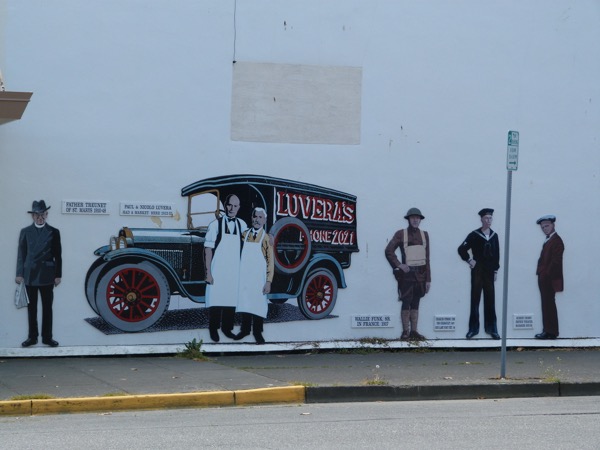
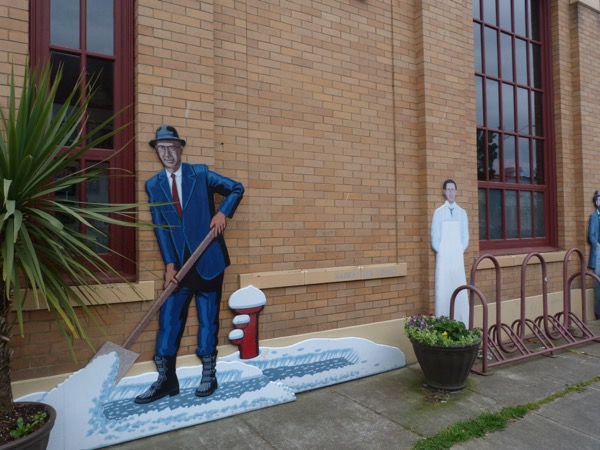
There is so much to love in Anacortes, but one of the things in the old part of Anacortes is something called the Anacortes Mural Project 1993.
ANACORTES MURAL PROJECT
(from the City of Anacortes, WA website)
The intent of the Anacortes Renaissance and Revival Confederation, which Bill Mitchell helped organize, is where the idea of murals first surfaced. Intrigued, he brought several images to the group’s second meeting, got a thumbs-up, and by the third meeting, took charge. “I had the time and the background, education, and experience to be able to head up a mural project and I had a work space.” Equally important was “enough talented friends that I felt I could put together a crew.”
The Anacortes Women’s Club sponsored the first mural – Fred White and his 1891 safety bike – for a scant $50. Mounted May 3, 1984, the mural was christened with a bottle of Miller Hi-Life. In a shower of beer and broken glass, the Anacortes Mural Project was launched.

Murals are sponsored by families, friends, businesses, the City, Chamber, and local service clubs. Mitchell owns the murals, to insure they can’t be moved to someone’s private residence. “This keeps the project together but it also makes me responsible for the maintenance.”
One of the original goals of the project was to inspire the town’s merchants to spruce up their buildings. It gratifies him that a decade into the AMP, the downtown had a new spirit. “People had been painting their buildings and there was a new feeling of optimism downtown that I would like to think we helped to create.”
Mitchell meant to end the mural project years ago but can’t seem to let go. There are still too many characters and scenes he’d like to capture. And if along the way he can inspire other towns to give it a go and recover their mojo, that would be just fine with him.
This is a joyful project, as you can see, each mural sponsored by the building on which it is posted. It gave us joy, too, discovering as many as we could. They are everywhere!
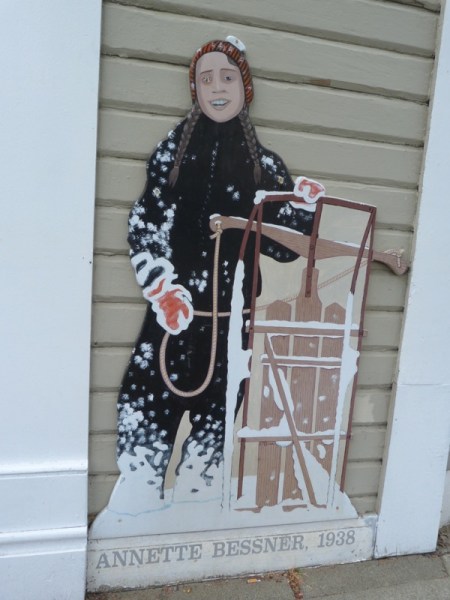
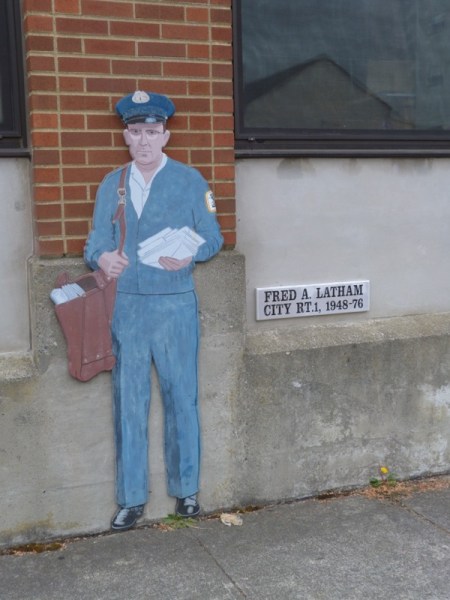



“Setrocana” mystified us, until we learned it is the name of a made-up mermaid, and is the spelling of Anacortes, backwards 🙂

Anacortes is on a peninsula/island surrounded by Puget Sound water traffic lanes. If you lived here, you could have a view that changes with the minute, weather, water traffic, aquatic life.



Tel: 302-766-2673 IRS Lawsuit
“We had a phone call from the IRS,” I told AdventureMan as he headed upstairs for reading time with the Grandson.
“Oh, I forgot to tell you, I got one too, this morning,” he replied. “Is this about the lawsuit?”
“Yep.” I said calmly, continuing with my Honey Cake.
We’ve had a long relationship with the Internal Revenue Service. As with any long relationships, sometimes there are misunderstandings, miscommunications, even face-to-face meetings with questions, answers and resolutions. Our taxes are complicated by investments and a variety of retirement vehicles, and years and years of overseas living and earnings. It’s complicated. It’s a very normal long-term relationship.
I am posting this because this phone call is a SCAM. The phone call sounds very threatening:
THIS IS YOUR LAST WARNING. THE IRS WILL FILE A LAWSUIT AGAINST YOU IMMEDIATELY! YOU NEED TO CALL 302-766-2673 IMMEDIATELY!
This is not the way the IRS communicates with taxpayers.
Please warn those vulnerable to deception about this scam.
The Badass Librarians of Timbuktu
I saw this today on the NPR Books section, and as one great admirer of librarians, I wanted to share it with you. These librarians are my kind of badass! They are providing a service to humanity.
Timbuktu’s ‘Badass Librarians’: Checking Out Books Under Al-Qaida’s Nose

Handout picture dated 1997 and released in 2012 by the UN shows ancient manuscripts displayed at the library in the city of Timbuktu. Al-Qaeda has destroyed ancient texts it considers idolatrous.
Evan Schneider/AFP/Getty Images
For hundreds of years, Timbuktu has had a place in the world’s imagination. Located on the southern edge of the Sahara desert, the city flourished as a center of Islamic culture and scholarship in the 13th through 16th centuries. It was placed on the UNESCO World Heritage List in 1988, recognized for the University of Sankore, which had as many as 25,000 students who studied the Quran, as well as the historic Djingareyber and Sidi Yahia mosques.

The Bad-Ass Librarians of Timbuktu
And Their Race to Save the World’s Most Precious Manuscripts
Timbuktu was a center of the manuscript trade, with traders bringing Islamic texts from all over the Muslim world. Despite occupations and invasions of all kinds since then, scholars managed to preserve and even restore hundreds of thousands of manuscripts dating from the 13th century.
But that changed when militant Islamists backed by al-Qaida arrived in 2012. The hardline Islamists didn’t see these texts as part of their Islamic heritage, but as idolatry, contradicting their interpretation of Islam. They set about destroying important cultural icons, including 15th-century mausoleums of Sufi Muslim saints. Librarians feared the city’s prized medieval collections of manuscripts would be next.
Librarian Abdel Kader Haidara organized and oversaw a secret plot to smuggle 350,000 medieval manuscripts out of Timbuktu. Joshua Hammer chronicled Haidara’s story in the book The Bad-Ass Librarians of Timbuktu. Hammer spoke with NPR’s Michel Martin about how a librarian became an “operator.”
Interview Highlights
Why these manuscripts were so important
These volumes — and we’re talking hundreds of thousands of them — at the point at which al-Qaida invaded Timbuktu, there were something like 370,000 manuscripts amassed in libraries in Timbuktu. And they portrayed Islam as practiced in this corner of the world as a blend of the secular and the religious — or they showed that the two could coexist beautifully. And they did in this city.
So it was tremendously important for Haidara and those who supported him to protect and preserve these manuscripts as evidence of both Mali’s former greatness and the tolerance that that form of Islam encouraged.
On Abdel Kader Haidara’s background
Abdel Kader Haidara was a son of a scholar and he grew up in an intellectual environment in Timbuktu. He was not a wealthy person. After his father’s death in the early 1980s he inherited the family’s centuries-old manuscript collection.
So in 1984 the head of the Ahmed Baba Institute, the government-owned library in Timbuktu, called on Haidara and said, “Hey, we’re having trouble getting off the ground, we need to find manuscripts. We know they’re out there, they’re hidden away in the desert, in river towns. Can you undertake this job of traveling around northern Mali, tracking down these manuscripts that have been lost — buried, disappeared — over generations? Gather them up, we’ll give you money. And we want this library to be splendid. We want this to be something that people from all around the world will come to visit. So go out, do your best, find books for us.”
He was reluctant at first, but the call of duty and the curator’s constant pressure prevailed. And in 1984 he began this what turned into a 12-year really amazing quest to ferret out these manuscripts all across Mali.
How Libya changed Mali
In 2011, the Arab Spring breaks out. Gadhafi’s downfall, the arsenals of Libya — in the chaos of Gadhafi’s murder and the disintegration of the Libyan state — are opened for the taking. Then you’ve got these various rebel groups in Mali. You’ve got Islamic radicals all descending on Libya — on these arsenals. Walking in, loading up their pickup trucks with heavy weaponry, driving through the dust across the desert back to Mali. And so these heavily armed rebels sweep across the desert and in three months have captured two-thirds of the country.
Why he decided to do what he did
The first thing that Abdel Kader was worried about, frankly, was looting. In the first few days after the rebels took over Timbuktu and the army and the police had fled, there was total disorder. That’s when he kind of began to scheme — “Hey, the great treasures of Timbuktu are being held in these very ostentatious libraries.” He said, “These are going to be targets.”
The looting subsided pretty quickly. But as it subsided, you had this growing radicalism, you had Islamic police roaring through the streets, stopping people, throwing them in jail, grabbing cigarettes out of their mouths, whipping them in public. He just foresaw that this was going to get worse, and that the manuscripts, which as we already said expressed values that were anathema to fundamentalist Islam — to Wahhabi Islam — were in danger. That sooner or later, these manuscripts are going to be held hostage. They’re going to become political tools, they could be destroyed in an act of vengeance, caught up in military action. We’ve got to protect them.
So that’s when Abdel Kader and a small group of his supporters, friends, relatives got together and began what ended up being a three-stage effort to protect, and essentially smuggle to safety, all of these manuscripts.
Becoming a ‘badass’
Let’s remember that Abdel Kader was more than a librarian, this guy had spent 12 years as a badass explorer, as an adventurer. He was traveling on camels across the Sahara, on riverboats, going to small villages, finding these manuscripts. So he was an operator. So when the time came, he just knew what to do.
He said, “The first thing we’re going to do is get them out of these big libraries. We’re going to take trunks, we’re going to pack them into trunks at night when the rebels are asleep. And then we’re going to move them in the dead of night by mule cart to these various houses — safe houses, scattered around the city. We’re going to stick them in there and hopefully they’ll be safe for the duration of this occupation.” Which of course, nobody knew when that was going to end.
Why it’s important
One of the things that I think is important to draw from it is to realize that there is this whole strain of Islam that is moderate, that celebrates intellectuality, that celebrates culture, that celebrates diversity, secular ideas, poetry, love, human beauty. I think that is lost in this debate that’s going on. We tend to really kind of turn against Islam because of the actions of this particularly violent group.
But I think in fact that the Islam represented by those in Timbuktu and the badass librarians is in fact more representative of what Islam is. And these people [who] were the real victims of extremism in this part of the world are fellow Muslims. They were the ones who really suffered. They were the ones who had their hands and feet chopped off, who had to live through the horror of daily occupation.
For the most part, we see this from afar, but these people are on the front lines and they are living through the horror of radicalism every day and every minute.
Where the manuscripts are now
He hopes that he’ll be able to return them to Timbuktu. They are in about a dozen climate-controlled storage rooms in Bamako, the capital of Mali. And as far as moving them back, he’s waiting. I mean, these are very hard people to root out. But Timbuktu is a ghost town — tourists aren’t going there, flights aren’t going there. It’s very sad. And I don’t know and he doesn’t know if those glory days can ever be recaptured, given the strength of the Islamists — the terrorists in that area, in that part of the world.
Doris Duke’s Shangri-La
Months in advance, my friend said “You’ll really want to see Shangri-La,” and I had never heard of it, but I looked online, and it looked beautiful. Doris Duke, one of the richest women ever to live, could buy anything she wanted. She had a good eye for art, good timing, and she bought much of what is in Shangri-La and her other residences at bargain prices after WWII. The value of her art holdings increased dramatically, and she ended up with an even bigger fortune than that with which she started.
How do I know? I am in the middle of my third book, reading about Doris Duke. The books are pretty bad. Each author seems to have an axe to grind, and one author took very little information and used it to speculate endlessly, full of gossip and mean-spirit. Altogether, Duke does not come off as a very kind person, but who can say which version of this very private person is the “real” Doris Duke?
To visit Shangri-La, you must go through the Honolulu Museum of Art. They have an online reservation system – the next two weeks are already fully booked. My friend booked months in advance so that we could attend. We got to the Museum, found a good parking place, entered the museum, receiving a lapel sticker and a wristband which later allowed us to visit the museum for as long as we liked.
We boarded a bus and watched a very romanticized movie about the life of Doris Duke, and then we were there! We were warned we could take no photos inside. What a pity! The interiors are magnificent, all marble, and tiles, gorgeous woodwork, and all kinds of Islamic Art that looks like it would go well in the Qatar Museum of Islamic Art. I couldn’t help but wonder if the newly rich aren’t trying to buy some of their cultural objects back?

Our guide ushered us into a beautiful entry, with meshribiyya and tiles and beautiful light fixtures inside. I wish I could show you.

About half way through the tour, we had a break on a terrace from which we had this spectacular view. I read in one of the books that Duke built this rock harbor without asking permission from the Hawaii government, just did it. It is lovely. The terrace also has gorgeous Persian tiles, the interior tiles are Persian and Iznik.

After visiting the Damascus Room and the Syrian Room and the Mogul Room, we visited Doris Duke’s bedroom, bare but for a couple couches. Then, out to the gardens.

We were allowed to take photos in the gardens 🙂

This is a tree at the entry to the house; the tree sends down those shoots that form new roots and new trees. It is magnificent!

After our visit to Shangri-La, we returned to the Honolulu Museum of Art, and had lunch. This is the market salad with salmon – Yumm.

As we lunched, a character went around taking selfies. I think this is a performance artist, and I think it may have been a guy.

Being three very independent kind of folk, we split up to see what we wanted to see at the museum. There was a special temporary exhibit on Japanese street fashion which I found fascinating. I loved some of these street fashions, which strike me as very imaginative. When I got to the Lolita section, however, little girl dresses for grown women, I found it too creepy and strange to photograph.


There is a section on Islamic Art with beautiful tiles and examples of several genres of art objects.

Out on one of the patios, I found this screen which reminded me of a very modern sort of tree-of-life.

Altogether, a grand day. My friend was right – we really enjoyed seeing this.
Perfect Ending at Nuuanu Pali
We suddenly leave the noise and traffic of late afternoon Honolulu and head uphill on a narrow road, with trees creating a tunnel in places, and wild vines twining up into the trees to create walls of foliage.
“There’s something you have to see,” my friend tells us, and we head into this amazing canyon, sort of valley place, alternately dark with shadow and glowing with green light. “We hike up here all the time.”
She takes another tack, and we reach the top of a hill; she parks and we get out. It says we have to pay but she just laughs and says locals don’t have to pay. It’s late in the day and there is no problem finding a place to park, and the light is wonderful. There are more wild chickens, a strutting rooster, and lots of new chicks.

This is the story of Nuuanu Pali, and the great king, Kamehameha, who united the Hawaiian Islanders. He had to fight, he had to do terrible things to accomplish his goal. This was his last fight, where he forced 400 battling warriors off a cliff to their deaths.

And this is the view, late in the day with the sun behind us. Kailua, where we are staying in my friend’s beautiful happy place, is to our right, down on the coast.

I have never seen a “Beware of Bees” sign before.


Love the Cockroach

Happy New Year! Thank you for continuing to visit and read here all these years, and thank you for your comments and e-mails.
Today, reading my morning meditations, the Lectionary and my daily e-mail from Dr. Richard Rohr, I come across this paragraph in Father Rohr’s message:
| The Christian vision is that the world is a temple. If that is true, then our enemies are sacred, too. Who else created them but God? The ability to respect the outsider is probably the litmus test of true seeing. And it doesn’t stop with human beings and enemies and the least of the brothers and sisters. It moves to frogs and pansies and weeds. Everything becomes enchanting with true sight. One God, one world, one truth, one suffering, and one love. All we can do is participate. I hope you enter the New Year with this awareness and an intention to join in with all your heart, mind, and body! |
 |
Trying to be a Christian is so hard. To learn to love the stranger, I was sent to strange countries. Many countries. Many years. Until I could see that the commonality of humanity was greater than the differences in our dogma, I was sent. It didn’t have to do with carrying a message. It had to do with keeping my eyes and ears open, and most of all, keeping my heart open, to learn what I was meant to learn.
When I finally “got” it, our years of living overseas stopped. Now I have a new challenge, living in my own culture and feeling like “the other.”
I get the part about seeing God in all humanity. It’s not like I can do it, but it is important to God that I try. Today Father Rohr has also mentioned frogs and pansies and seeds, and then he says EVERYTHING. Ummm. Everything includes cockroaches.
I have no control over my reaction to cockroaches. They are dirty, and they skitter. One time, we had one in the house that flew – and HISSED! (I disabled him with a spray of Pledge, then disposed). We have a pest control man who makes sure my visitors are far and few between, but . . . this is Florida. Florida has cockroaches. The secret is to keep them to a minimum. Unfortunately, they just give me the creeps, and I can’t rest comfortably until the world has one less cockroach.
My first thought when I read today’s message, seeing God in his infinite glory in EVERYTHING, is that I have a huge challenge. The cockroach. The slug. The mosquito. The snake. There are so many creations that give me the creeps. How am I going to practice this? Is giving them space enough?
Dining in the Dar Es Salaam, Marrakech

We have driven a couple hours to get from Casablanca to Marrakech, and the bus lets us off just a short walk from the restaurant, the Dar Es Salaam. I don’t believe this restaurant is open to the public; I believe this restaurant is a dedicated group-tours service restaurant.
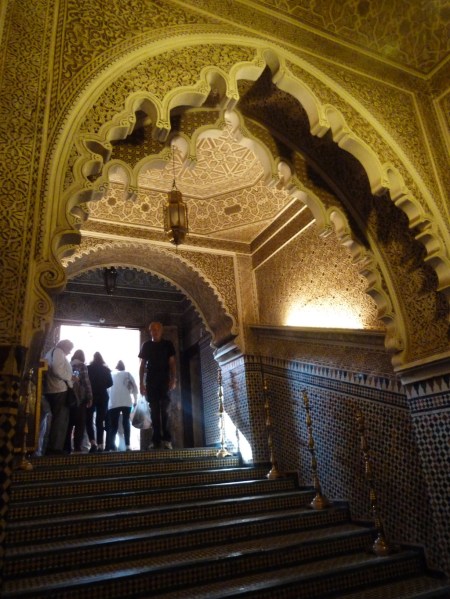
I admire what they do. They have a lovely venue, it looks like it might have been one of the grand old homes in the city, or even an old mosque. It has elaborate decorations, and lovely spaces. Whatever it was at one time, it has been gutted, and turned into a restaurant that can seat and feed many many people in a very short amount of time.

Those are not leftover bread crumbs on the table, they are rose petals to welcome groups.


Tables were marked with signs indicating Smithsonian and/or Purple, and as soon as eight people were seated around a table, service began, first hot towels, then water and small appetizers/mezze. They were pretty good. Most were not heavily spiced.


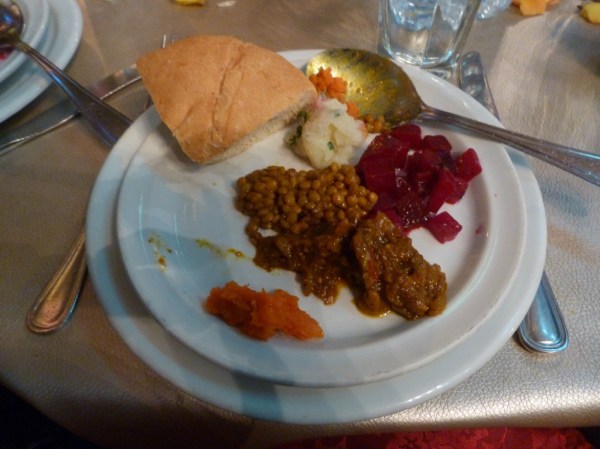
Appetizers were some kind of lentils, a beet salad, a mashed potato and pea combination, something maybe with a little lamb, and olives. The olives were delicious.


They served a huge tajine with some kind of beef dish. It was well cooked, like beef and carrots, with little or no spices that I could detect. Nourishing. Filling.
The venue is spectacular. It is truly a fabulous environment in which to take a meal. The catering service has paid attention to detail, with rose petals on the table, good settings, enough water, good sweets at the end of the meal and hot mint tea poured with a flourish. The restrooms were clean and there were several. I admire the way they can serve so many people so quickly, get-them-in, get-them-out and give them a meal in which there is little to object to . . . unless you’ve had Moroccan cooking before, and like a little taste in your food. We like taste in our food.
We’ve been married and traveling together for so long now that we know we aren’t going to be able to stay with the group. We love Marrakech; we’ve been here before. The last time was with our son, about fifteen years ago, but not a lot has changed. Our group leader looks a little worried, until we explain that we know the city, we speak Arabic and French, we know the customs, and we can find our way to the hotel on our own when we are finished. We walk – we almost run – away before anyone else knows we are gone.
Recent Comments
ExpatAlien on What Country am I Living … intlxpatr on Yellowstone: Old Faithful to C… Michelle on Yellowstone: Old Faithful to C… Cathy on No Grown-Ups in Charge intlxpatr on Waiting for Snow Wikipedia Donate Button

Amazina


Early Voting in Florida


 Here There and Everywhere