More Deaths than Birth for White Americans, a Minority in Three Decades
Don’t you love demographics? Demographics are a great forecasting tool, if you have the courage to use them. Demographics forced change on the United States military, forcing them to include women in more roles, recently increasing their job opportunities as the demographic pool dwindles. The same demographics are hurting the military budget now, as the huge bulge of baby-boomers retires, takes pensions and guaranteed free medical care, living a LONG time with more serious age-related illnesses, while the military struggles to allocate scarce resources.
Here is a fascinating factoid from The New York Times, a journal which notices small – but significant – changes, and gives us a little idea what the impact may be.
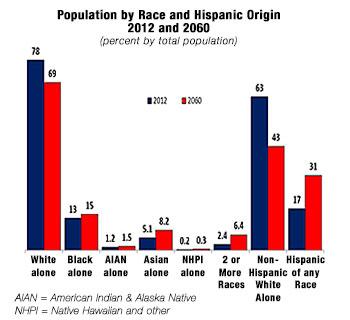
Census Benchmark for White Americans: More Deaths Than Births
By SAM ROBERTS
Published: June 13, 2013 232 Comments
Deaths exceeded births among non-Hispanic white Americans for the first time in at least a century, according to new census data, a benchmark that heralds profound demographic change.
The disparity was tiny — only about 12,000 — and was more than made up by a gain of 188,000 as a result of immigration from abroad. But the decrease for the year ending July 1, 2012, coupled with the fact that a majority of births in the United States are now to Hispanic, black and Asian mothers, is further evidence that white Americans will become a minority nationwide within about three decades.
Over all, the number of non-Hispanic white Americans is expected to begin declining by the end of this decade.
“These new census estimates are an early signal alerting us to the impending decline in the white population that will characterize most of the 21st century,” said William H. Frey, a demographer with the Brookings Institution.
The transition will mean that “today’s racial and ethnic minorities will no longer be dependent on older whites for their economic well-being,” Dr. Frey said. In fact, the situation may be reversed. “It makes more vivid than ever the fact that we will be reliant on younger minorities and immigrants for our future demographic and economic growth,” he said.
The viability of programs like Social Security and Medicare, Dr. Frey said, “will be reliant on the success of waves of young Hispanics, Asians and blacks who will become the bulwark of our labor force.” The issues of minorities, he added, “will hold greater sway than ever before.”
In 2010, according to the National Center for Health Statistics, more non-Hispanic whites died than were born in 11 states, including California, Florida and Pennsylvania. White deaths exceeded births in a majority of counties, including Los Angeles, the most populous.
The disparity between deaths and births in the year that ended last July surprised experts. They expected that the aging white population would eventually shrink, as it has done in many European countries, but not for another decade or so.
Nationally, said Kenneth M. Johnson, the senior demographer at the Carsey Institute, a research center based at the University of New Hampshire, “the onset of natural decrease between 2011 and 2012 was not anticipated.” He attributed the precipitous shift in part to the recession, adding that “the growing number of older non-Hispanic whites, which will accelerate rapidly as the baby boom ages, guarantees that non-Hispanic white natural decrease will be a significant part of the nation’s demographic future.”
Professor Johnson said there were 320,000 more births than deaths among non-Hispanic whites in the year beginning July 2006, just before the recession. From 2010 to 2011, the natural increase among non-Hispanic whites had shrunk to 29,000.
Census Bureau estimates indicate that there were 1.9 million non-Hispanic white births in the year ending July 1, 2012, compared with 2.3 million from July 2006 to 2007 during the economic boom, a 13.3 percent decline. Non-Hispanic white deaths increased only modestly during the same period, by 1.6 percent.
The census population estimates released Thursday also affirmed that Asians were the fastest-growing major ethnic or racial group. Their ranks grew by 2.9 percent, or 530,000, with immigration from overseas accounting for 60 percent of that growth.
The Hispanic population grew by 2.2 percent, or more than 1.1 million, the most of any group, with 76 percent resulting from natural increase.
The non-Hispanic white population expanded by only 175,000, or 0.09 percent, and blacks by 559,000, or 1.3 percent.
The median age rose to 37.5 from 37.3, but the median declined in Alaska, Hawaii, Kansas, North Dakota and Oklahoma. It ranged from 64.8 in Sumter, Fla., to 23 in Madison, Idaho.
The number of centenarians nationally neared 62,000.
11,800 Deported: Kuwait Deportations Continue “Without an End Date”
I still have a large contingent of loyal readers from Kuwait, but by early this morning, I could see something was up:

It’s not often that I have 132 Kuwait hits before noon.
So I checked the Kuwait Times:
Expat deportations will continue: Traffic chief – 11,800 deported in two-and-a-half months
KUWAIT: Major General Abdulfattah Al-Ali’s name has become synonymous with extensive traffic campaigns, aimed at enforcing the law at all costs, including implementation of mass deportations. The senior Interior Ministry official, who takes pride in deporting 11,800 people and impounding 3,000 vehicles during his tenure as head of the Ahmadi Security Department over the past two and a half years, told a local daily that deporting expatriates for serious violations will continue without an end date. “Administrative deportation of violating expatriates is not going to stop, especially of those carrying passengers illegally, in which case a person would be in violation of traffic and labor regulations,” Maj Gen Al-Ali, the Interior Ministry’s Assistant Undersecretary for Traffic Affairs, told Al-Rai on Friday.
He added that any ticket can be disputed “by a request to refer the case for traffic department investigations”. In the series of crackdowns that started late April, at least 2,000 traffic violations were registered, including 1,000 tickets issued directly on the street, while thousands of people were reportedly deported. Moreover, Maj Gen Al-Ali revealed that the ministry collected KD4 million, out of the KD24 million owed in traffic fines, during the same period. In that regard, the senior official pointed out that only KD8 million worth of fines are registered against individuals, while the rest are against companies and state departments. Out of the KD8 million, KD6 million is registered against expatriates, Maj Gen Al-Ali said. “Cases are soon to be filed with the traffic court in order to issue travel ban orders against people with more than KD80 in fines owed to the ministry,” he added.
Al-Rai published Maj Gen Al-Ali’s statement yesterday, along with a transcript of an interview with Al- Watan TV during which he defended the ongoing campaigns. “Our procedures are necessary to save lives, with average statistics indicating that 450 people are killed and 3,000 are injured annually due to traffic accidents,” he explained. During the interview, Maj Gen Al-Ali insisted that all drivers are equal when it comes to implementation of the law. “There have been doctors among the people deported, including a surgeon caught driving without a license for three years,” he said, before confirming news reports that he had taken a decision to impound a vehicle owned by Minister of Cabinet Affairs Sheikh Mohammad Al-Abdullah Al-Sabah on grounds of repeated violations committed by his personal driver. Meanwhile, the senior official urged any person who had obtained a license through illegal means to dispose of it “because once caught, they are going to be charged with forgery”. —Al-Rai, Al-Watan
Forty Years Wedding Anniversary

“You’re going to celebrate your anniversary for three days?” my friend asked incredulously.
“No, no, actually, it’s in two parts, we are celebrating the entire weekend, three days, but it’s because it is too hot to walk around New Orleans; so this is just part one, and in December we will celebrate part two with a trip to New Orleans when we can walk around and enjoy all the Christmas decorations and stay somewhere nice.”
It’s what we do.
There have been some years, particularly years with moves, or new positions, or new contracts in them, when anniversaries have sort of fallen by the wayside. We are enjoying making up for all the missed anniversaries, now that we have the great luxury of time.

We have all kinds of fun plans, a hotel stay, a dinner in a fine restaurant, star gazing out at Ft. Pickens, maybe a dolphin cruise, and a trip up in the very large beach ferris wheel, while it is still at Pensacola Beach. We plan a day in several pools with our son and his wife and our little grandson. All. or part, or some of this may really happen, depending on what the weekend weather looks like. Ft. Pickens has already evacuated all the campers with concerns over this Tropical Storm Andrea coming in, and a dolphin cruise or a trip up on the great wheel may not be such a hot idea at 40 – 50 mph winds, LOL.

AdventureMan and I knew when we married that we were in it for the long haul. We also knew it wouldn’t be easy. We come from different cultures, different life styles. We both had independent lives and responsibilities. We moved a lot. It wasn’t always easy, but then whose life is, when you know that life from the inside? We’ve had some great adventures, and some fabulous, astounding experiences. We’ve met extraordinary people and made very special life-long friends.

When I told AdventureMan our weekend might not be as exciting as planned, he laughed and said “we can bring our books.” He always knows how to make me laugh, and taking books is exactly what we did when we first got married, and would take weekend trips to a lakeside resort called Chiemsee; it would be snowing and cold and we would go into this large old lodge with it’s double doors and double shuttered windows, with it’s eiderdown comforters and huge fireplace, and we would pack books. We would sleep and read, and sometimes go eat. If that’s how this anniversary turns out, it’s a very comfortable and familiar way to celebrate.:-)

AdventureMan loves this blog. He always looks for his name. 🙂 Happy Anniversary, dear husband.
Three Little Kittens

This morning, driving to the commissary, about ten feet apart on the highway, I saw the smooshed bodies of three little kittens. They must have been about five or six weeks old. I felt sick; I still do. What kind of animal would throw little kittens out the window of a car to let them die in terror on a busy highway? Who raises these people who could act with such cruelty?
I am a believer; I believe God put each one of us here for a purpose. I think we often misunderstand some of God’s intentions; I think sometimes we get it very wrong. I fantasize that maybe these little cats and dogs we adopt are really our guardian angels, who will speak up for us on the last days and tell the Lord Jesus how we treated his little ones. Imagine the punishment for hurting a helpless animal! Imagine the penalty for hurting an innocent, defenseless child!
Anesthesia Linked to Dementia Risk in Seniors
It may not be dementia. It may be a reaction to a medication in the elderly that LOOKS like dementia.
My father was 87, and doing pretty well for a man 87. He still walked on his own, using a walker when he had to, and very rarely, a wheelchair if we were going a long ways. He went into the hospital for a minor surgery. The tube inserted in his hand for the anesthetic became infected. Dad was acting weird, he was having hallucinations, and my sister rightly identified that Dad had a reaction to the diuretic drug Lasix; when they switched him to an alternative, the raving and hallucinations stopped.
He was transferred to a rehabilitation unit, where for two days, they put him back on Lasix. Poor communication between hospital and the rehab facility, plus standardization of drug regimens – they switched him without telling him, or us. Once again, he went loony tunes, and at the same time, his right hand began to swell until it looked like a lobster claw. He kept saying it hurt, and it was big and red, and the rehab people kept saying it would get better.
Dad was rushed to another hospital, one the rehab clinic worked with, and the doctors told us he had a ‘cascade of problems’ and which were the primary three we wanted them to work with?
Get him off the Lasix, first thing, we all agreed, and find a way to have it annotated on any record that he is never to have Lasix. (It did no good; the next hospitalization, back at the first hospital, they gave him Lasix again, which made him crazy and masked all the other symptoms.)
Long story short, there were a cascade of hospital mistakes – not one hospital, two hospitals and the rehab clinic – where miscommunications, inattentions and shortage of trained personnel resulted in a cascade of issues that led to my father’s death later that year. The other lesson learned is that if you go into a hospital, make sure you have a good support system, someone with you who will bravely ask questions, and remind someone if an inappropriate medication is prescribed. You need a family member with you for protection against inattention, mistakes, miscommunications and personnel shortages.
It’s not like there’s anyone to bring a lawsuit against; they were all doing the best they could, but Dad was old. My bet is that he might have lived another couple years, at the very least, had he not gone in for that first non-essential minor surgery. To me, the moral of the story is if you want to live a long life, stay away from hospitals.

Anesthesia Linked to Increased Dementia Risk in Seniors
Exposure to anesthesia has been linked to a 35 percent increase of dementia in patients over age 65, according to a new study.
By Jeffrey Kopman, Everyday Health Staff Writer
FRIDAY, May 31, 2013 — Caregivers and seniors struggling with the dilemmas of elder care have another risk to weigh against potential rewards — senior patients exposed to general anesthesia face an increased risk of dementia, according to research presented at Euroanaesthesia, the annual congress of the European Society of Anaesthesiology (ESA).
Researchers reviewed the medical information of 9,294 French patients over the age of 65. The patients were interviewed several times over a ten year period to determine their cognitive status.
After two years, 33 percent of participants had been exposed to anesthesia. Most of the exposed patients (19 percent overall) were exposed to general anesthesia — a medically induced coma. The rest were exposed to local/locoregional — any technique to relieve pain in the body — anesthesia.
In total, 632 participants developed dementia eight years after the study began. A majority of these patients, 512, were diagnosed with probable or possible Alzheimer’s disease. The remainder had non-Alzheimer’s dementia.
The gap between dementia related to general anesthesia (22 percent) and non-dementia patients (19 percent) was associated with a 35 percent increased risk of developing dementia. This risk was linked to at least one general anesthesia.
“Elderly patients are at an increased risk for complications following anesthesia and surgery,” said Jeffrey H. Silverstein, MD, MS, and vice chair for research at the Department of Anesthesiology at Mount Sinai in New York City. “[They] are particularly prone to postoperative delirium, which is a loss of orientation and attention. Anesthesiologists have been evaluating higher cognitive functions (for example, memory and executive processing) and found that a substantial number have decreases in one or more of these areas after a surgical procedure.”
Researchers hope this study will lead to more awareness for surgeons.
“Recognition of postoperative cognitive dysfunction (POCD) is essential in the perioperative management of elderly patients,” said study author Dr. Francois Sztark, INSERM and University of Bordeaux, France, in a press release. “A long-term follow-up of these patients should be planned.”
Elderly Care: Risk vs. Reward
Senior citizens and their caregivers might be willing to accept an increased risk of dementia if it means getting necessary anesthesia for an important medical procedure. Dementia is a relatively common occurrence in old age: One in three seniors has Alzheimer’s disease or dementia by the time of their death.
But surgery at old age can also carry more severe, and less common, health risks. In fact, simply surviving surgery can be difficult for elderly patients, especially those over the age of 80.
While the numbers vary depending on procedure, researchers have found that mortality risk tied to elective major surgeries increases with age. The risk more than doubles for patients over 80 compared to patients ages 65 to 69.
But other surgery complications are even more common in seniors.
“The major risk for elderly patients following surgery is pneumonia,” said Dr. Silverstein. “Cardiac complications are next most common.”
However, Dr. Silverstein still feels that if surgery is deemed necessary, patients should not fear the risks.
“In theory, only necessary surgery is done,” he said. “Knowing how [patients] reacted to anesthesia and surgery in the past may give them some idea of their postoperative course.”
Last Updated: 05/31/2013
Rovaer Norway: The Best Wedding Proposal Ever
The groom-to-be was able to rope the entire village into participating in his proposal to his girlfriend. He knocks her socks off – no matter what the highs and lows of the marriage to come, she will never forget this proposal:
Round-Up Herbicide Tied to Serious Health Deterioration
Shocking news for everyone with grounds and gardens – we’ve all been using this, not knowing its long term impact on our environment – and on us.

Roundup, An Herbicide, Could Be Linked To Parkinson’s, Cancer And Other Health Issues, Study Shows

The peer-reviewed report, published last week in the scientific journal Entropy, said evidence indicates that residues of “glyphosate,” the chief ingredient in Roundup weed killer, which is sprayed over millions of acres of crops, has been found in food.
Those residues enhance the damaging effects of other food-borne chemical residues and toxins in the environment to disrupt normal body functions and induce disease, according to the report, authored by Stephanie Seneff, a research scientist at the Massachusetts Institute of Technology, and Anthony Samsel, a retired science consultant from Arthur D. Little, Inc. Samsel is a former private environmental government contractor as well as a member of the Union of Concerned Scientists.
“Negative impact on the body is insidious and manifests slowly over time as inflammation damages cellular systems throughout the body,” the study says.
We “have hit upon something very important that needs to be taken seriously and further investigated,” Seneff said.
Environmentalists, consumer groups and plant scientists from several countries have warned that heavy use of glyphosate is causing problems for plants, people and animals.
The EPA is conducting a standard registration review of glyphosate and has set a deadline of 2015 for determining if glyphosate use should be limited. The study is among many comments submitted to the agency.
Monsanto is the developer of both Roundup herbicide and a suite of crops that are genetically altered to withstand being sprayed with the Roundup weed killer.
These biotech crops, including corn, soybeans, canola and sugarbeets, are planted on millions of acres in the United States annually. Farmers like them because they can spray Roundup weed killer directly on the crops to kill weeds in the fields without harming the crops.
Roundup is also popularly used on lawns, gardens and golf courses.
Monsanto and other leading industry experts have said for years that glyphosate is proven safe, and has a less damaging impact on the environment than other commonly used chemicals.
Jerry Steiner, Monsanto’s executive vice president of sustainability, reiterated that in a recent interview when questioned about the study.
“We are very confident in the long track record that glyphosate has. It has been very, very extensively studied,” he said.
Of the more than two dozen top herbicides on the market, glyphosate is the most popular. In 2007, as much as 185 million pounds of glyphosate was used by U.S. farmers, double the amount used six years ago, according to Environmental Protection Agency (EPA) data.
Farewell Annette Funicello
We all wanted to be her 🙂
Ezekiel Prophesies to Bare Bones in the Desert
When I read a segment like this in the daily Lectionary Readings, I wonder what happens next? What a great science fiction/fantasy story this would make, writing from the point of view of a newly raised newly re-fleshed person – like would they have their former memories? Would they remember their deaths? Or would they come into the world with the blank unfilled minds of babies, but in grown bodies? Did the Lord God just revive them and set them on their way? We know he was making a point to the prophet Ezekiel, but you have to wonder . . . what came next?

Ezekiel 37:1-14
37The hand of the Lord came upon me, and he brought me out by the spirit of the Lord and set me down in the middle of a valley; it was full of bones. 2He led me all round them; there were very many lying in the valley, and they were very dry. 3He said to me, ‘Mortal, can these bones live?’ I answered, ‘O Lord God, you know.’ 4Then he said to me, ‘Prophesy to these bones, and say to them: O dry bones, hear the word of the Lord. 5Thus says the Lord God to these bones: I will cause breath* to enter you, and you shall live. 6I will lay sinews on you, and will cause flesh to come upon you, and cover you with skin, and put breath* in you, and you shall live; and you shall know that I am the Lord.’
7 So I prophesied as I had been commanded; and as I prophesied, suddenly there was a noise, a rattling, and the bones came together, bone to its bone. 8I looked, and there were sinews on them, and flesh had come upon them, and skin had covered them; but there was no breath in them. 9Then he said to me, ‘Prophesy to the breath, prophesy, mortal, and say to the breath:* Thus says the Lord God: Come from the four winds, O breath,* and breathe upon these slain, that they may live.’ 10I prophesied as he commanded me, and the breath came into them, and they lived, and stood on their feet, a vast multitude.
11 Then he said to me, ‘Mortal, these bones are the whole house of Israel. They say, “Our bones are dried up, and our hope is lost; we are cut off completely.” 12Therefore prophesy, and say to them, Thus says the Lord God: I am going to open your graves, and bring you up from your graves, O my people; and I will bring you back to the land of Israel. 13And you shall know that I am the Lord, when I open your graves, and bring you up from your graves, O my people. 14I will put my spirit within you, and you shall live, and I will place you on your own soil; then you shall know that I, the Lord, have spoken and will act, says the Lord.’
Recent Comments
intlxpatr on Shampoo Ginger tigerbutterya0c5ff1d… on Shampoo Ginger intlxpatr on British Soldier Kidnapped, Esc… John on British Soldier Kidnapped, Esc… intlxpatr on British Soldier Kidnapped, Esc… Wikipedia Donate Button

Amazina


Early Voting in Florida


