Where is Rwanda and How Do They Celebrate a Genocide Anniversary?
Today the church prays for the diocese of Byumba, in Rwanda. There is Rwanda, below, right in the heart of Africa, nestled between the Democratic Republic of the Congo, Uganda, Kenya, Tanzania and Burundi.
 Rwanda was in the news this last week for something very special. Most of our western news stations gave it zero coverage, but you could catch a glimpse online. This, from the Christian Science Monitor: on an amazing event just twenty years after one of the worst genocides in my memory. To me, it is wonderful and inspiring that they forgive one another and love one another to live in peace with one another. It gives me hope for our world.
What to celebrate in Rwanda’s genocide anniversary
The 20th anniversary of the Rwanda genocide should focus as much on how the African nation worked toward reconciliation through forgiveness as on the mass slaughter itself.
This month, Rwanda marks the 20th anniversary of an event that its name is most associated with – the 1994 mass slaughter of the Tutsi minority and many in the majority Hutu. Over 100 days starting April 7, more than 800,000 people were killed, many by neighbors incited to ethnic hatred by a political elite. It is a genocide often cited since then to justify military intervention in similar ongoing atrocities.
But another lesson from Rwanda’s experience deserves to be remembered – an amazing reconciliation of killers and survivors through individual confession and forgiveness in nonjudicial village courts.
This type of reparative justice in an intimate setting could prove useful in countries that will need post-conflict healing, such as Syria, Colombia, andMyanmar (Burma). It might also help prevent a cycle of revenge and retribution in those countries, as it has in Rwanda.
Most of Rwanda’s main perpetrators in the genocide have been tried in regular courts, either in Rwanda, Europe,, or the International Criminal Tribunal for Rwanda, set up by the United Nations. But for hundreds of thousands of others who were charged with killing, the Rwandan criminal-justice system was too weak and its jails too full. Legal trials would have taken decades. The country had to fall back on a form of community-based traditional justice known asgacaca.
Other post-conflict countries in transition, notably South Africa, have relied on a similar process with their truth-and-reconciliation commissions. But the bodies have usually been more formal and national in scope. Rwanda’s gacaca are far more personal, designed to achieve the end result of allowing people who knew each other to resume living in the same community. They also bring together an entire village to witness a confession, attest to its sincerity, encourage forgiveness by the victim, and agree on some reparation, such as helping till a victim’s fields for a time.
It hasn’t worked in every case. Many Tutsis who killed Hutus have not been tried. Many victims could not bear the trauma of hearing how their loved ones had died. And many Hutus disappeared or were able to hide from the truth.
The government under President Paul Kagame, despite its drift toward authoritarian rule, has encouraged the process by outlawing formal use of ethnic identities. “The divisionism of before is gone. All of us now have equal access to opportunities,” a young Rwandan told The Christian Science Monitor.
The gacaca rely on the guilty to listen to the stories of their victims with empathy, admit their acts with repentance, and rethink their self-identity within the community. For the victims who forgive, the process can lift feelings of rage and bitterness. Much of the justice lies in the restoration of relationships as much as in material reparations.
Rwanda is not yet a “post-ethnic” African nation. But the possibility of a future political class inciting Hutus and Tutsis to take up violence now seems slim. More Rwandans have a higher sense of identity.
As the world helps Rwanda mark the 1994 genocide, it should also spread the lessons of this post-genocide reconciliation. Dispute resolution is a common technique in every society, whether in families or courts. But when almost every village in an entire nation goes through it, the lesson is worth repeating elsewhere.
Donna Leon and The Golden Egg
“What are manners?”
“What is ‘nice’, what does it mean?”
“What is ‘kind’?” the most adorable little boy in Pensacola asked me. It was bath time, a time when we have some of our best conversations, and you never know where the conversation will go.
I love these conversations because I have to think, too, but most of all, because I love to watch this little boy’s mind grow in grasping concepts and perceptions. He is four; his class in school is on the letter “U” this coming week, and already he can sound out words in the books we read together. He knows what a globe is, and how it differs from a map. He knows his address, and he can point to Pensacola on the globe.
He knows things because we talk to him, and because he goes to school and his teachers talk to him. His mind is wide open and he is eager to learn, and he asks the most wonderful questions.

Donna Leon’s Commissario Guido Brunetti has a new case that troubles him. He knows the dead man, not well, but he would see him in his quarter, and he often saw him helping out at the local laundry. He assumed the man was deaf and retarded, everyone knew that. When the dead man has no papers, in bureaucratic Italy, no birth certificate, no medical records, no finance records, no record of social aid (he is poor as well as disabled) Brunetti is troubled. How could such a familiar figure be so undocumented?
His mother is no help; her stories are transparent lies about travel to France and her son having grown up in the country with people whose name she cannot remember.
It is a troubling book. If you read Donna Leon, you will understand how close and wonderful and articulate Brunetti’s family is, how loved and cherished their children. We eat meals with them, we understand how the Venetian vernacular distinguishes those to whom one speaks more frankly and those to whom one lies. Brunetti’s a detective; the things he sees often trouble him, but this case troubles him more than most.
I can’t tell you more without spoiling the ending. All I can tell you is that it will encourage you to love your children, hold them closely, and give them all the benefits in their life-toolbox of attention, instruction and loving discipline that a parent (and grandparent!) can give.
What is Lent and Why Do We Observe Lent?
From today’s AOL News:
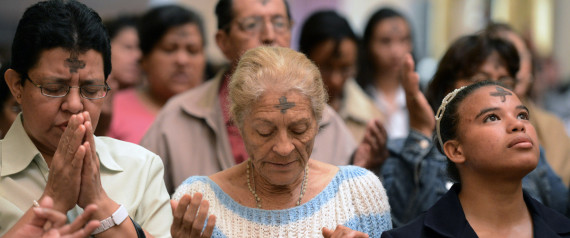
Ash Wednesday 2014: History, Dates, Traditions Of Lent’s First Day Of Fasting
Ash Wednesday is observed on March 5, in 2014. The Christian holy day marks the beginning of Lent, a 40-day season of fasting that is considered preparation for Holy Week and the celebration of Easter.
Although there is no Biblical reference to Ash Wednesday or Lent, scholars of Christianity date the tradition of a 40-day fasting period back to 325 A.D.
Lent mirrors Jesus’ own 40-day period of fasting, described in the book of Matthew. Observers have ash placed on their foreheads in the shape of the cross as the words from Genesis 3:19 are spoken: “You are dust, and to dust you shall return.”
Fasting requirements for Catholics are outlined by the Code of Canon Law, and include eating no meat on the Fridays during Lent, as well as fasting on Ash Wednesday and Good Friday. (Fasting in this case refers to eating just one full meal a day.)
Many Christians will make personal vows of abstinence during Lent, which could include anything from refraining from eating candy, meat, vowing not to gossip, or being less selfish. Others will make a vow to do more for others including volunteering and working for social justice. All are expected to spend more time in prayer and reflection as Lent is considered by many to be an opportunity for spiritual transformation.
The Catholic nun Sister Joan Chittister writes:
Lent is the opportunity to change what we ought to change but have not…Lent is about becoming, doing and changing whatever it is that is blocking the fullness of life in us right now… Lent is a summons to live anew…Lent is the time to let life in again, to rebuild the worlds we’ve allowed to go sterile, to “fast and weep and mourn” for the goods we’ve foregone. If our own lives are not to die from lack of nourishment, we must sacrifice the pride or the sloth or the listlessness that blocks us from beginning again. Then, as Joel (2:12-18) promises, God will have pity on us and pour into our hearts the life we know down deep that we are lacking.
A Stalwart Falls

“Are you catching colds?” our friend asked as the funeral ended.
“No, no, I said, funerals just find us very vulnerable, and we have to deal with losses, past, present . . . and future. We have an ongoing fight over who is going to bury whom.”
We did not know the man well who had died, but we knew him as a stalwart. He was a greeter and usher at our service, and he was only rarely ever not there. He served the church. He was always there. I had asked his wife to help me with tickets, and she had laughed and said “of course, I’ll be there because my husband will be there, and if you need me just holler.”
They weren’t there. It made me uneasy, it nagged at me. I didn’t need her, but I missed her, and as I said – they are ALWAYS there. Sometimes it’s what is missing that catches your attention. It caught mine.
When I learned her husband had died, suddenly and unexpectedly, just as the Antique Fair was starting, it came almost as a physical blow. It’s not that I knew him that well. It’s that his presence at the church was something we took for granted, he was stalwart. You could count on him. We attended out of respect, respect for him, support for his wife.
And I know that the two of them spend (spent) as much time together as AdventureMan and I do. I don’t like to think that it could happen to me, that I could be suddenly left. AdventureMan was a military man, he would often leave, all these years, and he might tell me where he was going but I never knew for sure where he was going. We had a code to use if he was lying, but although he never used the code, I know there are times he lied, all for that bitch, national security. Yes, yes, I know, strong language from Intlxpatr, but strong times call for strong language. We both knew that there were times when there was a risk he wouldn’t come back.
We didn’t have to deal with death a lot in our life abroad. Of course, in the military, everyone is young. In all the countries where we worked in the Gulf, there were upper age limits – people retired and people left; you can’t live out your years in Qatar or Kuwait, there are laws against it. You can’t even be buried there without special permission. We learned to deal with the losses of people coming into our lives and leaving, but we didn’t have to deal with the great finality of death. We’re learning.
AdventureMan insists he is going to go first. I am tough in a lot of ways, but I don’t know that I am tough enough to go through his funeral. The very thought of it makes me sick to my stomach.
He tells me not to worry. He wants a Viking funeral; he wants to be sent out in a kerosene soaked ship and for archers to set it on fire as it sails off, disintegrating in flames. Isn’t going to happen, AdventureMan, but if it did, I might give some thought to pitching myself on the ship as it departs . . . otherwise, I’m afraid I might live the rest of my life as the one of the walking wounded.
191 Nepali Laborers Died in Qatar in 2013
From Agence France, a report that 191 Nepali laborers died in Qatar in ONE year:

Nearly 200 Nepali migrant workers died in Qatar last year, many of them from heart failure, officials said Monday, figures that highlight the grim plight of labourers in the Gulf nation.
Tens of thousands of impoverished Nepalis head every year to Qatar, where a construction boom is gathering pace as it prepares to host the 2022 football World Cup.
The Nepal embassy in Doha said it registered 191 deaths last year compared with 169 the year before, with a foreign ministry official describing many of the deaths as “unnatural”.
“In the year 2013, a total of 191 Nepali migrant workers died in Qatar,” Harikanta Paudel, a senior embassy official, told AFP by telephone.
“The highest number of deaths occurred in July when 32 workers died,” Paudel said.
Qatar is under mounting pressure over poor conditions for migrant labourers, particularly during the blisteringly hot summer, in the gas-rich nation’s booming construction industry.
A Kathmandu-based foreign ministry official told AFP that a third of the deaths recorded were due to “unnatural” heart failure.
“Young and healthy men in their twenties and thirties have died… it is unnatural,” said official Subhanga Parajuli.
“Cardiac arrest is followed by traffic accidents as another main cause of death. The third cause of death is injuries during work,” Parajuli said.
An Amnesty International report released last November said migrant workers in Qatar endured a series of abuses including “non-payment of wages, harsh and dangerous working conditions, and shocking standards of accommodation”.
The rights group said its researchers overheard one construction firm manager use the term “animals” to describe migrant workers, while a labourer told the watchdog that “Nepalis are treated like cattle”.
Qatari authorities last October said allegations of abuse of labourers working on World Cup facilities were exaggerated but insisted they took such claims seriously.
More than one million Nepali migrant workers toil in the Gulf region and Southeast Asia. Qatar alone hosts around 400,000 Nepalis as part of its two-million strong migrant workforce.
Promises, Promises (Lies, Lies!)
West Virginia is one of the poorest – and most beautiful – of the 50 United States, green with forests and uninhabited spaces. It also has pockets of some of the poorest people in the United States. It is a state which accepts that which other states might find unacceptable. And when the chemical spill poisoned the water of thousands of people, Freedom Industries, the responsible company, declared bankruptcy.
Even today, while their water has been declared OK, people say it tastes funny, and chemists have found unacceptable traces of chemicals that other tests were not even measuring. Today, we have this report that the spill was much worse that the company originally reported.
Its sad, and it is disheartening.
In Florida, there are constant proposals for land use restrictions being lifted. The military, the companies – they all promise that this (whatever) will have no impact on the environment. Why, no one could be more environmentally responsible than (_______) fill in the blank with whatever the requestor is.
Yeh. Right.
My guess is that if the true cost of the BP oil spill in the Gulf were known, it would bankrupt BP.

The West Virginia Department of Environmental Protection issued an update on Monday evening indicating that the Elk River spill in West Virginia earlier this month involved more gallons of chemicals than previously reported.
Freedom Industries, which owned the tank that leaked into a river supplying water in the state, now says that approximately 10,000 gallons of the chemicals 4-methylcyclohexane methanol (also known as MCHM) and PPH were released. The company initially said 7,500 gallons spilled, and failed to disclose the presence of the second chemical until last week. The leak, first reported on Jan. 9, left hundreds of thousands in the capital region without access to tap water for days. Though the formal advisory on the water has been lifted, some in the region say they are still concerned about the safety of their water.
The DEP’s press release provides Freedom Industries’ newest estimate, but notes, “It is not known how much material spilled into the Elk River and shut down the drinking water supply for citizens across nine West Virginia counties.”
“We are not making any judgment about its accuracy,” DEP Secretary Randy Huffman said in a statement, referring to the company’s latest spill figure. “We felt it was important to provide to the public what the company has provided the WVDEP in writing. We are still reviewing the calculation, and this is something that will be researched further during the course of this investigation.”
“This is the first calculation that has been provided concerning the amount of materials that spilled on Jan. 9,” Huffman said. “This new calculation does not change any of our protocols in dealing with this spill, nor does it affect the ongoing remediation efforts. Our actions have never been dependent on what Freedom has reported to us. From the start, we have acted aggressively to contain the spill and remediate the site.”
West Virginia Gov. Earl Ray Tomblin (D) has called for the storage facility to be torn down, and for a full remediation of the site.
Giving Birth to Gun in the South Sudan
This is the newest blog entry from my friend Manyang David Mayar in the South Sudan He visited Pensacola as part of an IVLP program with our Gulf Coast Citizens Diplomacy Council:

Pregnant women fleeing the fighting in Jonglei state, South Sudan.
I was in the town of Bor when fighting broke out last month in South Sudan. I managed to escape the town despite being shot in the arm. But many other people had a far tougher time – people like Nyiel Magot, nine months pregnant and faced with the awful choice of staying in Bor’s hospital or fleeing into the bush.
Against her doctors’ advice, Nyiel decided to escape the immediate danger, and with her five children, took a narrow path out of town which was packed with people also heading to safety.
But, she told me, with every step she took, she grew weaker and more and more people overtook her.
“I was really tired and the pain became really unbearable,” Nyiel said. “I knew the time had come for me to give birth and I had to get out of Bor immediately to escape the attackers.”
Giving birth in the bush
Later that evening, the pain finally forced Nyiel to stop. Instead of a hospital ward, she found an abandoned grass-thatched house.
Luckily, there was a traditional birth attendant nearby who used her bare hands to help Nyiel deliver a healthy baby boy.
But the cold nights and hot days of December in South Sudan soon started to take their toll on the new born and reports of an imminent rebel attack forced Nyiel and her family to leave their hideout.
They walked for days until they crossed the River Nile and came to a large camp for displaced people in Awerial. And then her baby caught diarrhoea and started to vomit.
He was rushed to a hospital in Juba where, after days of treatment, he recovered.
A child of conflict
It was in the hospital in Juba that I met Nyiel and heard her story – and also learned the name of her little baby.
Nyiel had called him Matuor, the Dinka word for ‘gun’, because he was born amid gunfire.
As the conflict continues in South Sudan, I fear he won’t be the last baby born in the bush with such a name.
Stock Market Dive and Psalm 30
Yesterday the American stock market dropped 318 points and it’s like all those chickens running around saying “the sky is falling! the sky is falling!” AdventureMan checked our holdings and said we had lost a significant amount. Oh well. It’s all paper gains and paper losses until you have to sell – or, LOL, until you have to pay taxes.
(Why is it the market never drops significantly just before the end of the year, at which point taxes are calculated???)
So this morning’s Lectionary readings make me smile. Life is transitory, wins and losses are ephemeral. We keep our eyes on the Lord, and give him thanks.
Psalm 30
A Psalm. A Song at the dedication of the temple. Of David.
1 I will extol you, O Lord, for you have drawn me up,
and did not let my foes rejoice over me.
2 O Lord my God, I cried to you for help,
and you have healed me.
3 O Lord, you brought up my soul from Sheol,
restored me to life from among those gone down to the Pit.*
4 Sing praises to the Lord, O you his faithful ones,
and give thanks to his holy name.
5 For his anger is but for a moment;
his favour is for a lifetime.
Weeping may linger for the night,
but joy comes with the morning.
6 As for me, I said in my prosperity,
‘I shall never be moved.’
7 By your favour, O Lord,
you had established me as a strong mountain;
you hid your face;
I was dismayed.
8 To you, O Lord, I cried,
and to the Lord I made supplication:
9 ‘What profit is there in my death,
if I go down to the Pit?
Will the dust praise you?
Will it tell of your faithfulness?
10 Hear, O Lord, and be gracious to me!
O Lord, be my helper!’
11 You have turned my mourning into dancing;
you have taken off my sackcloth
and clothed me with joy,
12 so that my soul* may praise you and not be silent.
O Lord my God, I will give thanks to you for ever.
Manyang: Our Friend in South Sudan
God willing, in life, people cross paths and share their stories. I told you about Manyang, how he visited us near Christmas in 2012 and how his story changed our lives. Now, when we hear stories of the South Sudan, it is immediate, it is real, because we know the story of a young boy grown to be a very fine man, who survived the chaos and horrors of the janjaweed invasions and tribal conflicts before his country attained nationhood.
I recently wrote to Manyang, hoping he is still alive. It was that basic. I asked him, if he could, just to let us know he was alive, and that whether he could respond or not, our prayers were with him, for him, his family and his country.
This morning, by the grace of God, I received this wonderful response. Please, join your prayers with ours for Manyang/David, and his country, South Sudan, for peace, safety and prosperity, for justice and equitable distribution of resources.
I am glad to hear from you again. I have been talking of the nice people I was able to meet in Pensacola. Whenever, I talk about these people you are the first people I talk about. I still remember the nice dinner we had in your house.
I think God touched you to worry about my safety. You might have heard from news report the critical condition my country – South Sudan is going through. It is just like the story of my childhood to many other children now.
A political row in the ruling party here, turned violent in Juba, the capital of this country on December 15, 2013. Heavy artillary were fired and sporadic gunfire broke out in most part of the city. it was a genesis of another war which is now going on. Thousands of people were killed only in Juba.
I was in Bor, the captal of Jonglei State, about 125 miles north of Juba. The violent in Juba quickly spread to us in Bor and I was forced to flee to the bush with my family and the rest of the civil population as the town was quickly seized by anti-government forces. I carried my back on my head, walk long distant and drink dirty water again and eat grains when I was in the bush for seven days.
(This is a screenshot from Google Maps; Bor is the “A” north of Juba)

(These are photos from Manyang’s BBC blog, referenced below. Please go there to read more in his own words about the terrors of the South Sudan chaos.)

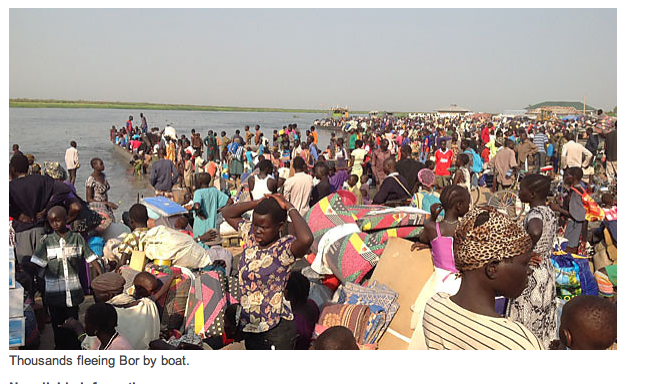
The government forces recaptured the town and we returned to the town. Many more people were killed and bodies were lying everywhere and there was a terrible smell. The rebels killed everyone they found in the town including old women, lame, deaf and all vulnerable people. And I was wounded in the upper left arm by a stray bullet of soldiers celebrating. The wound has healed and I am fine now.
It did not take long for the rebel to recaptured the town of goverment forces for a second time. And I was force to flee, this time cross the River Nile by boat to a makeshift camp across the river. This was where I got an access to go to Juba which was abit calm at the time. I am now in Juba staying in fear, not knowing where else to go.
God was speaking to you those conditions I was in in December and part of January. We spent Christmas and New Year Day on the run. I am glad for your prayers were able to lead me out of that mess. I still have hope that your prayers will continue to press political leaders to reach a peaceful solution to this crisis.
I have a live blog where I am sharing my bush experiences. You may have a look.
http://www.bbc.co.uk/blogs/bbcmediaaction/posts/Pens-down-in-South-Sudan
Share my message with the rest of the great people of Pensacola. My heart is always there with you.
Blessings
Manyang
NZ Speeding Ad Goes Viral
This is a shocking ad; an ad that shocks the viewer into reviewing priorities
Recent Comments
tigerbutterya0c5ff1d… on “Who Would Do Such a… intlxpatr on A Lawless, Authoritarian … Kuwait Someday on A Lawless, Authoritarian … intlxpatr on Oh Thank You, Amazon! Rivergirl on Oh Thank You, Amazon! Wikipedia Donate Button

Amazina


Early Voting in Florida


 Here There and Everywhere