Doc by Mary Doria Russell

Mary Doria Russell is one of my favorite authors because she tackles large topics fearlessly, humorously and with great compassion. I first read her many years ago in a novel called Children Of God; you can read it stand-alone as I did, but I should have read The Sparrow, which preceded it. That one is about the Jesuits who take the Gospel into outer space, and has some laugh-out-loud moments in the midst of utter hopelessness. Yes. She’s that kind of author, my kind of woman.
Here is the ending Question and Answer from an interview at the back of Doc, an interview with John Connelly:
Q: Authors are often asked what advice they’d give young writers. I would like to ask you a similar question: What do you think the worst advice a young writer could get is?
Mary Doria Russell: Major in English. Join a writer’s group. Blog.
My advice is to major in and do something REAL. Have an actual 3-D life of your own. And please, shut up about it until you’ve got something genuinely wise or useful or thoughtful to share. Then again, I’m a cranky old lady! What the hell do I know?
Reading a book about legendary heroes of the Old West is not something I looked forward to, so the book languished on my “to read” pile until one day I picked it up just because it is written by Mary Doria Russell, and because she has knocked my socks off with every book I’ve read by her.
It starts off slow, summing up the early genteel years of John Henry Holliday in Georgia, just prior to, during and after the War Between the States. At 22 he is diagnosed with acute tuberculosis, and is advised that a drier climate out West might provide him with a more comfortable life, as short as it was likely to be. He had trained as a dentist, so he had a skill. Times were hard, and while he was a very very good dentist, it was a good thing he also had skills with card playing, to supplement his income when people didn’t have the money to go to the dentist.
Don’t skip over the early years, because what happens in the early years resonates into his years living in the West. The majority of the book takes place in Dodge, a border town where laws are made over a card game and by the men who will profit from them. Lives are hard, and short. While it is surely the wild west, the focus is on the relationships Doc builds – Wyatt and Morgan Earp (all the Earp brothers), Bat Masterson, the gals . . . here is where Russell’s artistry shines; the cardboard figures begin to become real people. We start to like one or two, admire another, despise one more.
Here’s what I love about Mary Doria Russell – without being at all preachy, she makes you stop and think about some of the values you hold most dear. Once you get west, 80% of the women featured in the book are prostitutes. Most of the characters drink heavily, and routinely use drugs which are today restricted to prescriptions. There is corruption, and murder, and arson, and abortion, and contraception, and adultery, and there is no one character who is purely good or purely evil, they are all complicated, just as we are. She can lead you to dislike a character, who at just the right moment knows just the right thing to say, and suddenly, you see that character differently, because another facet of his or her character has been revealed.
In the questions at the back of the book, we are asked if we were to meet Doc Holliday, would we like him? I had to ask the question the other way around – if I were to meet Doc Holliday, how would he perceive me? I found myself thinking outside the box, found myself thinking that if I knew my life were going to be very very short, would I want to hang around with normal people, dull, predictable people? Maybe people who look better on the outside than they are, or think more highly of themselves than they ought? Doc Holliday hung around with lawmen and gamblers and prostitutes and bartenders; his patients were law-abiding church-going citizens. Who gave greater color and meaning to his life? Who were more likely to be down-to-earth and practical and unpretentious?
There is an absolutely delightful segment about a Jesuit priest from an old Hungarian aristocratic family who finds himself riding out to visit all the small Catholic Indian parishes on a donkey, replacing a highly popular priest who is very sick; he is teased and mocked and treated with disrespect. One night, cold and wet, covered with dirt and filth in the desert, he has an epiphany that changes his life. Mary Doria Russell books have these luminous moments, worth reading the entire book for, and which will bring a smile of memory to your face long after you have finished reading the book.
Your Vote – The Power of We (Blog Action Day 2012)
This year, in the United States we are going through a vicious process, that of choosing one candidate over another for political office. Many people are so put-off by the mechanics of the process that they opt out of the choosing altogether. Others are just too busy to vote, beset by the needs of family, job, car pool, church, social activities, etc. in spite of the ease with which one can ask for and receive an absentee ballot.
You need only live in a country where people have no meaningful vote to quickly learn the value of your vote. Your vote may be just one, but in a democracy, where just one vote can turn an election – your vote counts. Together, with other voters of your persuasion, your vote counts.
There has never been a country where women have the vote and men don’t. Sadly, the opposite is true; there are still countries where women are not considered fully qualified to vote. Less than 100 years ago, our own country was one of them. Yes, it’s true, we didn’t get the vote until 1920. I reprint the following from a post I wrote several years ago, a post I have never forgotten, because it was so shocking to me when I read the price these women paid that I might freely vote today.
“The doctor admonished the men: ‘Courage in women is often
mistaken for insanity.’”
We may have different preferences for who gets elected; that doesn’t matter to me. What matters to me is the power of we – that we care enough about our country and its policies to exercise our right as citizens, to get out there and vote.
This is reblogged from July 17, 2008:
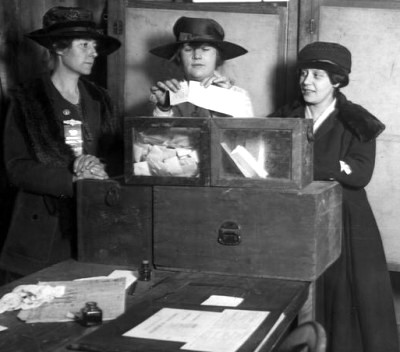
WHY EVERY WOMAN SHOULD VOTE
This is the story of our Grandmothers, and Great-grandmothers, as they
lived only 90 years ago. It was not until 1920 that women were granted
the right to go to the polls and vote.
Thus unfolded the ‘Night of Terror’ on Nov. 15, 1917, when the warden at
the Occoquan Workhouse in Virginia ordered his guards to teach a lesson
to the suffragists imprisoned there because they dared to picket Woodrow
Wilson’s White House for the right to vote. The women were innocent and
defenseless. And by the end of the night they were barely alive. Forty
prison guards wielding clubs and their warden’s blessing went on a
rampage against the 33 women wrongly convicted of ‘obstructing sidewalk
traffic.’
They beat Lucy Burn, chained her hands to the cell bars above her head
and left her hanging for the night, bleeding and gasping for air. They
hurled Dora Lewis into a dark cell, smashed her head against an iron bed
and knocked her out cold. Her cell mate, Alice Cosu, thought Lewis was
dead and suffered a heart attack. Additional affidavits describe the
guards grabbing, dragging, beating, choking, slamming, pinching,
twisting and kicking the women.
For weeks, the women’s only water came from an open pail. Their
food–all of it colorless slop–was infested with worms. When one of the
leaders, Alice Paul, embarked on a hunger strike, they tied her to a
chair, forced a tube down her throat and poured liquid into her until
she vomited. She was tortured like this for weeks until word was
smuggled out to the press.
So, refresh my memory. Some women won’t vote this year because–why,
exactly? We have carpool duties? We have to get to work? Our vote
doesn’t matter? It’s raining?
Last week, I went to a sparsely attended screening of HBO’s new movie
‘Iron Jawed Angels.’ It is a graphic depiction of the battle these women
waged so that I could pull the curtain at the polling booth and have my
say. I am ashamed to say I needed the reminder.
All these years later, voter registration is still my passion. But the
actual act of voting had become less personal for me, more rote.
Frankly, voting often felt more like an obligation than a privilege.
Sometimes it was inconvenient.
My friend Wendy, who is my age and studied women’s history, saw the HBO
movie , too. When she stopped by my desk to talk about it, she looked
angry. She was–with herself. ‘One thought kept coming back to me as I
watched that movie,’ she said. ‘What would those women think of the way
I use–or don’t use–my right to vote? All of us take it for granted
now, not just younger women, but those of us who did seek to learn.’ The
right to vote, she said, had become valuable to her ‘all over again.’
HBO released the movie on video and DVD. I wish all history, social
studies and government teachers would include the movie in their
curriculum. I want it shown on Bunco night, too, and anywhere else women
gather. I realize this isn’t our usual idea of socializing, but we are
not voting in the numbers that we should be, and I think a little shock
therapy is in order.
It is jarring to watch Woodrow Wilson and his cronies try to persuade a
psychiatrist to declare Alice Paul insane so that she could be
permanently institutionalized. And it is inspiring to watch the doctor
refuse. Alice Paul was strong, he said, and brave. That didn’t make her
crazy. The doctor admonished the men: ‘Courage in women is often
mistaken for insanity.’
Please, if you are so inclined, pass this on to all the women you know.
We need to get out and vote and use this right that was fought so hard
for by these very courageous women. Whether you vote democratic,
republican or independent party – remember to vote.
History is being made.
Libyans Say “Sorry” In Counter-Protests
I was living in Qatar, and the Libyan ambassador’s wife had invited me, along with several other women, to morning coffee. It’s what people did. I was sitting between one of my Libyan friends and my good Iranian friend, and I started laughing. I said “Oh, what is this good little American girl doing sitting between a Libyan and an Iranian?” and then we all laughed. We weren’t Libyan, or American, or Iranian, we were just women who liked each other; we got along.
We were all religious women. Not the same religion, but all believers in the Abrahamic tradition. I felt more comfortable with them than I felt around non-religious women. We had a lot of fun together, and we liked each other.

It breaks my heart when bad things happen, and I know how good these people are, and that the people on the attack have their own agenda which has nothing to do with Islam, or Christianity, and everything to do with power. If they prevail, I fear for my good friends.
This article from USA Today made me cry this morning. Ambassador Stevens was loved, and these brave people are risking their futures to tell us so.
Libyans express sorrow over killing of Americans
by Donna Leinwand Leger, USA TODAY
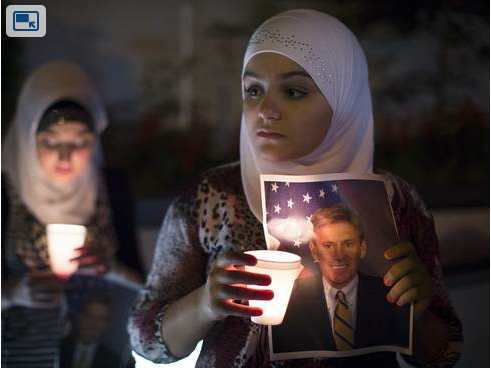
Hours after learning of Ambassador Chris Stevens’ death, the Libyan Youth Movement transformed its Facebook page into a tribute to the slain diplomat. It changed its cover photo from “Free Libya” graffiti sprayed on a Tripoli wall to a somber photo of Stevens with the tag “RIP Christopher Stevens1960-2012.”
“As North America wakes up, dread washes over me. What a rough night. I’m sorry for the horrible day the world is about to face,” the administrator of the Shabab Libya page wrote. “We are sorry.”
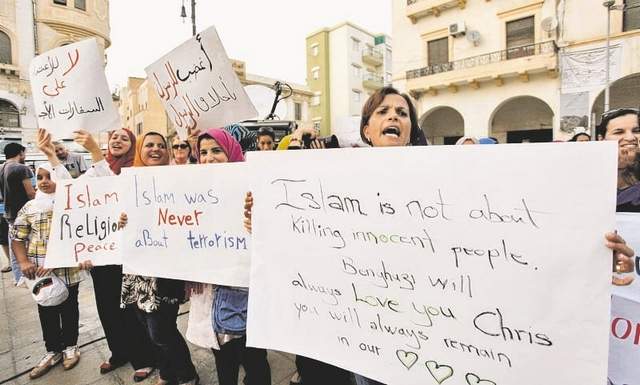
As anti-American protests swept across North Africa and the Persian Gulf, a counter-protest of apology emerged. Photos of Libyans carrying hand-lettered signs condemning the violence and expressing contrition for their countrymen appeared on Facebook. “Sorry” became the trending mantra of Libyans on Twitter.
At one counter-protest, an unidentified man carried a crude sign phonetically written in English with blue marker on lined notebook paper, “Sorry People of America this not the Pehavior of our ISLAM and Profit.”
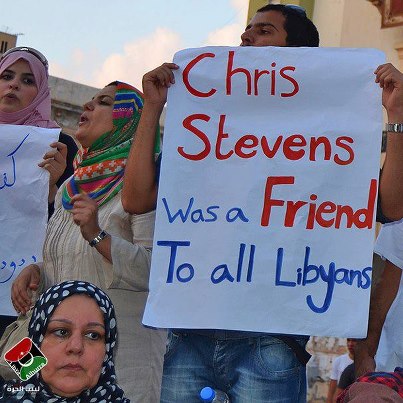
Another sign in red, white and blue read: “Chris Stevens wasa friend to all Libyans.”
On Facebook, one group formed The Sorry Project, designed to collect thousands of personal, written apologies from Libyans. Its profile photo is a man holding a sign, “USA. We are sorry. We are sad.”
“We Are Sorry,” the group wrote on the page created Sept.11. “We would like show that as Libyans we do not support on the actions committed by these criminals. USA, we are sorry and we will say it one thousand times over. Our apologies will never be enough, but the Libyan people will always be grateful for you since you were the first to stand by us in our fight for freedom and hopefully you will continue supporting us.”
One commenter, Hajer Sharief, vowed to avenge Stevens’ death by rebuilding a “new civilized democratic Libya.”
“We promise, we will not tire, we will not falter, and we will not fail,” Sharief wrote. “This is the way real Libyans will pay you back Mr. Ambassador Chris Stevens.”
At the ceremony Friday outside Washington to repatriate the remains of the four American victims, President Obama acknowledged Libya’s internal conflict.
“I know that this awful loss, the terrible images of recent days, the pictures we’re seeing again today, have caused some to question this work. And there is no doubt these are difficult days. In moments such as this — so much anger and violence — even the most hopeful among us must wonder,” Obama said. “But amid all of the images of this week, I also think of the Libyans who took to the streets with homemade signs expressing their gratitude to an American who believed in what we could achieve together. I think of the man in Benghazi with his sign in English, a message he wanted all of us to hear that said, ‘Chris Stevens was a friend to all Libyans.’ “
How One Church Handles Cell Phone Interruptions
LLLOOOOOLLLLLLL! A church with a sense of humor! Thank you, Kit Kat!
US Ambassador Killed by Angry Mob in Libya
Most people who die heroic deaths don’t wake up in the morning thinking “today I will do something heroic.” Most people who die heroic deaths end up dead because they make a choice to do the right thing.
Some minor film maker made a film mocking the prophet Mohammed. Under our system, it was his right; a man (or woman) can say what they think, even if another disagrees with it. It doesn’t mean the film is accurate, it doesn’t make it a good film; he had an idea and he made a film. The film – or even the idea of the film – is causing outrage, and attacks on US Embassies in Islamic countries. Ambassador Chris Stevens personally went to the consulate site to make sure his people got out safely while the consulate was under attack by an angry mob. He lost his life in the effort. May he rest in peace.
I’ve never liked crowds, and even less when a crowd is excited, or angry, and becomes a mob. There is something about doing things as a large group that anesthetizes thinking; mobs do horrendous things that any one individual acting within the mob would never do. Group-think is dangerous thinking; you need disagreement and dissent to rein in rash actions.
From today’s Huffpost:
TRIPOLI, Libya — The U.S. ambassador to Libya and three American members of his staff were killed in the attack on the U.S. consulate in the eastern city of Benghazi by protesters angry over a film that ridiculed Islam’s Prophet Muhammad, Libyan officials said Wednesday.
They said Ambassador Chris Stevens was killed Tuesday night when he and a group of embassy employees went to the consulate to try to evacuate staff as the building came under attack by a mob guns and rocket propelled grenades.
The three Libyan officials who confirmed the deaths were deputy interior minister for eastern Libya Wanis al-Sharaf; Benghazi security chief Abdel-Basit Haroun; and Benghazi city council and security official Ahmed Bousinia.
The State Department said Tuesday that one American was killed in the attack. It has not confirmed the other deaths.
The attack on the Benghazi consulate took place as hundreds of protesters in neighboring Egypt scaled the walls of the U.S. Embassy in Cairo and tore down and replaced the American flag with a black Islamic banner.
The attacks in Benghazi and Cairo were the first such assaults on U.S. diplomatic facilities in either country, at a time when both Libya and Egypt are struggling to overcome the turmoil following the ouster of their longtime authoritarian leaders, Moammar Gadhafi and Hosni Mubarak, in uprisings last year.
The protests in both countries were sparked by outrage over a film ridiculing Muhammad produced by an Israeli filmmaker living in California and being promoted by an extreme anti-Muslim Egyptian Christian campaigner in the United States. Excerpts from the film dubbed into Arabic were posted on YouTube.
Stevens, 52, was a career diplomat who spoke Arabic and French and had already served two tours in Libya, including running the office in Benghazi during the revolt against Gadhafi. He was confirmed as ambassador to Libya by the Senate earlier this year.
Before Tuesday, five U.S. ambassadors had been killed in the line of duty, the last being Adolph Dubs in Afghanistan in 1979, according to the State Department historian’s office.
___
Michael reported from Cairo. Associated Press writer Matthew Lee in Washington contributed to this report.
Ten Shot While Kuwaiti Youngsters Are ‘Just Having Fun’
As AdventureMan and I read the Pensacola News Journal, we often wonder if we knew what we were getting into. Shootings in Pensacola are frequent. Killings, by gun, by beating, by knife – are equally frequent. Pensacola has one of the highest violent death rates per capita in the nation. Just this week a 72 year old man shot a preacher at his church because he thought the preacher was having an affair with his 69 year old wife. He then tried to enter the child care center where she was caring for small children, still with his loaded weapon. The paper quotes his wife as saying he has mental health issues.
What are people with mental health issues doing with loaded guns???
My Southern friends ask me if we more strictly regulate guns, how will they protect themselves, that the ‘bad guys’ will still have guns. Right now, they can protect themselves, they also have the right to shoot to defend their property? I can’t answer. All I know for sure is that the more people who carry guns, the more likely guns are to be used when the instinct strikes, whether it is a real threat or a perceived threat.
And then – there are these Kuwaiti teens, shooting passers-by, and when arrested, still carrying the shotgun used, say that they were ‘just having fun.’
KUWAIT: Jahra detectives, in cooperation with criminal investigation detectives, have arrested two Kuwaiti 17-year-old juveniles on charges of misuse of a hunting gun, which resulted in the shooting and wounding of 10 people in Jahra area. Police received several reports of pedestrians being wounded after they were shot by unknown assailants. Following an investigation, the juveniles were arrested with the gun still in their possession. They confessed to the shootings, claiming they were only having a good time. The teens were sent to concerned authorities. Later, Ministry of Interior officials called upon citizens and expatriates to watch their children and prevent them from behaving in ways that might cause harm to others, as the parents could be held liable for their children’s acts.
By Hanan Al-Saadoun, Staff Writer
Kuwait Times
The link refers to ‘hunting gun misuse.’ Because they are Kuwaiti, and because they are young, they are unlikely to have any severe punishment. They are likely to be released into the custody of their parents. Where were these parents when their children wounded ten innocent people? What lesson do these young men, 17 years old, learn if they can shoot ten people and be charged with ‘misuse’ of a weapon?
The only good thing I can think of in this case is that these youngsters had so little self-discipline that they never learned to shoot straight, thus no one was killed. They weren’t just lacking in any compassion for their fellow human beings, they were also bad shots. (I’m from a hunting culture. That’s an insult.)
That Cheeky Woman At The Well
Today’s Gospel reading from the Lectionary is one of my favorites, and every time I read it, I am amazed. Amazed that this good Jewish boy would speak to a woman who cavorted with men, having five husbands, and being with a man now who was not her husband. It’s the middle of the day, and he is sitting by a well having a conversation with a woman most good Jewish boys would run from, a woman of ill-repute!

She must have had a rough life, five husbands, etc. but it hasn’t broken her spirit, and she is joking around with Jesus. She knows something about Jewish traditions, but has no idea who Jesus might be. Then, oddity of oddity, he reveals himself to her as the Messiah – to this woman. He reveals himself to a woman at the very lowest end of the social scale, a woman barely tolerated in her own society. This woman believes him; for all her sins, she ‘hears’ the truth of what he is saying in her heart.
John 4:1-26
4Now when Jesus* learned that the Pharisees had heard, ‘Jesus is making and baptizing more disciples than John’— 2 although it was not Jesus himself but his disciples who baptized— 3he left Judea and started back to Galilee. 4But he had to go through Samaria. 5So he came to a Samaritan city called Sychar, near the plot of ground that Jacob had given to his son Joseph. 6Jacob’s well was there, and Jesus, tired out by his journey, was sitting by the well. It was about noon.
7 A Samaritan woman came to draw water, and Jesus said to her, ‘Give me a drink’. 8(His disciples had gone to the city to buy food.) 9The Samaritan woman said to him, ‘How is it that you, a Jew, ask a drink of me, a woman of Samaria?’ (Jews do not share things in common with Samaritans.)* 10Jesus answered her, ‘If you knew the gift of God, and who it is that is saying to you, “Give me a drink”, you would have asked him, and he would have given you living water.’ 11The woman said to him, ‘Sir, you have no bucket, and the well is deep. Where do you get that living water? 12Are you greater than our ancestor Jacob, who gave us the well, and with his sons and his flocks drank from it?’
13Jesus said to her, ‘Everyone who drinks of this water will be thirsty again, 14but those who drink of the water that I will give them will never be thirsty. The water that I will give will become in them a spring of water gushing up to eternal life.’ 15 The woman said to him, ‘Sir, give me this water, so that I may never be thirsty or have to keep coming here to draw water.’
16 Jesus said to her, ‘Go, call your husband, and come back.’ 17The woman answered him, ‘I have no husband.’ Jesus said to her, ‘You are right in saying, “I have no husband”; 18for you have had five husbands, and the one you have now is not your husband. What you have said is true!’ 19The woman said to him, ‘Sir, I see that you are a prophet. 20Our ancestors worshipped on this mountain, but you* say that the place where people must worship is in Jerusalem.’
21 Jesus said to her, ‘Woman, believe me, the hour is coming when you will worship the Father neither on this mountain nor in Jerusalem. 22You worship what you do not know; we worship what we know, for salvation is from the Jews. 23But the hour is coming, and is now here, when the true worshippers will worship the Father in spirit and truth, for the Father seeks such as these to worship him. 24God is spirit, and those who worship him must worship in spirit and truth.’ 25The woman said to him, ‘I know that Messiah is coming’ (who is called Christ). ‘When he comes, he will proclaim all things to us.’ 26Jesus said to her, ‘I am he,* the one who is speaking to you.’

“Baba, You Are A Terrible Driver!”
Our tiny terror, the Happy Toddler, is at that developmental stage where he says “No” even if it is something he wants to do, he says he doesn’t like things he loves and he is just compelled to be contrary. It is exasperating, and it is also hilarious.
Yesterday he dropped his favorite train as he and AdventureMan were on the long bridge en route back to the beach, and yelled for “Baba” to help him with his train.
“I can’t stop now; we’re on a bridge!” AdventureMan explained.
“I want a red light! I want a red light!” the Screeching Toddler shouted, knowing that red lights mean stop, and that a stop would mean his Baba might reach the train and return it to him.
“We’re on a bridge! There are no red lights!” AdventureMan explained again.
“Baba, you are a terrible driver!” Angry Toddler said.
When they finally reached a red light and AdventureMan rescued the train and restored it to the Terrible Two and a Half Toddler, everything was right again.
“Am I still a terrible driver?” AdventureMan asked him.
“No Baba, you are a GOOD driver!” the Happy Toddler grinned.
Spy the Lie on the Diane Rehm Show

Thursday, July 24th, Diane Rehm had another wonderful show. Diane Rehm has a gift for asking thoughtful questions, listening carefully, and then following up with another thoughtful question. She treats her guests with great civility, but she never hesitates to ask the tough question.
Thursday, she interviewed Senator Marco Rubio, who did pretty well until she started asking him the tough, revealing questions, and you could actually hear him squirm.
Far more interesting than Senator Rubio was her interview with former CIA employees Philip Houston and Michael Floyd, discussing their new book Spy the Lie. We’ve all heard different ways liars give themselves away, but these two former interrogators told us how to ask questions, and a “cocktail” of responses – not one response, eyes shifting away, but a variety together – which tell you that you are being lied to.
Deflection, change of voice tone, swearing to God, anger at being asked – these and other giveaways work together. Bottom line – if your instincts are screaming “Lie! Lie!” then chances are good you are being lied to.
The truth is, most of us know when we are being lied to. There are times the liar will never admit to it, but you have to work with the knowledge that what he or she is saying is a lie. At least you know. You don’t have to buy into the lie. And you know my position – lying hurts the liar most of all.
James Lee Burke and the Creole Belle
James Lee Burke is number one on my guilty-pleasures list.

I first met his main character Dave Robicheaux in A Morning For Flamingos, a book I picked up in a military library at Lindsay Air Station, a post that doesn’t even exist any more. In the cold dark endless winter in Wiesbaden, Germany, James Lee Burke lit up my life. I had thought I was picking up just another escapist mystery novel, but when James Lee Burke puts words together to describe the way a storm moves in over the bayou, prose becomes poetry.
There is a downside. Whether it is his character Dave Robicheaux, the former New Orleans cop, now head homicide investigator in New Iberia, Louisiana, or his Hackberry Holland series set in West Texas, James Lee Burke’s books are filled with extreme violence and disturbing images that live in your head for a long time.
I’ve recommended James Lee Burke to friends, some of whom have said “Why do you read this trash??? It is HORRIBLE! It is full of over-the-top violence!”
And then again . . . he is writing about some really really bad people. They are out there. There are people who exist who inflict cruelty. I don’t understand it, I can’t begin to fathom where the urge would come from, but I’ve seen it. It’s out there. James Lee Burke pulls up that rock and exposes the dark happenings underneath.
On one level, as I started reading Creole Belle, I thought “Oh James Lee Burke, stop! Stop! It’s the same old formula! A downtrodden victim (often a beautiful woman) cries for help. You and Clete start looking for information and end up beating people up and then they retaliate by threatening your family! There is a rich, beautiful woman who seems vulnerable and who you kind of like, but she is complicated. There are rich amoral people who keep their hands clean, but who are calling the shots and never go to jail! Stop! Stop!”
Well, I should say that, and maybe I should stop. Then he starts talking about the smoke from the sugar cane fields and the bridge over the Bayou Teche, and the big Evangeline oak in St. Martinsville, and I am a goner. I’m sucked in, I’m hooked.
I detest the violence and the images. I keep coming back because James Lee Burke has some important things to say.
I’d love to have him to dinner. I’d love for him and our son to have a chance to talk about Law Enforcement. Here is what James Lee Burke has to say in Creole Bell:
There are three essential truths about law enforcement: Most crimes are not punished; most crimes are not solved through the use of forensic evidence; and informants product the lion’s share of information that puts the bad guys in a cage.
My son hates shows like CSI, and Law and Order, where the evidence convicts the criminals. He says it raises unreal expectations in juries, and makes it harder to get a conviction.
We watched a Violation of Parole hearing, or actually a series of hearings, where the judge asked each individual whose parole was about to be revoked what had happened when he or she was re-arrested. In each case, the parolee had done something stupid; drove a car with an expired license, drove to another state, was arrested driving drunk, etc. EVERY time. The judge made his point, I believe.
From Creole Belle:
But if Caruso was the pro Clete thought she was, she would avoid the mistakes and geographical settings common to the army of miscreants and dysfunctional individuals who constitute the criminal subculture of the United States. Few perpetrators are arrested during the commission of their crimes. They get pulled over for DWI, an expired license tag, or throwing litter on the street. They get busted in barroom beefs, prostitution stings, or fighting with a minimum-wage employee at a roach motel. Their addictions and compulsions govern their lives and place them in predictable circumstances and situations over and over, because they are incapable of changing who and what they are. Their level of stupidity is a source of humor at every stationhouse in the country. Unfortunately, the pros – high end safecrackers and jewel thieves and mobbed-up button men and second story creeps – are usually intelligent, pathological, skilled in what they do, middle class in their tastes and little different in dress and speech and behavior from the rest of us.
And then there are paragraphs like this that discuss the human experience, and have a far wider application than the book:
No one likes to be afraid. Fear is the enemy of love and faith and robs us of all serenity. It steals both our sleep and our sunrise and makes us treacherous and venal and dishonorble. It fills our glands with toxins and effaces our identity and gives flight to any vestige of self-respect. If you have ever been afraid, truly afraid, in a way that makes your hair soggy with sweat and turns your skin gray and fouls your blood and spiritually eviscerates you to the point where you cannot pray lest your prayers be a concesion to your conviction that you’re about to die, you know what I am talking about. This kind of fear has no remedy except motion, no matter what kind. Every person who has experienced war or natural ctastrophe or man-made calamity knows this. The adrenaline surge is so great that you can pick up an automobile with your bare hands, plunge through glass windows in flaming buildings, or attack an enemy whose numbers and weaponry are far superior to yours. No fear of self-injury is as great as the fear that turns your insides to gelatin and shrivels your soul to the size of an amoeba.
Last, but not least, this is what keeps me coming back to James Lee Burke, so much so that I buy the book almost as soon as it is released. James Lee Burke isn’t afraid to take on the big guys. He “gives voice to those who have no voices.” (Proverbs 31:8) His focus is always on the dignity of the common man, the dignity of hard work, done well, and on the dignity of doing unexpected kindnesses to those who have no expectation of kindness.
. . . All was not right with the world. Giant tentacles of oil that had the color and sheen of feces had spread all the way to Florida, and the argument that biodegradation would take care of the problem would be a hard sell with the locals. The photographs of pelicans and egrets and seagulls encased in sludge, their eyes barely visible, wounded the heart and caused parents to shield their children’s eyes. The testimony before congressional committees by Louisiana fisher-people whose way of life was being destroyed did not help matters, either. The oil company responsible for the blowout had spent an estimated $50 million trying to wipe their fingerprints off Louisiana’s wetlands. They hired black people and whites with hush-puppy accents to be their spokesmen on television. The company’s CEO’s tried their best to look ernest and humanitarian, even though the company’s safety record was the worst of any extractive industry doing business in the United States. They also had a way of chartering their offshore enterprises under the flag of countries like Panama. Their record of geopolitical intrigue went all the way back to the installation of the shah of Iran in the 1950’s. Their even bigger problem was an inability to shut their mouths.
They gave misleading information to the media and the government about the volume of oil escaping from the blown well, and made statements on worldwide television about wanting their lives back and the modest impact that millions of gallons of crude would have on the Gulf Coast. For the media, their tone-deafnessness was a gift from a divine hand. Central casting couild not have provided a more inept bunch of villains.
James Lee Burke has a voice, and he uses it. He could just cash in on his reputation as an Edgar Award winning author, but he uses his voice to speak out against injustice and corruption. He is a champion of the people. I’ve written several book reviews, and taken some trips just because I wanted to see James Lee Burke country; if you are interested in those, you can read them here.
I have a concern about this series, in that this book ended differently than all the others. So differently it made me seriously question whether Burke intends to continue writing about Dave Robicheaux or if Dave is about to hang up his shield and call it a day. He’s a guilty pleasure I am not yet ready to give up.
Recent Comments
ExpatAlien on What Country am I Living … intlxpatr on Yellowstone: Old Faithful to C… Michelle on Yellowstone: Old Faithful to C… Cathy on No Grown-Ups in Charge intlxpatr on Waiting for Snow Wikipedia Donate Button

Amazina


Early Voting in Florida


 Here There and Everywhere