Absolute Favorite, in Mancos, Colorado

Every now and then pure unexpected magic happens, a blessing, pure grace. Every now and then you make a stop and all the right things happen.
We had not enjoyed our breakfast the previous morning at the Far View Lodge, so we decided to get on the road early, and find a place to eat on the road. We were up and out by seven, and it took about half an hour just to get off the mesa and down to the main road. Once we hit the main road, we start looking for a good place to stop.
We see a sign: The Absolute Bakery in Mancos, Colorado, just turn right at the next stop light.
We turn right. We find the bakery, which looks cute from the outside:

And then we found a place to park, in front of a Hat-Maker’s Shop guarded by a beautiful long-haired cat. For me, the magic has already started. Did you even know of a hat maker anymore? I thought they had all disappeared:
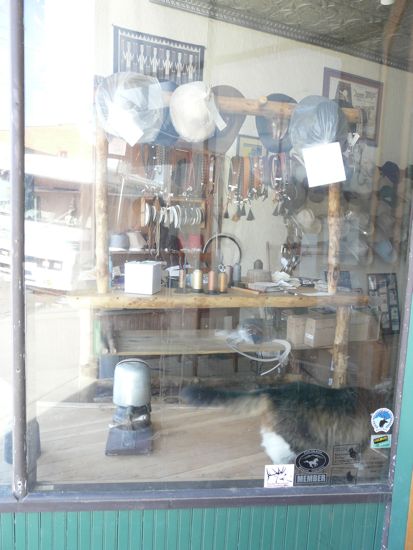
As we walked into the Absolute Bakery, we were enticed with smells, the odor of break baking with cinnamon, the fragrance of freshly brewed coffee, bacon frying . . . and inside, it is homey, and welcoming, and you are warmly welcomed, and we just feel so glad to be there on this sunny morning when we have so far to drive . . .


The breakfast menu has so many good things, you don’t know what to order.

AdventureMan chose the VegHead Stack, which was totally wonderful:

And I chose the Absolute Breakfast special with Chorizo – total YUMMMMM:
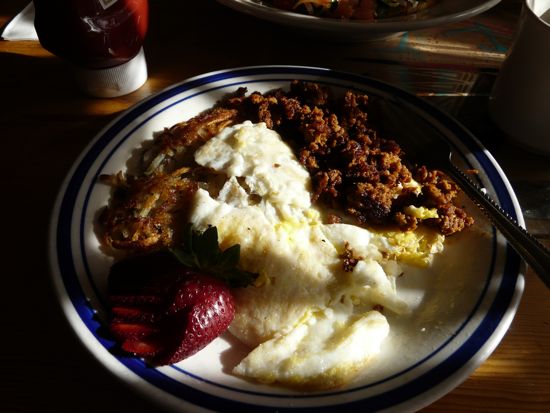
The breakfasts are delicious, and as we eat, the bakery fills up, travelers, locals, families . . . it has the feel of a place we would like to live, a community, people who know each other.
You know how it is sometimes when you have so much to do, and you really need to get started? As we paid for our breakfast, instead of getting on the road, we dawdled. We picked out cookies for the road – I had the most huge delicious macaroon I have ever had, just a bite now and then, and it lasted all the way to Amarillo. We got to talking with travelers headed the direction we had come from, just strangers crossing paths, but it was a great conversation, and we hated to pull ourselves away, to get back to the serious business of driving.
Lunch was OK. It was BBQ, but someone forgot our order, so we lost some time:

To add insult to injury, not only is it a long day on the road, but we also loose an hour, so we get in even an hour later than we would have. As we near the border, I am watching my phone to see if I can see the change, but it happened about six miles before the border and I missed it. AdventureMan’s on the same system, but his phone changed a little later.
The morning drive was mostly through the Navajo nation and backroads, full of ranches and horses and some drama. The afternoon, on Interstate 40, was just boring, with an occasional moment of hilarity:

What can you imagine would use a tire that big?
We have reservations in Amarillo, and by the grace of God, our hotel is just off the highway, and my little iPhone tells us exactly how to get there. We hit the pool, and get some exercise. We split the last apple and some trail mix for dinner – we are still full from breakfast at the Absolute Bakery!
The 700 Years Tour at Mesa Verde
Early early in the morning we are up and ready to grab a bite of breakfast at the Far View Lodge and to take the 700 years tour. When we called for reservations at the Far View Lodge, the desk clerk asked if we would like to sign up for the 700 Years of Culture tour, and since Sparkle had told us that the tours fill up early, we signed up.
The light in Mesa Verde is beautiful at eight in the morning, and we were shocked when thirty-something people around our age (I guess we are all out exploring America!) got on the bus. Somehow, for $45, I had thought it would be a tour of five to seven people. I didn’t think so many people would pay so much for a tour!
The guide, Dave, and the bus driver, Leiter, were both local men, living in Cortez, men who double as guides a couple days a week to liven up their retirement. Dave’s depth of knowledge and investigative spirit was impressive; clearly he has a passion for the Ancestral Puebloans, and reads everything he can get his hands on. He has read all the latest studies and speculation, and as a farming man, he had some of his own down-to-earth speculations which he shared with us. It was all good stuff.
First, we went to look at early pit dwellings:
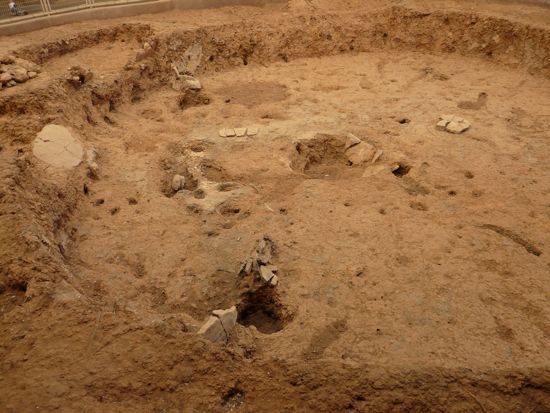
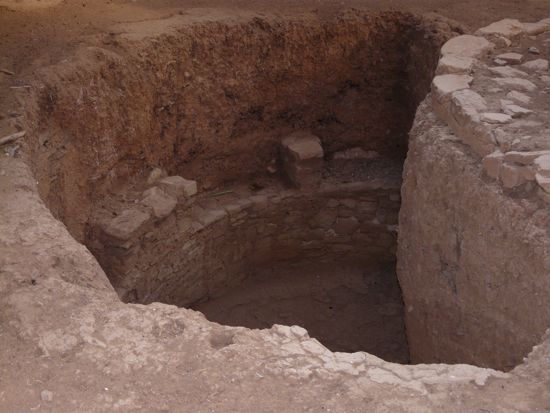
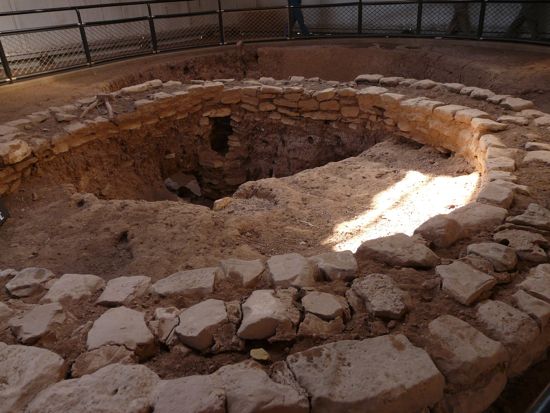
And then we headed off to visit some of the more and less famous cliff dwellings:

Does this remind you of anything? (Hint: see previous post)
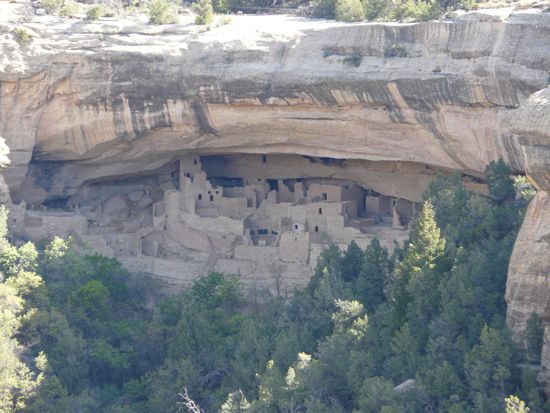
Look at the terrain – so similar to other places where similar dwellings have evolved . . . (Hint Hint: Les Eyzies de Tayak) There are cliff dwellings in almost every conceivable concavity.
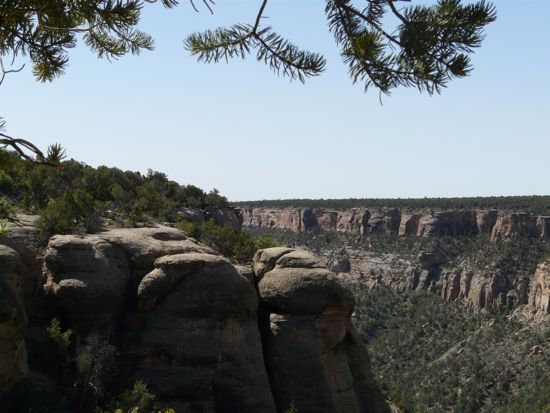
From pit dwellings to small family dwellings, to multiple family dwellings, small villages . . .
This is the Cliff Palace, a multiple family dwelling:


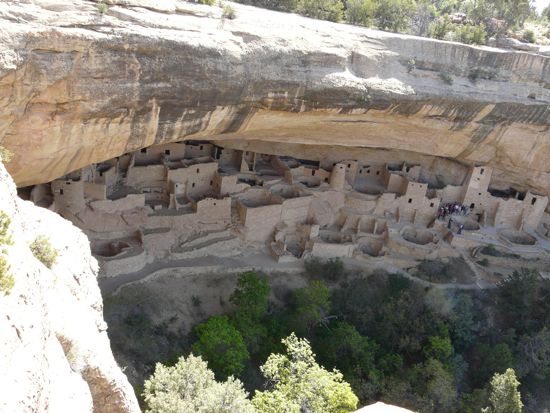
And then, the old legend goes, they just disappeared . . . or did they? Dave, the guide, tells us that the Apaches and Navajos won’t come any where near the Mesa, that the mesa is full of old spirits, not their spirits. The Hopi, however, a little further South, have no fear; the customs and dwellings of the Ancient Puebloans are familiar to them.
It’s kind of like conspiracy theories. We all love a good scary story.
“And then, they all just disappeared!”
But Dave thinks they didn’t disappear, that maybe they just moved on. Maybe too many years of drought, or maybe the soil they were farming gave out. Maybe they heard life was easier a few miles down the road and just picked up and moved a little on down the road . . . which seems to me to be a more logical, if less romantic, possibility.
Anyway, one of the things I really liked was that these ancient peoples, whoever they were, built their dwellings in locations and styles similar to the pre-France people of . . .umm . . . err. . . France.
I need to add a footnote here. This doesn’t happen to everybody, but it happened to me. Once I got to Grand Canyon, activities that I normally do without batting an eye began to be harder. I am a walker and a hiker, but any time I had to hike uphill in the Grand Canyon, I was huffing and puffing like a geezer. “Oh no! Oh no!” I was thinking to myself, “I must have some terrible respiratory condition! I’m suddenly getting old!”
Not so. As it turns out, I am just sensitive to high altitude. I should have known. I drove through Colorado once, and my eyes turned bright red, tiny little capillaries in my eyes burst.
At 8000 feet, in Mesa Verde, I could function, but sometimes found myself huffing and puffing. As soon as we descended a couple thousand feet, I was fine. Leiter, the bus driver, told me that many athletic teams train at high altitude so that when they perform, at a lower altitude, they will exceed themselves. It is such a relief to be able to move fast now, and not puff. I always took it for granted before. Not now.
The Magic of Back Roads – En Route to Albuquerque
I love interstate driving, it gets the job done. We love having all that room and zooming down a highway, especially if the highway is empty. We were born to drive.
I also love the backroads, and the USA has some great backroads. Today is almost all backroad, and oh, what a fun driving day it is.

Leaving Roswell, New Mexico, we take a route to Albuquerque through cattle country, and through Billy-the-Kid country, and Smokey-the-Bear country. We come across a giant lava flow, it goes on for miles, with vegetation finding a way to survive – even thrive – in the formerly molten rock:

We find a restaurant with old Homer Simpson in front:

When we were kids, everyone knew the song about Smokey the Bear:
And along this road, we went through Smokey the Bear’s home town!

We merge onto the interstate into Albuquerque, and this time, I successfully call a real Fairfield Inn and find a room for the night.
Now I rarely do this. If there is a place we eat and don’t like it, I just won’t say anything. This time I will say something, because this place, The Quarters, is listed in the Marriott recommended list of nearby restaurants. Hey, and it’s barbecue.
We found it, there aren’t a lot of restaurants around, and this sign was about 2 feet by 3 feet:


Less than a BBQ restaurant, it is very much a lounge, and as soon as you walk in you see men sitting alone at the bar, looking like they’ve been planted there for a century. There isn’t a lot of jolly conversation, just men silently drinking.
There is a separate area for dining, and I will say this, the servers are doing their best to make the best of a bad situation. The dining area has a mixture of bar mirrors and old quilts hanging. We ordered from the menu, and when my BBQ Turkey came, it was like Publix sliced turkey, the kind you buy in a package, on a normal hamburger bun. Their BBQ sauce was good, but this sandwich – it was like you would throw together with scraps you had left over in your own kitchen.
The Quarters has seen better days. It is dingy. The furniture is in bad repair. The carpets are in bad need of cleaning. And it’s Albuquerque – I am sure there are better places to eat. Don’t go there.
Happy Easter
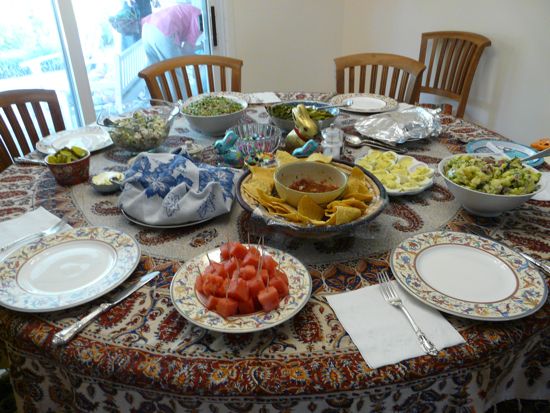
While an Easter Church service can get a bit long for a toddler (“No baby church! Big church!”), learning to hunt for eggs is just pure delight. We had Easter dinner and an egg hunt and then our little Happy Toddler spent the night. He has his own room, his own bed – and he slept through the entire night! Woo HOOOO!

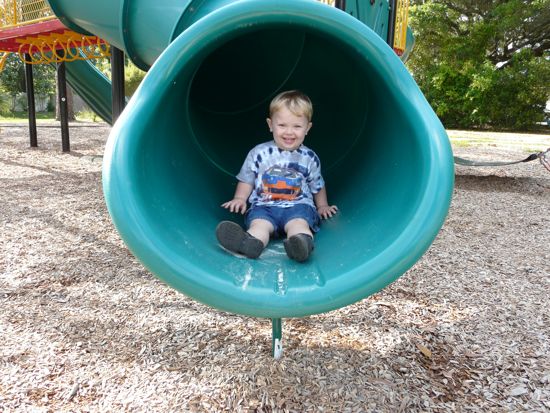
We have a nearby park that he just loves! Who wouldn’t? When you are two years old, and love to run, all the world is your playground!



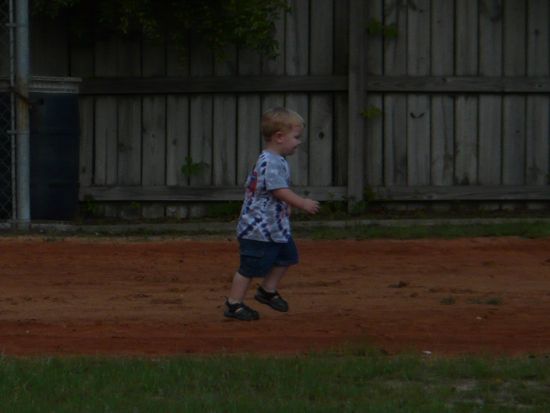
The Winner!
You’d think, now that we are ‘retired’ that we would have a lot of time, but we have plugged in to our community, and we are busy and scheduled! Before I left for Seattle, I was preparing for, and then helping with the Pensacola Quilt Show, held only every two years.
It was a lot of fun. Pensacola has amazing quilters, people who hand-piece and hand quilt, people who are amazingly skilled at machine quilting, and I am honored to know some of them, and delighted when I get a chance to work alongside them.
Whether or not I had won a ribbon, I would be honored just hanging my quilts in the same room with these talented women. Nevertheless, I did win an honorable mention in the theme quilt catagory, which was Snail’s Trail. I am only telling you this because I want to show you the ribbon, which is whimisical, clever and delightful:

I smile every time I look at it.
In addition, I won one of the offerings at the Chinese Auction. I have seen these auctions run different ways, but in this one, you get 25 chances for $5, and I put all my chances in the jar for these fabrics, I wanted them so badly. I took a class from the lady who made them, and I love the work she does. Winning this is like winning a pot of gold for a quilter 🙂

When I look at these fabrics, I am ready to start quilting again!
Rape Victim Commits Suicide After Being Forced to Marry Rapist
Aon AOL-Huffpost:
Amina Filali, Morocco Rape Victim, Commits Suicide After Forced Marriage To Rapist
By PAUL SCHEMM
RABAT, Morocco — The case of a 16-year-old girl who killed herself after she was forced to marry her rapist has spurred outrage among Morocco’s internet activists and calls for changes to the country’s laws.
An online petition, a Facebook page and countless tweets expressed horror over the suicide of Amina Filali, who swallowed rat poison on Saturday to protest her marriage to the man who raped her a year earlier.
Article 475 of the Moroccan penal code allows for the “kidnapper” of a minor to marry his victim to escape prosecution, and it has been used to justify a traditional practice of making a rapist marry his victim to preserve the honor of the woman’s family.
“Amina, 16, was triply violated, by her rapist, by tradition and by Article 475 of the Moroccan law,” tweeted activist Abadila Maaelaynine.
Abdelaziz Nouaydi, who runs the Adala Assocation for legal reform, said a judge can recommend marriage only in the case of agreement by the victim and both families.
“It is not something that happens a great deal – it is very rare,” he said, but admitted that the family of the victim sometimes agrees out of fear that she won’t be able to find a husband if it is known she was raped.
The marriage is then pushed on the victim by the families to avoid scandal, said Fouzia Assouli, president of Democratic League for Women’s Rights.
“It is unfortunately a recurring phenomenon,” she said.”We have been asking for years for the cancellation of Article 475 of the penal code which allows the rapist to escape justice.”
The victim’s father said in an interview with an online Moroccan newspaper that it was the court officials who suggested from the beginning the marriage option when they reported the rape.
“The prosecutor advised my daughter to marry, he said ‘go and make the marriage contract,'” said Lahcen Filali in an interview that appeared on goud.ma Tuesday night.
In many societies, the loss of a woman’s virginity outside of wedlock is a huge stain of honor on the family.
In many parts of the Middle East, there is a tradition whereby a rapist can escape prosecution if he marries his victim, thereby restoring her honor. There is a similar injunction in the Old Testament’s Book of Deuteronomy
Morocco updated its family code in 2004 in a landmark improvement of the situation of women, but activists say there’s still room for improvement.
In cases of rape, the burden of proof is often on the victim and if she can’t prove she was attacked, a woman risks being prosecuted for debauchery.
“In Morocco, the law protects public morality but not the individual,” said Assouli, adding that legislation outlawing all forms of violence against women, including rape within marriage, has been stuck in the government since 2006.
According to the father’s interview, the girl was accosted on the street and raped when she was 15, but it was two months before she told her parents.
He said the court pushed the marriage, even though the perpetrator initially refused. He only consented when faced with prosecution. The penalty for rape is between five and 10 years in prison, but rises to 10 to 20 in the case of a minor.
Filali said Amina complained to her mother that her husband was beating her repeatedly during the five months of marriage but that her mother counseled patience.
A Facebook page called “We are all Amina Filali” has been formed and an online petition calling for Morocco to end the practice of marrying rapists and their victims has already gathered more than 1,000 signatures.
Stop Kony 2012
I love this campaign. I love its focus and specificity. I love that it goes after a merciless bully who uses children as a weapon, and twists religion to serve the evil. I spit on you, Lords Resistance Army.
Please, take twenty-something minutes to watch this, what young people all around the world are doing to stop a hideous abuse of children in Uganda.
April 20. Wooo HOOOO!
Signs of Spring in Pensacola
Coming home from a meeting last night, I head into Joe Patti’s to pick up some crab for dinner, and holy smokes! The parking lot is full! There is no line coming out the door, and a car pulls out so I get a space, but what is going on?
Once I get in, I know. The place is PACKED, and most of these folk are wearing beach clothes or short sleeves, a couple young women in strapless sun dresses . . . I get it. It’s Spring Break time in Pensacola, and Joe Patti’s is as packed as it was on Christmas Eve Day. Lines to pay are snaking around everywhere, and I get the last loaf of multigrain French bread.
At least the lines are civil. The locals smile at one another – we’re all wearing long sleeves, it’s cloudy and a little on the cool side. Part of me smiles to think of myself as ‘local.’ Guess I’m getting there.

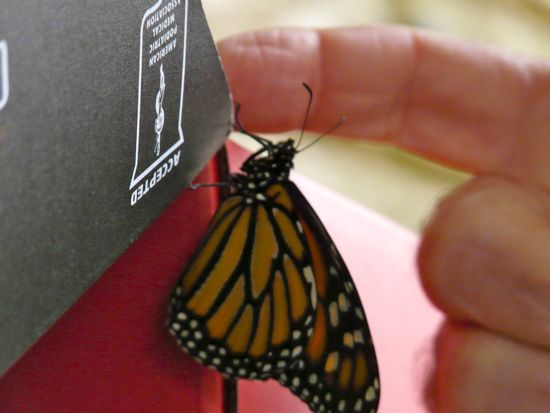
When I get home, AdventureMan is all smiles, and not just because I’m going to make Open Faced Crab Sandwiches for dinner. No! One of his Monarch butterflies has hatched! We’ve had such a mild winter that we’ve had a few hatching here and there all winter, but this is the first butterfly of spring, and he is fresh out of the cocoon. After losing two cocoons to hungry birds, he devised a protective shoe box. AdventureMan is fast becoming a local expert on creating a safe environments for butterflies to feed, lay eggs, cocoon and hatch. He’s also having a lot of fun with it.
On our back fence, a vine we planted last October is taking root and taking off. I think it is a coral honeysuckle, also called a coral trumpet honeysuckle, or coral trumpet vine. It attracts both butterflies and hummingbirds. 🙂


This is not particularly a Spring photo, but it is a seasonal photo. The oysters right now at the Marina Oyster Barn are HUGE! I had a bowl of oyster stew, AdventureMan had six raw oysters and the little lady sitting behind us had a full dozen. “I can’t get these in Illinois!” she exclaimed; AdventureMan could barely eat all six, they were so huge, so we had a hard time believing she could eat 12, but she did!

Just as the weather is perfect for getting outdoors and cleaning out the weeds, the pollen also starts flying. I get out while it is cool, weed a selected area and come back in and shower all the pollen off. It doesn’t do that much good; my eyes are still watering and I am sneezing, but who knows how bad it would be if I didn’t wash the pollen off?
Bullying and Community
I found this on AOL/Huffpost Parenting: it contains a line – I italicized it – that I need to think about. In America, we tend to think of the individual over the community. For the most part, we don’t encourage our children to continue with an activity they don’t like ‘for the good of the group,’ we tend to take them out of the activity. I’ve lived in cultures where obligations to the group are much stronger, and I’ve always felt confined and constricted by the burden of those expectations, but it does make for a more peaceful situation when we consider the needs of others and the needs of the group.
Preventing Bullying Begins With Us
Richard Weissbourd and Stephanie M. Jones
On Feb. 29, Lady Gaga will launch a foundation dedicated to creating caring communities and stopping bullying. Hosted by the Harvard Graduate School of Education and Harvard’s Berkman Center, Lady Gaga will be joined by Oprah and other celebrities. A powerful new film, “Bully,” will be widely released at the end of March, and many Americans in recent years have been galvanized by a blizzard of tragic bullying stories.
Yet too often in the past a problem plaguing children like bullying has received huge waves of public attention that simply never translates into any positive changes in kids’ lives. What will it take to capitalize on this attention? How can we curb this problem once and for all?
We can start by recognizing where the main solution lies. There is a tendency to simply blame bullying on “bad” kids or peer groups or destructive media. But bullying often has deep roots in parents’ attitudes and behavior, and stopping bullying begins with us.
How can parents prevent bullying? Parents in recent years have been flooded with articles and books that guide them in shielding, or “bully-proofing,” their own child. But just protecting our own kids won’t stop bullying, and this guidance reinforces the damaging tendency of many parents to just focus on their own children. The best way to prevent bullying — and many other forms of cruelty and harassment — is to encourage and enable children to care for and take responsibility for each other. Research indicates that bullying is greatly reduced in particular when children who witness bullying stand up for the victim. Bullying brings home to parents our fundamental moral responsibilities. How can we help our children widen their circle of concern and stand up for other children? How can we help our children build more just and caring communities?
Bullying, unlike more typically developmental teasing and hurtful remarks, is commonly defined as prolonged or frequent cruelty to others, often characterized by imbalances of power. This kind of cruelty can produce intense and often lasting feelings of shame in children, a sense that they are defective in some core way. About 30 percent of children are bullied each year on school property alone. Adults’ understandable reflex is to curb this kind of bullying by punishing perpetrators. Yet this strategy alone usually fails to stop bullying, and sometimes it backfires.
On the other hand, bystanders — especially a friend of the bully — tend to be far more effective. A bystander is present in 85 percent of bullying situations, and bystanders who intervene appear to prevail over half the time. Yet in the vast majority of cases bystanders elect not to intervene.
What can we do as parents to help our children stand up for others? Research suggests that parents bolster their children’s ability to act independently and to withstand disapproval when they respect their children’s capacity as independent thinkers from early ages and give them input into family decisions. All the things parents do to build in their children a sturdy sense of self make it easier for children to hold their ground against a powerful peer. As parents we strengthen the self, for example, when we praise appropriately, know and appreciate who our children are and maintain their trust and respect. Nurturing empathy in children from early ages certainly matters as well. That means in part helping children appreciate people who may not be on their radar, whether a bus driver, a custodian or a new child in class. It means helping children consider the perspectives of those they’re in conflict with as well as people who are different from them in customs or background or other characteristics.
While it’s vital that we convey high moral expectations and underscore the importance of sticking up for others, we also must listen carefully to our children and understand the complexity of their social worlds and ethical decisions. We as parents will be more real and valuable to children if we pay careful attention to their perceptions and experiences of bullying and discuss when and how to stand up for someone else. We need to talk to them about the complexities of balancing our needs with others and what consequences are worth and not worth bearing. We need to help them figure out how to challenge someone else constructively.
But perhaps most important, stemming bullying will require us to seriously examine our parenting priorities. As a good deal of research now indicates, we live in an era when many parents are intensely focused on their children’s self-esteem, happiness and achievements, not on how well they care for others. And in all sorts of subtle ways we can prioritize happiness over taking responsibility for others. Too many of us, for example, don’t push our children to fulfill obligations that might distress them. We let our children write off friends they find annoying, or fail to reach out to a friendless child on the playground, or quit a team or chorus without asking them to consider what it means for the group. How many of us simply tell our children that their classrooms, schools and neighborhoods are communities to which they have obligations?
Just as worrisome, many of us as parents are failing to model for our children a sense of responsibility for others. Over and over we have heard from teachers that many parents are occupied with their own child and care little about other children in the classroom. “It’s a dog fight,” one recently retired teacher says, driven out of the profession in part by his fatiguing battles with parents. “Parents are out of control. They’re always seeking an advantage for their own kid… they lobby for a gifted class or they want their kid to get extra attention… and they don’t care how they might be hurting other kids.” Some parents say they want kids with behavior problems immediately removed from the classroom because they believe their own child’s learning is compromised. But that message certainly doesn’t convey responsibility for others and the community. At least for some period of time, we as parents ought to encourage teachers to work with that child and ask our own child how she/he might support the struggling child.
It is, of course, a great deal easier and tidier for us as parents to simply wrap our attention around our own child or to periodically remind our child to respect others. But such bland reminders will never get us where we need to go. Our children’s moral development is deeply interwoven with our own. If we want our children to be fair, courageous and humane, we have to take a close, hard look at whether those values are priorities in our parenting, and whether we are living those values day to day.
Qatar’s Balancing Act (from National Post)
Fascinating article on Qatar – thank you, John Mueller, who sends me these great news articles.

From the National Post
Qatar’s balancing act
Fadi Al-Assaad, Reuters Files
Qatar’s Emir, Sheikh Hamad bin Khalifa Al-Thani, has steadily built a reputation for mediation and seeks to be regarded as an “honest broker” in the Middle East.
TwitterEmail
inShare
Peter Goodspeed, National Post · Feb. 25, 2012 | Last Updated: Feb. 25, 2012 5:16 AM ET
The tiny country of Qatar used the slogan “Expect the Amazing” when it successfully bid to host soccer’s 2022 World Cup.
It’s a phrase that could summarize the reign of Emir Sheik Hamad bin Khalifa Al-Thani, who in just 17 years has turned a small Arabian peninsula of salt and sand flats, once one of the poorest countries in the Persian Gulf, into the world’s richest country and possibly the Middle East’s most influential state.
A former British protectorate, which was noted for its declining pearl fishery when it became independent in 1971, Qatar was once described by the Lonely Planet Travel Guide as “possibly the most boring place on Earth.”
Now, according to the World Bank, its 250,000 citizens and 1.5 million foreign workers have the highest per capita income in the world (US$84,000, twice that of the United States) and an economy that outstripped China by growing 15.8% last year.
Since 2006, Qatar has been the world’s largest exporter of liquefied natural gas and the kingdom is transforming its new wealth into worldwide influence.
Qatar recently led the Arab League’s expulsion of Syria and, on Friday, called for the creation of an Arab military force to open humanitarian corridors to protect civilians in Syria.
Last month, it allowed Afghanistan’s Taliban to open an office in Doha to facilitate peace talks with the U.S.
And in the spring, it was the first Arab country to recognize the rebel government in Libya.
The emirate sent six Mirage fighters to Crete to help NATO enforce a no fly zone over Libya.
It also supplied rebels with the fuel, weapons, cash and the training they needed to overthrow dictator Muammar Gaddafi. Qatari special forces provided basic infantry training in the Nafusa Mountains, west of Tripoli and some helped lead the final assault on Col. Gaddafi’s compound in the capital.
They were so proud of their achievement, they hung a Qatari flag from the wreckage of his palace.
“The Qataris have really adopted a kind of adventurous foreign policy in the last couple of years and shown a willingness to send special forces to these kind of areas of conflict,” said Andrew McGregor, senior editor of the Global Terrorism Monitor for the Jamestown Foundation.
“They’ve used their considerable wealth to supply arms and whatever else is needed.
“I would be keeping a close eye on what they are doing [in Syria]. They are rapidly emerging as a real power in the Arab League, despite their size. They are very influential and very wealthy, and they have shown a willingness to be engaged.”
The Emir, Sheikh Hamad bin Khalifa Al-Thani, sometimes referred to disparagingly as the “Arab World’s Henry Kissinger,” has steadily built a reputation for mediation and seeks to be regarded as an “honest broker” in the Middle East.
“Since the mid-1990s, Qatar has pursued an activist foreign policy, using its affluence, unthreatening military position and skills as a mediator to interject itself in conflicts around the Middle East and beyond,” said David Roberts, deputy director of the Royal United Services Institute’s Doha Centre.
In recent years, Sheikh Hamad has carefully inserted himself in conflicts in Libya, Lebanon, Gaza and the West Bank, Sudan, Syria, Yemen and Afghanistan.
In 2008, an agreement negotiated in Doha averted another civil war in Lebanon by establishing a power sharing agreement between the country’s different factions. Around the same time, Qatar helped negotiate a short-lived ceasefire in Yemen, mediated a border dispute between Djibouti and Eritrea, and hosted peace talks between Sudan and rebel groups in Darfur.
A regional actor with international reach, Sheikh Hamad has pursued a foreign policy that is ripe with conflicts and contradictions.
Qatar maintains good relations with Iran, while still offering the U.S. its biggest and most important air base in the Middle East at al-Udeid, a few kilometres outside Doha.
Unlike most Arab states, Qatar has generally had good relations with Israel and allowed the Israelis to maintain a commercial office in Doha until the 2009 Gaza invasion.
At the same time, it has warm relations with Israel’s enemies Hamas and Hezbollah, and provides safe haven to hardline Islamists from all over the Arab world.
Leaders of the Muslim Brotherhood in Egypt and Syria fled to Qatar in the 1960s and 1970s, even though the kingdom’s rulers frown on organized political Islam and ban all political parties.
Qatar “has a reputation for ‘omni-balancing’ between seemingly incompatible policies,” said Kristian Coates Ulrichsen, a Gulf expert at the London School of Economics.
“Qatar’s rise, seemingly from nowhere, is rooted in deeper political, economic and security shifts and, in turn, is reconfiguring the balance of regional power.”
Those changes highlight Sheikh Hamad’s own rise to power and his reign in Qatar, where his family has ruled since the 19th century.
Raised by a maternal uncle’s family, after his mother died young, the Emir attended the Royal Military Academy at Sandhurst, west of London, graduating in 1971, the year Qatar won its independence and when its first natural gas field was discovered.
He was made a lieutenant colonel in Qatar’s army and, after his father deposed an uncle to become emir in 1972, he rapidly rose to become commander-in-chief of its armed forces.
As crown prince, Sheikh Hamad was gradually given the power to run the country day-to-day, while his father cultivated a taste for extravagance and spent most of his time on the French Riviera.
Sheikh Hamad oversaw development of Qatar’s oil and gas industry and carefully planned an economy that provides Qataris with free education, health care, housing and utilities – and no taxes.
But when his father returned home briefly in 1995 and arbitrarily demoted another son from his position as prime minister, Crown Prince Sheikh Hamad staged a bloodless coup. He informed his father by telephone while he was holidaying in Switzerland.
The old emir returned to the Gulf the following year, publicly disowning his son and trying to drum up support for a countercoup, but Sheik Hamad snuffed out the plot by freezing billions of dollars in his father’s overseas bank accounts.
Then, just 44 and the youngest ruler in the Gulf, he set about to reform and redefine Qatar.
Surrounding himself with young, Western-educated advisors, he drew up a longterm plan to develop a post-oil knowledge-based economy.
He has allocated 40% of Qatar’s budget between now and 2016 to massive infrastructure projects, including an $11billion international airport, a $5.5-billion deep-water seaport and a $1-billion transport corridor in Doha, as well as $20billion in new roads.
He has also invited foreign universities to establish Middle East campuses in a $100-billion Education City in Doha.
Without an elected parliament to advise him, the Emir has final say in the disposition of the country’s $70-billion to $100-billion sovereign wealth fund, which has made it a financial powerhouse internationally by investing heavily in everything from German carmakers Porsche and Volk-swagen to the Agricultural Bank of China, Harrods department store in London, a Brazilian bank, Chinese oil refineries, a Spanish soccer team and a French fashion house.
The Emir’s most influential investment was his creation of the 24-hour Arab-language Al Jazeera television network in 1996.
Granted a level of editorial independence unheard of in the Arab world, Al Jazeera is encouraged to report freely and aggressively on everything but Qatari politics, and is the most watched TV network in the Middle East.
The broadcaster was widely regarded as one of the driving forces behind the spread of the Arab Spring.
“Qatar hopes to insert itself as the key mediator between the Muslim world and the West,” Mr. Roberts said.
“Qatar sees its role as a highly specialized interlocutor between the two worlds, making – from the West’s point of view – unpalatable but necessary friendships and alliances with anti-Western leaders.”
Sheikh Hamad Bin Jasem Al-Thani, Qatar’s Prime Minister and a distant cousin of the Emir, likes to say his country is small and has to be proactive to protect its interest and avoid being run over by more powerful neighbours.
“Our policy is to be friendly with everybody,” the Emir said recently in a television interview. “We are looking for peace. It doesn’t mean if two parties turn against each other, we have to go to one party. No, we would like to stick with the two parties.”
– Formerly a British protectorate, Qatar has been ruled by the Al-Thani family since the mid-1800s. The current Emir, Hamad bin Khalifa Al-Thani, overthrew his father in a bloodless coup in 1995.
– Oil and natural gas revenues have enabled Qatar to attain the highest per-capita income in the world (US$84,000 according to a report this year by Global Finance).
– Oil output at current levels should last 57 years, according to the CIA World Factbook.
– It has a zero unemployment rate and zero percentage below the poverty line.
– The mostly flat and desert land is 11,586 square kilometres – only slightly larger than Jasper National Park.
– It has a population of 848,016 – similar to the population of Edmonton.
SOURCE: NATIONAL POST NEWS SERVICES
JONATHON RIVAIT / NATIONAL POST
pgoodspeed@nationalpost.com
Recent Comments
ExpatAlien on What Country am I Living … intlxpatr on Yellowstone: Old Faithful to C… Michelle on Yellowstone: Old Faithful to C… Cathy on No Grown-Ups in Charge intlxpatr on Waiting for Snow Wikipedia Donate Button

Amazina


Early Voting in Florida


 Here There and Everywhere