The Heart of Doha – Disney Does Doha?
“No, it’s not DOHALAND!” I snapped at my friend. ‘It’s called the ‘Heart of Doha’ project.”
We were exploring the project in it’s first phase, the destruction phase, which is turning old haunts into several circles of hell – shopping hell, driving hell, parking hell, disorientation hell. And just as we were inching our way into a new diversion, I saw the big sign describing the future this funky area of Doha and telling us to go to ‘Dohaland.com.’
Oops. I apologized profusely and she very humbly pretended not to be gleeful that she was right and I was wrong. Well, actually, we are both right. It is both ‘Dohaland’ and ‘The Heart of Doha,’ but I shouldn’t have snapped at her over something so inconsequential. Blame it on the rain . . . umm . . . .err . . . the traffic.
Dohaland. I’m sorry, it sort of cracks me up. It’s just like Disney – JungleLand, FutureLand, etc.
I remember when the Suq al Waqif project first started, how outraged I felt, and how delighted I am to go down there now, where the shop-keepers have electricity that is reliable, even air-conditioning wafting out into the corridors, the appearance of ancient woven mats shading the twisting cobblestone street which no longer reaches out and grabs your heels, or changes levels unexpectedly. How can you be a successful curmudgeon when it turns out so positively? Even if it is a little bit Disney-does-Doha, it is so attractive!
What I love about what has been accomplished so far is how it has enhanced the experience for everyone. If you go down into the souks, you see more people. You used to see only a few westerners, now you see all kinds, even tourists, even your neighbors; you see every nationality down in the souks now, and people are actually buying things, not just killing time. There is a great variety of shops and restaurants, and even if the parking spots are tiny, there is parking.
Have you visited the website yet? Dohaland.com? I love the vision, although in one shot with people in suits crossing the streets, I want to shout “Hurry! Hurry! Or you’ll get run over!”
Here is what it is going to look like – and you can go to the Dohaland website and get a great big full screen map:
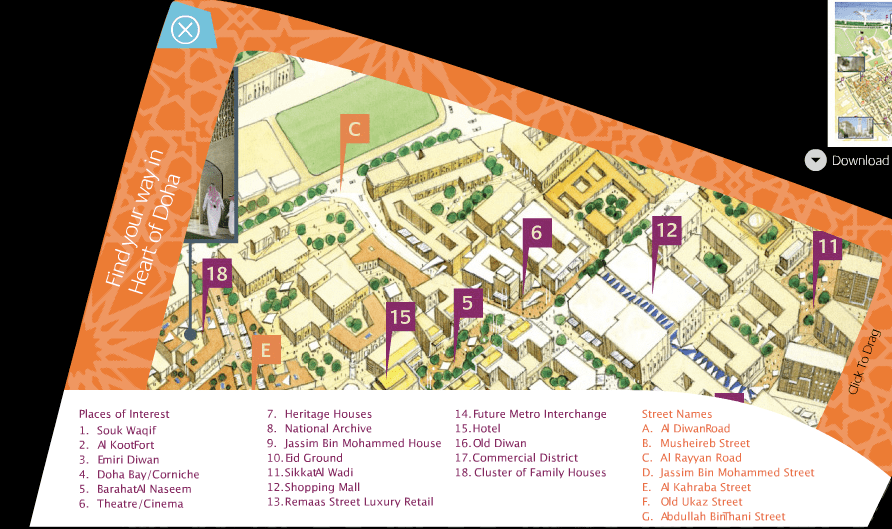
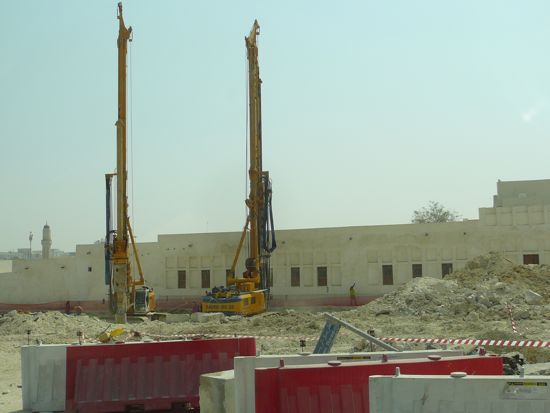
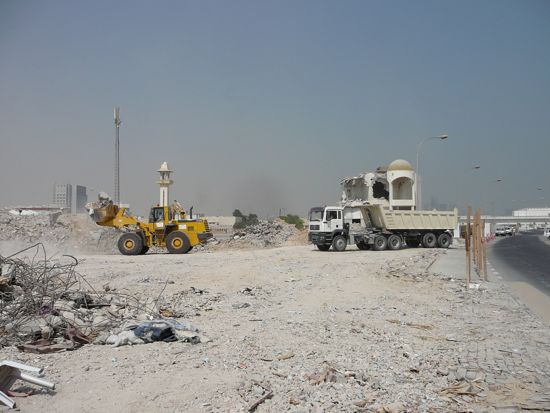
And here is what it looks like now:
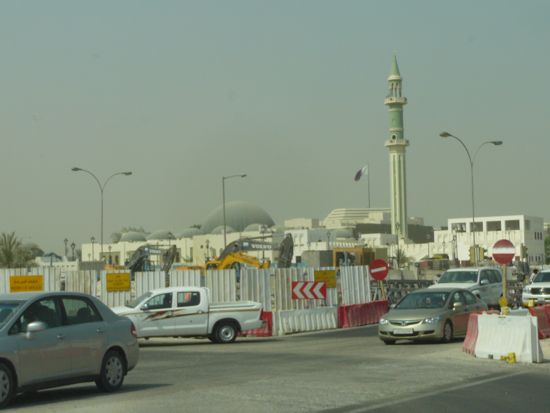

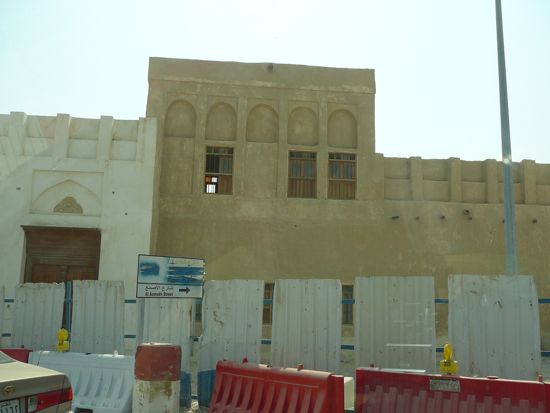
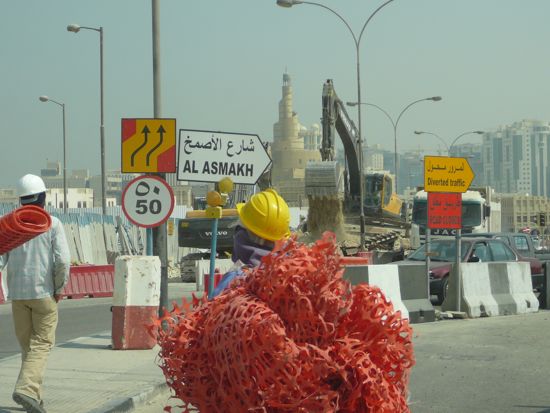
These machines are like huge dentist’s drills, with points that pound down into the hard-packed Qatar soil to break it up so that foundations can be built:

It’s not unlike house-cleaning. When you pull everything out of the closets, out from under the beds, the drawers, those piles of things in the corner, for a while everything looks worse than it did before you started. Slowly, slowly, you create areas of organization and calm amidst the chaos, and slowly, slowly those areas expand, join, until the chaos is eliminated, you know where things are, and your living area is a calm and peaceful and organized oasis. I hope I get to see that day in Doha.
Update: Dohaland AKA Heart of Doha is now known as Musherib
Souk Fire Damage
The fires in the souks between Souk al Dira’a and Souk al Asseiri caused a serious drop in customer traffic to an area already hard hit by the current economic situation world-wide. While Qatar claims to be relatively untouched, there are small signs that non-Qatteris living in Qatar are touched, indeed – expats losing jobs, expats going home, and expats not spending a lot of money because they do not feel secure about tomorrow.
We only had to drive around the long block three times before we found a parking spot. Pretty amazing, huh?
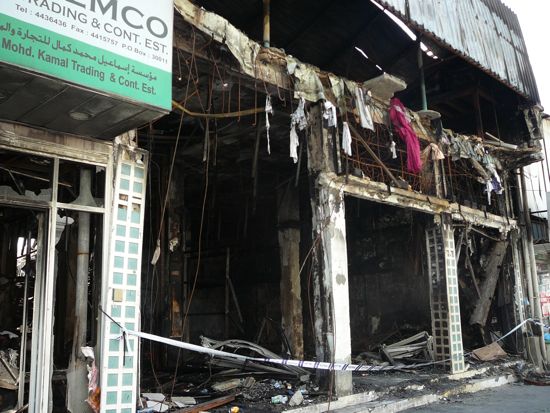
I wanted to see how badly the Dar al Thaqafa had been hurt. There was a fire truck nearby, and the fireman said that there had been a smoldering spot. It smelled like a campfire.
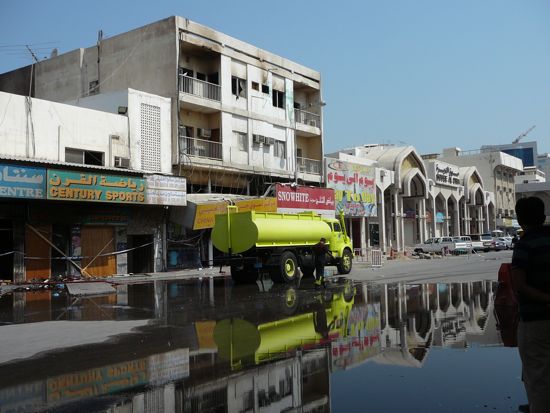
Here are some shots of how the area looks today:


Where Great Decisions are Made
Today, on my way home from a marathon-fun day, even though it was full of errands, I got to thinking great thoughts – in my car. Some of my best ideas come when I am sitting in traffic, something about the enforced nothing-to-do frees up my unconscious to tackle things I don’t otherwise think about.
One of the things I was thinking about was what, when I studied it, was called The Decision Making Process. It’s something you study in Political Science, and, although I can’t say this for sure because I haven’t specialized in these other areas, I am betting you would also study the process in Business, in Economics, in Engineering . . . when you know the process by which decisions are made, so the theory goes, you can get better at predicting how the decision making will go, what people will decide.
Or so the theory goes. . .
My personal observation is that human beings are highly unpredictable, and sometimes will make an opposite decision, even an irrational decision, in order not to be so predictable. I hate to be so cynical, but I think we are not so rational as we like to think we are.
In my Kuwait life, I remember being at a not-so-important meeting, more just a gathering, but at one point, I saw four people – influential people – meeting off in a corner, very casually, probably no one else even noticed, but they were deciding an outcome of an election, I realized later that day. OOps – not THE Kuwait election, my friends, no no no, a much lesser election. But that was where the decision was really made. These four quiet people were people who had the respect of others, and once they decided, they quietly shared their opinion with others, who shared their opinion with others and on it went, until the deed was done.

I have seen decisions made in a swimming pool. I know decisions are made on golf courses. I was hired for one job once after attending a concert, and for another because I had a responsible position in my church (it had nothing to do with the job I was hired for, but the skills were transferable.) I was hired once because my hair and eyes matched another woman working in the front office, and the boss wanted a “matched pair.” (I didn’t know that until later.)
I know that at one time AdventureMan helped lay out a military base. He said they were in a truck, and as they drove along someone dropped big stones out the back to mark the boundaries. Don’t you love it?
Gulf women tell me that weddings are important; young women are often spotted by future mother-in-laws, so moms try to make sure that their daughters are well appointed for major weddings, major events where they may be on display . . . and then they ask around checking on character and personality and suitability. But I wonder on what basis those decisions are really made, deep down? Family alliances? Securing a future? Business connections? I know there are rare alliances based on true and lasting love; I wonder how often that happens?
I know there are matrixes, and even simple two-column + – lists by which people can rationally work out what to decide. What I am cynical about – after all the matrixes are filled out, after all the plusses and minuses are totaled – I think that the decision can go counter to rationality, because we are – if not irrational – then intuitive, we are people who make decisions with other than our conscious minds. I think our hearts get involved, and you KNOW that feelings/emotions get involved. Sometimes we have “a gut feeling”; sometimes we know something on an unconscious level that we don’t know on a conscious level. If we all acted in our own rational self interest, there would not be young drivers dying on our roads, people would not be irrationally exuberant about investments, young people would not fall in love with the wrong people and life would sure a lot more dull, wouldn’t it?

I am cynical even about decisions made at the highest levels, because even decisions made by boards and after studies – even these decisions are ultimately based by human beings, and sometimes on “hunches.”
So I am wondering if YOU have had similar experiences? Have you seen major decisions made irrationally?
All this because I was stuck in traffic . . . .
Suq al Waqif Bird Market
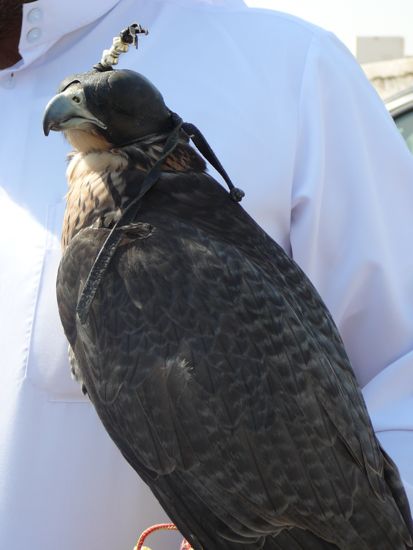
As we were heading into the Suq al Waqif for breakfast Saturday morning (Yes! Several of the restaurants are open for breakfast!) we saw a man and his son, both carrying falcons.

AdventureMan joked that they are hired by the administrators to walk around adding local color. We scoffed. Maybe someday, but for right now, these are still real people, with their own falcons. We know because our Kuwaiti visitor stopped them and asked about the falcons. They were so sweet and so delighted to tell us about their birds, and to allow us to photograph them:
There was also a lively bird auction going on:

What we love about the renovated market is that it is still a true market, where real people by daily items for use.
Farewell Dar al Thaqafa
We were sitting in a meeting when two friends rushed in, full of news of the fire down at the Souk al Diraa / Souk al Asseiri, familiarly known as The Fabric Souks. Our friend’s car had been near where the blaze broke out and they had been stuck while the firemen refused to allow her near her car, and finally they moved it out of the way for her, covered with ash and dirty water, but otherwise unharmed.
We all waited breathlessly to hear if the fabric souks were harmed. They weren’t. For such a big blaze, such a long-lasting fire, no lives were lost, no one was hurt, as far as anyone knows.
But in this morning’s paper, I see that while the fire started out a small fire, somehow, it was not contained, and in the clutter and chaos of the older souks, it grew, fed by stacks of stored goods and rubbish.
One of the victims was an old friend of mine – the Dar al Thaqafa. Little Diamond and I would often find treasures there, books you couldn’t find anywhere else. There are other bookstores in this chain, but this one, this Dar al Thaqafa was THE oldest bookstore in Doha, stocking school supplies, children and adult fiction and non-fiction, textbooks and obscure Islamic scholarly works. It was a quiet place, an old fashioned book-store, tucked behind the very tacky toy vender where I once bought both a dancing Osama bin Laden and a dancing Saddam Hussein.
We are sorry to see this old friend go. (They gave me permission to take these photos)

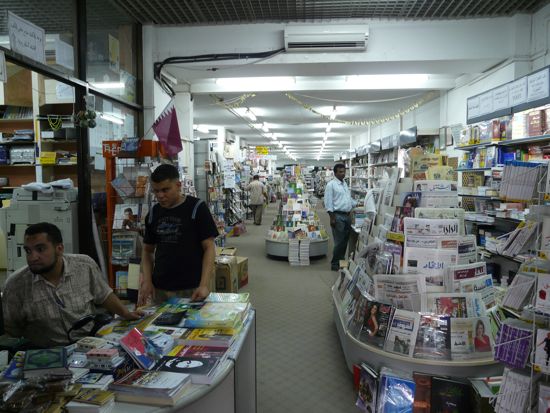
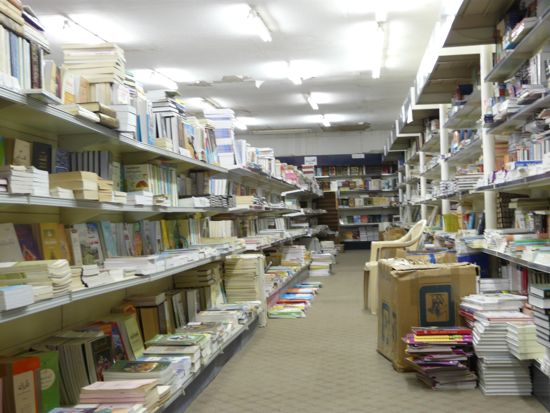
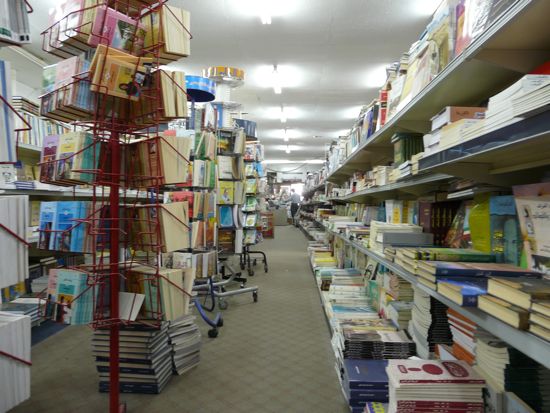
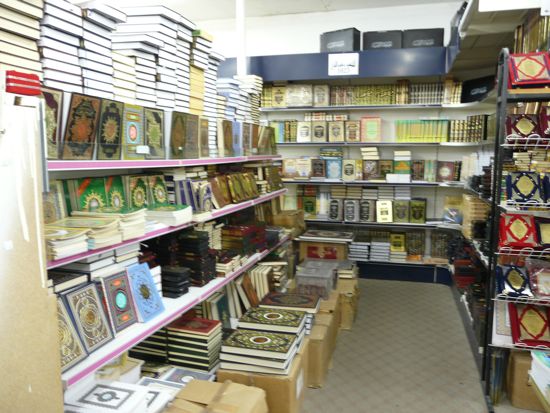

The area was full of small merchants, most of whom I suspect could ill-afford this loss of merchandise and income. I took a photo of an alleyway in the area of the fire (taken in July)

Home Foreclosures: The Storm That’s Yet to Come
This is just an excerpt from a much longer article I found on the AOL Money and Finance Site which you can access to read the entire article, and find others like it, by clicking on the blue type.
Experts are saying that there is a turn-around. I believe it, I also see the improving signs, but the wreckage will remain, and may even get worse, for some time to come in the real-estate markets.
Home foreclosures move up-market as discounting pushes prices down
Lita Epstein
A greater number of foreclosures are hitting the high-end real estate markets in 2009 as price discounting continues to throw more and more properties underwater. It’s like a self-fulfilling prophecy: As some homeowners see their homes’ values drop below the balances due on their mortgages, they give up trying to save their homes.
Zillow’s chief economist, Stan Humphries, found that while high-end markets accounted for only 16 percent of foreclosures in 2006, by July 2009, 30 percent of foreclosures hit the top third of homes. “That means that top-tier homes make up almost twice the proportion of foreclosures as they did just three years ago,” Humphries wrote on his blog.
Foreclosures are no longer a primarily subprime problem. While in 2006 about 55 percent of foreclosures came on subprime loans, in 2009 subprimes represent just 35 percent of foreclosures, another 35 percent are in the middle tier and 30 percent are in the top tier. The primary contributing factor is higher delinquency rates in Prime, Alt-A and Option ARM mortgage products.
According to the Amherst Security Group, this problem won’t go away any time soon, because:
• Loans are transitioning into delinquency/foreclosure at a rapid pace, but moving out at a slow pace;
• Cure rates are low. In other words, fewer people are paying their past-due amounts and getting back on track.
• Loans are taking longer to liquidate. In other words, the length of time between the start of the foreclosure process and the point when the lender gets control of the property is growing.
The Amherst Mortgage Insight report notes that there are currently 7 million homes in a shadow market — homes that are either in delinquency or in foreclosure, but not yet on the market. This number translates into 135 percent of a year of existing home sales, which means that whatever numbers you’re seeing now about homes sales, they don’t truly reflect the storm that’s yet to come.
Driving Safety to Improve in Kuwait
I used to read a lot of science fiction. I can’t always remember the stories, but sometimes the concepts stick with me. I remember one story about a guy who gets to the future to discover nobody is as bright as they are in our time. One of the things they do to prevent the not-so-bright drivers from hurting themselves is to make the cars very rubbery and very slow, but the cars all make whoooooshing noises like they are going really really fast, so all the drivers are happy.
Kuwait loses a lot of young men, particularly, but also young women, to car accidents. Many pedestrians in Kuwait lose their lives, some stepping right in front of cars.
From today’s Arab Times: Kuwait
Strategy needed to counter hike in Kuwait’s road accidents: minister
KUWAIT CITY, Oct 11: Making our roads safer is in the interest of the nation’s progress as most of the deaths in traffic accidents involve youngsters and children, who are the future of our nation, said Kuwait’s Minister of Interior Sheikh Jaber Khaled Al-Sabah on behalf of HH the Prime Minister Sheikh Nasser Al-Mohammed Al-Sabah at the International Conference on Traffic in Kuwait Sunday.
The conference, held under the patronage of the prime minister at Holiday Inn Hotel, was organized by Kuwait Society for Traffic Safety, and was attended by delegates from the US, Turkey, UAE, Bahrain, Saudi Arabia, Lebanon, Jordan and other countries. Some of them also gave lectures. The Deputy Minister of Interior of Ukraine, Brigadier Oleksandr Savchenko, was a special guest at the conference.
The interior minister stressed the need for strategies to tackle the crisis of increasing road accidents in Kuwait based on the experiences of countries that have successfully handled the issue. “The lessons learnt from the conference must be implemented in Kuwait and all the government departments must cooperate with one another for bringing about positive changes in this direction.”
He also urged people from all walks of life to contribute to make roads safer “as it is the responsibility of the whole community.”
In the key note address, the chief of Kuwait Society for Traffic Safety said that road accidents in Kuwait have taken away more than 300,000 lives in the past, and caused severe disabilities. “The average age of those dying in accidents is 20. Between 1995 and 2008, more than 5000 people lost their lives in traffic accidents in Kuwait.”
Giving further statistics, he noted that 2.5 percent of Kuwait’s GDP is lost in accidents, “while in countries like the US it is only 0.1 percent of their GDP.
“According to WHO’s report, there are over 2 million accidents taking place every year, incurring losses to the tune of $2 billion.
“Kuwait Society for Traffic Safety will be soon launching a five-year program in Jan 2010 to bring about a change in the attitudes of people towards driving.”
Prof Fernand Cohen of Drexel University, USA, was the first speaker at the conference. He spoke on the topic, “How much can technological advancement increase traffic safety?”
He began by saying that the issue of traffic safety begins with man’s attitude. “To change traffic safety, we have to address that issue first.”
Prof Cohen said that technological advancement can reduce traffic accidents by up to 32 percent. He based his arguments on reliable studies in the field. “When you compare this percentage against the total number of accidents in the US every year, 5.8 million, it makes a significant difference.
“Basic safety features like seat belts and airbags have all become a standard feature in our cars, and have contributed to making our cars safer. But we have to go beyond that.”
Estimate
The professor mentioned studies estimate that deaths due to traffic accidents in the US will go down to 25,000 by 2020. “In 2004, the total number of road kills in the US was 43,000.
“We are moving more and more towards hybrid navigation system in car involving man-machine interaction. The car will make up for the shortfalls in the driver.
The professor said that the new technological approach to making roads safer must have a preventive rather than a punitive approach. “The focus should be crash avoidance technology. There should also be ‘Psychological Impact Technology.’
The emerging technologies, he noted, “looks at solutions such as a visual or audio alert signal for corrective action to avoid an imminent crash. There could be measures to make the car intervene and apply brakes when needed.”
Under crash avoidance technology, the professor presented technologies such as blind-spot detection, which provide greater visibility to drivers. “Rear view cameras can eliminate threat to pedestrians, children or animals while a car is backing.
“Lane Departure Warning can tell you if you are too fast to change lanes. It can prevent you from wandering out of lane.
Monitors
“The Wake-You-Up feature monitors a driver’s eyes, heart rate and other factors and gives a signal if the driver shows a tendency to fall asleep.”
He also touched upon other technologies such as sensors to indicate approaching vehicles, monitors to check tyre pressure, adaptive headlights that turn when the car is negotiating a curve and rollover prevention systems among others.
The professor then discussed technologies that can be incorporated on the road to make driving safer: warning signs prior to the red lights to warn cars to slow down; sensors at red lights to measure the speed of an oncoming car and prolong the duration of the signal if need be to allow a speeding car to pass; and encouraging drivers to drive at a particular speed, which would allow them to have green lights at every signal.
Some of the other topics handled during the conference were: The Lebanese Experience in Traffic Awareness; State of Road Safety Research in the US; Traffic Strategy for Kuwait.
By Valiya S. Sajjad
Arab Times Staff
Karabaa in Transition
This post is for my friends not here, friends who often accompanied me on trips to Karabaa and all the funky magical shops we would find there. I dropped off the towels at the Mumtaz Tailor to be embroidered, English on one end, Arabic on the other, and while the devastation is no longer so gut-wrenchingly stunning as it was – I guess I am becoming desensitized – I can also see changes.
A lot of the rubble has been carted away. So it makes me wonder, is this what The Pearl is being built on? Is rubble from the old Suq al Waqif and these old buildings along Musherib and Karabaa going to the sea to become reclaimed land? If so, isn’t this going to boggle the minds of archaeologists a couple thousand years from now who are going to find all this stuff jumbled together and try to figure it out?
Yes, yes, it’s true, my mind does wander into trivial areas . . .
From the old parking lot, looking towards Karabaa where the honey man used to be:
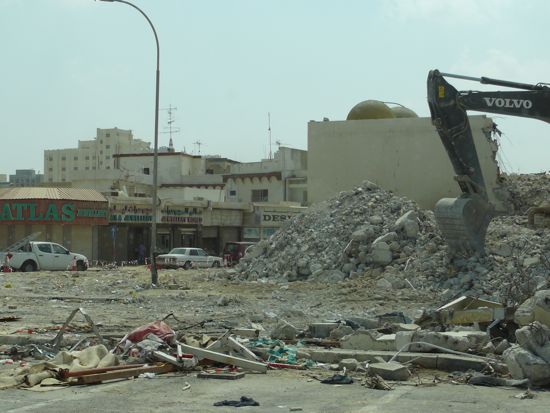
To help you know what you are looking at – remember the sign that shows people how to park? It’s still standing – so far 🙂

I wanted you to be able to see just how high the pile of rubble is:

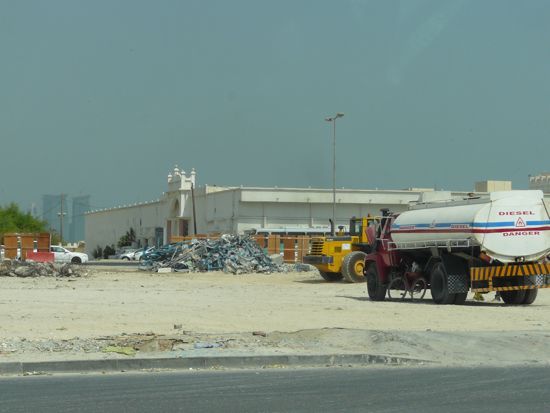
All the rubble that was The Garden is now gone, as if it never was:
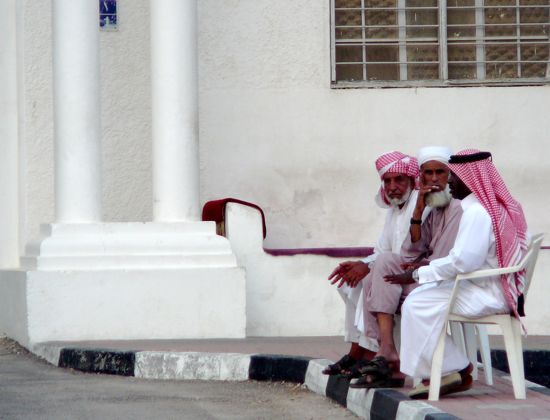
OK, now, in the midst of all this noise and demolition, the rubble and the trucks and bulldozers, there is this oasis of serenity. I often see old men sitting outside on those old fashioned built-in-plaster seating areas, or on the bench. Inside, it looks like it might even be a home for old indigents, but sort of palatial, very green, and well kept up. Is there anyone who can tell me what this is?

Recent Comments
ExpatAlien on What Country am I Living … intlxpatr on Yellowstone: Old Faithful to C… Michelle on Yellowstone: Old Faithful to C… Cathy on No Grown-Ups in Charge intlxpatr on Waiting for Snow Wikipedia Donate Button

Amazina


Early Voting in Florida


 Here There and Everywhere