Who Is My Neighbor?
You would think when someone so special is talking, people would listen. You would think that when he is trying to tell us what God expects from us to enter into his kingdom in the after life, people would be listening, and indeed, they listened, many listened. There were others who did not. There were also those closest to him who misunderstood! That always baffles me, that those closest could misunderstand.
Today’s lesson is one of my very favorites in the world. You can substitute any two races who hate one another and the story is equally clear. The man who was asking the question was setting Jesus up, or trying to, and Jesus used the occasion to teach a stunning truth – that love is stronger than hate.
Luke 10:25-37
25 Just then a lawyer stood up to test Jesus.* ‘Teacher,’ he said, ‘what must I do to inherit eternal life?’
26He said to him, ‘What is written in the law? What do you read there?’
27He answered, ‘You shall love the Lord your God with all your heart, and with all your soul, and with all your strength, and with all your mind; and your neighbour as yourself.’
28And he said to him, ‘You have given the right answer; do this, and you will live.’
29 But wanting to justify himself, he asked Jesus, ‘And who is my neighbour?’
30Jesus replied, ‘A man was going down from Jerusalem to Jericho, and fell into the hands of robbers, who stripped him, beat him, and went away, leaving him half dead. 31 Now by chance a priest was going down that road; and when he saw him, he passed by on the other side. 32 So likewise a Levite, when he came to the place and saw him, passed by on the other side. 33 But a Samaritan while travelling came near him; and when he saw him, he was moved with pity. 34 He went to him and bandaged his wounds, having poured oil and wine on them. Then he put him on his own animal, brought him to an inn, and took care of him. 35 The next day he took out two denarii,* gave them to the innkeeper, and said, “Take care of him; and when I come back, I will repay you whatever more you spend.” 36 Which of these three, do you think, was a neighbour to the man who fell into the hands of the robbers?’
37He said, ‘The one who showed him mercy.’ Jesus said to him, ‘Go and do likewise.’
I have seen this in my own life. I have seen hopeless situations, with no solution in sight, totally change because one person chooses to love, instead of to hate. Choosing to love, in the face of hatred, takes a lot more character, a lot more strength. It has the potential for changing everything.
Prayer Reshapes Your Brain
This is a very small excerpt from a much longer article I found on National Public Radio News, a special series on The Science of Spirituality. This article (you can read it all by clicking on the blue type, above) talks about measuring brain activity while a person is praying, how the brain changes. Fascinating stuff.
A Sense Of Oneness With The Universe
Newberg did that with Michael Baime. Baime is a doctor at the University of Pennsylvania and a Tibetan Buddhist who has meditated at least an hour a day for the past 40 years. During a peak meditative experience, Baime says, he feels oneness with the universe, and time slips away.
“It’s as if the present moment expands to fill all of eternity,” he explains, “that there has never been anything but this eternal now.”
When Baime meditated in Newberg’s brain scanner, his brain mirrored those feelings. As expected, his frontal lobes lit up on the screen: Meditation is sheer concentration, after all. But what fascinated Newberg was that Baime’s parietal lobes went dark.
“This is an area that normally takes our sensory information, tries to create for us a sense of ourselves and orient that self in the world,” he explains. “When people lose their sense of self, feel a sense of oneness, a blurring of the boundary between self and other, we have found decreases in activity in that area.”
Newberg found that result not only with Baime, but also with other monks he scanned. It was the same when he imaged the brains of Franciscan nuns praying and Sikhs chanting. They all felt the same oneness with the universe. When it comes to the brain, Newberg says, spiritual experience is spiritual experience.
“There is no Christian, there is no Jewish, there is no Muslim, it’s just all one,” Newberg says.
Wives, be subject to your husbands
This part of today’s reading, among my set and the things we discuss, is one of the most controversial. We can debate this for hours.
What does being subject mean? If we, as wives, are subject to our husband, just as our husbands are subject to God, does it mean we can’t argue? We can’t disagree?
I saw a husband say to a wife the other day “I forbid you.” I think this is more common in Gulf culture than in our culture. I am sorry, but the thought of a husband daring to say this to a wife in the west is unthinkable. What I have also noticed is that when a husband says “I forbid you” here, it is not the end, but the opening skirmish. 🙂
There is a lot of food for thought in this reading, and I publish it to give you insight into what we read, and because I suspect you have similar readings.
Colossians 3:18-4:18
18 Wives, be subject to your husbands, as is fitting in the Lord. 19Husbands, love your wives and never treat them harshly.
20 Children, obey your parents in everything, for this is your acceptable duty in the Lord. 21Fathers, do not provoke your children, or they may lose heart. 22Slaves, obey your earthly masters* in everything, not only while being watched and in order to please them, but wholeheartedly, fearing the Lord.* 23Whatever your task, put yourselves into it, as done for the Lord and not for your masters,* 24since you know that from the Lord you will receive the inheritance as your reward; you serve* the Lord Christ. 25For the wrongdoer will be paid back for whatever wrong has been done, and there is no partiality. 41Masters, treat your slaves justly and fairly, for you know that you also have a Master in heaven.
2 Devote yourselves to prayer, keeping alert in it with thanksgiving. 3At the same time pray for us as well that God will open to us a door for the word, that we may declare the mystery of Christ, for which I am in prison, 4so that I may reveal it clearly, as I should.
5 Conduct yourselves wisely towards outsiders, making the most of the time.* 6Let your speech always be gracious, seasoned with salt, so that you may know how you ought to answer everyone.
Breaking all the rules
I’m breaking all the rules I made for myself. I didn’t know how to tell you I was leaving, but I thought I would tell you after I left.
Actually, I am not gone yet. My husband and I just grabbed an opportunity for a quick Mother’s Day getaway (Americans celebrate Mother’s Day this coming Sunday) and I am in France, drowning my sorrows 🙂 and walking and eating really delicious salads and pretending I am not up to my ears in boxes.
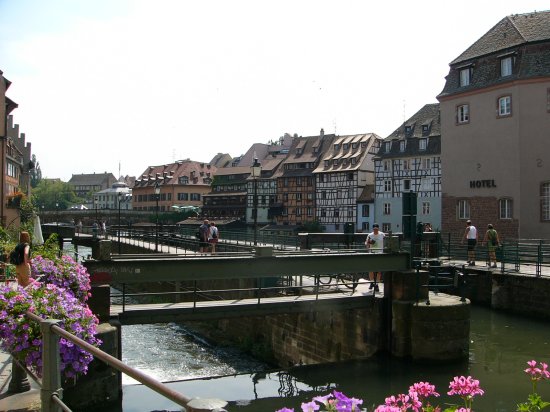
There are lilacs blooming everywhere, and wisteria. There are still some tulips. There are hydrangea. It is a riot of new life, color and growth. I am enjoying myself immensely. Very soon, it will be over and I will be back in Kuwait, packing boxes.
I will tell you more later, and even share some photos with you.
You are all so dear to me. I can’t tell you how much it hurts to move on. Usually, I cope by not thinking about it, just doing it. Somehow, in this situation, I don’t think that’s going to work very well.
Thank you for all your sweet thoughts. I haven’t decided if I will keep blogging; circumstances change . . . I will have to see if I even have anything to blog about!
An Interview with Chimamanda Ngozi Adichie
This interview is with a woman I admire very much, Chimamanda Ngozi Adichie, who has a new book out, a collection of stories, called The Thing Around Your Neck. Her most recent prior book, Half of a Yellow Sun, which tells of the three year struggle of the Igbo people to secede from Nigeria to create the independent nation of Biafra, and won the Orange Prize for Literature in 2007. The book is a total WOW.
More-on Bullying
The bullies have always been there – Jodi Picoult in 19 MInutes says that the worst part about being the bully is that nagging insecurity that if you stop trying for even a short time, your popularity will fall. So even the bully is struggling with nagging self-doubts, and those doubts compel his/her behavior – taunting someone “different”, smaller, weaker, more vulnerable, in order to make oneself look bigger. It’s pitiful, but how do we stop it?
This is a tragic article – so tragic I didn’t really want to publish it. It happens in every society, world-wide; the strong – but insecure – pushing around those who are weaker, to make themselves feel better.

April 16, 2009, 9:02 PM
Dude, You’ve Got Problems
by Judith Warner
From The New York Times
Early this month, Carl Joseph Walker-Hoover, an 11-year-old boy from Springfield, Mass., hanged himself after months of incessantly being hounded by his classmates for being “gay.” (He was not; but did, apparently, like to do well in school.)
In March, 2007, 17-year-old Eric Mohat shot himself in the head, after a long-term tormentor told him in class, “Why don’t you go home and shoot yourself; no one will miss you.” Eric liked theater, played the piano and wore bright clothing, a lawyer for his family told ABC news, and so had long been subject to taunts of “gay,” “fag,” “queer” and “homo.”
Teachers and school administrators, the Mohats’ lawsuit now asserts, did nothing.
We should do something to get this insanity under control.
I’m not just talking about combating bullying, which has been a national obsession ever since Columbine, and yet seems to continue unabated. I’m only partly talking about homophobia, which, though virulent, cruel and occasionally fatal among teenagers, is not the whole story behind the fact that words like “fag” and “gay” are now among the most potent and feared weapons in the school bully’s arsenal.
Being called a “fag,” you see, actually has almost nothing to do with being gay.
It’s really about showing any perceived weakness or femininity – by being emotional, seeming incompetent, caring too much about clothing, liking to dance or even having an interest in literature. It’s similar to what being viewed as a “nerd” is, Bennington College psychology professor David Anderegg notes in his 2007 book, “Nerds: Who They Are and Why We Need More of Them”: “‘queer’ in the sense of being ‘odd’ or ‘unusual,’” but also, for middle schoolers in particular, doing “anything that was too much like what a goody-goody would do.”
It’s what being called a “girl” used to be, a generation or two ago.
“To call someone gay or fag is like the lowest thing you can call someone. Because that’s like saying that you’re nothing,” is how one teenage boy put it to C.J. Pascoe, a sociologist at Colorado College, in an interview for her 2007 book, “Dude, You’re a Fag: Masculinity and Sexuality in High School.”
The message to the most vulnerable, to the victims of today’s poisonous boy culture, is being heard loud and clear: to be something other than the narrowest, stupidest sort of guy’s guy, is to be unworthy of even being alive.
It’s weird, isn’t it, that in an age in which the definition of acceptable girlhood has expanded, so that desirable femininity now encompasses school success and athleticism, the bounds of boyhood have remained so tightly constrained? And so staunchly defended: Boys avail themselves most frequently of epithets like “fag” to “police” one another’s behavior and bring it back to being sufficiently masculine when someone steps out of line, Barbara J. Risman, a sociologist at the University of Illinois at Chicago, found while conducting extensive interviews in a southeastern urban middle school in 2003 and 2004. “Boys were showing each other they were tough. They were afraid to do anything that might be called girlie,” she told me this week. “It was just like what I would have found if I had done this research 50 years ago. They were frozen in time.”
Pascoe spent 18 months embedded in a Northern California working-class high school, in a community where factory jobs had gone south after the signing of Nafta, and where men who’d once enjoyed solid union salaries were now cobbling together lesser-paid employment at big-box stores. “These kids experience a loss of masculine privilege on a day-to-day level,” she said. “While they didn’t necessarily ever experience the concrete privilege their fathers and grandfathers experienced, they have the sense that to be a man means something and is incredibly important. These boys don’t know how to be that something. Their pathway to masculinity is unclear. To not be a man is to not be fully human and that’s terrifying.”
That makes sense. But the strange thing is, this isn’t just about insecure boys. There’s a degree to which girls, despite all their advances, appear to be stuck – voluntarily – in a time warp, too, or at least to be walking a very fine line between progress and utter regression. Spending unprecedented amounts of time and money on their hair, their skin and their bodies, at earlier and earlier ages. Essentially accepting the highly sexualized identity imposed on them, long before middle school, by advertisers and pop culture. In high school, they have second-class sexual status, Pascoe found, and by jumping through hoops to be sexually available enough to be cool (and “empowered”) yet not so free as to be labeled a slut, they appear to be complicit in maintaining it.
Why – given the full array of choices our culture ostensibly now allows them – are boys and girls clinging to such lowest-common-denominator ways of being?
The strain of being a teenager, and in particular, a preteen, no doubt accounts for much of it; people tend to be at their worst when they’re feeling most insecure. But there’s more to it than that, I think. Malina Saval, who spent two years observing and interviewing teenage boys and their parents for her new book “The Secret Lives of Boys,” found that parents played a key role in reinforcing the basest sort of gender stereotypes, at least where boys were concerned. “There were a few parents who were sort of alarmist about whether or not their children were going to be gay because of their music choices, the clothes they wore,” she said. Generally, she said, “there was a kind of low-level paranoia if these high-school-age boys weren’t yet seriously involved with a girl.”
It seems it all comes down, as do so many things for today’s parents, to status.
“Parents are so terrified that their kids will miss out on anything,” Anderegg told me. “They want their kids to have sex, be sexy.”
This generation of parents tends to talk a good game about gender, at least in public. Practicing what we preach, in anxious times in particular, is another thing.
Rape in Kuwait – the flip side
By now you know a lot about who I am – what I laugh at, what I treasure, and what makes me break out in a storm of fury. Rape is one of those issues; the sheer entitlement that goes with stripping another human of choice and violating flesh as if the victim were nothing more than a piece of meat, it energizes me to a white rage, whether the victim is man, woman or child.
And then . . . and then . . . there are very strange cases of reported rapes in Kuwait that I have a hard time imagining exactly what happened here. I am not being flip, in a flippant sense; I am perplexed. We sometimes get so little of the story, and once you have a key piece of information – which we often never have – things make sense.
This is from today’s Kuwait Times:
Minor Raped
Police said a minor girl told Salhiya police that while she was sitting on the beach, a young man approached her and told her that he belonged to a well-known family. He then took her to an apartment in Sharq where he raped her before returning her to the same area. Later, another man approached her and took her to another apartment and raped her as well. She provided police with their mobile phone numbers. The case is under investigation.
Does this not sound peculiar to you? For one thing, is she sitting alone on the beach? Does she know these men? She goes with them – alone? By choice? Twice, with two different men? They give her their phone numbers?? To me, there is a lot of information missing in this report. It sounds like a very strange case of rape. I almost wonder if the minor has a mental incapacity, but it doesn’t say that.
Man, Woman arrested
A police patrol traveling in Sulaibiya recently suspected a young man and woman as they were driving. (Note to self: remind Kuwait Times that you do not use “Police suspected. . ” without specifying which behavior they found suspicious) Police asked to see their civil IDs and discovered that the young woman had run away from home one month ago. During interrogation, she confessed that the man and his three friends had raped her several times in a flat. The case is under investigation.
The following one is not about rape (nor am I sure the above cases are about rape) but is a case that makes you go “hmm. . .. what??”
Runaway Woman
A Filipina woman recently told Sulaibikhat police that she abandoned her sponsor’s home in Bneid Al-Gar before going to her Pakistani friend’s flat in Doha. Two months later, the woman became pregnant. She then reported the matter to the police.
She went to the police and said “I am a runaway, and I am pregnant” knowing she will be charged with absconding AND with immorality, maybe adultery? Knowing she will go to jail? What, exactly, is she hoping to gain? What is she reporting?
The crime news is full of mysterious glimpses, and we rarely know the rest of the story.
Prison Security Inspectors Attacked by Somali Women
I don’t know why this makes me laugh, but it does. Like if you are visiting a prison, don’t you just take it for granted that your bags, your person may be inspected? Why would you object – unless you are trying to smuggle something in to the person you are visiting? And can’t you figure out that if you ATTACK a security person, you are likely to get arrested? I don’t know why, I guess that life throws you curves and this is a situation that jumped from zero to 100 on the intensity scale in a very short time. You have to wonder – well, I have to wonder – what the participants were thinking?
Staff Writer
Al Watan
Kuwait: Security authorities in the Central Prison arrested two Somali women after they assaulted four female Kuwaiti inspectors and refused to submit to search while they were passing through Gate B in the prison.
The incident started when one of the female inspectors asked the two Somali women to submit to search procedures. However, the two women refused and attacked the inspector. Although the other female inspectors tried to save their colleague, they were also assaulted by the two Somali women. The prison authorities interfered and arrested the two women. The injured inspectors were taken to hospital to receive medical services, in addition to issuing a medical report that described their injuries.
Schools Start Date 23 September 2009 in Kuwait
School year to begin on Sept. 23
Staff Writer
Al Watan
KUWAIT: The Council of Undersecretaries at the Ministry of Education has officially announced the next academic year’s schedule. Intermediate and secondary stage students are scheduled to resume their classes on Sept. 23, while kindergarten and primaryـone schoolchildren are expected to return to school on Sept. 27, while children in the other primary stages are due to resume later; on Sept. 29. In another development, the council has also decided to cancel retests for students of all stages and announced that the new intermediate evaluation system will be introduced from the next academic year.
I am guessing that this is after Ramadan, and after the Eid al Adha?
Last updated on Monday 13/4/2009
William Dalrymple: The Age of Kali
Having read and loved In Xanadu: A Quest by William Dalrymple, and having received recommendations by friends who say they read ALL of William Dalrymple, I started on this second book, The Age of Kali. I didn’t like it, not one bit. I am proud to say I read it all the way to the end, because often if I don’t like a book, I will say to myself “I don’t need this!” and toss it, but I didn’t, I stuck with it. I am proud because it isn’t easy to stick with a book you don’t like, and I didn’t like this book.

In Xanadu, Dalrymple was wryly funny, hilariously funny, and most of the humor was directed at himself. In The Age of Kali, there is nothing funny.
The Age of Kali is a series of interviews and adventures in India and Pakistan. The author did these interviews and took notes (some are published in slightly different forms as magazine articles) over a period of ten years and then strung them all together to form this book. There is little or no linkage from one to the other. They are grouped geographically.
Here is what I like and admire – this man achieves the most amazing interviews, many times just by asking the right person at the right time. He insinuates himself, asks easy questions, and then sticks in a hard question. He doesn’t seem to flinch from putting himself in danger, and he doesn’t stand on respect when asking his questions. I admire that he went difficult places, interviewed difficult people, and wrote the interviews up without fawning over the celebrity status of his interviewee.
What I don’t like is that he doesn’t seem to like anybody very much. There are no funny anecdotes. By the end of the first interview, I began to get an impression that he doesn’t like India very much (and I believe that is NOT true, as he lives part-time in Delhi) and that India is not a place I want to visit. He interviews corrupt politicians, descendants of the moghuls, Benazir Bhutto – and her mother, Imran Khan (the cricket player) and many others. In each and every interview, he maintains a distance that tells us he doesn’t like these characters very much.
Here are some quotes from early in the book:
These days Bihar was much more famous for its violence, corruption and endemic caste-warfare. Indeed, things were now so bad that the criminals and the politicians of the state were said to be virtually interchangeable: no fewer than thirty-three of Bihar’s State Assembly MLAs had criminal records, and a figure like Dular Chand Yadav, who had a hundred cases of dacoity and fifty murder cases pending against him, could also be addressed as the Honorable Member for Barth.
As he interviews Bihar politician Laloo Prasad Yadav:
I asked Laloo about his childhood. He proved only too willing to talk about it. He lolled back against the side of the plane, his legs stretched over two seats.
‘My father was a small farmer,’ he began, scratching his balls with the unembarrassed thoroughness of a true yokel.
OK, that was funny. I had to read it aloud to AdventureMan. One of the things that still unnerves me living here is that the men are always touching themselves – something so totally forbidden in my culture as to be simply unthinkable.
In his section about Pakistan:
These people – the Pathans – have never been conquered, at least not since the time of Alexander the Great. They have seen off centuries of invaders – Persians, Arabs, Turks, Moghuls, Sikhs, British, Russians – and they retain the mixture of arrogance and suspicion that this history has produced in their character. History has also left them with a curious political status. Although most Pathans are technically within Pakistan, the writ of Pakistan law does not carry in to the heartland of their territories.
These segregated areas are in effect private tribal states, out of the control of the Pakistan government. They are an inheritance from the days of the Raj: the British were quite happy to let the Pathans act as a buffer zone on the edge of the Empire, and they did not try to extend their authority in to the hills. Where the British led, the modern Pakistani authorities have followed. Beyond the checkpoints on the edge of the Peshawar, tribal law – based on the institutions of the tribal council and the blood feud – rules unchallenged and unchanged since its origins long before the birth of Christ.
When I read this, I think of recent headlines about the problems Pakistan is having maintaining order, fighting the status of “failed-nation”, and the chaotic administration of tribal “justice.” The old ways have endured – but as we learned in Three Cups of Tea, there are villages where villagers are eager to have modern schools, eager to educate their daughters, and they, too, are victims of the fanatics who burn the schools and throw acid on women attending school.
The author is told, time and time again by Indian citizens, that India has entered The Age of Kali, “the lowest possible throw, an epoch of strife, corruption, darkness and disintegration.” The book reflects the darkness, corruption and disintegration the author found. I only wish there were some moments of relief, of lightness, hope or humor to encourage the reader on his/her way, but the documentation of this lowest throw was relentless.
Recent Comments
intlxpatr on Yellowstone: Old Faithful to C… Michelle on Yellowstone: Old Faithful to C… Cathy on No Grown-Ups in Charge intlxpatr on Waiting for Snow intlxpatr on Waiting for Snow Wikipedia Donate Button

Amazina


Early Voting in Florida


 Here There and Everywhere