Suq al Waqif Bird Market
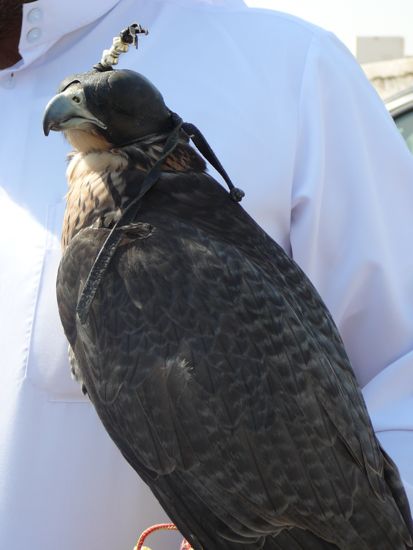
As we were heading into the Suq al Waqif for breakfast Saturday morning (Yes! Several of the restaurants are open for breakfast!) we saw a man and his son, both carrying falcons.

AdventureMan joked that they are hired by the administrators to walk around adding local color. We scoffed. Maybe someday, but for right now, these are still real people, with their own falcons. We know because our Kuwaiti visitor stopped them and asked about the falcons. They were so sweet and so delighted to tell us about their birds, and to allow us to photograph them:
There was also a lively bird auction going on:

What we love about the renovated market is that it is still a true market, where real people by daily items for use.
Karabaa in Transition
This post is for my friends not here, friends who often accompanied me on trips to Karabaa and all the funky magical shops we would find there. I dropped off the towels at the Mumtaz Tailor to be embroidered, English on one end, Arabic on the other, and while the devastation is no longer so gut-wrenchingly stunning as it was – I guess I am becoming desensitized – I can also see changes.
A lot of the rubble has been carted away. So it makes me wonder, is this what The Pearl is being built on? Is rubble from the old Suq al Waqif and these old buildings along Musherib and Karabaa going to the sea to become reclaimed land? If so, isn’t this going to boggle the minds of archaeologists a couple thousand years from now who are going to find all this stuff jumbled together and try to figure it out?
Yes, yes, it’s true, my mind does wander into trivial areas . . .
From the old parking lot, looking towards Karabaa where the honey man used to be:
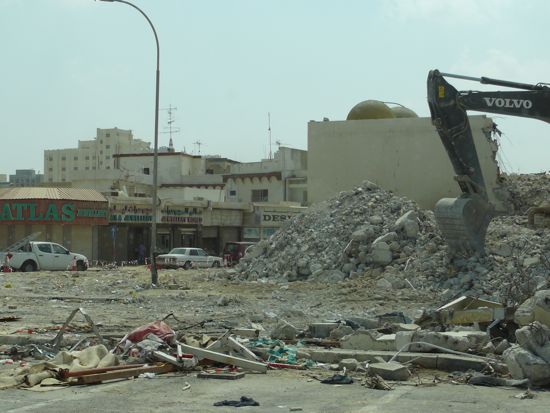
To help you know what you are looking at – remember the sign that shows people how to park? It’s still standing – so far 🙂

I wanted you to be able to see just how high the pile of rubble is:

All the rubble that was The Garden is now gone, as if it never was:
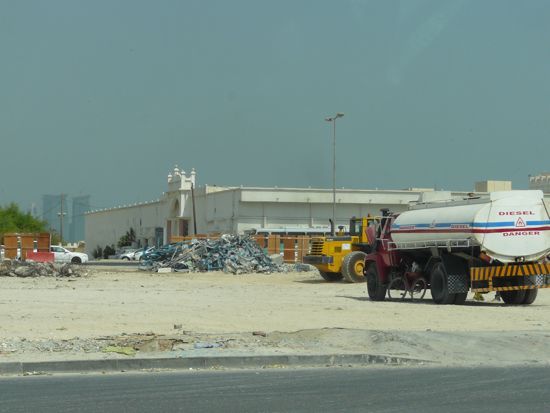
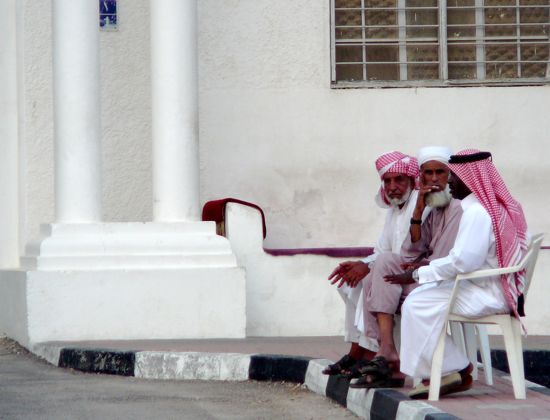
OK, now, in the midst of all this noise and demolition, the rubble and the trucks and bulldozers, there is this oasis of serenity. I often see old men sitting outside on those old fashioned built-in-plaster seating areas, or on the bench. Inside, it looks like it might even be a home for old indigents, but sort of palatial, very green, and well kept up. Is there anyone who can tell me what this is?

Doha Museum of Islamic Art Wins Coveted Award
What I love the most about this award is that it takes into account the usage of local materials. It’s also something I love about The Pearl development; all those buildings and villas built on the rubble carted away from earlier demolition projects and turned into reclaimed land. 🙂 Re-cycling to the max!
Museum of Islamic Art bags architecture award
Web posted at: 10/6/2009 1:19:1
Source ::: The PENINSULA
Dubai: Museum of Islamic Art in Doha was awarded “Overall Project of the Year” at the 2nd Annual Middle East Architect Awards.
Qatar Museums Authority (QMA) was presented with the award, for the Museum of Islamic Art – Doha, at a ceremony hosted by the Middle East Architect magazine.
The annual ceremony is the most prestigious event dedicated to recognise outstanding architectural projects in the region.
The Museum of Islamic Art was chosen for its traditional design principles that use indigenous materials and processes and integrates them with contemporary technology to create familiar, functional and environmentally sustainable architecture.
Accepting the award on behalf of QMA, Omar Chaikhouni, Manager of Public Relations and Information said: “We are delighted and honoured to be recognised as the top overall project in 2009 among all the nominees from the region. The Middle East Architect awards ceremony is a great initiative and we wish it all the success in years to come.”
Organised by ITP Business Publishing, the lavish awards ceremony took place at the Westin Dubai with the presence of more than 200 leading professionals from the region’s architecture industry, including architects, developers, service providers, contractors and building owners.
The 2nd Annual Middle East Architect Awards set out to raise the profile of the industry and reward and recognise those that have made significant contributions to its development.
Ten awards were presented at the ceremony in categories that covered a number of fields, from infrastructure project of the year to mixed-use development of the year, and from engineering firm of the year to architect of the year.
The winners were judged by a panel of experts, which consisted of industry-leading academics, architects and engineers from around the Middle East.
Attempt to Kidnap Kuwaiti Girl: Print Their Names
From the Arab Times
Here is what scares me about this story – the language. It says “the side glass of the car broke.” That is very neutral language. I am pretty sure that the girl who was the intended victim would not break the glass; it was part of the barrier protecting her from the would-be kidnappers. It bothers me that it doesn’t state that the man broke the car glass attempting to kidnap the girl.
It also bothers me that the language says that they have been “detained for interrogation.” These men are a danger to society. They need to be locked up, for their own good and for the sake of the innocent young women who are their potential victims. There are witnesses, including the police. Enough! Try them, convict them and put them away!
It is also time to start publishing the names of the men who commit these acts. Would you want your daughter to marry such a man? Your cousin? Your sister? Doesn’t a woman have a right to know what sort of man she is marrying? Yes, it would shame the families from which the kidnappers have come. It seems that maybe shame is the only effective tool for deterring this kind of shameful behavior. If the families forbade this kind of behavior, you would see a drastic drop in the crime of kidnapping. Print their names.
Women are not the only victims. These same entitlement-loaded kidnappers seize boys and young me off the streets, sometimes lure their own friends, take them to the desert and rape them. What are they thinking? What makes them think they have that right? What makes them think there will be no consequences for bestial behavior?
Police save Kuwaiti girl from kidnappers’ clutches in Shaab Entertainment Park
KUWAIT CITY, Oct 2: The Hawalli police recently foiled at attempt by two Kuwaitis to kidnap a female compatriot from the parking lot of the Shaab Entertainment Park, reports Al-Shahid daily.
It has been reported as the victim was about to pull out of the parking lot, the youths blocked her way with their car and one of them got down from his vehicle and tried to drag the girl into his vehicle.
At this point the victim strongly resisted and in the confusion the side glass of the car broke. The victim then cried for help and a passing police patrol went to her rescue.
Seeing police the suspects grabbed the victim’s handbag containing her personal documents, cell phone and money and tried to escape but police chased and arrested them.
They have been detained at the Hawally Police Station for interrogation.
Predators prey on those they perceive to be weak and without protection. We, society, are supposed to be protecting the weak. When this man is refused sex, he and his friends try to rape the man, and trash the entire massage parlor?
Kuwaiti Man attempts to rape Jordanian massageur
KUWAIT CITY, Oct 2: An 18-year old Jordanian teenager reported at Jahra Police Station that a Kuwaiti man attempted to rape him while he was massaging the suspect inside a men’s salon — where the complainant works, in the Industrial Area on Thursday.
He narrated the man offered to pay him certain amount of money if he acceded to his demand for immoral act, which the complainant turned down and immediately asked the suspect to leave the salon.
He stressed the suspect later tried to kidnap him, which he resisted, so the suspect fled with his friends, but they destroyed some contents of the salon before fleeing the scene. However, he managed to record the number plate of the suspect’s car, which the detectives found out it belonged to a Kuwaiti man. A case has been registered against the suspect.
New Regulations Enforced for Drinking in Qatar Bars
New bar rules evoke complaints
By Peter Townson/Staff Reporter
From The Gulf Times
A number of residents in Doha have complained about recently introduced regulations requiring them to apply for membership to certain bars and clubs as well as providing ID upon entering such establishments in Qatar.
Due to new national regulations, hotels are enforcing membership rules, ensuring that all visitors have either a valid Qatari ID, their passport, or in many cases a membership card to enter the premises.
The bars now have a published set of rules outside the premises to indicate the necessary entry requirements, and although certain rules change from place to place, the general guidelines are the same throughout.
All applicants for membership must be over 21 years of age and possess a valid Qatari ID card, and the printing of membership cards usually costs a small fee, ranging from around QR30 to QR50 (and QR100 for replacements in some cases).
However, the new rules have meant that many places have substantial queues outside their establishments, and during special events guests can often have to wait for over half-an-hour to have their membership cards of ID scanned by hotel staff.
A representative of one hotel bar in Doha claimed that another major issue with the new membership rules had been the problem of informing their guests of the regulations.
“It seems it has been the hotels who have had to tell people about these new rules, not the people who have instigated them,” he said, arguing that it would have been beneficial to have some information regarding the reasons for the new rules and their specific details.
“I think they brought in the rules to prevent people who are living here illegally from drinking in the bars, and also to stop Qatari ladies from entering any drinking establishments,” he added.
Another hotel representative explained that the introduction of the new membership system had cost the hotel a significant amount.
“It was a big cost to the hotel to get all the necessary software and hardware to create the membership cards and register everyone’s details,” he said, adding: “However, we are trying to keep the cost of membership as low as possible for our guests.”
He pointed out that the new regulations do make it somewhat easier to “control the clientele,” and said that the rules have made life easier for the busier bars in Qatar.
However, a number of Western expatriates who have lived here for many years have become disgruntled at the new rules, claiming that it makes it more difficult for them to enter bars – especially if they have guests visiting from aboard.
Many have reported that visitors have travelled to hotels, only to be informed that they cannot enter without their passport – a document most travellers like to keep safe in their hotel room when abroad.
And other visitors to the bars – especially those who are quite obviously over 21 – resent the need to screen their ID before entering establishments they have been frequenting for years.
Government regulations defining what is appropriate dress and behaviour have also been highlighted by the hotels.
But these have also been bemoaned by customers who have in fact been turned away from places because of the clothes they are wearing.
Government officials were unable to comment, except to confirm that new rules had recently been introduced to all establishments serving alcohol in the country.
Karabaa in Rubble
It’s even worse. Rubble everywhere. It looks like a war zone.
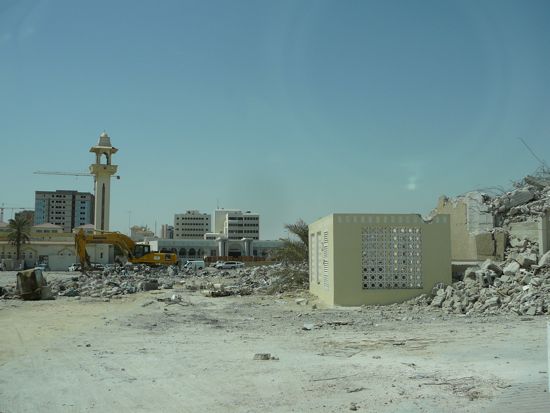
Ripping out the Heart of Doha . . .
Drive to Reduce Traffic Deaths in Qatar
I am a great admirer of Brig Mohamed Abduallah al-Malki. I remember once, when Qatar was much smaller, when he printed his phone number in the paper and told people to call him when they saw drivers misbehaving. What a brave man, a committed man, and a courageous man.
I admire his persistence, his sincere desire to bring down traffic deaths in Qatar.
Yesterday, as I was driving, I noticed most drivers slowing down – when that happens, you know there are new speed cameras set up, and you slow down too. You slow down – or most of us do. There are a visible few who seem to believe that the rules do not apply to them.
There is a persistent rumor that traffic fatalities fell dramatically when the new laws were introduced – and enforced – equally – against all law breakers. As long as laws are enforced equally against ALL nationalities, the death rate will lower.
To me, it is a huge national tragedy that so many young Qatteri men lose their lives, or are seriously physically damaged, in traffic accidents that could have been prevented. It is like a huge national resource, just wasted, all that potential, gone.
This is from today’s Gulf Times
Drive to raise students’ road safety awareness
Traffic department and IBQ officials at the launch of the campaign yesterday
By Riham el-Houshi
The ‘Schools without Accidents’ campaign launched yesterday for the second year running by the Traffic Department is aimed at cutting the number of road accidents in Qatar by half, a top official has said. The campaign aims at raising awareness about road safety among students.
Traffic Department expert and general co-ordinator of the National Campaign for Road Accident Prevention, Brig Mohamed Abduallah al-Malki, said “there has been a decrease in the number of deaths in 2009 but a final picture will emerge only by December.”
The number of road accident deaths in the country fell by 20% in 2008 compared to the previous year. The total number of road accidents last year was 20,455, with approximately 200 deaths, according to the Traffic Department.
The initiative, launched within the framework of the ‘National Campaign for Road Accidents Prevention,’ is a programme to raise awareness on the importance of road safety among students across Qatar.
Al-Malki added that 35% of road accident victims were pedestrians who were usually expatriates.
“Therefore the campaign this year will focus on expatriate schools as well as local ones,” al-Malki pointed out.
The campaign will be funded by the International Bank of Qatar (IBQ), who has given QR500,000 to the Traffic Department. The bank donated QR250,000 to the cause last year. According to al-Malki, the money will be spent on brochures, signboards, and competitions.
“Too many of our young people never have the chance to realise life’s opportunities as their lives are cut tragically short by preventable road accidents,” said IBQ managing director George Nasra.
“We can and must do even more to reduce the number of traffic accidents and fatalities – especially among our youth.”
A recent survey conducted by Gulf Times had shown that 41% of the respondents feel that Qatar was the worst country to drive because of the number of accidents caused by reckless driving.
Qatar Rents Expected to Fall Further as Supply Exceeds Demand
Hot off the press, in today’s Peninsula:
Experts expect house rents to fall further
Web posted at: 9/28/2009 0:55:46
Source ::: The Peninsula
DOHA: Real estate experts estimate that some 6,000 new housing units have sprung up in Doha and its suburbs for uptake this year alone.
With supplies having gone up, the experts expect house rents to fall by a further five to 10 percent over the short term.
House rents are believed to have dropped between 30 and 40 percent until now, says the manager of a real estate company, Falah Matar.
“So due to higher supply, tenants now have a lot of option,” he added.
According to Khalifa Al Muslemani, another real estate expert, some 6,000 new housing units have come on the market this year, further pushing supplies higher.
These are both private and semi-government projects. “Higher supplies have led to a fall in rents,” added Al Muslemani.
Talking of the existing rent law which was enforced in early 2008 for two years, Matar said there was the need for a new legislation to replace it once it expires in February next year.
The proposed law should either lower the limit by which landlords can raise rents annually to five percent, or retain the existing limit of 10 percent.
He allayed fears among tenants that once the current rent law expires landlords would begin to raise rents unjustifiably like they did in the previous years.
He said that due to excess supplies, tenants facing this kind of pressure from property owners would have the option to leave and look for alternative accommodation.
Agreeing with this view, an official from a real estate agency, Mahmoud Al Jirsha said tenants need not worry about landlords raising rents unjustifiably because of huge supplies.
The situation in the previous years was different because housing supplies were limited and the demand was far too more. “Reverse is the case now as supplies far exceed demand,” he added.
Girls of Riyadh by Rajaa AlSanea
“Have you read Girls of Riyadh?” my friend asked me on the phone, and when I said I had not, she said she would bring it to me.
“It’s an easy read” she said, “it will take you an afternoon.”
Sometimes life intruded. It took me a little longer. I had expected this to be lightweight, along the lines of the shopaholic books, read ’em and forget ’em. Airport reading, stuff you save to read when you know you will have time to kill.
I was surprised. I guess I had gotten the impression it was lightweight because I had seen it discussed on some of the blogs, and there are some light-hearted moments in the book. The four young women are well drawn, and their experiences are handled with sensitivity. She never reveals which character from the book she is, but I have my suspicions. 🙂
Each girl has her own unique experiences as she reaches young womanhood, and mating. Although the experiences are treated deftly, there is a serious undercurrent that belies the light tone. The underlying circumstances surrounding the mating rituals in a country so tradition-bound as Saudi Arabia turn mating into a dark ritual, full of unseen pits and minefields.
The very worst fear during these years is the wagging tongues of others. I have heard this theme over and over in my own dealings with young women in this part of the world.
“You know, khalto, a woman’s reputation is like glass, it is easily shattered,” explained my young-woman Qatteri friend, solemnly.
(for my Western readers, Khalto means ‘aunt’ literally, and is a term used respectfully for family friends, meaning ‘sister of my mother’)
“I don’t want to get married,” she continued, “They come for you as a bride and they are so nice and they make you feel so in love with them, but then, when you are married, they change. Men are . . . men are . . ”
“Dogs?” I asked.
“Yes! Yes!,” she exclaimed, “Dogs!” (pause)
“How did you know, Khalto?”
LLLLOOOOLLLLLLLLLL! It’s one of those moments when you know we are all more alike than we are different.
Girls of Riyadh is a worthy read. It is thought-provoking, and compassion-provoking. You grow to love these girls, and you hope a happy ending for them.
Recent Comments
intlxpatr on Shampoo Ginger tigerbutterya0c5ff1d… on Shampoo Ginger intlxpatr on British Soldier Kidnapped, Esc… John on British Soldier Kidnapped, Esc… intlxpatr on British Soldier Kidnapped, Esc… Wikipedia Donate Button

Amazina


Early Voting in Florida


