Rola Dashti Tackles Sensitive Issues
“Why are you looking so sad?” AdventureMan asked me as we sat down to dinner.
(Sigh) “There are people in Kuwait who don’t believe change is possible, and there is a movement afoot to WITHHOLD their votes as a protest.”
“Why do you care? It’s not your country?”
We call it “falling on your sword,” when a person does something fatal to self, to career, to family or to country, choosing an issue and staking everything on it. Rarely does it pay. The world moves on, life goes on and you are left behind bleeding on your sword.
Withholding your vote gives more power to those who are good at stirring up the rabble with irrational and selfish issues. Those who get the votes are those who make grandiose – and general – promises, those who refuse to be held accountable.
If you are a person who cares deeply about Kuwait – Please, do not withhold your vote. Do the hard work of listening to the candidates, and exploring their reputations for truthfulness and accountability. Think beyond your own needs, think of the greater good of Kuwait.
This is from today’s Al Watan; a candidate tackling some very sensitive issues, bringing them out in the open.
Ghenwah Jabouri
Staff Writer Al Watan
KUWAIT: In pursuit of winning enough ballots to secure a seat in the National Assembly, Dr. Rola Dashti, who is believed to be a potential woman candidate, delivered an emotive speech Monday evening to announce her parliamentary agenda if elected.
Dashti touched on sensitive and delicate issues which aroused the emotions of the audience, resulting in heated engagements later on in the evening.
Dashti mainly focused on family related issues, germane to women issues.
In an attempt to recoup the cynicism manifested by citizens toward parliament, Dashti urged the audience to not ponder on who is wrong or right.
“We need to move on; seeking to blame parliament, government, MPs, etc., is not going to serve us justice. We need to focus on developing Kuwait, rather then pointing our fingers at the wrongdoers, ” Dashti said.
She stressed that whether it was the parliament, the government, or the citizenship who committed the mistakes is not important; “what is important is that we learn from such mistakes.
“Individuals who have the cultural habituate of blaming, attacking and are cynical, do not want to move toward the future; rather, they want to travel back in time. Allow me to give you an example: last year, thirty percent of citizens in my constituency did not cast their ballot. These people are like you and me: their heart is burning for Kuwait, and they observed nothing positive, and they are in immense suffering.
“They gave up on hope and decided to ultimately not vote. Had half of them voted (nine thousand), ten people who would have succeeded in the Third Constituency elections would have determined a better fate for those that abstained from voting.” She further lamented that society should consider first and foremost Kuwait, and that the children, the youth and coming generations “deserve this.”
Dashti, further illustrating her point, noted: “For example, if soـandـsoـperson does not vote, who is going to protect their rights and so forth?”
Dashti stressed that Kuwait is experiencing “tumultuous times” and that the country is on the verge of a major collapse.
“Kuwait cannot afford political arguments and political confrontations and commotions. It is in our hands to save Kuwait. If we take responsibility, vote and call on those who did not vote to cast their ballot, change might have a chance of survival.
“Hundreds of people did not cast their votes because they lost their confidence in parliament. However, many families are suffering, and so, it is pivotal to acquire each and every vote; we need to give back what Kuwait bestowed us with.
“We need to give a little back to those who lost their lives to protect Kuwait during the Iraqi invasion in 1990; many people lost their lives during the invasion who fought for our liberty. Women were raped and families were torn apart. We need to give back a little, we need to continue to believe, and fight for our children and future generations,” Dashti added.
“Does Kuwait not deserve for us to stand in the cue for fifteen minutes to cast our votes?”
Talking more about women”s issues, Dashti noted that there are many things that need to be considered where women’s issues are concerned.
“Women have many burdens that they shoulder; the divorced, the widowed, the one who is married to an expatriate, and housing for women, all are issues the Kuwaiti woman suffers from.”
She pointed out that not every family is living happily, “although this is something I would love to achieve.
“Today, the Kuwaiti family has to wait fifteen years for (government) housing. Where will the divorced woman go during this lengthy period?
“This woman could be my sister, my mother, or our daughter; where does she go?”
Dashti noted that the law stipulates that a woman who is over forty years of age and both of whose father and mother are deceased and is unassisted by a guardian “is entitled to receive a housing allowance.”
“However,” Dashti said challenging the law, “what about other women in a somewhat parallel situation where the father is deceased but is not receiving allowance from her guardian ـ what can she do? Shall the woman take her guardian to court to sue him?
“Why does the law in pursuit of helping women insist on punishing them, even insulting her?
“This law is one of many that are flawed and need to be amended,” Dashti stressed.
She further said that “neither Kuwait or the people of Kuwait can tolerate empty words and useless slogans. Today we need to put many things on the table and take action in tackling them.
“Let”s now have a look at the children of some Kuwaiti women who are married to expatriates: we need to look at their educational, health, and employment and social needs and treat them with justice, like other children are treated who have Kuwaiti fathers.
“This is their country, why are we abusing them? These are our cousins, our brothers and sisters, and have to be treated with equality when their mother is a citizen of the country.”
She further added that citizens have been “fooled” enough; “vote for someone who knows what they can do, someone who can save us from the financial burden.” Touching on an issue that has become central in campaigns, Dashti noted, “We should not allow people who do not understand finance to tamper with the budget.
“Nor should we allow individuals who are responsible in dealing with the financial budget to use the financial budget for personal gains.”
“Why should we follow those who damage our financial budget, and steal the money of the public? There is another option: choose someone who will protect the public financial budget and enhance the budget!”
Dashti further stated that there is an “internal bleeding” in the country and that she is not going to offer an “aspirin to silence your pain to only kill you” as a member of parliament.
“I will opt for a long term alternative and choose to cure you.”
During the question and answer session following her address, particularly passionate but enraged voices emerged, where some expressed their frustration with the old faces of parliament.
One woman said she was “fed up with the old faces and that it is about time new faces took over.”
She further said, “We have been deceived, fooled and cheated by the old MPs,” and stressed, “We are suffering and are in desperate need of MPs who will promote social and financial justice.
“Kuwait has hit a plateau and something”s got to give,” she noted.
Another woman made a remark about Dashti”s strong foreign accent.
She noted: “Society often criticizes you (Dashti) for speaking in a Lebanese accent.
“I don”t understand why you come under scrutiny for such a reason. After all, people have television at home and typically watch the satellite channels, all of which speak in foreign accents.”
The woman”s comment was understood to be a positive comment, where she welcomed Dashti”s candidacy and believes that the candidate will be a forceful vehicle towards righteous deeds toward society.
Another frustrated woman spoke about property and about people whose houses was taken from them by the banks. She said that she read an article in Al Watan newspaper that there are many withdrawn properties and houses for sale.
“The inheritors are crying blood and are traumatic, because their houses are being taken from them. Other citizens are staying in small apartments after they used to occupy villas,” she said.
Another woman who was virtually in tears pled to the people “to opt for change and choose new faces, even if the new members of parliament will do nothing.
“The former parliament has tormented and killed me; please, give your votes to new faces, in the name of God, please, vote for change.”
Free Speech in Fiji
It was prime drive time in Kuwait, and I almost laughed so hard that I might have been a danger on the road. A brief news article on BBC News featured the national leader in Fiji saying “free speech is nothing but trouble.” The news reporter was saying that the only real news in Fiji right now is from the bloggers. Here is a fragment of an article on BBC April 15th:
Free speech ‘trouble’
In an interview with Radio New Zealand, Mr Bainimarama said he was determined to carry out what he described as reforms.
He defended the introduction of emergency regulations that include an edict that the local Fijian media publishes only positive news, saying Fiji does not need free and open public discussion about current issues.
“That was how we ended up with what we came up with in the last couple of days,” he told Radio New Zealand.
“The circumstances have changed. We [the government] now decide what needs to be done for our country, for the reforms that need to be put in place for us to have a better Fiji,” he said.
Fiji’s Court of Appeal ruled last Thursday that the Bainimarama regime, in power since staging a 2006 coup, was illegal under the country’s 1997 constitution.
In response, the country’s ailing President Josefa Iloilo sacked the judges, dissolved the constitution and reappointed Mr Bainimarama, who then said there would be no democratic elections until 2014.
Income Tax Blessing
You didn’t think those words could all be used in the same sentence, did you? AdventureMan and I have to pay something called “quarterly estimated taxes” and this year, I guess because our investment income went seriously down, we overpaid our taxes. I know, I know, that doesn’t sound like good news to you, but it sure beats the pit-in-the-stomach of learning that you owe more to Uncle Sam. We overpaid, and we will go ahead and apply it to next year’s taxes and hope that everything works out well next year, too.
We used to talk to my father about ways he could pay less tax on his income and savings. He would look at us and say “But the government was always good to me!” (he worked for the government) “They paid my salary! They pay my retirement! They help pay my medical bills! Why would I not want to pay them taxes?”
It was an extraordinary attitude; I have never forgotten it.
Horseback Riding Camp

“Whatever you might have heard from your kids” the camp director started, and AdventureMan and I looked at one another with concern, “it is just rumors. The counselors did not have a big drunken party, and we have the situation under control.”
We hadn’t heard anything. We were there to pick up our son and his best friend from Horseback Riding Camp. They were eight years old and this was their first time away. We had dropped them off a mere week before, at the clean clean little chalet camp in Southern Germany, where they would learn to ride and take care of their horses.
“So, son,” AdventureMan starts with that casual voice grown-ups use with their children when about to launch an interrogation, “tell us about the camp!”
We were driving back, and wanted to get a campers-eye-view of the week. Our eight-year-old son was exhausted and not very talkative; it was only during the following week that most of the details came out.
He hated horseback riding. He hated taking care of horses. The instruction they got was minimal to non-existent. Most days they missed their horse riding lessons because the counselor overslept. The kids got up and got their own breakfast – cereal – until the milk ran out, and then they ate it dry.
Horrors. We had done everything right. We had checked the camp references, had visited and inspected the camp before deciding to send him there, had met the counselors – horrors! In fact, our son enjoyed the week, but mostly because they had a TV, and no supervision. They spent most of the week watching TV.
In the following years, he went to other camps – adventure training camp, karate camps, Space Camp (that was the best organized) and then became a camp counselor himself, teaching karate. Our most graphic memories as parents, however, are of picking him up at horseback riding camp and learning how loosely organized and supervised it was, compared to what the brochure said and the inspection visit promised.
Kuwait: Our History Runs in our Blood (Mohammed Ali Dashti)
Kuwaitis showing new interest in the past; Traditions, culture wiped out by ‘change’
From today’s Arab Times; you can read the entire interview by clicking here
A born artist makes it his life’s mission to chronicle the past of Kuwait using his artistic skills and his academic erudition. His brush strokes have brought to life scenes from a Kuwait straddling a dying hidebound order and a modern state taking birth. His passion drove him beyond the pale of his canvas to physically revive some lost traditions for posterity.
Read on to find out more about Mohammed Ali Dashti’s enchanting four-decade long mission and some of the precious values from the past which we have now lost and which he fears we may never recover.
Q: You are involved in a rather enchanting profession of recreating the past. What is your goal?
A: When oil was discovered in Kuwait, the state underwent a rapid transformation. The change was very sudden and very fast. In a short span of time, Kuwait leapt from an ancient system to a very modern state. This change wiped out many elements from our traditions and culture.
Until sometime ago, the people of Kuwait were disposing of the antiquated paraphernalia from their homes. But now, there is a sudden interest in these items, and now they are buying them back to preserve the past. It is the only way of holding fast to our roots and knowing how our forefathers, not from a distant past, conducted their lives. Kuwaitis are buying doors and furniture used in the old Kuwaiti homes.
We, as an organization, are working to preserve our history for posterity to learn and know. We produce ancient household items like the Mubkhar (incense stand) with which our grandparents used to scent clothes and fan fragrant smoke around the house.
In the old days, we had no airplanes or cars. The only way we were connected with other places in the region was the sea. Kuwait, owing to its geographical advantages, became a center for shipbuilding. Kuwaitis were experts in making dhows for different purposes. Boats were built in a variety of sizes and designs based on their use. There were cargo ships, fishing boats and vessels for pearl diving. The size of boats ranged from a meter to up to 6 meters. This is another aspect of history that we are trying to preserve and we have been recreating many of the original models our ancestors voyaged in.
We showcase our creations at universities, malls, schools and other places. Thus we have been able to generate interest in our past. We take our craftsmen along and explain to the present generation about Kuwait’s history.
Q: What do you think has created this new interest in the past among Kuwaitis? Can this be read as a reemergence of old traditional values?
A: Our history actually runs in our blood. It is very difficult to detach ourselves from our cultural roots. And so whenever any nation travels too far away from its true origins, at some point of time, it stops and tends to recall the past. History is what gives our existence contextual relevance. And we often try to find it by clawing back into our past, by remembering the way we came through.
Q: You said you make old-model boats. Aren’t you specialized in Warjiyas, the simplistic fishing boats from the past? Which is the biggest boat you have ever built?
A: The biggest boat I have ever built so far is 6 meters long. I make Warjiyas because it is most symbolic of our old fishing traditions. These boats were very famous among the people on Failaka Island. They used it for fishing and it is very easy to construct.
The specialties of Warjiya are: it is wholly made of palm tree to the last detail. The body is built with spines of palm leaf, which are trussed using ropes made our of palm fiber. It is very light and so easy to carry.
Warjiyas sort of became extinct about 60 years ago with the advent of oil and the independence of the state’s economy from fishing and pearl diving. We can’t return to those ancient livelihoods, and so we are now planning to start an annual Warjiya race to keep the tradition alive. The first race will be held in September this year.
Q: Do you have any plans of reviving even the tradition of fishing along with these boats?
A: No, as I said, we can’t actually go backwards to keep our original traditions alive. So, these things can only happen in a token manner. The aim is to keep the future generations aware about how their grandfathers and people before them lived. We don’t have to make our children live a similar life to make them appreciate the ancient way of life.
Q: All over the world there is great demand for antique items. Is what we are seeing in Kuwait a similar trend — a fascination for antique pieces — or is it more than that?
A: No. It is not just a fad in Kuwait. The people really care for the past and there are efforts at all levels to preserve relics from the past or have their duplicated versions. These efforts have been sincerely undertaken by Kuwait National Museum and other private museums in the country, and between them they share a vast treasure of valuable relics and information about Kuwait’s past.
The government is also giving due encouragement to all of us to help us in our endeavors. The ministry of information is doing everything within its means to promote our traditional and cultural heritage in other Gulf countries and beyond.
Easter Sunrise and Noah’s Ark
Today is the most beautiful day in the church year, Easter Sunday. Mary and Mary go to the tomb where Jesus was laid, only to find the 2 ton stone rolled away from the entrance, and angels waiting there, telling the women that Jesus was not there, that he had arisen. If you have been reading this blog for any time at all, you will know that it delights my heart that women were the first to know, and that Jesus, resurrected, appeared first to a woman. In the Bible, she tells the men and they don’t believe her. LLOOLL.
It is a glorious Easter morning:

As part of her Easter greeting today, a friend sent the following, which I love. Since all three traditions, Jewish, Christian and Moslem, celebrate Noah (Noh) I thought I would share it with you.
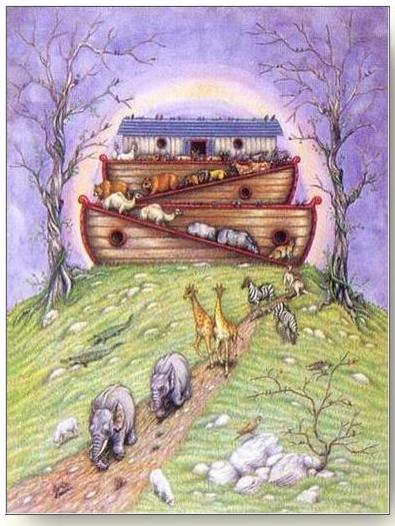
Noah’s Ark
(Everything I need to know, I learned from Noah’s Ark. )
ONE: Don’t miss the boat.
TWO: Remember that we are all in the same boat!
THREE: Plan ahead. It wasn’t raining when Noah built the Ark.
FOUR: Stay fit. When you’re 60 years old, someone may ask you to do something really big.
FIVE: Don’t listen to critics; just get on with the job that needs to be done.
SIX: Build your future on high ground.
SEVEN: For safety’s sake, travel in pairs.
EIGHT: Speed isn’t always an advantage. The snails were on board with the cheetahs.
NINE: When you’re stressed, float awhile.
TEN: Remember, the Ark was built by amateurs; the Titanic by professionals.
ELEVEN: No matter the storm, when you are with God, there’s always a rainbow waiting.
Have a great day, a blessed day, Kuwait.
Bees and Bee Keeping in Kuwait
Also from the Kuwait Agrifood Website – who knew? Who knew there was a family in Kuwait working to build a viable honey-production culture? I came across this accidentally, and love the site.
Growing up, i remember hearing that people with allergies should eat local honey, it helps build resistance (don’t ask me, I’m not a doctor!) and, in addition, we are all trying to shop and live more locally, so having Kuwait honey is – to me – way cool.
Have you seen honey from this farm in the markets? Can you tell me where?
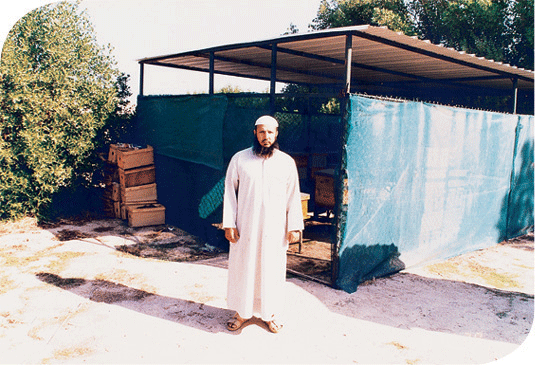
Established in 1996 as a small apiary with 1-15 hives. A year later the apiary was supported with 5 hives imported from Al Yahya Company in Egypt which appeared to be a good start and was of distinguished quality and quantity. That encouraged us to invest in this field and plan to take it as a side job
Ever since that time the apiary grew year after another till the number of hives reached 300 in the year 2002 and it greaw rapidly in the following year till it became 700 hives distributed in different areas of Kuwait
Our production is divided into 3 Seasons. We produce 4 different kinds of honey: These are Cidar honey (main products) lasts from 10/9- 10/11 every year. The second season includes 2 products: flowers honey. (Rhanterium epoposum) and spring honey i.e. flowers of inhabited areas this lasts from 10/3-10/5 every year. The third season started in 10/5- 10/7 and is mainly kina honey
We bread a good kind of bees internationally well known: Crinoboly and Italian, both are originated from AlYahya Company- Egypt. We are producing Italian queens of a very good quality able to adapt with Kuwait environment. A test is being implemented in our apiary upon which we will decide whether we will be able to fill our needs and the needs of local market
We have a specialized team who know how to choose good places, provide wooden hives, import bees and settle it inside the wooden hives and carry out all necessary care such as follow up, supervise, feeding and honey cultivation
FAHAD BIN AJAJ Apiary
Jaber Al-Ali Suburb 7th – block 1 – Street 5
7911796-7192738 7192738 – 7911796 – Tel
e-mail: hunyQ8@yahoo.com
William Dalrymple: The Age of Kali
Having read and loved In Xanadu: A Quest by William Dalrymple, and having received recommendations by friends who say they read ALL of William Dalrymple, I started on this second book, The Age of Kali. I didn’t like it, not one bit. I am proud to say I read it all the way to the end, because often if I don’t like a book, I will say to myself “I don’t need this!” and toss it, but I didn’t, I stuck with it. I am proud because it isn’t easy to stick with a book you don’t like, and I didn’t like this book.

In Xanadu, Dalrymple was wryly funny, hilariously funny, and most of the humor was directed at himself. In The Age of Kali, there is nothing funny.
The Age of Kali is a series of interviews and adventures in India and Pakistan. The author did these interviews and took notes (some are published in slightly different forms as magazine articles) over a period of ten years and then strung them all together to form this book. There is little or no linkage from one to the other. They are grouped geographically.
Here is what I like and admire – this man achieves the most amazing interviews, many times just by asking the right person at the right time. He insinuates himself, asks easy questions, and then sticks in a hard question. He doesn’t seem to flinch from putting himself in danger, and he doesn’t stand on respect when asking his questions. I admire that he went difficult places, interviewed difficult people, and wrote the interviews up without fawning over the celebrity status of his interviewee.
What I don’t like is that he doesn’t seem to like anybody very much. There are no funny anecdotes. By the end of the first interview, I began to get an impression that he doesn’t like India very much (and I believe that is NOT true, as he lives part-time in Delhi) and that India is not a place I want to visit. He interviews corrupt politicians, descendants of the moghuls, Benazir Bhutto – and her mother, Imran Khan (the cricket player) and many others. In each and every interview, he maintains a distance that tells us he doesn’t like these characters very much.
Here are some quotes from early in the book:
These days Bihar was much more famous for its violence, corruption and endemic caste-warfare. Indeed, things were now so bad that the criminals and the politicians of the state were said to be virtually interchangeable: no fewer than thirty-three of Bihar’s State Assembly MLAs had criminal records, and a figure like Dular Chand Yadav, who had a hundred cases of dacoity and fifty murder cases pending against him, could also be addressed as the Honorable Member for Barth.
As he interviews Bihar politician Laloo Prasad Yadav:
I asked Laloo about his childhood. He proved only too willing to talk about it. He lolled back against the side of the plane, his legs stretched over two seats.
‘My father was a small farmer,’ he began, scratching his balls with the unembarrassed thoroughness of a true yokel.
OK, that was funny. I had to read it aloud to AdventureMan. One of the things that still unnerves me living here is that the men are always touching themselves – something so totally forbidden in my culture as to be simply unthinkable.
In his section about Pakistan:
These people – the Pathans – have never been conquered, at least not since the time of Alexander the Great. They have seen off centuries of invaders – Persians, Arabs, Turks, Moghuls, Sikhs, British, Russians – and they retain the mixture of arrogance and suspicion that this history has produced in their character. History has also left them with a curious political status. Although most Pathans are technically within Pakistan, the writ of Pakistan law does not carry in to the heartland of their territories.
These segregated areas are in effect private tribal states, out of the control of the Pakistan government. They are an inheritance from the days of the Raj: the British were quite happy to let the Pathans act as a buffer zone on the edge of the Empire, and they did not try to extend their authority in to the hills. Where the British led, the modern Pakistani authorities have followed. Beyond the checkpoints on the edge of the Peshawar, tribal law – based on the institutions of the tribal council and the blood feud – rules unchallenged and unchanged since its origins long before the birth of Christ.
When I read this, I think of recent headlines about the problems Pakistan is having maintaining order, fighting the status of “failed-nation”, and the chaotic administration of tribal “justice.” The old ways have endured – but as we learned in Three Cups of Tea, there are villages where villagers are eager to have modern schools, eager to educate their daughters, and they, too, are victims of the fanatics who burn the schools and throw acid on women attending school.
The author is told, time and time again by Indian citizens, that India has entered The Age of Kali, “the lowest possible throw, an epoch of strife, corruption, darkness and disintegration.” The book reflects the darkness, corruption and disintegration the author found. I only wish there were some moments of relief, of lightness, hope or humor to encourage the reader on his/her way, but the documentation of this lowest throw was relentless.
Brilliant Sunrise, 5 Apr 09
Goooooooooooood Morning, Kuwait! 🙂
It is going to be another gorgeous day in Kuwait. Don’t let this “heavy fog” deter you. When I got up, the sunrise was so bright, I couldn’t see the sun, it was refracted all over the sky. I was only able to get the shot by focusing on the reflection of the sun on the water.

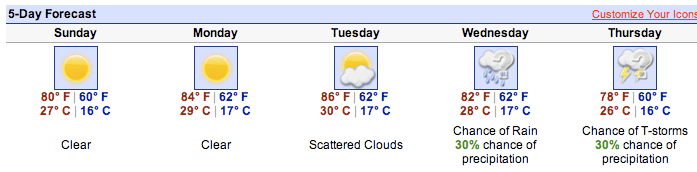
It is going to be a fantastic week – sweet warm days and cooling off evenings, perfect for sitting outside and drinking coffee, visiting with friends – and a little later in the week, a chance of more rain:
AdventureMan and I saw Journey to Mecca yesterday, along with about 500 others living in Kuwait. The movie is still packing people in! The audience was about 3/4 full with children, and I thought “oh this is going to be great, crying children and people talking on their cell phones.” I was SO wrong. Although the movie theater was full, I did not hear a single phone, I did not hear a single crying child – the movie held us all spellbound. We loved the movie, and we loved seeing it in the IMAX theatre.
(There are special headsets for non-Arabic speakers, with the dialogue in English. We didn’t know; they just spotted us as probably-non-Arabic and handed us the headsets.)
Sometimes, I am just slow. My niece, Little Diamond, had recommended a book called Travels with a Tangerine: From Morocco to Turkey in the Footsteps of Islam’s Greatest Traveller, but it was not until yesterday that I got it – that Ibn Batuta was from Tangiers! Sometimes, I am just slow . . . sometimes I can grasp subtleties but the obvious escapes me totally.

You can buy this book from Amazon.com for a mere $10.17 plus shipping. Yes, I own stock in amazon.com.
You can also probably find it at the Kuwait Bookstore, that amazing store in the bottom of the Al Muthanna Mall, near the Sheraton Circle downtown.
What Dreams Mean
Today on AOL heath: I was reading this article out of idle curiousity until I came across my own dream – below. I had college exam dreams for years – I had dropped a Shakespeare class but somehow it hadn’t been registered so I had to take a final I was not prepared for.
Later in life, one night I woke up groping the bed, scared my husband to death, and when he asked what was the matter, as I desperately searched the sheets, I said “I’m looking for the baby!” I was a brand new mother, and for me, it was very stressful.
Now, most of my really bad dreams come when I have a move coming up – panicked dreams of the movers arriving and I an not ready, or a flight to catch and I have not packed. Recently, I had a dream where I was stressed over not being ready for a flight and the airline called and asked me “Are you coming? We are ready to close the gate!” and (although I was not packed) I said “I’m on my way! Hold the plane!” and I woke up gasping.
It never occurred to me I would see my worst nightmare in print. Go Here read through and tell me if you see yours. . . What’s your nightmare?
Theme: unpreparedness
The dream: “I’m back in high school and don’t know which classes I’m supposed to go to, so I end up missing one — usually Mr. Westerman’s world religions class. I become terrified about not knowing when the tests are, then finals come around and I wake up completely freaked out!” — Lori Huffman, 31, Houston
Variation: You’re rushing to catch a flight but haven’t packed or can’t find your ticket. A new mother may dream she can’t find her baby.
What it means: Dreaming about something you’ve already accomplished (i.e., graduating from high school) can mean you’re scared to make mistakes in an area where you usually succeed. “Perfectionist people tend to have these sorts of dreams,” says Kramer. One explanation is that you may be tying your self-worth too tightly to how you perform at work. If you usually spend hours fretting over an upcoming event or presentation, give yourself a set time to prepare and then force yourself to put it out of your head. “The outcome doesn’t change by agonizing over it,” assures Nezu.
Recent Comments
Kitchen on Isiais: Winding Down intlxpatr on Shampoo Ginger tigerbutterya0c5ff1d… on Shampoo Ginger intlxpatr on British Soldier Kidnapped, Esc… John on British Soldier Kidnapped, Esc… Wikipedia Donate Button

Amazina


Early Voting in Florida


