‘Staggering’ Traffic in Qatar as Cars Exceed Highway Capacity
From the Gulf Times Qatar
By Bonnie James/Deputy News Editor
Increase in the number of vehicles beyond the carrying capacity of roads, improper driving manners of many motorists and road works are among the key factors behind the acute traffic congestion currently being experienced in Doha and suburbs, it has been pointed out.
Brigadier Mohamed Saad al-Kharji, director of the Traffic Department, was on record the other day that the number of vehicles in Qatar has exceeded 1mn.
The total number of registered vehicles in Qatar had stood at 876,039 in 2012, according to official statistics. This means, as many as 123,961 new vehicles have been added to the roads within nine months of this year, at the average rate of a 13,773 every month, whereas the 2012 average for new vehicles was only 5,138 per month.
“The increase in the number of new vehicles is staggering and at almost three times the monthly average from 2012, it now exceeds the carrying capacity of the roads of Doha and suburbs, even from a layman’s perspective,” a traffic safety expert said.
This is evident on Al Shamal Road, a vital link of the Qatar Expressway Programme and a major arterial thoroughfare, during peak hours from Sunday to Thursday. All the way from The Mall signal to the Gharrafa area, the highway is clogged with bumper-to-bumper traffic.
“The average speed on Al Shamal Road would be around 30kmh, as against the maximum allowed speed of 100kmh, and that too if there are no accidents,” observed a motorist who drives on the highway regularly.
The congestion on Al Shamal Road has gone from bad to worse ever since the reopening of schools on September 10, compared to the time before the summer vacation, asserted another resident.
“Al Shamal Road is the preferred choice of tens of thousands of motorists who have to travel to the northern parts of the country and back, but the carrying capacity of its busiest portions has been exceeded,” the expert maintained.
Though Al Shamal Road has three lanes each in either direction, they are proving thoroughly inadequate during the rush hours. “You have to go beyond the Gharrafa stretch to be able to drive at the maximum permissible speed, if proceeding to the north,” a motorist said.
Many road users also feel the traffic management strategy leaves much to be desired, especially with regard to Al Shamal Road.
“On Thursday, access from many service roads to Al Shamal Road was blocked off in a bid to ease congestion on the highway. But this led to vehicles being stuck on the service roads for up to 40 minutes,” a road user recalled.
A parent who drives his children from the Qatar Decoration area of Salwa Road to their school at Duhail, a distance of about 23km, said it took him more than one hour to reach the destination, as access to Al Shamal Road from the service road at Al Waab was blocked.
“My children were late for school the first time this academic year as we were stuck on a service road for nearly 40 minutes while vehicles were moving fast on Al Shamal Road, a rare sight these days,” he said.
Many motorists don’t use indicators or move ahead promptly when the vehicle in front moves. “It is a common sight to see people having their breakfast, putting on make up, or having animated conversations on a handheld phone, while they are behind the wheel, oblivious to the fact that they are holding up traffic and aggravating the congestion,” noted a woman who observes the road scenes from her front passenger seat.
The traffic situation on the Corniche is expected to take a turn for the worse, given that Grand Hamad Street’s intersection with Doha Corniche has been closed for 10 days from Thursday midnight.
“If I used to start from home at 6.30am before summer vacation, I leave 15 minutes early these days, but now I guess I have no option but to start even earlier,” another motorist added.
The helicopter patrol, introduced by the Traffic Department since last week, to help ease congestion on Qatar roads by giving guidance to police on the ground during morning rush hours has improved traffic flow by 30%, according to Brigadier al-Kharji.
God Vs. Worry; God Wins
One of the things that adds texture to my life, and helps keep me on the straight and narrow (and that takes a LOT) is reading the daily lectionary every single morning of the year, before I do anything else. Normal days, I access it from my computer, traveling or appointment days, I can access it from my iPad or iPhone. It’s like a little extra fence that helps keep me safe from myself and my own creativity when it comes to evil.
There is another side, the blessing side. In one of the bible studies I attend, we learn, over and over that God blesses the believer. You don’t have to be perfect – and it’s a good thing, because none of us are. If you want to see how much God can love a sinner, just read your bible. Sin is one of the main characters, right along side Abraham and Sarah, Job, Lot, and especially King David.
But in my life, I have seen wondrous things, and I have had some totally WOW moments when God has blessed me beyond any prayer I could have raised. One of those moments was showering under a waterfall near an oasis in the Tunisian desert. Two others happened this year, and these were blessings that stopped me in my tracks with their timing and aptness. First, we got an unexpected tax refund which arrived in our account just in time to cover the big expensive air conditioning system on the main floor when it broke and had to be replaced.
Second, when we were looking for the last few thousand dollars to help us buy a new car (we prefer to pay cash) we got another tax refund – we had asked that they re-look taxes for a move, and they allowed the moving expenses. We had waited almost a year for that decision; we had waited so long we had pretty much forgotten and given up on it. I mean tax refunds – it’s a never-never land, it all seems so arbitrary. You can have a perfect case, and it can be denied for a reason you’ve never heard of.
God’s timing is perfect. His sense of humor is breath-taking. The funds we needed poured into our hands just when we needed them, in just the right amount.
Matthew 6:25-34
25 ‘Therefore I tell you, do not worry about your life, what you will eat or what you will drink,* or about your body, what you will wear. Is not life more than food, and the body more than clothing? 26Look at the birds of the air; they neither sow nor reap nor gather into barns, and yet your heavenly Father feeds them. Are you not of more value than they? 27And can any of you by worrying add a single hour to your span of life?* 28And why do you worry about clothing? Consider the lilies of the field, how they grow; they neither toil nor spin, 29yet I tell you, even Solomon in all his glory was not clothed like one of these.
30But if God so clothes the grass of the field, which is alive today and tomorrow is thrown into the oven, will he not much more clothe you—you of little faith? 31Therefore do not worry, saying, “What will we eat?” or “What will we drink?” or “What will we wear?” 32For it is the Gentiles who strive for all these things; and indeed your heavenly Father knows that you need all these things. 33But strive first for the kingdom of God* and his* righteousness, and all these things will be given to you as well.
34 ‘So do not worry about tomorrow, for tomorrow will bring worries of its own. Today’s trouble is enough for today.
Or How About A Gold Mine in Burkina Faso?
Dear Sir
We are village local gold miners located here in Burkina Faso in West Africa we
hereby make this offer of au metal gold dust under the penalty of perjury with
full responsibility. the purity below.
1. Product: Au metal (gold dust) & (dore gold bar)
2. Origin: Burkina Faso, west Africa
3. Type: alluvial
4. Purity: 92.8% or better(gold dust) & 96.8% or better(dore gold bar)
5. Carats: 22+
6. quantity :400kg(gold dust)and 350k(dore gold bar)
7. Price gold dust: $34,000usd(CIF) & $28,000usd(FOB)
8. Price dore gold bar: $36,000usd(CIF) & 32,000usd(FOB)
PROCEDURE FOB
Buyer will have to come to Burkina Faso for face to face transaction, The
Seller brings the gold to BUMIGEB (Ministry of Mines) Ouagadougou, where the
gold will be essayed in the presence of Buyer. Buyer pays for the gold and pay
for all export taxes. We can also FOB to AA Minerals or PMMC refineries in Accra
Ghana. The Seller ships the gold to Accra Ghana, Buyer meets up with Seller at
any of these refineries. The gold is essayed in the presence of both Buyer and
Seller, after which Buyer makes payment through Seller’s account with any of the
refineries.
goldmines226@gmail.com
My Friend BOUDA NAZIKO in Ouagadougou
When we were with the embassy in Amman, there was a joke that if you were really bad, you would be sent to Ouagadougou. When I see Ouagadougou, I still smile. I did not know that I have a friend in Ouagadougou who wants to share a lot of money with me. He just needs a few of my personal financial details . . .
He got a little careless, I think, and sent me his draft. He was so excited, he sent it to me twice, with an unidentified party invite at the bottom, LOL.
نعم Can you Assist Me..
FROM THE DESK OF MR BOUDA NAZIKO
AUDIT/REMITTANCE DEPARTMENT OF
OUAGADOUGOU BURKINA FASO
ALTERNATE E-MAIL 😦 mr_bouda.n@outlook.com )
SIR/MADAM,
(CONFIDENTIAL)
I KNOW THAT THIS EMAIL WILL BE A BIG SURPRISE TO YOU, BUT I WANT YOU TO CALM DOWN AND READ VERY CAREFULLY. I GOT YOUR IMPRESSIVE INFORMATION THROUGH ONLINE INTERNET HERE IN OUAGADOUGOU, BURKINA FASO. I CONTACTED YOU TO BE MY PARTNER AND PERSON TO BE VIABLE AND CAPABLE TO CHAMPION A
BUSINESS OF SUCH MAGNITUDE WITHOUT ANY PROBLEM, ALTHOUGH I DON’T KNOW YOU BEFORE, NIETHER WE HAVE MET BEFORE BUT I BELEIVE GOD THAT YOU WILL NOT SEAT ON THIS FUND WHEN ITS GET TOYOUR COUNTRY POSTION.
I HAVE A BUSINESS WHICH WILL BE BENEFICIAL TO BOTH OF US. THE AMOUNT OF MONEY INVOLVED IS ($ 2,700:000:00 TWO MILLION SEVEN HUNDRED THOUSAND US DOLLARS) WHICH I WANT TO TRANSFER OUT OF THE COUNTRY TO YOUR BANK ACCOUNT, ALL TO MY FINANCIAL BENEFIT AND YOURS TOO AND
ALSO TO TAKE MY WIFE ABROAD FOR TREATMENT OF LIVER DAMAGE.
THIS MONEY IS OWNED BY A MAN CALLED BAO YU, A BUSINESS COMMERCIALIST IN WEST-AFRICAN REGIONS. HE HAS BEEN DEAD SINCE SIX YEARS AGO AND SINCE THEN; NO CLAIM HAS BEEN PLACED ON HIS BANK ACCOUNT BALANCE.
I WANT TO TRANSFER THIS MONEY OUT OF THE COUNTRY BUT SUCH FUND CANNOT BE TRANSFERRED WITHOUT A NEXT OF KIN ATTACHED TO THE FUND.
THE FUND COULD BE TRANSFERRED IN THESE WAY; YOU SHALL PRESENT YOURSELF AS A BUSINESS ASSOCIATE TO THE DECEASED PERSON AS DETAILS SHALL BE THAT YOU ARE THE CARE-TAKER BUSINESS ASSOCIATE TO LATE DECEASED CUSTOMER AND HIS PROPERTIES.
I SHALL MAKE AVAILABLE TO YOU MATERIALS AND INFORMATION WITH WHICH A SUCCESSFUL CLAIM SHALL BE PLACED ON THE FUND. I SHALL ALSO BE YOUR GUIDIANCE AND INSTRUCTOR THROUGHOUT THE DURATION OF THIS TRANSACTION SO AS TO ENSURE A SWIFT AND SURE TRANSFER OF THE FUND TO
YOUR BANK ACCOUNT.AS TO YOUR BENEFITS, YOU SHALL BE ENTITLED TO 40% OF THIS FUND FOR YOUR CO-OPERATION IN THIS TRANSACTION WHILE 5% WILL BE SET ASIDE FOR EXPENCES INCURED DURING THE COURSE OF THIS TRANSACTION.
IN FACT I COULD HAVE DONE THIS DEAL ALONE BUT BECAUSE OF MY POSITION IN THIS COUNTRY AS A CIVIL SERVANT (ABANKER),WE ARE NOT ALLOWED TO OPERATE A FOREIGN ACCOUNT AND WOULDEVENTUALLY RAISE AN EYE BROW ON MY SIDE DURING THE TIME OF TRANSFER BECAUSE I WORK INTHIS BANK.
THIS IS THE ACTUAL REASON WHY IT WILL REQUIRE A SECOND PARTY OR FELLOW WHO WILL FORWARDCLAIMS AS THE NEXT OF KIN WITH AFFIDAVIT OF TRUST OF OATH TO THE BANK AND ALSO PRESENT AFOREIGN ACCOUNT WHERE HE WILL NEED THE MONEY TO BE RETRANSFERRED INTO ON HIS REQUEST AS
IT MAY BE AFTER DUE VERIFICATION AND CLARIFICATION BY THE CORRESPONDENT BRANCH OF THEBANK WHERE THE WHOLE MONEY WILL BE REMITTED FROM TO YOUR OWN DESIGNATION BANK ACCOUNT.
SO IF YOU ARE INTRESTED, SEND A REPLY TO ME IMMEDIATELY AND IN YOUR REPLY PLEASE INCLUDE YOUR [PRIVATE PHONE AND YOUR FAX NUMBERS] URGENCY HAS TO BE IMPLIED AND THIS BUSINESS MUST STRICTLY BE A DEAL BETWEEN BOTH OF US.WAITING FOR YOUR URGENT RESPONSE SO THAT I CAN MOVE AHEAD AND GIVE YOU THE INDEPT DETAILS CONCERNING THIS TRANSACTION AND ALSO THE STEPS TO TAKE FOR A SMOOTH TRANSFER OF THE FUND
INTO YOUR BANK ACCOUNT.
BEST REGARDS,
BOUDA NAZIKO
PLEASE REPLY ME HERE; mr_bouda.n@outlook.com
When
Fri Sep 27, 2013 12:30am – 1:30am Eastern Time
Calendar
mariamadams2010@gmail.com
Who
(Guest list has been hidden at organizer’s request)
Going? Yes – Maybe – No more options »
“Open His Eyes That He May See”
Some of the historical books of the bible have the most amazing stories. What I love about this one is that when the servant’s eyes are opened, he sees the unseen heavenly beings which surround us. Imagine, too, the King of Israel preparing a feast for the warrior force sent against him, and sending them peacefully on their way back after eating and drinking. This is the old testament reading from today’s Lectionary:
2 Kings 6:1-23
6Now the company of prophets* said to Elisha, ‘As you see, the place where we live under your charge is too small for us. 2Let us go to the Jordan, and let us collect logs there, one for each of us, and build a place there for us to live.’ He answered, ‘Do so.’ 3Then one of them said, ‘Please come with your servants.’ And he answered, ‘I will.’ 4So he went with them. When they came to the Jordan, they cut down trees. 5But as one was felling a log, his axehead fell into the water; he cried out, ‘Alas, master! It was borrowed.’ 6Then the man of God said, ‘Where did it fall?’ When he showed him the place, he cut off a stick, and threw it in there, and made the iron float. 7He said, ‘Pick it up.’ So he reached out his hand and took it.
8 Once when the king of Aram was at war with Israel, he took counsel with his officers. He said, ‘At such and such a place shall be my camp.’ 9But the man of God sent word to the king of Israel, ‘Take care not to pass this place, because the Arameans are going down there.’ 10The king of Israel sent word to the place of which the man of God spoke. More than once or twice he warned such a place* so that it was on the alert.
11 The mind of the king of Aram was greatly perturbed because of this; he called his officers and said to them, ‘Now tell me who among us sides with the king of Israel?’ 12Then one of his officers said, ‘No one, my lord king. It is Elisha, the prophet in Israel, who tells the king of Israel the words that you speak in your bedchamber.’ 13He said, ‘Go and find where he is; I will send and seize him.’ He was told, ‘He is in Dothan.’ 14So he sent horses and chariots there and a great army; they came by night, and surrounded the city.
15 When an attendant of the man of God rose early in the morning and went out, an army with horses and chariots was all around the city. His servant said, ‘Alas, master! What shall we do?’ 16He replied, ‘Do not be afraid, for there are more with us than there are with them.’ 17Then Elisha prayed: ‘O Lord, please open his eyes that he may see.’ So the Lord opened the eyes of the servant, and he saw; the mountain was full of horses and chariots of fire all around Elisha. 18When the Arameans* came down against him, Elisha prayed to the Lord, and said, ‘Strike this people, please, with blindness.’ So he struck them with blindness as Elisha had asked. 19Elisha said to them, ‘This is not the way, and this is not the city; follow me, and I will bring you to the man whom you seek.’ And he led them to Samaria.
20 As soon as they entered Samaria, Elisha said, ‘O Lord, open the eyes of these men so that they may see.’ The Lord opened their eyes, and they saw that they were inside Samaria. 21When the king of Israel saw them he said to Elisha, ‘Father, shall I kill them? Shall I kill them?’ 22He answered, ‘No! Did you capture with your sword and your bow those whom you want to kill? Set food and water before them so that they may eat and drink; and let them go to their master.’ 23So he prepared for them a great feast; after they ate and drank, he sent them on their way, and they went to their master. And the Arameans no longer came raiding into the land of Israel.
Get Ready For the Harvest Moon

From Weather Underground News where you can read the entire article by clicking on the blue type:
Get ready for the Harvest Moon. Depending on where you live on the planet, it’s either Wednesday or Thursday of this week.
“In traditional skylore, the Harvest Moon is the full moon closest to the autumnal equinox,” EarthSky reports, “and depending on the year, [it] can come anywhere from two weeks before to two weeks after the autumnal equinox.” For 2013, that changing of the seasons happens on September 22 — just a few days from now.
Unlike the Blue Moon we covered back in August, the Harvest Moon behaves differently than a typical full moon. “Throughout the year, the moon rises, on average, about 50 minutes later each day,” according to NASA Science News. “But near the autumnal equinox … the day-to-day difference in the local time of moonrise is only 30 minutes.” Why does that matter? Simply put, agriculture.
“In the days before electric lights, farmers depended on bright moonlight to extend the workday beyond sunset,” wrote NASA’s Dr. Tony Phillips. “It was the only way they could gather their ripening crops in time for market. The full moon closest to the autumnal equinox became the Harvest Moon, and it was always a welcome sight.”
So my question is this – the Harvest Moon is what we call it, because it gave farmers extra time to bring in the harvest. What do other cultures call it?
One Night in Hawali; Cops Book 995 “To Fight Chaos On the Roads”
KUWAIT: Traffic police in the area of Hawalli have set a record by booking 995 drivers and motorcycle riders in a one-day campaign to fight chaos on the roads. “A large team of traffic policemen was deployed in the area to check the extent of discipline and compliance with the law on the roads,” security sources told local daily Al-Rai. “The policemen detained 20 people and impounded their cars. Among them, there were five people who did not have a driving licence, seven who were utterly reckless in their driving, three who staged a race and five who did not have licences to ride their motorcycles,” the sources said. According to the figures he revealed, 23 cars and five motorbikes were impounded in the crackdown conducted on Friday.
Lesser violations included uninsured vehicles, tinted windows, not wearing seat belts and parking in areas for people with special needs, the sources said. Traffic officers in Kuwait have been actively engaged in relentless campaigns to restore order in a sector plagued by a high toll of accident fatalities, reckless driving and non-compliance with administrative procedures. Foreigners who repeatedly broke the law have been deported for endangering lives while citizens have been deprived of their vehicles or licences.
Abdul Fattah Al Ali, assistant undersecretary for traffic and the force behind the campaigns, who had come under attack, mainly from the opposition, for his strong approach towards foreign drivers who commit several traffic offences, said that the trend to end the chaos and impose road discipline would continue.
“I am not an abusive person, but I do apply the law and assume my responsibilities to save lives and protect people from reckless drivers,” he said. “The expatriates who do not respect the law should be sent home. We will deport the irresponsible expatriates who do not respect the laws of the country,” he said. “We have also extended the vehicle impounding period from two to four months and drivers can now be held for 48 hours for the sake of the investigation and the normal procedures.”
The crackdown led the authorities to discover that 20,000 forged driving licences had been issued since 2010. “We have withdrawn 7,000 forged licences, and we are working on tracking down and cancelling all the others,” Al-Ali has said.
He added that expatriates summoned to the traffic directorate should come forth and hand their licences, assuring them that there would be “no questions asked”. However, those who fail to show up to hand back the licences will face forgery charges and will be deported, he said.
Comment: 20,000 forged licenses??? 20,000???
Dinner at the Twisted Fish in Juneau
Even though it was down on the docks where the cruise ships dock, local people we asked often mentioned Twisted Fish as the place they liked to dine in Juneau. Here is the menu so my Mom can see the prices 🙂

The entrance to Twisted Fish facing the wharf:

Interior dining area with view

Interior Host(ess) and Bar

Very nice side salad

First Mate’s Plate – grilled salmon, grilled halibut and (for us) a side of sauteed spinach instead of fries or mashed potatoes 🙂
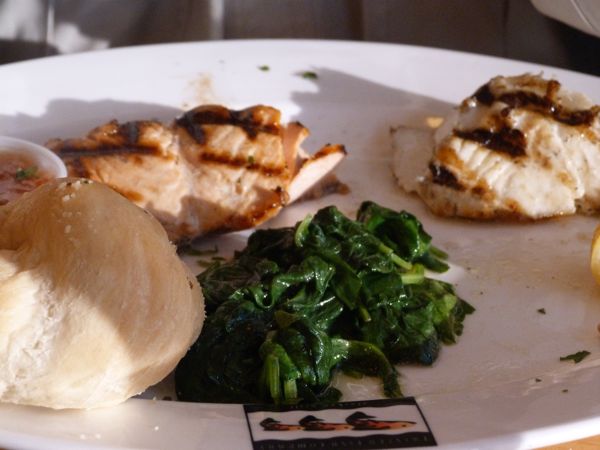
Although it is on the cruise ship docks, it is way down at the south end, and many of the cruise ship people would rather eat free (well, already paid for) on board, or eat elsewhere. The Twisted Fish was recommended by a local, and we can see several locals already seated when we come in. The hostess is good at finding us a good table with a view – we like this place.
Twisted Fish is in the same building as the Taku smoked fish building. It has a lot of wood decor, and a lively bar, and a good menu. AdventureMan and I end up ordering the same thing – side salads, and the First Mate’s Plate, which is a slab of grilled halibut and a slab of grilled salmon, served, as we requested, with no rice or potatoes, but with sauteed spinach, YUMMY. We had a Lost Angels cabernet, nice, dry, complex. The sun set behind one of the cruise ships, LOL.
I had hoped they might have some kind of berry cobbler for dessert, but all their desserts were huge mammoth portions of fudgy chocolatey or creamy things, and we passed on dessert and went looking for gelato. We were hugely full anyway, and very happy with our dinners. It’s a good thing, because by seven, all the tourist-oriented stores and ice cream places are closed down, hosing down their outside venues, pulling all their display items inside.
It’s hilarious how quickly and how early everything shuts down. I wonder what the Europeans think; do they look for night life? I wonder about our Middle Eastern friends used to the souks with lights and colors staying open all hours of the night ‘for your buying convenience?’ 😉
The Alaska State Museum in Juneau
“Oh,” the docent laughed, “everyone asks about that old bear. He hasn’t been around for years. He got all patchy because all the kids touched him and his hair fell off.”
LOL. I know one of those kids. There was a big sign that said “Do Not Touch the Bear” but he was a snowy white polar bear and . . . irresistible. My Dad worked in the same building as this museum, in its old location, and I would meet him there for a ride home after going to the library.
I loved this museum.
This time, it was one of the highlights of the entire trip. This museum is rich in well-curated pieces, and they are beautifully arranged. A new museum is going up; I can only hope that when it opens, it is at least as well done as this one is. Both AdventureMan and I could spend a lot more time in this museum.
Carving at the entrance:


Bent wood box

Painted chest
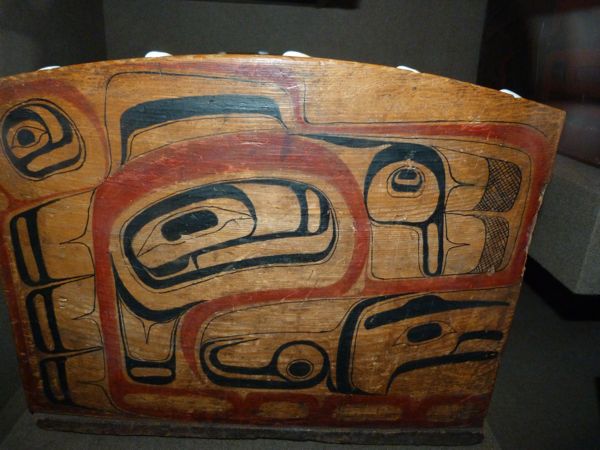
Ceremonial robe
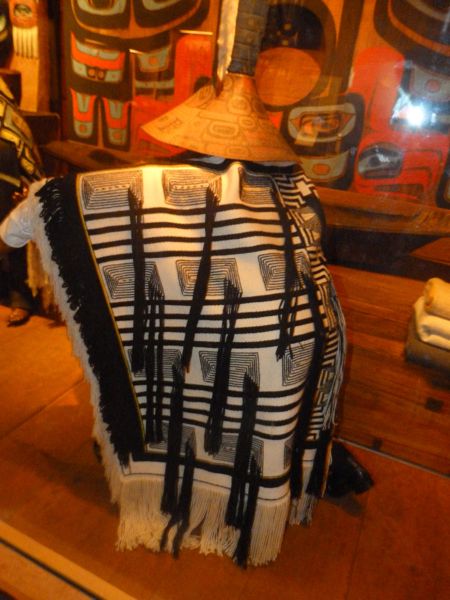
Everyday clothing
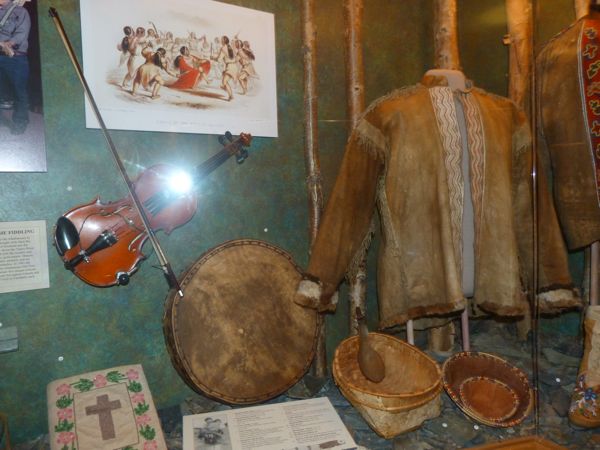
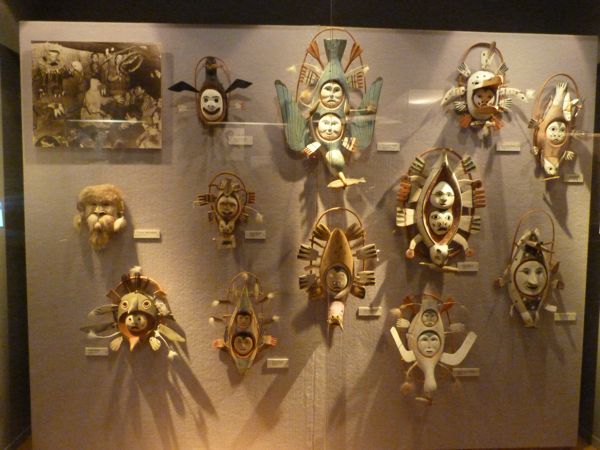
Upiq masks
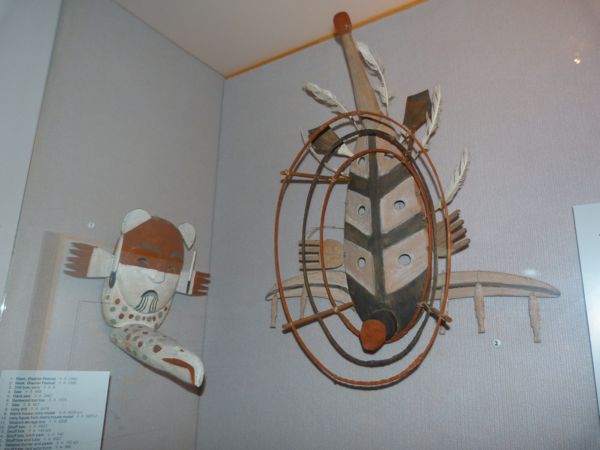
Close up Upiq masks
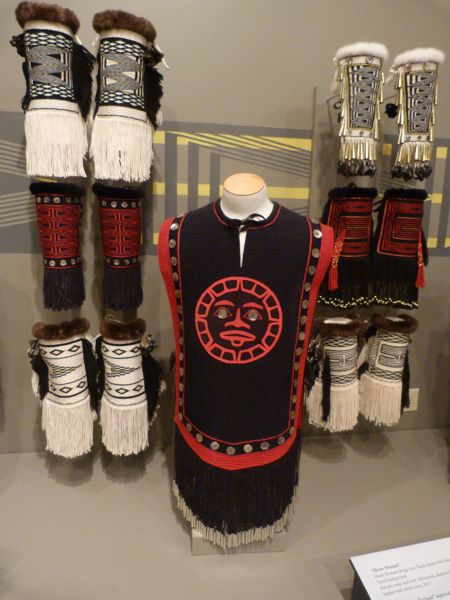
Sun motif ceremonial outfit – look at the leg pieces – don’t they look like Sadu weaving to you?

Moon motif ceremonial outfit
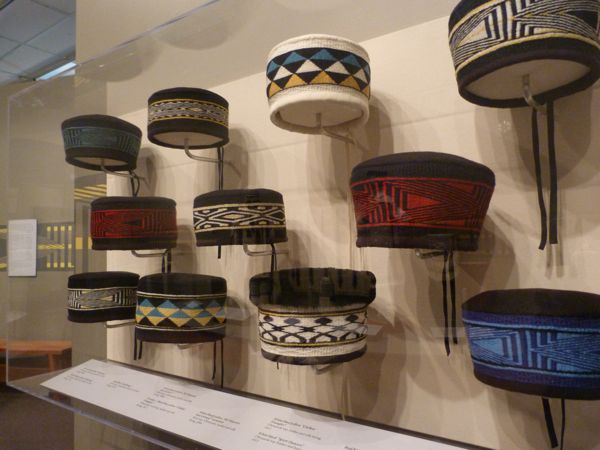
Hand made hats. I was so surprised; these are like prayer caps in Oman and in Pakistan and I think in Indonesia. That they would be so similar in shape and geometric embroidery was amazing to me.
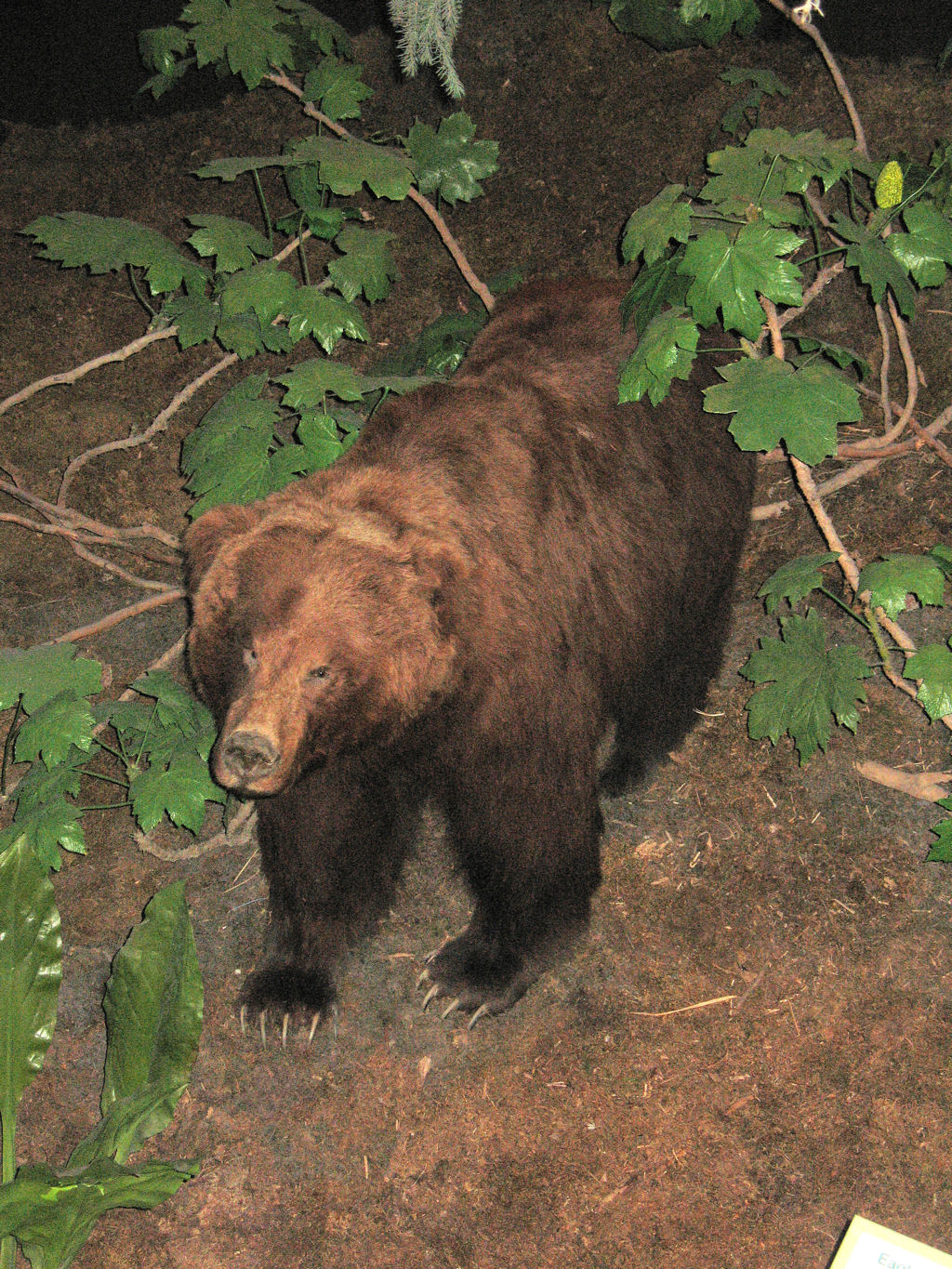
Eagle’s nest display, with eagle sounds. I love this! There is also a bear, but positioned so you really cannot touch . . . 😦

Corner pillars of Alaskan native houses used to look like this, not exactly totemic but with carved spirits:

There is so much more. I focused on the Alaskan Native inhabitants, but there are also exhibits of the coming of the Russians, the gold rush, the transition to territory and statehood . . . I can only take in so much at one time! Good thing we are going back 🙂
ALASKA STATE MUSEUM
395 Whittier Street
Juneau, AK 99811-1718
Tel: 907.465.2901
Fax: 907.465.2976
Recent Comments
intlxpatr on Shampoo Ginger tigerbutterya0c5ff1d… on Shampoo Ginger intlxpatr on British Soldier Kidnapped, Esc… John on British Soldier Kidnapped, Esc… intlxpatr on British Soldier Kidnapped, Esc… Wikipedia Donate Button

Amazina


Early Voting in Florida


