Mayor Emory Valentine Doesn’t Get His Way

It all started with a conversation with my Mom, during which, in a hushed voice, she told me about a neighbor “who had gotten a blue card.” A blue card? I had never heard of a blue card.
“It meant she had to leave the state!” Mom said.
Such a small thing, and such a journey it has led me on, trying to find out about the blue card and how it functioned. It led me to The History of the Juneau Alaska Police Department, and reading through that led to an hour of hilarity reading through the struggles of a small frontier town trying to bring order out of chaos and fight the battles of sewers, garbage, untethered horses, bawdy houses, and law enforcement.
Here are some examples of early actions:
1904
September, 1904 – George Kyrage (“George the Greek”) was elected to the Council and served with Mayor George Forrest, Councilmen Henry Shattuck, John Reck, Louis Lund, J.P. Jorgenson, and Henry States. Kyrage was named chairman of the Police Committee and found himself squarely between those who wanted prosperity through a wide open town, and those who demanded strict enforcement of a new ordinance prohibiting women loitering in saloons.
1910
January 7, 1910 – The conduct of a man named Al Graham was discussed and the Council ordered that he be given a “Blue Ticket”.
April 15, 1910 – The applicants for City Marshal were as follows: Charles Biernoth, W.G. Harris, Charles Meline, Mike McKenna, William Steinbeck, John Sweeney, Fred LaMarche Holmberg, and J.T. Martin. Charles Biernoth received the majority of the votes and was elected.
May 6, 1910 – City Marshal Charles Biernoth was asked to resign.
1913
April 18, 1913 – Mr. Nolan appeared before the Council and protested that the women of ill fame were allowed to live in the vicinity of the saw-mill outside of the restricted district, and the matter was referred to the Police Committee and the Chief of Police.
1914
January 2, 1914 – The City Attorney was instructed to prepare an ordinance against expectorating on the sidewalks of the City of Juneau.
-An ordinance was passed that provided punishment for pimps and moques to be set at not more than one hundred dollars.
City refuses to clean up red light district
February 6, 1914 – Councilman H.J. Raymond said that the last Grand Jury: wanted the City of Juneau to do something about cleaning up the red light district in the City. It was moved that the Chief of Police be ordered to close up every bawdy house in the City; but the motion died for lack of a second. It was then moved that the Chief of Police be instructed to stop the sale of liquor in all houses of prostitution in the City of Juneau; and again the motion died for lack of a second. It was then moved and seconded that a letter be forwarded to John Rustgard, US District Attorney, First Division of Alaska, stating that the City authorities of Juneau will be glad to lend all the aid they can in the enforcement of the law in the sale of liquor in houses of prostitution in the City of Juneau.
May 14, 1914 – A day’s labor in the Municipality of Juneau was set at eight (8) hours, common laborers were paid 35 cents per hour, and could work any number of additional hours at the same rate per hour.
1915
January 27, 1915 – A special meeting was called to hear charges of misconduct in office that have been made against Chief of Police William McBride. The Council requested that witnesses give their testimony. Harry Grove was duly sworn and testified and Charles Freegrove, Helen, and J.H. Gilpatrick were called and questioned by different councilmen. The hearing was then continued to a subsequent meeting of the Council.
January 29, 1915 – The Clerk read the resignation of William McBride from the office of the Chief of Police of the City of Juneau which took effect on February 1, 1915.
-A proposed ordinance was presented entitled “An ordinance requiring horses to be tied”.
July 7, 1916 – S.A. Judd protested that the Chief of Police had ordered him to leave town.
It makes for fascinating reading. Then I came across this sequence of reports, but for all my Googling, I cannot find out what the charges were against Chief of Police W.S. Harding:
1917
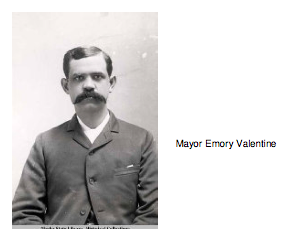
April 11, 1917 – Mayor Valentine declared that grave and serious charges have been made against W.S. Harding, Chief of Police, and that proofs are now in his possession. He further declared that an emergency existed, ordered that the office of Chief of Police be declared vacant, and stated that he will in due time appoint an emergency Chief of Police.
Councilman King asked Mayor Valentine the nature of the charges, to which Mayor Valentine replied that Mr. Harding would be given an opportunity to answer them, and that he would call a special meeting for that purpose.
April 12, 1917 – It was moved and seconded that W.S. Harding be elected to the position of Chief of Police for the coming year, to which Mayor Valentine declared out of order and stated that Mr. Harding had been suspended under the rules. Councilman Blomgren called for a vote on the adoption of the motion, and all six councilmen vote aye.
April 20, 1917 – The Clerk read the following demand: To Emory Valentine, Mayor and Common Council of the City of Juneau:
Whereas, Emory Valentine Mayor of the City of Juneau did at a public meeting held in the City of Juneau on the night of the 19th day of April, 1917, read certain affidavits purporting to contain certain charges against me as Chief of Police of Juneau, and that Emory Valentine publicly announced on the streets and public places of the Town of Juneau that he had other charges against me, I hereby demand that affidavits and all charges made against me as a public official and against my conduct, if committed and filed with the Common Council of the City of Juneau, or the Clerk of the City, and that a hearing be had immediately. Respectfully submitted, dated Juneau, Alaska, April 20, 1917. (signed) W.S. Harding
-An Executive Session was scheduled for Monday, April 23, 1917, at the hour of eight o’clock p.m. for the purpose of having the charges against W.S. Harding formally filed or presented.
-The Mayor called for the election of a person to fill the position of Chief of Police for the coming year. The Clerk read the following names as persons who had filed their applications: W.S. Harding, W.D. McMillan, E.J. Sliter, and Capt. E. Harrigan. W.S. Harding received six votes and the other applicants received none. The Mayor declared a veto on the election of W.S. Harding as Chief of Police.
-Harding appointed Dan Harrington, W.D. McMillan, and Emil Mullenbeck, to serve as police officers under him and asked for approval of the Council which was given. The Mayor declared a veto to the action of the Council.
April 27, 1917 – The Common Council of the City of Juneau, Alaska, convened in the Council Chambers of City Hall at the hour of eight o’clock p.m. on Friday, April 27, 1917, for the purpose of trying the charges against W.S. Harding, Chief of Police.
-The trial of the charges was to be heard by affidavit, and W.S. Harding was given until Monday night to file his answering affidavits, with the trial continued to Thursday, May 3, 1917 at the hour of eight o’clock p.m.
May 3, 1917 – The Common Council of the Town of Juneau, Territory of Alaska, convened in the Council Chambers of the City at the hour of eight o’clock p.m. on Thursday, May 3, 1917 – Mayor Valentine presiding. A resolution calling for the reading of the charges against W.S. Harding, Chief of Police accusing him of misconduct in office and the answering affidavits from the Chief was read.
-Affidavits of Walter Johnson, Frank Morrison, Jack Ivey, Fred Alexander, Mrytle Mercer, J.W. Felix, D. DeBlaser, F.J. Breezee, L.N. Ritter, and E. Valentine supported the charges.
-Affidavits of W.S. Harding, Emil Mullenbeck, Louise Dejonghe, E.W. Pettit, L.O. Sloane, C.O. Lindsey, Carl R. Brophy, W.D. MacMillan, A.C. Williams Jr., Frank E. Sargent, Glen C. Bartlett, H.H. Post, D.J. Harrington, George C. Burford, Edith Johnson, John B. Marshal, Harry Ellingen, and E.A. Naud were read in answer to the charges.
-The Council took a ten minute recess to consider the charges, and Mayor Valentine left the meeting.
-Following the recess, the following resolution was read: Be it resolved that W.S. Harding, Chief of Police of the City of Juneau, whom certain charges have been filed against, has been exonerated and it is the wish of the Council that he continue as Chief of Police.
May 4, 1917 – The electric light at the end of the garbage dump was out, causing trouble for boats navigating up and down the channel.
-Mayor Valentine objected to the claim of Chief Harding for his full monthly salary, saying that he was only entitled to pay for the first eleven days in April, because Harding was relieved from office on that date.
-The Clerk read Mayor Valentine’s veto message to the action of the Council electing W.S. Harding as Chief of Police on April 20, 1917, and to the action of the Council confirming the appointments of W.S. Harding, Patrolman Harrington and Mullenbeck. The following resolution was then read: Be it resolved that the veto of Mayor Valentine to the action of the Council in electing W.S. Harding, Chief of Police of the City of Juneau, Alaska on April 20, 1917, be overruled and held for naught. And be it further resolved that the veto of Mayor Valentine to the action of the Council in confirming the appointment of Patrolman Harrington and Mullenbeck on April 20, 1917, be overruled and held for naught.
Mayor Valentine served as Mayor for six terms, according to Wikipedia, and organized the volunteer fire department and designed the city’s first water system. For some reason, he really didn’t like the Chief of Police, but Harding and a lot of support among the council members, and retained his position. Fascinating stuff; brings history to life.
And you thought history was dull?
The Church Remembers Bede the Venerable
I found this while reading the daily meditation at Forward Day by Day:

Today the church remembers Bede, the Venerable, Priest, and Monk of Jarrow, 735.
When the monks of Jarrow sang, “Lord, leave us not as orphans,” it is said that Bede would often weep. As a child he was left orphaned in a dark, hostile, and dangerous land. He was cared for and reared by kindly monks. When he was but a youngster, plague struck the monastery, almost wiping it out. The only surviving souls were Bede and the old abbot. Bede naturally had a strong sense of the importance of community, of the fine line between life and death, and of our utter dependence upon the Creator.
He rarely ventured outside the walls of Jarrow monastery, yet his knowledge of theology, geography, and language was worthy of the most sophisticated of his time in Western Europe. He wrote a number of excellent books on various subjects, but he is best remembered for his Ecclesiastical History of the English People. This work has justly earned for him the title “Father of English History.” Unlike some of the careless historians of his day, he was meticulous in listing his authorities and sources. He took care to separate known fact from hearsay, but his descriptions are lively and dramatic.
Bede thought of himself as a teacher, and he seems to have built most of his teaching around the Divine Offices which the monks read daily. It is altogether fitting that he was pronounced a “Doctor of the Church” by Pope Leo XIII. Bede’s remains rest in Durham.
May the riches of Bede’s scholarship inspire us to fill our minds with the story of your work among us, O God. Amen.
Heavenly Father, you called your servant Bede, while still a child, to devote his life to your service in the disciplines of religion and scholarship; Grant that as he labored in the Spirit to bring riches of your truth to his generation, so we, in our various vocations, may strive to make you known in all the world; through Jesus Christ our Lord, who lives and reigns with you and the Holy Spirit, one God, for ever and ever. Amen.
“We Must Meet One Another Doing Good”
Woooo HOOOOO! I like this new Pope Francis! He takes on religious dogma and shatters all assumptions. Yes, Jesus died for us ALL! Even us non-Catholics? Even atheists? Yes, says Pope Francis, emphatically yes. “Do good and we will find a meeting point.”
Pope Francis rocked some religious and atheist minds today when he declared that everyone was redeemed through Jesus, including atheists.
During his homily at Wednesday Mass in Rome, Francis emphasized the importance of “doing good” as a principle that unites all humanity, and a “culture of encounter” to support peace.
Using scripture from the Gospel of Mark, Francis explained how upset Jesus’ disciples were that someone outside their group was doing good, according to a report from Vatican Radio.
“They complain,” the Pope said in his homily, because they say, “If he is not one of us, he cannot do good. If he is not of our party, he cannot do good.” And Jesus corrects them: “Do not hinder him, he says, let him do good.” The disciples, Pope Francis explains, “were a little intolerant,” closed off by the idea of possessing the truth, convinced that “those who do not have the truth, cannot do good.” “This was wrong . . . Jesus broadens the horizon.” Pope Francis said, “The root of this possibility of doing good – that we all have – is in creation”
Pope Francis went further in his sermon to say:
“The Lord created us in His image and likeness, and we are the image of the Lord, and He does good and all of us have this commandment at heart: do good and do not do evil. All of us. ‘But, Father, this is not Catholic! He cannot do good.’ Yes, he can… “The Lord has redeemed all of us, all of us, with the Blood of Christ: all of us, not just Catholics. Everyone! ‘Father, the atheists?’ Even the atheists. Everyone!”.. We must meet one another doing good. ‘But I don’t believe, Father, I am an atheist!’ But do good: we will meet one another there.”
Responding to the leader of the Roman Catholic church’s homily, Father James Martin, S.J. wrote in an email to The Huffington Post:
“Pope Francis is saying, more clearly than ever before, that Christ offered himself as a sacrifice for everyone. That’s always been a Christian belief. You can find St. Paul saying in the First Letter to Timothy that Jesus gave himself as a “ransom for all.” But rarely do you hear it said by Catholics so forcefully, and with such evident joy. And in this era of religious controversies, it’s a timely reminder that God cannot be confined to our narrow categories.”
Of course, not all Christians believe that those who don’t believe will be redeemed, and the Pope’s words may spark memories of the deep divisions from the Protestant reformation over the belief in redemption through grace versus redemption through works.
The pope’s comment has also struck a chord on Reddit, where it is the second most-shared piece.
More from Reuters:
Atheists should be seen as good people if they do good, Pope Francis said on Wednesday in his latest urging that people of all religions – or no religion – work together.
The leader of the world’s 1.2 billion Roman Catholics made his comments in the homily of his morning Mass in his residence, a daily event where he speaks without prepared comments.
He told the story of a Catholic who asked a priest if even atheists had been redeemed by Jesus.
“Even them, everyone,” the pope answered, according to Vatican Radio. “We all have the duty to do good,” he said.
“Just do good and we’ll find a meeting point,” the pope said in a hypothetical conversation in which someone told a priest: “But I don’t believe. I’m an atheist.”
Francis’s reaching out to atheists and people who belong to no religion is a marked contrast to the attitude of former Pope Benedict, who sometimes left non-Catholics feeling that he saw them as second-class believers.
Island Kitchen in Pensacola
“I think this is what MaMa might fix for us if we lived in Jamaica,” I said to AdventureMan as our meals were delivered at the Island Kitchen. We’ve passed Island Kitchen a hundred times, and many of those times AdventureMan has said one of these days he’d like to give it a try. This was the day.
There were other Islanders eating there – one eating oxtail and another eating goat curry. It looks like a lively place on the weekends, when expats come to eat food from home and listen to Island music.

I ordered the Jamaican Tea; it was delicious. I thought it was ginger, but the server said no, it was an herbal tea.

We ordered at the counter – so many options, and a set of choices unlike any other restaurant in Pensacola. Our orders were the special-of-the-day, AdventureMan ordered the Chicken With Brown Sauce and I ordered the Chicken Curry.


It was down-home chow. It was food like Grandmama would serve, if Grandmama were Caribbean. There are other options – Oxtail. Goat Curry. Beef Pasties. Everything looked well prepared, wholesome, and copious.





Still hoping for an Ethiopian restaurant in Pensacola . . . 🙂
Afghanistan: Such Laws Give Women Ideas . . .
Law Protecting Afghanistan Women Blocked By Conservatives
By KAY JOHNSON 05/18/13 08:03 AM ET EDT 
KABUL, Afghanistan — Conservative religious lawmakers in Afghanistan blocked a law on Saturday that aims to protect women’s freedoms, with some arguing that parts of it violate Islamic principles or encourage women to have sex outside of marriage.
The failure highlights how tenuous women’s rights remain a dozen years after the ouster of the hard-line Taliban regime, whose strict interpretation of Islam kept Afghan women virtual prisoners in their homes.
Khalil Ahmad Shaheedzada, a conservative lawmaker for Herat province, said the legislation was withdrawn shortly after being introduced in parliament because of fierce opposition from religious parties who said parts of the law are un-Islamic.
“Whatever is against Islamic law, we don’t even need to speak about it,” Shaheedzada said.
The Law on Elimination of Violence Against Women has actually been in effect since 2009 by presidential decree. It is being brought before parliament now because lawmaker Fawzia Kofi, a women’s rights activist, wants to cement it with a parliamentary vote to prevent its reversal by any future president who might be tempted to repeal it to satisfy hard-line religious parties.
Among the law’s provisions are criminalizing child marriage and banning “baad,” the traditional practice of selling and buying women to settle disputes. It also criminalizes domestic violence and specifies that rape victims should not face criminal charges for fornication or adultery.
“We want to change this decree as a law and get the vote of parliamentarian for this law,” said Kofi, who is herself running for president in next year’s elections. “Unfortunately, there were some conservative elements who are opposing this law. What I am disappointed at is because there were also women who were opposing this law.”
Afghanistan’s parliament has more than 60 female lawmakers, mostly due to constitutional provisions reserving certain seats for women.
The child marriage ban and the idea of protecting female rape victims from prosecution were particularly heated subjects in Saturday’s parliamentary debate, said Nasirullah Sadiqizada Neli, a conservative lawmaker from Daykundi province.
Neli suggested that removing the custom – common in Afghanistan – of prosecuting raped women for adultery would lead to social chaos, with women freely engaging in extramarital sex safe in the knowledge they could claim rape if caught.
Lawmaker Shaheedzada also claimed that the law might encourage promiscuity among girls and women, saying it reflected Western values not applicable in Afghanistan.
“Even now in Afghanistan, women are running from their husbands. Girls are running from home,” Shaheedzada said. “Such laws give them these ideas.”
Freedoms for women are one of the most visible – and symbolic – changes in Afghanistan since 2001 U.S.-led campaign that toppled the Taliban regime. Aside from their support for al-Qaida leaders, the Taliban are probably most notorious for their harsh treatment of women under their severe interpretation of Islamic law.
For five years, the regime banned women from working and going to school, or even leaving home without a male relative. In public, all women were forced wear a head-to-toe burqa veil, which covers even the face with a mesh panel. Violators were publicly flogged or executed. Freeing women from such draconian laws lent a moral air to the Afghan war.
Since then, women’s freedoms have improved vastly, but Afghanistan remains a deeply conservative culture, especially in rural areas.
___
Associated Press writer Rahim Faiez contributed in Kabul.
Rovaer Norway: The Best Wedding Proposal Ever
The groom-to-be was able to rope the entire village into participating in his proposal to his girlfriend. He knocks her socks off – no matter what the highs and lows of the marriage to come, she will never forget this proposal:
Hilarious Abercrombie & Fitch Homeless Campaign
Scour your closets, donate your Abercrombie & Fitch clothing to the homeless 🙂
Bloggers Create Freedom Friday in Oppressed Eritrea
I heard whispers of this on National Public Radio, and found this write up on The International Business Times website. The message is simple – in a country where even a glance can be interpreted as treason, express your non-support of the government by STAYING AT HOME ON FRIDAY, the day Ethiopians usually go out and visit with friends, gather together and mingle. Ghandi would smile; this is civil expression at it’s most civil 🙂
Let the empty streets speak for you. LOL @ a tyrant making staying at home a crime against the government!
Eritrean bloggers outside of Ethiopia started it, smuggling an old Eritrean phone book out of the country and making calls to acquaintances – and strangers – in Eritrea. People didn’t even have to respond. they could just listen . . . then they developed a robo-call to help them enlarge the number they could reach.
Eritrea is considered one of the continent’s most opaque countries. National elections have not been held in the Horn of Africa country since it gained independence in 1993. Torture, arbitrary detention and severe restrictions on freedom of expression remain routine.
President Isaias Afwerki does not tolerate any independent media, the internet is strictly controlled and Reporters without Borders recently named it 179th out of 179 countries for freedom of expression.
It is illegal to criticise the government, prompting the Eritrean diaspora to set up a campaign to reverse the Arab-style call to take to the streets every Friday by emptying the streets in protest.

“We made phone calls from diaspora to Eritrea,” Meron Estefanos toldIBTimes UK. “We have a phone catalogue and called random numbers every Friday, telling them to stay at home and think about problems in our country.”
The phone calls “give them [Eritreans within the country] an opportunity to protest without risking too much”, according to Freedom Friday’s coordinator in the UK Selam Kidane.
The activists turned to a computerised auto-dialer called robocall to spread hundreds of thousands of taped messages to Eritrean phones. “It is time to restore our liberty and dignity” messages were sent automatically.
In another message, the mother of renowned political prisoner Aster Yohannes recalls the fate of her daughter, who was arrested in 2003 and has disappeared.
After two years, the movement is finally gaining momentum inside the country.
“Now they trust us inside the country, we have our team in Eritrea that puts out posters and leaflets late at night,” Estefanos said.
“The plan now that we have their trust is asking them to go out and demonstrate.”
About 1,500 Eritreans leave their country every month, according to the United Nations, paying up to 30,000 euros ($39,500) each to seek a new life free of grinding poverty and repression.
Earlier this year, Amnesty International put the spotlight on Eritrean asylum-seekers who are kidnapped from Sudanese refugee camps by the local Rashaida tribe, sold to Bedouin criminals in Egypt’s Sinai peninsula and severely abused while they are held for ransom.
One thousand refugees are held captive in the Sinai, according to reports. About 7,000 people in total may have been tortured and 4,000 may have died as a result of the people-trafficking in humans from 2009 to October 2012, according to recent data. A total of 3,000 people disappeared from 2007-11.
Expats in Kuwait: A Burden on the State?
From today’s Kuwait Times . . . .

KUWAIT: The government has sent a draft law to the parliament stipulating an increase in fees collected from expatriate residents for using public services in Kuwait, a senior state official said in statements reported yesterday by the local press.
Minister of Cabinet Affairs Sheikh Mohammad Al-Abdullah Al-Sabah further indicated that the proposal is currently under review primarily to ensure it was in keeping with the constitution. “The state pays KD6 billion to subsidize public services, including electricity and water, while only KD2 billion of it is the average share of Kuwaitis,” he told a gathering of third constituency women voters at MP Ahmad Al-Mulaifi’s dewaniya on Monday night.
He also termed the remaining KD4 billion, a cost which supposedly the government bears for services used by expatriates, “a burden on the state.” Al-Sabah, who is also the State Minister for Municipality Affairs, added that similar steps have been adopted in the rest of the Gulf Cooperation Council states to increase the state revenue from expatriates. “Unfortunately, Kuwait’s law prohibits the government from increasing the fees unilaterally,” he said, referring to regulations which stipulate that such decisions must be passed by the parliament before becoming effective.
The minister’s statement is the latest turn in the government’s efforts seen targeted at the country’s expatriate community which comprises two thirds of the population, including a Ministry of Social Affairs and Labor announcement to deport 100,000 foreigners annually as part of a ‘demographic balance restoration plan’; the details of which are yet to be announced.
Meanwhile, Undersecretary Assistant for Traffic Affairs in the Interior Ministry, Major General Abdulfattah Al-Ali, announced that 213 expats were deported in the past few days for committing ‘grave’ traffic violations. In this regard, Al-Ali told Al-Rai on Tuesday that deportations only happen in cases where people have a record of repeated violations. “An expatriate who commits the same violation over and over again must be deported in the public interest,” he said, calling a person in this case as “abnormal” and “untreatable.” According to the ministry, the violations warranting deportation include driving without a driver’s license, jumping the red traffic light for a second time, using private vehicles to carry passengers and exceeding speed limits by 40 km. Al-Ali refuted the notion that the recent deportations were connected to the MSAL’s plan mentioned above.
Minister of Social Affairs and Labor Thekra Al-Rashidi had indicated that the annual deportation plan, through which the government hopes to deport a million foreigners in ten years, is chiefly going to target ‘marginal labor forces’ or workers who usually accept menial jobs and often live without valid visas.
Such workers are often the victim of visa traffickers who exploit loopholes in the ministry’s system to release work permits in the name of fake companies or nonexistent job openings, and then sell them to unskilled labor forces looking for a chance to work in the oil-rich Gulf region. The system is based on the kafala (sponsorship of foreign workers) program which is often criticized by international organizations for human right violations recorded in Kuwait and the entire region.
On a related note, Al-Rai reported yesterday that the social affairs and interior ministries are studying the possibility of creating an ‘amnesty period’ during the summer to allow illegal residents to leave Kuwait or obtain a new visa without paying the cumulative fines.
Anonymous sources were quoted in the report as saying that the project depends on the two ministries’ ability to “plug some loopholes” which could make violators irresponsive to it. “For example, we cannot expect Bangladeshi nationals staying illegally in Kuwait to leave when they know that they will be banned by law in this case from ever returning to Kuwait,” one source explained. “There are violators who become stuck in Kuwait due to circumstances in their home countries combined with regulations that prevent them from issuing a residency in Kuwait.
Legal obstacles in similar cases need to be removed before an amnesty period is announced,” the source added.
Recent Comments
intlxpatr on Shampoo Ginger tigerbutterya0c5ff1d… on Shampoo Ginger intlxpatr on British Soldier Kidnapped, Esc… John on British Soldier Kidnapped, Esc… intlxpatr on British Soldier Kidnapped, Esc… Wikipedia Donate Button

Amazina


Early Voting in Florida


