Guns in our Schools – A Shameful History
“Guns don’t kill people – PEOPLE kill people” say our gun-totin’ friends, smiling smugly, like who can argue?
People using guns kill people more efficiently, i.e., they can kill more people, faster, before they are stopped. People with assault rifles can kill more people even more efficiently.
Who needs to be carrying these guns?
“We need them to protect ourselves!” our gun totin’ friends whine.
From whom? Have you ever needed to use your concealed weapon to protect yourself? No? Why do you think you need lethal protection?
Statistics show that people owning guns are more likely to be shot. People carrying guns are more likely to be shot. People with guns in the house are more likely to shoot someone they know, a family member or friend, than someone from whom they need protection.
Yes, people without access to guns who want to hurt someone can use a knife, or poison, or steal a gun, but the other methods of killing are slower, and likely to attract attention earlier than someone planning a massacre. Guns make killing more efficient. Assault weapons, outside the use of the military and the police, have no place, none at all. Assault weapons take the sport out of hunting. It’s like hunting on one of those private reserves with animals ‘salted’ to be killed. Everyone knows where they hang out; they don’t have a chance against the ego-driven “hunter” (she says with scorn) who wants the thrill of having shot a lion or an elephant. (oops. off topic)
The nation is heavy with hurt. Killing 20 little first graders is horrifying. It’s the slaughter of the innocents. The shooters had access to guns, some of the shooters BOUGHT their weapons legally, some stole them from friends or used guns owned by their parents. Guns kept in the house, or guns kept in the car. These shooters had easy access to guns.
Statistically, they are almost 100% male. If you read through the decades (DECADES . . . ) of entries, you can see it is almost always some kind of testosterone thing. Women have gotten a bad rap; it’s not estrogen that makes these shooters kill, it is TESTOSTERONE.
Here’s the record for school shootings in the United States, it started bad and it gets worse and worse. This is from Wikipedia. God bless the heavy hearts that compiled this sorry history.
History of School Shootings in the United States
1700s
The earliest known United States shooting to happen on school property was the Pontiac’s Rebellion school massacre on July 26, 1764, where four Lenape American Indians entered the schoolhouse near present-day Greencastle, Pennsylvania, shot and killed schoolmaster Enoch Brown, and killed nine or ten children (reports vary). Only three children survived.[1]
1800s
November 2, 1853: Louisville, Kentucky A student, Matthew Ward, bought a self-cocking pistol in the morning, went to school and killed Schoolmaster Mr. Butler for excessively punishing his brother the day before. Even though he shot the Schoolmaster point blank in front of his classmates, he was acquitted.[2]
An April 30, 1866 editorial in the New York Times argued against students carrying pistols, citing “…pistols being dropped on the floor at balls or being exploded in very inconvenient ways. A boy of 12 has his pantaloons made with a pistol pocket; and this at a boarding-school filled with boys, who, we suppose, do or wish to do the same thing. We would advise parents to look into it, and learn whether shooting is to be a part of the scholastic course which may be practiced on their boys; or else we advise them to see that their own boys are properly armed with the most approved and deadly-pistol, and that there may be an equal chance at least of their shooting as of being shot.”
[3]
June 8, 1867: New York City At Public School No. 18, a 13 year old lad brought a pistol loaded and capped, without the knowledge of his parents or school-teachers, and shot and injured a classmate.
[4] December 22, 1868: Chattanooga, Tennessee A boy who refused to be whipped and left school, returned, with his brother and a friend, the next day to seek revenge on his teacher. Not finding the teacher at the school, they continued to his house, where a gun battle rang out, leaving three dead. Only the brother survived.
[5]
March 9, 1873: Salisbury, Maryland After school as Miss Shockley was walking with four small children, she was approached by a Mr. Hall and shot. The Schoolmaster ran out, but she was dead instantly. Hall threw himself under a train that night.
[6]
May 24, 1879: Lancaster, New York As the carriage loaded with female students was pulling out of the school’s stables, Frank Shugart, a telegraph operator, shot and severely injured Mr. Carr, Superintendent of the stables.
[7]
March 6, 1884: Boston, Massachusetts As news of Jesse James reached the east coast, young kids started to act in the same manner. An article from the New York Times reads, Another “Jesse James” Gang – Word was brought to the Fifth Police Station to-night that a number of boys were using the Concord-street School-house for some unknown purpose, and a posse of officers was sent to investigate. The gang scattered at the approach of the police, and in their flight one drew a revolver and fired at Officer Rowan, without effect, however. William Nangle, age 14, and Sidney Duncan, age 12, were captured, but the other five or six escaped, among them the one who did the shooting. The boys refused to disclose the object of their meeting, but it is thought that another “Jesse James” organization has been broken up.
[8]
March 15, 1884: Gainesville, Georgia In the middle of the day, a group of very drunk Jackson County farmers left the Jug Tavern drinking and shooting their revolvers as they headed down the street driving people into their homes. As they approached the female academy, the girls fled the schoolyard into the school where the gang followed swearing and shooting, firing several rounds into the front door. No one was hurt.
[9]
July 4, 1886: Charleston, South Carolina During Sunday school, Emma Connelly shot and killed John Steedley for “circulating slanderous reports” about her, even though her brother publicly whipped him a few days earlier.
[10]
June 12, 1887: Cleveland, Tennessee Will Guess went to the school and fatally shot Miss Irene Fann, his little sister’s teacher, for whipping her the day before.
[11]
June 13, 1889: New Brunswick, New Jersey Charles Crawford upset over an argument with a school Trustee, went up to the window and fired a pistol into a crowded school room. The bullet lodged in the wall just above the teacher’s[vague] head.
[12]
The first known mass shooting in the U.S. where students were shot, was on April 9, 1891, when 70 year old, James Foster fired a shotgun at a group of students in the playground of St. Mary’s Parochial School, Newburgh, New York, causing minor injuries to several of the students.
[13] The majority of attacks during this time period by students on other students or teacher, usually involved stabbing with knives, or hitting with stones.
1900–1930s
This section does not cite any references or sources. (August 2012)
There are very seldom reports of mass or multiple school shootings during the first three decades of the 20th Century, with the three most violent attacks on schools involving either arson or explosions.
February 26, 1902: Camargo, Illinois teacher Fletcher R. Barnett shot and killed another teacher, Eva C. Wiseman, in front of her class at a school near Camargo, Illinois. After shooting at a pupil who came to help Miss Wiseman and wounding himself in a failed suicide attempt he waited in the classroom until a group of farmers came to lynch him. He then ran out of the school building, grabbed a shotgun from one of the farmers and shot himself, before running away and leaping into a well where he finally drowned. The incident was likely sparked by Wiseman’s refusal to marry Barnett.
February 24, 1903: Inman, South Carolina Edward Foster, a 17-year-old student at Inman High school, was shot and fatally wounded by his teacher Reuben Pitts after he had jerked a rod from Pitts’ hands to resist punishment. According to the teacher, Foster struck the pistol Pitts had drawn to defend himself, thus causing its discharge. Pitts was later acquitted of murder.
October 10, 1906: Cleveland, Ohio Harry Smith shot and killed 22-year-old teacher Mary Shepard at South Euclid School after she had rejected him. Smith escaped and committed suicide in a barn near his home two hours later.
March 23, 1907: Carmi, Illinois George Nicholson shot and killed John Kurd at a schoolhouse outside of Carmi, Illinois during a school rehearsal. The motive for the shooting was Kurd making a disparaging remark about Nicholson’s daughter during her recital.
March 11, 1908: Boston, Massachusetts Elizabeth Bailey Hardee was shot to death by Sarah Chamberlain Weed at the Laurens School, a finishing school in Boston. Weed then turned the gun on herself and committed suicide.
April 15, 1908: Asheville, North Carolina Dr. C. O. Swinney shot and fatally wounded his 16-year-old daughter Nellie in a reception room at Normal and Collegiate Institute. He then committed suicide by shooting himself in the head.
February 12, 1909: San Francisco, California 10-year-old Dorothy Malakanoff was shot and killed by 49-year-old Demetri Tereaschinko as she arrived at her school in San Francisco. Tereaschinko then shot himself in a failed suicide attempt. Tereaschinko was reportedly upset that Malakanoff refused to elope with him.
January 10, 1912: Warrenville, Illinois Sylvester E. Adams shot and killed teacher Edith Smith after she rejected his advances. Adams then shot and killed himself. The incident took place in a schoolhouse about a mile outside of Warrenville after the students had been dismissed for the day.
March 27, 1919: Lodi Township, Michigan 19-year-old teacher Irma Casler was shot and killed in her classroom at Rentschler school in Lodi Township, Michigan by Robert Warner, apparently because she had rejected his advances.
April 2, 1921: Syracuse, New York Professor Holmes Beckwith shot and killed dean J. Herman Wharton in his office at Syracuse University before committing suicide.
February 15, 1927: Hempstead, New York James O’Donnell, 18-year-old senior at Hempstead High School, shot himself to death on the stage in the school’s auditorium. A suicide note stated that O’Donnell killed himself to lessen the financial burden on his family.
May 18, 1927: Bath, Michigan School treasurer Andrew Kehoe, after killing his wife and destroying his house and farm, blew up the Bath Consolidated School by detonating dynamite in the basement of the school, killing 38 people, mostly children. He then pulled up to the school in his Ford car, then set off a truck bomb, killing himself and four others. Only one shot was fired in order to detonate dynamite in the car. This was deadliest act of mass murder at a school in the United States.
May 22, 1930: Ringe, Minnesota Margaret Wegman, 20-year-old teacher at the local rural school, was shot and killed in the school by 24-year-old Douglas Petersen.
May 28, 1931: Duluth, Minnesota Katherine McMillen, 24-year-old teacher at the Howard Gensen rural school near Duluth, was accidentally shot and killed by a revolver brought to school by a pupil.
February 15, 1933: Downey, California Dr. Vernon Blythe shot and killed his wife Eleanor, as well as his 8-year old son Robert at Gallatin grammar school and committed suicide after firing three more shots at his other son Vernon. His wife, who had been a teacher at the school, had filed for divorce the week before.
September 14, 1934: Gill, Massachusetts. Headmaster Elliott Speer was murdered by a shotgun blast through the window of his study at Northfield Mount Hermon School. The crime was never solved.
March 27, 1935: Medora, North Dakota Emily Hartl, 24-year-old teacher at the Manlon school northwest of Medora, was shot and killed at the school by 28-year-old Harry McGill, a former suitor.
December 12, 1935: New York City, New York, Victor Koussow, a Russian laboratory worker at the School of Dental and Oral Surgery, shot Prof. Arthur Taylor Rowe, Prof. Paul B. Wiberg, and wounded Dr. William H. Crawford at Columbia Presbyterian Hospital, before committing suicide.
April 27, 1936: Lincoln, Nebraska, Prof. John Weller shot and wounded Prof. Harry Kurz in a corridor of the University of Nebraska, apparently because of his impending dismissal at the end of the semester. After shooting Kurz Weller tried to escape, but was surrounded by police on the campus, whereupon he killed himself with a shot in the chest.
June 4, 1936: Bethlehem, Pennsylvania, Wesley Crow shot and killed his Lehigh University English instructor, C. Wesley Phy. Crow went to Phy’s office and demanded that Mr. Phy change his grade to a passing mark. Crow committed suicide after shooting Phy.
September 24, 1937: Toledo, Ohio 12-year-old Robert Snyder shot and wounded his principal, June Mapes, in her office at Arlington public school when she declined his request to call a classmate. He then fled the school grounds and shot and wounded himself.
1940s
This section does not cite any references or sources. (August 2012)
May 6, 1940: South Pasadena, California. After being removed as principal of South Pasadena Junior High School, Verlin Spencer shot six school officials, killing five, before attempting to commit suicide by shooting himself in the stomach.
May 23, 1940: New York City, New York Infuriated by a grievance, Matthew Gillespie, 62-year-old janitor at the junior school of the Dwight School for Girls, shot and critically wounded Mrs. Marshall Coxe, secretary of the junior school.
July 4, 1940: Valhalla, New York Angered by the refusal of his daughter, Melba, 15 years old, to leave a boarding school and return to his home, Joseph Moshell, 47, visited the school and shot and killed the girl.
September 12, 1940: Uniontown, Pennsylvania, 29-year-old teacher Carolyn Dellamea is shot to death inside her third grade classroom by 35-year-old William Kuhns. Kuhns then shot himself in the chest in a failed suicide attempt. Kuhns had reportedly been courting Dellamea for over a year but the relationship was ended when Dellamea discovered that Kuhns was already married.
October 2, 1942: New York City, New York “Erwin Goodman, 36-year-old mathematics teacher at William J. Gaynor Junior High School, was shot and killed in the school corridor by a youth.
February 23, 1943: Port Chester, NY Harry Wyman, 13-year-old, shot himself dead at the Harvey School, a boys’ preparatory school.
June 26, 1946: Brooklyn, New York A 15-year-old schoolboy who balked at turning over his pocket money to a gang of seven youths was shot in the chest at 11:30 A.M. in the basement of the Public School 147 annex of the Brooklyn High School for Automotive Trades.
November 24, 1946: New York City A 13-year-old student at St. Benedict’s Parochial School, shot and fatally wounded himself while sitting in an audience watching a school play.
February 5, 1947: Madill, Oklahoma 1st grade teacher Jessie Laird, 40-years-old, was shot to death in her classroom, during recess, by her estranged husband, Ellis Laird, 62-years-old. Laird then fatally shot himself.
December 24, 1948: New York City A 14-year-old boy was wounded fatally by an accidental shot from the .22-caliber rifle of a fellow-student … the youth was shot in the head when he chanced into range where Robert Ross, 17, of Brooklyn, was shooting at a target near a lake on the school property.
March 11, 1949: New York City A 16-year-old student at Stuyvesant High School was accidentally shot in the arm by a fellow student who was ‘showing off’ with a pistol in a classroom.
November 13, 1949: Columbus, Ohio, Ohio State University freshman James Heer grabbed a .45 caliber handgun from the room of a Delta Tau Delta fraternity brother and shot and killed his fraternity brother Jack McKeown, 21, an Ohio State senior.
1950s
This section does not cite any references or sources. (August 2012)
April 25, 1950: Peru, Nebraska Dr. William Nicholas, 48, president of Peru State College and Dr. Paul Maxwell, 56, education department head, were shot to death at their desks by Dr. Barney Baker, 54-year-old psychology professor. Baker was found dead of a self-inflicted gunshot at his home on campus.
July 22, 1950: New York City, New York A 16-year-old boy was shot in the wrist and abdomen at the Public School 141 dance… during an argument with a former classmate.
March 12, 1951: Union Mills, North Carolina Professor W. E. Sweatt, superintendent and teacher at the Alexander school, was shot to death by students Billy Ray Powell, 16, and Hugh Justice, 19. The assailants had been reprimanded by Sweatt, and they waited for him as he locked his office door.
June 4, 1951: New York City, New York Carl Arch, a 50-year-old intruder to a girl’s gym class, was shot and killed by a police officer, at Manhattan’s Central Commercial High School.
November 27, 1951: New York City, New York David Brooks, a 15-year-old student, was fatally shot as fellow-pupils looked on in a grade school.
April 9, 1952: New York City, New York A 15-year-old boarding-school student shot a dean rather than relinquish pin-up pictures of girls in bathing suits.
July 14, 1952: New York City, New York Bayard Peakes walked in to the offices of the American Physical Society at Columbia University and shot and killed secretary Eileen Fahey with a .22 caliber pistol. Peakes was reportedly upset that the APS had rejected a pamphlet he had written.
September 3, 1952: in Lawrenceville, Illinois After 25-year-old Georgine Lyon ended her engagement with Charles Petrach, Petrach shot and killed Lyon in a classroom at Lawrenceville High School where she worked as a librarian.
November 20, 1952: New York City, New York “Rear Admiral E. E. Herrmann, 56 years old, superintendent of the Naval Postgraduate School, was found dead in his office with a bullet in his head. A service revolver was found by his side.
October 2, 1953: Chicago, Illinois 14-year-old Patrick Colletta was shot to death by 14-year-old Bernice Turner in a classroom of Kelly High School in Chicago. It was reported that after Turner refused to date Colletta he handed her the gun and dared her to pull the trigger, telling her that the gun was “only a toy.” A coroner’s jury later ruled that the shooting was an accident.
October 8, 1953: New York City, New York Larry Licitra, 17-year-old student at the Machine and Metal Trades High School, was shot and slightly wounded in the right shoulder in the lobby of the school while inspecting a handmade pistol owned by one of several students.
May 15, 1954: Chapel Hill, North Carolina, Putnam Davis Jr. was shot and killed during a fraternity house carnival at the Phi Delta Theta house at the University of North Carolina. William Joyner and Allen Long were shot and wounded during the exchange of gunfire in their fraternity bedroom. The incident took place after an all-night beer party. Mr. Long reported to the police that, while the three were drinking beer at 7 a.m., Davis pulled out a gun and started shooting with a gun he had obtained from the car of a former roommate.
January 11, 1955: Swarthmore, Pennsylvania After some of his dorm mates urinated on his mattress Bob Bechtel, a 20-year-old student at Swarthmore College, returned to his dorm with a shotgun and used it to shoot and kill fellow student Holmes Strozier.
May 4, 1956: in Prince George’s County, Maryland, 15-year-old student Billy Prevatte fatally shot one teacher and injured two others at Maryland Park Junior High School in Prince George’s County after he had been reprimanded from the school.
October 20, 1956: New York City, New York A junior high school student was wounded in the forearm yesterday by another student armed with a home-made weapon at Booker T. Washington Junior High School.
October 2, 1957: New York City, New York “A 16-year old student was shot in the leg yesterday by a 15-year old classmate at a city high school.”
March 4, 1958: New York City, New York “A 17-year-old student shot a boy in the Manual Training High School.”
May 1, 1958: Massapequa, New York A 15-year-old high school freshman was shot and killed by a classmate in a washroom of the Massapequa High School.
September 24, 1959: New York City, New York Twenty-seven men and boys and an arsenal were seized in the Bronx as the police headed off a gang war resulting from the fatal shooting of a teenager Monday at Morris High School.
1960s
This section does not cite any references or sources. (August 2012)
February 2, 1960: Hartford City, Indiana Principal Leonard Redden shot and killed two teachers with a shotgun at William Reed Elementary School in Hartford City, Indiana, before fleeing into a remote forest, where he committed suicide.
March 30, 1960 Alice, Texas Donna Dvorak, 14, brought a .22 target pistol to Dubose Junior High School, and fatally shot Bobby Whitford, 15, in their 9th grade science class. Dvorak believed Whitford posed a threat to one of her girlfriends.
June 7, 1960: Blaine, Minnesota Lester Betts, a 40-year-old mail-carrier, walked into the office of 33-year-old principal Carson Hammond and shot him to death with a 12-gauge shotgun.
January 4, 1961: Delmont, South Dakota Donald Kurtz, 17-year-old senior at Delmont High School, was fatally wounded by a .22 caliber bullet from a rifle. The shot, intended as a sound effect for a school play, hit him in the chest during a rehearsal just minutes before the play was to take place.
October 17, 1961: Denver, Colorado Tennyson Beard, 14, got into an argument with William Hachmeister, 15, at Morey Junior High School. During the argument Beard pulled out a .38 caliber revolver and shot at Hachmeister, wounding him. A stray bullet also struck Deborah Faith Humphrey, 14, who died from her gunshot wound.
August 1, 1966: University of Texas Massacre Charles Whitman age 25, climbed atop the observation deck at the University of Texas-Austin, and killed 16 people and wounded 31 during a 96-minute shooting rampage.
November 12, 1966: Mesa, Arizona Bob Smith, 18, took seven people hostage at Rose-Mar College of Beauty, a school for training beauticians. Smith ordered the hostages to lie down on the floor in a circle. He then proceeded to shoot them in the head with a 22-caliber pistol. Four women and a three-year-old girl died, one woman and a baby were injured but survived. Police arrested Smith after the massacre. Smith had reportedly admired Richard Speck and Charles Whitman.
January 30, 1968: Miami, Florida 16-year-old Blanche Ward shot and killed fellow student Linda Lipscomb, 16, with a .22-caliber pistol at Miami Jackson High School. According to Ward, she was threatened with a razor by Lipscomb during an argument over a fountain pen, and in the ensuing struggle the gun went off.
February 8, 1968: Orangeburg, South Carolina In the days leading up to February 8, 1968, about 200 mostly student protesters gathered on the campus of South Carolina State University, located in the city of Orangeburg, to protest the segregation of the All Star Bowling Lane. The bowling alley was owned by the late Harry K. Floyd. That night, students started a bonfire. As police attempted to put out the fire, an officer was injured by a thrown piece of banister. The police said they believed they were under attack by small weapons fire. The officers fired into the crowd, killing three young men: Samuel Hammond, Delano Middleton, and Henry Smith, and wounding twenty-seven others.
May 22, 1968: Miami, Florida Ernest Lee Grissom, a 15-year-old student at Drew Junior High School, shot and seriously wounded a teacher and a 13-year-old student after he had been reprimanded for causing a disturbance.
January 17, 1969: Los Angeles, California Two student members of the Black Panther Party, Alprentice Carter and John Huggins, were fatally shot during a student meeting inside Campbell Hall at the University of California, Los Angeles. The motive of the shooting regarded who would own the school’s African American Studies Center. The shooter, Claude Hubert, was never to be found but three other men were arrested in connection with the shooting.
November 19, 1969: Tomah, Wisconsin Principal Martin Mogensen was shot to death in his office by a 14-year-old boy armed with a 20 gauge shotgun.
1970s
The two most notable U.S. school shootings in the early 1970s were the Jackson State killings in May 1970, where police opened fire on the campus of Jackson State University and the Kent State shootings also in May 1970 where the National Guard opened fire on the campus of Kent State University.
The mid to late 1970s is considered the second most violent period in U.S. school history with a series of school shootings, most notably were;
December 30, 1974: Olean, New York, Anthony Barbaro, a 17-year-old Regents scholar armed with a rifle and shotgun, kills three adults and wounds 11 others at his high school, which was closed for the Christmas holiday. Barbaro was reportedly a loner who kept a diary describing several “battle plans” for his attack on the school.[14]
February 12, 1976: At Detroit, Michigan’s Murray-Wright High School, about six intruders, who according to police looked like junior high students or younger, entered Murray Wright. According to the police they were searching for a student who had “stolen one of their girlfriends.”[15] Two teachers discovered the intruders and asked them to leave. A security guard escorted the intruders down a hallway as about six Murray-Wright students followed the intruders as they were leaving. Outside of the door to the school, two of the intruders brandished guns and fired into the group., shooting and injuring five students. One of the injured was treated and released and the others were treated at Henry Ford Hospital.[15]
June 12, 1976: California State University, Fullerton massacre, where the school’s custodian opened fire with a semi-automatic rifle in the library on the California State University, Fullerton campus killing 7, and wounding 2.
February 22, 1978: Lansing, Michigan After being taunted for his beliefs, a 15-year-old self-proclaimed Nazi, kills one student and wounds a second with a Luger pistol.[14]
January 29, 1979: Grover Cleveland Elementary School Shootings, California, where 16-year-old Brenda Ann Spencer opened fire with a rifle, a gift from her father, killing 2 and wounding 9.
1980s
The early 1980s saw many single shootings, similar to the 1970s:
April 7, 1982: Littleton, Colorado, Deer Creek Jr. High School The gunman, 14-year-old Jason Rocha, was a student at Deer Creek. Rocha shot and killed 13 year-old Scott Darwin Michael.[16]
The early 1980s saw only a few multi-victim school shootings, including:
January 20, 1983: St. Louis County, Missouri Parkway South Middle School The eighth grade shooter brought a blue duffel bag containing two pistols and a murder/suicide note that outlined his intention to kill the next person heard speaking ill of his older brother, Ken, to school. He entered a study hall classroom and opened fire, hitting two fellow students. The first victim was fatally shot in the stomach, and the second victim received a non-fatal gunshot wound to the abdomen. He said, “no one will ever call my brother a pussy again,” then committed suicide.
According to the Center to Prevent Handgun Violence, in the United States, from September 1986 to September 1990:[17]
At least 71 people (65 students and 6 school employees) had been killed with guns at school.
201 were severely wounded by gun fire.
242 individuals were held hostage at gunpoint.
According to a 1987 survey conducted by the American School Health Association,[18] ” 3% of the boys reported having carried a handgun to school at least once during the school year; 1% reported carrying a handgun on a daily basis.”
The late 1980s began to see a major increase in school shootings, including:
May 17, 1984: Des Moines, Iowa While students in a French class at Southeast Polk High School were taking a test in the hallway, a 17 year old boy shot and killed a 16 year old female student before firing a single shot into his own head, killing himself.[19][20]
January 22, 1985: Goddard, Kansas James Alan Kearbey, 14, armed with a M1-A semiautomatic rifle and a .357-caliber handgun, killed principal Joseph McGee and wounded two teachers and a student at his Junior high school. He pleaded no contest and served seven years in a state youth facility.[citation needed]
September 4, 1985: Richmond, Virginia At the end of the second day of school at East End Middle School, a 12 year old boy shot a girl with his mother’s gun.[21][22]
October 18, 1985: Detroit, Michigan During halftime of the homecoming football game between Northwestern High School and Murray-Wright High School, a boy who was in a fight earlier that day pulled out a shotgun and opened fire, injuring six students.[23][24]
November 26, 1985: Spanaway, Washington A 14 year old girl shot two boys fatally, then killed herself with a .22-caliber rifle at Spanaway Junior High School.[25][26][27]
December 9, 1985: Philadelphia, Pennsylvania At Archbishop Ryan High School for Boys, a 22 year old Mental health patient took 6 students hostage with what ended up being a starter pistol. No one was hurt in the ordeal.
December 10, 1985: Portland, Connecticut At Portland Junior High School, the Principal was having a heated discussion with a 13 year old male eighth grader when he locked the boy inside an office. The student then pulled out a 9mm firearm and opened fire. The bullet shattered the glass door and struck the left forearm of the secretary, and the glass injured the Principal. The boy fled for the 2nd floor, where he shot a janitor in the head. The boy then took a seventh grader hostage. The boy’s father and another family member came to the school and talked to him over the intercom system. After 45 minutes, he tossed the gun out a school window and was taken into custody.[28]
May 16, 1986: The Cokeville Elementary School hostage crisis In a ransom scheme, David and Doris Young, both in their forties, took 150 students and teachers hostage. Their demand for $300 million dollars came to an abrupt end when Doris accidentally set off a bomb, killing herself and injuring 78 students and teachers. David wounded John Miller, a teacher who was trying to flee, then killed himself.
December 5, 1986: Fergus High School Lewistown, Montana A student shot and killed a substitute teacher in a classroom at his high school, then wounded a vice principal and two classmates. The 14-year-old student, who was armed with a large-caliber revolver, was arrested at his home after his parents turned him over to police following the 1:22 p.m. shootings at Fergus High School
March 2, 1987: De Kalb, Missouri Honours student Nathan Ferris, 12, killed a classmate and then himself.[29]
April 16, 1987:[30] a student at Detroit, Michigan’s Murray-Wright High School entered the school parking lot and shot 17-year old Chester Jackson, a junior running back, in the head, killing him. He attacker went into the gymnasium and shot 18-year old Damon Matthews, a basketball player, in the face. Tomeka Turner, an 18-year old, was wounded. Risen said that Turner’s injuries occurred “apparently in the school’s corridors as the attacker fled the building.”[31]
December 16, 1987: Mayde Creek High School near Katy, Texas A 15-year-old boy, Ramesh D. Tumalad, apparently despondent over love, shot himself to death in his Algebra class as his classmates looked on. The girl with whom he was having romantic problems was among those in the class. The shooting occurred about 10 a.m.; the teacher was standing near the door taking attendance when Ramesh, seated in the rear of room, shot himself. There were about 25 pupils in the class. [32]
May 20, 1988: Winnetka, Illinois 30 year old Laurie Dann shot and killed one elementary school student and wounded five others, then took a family hostage and shot a man before killing herself.
September 26, 1988: Greenwood, South Carolina In the cafeteria of the Oakland Elementary School 19 year-old James William Wilson Jr., shot and killed Shequilla Bradley, 8 and wounded eight other children with a 9-round .22 caliber pistol. He went into the girls restroom to reload where he was attacked by Kat Finkbeiner, a Physical Education teacher. James shot her in the hand and mouth. He then entered 3rd grade classroom and wounded six more students.
December 16, 1988: Virginia Beach, Virginia Nicholas Elliott, 15, opened fire with a SWD Cobray M-11 semiautomatic pistol on his teachers at the Atlantic Shores Christian School. His first shots struck teacher Karen Farley in the arm; when she went down he killed her at point blank range. Nicholas then injured Sam Marino. He turned the Cobray toward his classmates, but the gun jammed and he was quickly subdued by M. Hutchinson Matteson, a teacher, before he could fire another round.
January 17, 1989: Cleveland School massacre of Stockton, California where 5 school children were killed and 30 wounded by a single gunman firing over 100 rounds into a schoolyard from an AK-47, in which the perpetrator later took his life.[33]
1990s
From the late 1980s to the early 1990s, the United States saw a sharp increase in guns and gun violence in the schools. According to a survey conducted by The Harvard School of Public Health,[34] “15% [of students surveyed] said that they had carried a handgun on their person in the past 30 days, and 4% said that they had taken a handgun to school in the past year,” a sharp increase from just five years earlier. By 1993, the United States saw one of the most violent periods in school shooting incidences.
May 1, 1992: Olivehurst, California Eric Houston, 20, killed four people and wounded 10 in an armed siege at his former high school. Prosecutors said the attack was in retribution for a failing grade.
According to the National School Safety Center, since the 1992-1993 U.S. school year there has been a significant decline in school-associated violent deaths (deaths on private or public school property for kindergarten through grade 12 and resulting from schools functions or activities):[35]
1992–1993 (44 Homicides and 55 Deaths resulting from school shootings in the U.S.)
1993–1994 (42 Homicides and 51 Deaths resulting from school shootings in the U.S.)
1994–1995 (17 Homicides and 20 Deaths resulting from school shootings in the U.S.)
1995–1996 (29 Homicides and 35 Deaths resulting from school shootings in the U.S.)
1996–1997 (23 Homicides and 25 Deaths resulting from school shootings in the U.S.)
1997–1998 (35 Homicides and 40 Deaths resulting from school shootings in the U.S.)
1998–1999 (25 Homicides from school shootings in the U.S.)
1999–2000 (25 Homicides from school shootings in the U.S.)
According to the U.S. Department of Education, in the 1998-1999 School Year, 3,523 students (57% High School, 33% Junior High, 10% Elementary) were expelled for bringing a firearm to school.[36]
The late 1990s started to see a major reduction in gun related school violence, but was still plagued with multiple victim shootings including;
January 12, 1995: Seattle Washington A student left school during the day and returned with his grandfather’s 9mm. He wounded two students. The incident is portrayed in the documentary Cease Fire.[citation needed]
October 12, 1995: Blackville, South Carolina A suspended student shot two math teachers with a .32 caliber revolver.[citation needed]
November 15, 1995: Lynnville, Tennessee A 17-year-old boy shot and killed a student and teacher with a .22 rifle.[citation needed]
February 2, 1996: Moses Lake, Washington Two students and one teacher killed, one other wounded when 14-year-old Barry Loukaitis opened fire on his algebra class.[37]
February 19, 1997: Bethel, Alaska Principal and one student killed, two others wounded by Evan Ramsey, 16.[37]
October 1, 1997: Pearl, Mississippi Two students killed and seven wounded by Luke Woodham, 16, who was also accused of killing his mother. He and his friends were said to be outcasts who worshiped Satan.[37]
November 27, 1997: West Palm Beach, Florida Conniston Middle School 14-year-old John Kamel was fatally shot in the chest at 8:40 a.m. outside school on a sidewalk by 14-year-old Tronneal Mangum after an argument over an Adidas watch that Mangum had taken from Kamel.[citation needed]
December 1, 1997: West Paducah, Kentucky Three students killed, five wounded by Michael Carneal, 14, as they participated in a prayer circle at Heath High School.[37]
December 15, 1997: Stamps, Arkansas Two students wounded. Colt Todd, 14, was hiding in the woods when he shot the students as they stood in the parking lot[37]
March 24, 1998: Jonesboro, Arkansas Four students and one teacher killed, ten others wounded outside as Westside Middle School emptied during a false fire alarm. Mitchell Johnson, 13, and Andrew Golden, 11, shot at their classmates and teachers from the woods[37]
April 24, 1998: Edinboro, Pennsylvania One teacher, John Gillette, was killed and two students wounded at a dance at James W. Parker Middle School. Andrew Wurst, 14, was charged.[37]
May 21, 1998: Springfield, Oregon Two students killed, 22 others wounded in the cafeteria at Thurston High School by 15-year-old Kip Kinkel. Kinkel had been arrested and released a day earlier for bringing a gun to school. His parents were later found dead at home, shot to death by their son[37]
June 15, 1998: Richmond, Virginia One teacher and one guidance counselor wounded by a 14-year-old boy in the school hallway[37]
December 10, 1998: Detroit, Michigan One professor killed by a graduate student. [38]
April 20, 1999: Littleton, Colorado 15 students (including 2 shooters) and one teacher killed, 27 others wounded at Columbine High School. Eric Harris, 18, and Dylan Klebold, 17, had plotted for a year to kill at least 500 and blow up their school. At the end of their hour-long rampage, they turned their guns on themselves.[37]
May 20, 1999: Conyers, Georgia Six students injured at Heritage High School by Thomas Solomon, 15, who was reportedly depressed after breaking up with his girlfriend[37]
2000s
February 29, 2000: Unidentified 6-year-old offender in Michigan school shooting. 1 student fatality.[39]
May 26, 2000: Lake Worth, Florida Lake Worth Middle School Florida teacher Barry Grunow was fatally shot by his student, 13-year-old Nathaniel Brazill, who had returned to school after being sent home at 1 p.m. by the assistant principal for throwing water balloons. Brazill returned to school on his bike with a 5 inch Raven and four bullets stolen from his grandfather the week before. Brazill was an honor student. Grunow was a popular teacher and Brazill’s favorite.[39]
August 28, 2000: University of Arkansas shooting at Fayetteville, Arkansas 2 student fatalities.
September 26, 2000: Darrel Johnson, 13, offender in Louisiana school shooting with 1 student fatality.[39]
March 5, 2001: Charles Andrew William, age 15, offender in California school shooting, 15 wounded 2 of which died.[39]
March 30, 2001: Donald R. Burt Jr., age 18, offender in Indiana school shooting with 1 student fatality.[39]
September 24, 2003: John Jason McLaughlin, age 15, offender in Minnesota school shooting with 2 student fatalities.[39]
February 2, 2004: Unidentified offender in Washington, DC school shooting with 1 student fatality.[39]
May 7, 2004: Unidentified 17 year old offender in Maryland school shooting with 1 student fatality.[39]
March 21, 2005: Jeff Weise, 16 year old offender in Minnesota school shooting. Fatalities include 1 teacher, 5 students, 1 security guard, 2 relatives.[39]
November 8, 2005: Kenny Bartley, age 15, offender in Tennessee school shooting with 1 principal fatality.[39]
October 6, 2006: Charles Carl Roberts IV, a 32 year old a milk truck driver, murdered five Amish girls and injured five others before killing himself in an Amish school in the hamlet of Nickel Mines, in Bart Township, Lancaster County, Pennsylvania.
April 16, 2007: Seung-Hui Cho, age 23, offender in Virginia Tech University shooting. 32 students and faculty were killed, along with another 17 students and faculty injured in two separate attacks on the same day.
Main article: Virginia Tech Massacre
2010s
February 27, 2012: (Chardon High School shooting) T.J. Lane, 17, took a .22-caliber pistol and a knife to Chardon High School and fired 10 shots at a group of students sitting at a cafeteria table, killing 3 and wounding 2.[40]
August 27, 2012: Baltimore, Maryland Robert Gladden, 15, allegedly took a double barrel shotgun to Perry Hall High School and shot a 17 year old senior with Down syndrome in the lower back.[41][42]
September 26, 2012: Stillwater, Oklahoma Cade Poulos, 13, shot himself in the head right before classes started at Stillwater Junior High School.[43]
November 30, 2012: Christopher Krumm, age 25, offender in Wyoming school shooting with bow and arrow, 1 teacher, 1 relative and self.[44]
December 14, 2012 (Sandy Hook Elementary School shooting) Adam Lanza, age 20, killed 20 children and 7 adults – including his mother who worked at the school[citation needed] – before committing suicide.[45]
Christmas Cookie Prep – Done!
There was a time when I worked AND I was a mother, and I was a wife (still am) and I had other roles, all of which seemed to require at least a plate of cookies at every occasion, and often some kind of hors d’oeuvres as well. There was only one answer – be prepared! Like a good girl scout, I developed a strategy – do one or two cookies every day for about a week, then store them in storage containers and dig them out when you need them. The good thing is, you can buy these containers and pull them out once a year for a month for many, many years.
One of my earliest memories of Christmas cookies are of my mother and her best friend from university getting together once a year and making rosettes. I made my first rosettes when I graduated from college, sitting over pan on a stove burner, turning it up and then down, trying to get it to hold the perfect temperature, which it never did. Sometime around the 80’s there was a great fad for Fry Babies and Fry Daddies, and the Fry Daddy is just the perfect size for making rosettes, holding the perfect temperature.
This year, I did a hands-on seminar for a family group who wanted to learn how to make these. I am not sure it was a huge success. Everyone succeeded, but one said “I have learned how to appreciate YOU making them in the years to come.” A couple parodied my teaching technique (I am not such a great teacher) and I just figured it means they no longer have to be polite to me; I really am family, that’s what sisters do.
So I made them this week for my friend who hosts a big party every year for the ballet performers. I think of them as ballerina cookies, light as air, mostly made of air – wrapped in fat and sugar:
Rosettes – DONE.

Meringues, too, have that light-as-air feeling, and I am hoping the weather will stay crisp enough that they will not get chewy:
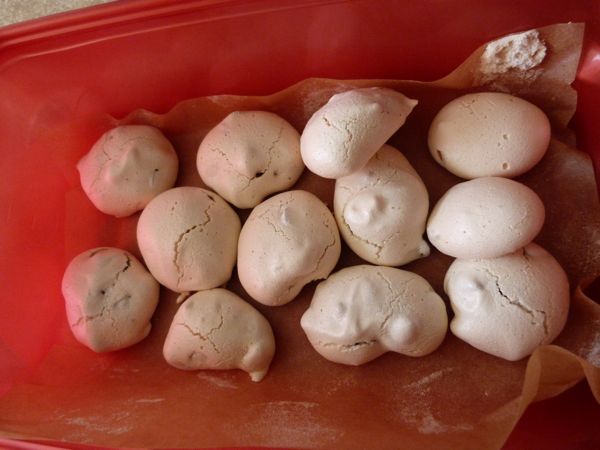
Still light, and melt-in-your-mouth, are the Russian Teacakes, snowy in powdered sugar:

Last, but necessary for color, are the stalwart sugar cookies, time-consuming and fiddly, but so good and so colorful:

Cookie prep – DONE!
Comfort Food: Corn Bread and Chili
While I was cleaning the kitchen and waiting for the last batch of cookies to bake, I whipped up a batch of corn bread for AdventureMan – no use in wasting a hot oven! It is a perfect, cold day in Pensacola. Perfect I say, because it really really is NOT fun baking Christmas cookies – or anything else – in a hot, humid kitchen. How did our grandmother’s and great great’s do it, especially in those voluminous dresses and no air conditioning??
The secret to truly great cornbread is to cook it in a cast iron skillet. You put the skillet in the oven until it is very hot, you take it out (using a pot holder, of course), melt a little butter in the pan, then pour the batter in. It will sizzle, and form a delicious crust. Pop the skillet back into the oven and in 22 minutes (at 425°F) your cornbread will be finished, with a toasty crust. If you want to guild the lily, you can swirl a pat of butter over the top, too.
AdventureMan dunks his corn bread in a glass of milk, which I find totally disgusting, but reminds him of when he was a little boy. It’s just a custom, I know, but I can’t look.

We have a pot of chili brewing, with the last of our home grown tomatoes:

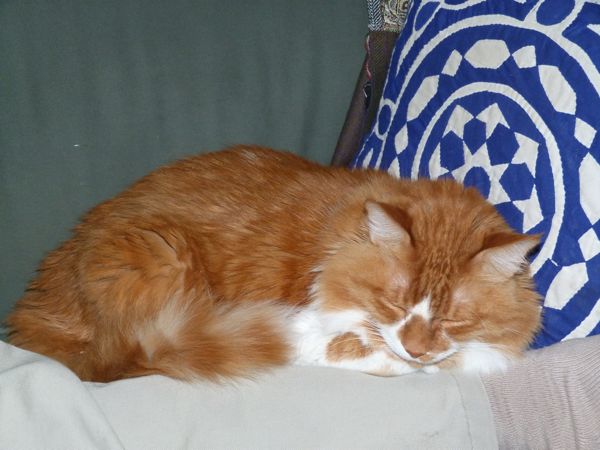
The Qatari Cat is following AdventureMan around, telling him to lie down so they can take a snooze together . . . I think it worked. I can hear them both sleeping . . .
Christmas House Prep . . . Done!
No, no, not the CELEBRATION of Christmas . . . That’s just beginning. But the craziness of getting ready for Christmas, after which you can sit back and enjoy some time for reflection.
A lot of the pain is self-inflicted. Before I even went to Seattle, I got out the garland and threaded it up the stairs. Found some glittering stars, and worked it so they would twirl and send twinkles of light throughout the entry. I sighed and puffed up and down the stairs . . . putting on lights is hard work, especially if, like me, you like LOTS of lights, it is hard work . . . but so, so worth it in the end. We had a little Christmas lighting up the house!
Stairway: DONE!

Years and years ago, like thirty years ago, I took a lot of time embroidering this Christmas wreath, so up it goes, every year: DONE

Life was on the fast track when I got back from Seattle, so I did a little bit every day, like “on the first day of Christmas prep, I hung the reindeer . . . ”

Then, it’s counter-intuitive, but I needed to get the outside lights up. Like how can it be Christmas if you don’t share? I’m annoyed that the icicle lights don’t match the tree lights; I’ll have to deal with that . . . next year 🙂

Done!
Now, to drag out all the boxes for the Christmas tree inside, and oh, what an adventure, always, to find forgotten treasures and to remember where we got the ornaments. I find all the pieces of the tree and set it up. I hate using an artificial tree, but the real trees get SO dry, especially when Pensacola experiences an unseasonal warm spell. It’s like you end up with large branches empty of needles, and you find needles strewn on our carpets for months to come.
Tree: done!

We saved a few ornaments for Q to “help” and three was just the right number, four was one too many, LOL!

The camel my friend in Doha made me – a Wise Man’s camel, following the great star, laden with gifts for the new baby:

Brass Christmas ornaments from the Women’s Cooperative in Damascus, along with a manger scene from Germany, and a cross – another cross – from Kuwait. Yes, yes, if you knew where to look, there were Christmas ornaments all over Qatar and Kuwait:

An Italian Creche and a tiny French Santon Creche, jumbled with collected camels and wise men . . . who says there can be only three wise men? I like LOTS of wise men come to greet the new baby Jesus 🙂

A Nurnberg angel from our first year of marriage and a Damascus tablecloth from our last trip to Damascus:
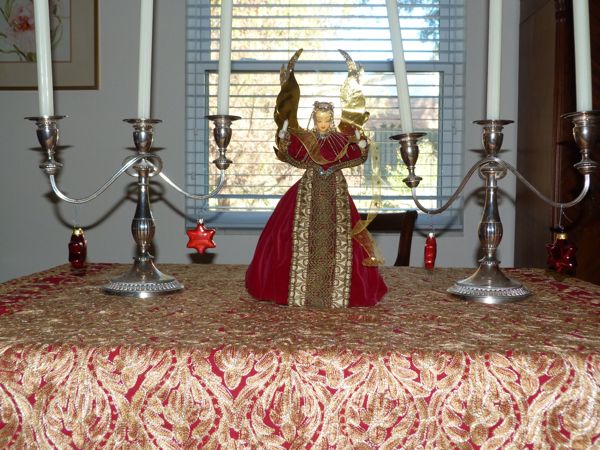
Rosenthal angels; I think I might have had these even before I married AdventureMan:

Have to have a nutcracker – or two, or three . . .

Some antique German glass ornaments, too fragile to be hung on the tree:

A total mishmash of all the places we have been, so much fun. Hard work, yes, pulling it all out every year, but every year we grin when we see our old friends and think of all the good times we have had in so many different countries!
Welcome, Jesus! Welcome, all who celebrate the season of your birth!

Done!
Jesus and the Woman to be Stoned for Adultery
I’ve always loved this passage, along with the woman at the well, and the woman who touched the hem of his garment to be healed from a bleeding disease – Jesus was kind to women, in a time and culture where a pious man would not speak to a woman.
Hilary Mantel captures the stunning experience in Eight Months on Ghazzah Street, where she asks a man at a counter for an item and he looks right past her. She repeats her request and he acts as if she isn’t there. Her husband walks up, asks, and receives an answer. Cultural biases most often do not favor women. In this regard, Jesus – and the prophet Mohammed – changed everything, and treated women as equal people. It’s amazing to me how many of the Jesus anecdotes featuring females survived; it must have been astonishing in his time to treat females – property – with such compassion and humanity.
Footnote to this passage from The Lectionary: The most ancient authorities lack 7.53—8.11; other authorities add the passage here or after 7.36 or after 21.25 or after Luke 21.38, with variations of text; some mark the passage as doubtful.
John 7:53-8:11
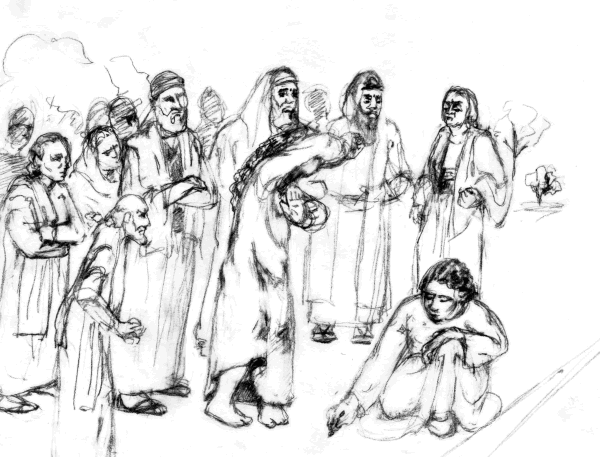
53Then each of them went home, 81while Jesus went to the Mount of Olives. 2Early in the morning he came again to the temple. All the people came to him and he sat down and began to teach them. 3The scribes and the Pharisees brought a woman who had been caught in adultery; and making her stand before all of them, 4they said to him, ‘Teacher, this woman was caught in the very act of committing adultery. 5Now in the law Moses commanded us to stone such women. Now what do you say?’ 6They said this to test him, so that they might have some charge to bring against him. Jesus bent down and wrote with his finger on the ground. 7When they kept on questioning him, he straightened up and said to them, ‘Let anyone among you who is without sin be the first to throw a stone at her.’ 8And once again he bent down and wrote on the ground.* 9When they heard it, they went away, one by one, beginning with the elders; and Jesus was left alone with the woman standing before him. 10Jesus straightened up and said to her, ‘Woman, where are they? Has no one condemned you?’ 11She said, ‘No one, sir.’* And Jesus said, ‘Neither do I condemn you. Go your way, and from now on do not sin again.’]]*
Qatar ‘ONE OF US’ Campaign – Nice Touch
Expat women who don’t wear enough clothing has long been a bone of contention for traditional and conservative Qatari women, who find themselves a minority in their own country. I remember well the anguish in the voice of one of my friends talking about how the salesgirl her mother was speaking with was showing “everything” AND she didn’t even speak Arabic, only English. Her mother was wondering whose country Qatar was?
Qatar doesn’t want to go to the extreme lengths of Saudi Arabia, they just want the non-Moslem, non-local women to cover up a little. Oh! Not just the women, the men, too! It’s a cute campaign – If you’re here, you’re one of us. I like it. It has a welcoming sound, but at the same time it politely reminds the expat that we are a guest in their country. This is the expectation, stated politely. Here is one of the visuals
(I found this article on Doha News)

A grassroots modesty campaign started by a group of Qatari women this summer has received the backing of the Qatar Tourism Authority, with the goal of helping visitors and expat residents “avoid embarrassment” and “feel welcome” here, the group has announced.
The “One of Us” drive, which was launched in June, highlights the part of the Qatari penal code that prohibits wearing “indecent” clothing in public, but adds to it by clarifying what exactly is deemed inappropriate – namely, bare shoulders and legs.
QTA will ensure that the dress code campaign guidelines will be displayed on posters in shopping malls and public spaces. They will also be posted on the QTA website and in future guides and brochures that the group publishes.
In June, campaign organizer Najla Al-Mahmoud told Doha News:
I don’t blame foreigners as they come from a different culture and they don’t know that it’s not acceptable… that’s why a group of ladies from different group of age gathered and decided to do something for Qatar…
We don’t want to interfere with anyone’s religion and force them to wear hijab … we only want modest clothing. It’s a matter of etiquette and class. We want to be able to go to public places without a lot of flesh around us.
Despite organizers’ efforts not to raise hackles, the campaign sparked a fierce debate on social media and Doha News about local/expat relations and the definition of decency.
Commenter J wrote:
This is a tricky issue for ex-pat women here as being “modest” is relative. And there are lots of mixed messages. You may see a young Muslim woman wearing a Shayla, a long, loose skirt, and the tightest long-sleeve shirt you’ve ever seen, leaving little to the imagination. And men wear tight t-shirts, tight skinny jeans, and shirts with the first three buttons open showing their chest. I think this campaign should not be aimed at everyone, not just at ex-pat women.
Others said they supported the campaign and expressed appreciation for having concrete guidelines to follow.
Meanwhile, Qatar University rolled out its own dress code in September, to mixed reaction from the student body, who are now prohibited from wearing tight, revealing clothing (including tight abayas) and casual wear like sweatpants and Bermuda shorts.
LOL@SCAMMER!
This was in my mailbox this morning, from a name I recognize. Fortunately, I have heard of this scam before – often the name used is that of a family member. The scammer captures someone’s e-mail and use it to contact all contacts with this message. Of course, the real individual has not been mugged, has all his cash and is doing fine, while we wire money to the scammer. NOT!
I hope you don’t take offense in my sudden approach for help. I took a
trip this week to Limassol, Cyprus and was attacked and robbed. My
belongings including my cash, credit card and cell phones were all
stolen. I’ve made contact with my bank but the best they can do is to
mail me a new card which will take 7 working days to arrive here, am
currently concluding my documentation at the embassy so i can fly out.
I need you to lend me some funds to settle some bills.
Please let me know if you can assist me in anyway so i can forward you
details to effect a transfer. Waiting for your mail.
Thanks,
Clive
Favorite Things Restaurant Opens on Cervantes
“Have you eaten at Favorite Things yet?” our friend asked us.
“They have a restaurant?” I asked. I knew they had a little coffee shop and gifts, but I hadn’t heard they had a restaurant.
“Just opened,” he replied. “I took folks there for breakfast after church last Sunday. It was GOOD!”
So the next day we had to go, missing entirely the police shooting two burglars in our neighborhood.

I had driven by this place a million times, but I had never been in. It was cute, lots of unique gifts and good ideas, an old fashioned candy store and – a newly opened restaurant. Actually, they had just opened the previous Friday, this was still their soft opening while they work the kinks out of their system.
The dining room is cute, all different tables and chairs, all a country theme.
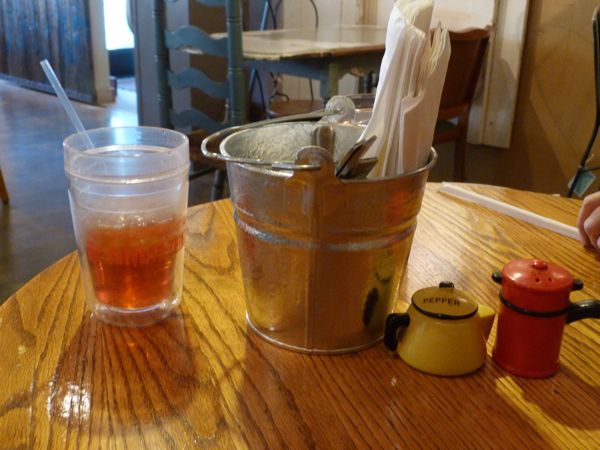

The menu offers a lot of options, breakfast options, sandwiches, entrees, local specialities. I overheard a manager talking it over with a long time friend; Favorite Things is associated with Jerry’s, next door, but “Jerry’s does all the fried food and we do all the rest!”
We ordered, then roamed through the store, looking at the gift offerings:



Oops! Food arrived while we were ooohing and aaahing over all the goodies.
AdventureMan ordered the soup and sandwich special with their gumbo and a turkey sandwich:

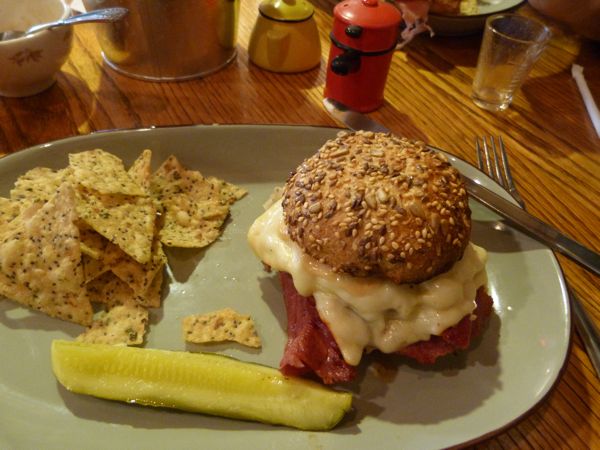
I ordered the Reuben sandwich on whole grain with a cup of the gumbo:


When I put the top on the Reuben, I saw something I really liked – look at all the grains on the top of the roll, and look at the whole grains in the chips:
We went back and tried breakfast, taking little-boy-Q with us, who was good as gold and ate everything with a fork except for the grapes. AdventureMan had a traditional egg special, little-boy-Q had parts of our meal and a fruit bowl, and I had the lachs and bagel breakfast, excellent, and I don’t even usually like bagels. Nice to know there is another good breakfast option near us.

Pensacola Christmas Parade 2012
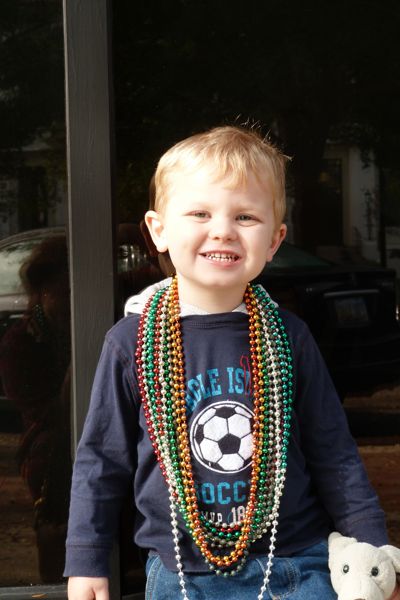
A perfect evening. Got there minutes before the one mile runners came by, parking at our church and walking to our favorite spot, meeting up with our son, his wife, and the adorable little boy who truly gets everything that is happening. This is his third parade; he always loved the lights and loud noises, but this year, he GETS it, gets the floats and the bands and the BEADS!
“I love this tradition,” my daughter-in-law says, leaning over to kiss me as we meet up to watch the parade and do a little-boy-transfer. He is coming to spend the night with us. He has his own room in our house.
ZOOOOOMMMMM! the motorcycle police accompany the runners, EEERRRRRRRROOOOOOOOOWWWWWWWW the fire engine, all lights and noise comes by at the beginning of the parade, and then a high school band from New Orleans with a killer beat leads the parade. Wooooo HOOOOOOOO, shouts Intlxpatr, totally into another cultural experience. 🙂
One of the optical shops had running eyeballs, totally hilarious!

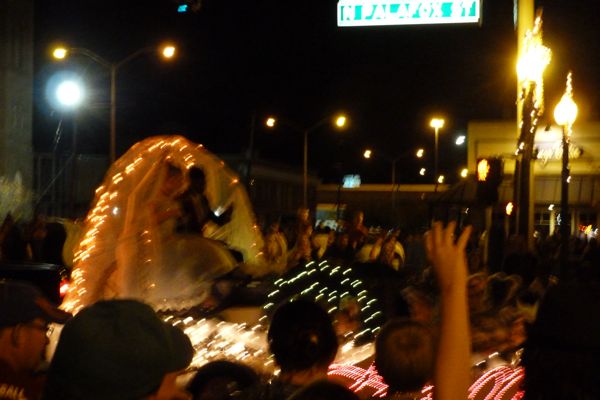
“Beads! Beads!”

This float was giving out Chobani yoghurt

“Beads! Beads! More beads!” People taller than I were catching beads – and then passing them on to the little children. So kind, so generous.


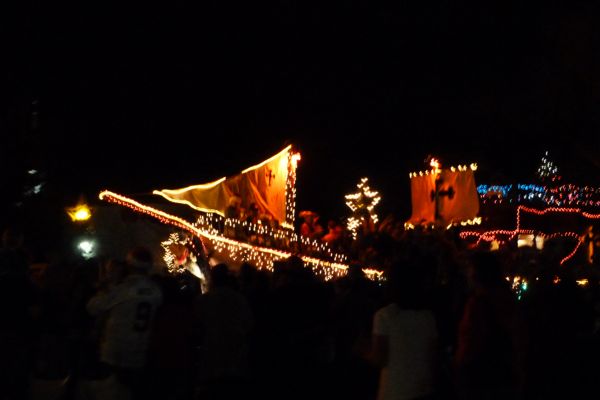
My favorite, of course, a pirate ship:
This parade is great fun. Here is a thing I love about Pensacola. About 50,000 people attend. Many walk from nearby neighborhoods, others drive down and park – there is still plenty of parking in Pensacola. People gather peacefully. There is no fighting over great spots; there are a lot of great spots from which you can watch the parade. At the end of the parade, everyone disperses peacefully – no fighting. In fifteen – twenty minutes the crowd is GONE, 50,000 people gone home, peacefully. It is a great community, all walks of life, all having a great time watching this home town Christmas parade.
Early this morning, the morning after, we started a new tradition – we got a long stick with a hook, and went after some of the beads stuck up in the trees. AdventureMan and Q got started while I went to church, meeting up with some experts who gave them tips – and beads. Such is the kindness of strangers, and the brotherhood of bead chasers. 🙂
Great Weather for the Pensacola Christmas Parade
The weather in Pensacola is crazy right now, after a couple months of cooling temperatures, we are up in the 70’s during the days and down in the 60’s at night, maybe the 50’s – it is so warm that our aloe is blossoming, she thinks it is spring.
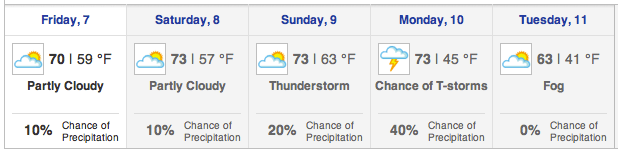
The good news is that the Pensacola Christmas Parade is tomorrow night, and it looks like it will be a balmy evening with NO RAIN! We are looking forward to taking our grandson – this will be his third Christmas Parade, but this is the first time he is really walking and talking, and we think the sound and lights (it always starts with the motorcycle police and the fire engines blasting and all their emergency lights spinning) are going to blow him away. This year he will be able to shout “beads! beads!” and scramble with the other kids for beads and candies; the parade is a wild mix of Christmas and Mardi Gras. It is a hilarious experience, and we are eager to see it through his eyes.

Recent Comments
intlxpatr on Shampoo Ginger tigerbutterya0c5ff1d… on Shampoo Ginger intlxpatr on British Soldier Kidnapped, Esc… John on British Soldier Kidnapped, Esc… intlxpatr on British Soldier Kidnapped, Esc… Wikipedia Donate Button

Amazina


Early Voting in Florida


