Publix Helps Us Cook At Home
Through blogging, I became a fan, and then in the way things happen in this wonderful virtual world, a friend of another blogger, John Lockerbie, who writes about many things, my favorite of which is Islamic design. He writes about the architecture, the boats, development in the Gulf, and behind the blogs, we have had our own correspondence.
Recently he commented on the post I wrote about how American health problems are mostly self-inflicted, and could be turned around with proper diet, exercise and preventive visits to the doctor to deter the serious illnesses from showing up. He sent me a reference to a speech made by Jamie Oliver, when he won the TED prize, on changing one small thing in the modern world – teaching us to cook once again in our own homes instead of eating out, eating highly processed, highly salted, highly sugared and highly fatted foods.
There is a Florida chain of supermarkets called Publix, and they are marvelous. Publix is making it easy for people to cook at home. They have a program where they do cooking demos, give out the recipes, and have all the ingredients gathered in one place – at the same price as throughout the store, just located conveniently in this one place – to encourage people to cook at home.
All the ingredients for several recipes:

Close up:

The signage:

Pick a recipe!

I find I am enjoying cooking a lot more here, where shopping is so easy and everything looks so good. Oh yes, and the prices are so low!
No! No! Proposed Traffic Law Change is a Step Backwards!
You see it all the time, at the roundabouts. Those fellows – it’s always guys – in the hot cars, the Porche, the Cayenne, I don’t even know all the names. The light turns red; they don’t care. They see a gap, they go.
I would love a look at the statistics. I would love to see who is getting all the fines for jumping the red lights. I bet 90% are all the same nationality.
And now they want to LOWER the fine for running the red light???
Just when Qatar has proudly announced that traffic deaths are falling dramatically with the ENFORCEMENT of the new, stricter laws?
No! No! A moderation of this fine is a step backward! Please, please, don’t do it!
Lower fine proposed for running a red light
The Advisory Council seeks a review of the traffic law
By Nour Abuzant
Staff Reporter
The Advisory Council has proposed a review of the traffic law with a stress on reducing the current fine of QR6,000 for jumping the red signal, a member of the council said yesterday.
According to him, the draft proposal recommended a significant cut in the fine and suggested that the penalty be structured around a more practical model based on the circumstances of the violation and the number of times a motorist committed the same offence.
Senior officials of the Traffic Department had defended the stringent rules which came into force in October 2007, saying they had been issued to combat the mounting number of traffic accidents which claimed scores of lives on the country’s roads.
Advisory Council member Mohamed al-Hajery, who was one of the 20 citizens felicitated by the Traffic Department for their clean traffic record yesterday, told reporters on the sidelines of the ceremony that the House preferred a more pragmatic approach to the issue.
The awarding ceremony was part of Qatar’s celebration of the GCC Traffic Week, currently being held under the slogan “Beware of Other’s Faults”.
“The tendency of my fellow members is to take into consideration the number of previous traffic violations and the circumstances involving the jumping of the red-light,” al-Hajery said.
“You cannot treat someone who jumped the signal after a minute the light turned red and after a fraction of a second it turned red from orange,” he said.
“I think that the appropriate fine for a driver who jumped the red light without a criminal intention is QR1,500 – QR2,000.”
Al-Hajery stressed that his pleading for a more lenient treatment did not mean he was promoting traffic violations. “Anyone who deliberately jumps the signal should be treated like a potential killer and no mercy should be shown to him.”
He said he was in favour of treating each case of jumping the red light individually.
The Advisory Council members had on February 19, 2008, refused to ratify the 2007 law, arguing that “ it did not strike a balance between the crime and the punishment”.
In late July 2008, the Advisory Council members gave the law a “test period” that ended in October 2008, to check the effectiveness of the law.
The law had introduced for the first time a negative points system that might lead to the suspension or cancellation of driving licences.
The Advisory Council member said that he was personally against the system. He explained: “Sometimes, the (negative) points are registered in the driver’s account and sometimes against the owner of the vehicle. In some cases, your son drives the car and you sustain the points. It is an ineffective system and should be re-examined.”
However, Traffic Department director Brigadier Saad al-Kharji on Sunday said he was not aware of any intention to reduce, at least for the time being, the current fines.
“Anybody who respects the traffic regulations has nothing to fear,” he said arguing that after two and half years of its implementation, the law had “proved effective in reducing the number of casualties, if we take into consideration the increasing number of vehicles in the country”.
He said: “Our target is to save lives on Qatar’s roads and there is no fine that can equal the life of a human being. It is not true that our aim was just to collect money.”
Flat Stanley: Oh The Places You’ll Go!
This title refers to two classic American books that most kids are familiar with. The first book,
Flat Stanley (at Amazon.com) is about a boy who is flat and figures out that he can go places by envelope. The second book is a book by Dr. Seuss, Oh! The Places You’ll Go by Dr. Seuss (at Amazon.com) one of those books parents read to their children and at some point the children say “Look! I can read!” and they will appear to be reading the book because they have heard it so many times.
Some really smart and creative elementary teacher figured out how to turn Flat Stanley into a lesson combining writing and geography, and now kids are making flat versions of themselves and mailing themselves to far-away places. My friend, Grammy, has received requests to help with these projects at least twice – and oh, the fun we have with these flat kids.
You take pictures. You explain what Stanley is doing. You make a slide show and send it to the kid to share with his class. What a wonderful way to make another country come to life! These kids will know where Doha, Qatar is! They will know some of the sights in Doha. Can you imagine? I wish geography had been so much fun when I was a kid!
It also reminds me to tell you, our friends in the states, that living in places like Doha is NOT SCARY. Look at the faces of all the people who helped us with Flat Stanley. Every single person we encountered was delighted to help us. No one ever said no, and some even volunteered extra ideas. In the souks today were some school children groups, and they helped too, although I am not posting photos because I don’t have their parent’s permissions, but it was one of the sweetest moments of the day, with these adorable children holding Flat Stanley.
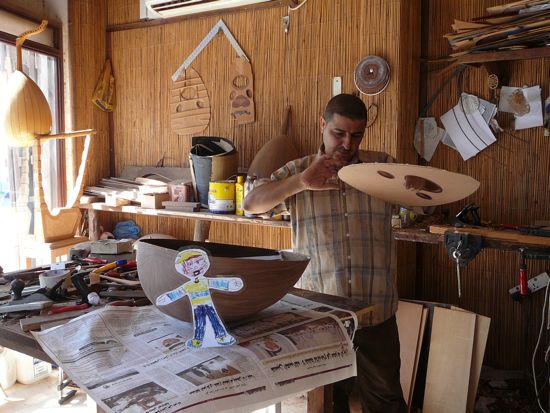
Stanley visits the maker of lutes:
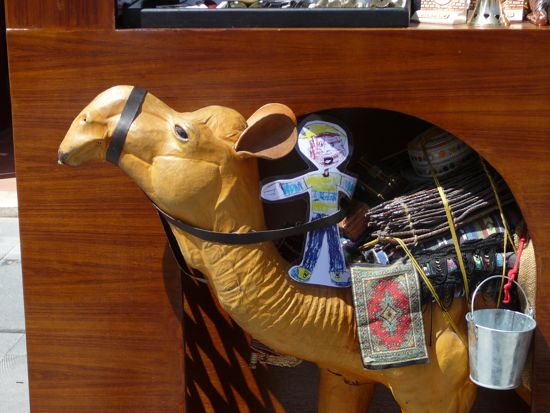
Stanley rides a camel:
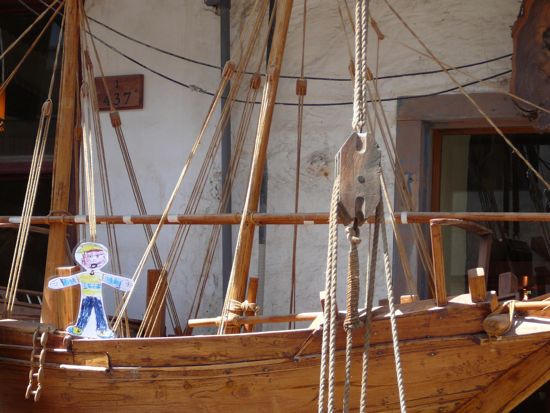
Stanley takes a ride on a dhow:
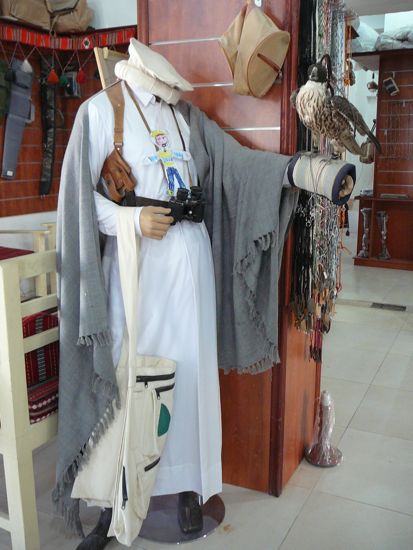
Stanley visits the falcon souk, only sadly, falcon season is over, so there are no live falcons 😦
Stanley takes a rest in an incense burner:

Stanley visits the scribes:

Stanley hitches a ride with a souk cop on his Segway:

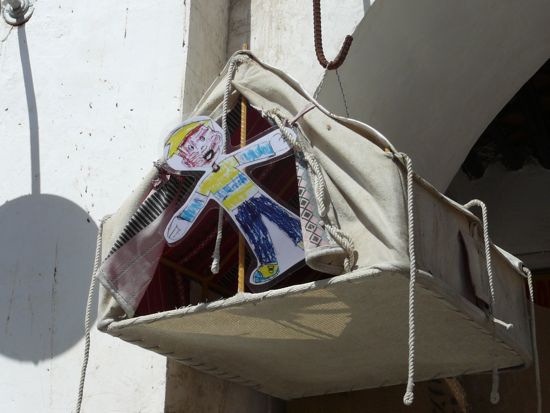
Stanley tries out a model tent at the tentmaker’s souk:
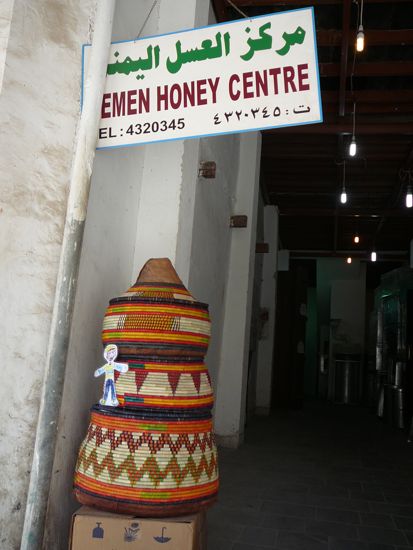
Stanley visits our friend, the Yemeni honey man, who also sells some of the worlds most wonderful baskets from the Asir in Yemen:
The weather is perfect. Take a trip to the souks. Get outside your normal boundaries and explore a little. Doha is a sweet family city, with lots to do, lots of family activities, great places for walking (the Corniche, Aspire Park, the beaches). Do it now, before the weather gets intense!
Qatar’s ‘Manly Women’
Thank you, Little Diamond, who sent this article from The Economist as an update to blog entry on cross dressing based on a tiny article in the Gulf Times
CROSS-DRESSING is on the rise among young Qataris. The local press says that more tradition-minded locals are upset by the growing number of young women affecting a masculine style of dress, baggy trousers, short hair and deep voices. These women, who call themselves boyat, which translates as both tomboy and transsexual (and is derived from the English word boy), are being seen in schools and on university campuses where some are said to harass their straiter-laced sisters.
In an episode of a talk show on Qatari television, called Lakom al Karar (The Decision is Yours), a leading academic said that the “manly women” phenomenon was part of a “foreign trend” brought into Qatar and the Gulf by globalisation. Foreign teachers, the internet and satellite television have been blamed. So have foreign housemaids, for badly influencing children in their care.
The studio audience was divided over how to respond. Some called for the death penalty for cross-dressers, while others favoured medical treatment. A rehabilitation centre for Qatari boyat has been set up, but a local report says that as many as 70% of them refuse to give up their “abnormal behaviour”.
It is not just Qataris who are rattled. A year ago the ministry of social affairs in the United Arab Emirates (UAE) launched a campaign against “masculine women”. The project, entitled “Excuse me, I’m a girl”, involved workshops, lectures and television programmes, stressing the virtues of femininity and raising awareness of the presumed dangers of women looking like men. An emirates’ foundation is helping to fund a research project on “gender identity disorder among Emirati youth”.
One official describes the “deviant behaviour” of the boyat as a “menace” to society. But others sound less fazed. An American university lecturer in the region says the short hair and gym shoes worn by these young women would look perfectly normal on an American campus. That is just what unnerves the traditionalists.
Why do you think these girls dress and act like men? Why would a girl do that?
I think girls do that – in any country – for a reason. If privileges and freedoms are heavily weighted in favor of males, perhaps there is no great mystery as to why some females would prefer to be males. It makes sense to me. Girls aren’t stupid. They can see who is getting all the goodies. My guess it is less a gender issue than a values issue.
On the other hand, when – and if – things are more equal, there is less motivation to be other than what we were created to be.
I had some young local friends who told me that they were taking Tai Kwan Do, but quit when a neighbor told their mother that it might threaten their virginity. It broke my heart. The martial arts give grace and confidence to young women. There are a lot of ways a hymen can be broken; I have never heard of it happening while training in Tai Kwan Do. These young, vibrant girls have fewer and fewer activities that they are encouraged to do, and end up staying home or strolling endlessly at the local malls. Aaarrgh!
Dads – teach your daughters to hunt! Teach them to fish! Teach them to swim, to throw a softball, to kick a football. Take them camping in the desert, and let them run freely. Teach them chess, and how to win. Give them the gift of physical and intellectual activity, give them the understanding that sports, employment and power are equally accessible for all sexes, and you won’t be having problems with girls who yearn for the freedoms and privileges of being male.
Ladies Bible Study in Doha
“Tell me the story of Noah” our priest said, and we all chimed in. Everybody knows the story of Noah, how God told him to build an ark, and how he did it. How everyone laughed at him, but he faithfully built. How he filled the ark with animals, and then it started raining and rained for forty days.
“OK, stop there” the priest said. “Is that what the bible says?”
Well, of course that’s what the bible says! We all know the story!
“Wrong!” he exclaimed!
“We have many stories with facts not in the bible, information gathered from another source – the Qur’an.”
We sat there, our eyes wide.
“No where in the bible will you find that Noah was living in a dry and arid place, or that his neighbors laughed at him – that’s in the Qur’an.”
The Episcopal lectionary is in Genesis right now, and so I have had a chance to read – and re-read – the story of Noah. The priest is right. There are details we all take for granted, not there.
One of the other details was that until Noah, the first instructions to Adam and Eve were that they could eat from every tree – no mention of meat. After the flood is the first mention of meat – but NO blood.
Genesis 9:1-17
9:1 God blessed Noah and his sons, and said to them, ‘Be fruitful and multiply, and fill the earth. 2 The fear and dread of you shall rest on every animal of the earth, and on every bird of the air, on everything that creeps on the ground, and on all the fish of the sea; into your hand they are delivered. 3 Every moving thing that lives shall be food for you; and just as I gave you the green plants, I give you everything. 4 Only, you shall not eat flesh with its life, that is, its blood. 5 For your own lifeblood I will surely require a reckoning: from every animal I will require it and from human beings, each one for the blood of another, I will require a reckoning for human life.
6 Whoever sheds the blood of a human,
by a human shall that person’s blood be shed;
for in his own image
God made humankind.
7 And you, be fruitful and multiply, abound on the earth and multiply in it.’
8 Then God said to Noah and to his sons with him, 9 ‘As for me, I am establishing my covenant with you and your descendants after you, 10 and with every living creature that is with you, the birds, the domestic animals, and every animal of the earth with you, as many as came out of the ark.* 11 I establish my covenant with you, that never again shall all flesh be cut off by the waters of a flood, and never again shall there be a flood to destroy the earth.’ 12 God said, ‘This is the sign of the covenant that I make between me and you and every living creature that is with you, for all future generations: 13 I have set my bow in the clouds, and it shall be a sign of the covenant between me and the earth. 14 When I bring clouds over the earth and the bow is seen in the clouds, 15 I will remember my covenant that is between me and you and every living creature of all flesh; and the waters shall never again become a flood to destroy all flesh. 16 When the bow is in the clouds, I will see it and remember the everlasting covenant between God and every living creature of all flesh that is on the earth.’ 17 God said to Noah, ‘This is the sign of the covenant that I have established between me and all flesh that is on the earth.’
Now I have to go find a Qur’an and read what it has to say about Noah and the ark. I like it that our traditions don’t have to be at war with one another, but can illuminate and enrich one another.
Doha Trade Fair Opens
I love these fairs – there are vendors from all over. One year, I bought bought fabrics from the Sudan and from Senegal – fabulous things I would never find anywhere else. It’s like a shopping trip around the world. 🙂
Huge turnout at Doha Fair
From today’s Gulf Times
Ahmed al-Nuami inaugurates the Doha Trade Fair 2010 at Doha Exhibition Centre yesterday
The eight-day Doha Trade Fair 2010 got off to a great start yesterday at the Doha Exhibition Centre in the presence of a large number of people.
The fair, organised by the Qatar Tourism and Exhibition Authority in association with Qatar Expo, has attracted more than 600 exhibitors from about 20 countries.
More than 15,000 square metres at the exhibition venue has been occupied by the exhibitors.
Bumper prizes and opportunities for bargains on an array of goods beckon visitors.
Products being sold at the venue include carpets, clothes, cosmetics, textiles, lighting accessories and brassware and handicrafts from many Asian, African, European and Middle East countries.
According to Qatar Expo, QR5mn worth of goods is expected to be sold at the fair in the next seven days.
“With 685 exhibitors this time, the fair is growing at an enormous pace every year. The event is expected to turn Doha into a top business destination of the whole of the Middle East,” an official of the organising company said. He also expressed confidence that there would be more participants at the fair next year.
Qatar Tourism and Exhibition Authority chairman Ahmed al-Nuaimi inaugurated the fair. Diplomats of a number of missions and senior Qatari community members attended the opening ceremony.
The fair timings are between 10am to 1pm and 4pm and 11pm. The event will conclude on January 24.
Community Police Graduate
Community policing is necessary when we neglect to police ourselves. . . if, for example, we find ourselves throwing a tissue out of our car window as we drive along, littering the pristine streets of Doha. If we bully someone because we want that parking spot he is driving into, if we disrupt the peace and quality of life of others by our behavior.
I notice, in this story from the Gulf Times, that women are a part of this program, and that they are wearing uniforms, and hijab, and that those uniforms are very modest and also that they are wearing pants. Please see the previous article.
I commend Qatar for this visionary program, helping the community police itself, and for including women from the very first class.
46 take part in community policing basic course
Graduates with officials at the convocation ceremony
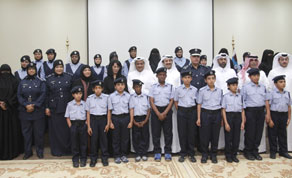
The Police Training Institute (PTI) recently held a ceremony to mark the graduation of participants in the first batch of the Community Policing Basic Course, under the auspices of Minister of State for Interior Affairs HE Sheikh Abdullah bin Nasser bin Khalifa al-Thani.
Some 46 students from various security departments took part in the course, which lasted seven weeks, said a spokesperson.
The ceremony was attended by the chairman on the Central Municipal Council, HE Nasser al-Kaabi; director of the PTI, Brigadier Mohamed Hassan Youssef al-Saei as well as other ministry officials.
Brigadier al-Saei explained that the course has been conducted to “enhance the role and mechanisms of community policing,” as well as helping to create partnerships with various social institutions to help with national security.
The PTI director added that the graduates of this course will be able to translate the Ministry of Interior’s aims and strategies to encourage understanding between various communities and to help the police to be able to prevent crimes before they are committed.
Brigadier Rashid Shaheen al-Atheeque, chairman of the steering committee of community policing, said: “The graduation of the first course of community policing is one of the stages of qualifying the national cadres at the Ministry of Interior to work in the national project.”
“Qatar is currently witnessing progress in all aspects of development in economic and social fields – this increases the role of all sectors in the country to face all kinds of challenges brought with this development,” he said, adding: “These factors require the improvement of capabilities to keep pace with development.”
Brigadier al-Atheeq explained that the ministry had pursued the initiative of community policing to help reduce crime throughout all institutions, and said that they had pursued the objective with the co-operation of the Supreme Council for Family Affairs as well as other ministries and companies, working towards the National Vision 2030.
He explained that the concept will initially be employed in the North Security Department from April 2010, with plans to apply it across the board from 2011.
Representing the director of the Ummul Qura Independent School for Boys, teacher Areezah al-Yami described the noticeable benefits of introducing the community policing programme in the school over the past year.
Qatar: “We Are a Nation That Does Not Read”
This is one of the saddest articles I could read, a Nation that Does Not Read.
There is a secret to teaching your child to read. The secret is: be readers.
When a child grows up surrounded by books and magazines, when she grows up seeing her parents with books, magazines and newspapers in their hands, guess what happens? The child also grows up to be a reader.
YOU are the key to your child’s reading. Do you read to your children before bed every night? Do they already have their favorite books? Do you use books to reward good behavior?
There is a world of wonderful children’s books out there for children of every age. I commend Qatar for taking these first steps to create a nation of readers, and I urge that this be a long term project, with continuing support.
There are several bookstores in Qatar – the Jarir has a large number of children’s books. Virgin has books. The Dar ath Thaqafa stores have children’s books. There is a store in City Center called Eye Spy which has all kinds of children’s educational resources, it is up on the third floor, I believe. Buy books when you are travelling abroad and give them out during the year as special treats. You CAN create a nation of readers. 🙂
From the Gulf Times
Club will nurture rare ‘book worms’
By Ourouba Hussein
The Childhood Cultural Centre is to launch an ambitious project that aims to inculcate the reading habit among children in Qatar.
Called the “Book Club”, the project was conceived after a study found that children in Qatar read only a quarter of a page per year.
Book Club project manager Abdullah Hamid al-Mulla said that children in Qatar read almost nothing outside their syllabus while children in the US read 11 books a year and their counterparts in the UK 8 books.
“We are a nation that does not read,” he stated.
According to the study, the number of books published in the Arab world is eight for every 12,000 children, al-Mullah said, adding “we know why Arabs are lagging in many fields”.
He said the project, under the slogan “a trip into the minds of people”, targeted children in the age group of 6-18 years and aimed at expanding their perceptions, as well as creating a reading culture.
He noted that since statistics showed that Arabs did not read more than six minutes per year and experience proved that children did not go to libraries or book clubs, the centre decided to reach out to them, in schools and “wherever they are”.
“We will work out agreements with schools and provide the books in schools also.”
Al-Mullah said incentives associated with the project that will be launched in conjunction with the Doha Book Fair 2009, featured excursions inside and outside Qatar, awards and cultural publications. The book fair opens at the Doha International Exhibition Centre today.
He explained that once a child is registered with the club, he will earn points according to participation in activities organised by the forum.
“Points are earned according to the level of the child’s usage of the free library, reciting stories for reading groups or attempts to write on his own, as well as participation in workshops,” he said.
According to the number of points earned, the child will be rewarded.
Al-Mulla also pointed out that experts would be available to help children select the most appropriate books.
He noted that the club’s pavilion at the Doha Book Fair will introduce many interactive educational projects for children.
Recent Comments
intlxpatr on Shampoo Ginger tigerbutterya0c5ff1d… on Shampoo Ginger intlxpatr on British Soldier Kidnapped, Esc… John on British Soldier Kidnapped, Esc… intlxpatr on British Soldier Kidnapped, Esc… Wikipedia Donate Button

Amazina


Early Voting in Florida


