A Prayer for Samuel Occum
I don’t always get a chance to read about a saint of the church on his/her saint’s day, but this morning, while reading The Lectionary readings, I took the time, and was glad I did. These readings tell me about ordinary people who made a difference, Samuel Occum by being Mohegan (Mohican?) and serving his community by raising funds for the establishment of Dartmouth College.
But what I loved was the prayer for his saint’s day, which starts “God, Great Spirit” and talks about his voice in the thundering wind.
PRAYER (contemporary language)
God, Great Spirit, whose breath gives life to the world and whose voice thunders in the wind: We thank you for your servant Samson Occom, strong preacher and teacher among the Mohegan people; and we pray that we, cherishing his example, may love learning and by love build up the communities into which you send us, and on all our paths walk in beauty with Jesus Christ; who with you and the Holy Spirit, is alive and reigns, one God, now and for ever. Amen.
SAMSON OCCUM
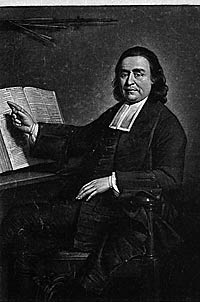
WITNESS TO THE FAITH IN NEW ENGLAND, 1792
The Reverend Samson Occom (1723 – 1792) (also spelled as Occum) was a Native American Presbyterian clergyman and a member of the Mohegan nation near New London, Connecticut. He has the distinction of being the first Native American person to ever publish documents and pamphlets in English.
Born to Joshua Tomacham and his wife Sarah, Occom is believed to be a direct descendant of the famous Mohegan chief, Uncas. In 1740, at the age of sixteen, Occom was exposed to the teachings of Christian evangelical preachers in the Great Awakening. He began to study theology at the “Lattin School” of Eleazar Wheelock in 1743 and stayed for four years until leaving to begin his own career.
Occom served as a missionary to Native American people in New England and Montauk, Long Island, where he married a local woman. It was also on Long Island where he was officially ordained a minister on August 30, 1759, by the presbytery of Suffolk.
Wheelock established an Indian charity school (which became Dartmouth College) with a benefaction from Joshua Moor in 1754, and he persuaded Occom to go to England in 1766 to raise money for the school, along with the Rev. Nathaniel Whitaker. Occom preached his way across the country from February 16, 1766, to July 22, 1767. He delivered in total between three and four hundred sermons, drawing large crowds wherever he went. By the end of his tour he had raised over twelve thousand pounds for Wheelock’s project. King George III himself donated 200 pounds, and William Legge, Earl of Dartmouth subscribed 50 guineas. The friendship between Occom and Wheelock dissolved when Occom learned that Wheelock had neglected to care for Occom’s wife and children while he was away. Occom also took issue with the fact that Wheelock put the funds toward establishing Dartmouth College for the education of Englishmen rather than of Native Americans.
Upon his return from England, Occom lived at Mohegan, then moved in 1786 with some New England and Long Island Indians to Oneida territory in what is known today as New York. He then helped to found Brothertown, and lived among the Brothertown Indians. Occom died on July 14, 1792, in New Stockbridge, New York.
Scamese
This was in my newest New Yorker magazine, originally given me by Little Diamond, now I can’t live without my subscription. 🙂 There is the kind of news you get on television, like what they have pictures of, maybe not the most important stuff but visual. Then there is National Public Radio news, and the New York Times, and The New Yorker. The New Yorker also has some of the greatest, funniest covers ever, and great cartoons. This one, as you might imagine, is near and dear to my heart:

The King’s Speech
“The movie is sold out!” my friend exclaimed as she and her husband joined me in the theater. We had really good seats. I had accidentally managed to get there early enough to get seats right in the center, close enough, but not too close. People looked at the seats I was saving for my friend and her husband with envy, and it was all I could do not to make a sign against the ‘evil eye.’ 🙂

Whoda thunk? Who would have thought a movie about an English king with a speech problem would sell out the entire theatre?
Must be word of mouth. The film is really, really good, and takes a personal tragedy and turns it into an inspiration. You wouldn’t think there could be anything funny about tackling such a problem, but the movie has some very very funny moments – the king, George VI, actually CAN speak without a stammer when he is swearing, when he is singing, or when he is very very angry.
His unorthodox speech tutor gives the King a new vision of himself, and helps him find insights into how the problem developed. There are some very moving moments, and some highly inspiring ones, too. All in all, the movie keeps moving, keeps you informed and makes you glad you spent the money on movie tickets.
Would You Like Fries With That?
When I saw this, I whopped with laughter, i couldn’t help myself, it was so unexpected and, to me, awful. This is just sad! This is for the kid who wants to grow up to say “Would you like fries with that?”

1001 Inventions: Muslim Inventions That Changed the World
A fabulous new exhibition, 1001 Inventions has opened, and will be coming to this country in December of this year. The exhibit details our Muslim heritage in the arts and sciences.
1001 Inventions – Discover The Muslim Heritage In Our World
From coffee to cheques and the three-course meal, the Muslim world has given us many innovations that we take for granted in daily life. As a new exhibition opens, Paul Vallely nominates 20 of the most influential- and identifies the men of genius behind them
Saturday, 11 March 2006

1 The story goes that an Arab named Khalid was tending his goats in the Kaffa region of southern Ethiopia, when he noticed his animals became livelier after eating a certain berry. He boiled the berries to make the first coffee. Certainly the first record of the drink is of beans exported from Ethiopia to Yemen where Sufis drank it to stay awake all night to pray on special occasions. By the late 15th century it had arrived in Mecca and Turkey from where it made its way to Venice in 1645. It was brought to England in 1650 by a Turk named Pasqua Rosee who opened the first coffee house in Lombard Street in the City of London. The Arabic qahwa became the Turkish kahve then the Italian caffé and then English coffee.
2 The ancient Greeks thought our eyes emitted rays, like a laser, which enabled us to see. The first person to realise that light enters the eye, rather than leaving it, was the 10th-century Muslim mathematician, astronomer and physicist Ibn al-Haitham. He invented the first pin-hole camera after noticing the way light came through a hole in window shutters. The smaller the hole, the better the picture, he worked out, and set up the first Camera Obscura (from the Arab word qamara for a dark or private room). He is also credited with being the first man to shift physics from a philosophical activity to an experimental one.
3 A form of chess was played in ancient India but the game was developed into the form we know it today in Persia. From there it spread westward to Europe – where it was introduced by the Moors in Spain in the 10th century – and eastward as far as Japan. The word rook comes from the Persian rukh, which means chariot.
4 A thousand years before the Wright brothers a Muslim poet, astronomer, musician and engineer named Abbas ibn Firnas made several attempts to construct a flying machine. In 852 he jumped from the minaret of the Grand Mosque in Cordoba using a loose cloak stiffened with wooden struts. He hoped to glide like a bird. He didn’t. But the cloak slowed his fall, creating what is thought to be the first parachute, and leaving him with only minor injuries. In 875, aged 70, having perfected a machine of silk and eagles’ feathers he tried again, jumping from a mountain. He flew to a significant height and stayed aloft for ten minutes but crashed on landing – concluding, correctly, that it was because he had not given his device a tail so it would stall on landing. Baghdad international airport and a crater on the Moon are named after him.
5 Washing and bathing are religious requirements for Muslims, which is perhaps why they perfected the recipe for soap which we still use today. The ancient Egyptians had soap of a kind, as did the Romans who used it more as a pomade. But it was the Arabs who combined vegetable oils with sodium hydroxide and aromatics such as thyme oil. One of the Crusaders’ most striking characteristics, to Arab nostrils, was that they did not wash. Shampoo was introduced to England by a Muslim who opened Mahomed’s Indian Vapour Baths on Brighton seafront in 1759 and was appointed Shampooing Surgeon to Kings George IV and William IV.
6 Distillation, the means of separating liquids through differences in their boiling points, was invented around the year 800 by Islam’s foremost scientist, Jabir ibn Hayyan, who transformed alchemy into chemistry, inventing many of the basic processes and apparatus still in use today – liquefaction, crystallisation, distillation, purification, oxidisation, evaporation and filtration. As well as discovering sulphuric and nitric acid, he invented the alembic still, giving the world intense rosewater and other perfumes and alcoholic spirits (although drinking them is haram, or forbidden, in Islam). Ibn Hayyan emphasised systematic experimentation and was the founder of modern chemistry.
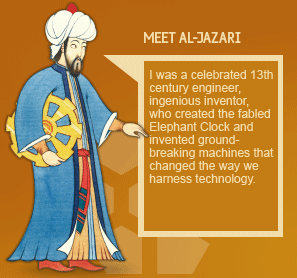
7 The crank-shaft is a device which translates rotary into linear motion and is central to much of the machinery in the modern world, not least the internal combustion engine. One of the most important mechanical inventions in the history of humankind, it was created by an ingenious Muslim engineer called al-Jazari to raise water for irrigation. His 1206 Book of Knowledge of Ingenious Mechanical Devices shows he also invented or refined the use of valves and pistons, devised some of the first mechanical clocks driven by water and weights, and was the father of robotics. Among his 50 other inventions was the combination lock.
8 Quilting is a method of sewing or tying two layers of cloth with a layer of insulating material in between. It is not clear whether it was invented in the Muslim world or whether it was imported there from India or China. But it certainly came to the West via the Crusaders. They saw it used by Saracen warriors, who wore straw-filled quilted canvas shirts instead of armour. As well as a form of protection, it proved an effective guard against the chafing of the Crusaders’ metal armour and was an effective form of insulation – so much so that it became a cottage industry back home in colder climates such as Britain and Holland.
9 The pointed arch so characteristic of Europe’s Gothic cathedrals was an invention borrowed from Islamic architecture. It was much stronger than the rounded arch used by the Romans and Normans, thus allowing the building of bigger, higher, more complex and grander buildings. Other borrowings from Muslim genius included ribbed vaulting, rose windows and dome-building techniques. Europe’s castles were also adapted to copy the Islamic world’s – with arrow slits, battlements, a barbican and parapets. Square towers and keeps gave way to more easily defended round ones. Henry V’s castle architect was a Muslim.
10 Many modern surgical instruments are of exactly the same design as those devised in the 10th century by a Muslim surgeon called al-Zahrawi. His scalpels, bone saws, forceps, fine scissors for eye surgery and many of the 200 instruments he devised are recognisable to a modern surgeon. It was he who discovered that catgut used for internal stitches dissolves away naturally (a discovery he made when his monkey ate his lute strings) and that it can be also used to make medicine capsules. In the 13th century, another Muslim medic named Ibn Nafis described the circulation of the blood, 300 years before William Harvey discovered it. Muslims doctors also invented anaesthetics of opium and alcohol mixes and developed hollow needles to suck cataracts from eyes in a technique still used today.
11 The windmill was invented in 634 for a Persian caliph and was used to grind corn and draw up water for irrigation. In the vast deserts of Arabia, when the seasonal streams ran dry, the only source of power was the wind which blew steadily from one direction for months. Mills had six or 12 sails covered in fabric or palm leaves. It was 500 years before the first windmill was seen in Europe.
12 The technique of inoculation was not invented by Jenner and Pasteur but was devised in the Muslim world and brought to Europe from Turkey by the wife of the English ambassador to Istanbul in 1724. Children in Turkey were vaccinated with cowpox to fight the deadly smallpox at least 50 years before the West discovered it.
13 The fountain pen was invented for the Sultan of Egypt in 953 after he demanded a pen which would not stain his hands or clothes. It held ink in a reservoir and, as with modern pens, fed ink to the nib by a combination of gravity and capillary action.
14 The system of numbering in use all round the world is probably Indian in origin but the style of the numerals is Arabic and first appears in print in the work of the Muslim mathematicians al-Khwarizmi and al-Kindi around 825. Algebra was named after al-Khwarizmi’s book, Al-Jabr wa-al-Muqabilah, much of whose contents are still in use. The work of Muslim maths scholars was imported into Europe 300 years later by the Italian mathematician Fibonacci. Algorithms and much of the theory of trigonometry came from the Muslim world. And Al-Kindi’s discovery of frequency analysis rendered all the codes of the ancient world soluble and created the basis of modern cryptology.
15 Ali ibn Nafi, known by his nickname of Ziryab (Blackbird) came from Iraq to Cordoba in the 9th century and brought with him the concept of the three-course meal – soup, followed by fish or meat, then fruit and nuts. He also introduced crystal glasses (which had been invented after experiments with rock crystal by Abbas ibn Firnas – see No 4).
16 Carpets were regarded as part of Paradise by medieval Muslims, thanks to their advanced weaving techniques, new tinctures from Islamic chemistry and highly developed sense of pattern and arabesque which were the basis of Islam’s non-representational art. In contrast, Europe’s floors were distinctly earthly, not to say earthy, until Arabian and Persian carpets were introduced. In England, as Erasmus recorded, floors were “covered in rushes, occasionally renewed, but so imperfectly that the bottom layer is left undisturbed, sometimes for 20 years, harbouring expectoration, vomiting, the leakage of dogs and men, ale droppings, scraps of fish, and other abominations not fit to be mentioned”. Carpets, unsurprisingly, caught on quickly.
17 The modern cheque comes from the Arabic saqq, a written vow to pay for goods when they were delivered, to avoid money having to be transported across dangerous terrain. In the 9th century, a Muslim businessman could cash a cheque in China drawn on his bank in Baghdad.
18 By the 9th century, many Muslim scholars took it for granted that the Earth was a sphere. The proof, said astronomer Ibn Hazm, “is that the Sun is always vertical to a particular spot on Earth”. It was 500 years before that realisation dawned on Galileo. The calculations of Muslim astronomers were so accurate that in the 9th century they reckoned the Earth’s circumference to be 40,253.4km – less than 200km out. The scholar al-Idrisi took a globe depicting the world to the court of King Roger of Sicily in 1139.
19 Though the Chinese invented saltpetre gunpowder, and used it in their fireworks, it was the Arabs who worked out that it could be purified using potassium nitrate for military use. Muslim incendiary devices terrified the Crusaders. By the 15th century they had invented both a rocket, which they called a “self-moving and combusting egg”, and a torpedo – a self-propelled pear-shaped bomb with a spear at the front which impaled itself in enemy ships and then blew up.
20 Medieval Europe had kitchen and herb gardens, but it was the Arabs who developed the idea of the garden as a place of beauty and meditation. The first royal pleasure gardens in Europe were opened in 11th-century Muslim Spain. Flowers which originated in Muslim gardens include the carnation and the tulip.
“1001 Inventions: Discover the Muslim Heritage in Our World” is a new exhibition which began a nationwide tour this week. It is currently at the Science Museum in Manchester. For more information, go to www.1001inventions.com.
Jonah and the Bush in the Quran
The readings in our Lectionary or daily readings, have been from Jonah. Johan has always been very real to me, growing up in Alaska, where great whales would swim in front of my house and occasionally a whale would beach, to the sorrow of all. Then one day, in far away Doha, a world away from Alaska, my Arabic instructor started telling us this story of Younis, and it sounded remarkably similar. I’d lived in the MIddle East for years, and I had no idea how many of our prophets also appear in the Quran.

So this morning, as the chapter of Jonas was finishing, I came to this one part, which has never made a lot of sense to me, Jonah mad at God because when Nineveh repents, God relents and does not destroy Nineveh (Jonah 3:10 – 4:11):
10 When God saw what they did, how they turned from their evil ways, God changed his mind about the calamity that he had said he would bring upon them; and he did not do it.
4 But this was very displeasing to Jonah, and he became angry. 2 He prayed to the Lord and said, ‘O Lord! Is not this what I said while I was still in my own country? That is why I fled to Tarshish at the beginning; for I knew that you are a gracious God and merciful, slow to anger, and abounding in steadfast love, and ready to relent from punishing. 3 And now, O Lord, please take my life from me, for it is better for me to die than to live.’ 4 And the Lord said, ‘Is it right for you to be angry?’ 5 Then Jonah went out of the city and sat down east of the city, and made a booth for himself there. He sat under it in the shade, waiting to see what would become of the city.
6 The Lord God appointed a bush,* and made it come up over Jonah, to give shade over his head, to save him from his discomfort; so Jonah was very happy about the bush. 7 But when dawn came up the next day, God appointed a worm that attacked the bush, so that it withered. 8 When the sun rose, God prepared a sultry east wind, and the sun beat down on the head of Jonah so that he was faint and asked that he might die. He said, ‘It is better for me to die than to live.’
9 But God said to Jonah, ‘Is it right for you to be angry about the bush?’ And he said, ‘Yes, angry enough to die.’ 10 Then the Lord said, ‘You are concerned about the bush, for which you did not labour and which you did not grow; it came into being in a night and perished in a night. 11 And should I not be concerned about Nineveh, that great city, in which there are more than a hundred and twenty thousand people who do not know their right hand from their left, and also many animals?’
Jonah is sulking? Jonah is angry that Nineveh listened, and turned from their evil ways?
(This time, too, as I read, I saw that last line where God is talking and he asks Jonah should he not be concerned about more than a hundred and twenty thousand people AND also many animals. 🙂 I love having a verse to quote from a book about a prophet common to both Christianity and Islam which clearly shows God has a concern for how animals are treated. )
So I Googled “Jonah in Quran” and found a Wikipedia article describing Jonah’s story from the Quran, which
Jonah’s Qur’anic narrative is extremely similar to the Hebrew Bible story. The Qur’an describes Jonah as a righteous preacher of the message of Islam but a messenger who, one day, fled from his mission because it’s overwhelming difficulty. The Qur’an says that Jonah made it onto a ship but, because of the powerfully stormy weather, the men aboard the ship suggested casting lots to throw off the individual responsible for this ‘bad luck’. When the lots were cast, Jonah’s name came out, and he was thrown into the open ocean that night. A gigantic fish came and swallowed him, and Jonah remained in the belly of the fish repenting and glorifying God to the maximum.
As God says: So also was Jonah among those sent (by Us). When he ran away (like a slave from captivity) to the ship (fully) laden, He (agreed to) cast lots, and he was condemned: Then the big Fish did swallow him, and he had done acts worthy of blame. Had it not been that he (repented and) glorified God, He would certainly have remained inside the Fish till the Day of Resurrection. (37:139-144).
God forgave Jonah out of His mercy and kindness for the man, and because he knew that Jonah was, at heart, one of the best of men. Therefore, the fish cast Jonah out onto dry land, with Jonah in a state of sickness. Thus, God caused a plant to grow where Jonah was lying to provide shade and comfort for the man. After Jonah got up, fresh and well, God told him to go back and preach at his land. As the Qur’an says:
But We cast him forth on the naked shore in a state of sickness, And We caused to grow, over him, a spreading plant of the gourd kind. And We sent him (on a mission) to a hundred thousand (men) or more. And they believed; so We permitted them to enjoy (their life) for a while. (37:145-148).
Aha! Jonah was sick. If I were in the belly of a fish for three days, I might be sick, too. And when I am sick, I can be irrational, and cranky, and like a sick cat I just want to crawl away and hide under a bush. In another commentary, the author suggests that as a Hebrew, Jonah might wish for the demolition of an Assyrian stronghold, which also makes sense.
Garden Gate Newsletter for June
We love this place!
The Garden Gate
3268 Fordham Pkwy.
Gulf Breeze, Fl. 32563
850-932-9066
thegardengategb@bellsouth.net
June Class Schedule
Cut Flowers
Flowers are used to mark every occasion in our lives — bouquets celebrate the birth of a baby, weddings and engagements, or other special celebrations and even help us mourn the passing of a loved one. Since Victorian times, certain flowers and flower colors have had special meanings and were used to convey tender (or not so tender) sentiments. Many of these meaningful flowers can be grown in our landscapes, either in an area dedicated to cut flowers or incorporated into other plantings. Join us Wed. June 9, from 10:00 until 11:00 A.M. to learn the about the language of these flowers plus how and where to grow them. Cost of the class is $5.00. Please call to register.
Shade Gardening
Even though shady sites can limit the plants that can be used, and are often hard to dig in because of roots, these areas can provide landscaping interest with color and texture. Many plants that grow in shade don’t bloom as long as their sun-loving counterparts but continuous color can be achieved by choosing species that flower in succession. Join us Sat. June 12, at 10:00A.M. Until 11:00A.M. to learn about plants that thrive in shady areas and how to successfully grow them. We will talk about under-story trees, shrubs, perennials, and ground covers to use in shade, how to amend your soil to plant them, plus other ideas to turn you shade into an low-maintenance asset rather than a landscaping problem. Cost of the class is $5.00. Please call to register.
Cooking Demo – Tomatoes!
Tomatoes will be the main ingredient in this cooking demonstration. Beefsteak, heirloom, cherry, grape – no matter the size and shape, they are delicious! Join us Sat. June 12, at 11:30A.M.when Kim Armstrong will demonstrate simple and exciting recipes using these home-grown favorites (we will talk a little bit about growing tomatoes in our area, too). The cost for this cooking demo (and tasting!) is $7.50. Please call to register.
Natural Pest Control
As the heat and humidity rise, so do the number of pest and diseases that attack our gardens and landscapes. Join us Wed. June 16, to learn ways to keep your plants healthy without using manufactured fungicides, pesticides, and other “cides”. We will discuss using organic products, physical barriers, beneficial insects and other wildlife, and companion planting plus other tips and techniques for less toxic gardening. Class will be held from 10:00 A.M. until 11:00 A.M. Cost of the class is $5.00 – please call to register.
Topiary
Join us Sat. June 19 to learn about the craft of topiary — growing plants on forms or by pruning plants to create shapes. This ancient form of gardening is enjoying a resurgence in popularity right now, adding a touch or formality or tradition when used in the landscape or in interior spaces. You will learn which plants to use for topiaries and how to plant and grow them, whether in containers or in the ground. Tips for maintaining topiaries will also be discussed. We will provide all materials for you to make a topiary during the class, to take home. (This is the season to start topiaries to use or to give as gifts during the holiday season.) Class will begin at 9:30 A.M. until approx. 11:00A.M. Cost of the class is $30.00. Space will be limited for these classes, so please call to register.
Summer Containers
This class will teach you tricks to plant and maintain beautiful planters in summer’s high heat and humidity. Choosing the right plants for your growing conditions is only a part of successful summer container gardens. How to select plants for dramatic effect will also be discussed – combining “thrillers, fillers and spillers” (using flowers, herbs, vegetables, or grasses) to make fantastic, functional focal points in your landscape. Learn watering, fertilizing and maintenance techniques in the lecture part of the class. After the class, you are invited to put together a great container garden to take home. We will provide all plants and materials. This class will be held on Wed. June 23, and Sat. June 26, at 10:00A.M. Second session will follow immediately at approx. 11:00 A.M. Cost of the class is $5.00. Cost of the after-session is $25.00. Please call to register and let us know if you will be staying for both sessions.
News and Notes
Hot weather, rainy weather, steamy weather – it must be summer! Spring flowers are beginning to fade but the heat-loving flowers are coming on strong. Annuals such as zinnias, cosmos, and coleus are tried and true for summer color. Unlike in our grandmother’s time, however, coleus can now be grown in the sun and cosmos can be found in dwarf or double forms in a much wider range of colors. The dwarf zinnias are our favorites, blooming from now until frost with a low mounding habit that does not need dead-heading. They are available in pinks, oranges, reds, yellows, and whites. Try the Profusion series or the Narrow-leaf zinnias in hanging baskets or other containers or in the front of a flower bed. Plant breeders have also worked to improve some old-fashioned perennials. For example, there are many new forms and cultivars of rudbeckia (black-eyed Susans) and gaillardia, or blanket flowers. Some of the most recent and interesting breeding breakthroughs have been with Echinacea (or purple-cone flower). By crossing a yellow species with a purple species, a series of orange flowered Echinacea have been developed. These North American native perennials are now available in all the colors of a sunset or a sunrise. They make spectacular and long-lasting cut flowers, blooming from summer well into fall. Purple cone flowers like sunny sites on the dry side, with a little compost or manure to slightly sweeten the soil. Butterflies love them!
We are seeing lots of birds at our feeders right now, mostly hard-working moms and dads feeding their nestlings. The Carolina wrens that have built the nest in the canvas bag on our porch seem especially busy, not only visiting the feeders but also combing the gardens and container plants for insects for their ravenous young. This week, we have seen the wrens, chickadees, house finches, cardinals, sparrows, bluejays, and red-bellied woodpeckers at our feeders. And then we have our “other” birds — for those of you who have not met “the girls”, we now have six chickens (all hens) brought to us by a customer in early April. We have two California Whites (Beatrice and Gertrude), two Rhode Island Reds (Perryia and Katherine Hepburn), and two Americaunas (Betsy Ross and Martha Washington). We are busily preparing to build a new coop for “the girls”. Come by and check our progress.
We are planning a number of new upcoming classes and cooking demos, and we would love to have your input about garden subjects or related crafts that you would like to learn about. Ideas that we are working on include classes on meditation gardens, romantic gardens, gardening on the water, living roofs and walls or vertical gardening. We are always looking for ways to engage children in gardening or the environment, we are always interested in connecting cooks and gardeners, and we are always interested in passing along information that makes gardening easier or more successful. Please let us know your ideas for classes and other activities, by calling, e-mailing, or just stopping by. Thanks!
Grilling at Garden Gate Nurseries
Late Friday, we saw a notice in the paper that there would be a class on grilling vegetables held on Saturday at the Garden Gate Nursery. Any excuse will do; AdventureMan calls and finds there are still a couple slots available and we sign up.
Oh what fun! The teacher, Kim, was clever and entertaining, and best of all, she has a gift for imagining what flavors will go together if fresh ways. We learned how to grill corn-on-the-cob which is plentiful right now in the Florida markets, and how to grill pineapple, with an orange sauce, fabulous over ice cream.
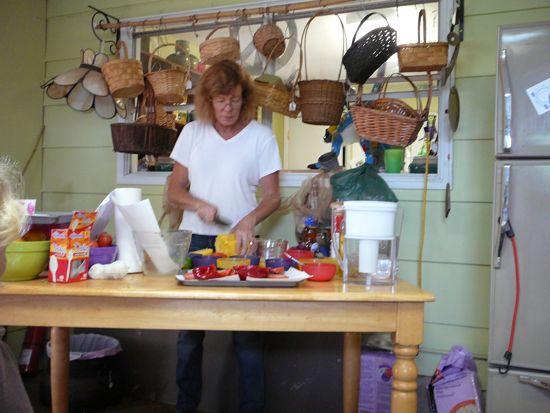
Garden Gate is so clever, combining gardening and growing and grilling, but also, they are coming up with classes on how to manage the vegetables and fruits that you grow – cooking with basil, iced courses made with exotic and unexpected ingredients, new ways to utilize all those zuccini and tomatoes . . . Well worth the drive. 🙂
Señor Driving
You get a reduction on your insurance rates if you take the safe driving classes for seniors. AdventureMan still isn’t all that comfortable with being a senior, so he calls himself “señor,” which is ‘Mister’ in Spanish. He tells people we are taking “señor” driving classes, and everyone looks at him like he is a little nuts.
Well. . . he is, actually. More than just a little. And now he has the time and energy to be a full time nut, and more power to him.
The “señor” driving classes were actually all right. We learned some things we didn’t know, and we met some interesting people, one, a retired New York fireman, and his wife, a retired nurse. They invited us to go eat seafood after class, and we learned all kinds of things.
On our way back from the ladies room, his wife leaned over to me and whispered “Is he helping you?” I laughed. I knew what she meant. “Yes!” I whispered back, “So far, so good!”
Living in Kuwait and in Qatar, most of the people were younger than us. Countries with all kinds of imported labor put upper limits on workers, so they don’t have a lot of old guys kicking the bucket in their countries. You can get exceptions to the rules in certain jobs, and we had a lot of good friends around our ages, thank God, but here in Pensacola, we feel like YOUNG older people – there are so many older people, and so much to learn. They are all really good about sharing their tricks for survival, and we find that keeping our ears open is a good thing.
Tax Day Tea Party in Pensacola
We don’t really understand the Tea Party. It is clearly against Obama, but then again, it is clearly the party of “against” and it is hard to find anything it is for. This is a problem; it is easy to tear down, and it is a lot more difficult to create – to formulate solutions which will provide benefits for the majority of participants.
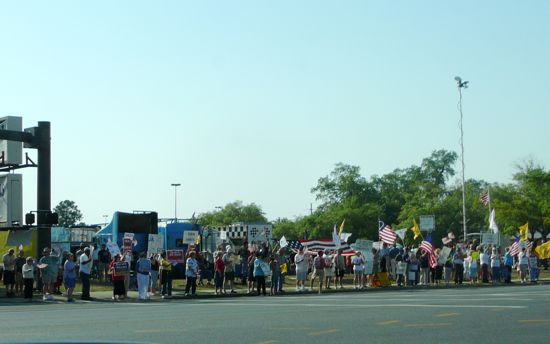
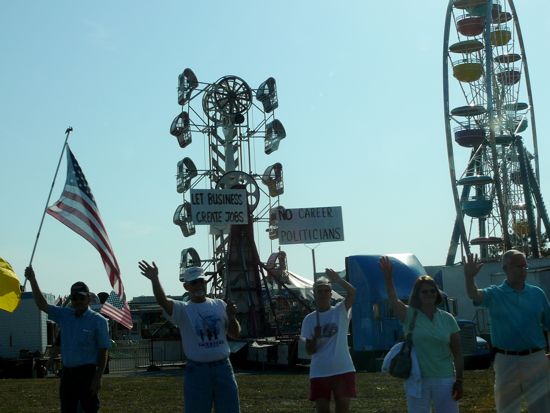
As we were approaching our hotel, we saw this huge crowd of ‘protesters’ who appeared to be partying. But every sign was different! As 15 April is Tax Day, the day our income taxes are due, maybe about 10% were carrying signs that had to do with taxes, preferably NO taxes. The rest of the signs protested other things – constitutional amendments (what – women voting? black people being counted as full people? the repeal of prohibition?), no abortion, putting God first – it was a total potluck of causes.
The weather was mild, the sun was shining, there was a breeze – great day for an incoherent protest, LOL. I took pictures from the safety of our car, although everyone seemed very friendly:
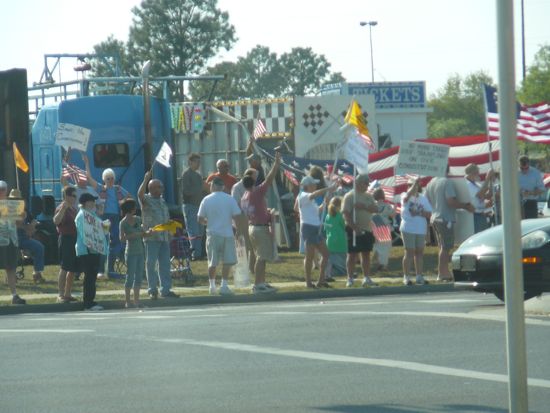



Here is what cracks us up. Pensacola is a highly military reliant community. There is a huge military presence here, from Eglin Air Force Base to the Pensacola Naval Air Station. Pensacola is glad to have the military business. So where do they think the money comes from that pays the military salaries, and thus, gets spent in their economy, at their businesses? Few Americans have saved enough to comfortably retire, who do they think is contributing to their Social Security support, and Medicare, and Medigap? Tax dollars! Who do they think supports public education, and guarantees law and order? Who do they think runs the justice system? Who do they think provides emergency fire and medical services? Tax dollars! Who builds and maintains the roads and bridges, insures safety in our food supplies, construction and medicines? Our government, supported by our tax dollars!
Do I like paying taxes? No! Not one bit! But in the interest of the greater good, we pay our taxes honestly, and thank God to live in a society with order, thanks to our tax dollars.
Recent Comments
intlxpatr on Shampoo Ginger tigerbutterya0c5ff1d… on Shampoo Ginger intlxpatr on British Soldier Kidnapped, Esc… John on British Soldier Kidnapped, Esc… intlxpatr on British Soldier Kidnapped, Esc… Wikipedia Donate Button

Amazina


Early Voting in Florida


