Denver, Damascus and Pensacola
We are leaving Santa Fe, but we have time for one more Santa Fe experience: Harry’s Roadhouse. It’s on the road out of Santa Fe, and hey, we have to have breakfast anyway. We are so glad we stopped here. This is a very cool place.
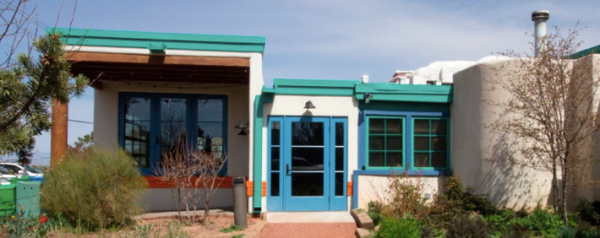

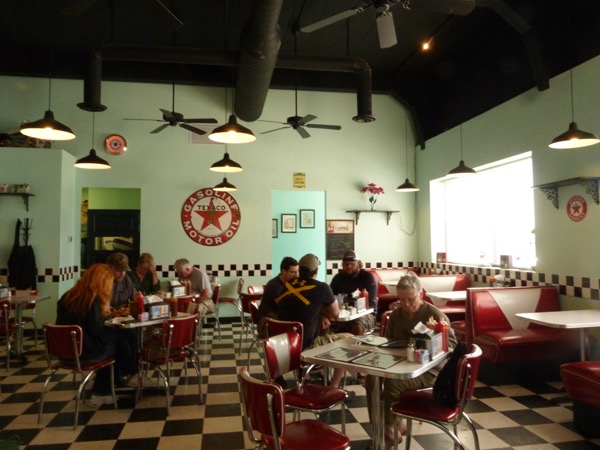
There are lots of rooms. This is the room we ate in, below. They have all kinds of wonderful breakfast foods, and the furnishings are all different colors. It is a colorful restaurant, sort of like it breaks the rules of taste and it doesn’t care. It’s kind of freeing 🙂

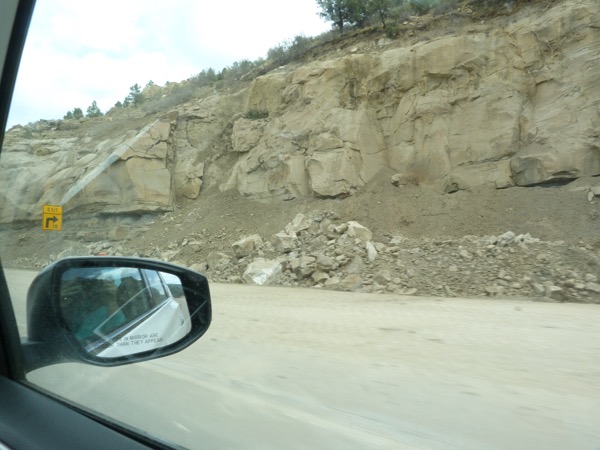
We are making really good time on the way to Denver when all of a sudden, on a not so busy freeway to this point, everything stops. “What on earth???” AdventureMan asks, and I have no clue. “Probably rockfall,” I say. It’s happened to me before on Colorado roads. Sometimes a huge boulder will just dislodge and fall on the highway. It can really hurt somebody if it hits them – of if they don’t expect a big boulder in the middle of the road and they hit it.
We are stuck for around 30 minutes. When we drive by the bottleneck, one lane, the rockfall has been mostly cleared. It takes massive equipment to get the rock off the road.
We pass Trinidad, a town we’ve stopped in before, but we aren’t hungry yet. An hour later, we need gas and we need to eat, but there is a whole lot of nothing near the road. As soon as we see anything, we head for it.
First gas. Then – another Barbecue. LOL, it’s not as if we don’t get BBQ in Pensacola, but as it turns out, this is pretty good barbecue.


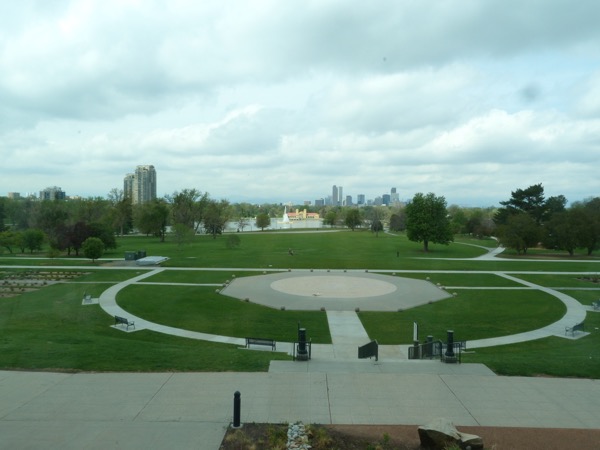
We hit Denver just about prime traffic time, and worse, Denver has just been hit by a heavy rain and sleet storm. We recognize a street name we know, exit the interstate and in very short time find my sister and her husband and happily settle in. Tonight we are all having dinner together over at Little Diamonds, with the kids; AdventureMan and I still have the remains of our BBQ, and we split a salad. Dinner is great, the conversation is even better, and the children are delightful.
The next day is so much fun, my sister has tickets for the Viking exhibit AdventureMan has wanted to see at the beautiful Denver Museum of Natural Sciences. This is a great exhibit, full of treasures and wonders, beautifully exhibited. We have such a great time.
This is my very favorite part of the entire exhibit, and I am sorry my photos are blurry but we can only take photos with no flash, and the light is very low in the exhibit to protect the artifacts.
There are people associated with the exhibit who are character actors. This is Tova, an older, still beautiful, much married woman, who tells us about her three marriages, her husbands, her life, her wealth and property, all the while holding a spindle with which she spins thread while she talks to us. She interacts with her audience, asking questions, but never straying from her character. She was enchanting, and even better, she was convincing. We learned so much from her.

I wish you could see how beautifully made so many of these articles are, and read all the descriptions. This was well curated.

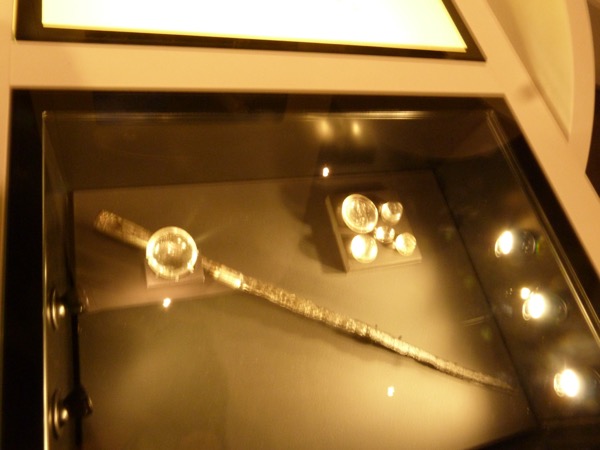
Another of my favorite exhibit, and almost impossible to photograph. These are nails, exactly in the positions they were found. An entire Viking ship had been found, buried in dirt and mud. The wood all rotted away, and disappeared, but the nails stayed exactly where they had been, and in the exhibit, thin, nearly invisible lines hold each nail in its place. Together, the nails form the shape of a ship, but you have to find the right perspective to see it. I tried, this was the best I could get.

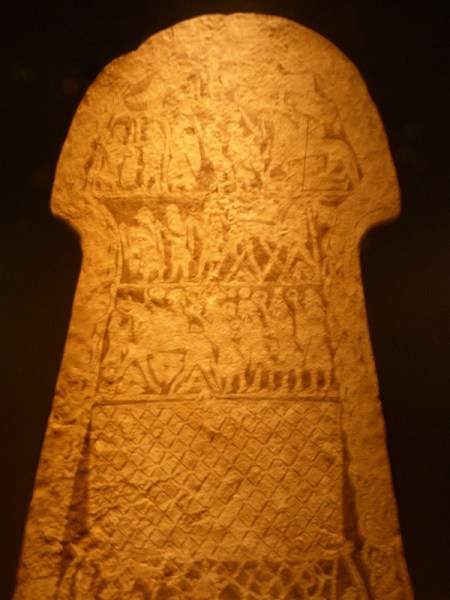
A tombstone put up by a wife to honor her dead husband – and to determine, also, her property lines 🙂
Another character actor helping the students find the answers to their worksheets.



The exhibit was full of school groups, with booklets to find the answers to. These kids were having so much fun, and learning so much. This group donned Viking helmets for a photo, but were in constant motion (sigh) in the low light.
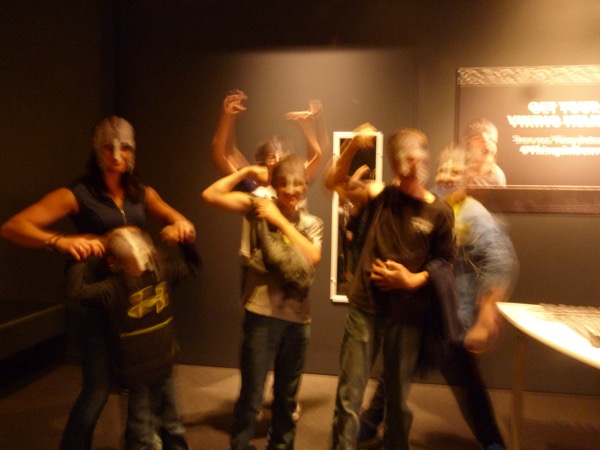
Probably the very best gift (from his perspective) our grandson got was one of these paper Viking helmets; our grandson wore it all the next day, after we got home, even to choir practice!

We had lunch at Sams #3, wow, so much selection and every dish was wonderful. Then, home to pack up and have a rest before we all meet up again for dinner. Dinner is a lot of fun, we’ve all been to Damascus, so we are eating at a restaurant near Denver University called . . . Damascus!
Things did not start well. “Mike” greeted us and told us he was not really the waiter, but the waitress had quit and he was the dishwasher, but tonight he would try to be the waiter while the owner trained a new cook. They couldn’t promise that everything on the menu would be available, but . . .
The good news was that as much as we all love Middle Eastern, particularly Damascus, cuisine, more than anything we wanted time together, sitting, talking, laughing, telling stories, so we just rolled with it. We ordered and it seemed nothing was not going to be served.
First out was hummus, and mohammara, and a big basket of hot hot hot fresh pita bread. Oh! I had forgotten how good it tastes, fresh out of the oven, and so plentiful. We were so happy, we stopped even thinking about the rest of dinner.
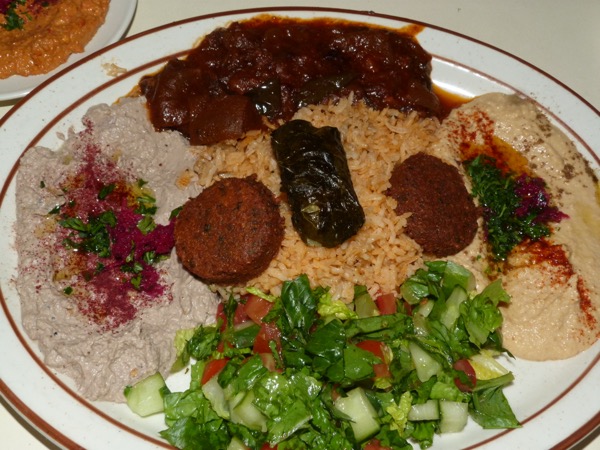
A while later, our dinners appeared, and they were each wonderful. AdventureMan had a felafel sandwich, which I failed to photograph. I had ordered this wonderful vegetarian platter, which I was happy to share with everyone.
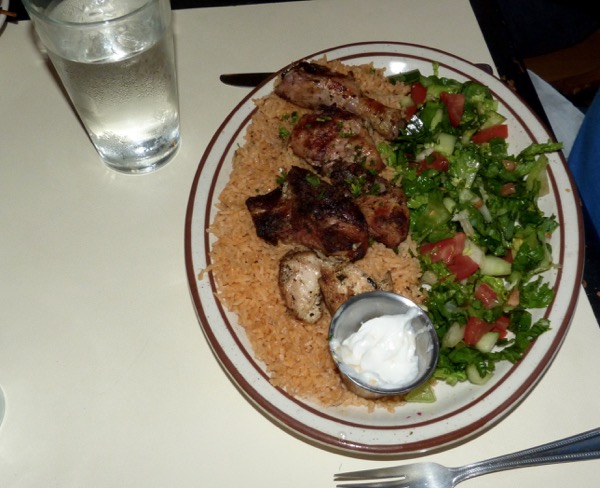
My brother-in-law had chicken on the bone, with rice and salad. Perfect!
Little diamond had fattoush and grilled mushrooms.
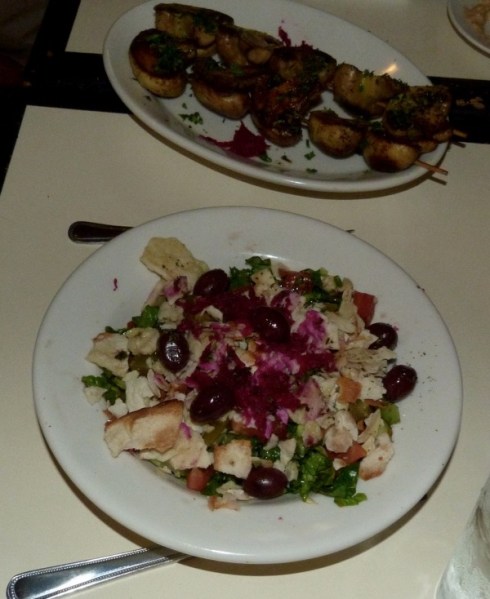
My sister had a cucumber soup. We all had lots of mohammara and bread. As we ate, the restaurant filled. Mike explained to each table that things might not go well, but every table seemed to get a great dinner. It’s the old adage, Under Promise and Over Deliver. Makes customers happy every time. 🙂

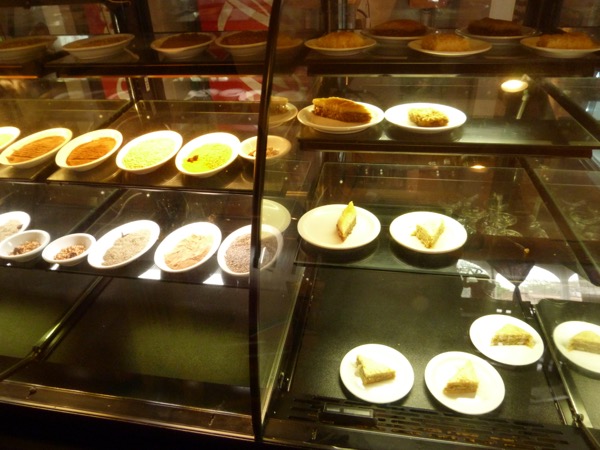

This was the BEST way to leave Denver, full, happy, having time with family.
We leave early the next morning for Pensacola. Not everything goes smoothly, but we arrive in Pensacola little worse for wear. It’s been a great trip.
And we’re off on our next adventure! 🙂
The Edmonds Little Free Library
We are working on a Little Free Library for our church, so I have become very aware of the Little Free Libraries wherever I go. As I was photographing this (utterly gorgeous) Little Free Library, an Edmonds resident passing by said “You know we have hundreds of the Little Free Libraries in Edmonds, but this is the most beautiful.”
Hundreds. Edmonds is a civil place, and a bookish place. Edmonds people share. Every year there is a huge tour of gardens, and it includes many many many gardens. People work hard on their gardens, to give joy to passers-by. It thrills my heart to think of so many Little Free Libraries.
But this is the most beautiful:

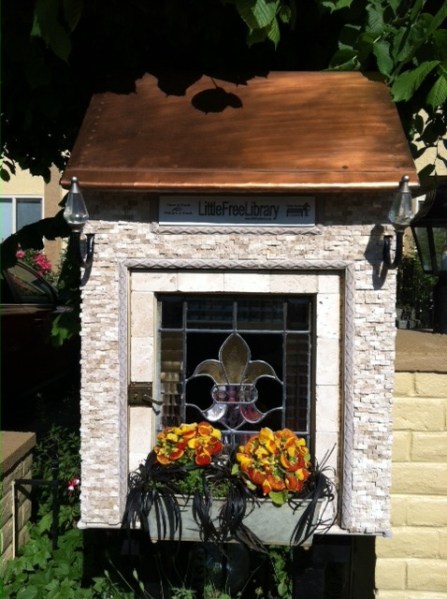
Bricks. A stained glass window. A copper roof. A window box – so much loving attention to detail, for something to give away to the public. I love this town.
Wouldn’t it be wonderful to think of Little Free Libraries popping up in Kuwait? Qatar? Saudi Arabia? Tunisia?
The Badass Librarians of Timbuktu
I saw this today on the NPR Books section, and as one great admirer of librarians, I wanted to share it with you. These librarians are my kind of badass! They are providing a service to humanity.
Timbuktu’s ‘Badass Librarians’: Checking Out Books Under Al-Qaida’s Nose

Handout picture dated 1997 and released in 2012 by the UN shows ancient manuscripts displayed at the library in the city of Timbuktu. Al-Qaeda has destroyed ancient texts it considers idolatrous.
Evan Schneider/AFP/Getty Images
For hundreds of years, Timbuktu has had a place in the world’s imagination. Located on the southern edge of the Sahara desert, the city flourished as a center of Islamic culture and scholarship in the 13th through 16th centuries. It was placed on the UNESCO World Heritage List in 1988, recognized for the University of Sankore, which had as many as 25,000 students who studied the Quran, as well as the historic Djingareyber and Sidi Yahia mosques.

The Bad-Ass Librarians of Timbuktu
And Their Race to Save the World’s Most Precious Manuscripts
Timbuktu was a center of the manuscript trade, with traders bringing Islamic texts from all over the Muslim world. Despite occupations and invasions of all kinds since then, scholars managed to preserve and even restore hundreds of thousands of manuscripts dating from the 13th century.
But that changed when militant Islamists backed by al-Qaida arrived in 2012. The hardline Islamists didn’t see these texts as part of their Islamic heritage, but as idolatry, contradicting their interpretation of Islam. They set about destroying important cultural icons, including 15th-century mausoleums of Sufi Muslim saints. Librarians feared the city’s prized medieval collections of manuscripts would be next.
Librarian Abdel Kader Haidara organized and oversaw a secret plot to smuggle 350,000 medieval manuscripts out of Timbuktu. Joshua Hammer chronicled Haidara’s story in the book The Bad-Ass Librarians of Timbuktu. Hammer spoke with NPR’s Michel Martin about how a librarian became an “operator.”
Interview Highlights
Why these manuscripts were so important
These volumes — and we’re talking hundreds of thousands of them — at the point at which al-Qaida invaded Timbuktu, there were something like 370,000 manuscripts amassed in libraries in Timbuktu. And they portrayed Islam as practiced in this corner of the world as a blend of the secular and the religious — or they showed that the two could coexist beautifully. And they did in this city.
So it was tremendously important for Haidara and those who supported him to protect and preserve these manuscripts as evidence of both Mali’s former greatness and the tolerance that that form of Islam encouraged.
On Abdel Kader Haidara’s background
Abdel Kader Haidara was a son of a scholar and he grew up in an intellectual environment in Timbuktu. He was not a wealthy person. After his father’s death in the early 1980s he inherited the family’s centuries-old manuscript collection.
So in 1984 the head of the Ahmed Baba Institute, the government-owned library in Timbuktu, called on Haidara and said, “Hey, we’re having trouble getting off the ground, we need to find manuscripts. We know they’re out there, they’re hidden away in the desert, in river towns. Can you undertake this job of traveling around northern Mali, tracking down these manuscripts that have been lost — buried, disappeared — over generations? Gather them up, we’ll give you money. And we want this library to be splendid. We want this to be something that people from all around the world will come to visit. So go out, do your best, find books for us.”
He was reluctant at first, but the call of duty and the curator’s constant pressure prevailed. And in 1984 he began this what turned into a 12-year really amazing quest to ferret out these manuscripts all across Mali.
How Libya changed Mali
In 2011, the Arab Spring breaks out. Gadhafi’s downfall, the arsenals of Libya — in the chaos of Gadhafi’s murder and the disintegration of the Libyan state — are opened for the taking. Then you’ve got these various rebel groups in Mali. You’ve got Islamic radicals all descending on Libya — on these arsenals. Walking in, loading up their pickup trucks with heavy weaponry, driving through the dust across the desert back to Mali. And so these heavily armed rebels sweep across the desert and in three months have captured two-thirds of the country.
Why he decided to do what he did
The first thing that Abdel Kader was worried about, frankly, was looting. In the first few days after the rebels took over Timbuktu and the army and the police had fled, there was total disorder. That’s when he kind of began to scheme — “Hey, the great treasures of Timbuktu are being held in these very ostentatious libraries.” He said, “These are going to be targets.”
The looting subsided pretty quickly. But as it subsided, you had this growing radicalism, you had Islamic police roaring through the streets, stopping people, throwing them in jail, grabbing cigarettes out of their mouths, whipping them in public. He just foresaw that this was going to get worse, and that the manuscripts, which as we already said expressed values that were anathema to fundamentalist Islam — to Wahhabi Islam — were in danger. That sooner or later, these manuscripts are going to be held hostage. They’re going to become political tools, they could be destroyed in an act of vengeance, caught up in military action. We’ve got to protect them.
So that’s when Abdel Kader and a small group of his supporters, friends, relatives got together and began what ended up being a three-stage effort to protect, and essentially smuggle to safety, all of these manuscripts.
Becoming a ‘badass’
Let’s remember that Abdel Kader was more than a librarian, this guy had spent 12 years as a badass explorer, as an adventurer. He was traveling on camels across the Sahara, on riverboats, going to small villages, finding these manuscripts. So he was an operator. So when the time came, he just knew what to do.
He said, “The first thing we’re going to do is get them out of these big libraries. We’re going to take trunks, we’re going to pack them into trunks at night when the rebels are asleep. And then we’re going to move them in the dead of night by mule cart to these various houses — safe houses, scattered around the city. We’re going to stick them in there and hopefully they’ll be safe for the duration of this occupation.” Which of course, nobody knew when that was going to end.
Why it’s important
One of the things that I think is important to draw from it is to realize that there is this whole strain of Islam that is moderate, that celebrates intellectuality, that celebrates culture, that celebrates diversity, secular ideas, poetry, love, human beauty. I think that is lost in this debate that’s going on. We tend to really kind of turn against Islam because of the actions of this particularly violent group.
But I think in fact that the Islam represented by those in Timbuktu and the badass librarians is in fact more representative of what Islam is. And these people [who] were the real victims of extremism in this part of the world are fellow Muslims. They were the ones who really suffered. They were the ones who had their hands and feet chopped off, who had to live through the horror of daily occupation.
For the most part, we see this from afar, but these people are on the front lines and they are living through the horror of radicalism every day and every minute.
Where the manuscripts are now
He hopes that he’ll be able to return them to Timbuktu. They are in about a dozen climate-controlled storage rooms in Bamako, the capital of Mali. And as far as moving them back, he’s waiting. I mean, these are very hard people to root out. But Timbuktu is a ghost town — tourists aren’t going there, flights aren’t going there. It’s very sad. And I don’t know and he doesn’t know if those glory days can ever be recaptured, given the strength of the Islamists — the terrorists in that area, in that part of the world.
Doris Duke’s Shangri-La
Months in advance, my friend said “You’ll really want to see Shangri-La,” and I had never heard of it, but I looked online, and it looked beautiful. Doris Duke, one of the richest women ever to live, could buy anything she wanted. She had a good eye for art, good timing, and she bought much of what is in Shangri-La and her other residences at bargain prices after WWII. The value of her art holdings increased dramatically, and she ended up with an even bigger fortune than that with which she started.
How do I know? I am in the middle of my third book, reading about Doris Duke. The books are pretty bad. Each author seems to have an axe to grind, and one author took very little information and used it to speculate endlessly, full of gossip and mean-spirit. Altogether, Duke does not come off as a very kind person, but who can say which version of this very private person is the “real” Doris Duke?
To visit Shangri-La, you must go through the Honolulu Museum of Art. They have an online reservation system – the next two weeks are already fully booked. My friend booked months in advance so that we could attend. We got to the Museum, found a good parking place, entered the museum, receiving a lapel sticker and a wristband which later allowed us to visit the museum for as long as we liked.
We boarded a bus and watched a very romanticized movie about the life of Doris Duke, and then we were there! We were warned we could take no photos inside. What a pity! The interiors are magnificent, all marble, and tiles, gorgeous woodwork, and all kinds of Islamic Art that looks like it would go well in the Qatar Museum of Islamic Art. I couldn’t help but wonder if the newly rich aren’t trying to buy some of their cultural objects back?

Our guide ushered us into a beautiful entry, with meshribiyya and tiles and beautiful light fixtures inside. I wish I could show you.

About half way through the tour, we had a break on a terrace from which we had this spectacular view. I read in one of the books that Duke built this rock harbor without asking permission from the Hawaii government, just did it. It is lovely. The terrace also has gorgeous Persian tiles, the interior tiles are Persian and Iznik.

After visiting the Damascus Room and the Syrian Room and the Mogul Room, we visited Doris Duke’s bedroom, bare but for a couple couches. Then, out to the gardens.

We were allowed to take photos in the gardens 🙂

This is a tree at the entry to the house; the tree sends down those shoots that form new roots and new trees. It is magnificent!

After our visit to Shangri-La, we returned to the Honolulu Museum of Art, and had lunch. This is the market salad with salmon – Yumm.

As we lunched, a character went around taking selfies. I think this is a performance artist, and I think it may have been a guy.

Being three very independent kind of folk, we split up to see what we wanted to see at the museum. There was a special temporary exhibit on Japanese street fashion which I found fascinating. I loved some of these street fashions, which strike me as very imaginative. When I got to the Lolita section, however, little girl dresses for grown women, I found it too creepy and strange to photograph.


There is a section on Islamic Art with beautiful tiles and examples of several genres of art objects.

Out on one of the patios, I found this screen which reminded me of a very modern sort of tree-of-life.

Altogether, a grand day. My friend was right – we really enjoyed seeing this.
Monday is Homework Day
This is not the life we expected – it is so much better. Before we retired, my husband asked me what we would do, and I said I knew what I would do, but I didn’t know what he would do; he would have to figure out what he wanted to do. But I was wrong. I didn’t know what I would be doing.
Life evolves. One decision leads to another, down paths you can’t foresee.
I had no idea I would love my grandchildren so much. I had no idea how much joy being close to our adult son and his wife would be, watching them mature, seeing them parent so lovingly and patiently. The other day, he spotted a photo of a time we were on our way to a German Military Ball; he said “How old were you in this photo?” and as we figured it out, we were almost exactly the age he is now. That was a moment of wonder to all of us. It helps us to remind ourselves that he no longer needs parenting, no more than we did at his age. He needs respect, and the support of a loving family that can mind their own business unless asked for input.
Doing kindergarten homework is mind-numbing. Q, who is a smart little boy, looked at me and said “when you do the same thing over and over, it is really boring.” He loves new words, so I said “when you do the same thing over and over again, that is called ‘repetitious’,” and he said “Yes, so it is repetitious and BORING.” We both laughed.
While it IS boring, what he is doing now is also crucial, mastering his numbers and how they work together, and his letters, and distinguishing “b”s from “d”s, and “g”s from “q”s and a lot of learning just requires that repetition to engrave it in your mind. He is learning to write, and he is adept at reading books above his level – but it all takes work.
We have some break activities. He can run laps around my first floor, running a circle which I make him change direction every now and then. He can jump on my running trampoline. He can play hide and seek with his Baba. We are working on jig-saw puzzles, and for fun, he gets to play one of Baba’s computer games requiring strategic thinking skills.
We still do our volunteering, our church activities, our house things. We have lunch out almost every day; we are free until after school.
While the homework is for the whole week, we have discovered that dragging it out is just that – a drag. Get it done! Just do it! We are learning to focus, and the work is not that hard. When we finish the homework, we have the rest of the week to play!
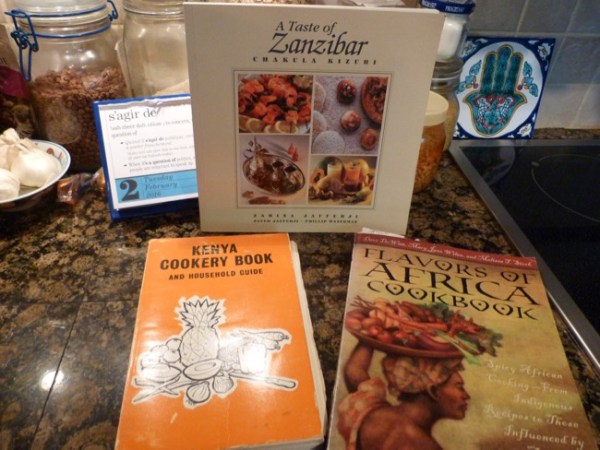
Today I was exploring online, looking for an old African recipe I have for African Gingerbread. This is a really old recipe; what I liked about it is that when you add the baking soda and molasses, it fizzes and bubbles. I looked in all my books, but in my never-ending quest to get rid of, get rid of, get rid of, not to burden myself with too many THINGS, I must have given away that particular book. But as I was looking for the recipe online, the only place I found it . . . was here. On my own blog! Old Fashioned Gingerbread. It makes me grin, thinking of how thrilled this five year old will be when we make old fashioned African gingerbread and it all starts fizzing. Woo HOOOO!
When the homework is done, the fun begins!
Small Glimpses of North Seattle
“As Sallam wa alaikum!” I smiled at the Sudanese women coming in to their jobs in our hotel.
They stopped still in their tracks.
“You speak Arabic!” they said, astonishment clear on their faces.
“Only a little!” I smiled back.
I had a whole squad of new friends.
Now that financial times are easing, many hotels we have visited over the last few months are renovating and getting new mattresses. This was a real bonus for our Sudanese friends, and all of their friends.
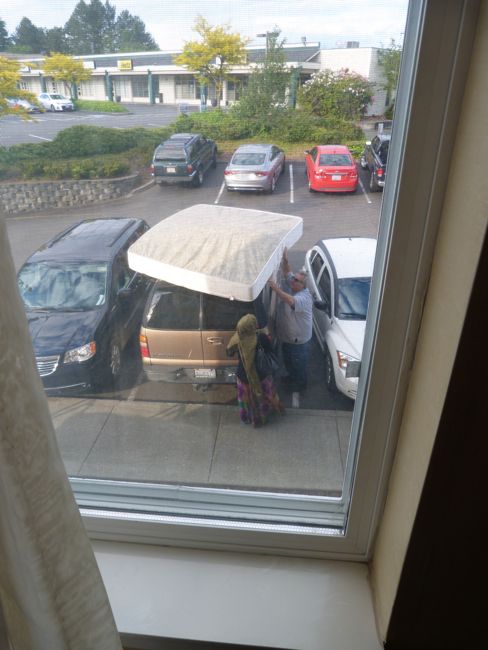

Have you ever tied a mattress on the top of your car and tried to drive? It is a wild and dangerous adventure; the wind lifts and pushes the mattress toward the back as you drive. Unless the mattress if firmly and thoroughly tied down, you are in for a wild ride.
And then again, if you are new in a country, and in need of a mattress, a wild ride is a small price to pay.
On our way back to the hotel, we see protestors in red shirts at every corner. This is not protestors Ferguson style, these are Seattle style protestors, making a big demonstration for fully funding public education, and all the signs are grammatical 🙂

We are so full from lunch that we just want a small dinner. We find a good Ethiopian restaurant listed near our hotel, and head there, but when we arrive, there is plywood over two windows and a sign saying “Sorry, dear customers, but due to car accident our restaurant is closed until it is fixed.”
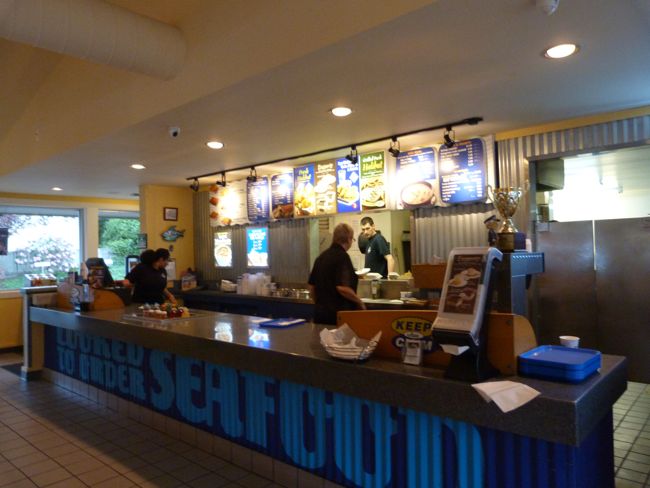
We end up at Ivar’s Seafood Bar, which is quick food, but not cheap food, and very very good food. We are greeted by an older man as we enter, he says “Welcome to Ivars! I hope you have a great meal.” We thought he might be an official greeter, but no, he was a customer like us. We ended up sitting in a booth next to his, so he stopped on his way out to see what we had ordered (halibut and chips, smoked salmon chowder, Dungeness crab cocktail) and just to chat. It’s an Edmonds kind of thing, neighborliness and civility.
Tiepolo Sky
Just back from a quick trip to Seattle for a wedding, driving home. and there is the most beautiful sky!

A long time ago, working on my undergraduate degrees, I took a minor in Art History, and spent happy hours at the Seattle Art Museum on projects for my classes. Up on the ceiling of one of the rooms (this is in the old Seattle Arts Museum up on Volunteer Hill) there was this wonderful Tiepolo ceiling, with clouds and blue sky and . . . God? I can’t remember anything but the sky part, and tonight’s sky in Pensacola reminded me of that ceiling.
The Creole Nature Trail! At Last!

We were all ready to hit this trail once before, but weather forecasts for the week we had it planned were full of thunderous storms and lots of rain, so we postponed.
This time, circumstances all came together fortuitously. AdventureMan had a conference in nearby Baton Rouge, and the temperature and humidity dropped dramatically. We had clear skies, no mosquitos, and glorious weather. As we left the Coffee Call in Baton Rouge, we were grinning from ear to ear.
You gotta love these smart phones. Better than a map for letting you know where you are and where you can turn off to get where you want to go. We wanted the Creole Nature Trail, which is a loop, Louisiana Road 27.

Shortly after we started down LA 27, we came to a US Fish and Wildlife Station, and there we met Sarah, who was a Student Conservation Associate, working for several months at the site. She had all kinds of good information, and was delighted to share with us. We laughed; she told us she was from “the other LA”, Los Angeles, and she had experienced culture shock coming to the backroads of Louisiana, but she had adjusted, learned a lot, and she loves the place.
This is their website: Southwest Louisiana National Wildlife Refuge Complex.
We started at Cameron Prairie, which had a three mile drive and a stop with a one mile boardwalk. The boardwalk was gorgeous, and beautifully kept.
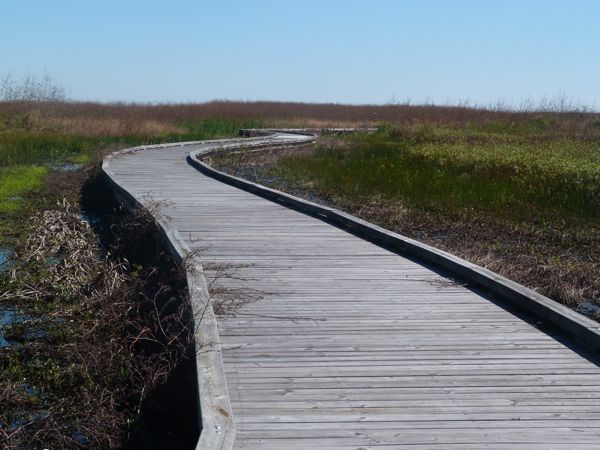
As AdventureMan focused on some alligators, I enjoyed the birds, and the colors:




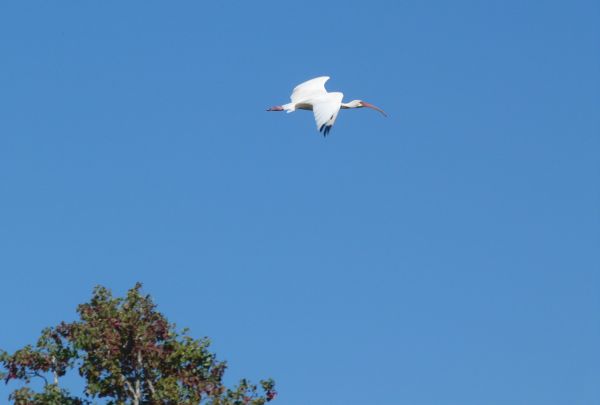

We don’t know what this bird might be. It was huge. Maybe a Red Shouldered Hawk.


We had the park entirely to ourselves, except for one car that came – and left! We could have spent hours, but it was after lunch time when we left, and we were hungry!
Arab World Most Unequal in World for Women: UNESCO
FROM Lebanon’s Daily Star:

BEIRUT: The Arab world is among the most unequal regions in the world when it comes to gender and education, according to a new report released Monday by UNESCO.
The Education for All Global Monitoring Report studied gender imbalances in education across the globe, finding that 100 million women in low- and middle-income countries were unable to read a single sentence. The report concludes that not a single goal set by the U.N.’s Education for All initiative will be reached by the 2015 deadline.
According to the report, it is projected that by 2015, only 70 percent of countries will have achieved parity between the sexes in primary education and 56 percent will have achieved parity in lower secondary education. The report calls for immediate efforts to address this gap and ensure equal access to education for both boys and girls.
In the Arab world, girls make up 60 percent of children out of school, the largest percentage of any of the regions in the report, including sub-Saharan Africa. Moreover, that number has not budged since 1999, indicating little if any progress.
“The Arab world is the region that is lagging most behind in that respect,” the study’s author, Pauline Rose, told The Daily Star by phone from London. “The reasons are largely cultural.”
Cultural biases are compounded by poverty, Rose said, explaining that many poor families in countries like Yemen can only afford to send some of their children to school, and they see their male children as a better investment for the family.
“They are more likely to get a return on their son’s education, because they expect them to get work and give more back to the household,” Rose, who is the outgoing director of the EFA Global Monitoring Report, said.
In some countries in the region, such as Syria, violence has interrupted education for all children, but it is more likely to adversely affect girls than boys.
“In insecure contexts, girls are more likely to be subjected to sexual violence, and parents are less likely to let them go to school if they have to worry about them walking through the streets,” Rose said. “This is in addition to whether there are any schools.”
Even the seemingly bright spots in the report, such as that educated Arab women make 87 cents to the dollar men make – above the global average – are likely evidence of other socioeconomic inequalities.
“I think the reason for this is a very high selection bias,” explained Rose. “If you are a woman who gets a job, you are likely be from a better-off family, to have connections.”
One of the domino effects of having fewer girls in school is that the Arab world suffers from a shortage of female teachers in a region where segregated education is common and even preferred, especially in the same rural, disadvantaged areas where female teachers are needed most.
The two moderate success stories from the region were Iraq and Turkey, which both managed to close their gender gaps in education with teacher training and other targeted programs.
Even lower income countries can shorten this gap by reorganizing resources, Rose insisted. The key is to convince countries that girls’ education benefits not only women, but also the society as a whole, leading to lower birth rates and higher survival rates among mothers and children.
Several strategies that have yielded positive results in some countries include giving stipends to families for sending their girls to school; providing scholarships to girls, especially for secondary school; and recruiting teachers from underserved areas who are more likely to stay and understand the culture.
“In West Africa, one of the things that helped is that religious leaders and community leaders have mobilized to encourage parents to send girls to school. Poverty is still affecting girls more. … This is where cultural and community mobilization comes in, and it’s not very costly.”
A version of this article appeared in the print edition of The Daily Star on March 10, 2014, on page 9.
(The Daily Star :: Lebanon News :: http://www.dailystar.com.lb)
More Radar on Qatar Roads to Trap Violators
Qatar makes some great laws – like fining those who go through red lights, or who drive near the speed of light. . . but when the violators turn out to be mostly young Qattari men, who pays the fines? Does anyone pay the fines?
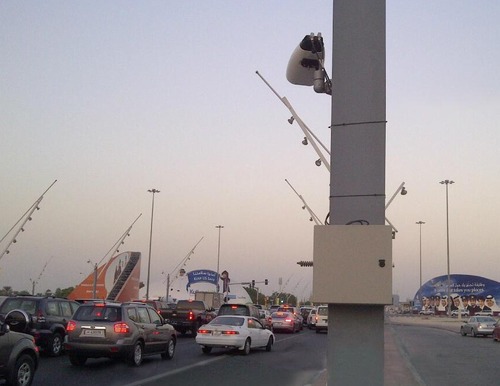
From Doha News:
In an effort to tackle bad driving in Qatar, the Ministry of Interior plans to set up speed radars every two to four kilometers on major roads, Traffic Department Director Brig. Mohamed Saad Al Kharji has said.
Additionally, some 120 radars are being installed to catch drivers who overtake others from the right lane, the Qatar Tribune reports Al Kharji as saying.
He added that the software of speed radars that are already installed on the roads would be updated so that they could also catch such violators.
No timeline for when the cameras would be installed was disclosed. But last fall, the MOI announced it would be rolling out radars to catch queue-jumpers.
Using the “slow” right lane to overtake vehicles in the left lane is a traffic violation punishable by a QR500 ticket, but among one of several rules flouted by motorists here.
Enforcement
In Qatar, traffic violators are rarely pulled over by police officers, despite brief campaigns to step up enforcement. In 2012, plainclothes police officers began ticketing drivers who overtook other vehicles on the right.
And at the end of last year, the traffic department began a three-month campaign to ticket those who violate road rules, including drivers who hadn’t fastened their seat belts, used their phones while driving, and rode without a license.
Both initiatives were lauded by many residents who said enforcement is key to improving safety on the roads, but neither seem to have lasted.
Recent Comments
intlxpatr on Shampoo Ginger tigerbutterya0c5ff1d… on Shampoo Ginger intlxpatr on British Soldier Kidnapped, Esc… John on British Soldier Kidnapped, Esc… intlxpatr on British Soldier Kidnapped, Esc… Wikipedia Donate Button

Amazina


Early Voting in Florida


