Eid Mubarak 2016

Eid Mubarak to all my Muslim friends who have come through one of the hottest Ramadan’s ever, refined by God’s holy fire. I wish you peace, peace with your family, peace in your country, and peace on earth, good will towards all mankind.
Cross Culture at the Y: Hawaiian Heart
For a year now, I have taken this class next to Leilani, who stands just a little shallower in the pool than I. Today, as we were warming up, one topic led to another. We were talking about getting rid of “things” and she told me a niece had asked for her lighthouse collection, and how was she going to mail them all to her, some of them were almost two feet high?

“Easy-peasy,” I said, “You know those storage tubs people buy at Target? You can use bubble wrap and ship them in those containers. They give fragile items a lot of protection.”
Leilani laughed and said how funny it was she didn’t know that because her husband had been a postman after his retirement from the military.
“Nice!” I said. “Two pensions!”
“Not really,” she said, “The day he retired he came home and handed me divorce papers. He’d been planning this for a long time. ”
“Another girl?” I asked.
“No,” she laughed sadly, “He was greedy. He said ‘You’ll never see a penny of my money.”
“I hope you got a good lawyer” I said.
“I did.” She didn’t look happy. “I had raised the four children, so I got parts of both pensions AND alimony. I don’t need a lot. I was happy.”
I asked if he had been the kind of man who had planned to walk out on her and leave her with nothing, if he had also been mean and stingy during their marriage, and if a part of her found peace when he left. She said because of the four children she would never have left him, but that yes, her life was better when he was no longer there.
“Money doesn’t make a person happy,” she said. “Things don’t make a person happy. You know he went and got a beautiful luxury apartment, and died just a few years later. He had emphysema from smoking all the time. No one to help him. So I went there every day, took him a meal because he couldn’t do for himself. I sat with him at night. I was there when he took his final breath.”
“And you know what he would do while I was out of the room? He would take out his money and count it. It never brought him any happiness.”
My pool friend is one of the sweetest hearted women I have ever met. In all this time, she has never said a bad word about her husband, and she was there by his side as he died. There is no bitterness in her, no anger; she didn’t resent him, she let all those feelings go and did the kind thing for a dying man.
I call this cross-cultural, because she is Hawaiian, and I have seen this kind of serenity in my Hawaiian friends and acquaintances. They are willing to let go of grudges, they are willing to move on. They have generous hearts. I feel like I learned something from her today.
Cross Culture at the Y
It’s a day I like in Pensacola; it may be summer and still hot and humid, but a little cooler today, with a cloud cover. I woke up refreshed, relaxed, having slept well, and actually, I sort of hoped for thunder so I could skip going to the YMCA for Water Aerobics, and stay home and finish up some quilting.
No such luck – no thunder. The skies were threatening, and leaky, but without the drama of thunder and lightning. No matter. The truth is, I don’t just go because I want to stay fit and strong, I also go because I feel better and more energetic after I’m done.
In retrospect, I would have missed a lot if I had missed today. In the fifteen or twenty minutes before the class, I heard some powerful messages, and I knew I was meant to be there. So my next three posts are about my cross-generational, cross-cultural experiences at my water aerobics class this morning.
God Shows No Partiality

Who can help but think of “wickedness, evil, covetousness, malice” as we listen to the daily news?
In today’s readings from the Lectionary, the first reading has to do with one of the earliest manifestations of the Holy Spirit, and this second reading ends with how the glory of God is for everyone, the Jew and also the Greek (of you might add, the American, and also the Moslem, or the Republicans, and also the Democrats), that God shows no partiality.
We all seem to shout “Go God!”, our own particular interpretation of God, and think that only we have it right.
What I do love, is that when a demented one kills in the name of God, the one true God rallies his true followers, whether in Syria, or Orlando, or Paris, or Nairobi, he rallies the hearts of his true followers to love one another, and to show that love by helping and serving one another, brother and sister, people of all colors and all nations and all religions and all sexes. God tells us to love him and to serve one another, and to leave all judgement to Him/Her.
Romans 1:28-2:11
28 And since they did not see fit to acknowledge God, God gave them up to a debased mind and to things that should not be done. 29They were filled with every kind of wickedness, evil, covetousness, malice. Full of envy, murder, strife, deceit, craftiness, they are gossips, 30slanderers, God-haters,* insolent, haughty, boastful, inventors of evil, rebellious towards parents, 31foolish, faithless, heartless, ruthless. 32They know God’s decree, that those who practise such things deserve to die—yet they not only do them but even applaud others who practise them.
2Therefore you have no excuse, whoever you are, when you judge others; for in passing judgement on another you condemn yourself, because you, the judge, are doing the very same things. 2You say,* ‘We know that God’s judgement on those who do such things is in accordance with truth.’ 3Do you imagine, whoever you are, that when you judge those who do such things and yet do them yourself, you will escape the judgement of God? 4Or do you despise the riches of his kindness and forbearance and patience? Do you not realize that God’s kindness is meant to lead you to repentance? 5But by your hard and impenitent heart you are storing up wrath for yourself on the day of wrath, when God’s righteous judgement will be revealed. 6For he will repay according to each one’s deeds: 7to those who by patiently doing good seek for glory and honour and immortality, he will give eternal life; 8while for those who are self-seeking and who obey not the truth but wickedness, there will be wrath and fury. 9There will be anguish and distress for everyone who does evil, the Jew first and also the Greek, 10but glory and honour and peace for everyone who does good, the Jew first and also the Greek.11For God shows no partiality.
Enter another bible reference:

biblemail@oremus.org
v 2.2.7
10 February 2011
Saint Ephraim, the Syrian
Today the church remembers St. Ephraim, a very good man, a solid contributor to the early church. At a time when many seem to be in fear that Syrians are coming to our shore, I think a reading about Saint Ephraim is timely. He wrote some of the earliest church hymns. He very likely contributed some of the verbiage in our Nicene creed.
I also smile; I remember my Arabic instructors at the Qatar Center for the Presentation of Islam, truly gentle women who knew the bible better than I did, and inspired me to know it better in self defense. While they didn’t expect me to cover, i.e. to wear a scarf over my hair, or to wear an abaya, they could point out to me verses in the bible where women are instructed to cover, and they could show me biblical pictures in which the women were cloaked and their hair covered.
They also pointed out the many places in the Bible where praying was done by prostrating oneself face down before God, as Ephraim instructs in the prayer at the bottom of the reading.
I never felt pressured. They were like my Mormon sisters, my Baptist sisters; they only wanted me to have what they had found, the best way to worship.
EPHREM OF EDESSA
DEACON AND HYMN-WRITER (10 JUNE 373)
 Ephrem (or Ephren or Ephraim or Ephrain) of Edessa was a teacher, poet, orator, and defender of the Faith. (To English-speakers, the most familiar form of his name will be “Ephraim.” It is the name of the younger son of Joseph, son of Jacob (see Genesis 41:52), and is thus the name of one of the largest of the twelve tribes of Israel.) Edessa (now Urfa), a city in modern Turkey about 100 kilometers from Antioch (now Antakya), was a an early center for the spread of Christian teaching in the East. It is said that in 325 he accompanied his bishop, James of Nisibis, to the Council of Nicea. Certainly his writings are an eloquent defense of the Nicene faith in the Deity of Jesus Christ. He countered the Gnostics’ practice of spreading their message through popular songs by composing Christian songs and hymns of his own, with great effect. He is known to the Syrian church as “the harp of the Holy Spirit.”
Ephrem retired to a cave outside Edessa, where he lived in great simplicity and devoted himself to writing. He frequently went into the city to preach. During a famine in 372-3 he worked distributing food to the hungry, and organizing a sort of ambulance service for the sick. He worked long hours at this, and became exhausted and sick, and so died.
Of his writings there remain 72 hymns, commentaries on the Old and New Testaments, and numerous sermons.
Several hymns are available at:
http://www.voskrese.info/spl/XefremSyria.html
Among Orthodox he is best known for a fasting prayer:
THE PRAYER OF ST EPHRAIM THE SYRIAN
O Lord and Master of my life, do not give me the spirit of laziness, meddling, self-importance and idle talk. (prostration)
Instead, grace me, Your servant, with the spirit of modesty, humility, patience, and love. (prostration)
Indeed, my Lord and King, grant that I may see my own faults, and not condemn my brothers and sisters, for You are blessed unto ages of ages. Amen. (prostration)
(Twelve deep bows, saying each time: O God, be gracious to me, a sinner.)
[Translation by Fr James Silver, Drew University; posted on the Orthodox list]
by James Kiefer
Where is Coimbatore, India?
Today the church prays for the district of Coimbatore, in Southern India, which I learned, when trying to find it, that it is also referred to as “the Manchester of India” for it’s industrialization and textiles.

The map is from Google Maps.
“Through You and In Spite of You”
Just a small post on a reading from Father Richard Rohr in today’s e-mail. It gives me great hope:
In the journey of prayer, as you sink into the mystery of God’s perfect love, you realize that you’re nothing in the presence of God’s goodness and greatness, and that God is working through you in spite of you.
LOL, it’s the “in spite of you” that gives me hope 🙂
Leaving Sidney on the Anacortes Ferry, Return to Pensacola
Life isn’t fair. Ferry lines are just one of those things. First there are not necessarily first boarded or first unloaded, or first through the lengthy customs lines coming back into the United States. We have a saying “Every monkey gets his turn in the barrel.” This ferry ride was our turn. It wasn’t bad, it’s just after all the thrills of this vacation, this was an unwelcome hit of reality. We had a special vacation, but that doesn’t mean we are special, LOL.
Leaving Sidney:


The weather has changed. It is heavy overcast. We don’t see any whales, not a single sea otter. It is a great morning for catching up on our reading.
We arrive in Anacortes and the customs line crawls.
We need to stop at the Marina motel and pick up the skirt and shirt and scarf I left hanging in the closet which they have bagged and tagged “customer will pick up”. I had packed lightly, and it didn’t take me long to figure out where I left my clothes; we had been in a hurry to be on time for the ferry to Sidney. But this is a great stop, next door is Bob’s Chowder House and Salmon BBQ and we are starving.


Bob’s Salmon Chowder is out of this world. SO good.

Bob’s BBQ Salmon burger is also fabulous. AdventureMan ate every bite and said the salmon was perfect. It had a lemon sauce that was a surprise and a delight.

My halibut tacos were the special dish of the day. My bad; I like lettuce in my tacos, not cabbage. I only ate the halibut, but I had also had the chowder, so I was OK. Oh, yes, they also have great big home baked chocolate chip cookies, maybe that is also why I was filled up 🙂 but I split it with AdventureMan.

AdventureMan spotted this sign, and took this photo. Whoda thunk that we would find a sign to Pensacola in the parking lot?

This is the rest of the vacation. Really the “vacation” part is over, and this is all business. Driving through Seattle on I-5, thank God it’s Sunday, no big trucks but heavy traffic. It’s always heavy, unless maybe it’s 0430. Checking in to our hotel where there are a huge bunch of people about to debark on a cruise. Dropping our bags and heading to the Car Rental place to return our car. Taking the shuttle to the airport, calling the hotel shuttle to come pick us up. Back at the hotel, packing our bags in a hurry so we will be able to watch Game of Thrones. Actually, to our surprise, a good night’s sleep. Up way too early to catch the shuttle to the airport, a surprisingly easy time through security, and the long flight to Atlanta and the shorter flight to Pensacola. The taxi home. Sigh. The unpacking. The laundry. Every day demands. . . .
But God is good. My first night back a good friend greeted me and said “are you depressed?” I was so taken by surprise that I said “Yes!” and she said she always is too, coming home after a great vacation. It just felt good, my guilt at feeling depressed was taken away.
Our grandson has a cold and has been with us the last two days, to our total delight. His mother and sister came by last night to visit and to celebrate another stoke of good fortune which has struck our family. God is good. Thanks be to God.
The Badass Librarians of Timbuktu
I saw this today on the NPR Books section, and as one great admirer of librarians, I wanted to share it with you. These librarians are my kind of badass! They are providing a service to humanity.
Timbuktu’s ‘Badass Librarians’: Checking Out Books Under Al-Qaida’s Nose

Handout picture dated 1997 and released in 2012 by the UN shows ancient manuscripts displayed at the library in the city of Timbuktu. Al-Qaeda has destroyed ancient texts it considers idolatrous.
Evan Schneider/AFP/Getty Images
For hundreds of years, Timbuktu has had a place in the world’s imagination. Located on the southern edge of the Sahara desert, the city flourished as a center of Islamic culture and scholarship in the 13th through 16th centuries. It was placed on the UNESCO World Heritage List in 1988, recognized for the University of Sankore, which had as many as 25,000 students who studied the Quran, as well as the historic Djingareyber and Sidi Yahia mosques.

The Bad-Ass Librarians of Timbuktu
And Their Race to Save the World’s Most Precious Manuscripts
Timbuktu was a center of the manuscript trade, with traders bringing Islamic texts from all over the Muslim world. Despite occupations and invasions of all kinds since then, scholars managed to preserve and even restore hundreds of thousands of manuscripts dating from the 13th century.
But that changed when militant Islamists backed by al-Qaida arrived in 2012. The hardline Islamists didn’t see these texts as part of their Islamic heritage, but as idolatry, contradicting their interpretation of Islam. They set about destroying important cultural icons, including 15th-century mausoleums of Sufi Muslim saints. Librarians feared the city’s prized medieval collections of manuscripts would be next.
Librarian Abdel Kader Haidara organized and oversaw a secret plot to smuggle 350,000 medieval manuscripts out of Timbuktu. Joshua Hammer chronicled Haidara’s story in the book The Bad-Ass Librarians of Timbuktu. Hammer spoke with NPR’s Michel Martin about how a librarian became an “operator.”
Interview Highlights
Why these manuscripts were so important
These volumes — and we’re talking hundreds of thousands of them — at the point at which al-Qaida invaded Timbuktu, there were something like 370,000 manuscripts amassed in libraries in Timbuktu. And they portrayed Islam as practiced in this corner of the world as a blend of the secular and the religious — or they showed that the two could coexist beautifully. And they did in this city.
So it was tremendously important for Haidara and those who supported him to protect and preserve these manuscripts as evidence of both Mali’s former greatness and the tolerance that that form of Islam encouraged.
On Abdel Kader Haidara’s background
Abdel Kader Haidara was a son of a scholar and he grew up in an intellectual environment in Timbuktu. He was not a wealthy person. After his father’s death in the early 1980s he inherited the family’s centuries-old manuscript collection.
So in 1984 the head of the Ahmed Baba Institute, the government-owned library in Timbuktu, called on Haidara and said, “Hey, we’re having trouble getting off the ground, we need to find manuscripts. We know they’re out there, they’re hidden away in the desert, in river towns. Can you undertake this job of traveling around northern Mali, tracking down these manuscripts that have been lost — buried, disappeared — over generations? Gather them up, we’ll give you money. And we want this library to be splendid. We want this to be something that people from all around the world will come to visit. So go out, do your best, find books for us.”
He was reluctant at first, but the call of duty and the curator’s constant pressure prevailed. And in 1984 he began this what turned into a 12-year really amazing quest to ferret out these manuscripts all across Mali.
How Libya changed Mali
In 2011, the Arab Spring breaks out. Gadhafi’s downfall, the arsenals of Libya — in the chaos of Gadhafi’s murder and the disintegration of the Libyan state — are opened for the taking. Then you’ve got these various rebel groups in Mali. You’ve got Islamic radicals all descending on Libya — on these arsenals. Walking in, loading up their pickup trucks with heavy weaponry, driving through the dust across the desert back to Mali. And so these heavily armed rebels sweep across the desert and in three months have captured two-thirds of the country.
Why he decided to do what he did
The first thing that Abdel Kader was worried about, frankly, was looting. In the first few days after the rebels took over Timbuktu and the army and the police had fled, there was total disorder. That’s when he kind of began to scheme — “Hey, the great treasures of Timbuktu are being held in these very ostentatious libraries.” He said, “These are going to be targets.”
The looting subsided pretty quickly. But as it subsided, you had this growing radicalism, you had Islamic police roaring through the streets, stopping people, throwing them in jail, grabbing cigarettes out of their mouths, whipping them in public. He just foresaw that this was going to get worse, and that the manuscripts, which as we already said expressed values that were anathema to fundamentalist Islam — to Wahhabi Islam — were in danger. That sooner or later, these manuscripts are going to be held hostage. They’re going to become political tools, they could be destroyed in an act of vengeance, caught up in military action. We’ve got to protect them.
So that’s when Abdel Kader and a small group of his supporters, friends, relatives got together and began what ended up being a three-stage effort to protect, and essentially smuggle to safety, all of these manuscripts.
Becoming a ‘badass’
Let’s remember that Abdel Kader was more than a librarian, this guy had spent 12 years as a badass explorer, as an adventurer. He was traveling on camels across the Sahara, on riverboats, going to small villages, finding these manuscripts. So he was an operator. So when the time came, he just knew what to do.
He said, “The first thing we’re going to do is get them out of these big libraries. We’re going to take trunks, we’re going to pack them into trunks at night when the rebels are asleep. And then we’re going to move them in the dead of night by mule cart to these various houses — safe houses, scattered around the city. We’re going to stick them in there and hopefully they’ll be safe for the duration of this occupation.” Which of course, nobody knew when that was going to end.
Why it’s important
One of the things that I think is important to draw from it is to realize that there is this whole strain of Islam that is moderate, that celebrates intellectuality, that celebrates culture, that celebrates diversity, secular ideas, poetry, love, human beauty. I think that is lost in this debate that’s going on. We tend to really kind of turn against Islam because of the actions of this particularly violent group.
But I think in fact that the Islam represented by those in Timbuktu and the badass librarians is in fact more representative of what Islam is. And these people [who] were the real victims of extremism in this part of the world are fellow Muslims. They were the ones who really suffered. They were the ones who had their hands and feet chopped off, who had to live through the horror of daily occupation.
For the most part, we see this from afar, but these people are on the front lines and they are living through the horror of radicalism every day and every minute.
Where the manuscripts are now
He hopes that he’ll be able to return them to Timbuktu. They are in about a dozen climate-controlled storage rooms in Bamako, the capital of Mali. And as far as moving them back, he’s waiting. I mean, these are very hard people to root out. But Timbuktu is a ghost town — tourists aren’t going there, flights aren’t going there. It’s very sad. And I don’t know and he doesn’t know if those glory days can ever be recaptured, given the strength of the Islamists — the terrorists in that area, in that part of the world.
“You Shall Love the Alien as Yourself”
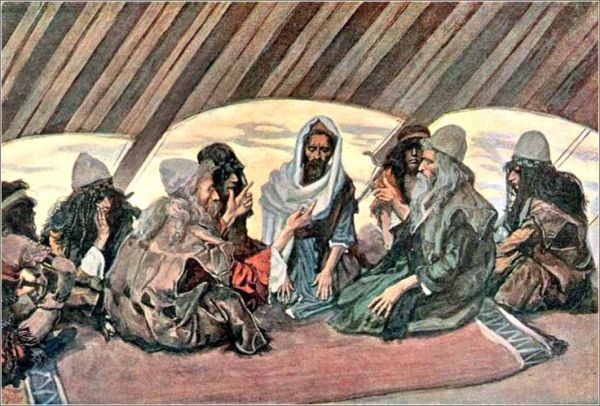
One of the disciplines available to those of the Episcopal faith is the reading of the Lectionary. Every day of the year are short readings from the Psalms, Old Testament, New Testament and Gospels. Every three year the cycle repeats itself. There are also additional readings on the “Saints” or remarkable people who have served God and his church.
Leviticus is not my favorite chapter, but today, I love Leviticus. As if the words were freshly spoken, I read Leviticus 19: 33-34:
33 When an alien resides with you in your land, you shall not oppress the alien. 34The alien who resides with you shall be to you as the citizen among you; you shall love the alien as yourself, for you were aliens in the land of Egypt: I am the Lord your God.
There are many references to the alien in the Bible, one of the earliest being Father Abraham, who is told to leave (what is now the current Iraq) and head for Canaan. When he arrives, peacefully, the local tribes are kind to him. They are good neighbors. Later, when Moses kills an Egyptian and flees to the desert tribes, he describes himself as “a stranger in a strange land.”
It’s who we are. It’s what our book tells us. We are to welcome the stranger. We are to leave wheat in the edges of our fields (yesterday’s reading) that he might not starve. We are not to oppress the alien, nor put up walls to fence them out. We are all aliens on this earth; waiting for the glory of the heavenly kingdom where we belong.
Recent Comments
ExpatAlien on What Country am I Living … intlxpatr on Yellowstone: Old Faithful to C… Michelle on Yellowstone: Old Faithful to C… Cathy on No Grown-Ups in Charge intlxpatr on Waiting for Snow Wikipedia Donate Button

Amazina


Early Voting in Florida


 Here There and Everywhere