Four Reasons Why You Shouldn’t Worry – Rick Warren
I used to worry. It was in my bones. I learned to control my anxieties by running, and now, with water aerobics or a good run on my trampoline, and of course, with faith. Worry changes nothing, worry impedes finding solutions.
This is the message Rick Warren sends out today on worry:
Four Reasons Why You Shouldn’t Worry
By Rick Warren — Aug 10, 2015
“Do not worry about your life, what you will eat or drink; or about your body, what you will wear. Is not life more than food, and the body more than clothes?” (Matthew 6:25 NIV)
Worry is essentially a control issue. It’s trying to control the uncontrollable. We can’t control the economy, so we worry about the economy. We can’t control our children, so we worry about our children. We can’t control the future, so we worry about the future. But worry never solves anything! It’s stewing without doing.
Jesus actually gives four reasons you don’t need to worry in his Sermon on the Mount.
Worry is unreasonable. Matthew 6:25 says, “Do not worry about your life, what you will eat or drink; or about your body, what you will wear. Is not life more than food, and the body more than clothes?” (NIV) Jesus is saying, if it’s not going to last, don’t worry about it. To worry about something you can change is stupid. To worry about something you can’t change is useless. Either way, it’s unreasonable to worry.
Worry is unnatural. Jesus gives us an illustration from nature in Matthew 6:26: “Look at the birds of the air; they do not sow or reap or store away in barns, and yet your heavenly Father feeds them. Are you not much more valuable than they?” There’s only one thing in all of God’s creation that worries: human beings. We’re the only things God has created that don’t trust him, and God says this is unnatural.
Worry is unhelpful. It doesn’t change anything. Matthew 6:27 says, “Can any one of you by worrying add a single hour to your life?” When you worry about a problem, it doesn’t bring you one inch closer to the solution. It’s like sitting in a rocking chair — a lot of activity, energy, and motion, but no progress. Worry doesn’t change anything except you. It makes you miserable!
Worry is unnecessary. Matthew 6:30 says, “If God cares so wonderfully for flowers that are here today and gone tomorrow, won’t he more surely care for you, O men of little faith?” (TLB) If you trust in God, you don’t need to worry. Why? Because he has promised to take care of all your needs: “God will meet all your needs according to the riches of his glory in Christ Jesus” (Philippians 4:19 NIV).
Does that include bills? Yes. Does that include relational conflicts? Yes. Does that include your dreams and goals and ambitions? Yes. Does that include the health issues you don’t know what to do with? Yes. God will meet all your needs in Christ.
Don’t worry about it!
Praying for Ruaha
Today in the Anglican Cycle of Prayer, we pray for the Diocese of Ruaha, in Tanzania.
We have such happy memories of exploring the Ruaha, and Selous. Many people visit the more famous sites in northern Tanzania, but fewer go to the more remote south. Wonderful people, we learned so much there.

Celebration at the Seville
“I think we ended up exactly where we were meant to be,” AdventureMan said as we drove away, and I love him for thinking that, and saying that. I think so, too.
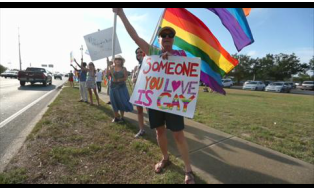
It’s been an amazing week.
I’m tempted to say, about so many of the subjects, “I don’t have a dog in that fight,” and yet, somehow, I do.
Our Supreme Court is been so greatly conservative that I had no hopes that so many decisions would come down on the side of what I consider human dignity.
We have great medical coverage, thanks to what is truly socialized medicine – life time medical care through career military service coupled with the medicare that United States citizens receive when we turn 65. So when people complain about “socialized medicine,” I just laugh and say I love my socialized medicine. It pays almost all my medical bills.
So why does it matter to me that others have affordable health care?
I worked with the homeless for a year, with homeless families. It was a program; we provided housing, some food, and counseling, and guided our residents into degree programs, assistance programs that would lead them to an ability to self-sustain.
What I learned, over and over, was stunning. Many women with children are one man away from homelessness. Women with children are exceedingly vulnerable. When a child gets sick, unless you are protected by family, the child cannot go to day care and Mama has to stay away from work to take care of them. Too many absences and that job disappears. No insurance, and the costs are those hugely exaggerated sums you see on your reconciliation sheets your insurance sends – what the cost is, what insurance pays, what your share is. IF you have insurance, your insurance company has negotiated the costs, and those costs are considerably less than if you don’t have insurance. The least able to pay are charged the most. Is that fair? I thank God for affordable care, so that all people have access to decent health care for themselves, and for their children.
It was teetering on the balance. Which way would the Supreme Court decide on this technicality? By the grace of God, the majority opinion was that law is tough enough to write and often mis-written and corrected before the ultimate wording is finalized. This was no exception; it needed refinement but the intent was clear. Affordable care is the law.
The poor and the minorities are not to be discriminated against in housing, either, the Supreme Court decided. Again, it’s not my fight, no one has ever discriminated against us, except for being military (and the implication was that military was riff raff). The significance here was that even if the discrimination was not clearly intentional, if it was discrimination, it was not allowed. It levels the field; makes life more fair for all of us.
And last. That people who want to marry will have the dignity of that right. That those people will have the same legal rights, rights that guarantee inheritance, rights that guarantee access to the partner that becomes hospitalized, rights to make legal decisions as a legal married couple. Again, AdventureMan and I, one man and one woman, are married, so we don’t have a dog in the fight – except that as human beings, we want the laws to be fair, and humane, and applicable to all. We have no say over how we are wired or who we love, and, as we see it, no right to restrict others from what we have chosen for ourselves.
We’ve had a great day. We went to early service, where Father Goldsborough spoke as a Southerner, and how his views have changed, and how he believes that if the Confederate flag is a cause of grief and horror to those whose family were once enslaved, that that flag should be retired. Yes, keep it as history, display it in museums, but not as a part of a public, governmental display. He is a courageous man.
And while I agree that it is time for the flag to be retired, the flag is just a symbol.
It is a kid that killed the bible study participants in South Carolina. It was a kid with a powerful GUN. So why are we not talking about gun control? I have the feeling that a lot of people are willing to pull down the Confederate flag in hopes that it will keep the attention off the fact that people with problems who have access to guns are the problem. Sure, you can kill with a knife, or a car, or a hundred other ways, but nothing beats a gun for killing efficiently, and no gun beats an automatic weapon for super efficient killing.
I headed straight for the commissary to do some weekly grocery shopping, while AdventureMan spent time in the garden. I got the groceries unloaded, and dinner started. AdventureMan came in and invited me to lunch at my favorite place, Five Sisters.
When we got to Five Sisters, every table was full and lines and groups of people were scattered around waiting. We headed to the Fish House for some fish and grits, but it was the same story. So we headed for Saville, where we found a parking place and while it was crowded, very crowded, we got a place in the Palace Bar, which we like anyway, and we liked that it was away from the music and we could talk.
After we ordered, I said “I think we are in the middle of a celebration,” and he agreed. We were surrounded by a very large group of guys about our age, but we had to guess they were gay, and they were all very celebratory. In fact, much of the restaurant was moving from table to table, hugging and exchanging greetings and congratulations.
The last time I remember feeling this way was in Alaska, last year, for The Celebration, where all the tribes gather to share culture and dances.
On our way out, I leaned over and said “Congratulations! We wish you happiness!” and they thanked us and we left.
Except, LOL, I had dropped my sunglasses, and we had to go back in. “Stop, stop!” our friends at the next table asked us, and thanked us again for our ‘kind words.’ But they needed to talk. It wasn’t about the right to get married, they explained, each jumping over the other in speech in eagerness to explain, “it is about legal rights in hospitals” said one “the right to be who we are” said another. These were men about my age, and they needed to be heard. I told them that I remember Juneau, Alaska, and I don’t remember any gay people. I said there must have been, but I never knew of any, and one man said “that was me! Imagine growing up knowing you are seriously different, that you like boys and not girls, and who do you talk to? There was NO-ONE!”
These guys had been married for varying amounts of time, but this weeks Supreme Court decision eliminated the anxiety that things could change, that a change in president could signal a cascade of change in state laws and the hard-won battles would have to be fought again. “The only person left in my family who would have the right to say whether to take me off life-support or not is a person who would likely say “pull the plug!” and my husband would have no say at all, before this decision!” one said, and the husband added “and she could keep me out of his hospital room, even though we’ve been married for years!”
I would have loved to hear more, but this was their celebration. It was like one huge wedding celebration, so much love, so much happiness, so much joy.
“I can be who I am!” one said to me, with such emotion. “I can be who I am!”
I almost cried with joy for him, for all of them. They have seen such change, from living their lives in hiding to being able to live legally, freely, as who they are. We were moved by their joy, moved beyond words. We felt so honored to have been able to share a little of their joy, even though – this isn’t our dog, this isn’t our fight, it isn’t our win.
Except, except that as human beings, maybe it all IS our dog, and is our fight. Maybe it is our win. Maybe, as Jesus says, we are all connected, we are all meant to love one another, and as weird as we are, as eccentric, as different, maybe we are all meant to love one another and to live in peace with one another. Maybe the dignity of every human being is relevant to my own . . .
It’s a heady thought for a celebratory Sunday.
Ramadan Kareem and Pope Francis
“God bless the work of your hands!” was one of the Moslem sayings I most loved as I lived my daily life in various countries in the Middle East. So, Pope Francis, God bless the work of your hands yesterday in your encyclical saying we are all responsible for the price we pay for progress. You are a brave man, and you don’t hesitate to name corruption when you see it, and to do your best to correct us, and straighten the path of the Lord.

“Everything is related, and we human beings are united as brothers and sisters on a wonderful pilgrimage, woven together by the love God has for each of his creatures and which also unites us in fond affection with brother sun, sister moon, brother river and mother earth,” he writes.
It is not entirely a happy message for me. One of the items he castigates is air conditioning, and as Pensacola hits the nineties every day, I hate to think of how I would live without air conditioning. I think I would turn into a slug, swinging in my hammock for hours every day reading a book. My house would be full of dirty dishes and dust. And I remember living in Tunis, and in Jordan, without air conditioning. We managed, by the grace of God.
Meanwhile, during the hottest months of the year, yesterday, our Moslem brothers and sisters began Ramadan, the holy month of fasting and personal purification. Imagine, going all day without water and without food, breaking the fast only as the sun goes down. I wonder if the Pope made his world-changing address on the eve of Ramadan on purpose, as he clearly made it to all mankind, not only to his Catholic followers.
Ramadan Kareem, my Moslem brothers and sisters, whom I cherish, and who taught me so much. May your fasting bring you great insights and purity of spirit.
“A Bribe Blinds the Eyes of the Wise”
i will confess Deuteronomy, with all it’s rules and admonitions, is not my favorite book in the bible, and yet I love the words about bribery found in today’s Old Testament reading from the Lectionary:
Deuteronomy 16:18-20,17:14-20
18 You shall appoint judges and officials throughout your tribes, in all your towns that the Lord your God is giving you, and they shall render just decisions for the people. 19 You must not distort justice; you must not show partiality; and you must not accept bribes, for a bribe blinds the eyes of the wise and subverts the cause of those who are in the right. 20 Justice, and only justice, you shall pursue, so that you may live and occupy the land that the Lord your God is giving you.
14 When you have come into the land that the Lord your God is giving you, and have taken possession of it and settled in it, and you say, ‘I will set a king over me, like all the nations that are around me’, 15 you may indeed set over you a king whom the Lord your God will choose. One of your own community you may set as king over you; you are not permitted to put a foreigner over you, who is not of your own community. 16 Even so, he must not acquire many horses for himself, or return the people to Egypt in order to acquire more horses, since the Lord has said to you, ‘You must never return that way again.’ 17 And he must not acquire many wives for himself, or else his heart will turn away; also silver and gold he must not acquire in great quantity for himself.
18 When he has taken the throne of his kingdom, he shall have a copy of this law written for him in the presence of the levitical priests. 19 It shall remain with him and he shall read in it all the days of his life, so that he may learn to fear the Lord his God, diligently observing all the words of this law and these statutes, 20 neither exalting himself above other members of the community nor turning aside from the commandment, either to the right or to the left, so that he and his descendants may reign long over his kingdom in Israel.
Female ISIL Recruits Surprised and Disappointed
They sign up for Hunger Games and get domestic drudgery and uber-control:
From Associated Press via Huffpost
PARIS (AP) — When three British schoolgirls trundled across the Syrian border; when a pregnant 14-year-old ran away from her Alpine home for the second time; when a sheltered girl from the south of France booked her first trip abroad — they were going to a place of no return.
Only two of the approximately 600 Western girls and young women who have joined extremists in Syria are known to have made it out of the war zone. By comparison, as many as 30 percent of the male foreign fighters have left or are on their way out, according to figures from European governments that monitor the returns.
In interviews, court documents and public records, The Associated Press has compiled a detailed picture of European girls and young women who join extremists such as the Islamic State group — a decision that is far more final than most may realize.
The girls are married off almost immediately, either in Turkey or just after crossing into Syria. With an estimated 20,000 foreign fighters — among them 5,000 Europeans — in Syria, there is no shortage of men looking for wives. That number is expected to double by the end of the year. Once among the jihadis, the women are not permitted to travel without a male chaperone or a group of other women and must remain fully covered outside, according to material published by Islamic State and researchers who follow the group. Otherwise, they risk a lashing or worse.
European women who blog about their lives under Islamic State tend to be chipper about the experience, but reading between the lines of an e-book of travel advice shows a life that will be radically circumscribed, with limited electricity, lack of even the most basic medicine, and practically no autonomy. Women do not fight, researchers say, despite the Hunger Games-like promises of recruiters.
“The lives of those teenage girls are very much controlled,” said Sara Khan, a British Muslim whose group Inspire campaigns against the dangers of extremist recruiters. “I don’t think that discussion ever comes up. It’s so romanticized, the idea of this utopia. I don’t even think those young girls have necessarily considered that there’s no way back now.”
The two exceptions to the rule of no return are perhaps most revealing in the very paucity of details about their journey — driving home how murky life is behind the Islamic State curtain.
Sterlina Petalo is a Dutch teenager who converted to Islam, and came to be known by the name Aicha. She traveled to Syria in 2014 to marry a Dutch jihadi fighter there and managed to return months later — apparently making her way to the border with Turkey, where her mother reportedly picked her up and brought her back to the Netherlands. Back home, she was immediately arrested on suspicion of joining a terror organization.
Her family, lawyers and prosecutors refuse to discuss the case. She was released from custody last November and has not been formally charged.
The second woman known to have made it out of the grip of Islamic State reconsidered after just a few weeks. The 25-year-old Briton, whom police have not named, had taken her toddler son all the way to Raqqa, the group’s stronghold, when she decided she had made a mistake and called home. She made her way back into Turkey and her father met her there. How she was able to travel the 250 kilometers (150 miles) from Raqqa to the Turkish border city of Gaziantep is not clear. Back in Britain, she was detained and is now free on bail pending formal charges.
Without knowing how the two escaped, it is difficult to say whether other girls and women could follow their path out of Syria, said Joana Cook, a researcher at King’s College London who studies the links between women and jihad.
“There are clearly many human smugglers working within Syria right now, helping Syrian civilians escape the violence, and I wonder if there is a similar, perhaps even growing market, for those trying to escape after joining ISIL,” Cook told The Associated Press in an email, using one of the acronyms for the Islamic State group. “There is great disillusionment for many who have traveled to Syria to join ISIL and you’ll find many stories of those who went abroad noting ‘this isn’t what we signed up for.'”
The question is whether the girls understood from the beginning how limited their choices would be once they crossed the frontier.
The case of a 15-year-old Avignon girl exemplifies such doubts. The girl hid her second Facebook account and Islamic veil from her moderate Muslim family, thereby managing to join a jihadi network, according to the family’s lawyer. Once within a unit of the al-Qaida offshoot Nusra Front, she was not permitted to leave, according to her brother, who went into Syria to fetch her and was turned away by the extremists. A French boy who joined the group around the same time was allowed to go home.
“I think they understand the premise of that, but not that they understand it in reality,” said Melanie Smith, another researcher at King’s College ICSR.
The networks that bring the women into Syria are increasingly organized around the extremists’ dream of building a nation of multinational jihadis, meaning European girls are particularly prized. Each new Facebook post, each new cheerleading Twitter account — and they pop up by the hour — helps them subvert government efforts to prevent young people from radicalizing and leaving.
The doggedness of jihadi methods for recruiting girls can be seen in the case of Amelia, a 14-year-old girl from France’s Alpine Isere region.
Amelia was first contacted on Facebook by a French fighter on Jan. 14, 2014 and within a month agreed to go to Syria and marry the man, who identified himself as “Tony Toxiko.” After she was turned back by airport border police in Lyon on her first attempt, “Tony Toxiko” persuaded another French adolescent girl to join him in Syria.
Amelia, meanwhile, ran away from home to Belgium, where an imam performed a religious ceremony that wed her to a different man, an Algerian jihadi. She returned to France homesick and pregnant, just long enough to speak to investigators building a case against a middleman who helped her run away. This winter, Amelia managed to deceive her family and left again — making it to Syria with the Algerian fighter, who is more than twice her age.
“It’s particularly difficult for these families. For them, radicalization is happening on the Internet and outside the family sphere,” said Sebastien Pietrasanta, a French lawmaker working on a program to de-radicalize young people. “For a girl of 14, I believe we can clearly save her from herself and save her from these barbarians.”
A French journalist got dangerously close to jihadi recruitment methods by creating a fake Facebook account that attracted a marriage proposal from a fighter in Syria.
Under the pseudonym Melodie, the journalist shared a video on the account, almost immediately getting a message from a man identified as Bilel, who asked how she’d liked the montage of him showing off in a 4X4 and with his weapons.
“I passed myself off as a 20-something, not stupid but a little lost, who suddenly found a huge response from a man in Syria,” said the journalist, who wrote a book “In the Skin of a Jihadist” under a pseudonym.
Bilel’s doubts about her began to grow as her reluctance to join him became clear. She ended up getting threats that she said would likely frighten a bewildered young woman into submission. As it was, the journalist, who never met Bilal in person, remains under constant police protection a year later.
“We’ll find you, we have the best operators here, you don’t know what you’re getting into, you’re messing with a terrorist group, you and your family will pay,” the woman said, recounting the litany of threats she received after returning to France. “If they were speaking to a 20-year-old, it would be very hard for her.”
___
Associated Press writer Mike Corder in Amsterdam contributed.
“Do All Americans Worship Idols?”
We have guests in town from another country who are living with Americans and visiting many others.
One of them asked her host “Do all Americans worship idols?” and the host was flummoxed.
We have been in private houses of the most religious Muslims, and their houses look very different from ours. They have nothing on the walls, except perhaps a picture of the Kaaba in Mecca, or a beautiful calligraphy in Arabic with one of the Surahs. To us, the houses look very plain, but they are being careful to observe carefully the word of the Lord.
We don’t consider the objects in our homes idols because we don’t worship them. When I read today’s Lectionary reading from Deuteronomy, I have to rethink what God might thing idols are.
Deuteronomy 4:15-24
15 Since you saw no form when the Lord spoke to you at Horeb out of the fire, take care and watch yourselves closely, 16 so that you do not act corruptly by making an idol for yourselves, in the form of any figure—the likeness of male or female, 17 the likeness of any animal that is on the earth, the likeness of any winged bird that flies in the air, 18 the likeness of anything that creeps on the ground, the likeness of any fish that is in the water under the earth. 19 And when you look up to the heavens and see the sun, the moon, and the stars, all the host of heaven, do not be led astray and bow down to them and serve them, things that the Lord your God has allotted to all the peoples everywhere under heaven. 20 But the Lord has taken you and brought you out of the iron-smelter, out of Egypt, to become a people of his very own possession, as you are now.
21 The Lord was angry with me because of you, and he vowed that I should not cross the Jordan and that I should not enter the good land that the Lord your God is giving for your possession. 22 For I am going to die in this land without crossing over the Jordan, but you are going to cross over to take possession of that good land. 23 So be careful not to forget the covenant that the Lord your God made with you, and not to make for yourselves an idol in the form of anything that the Lord your God has forbidden you. 24 For the Lord your God is a devouring fire, a jealous God.
Where is Mbeere District, Kenya?
Today the church prays for the diocese in Mbeere, in Kenya. It is north of Nairobi, mountainous, farming area.

“Plus ça change, plus c’est la même chose”
Last week, we were in Atlanta, and stayed near a small town called Smyrna. We wondered several times where ancient Smyrna was, guessing Greece or Turkey. We were both right.
Today, the church remembers Polycarp, Bishop and Martyr of Smyrna. It is timely. There is a saying, the more things change, the more they stay the same (“plus ça change, plus c’est la même chose” – Alphonse Kerr) – and today, too, we are seeing people killed for what they believe, when they do not fall into step with the specific style of belief of the crowd. Oh, the things we do in God’s name!
The Liturgical Calendar: The Church Remembers
Today the church remembers Polycarp, Bishop and Martyr of Smyrna, 156.
Polycarp, Bishop of Smyrna in what is now called Turkey, did not seek martyrdom and did not encourage others to do so. When persecution broke out, Polycarp made every honorable effort to protect his flock and himself. He even hid in the country but, eventually, the authorities found him.Since Christians worshiped Jesus Christ, an “unauthorized god,” and since they refused to worship the Roman gods or the “Divine Caesar,” they were considered atheists and subversives.
Where is the Diocese of Manicaland, Zimbabwe?
Today the church prays for the troubled and sometimes controversial diocese of Manicaland, in Zimbabwe.

Recent Comments
ExpatAlien on What Country am I Living … intlxpatr on Yellowstone: Old Faithful to C… Michelle on Yellowstone: Old Faithful to C… Cathy on No Grown-Ups in Charge intlxpatr on Waiting for Snow Wikipedia Donate Button

Amazina


Early Voting in Florida


 Here There and Everywhere