Rosy Dawn with Chills
Wooo HOOO, Kuwait! Look at this temperature at 7 ayem!
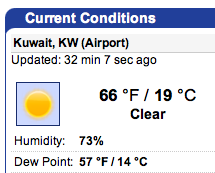
And then look at the humidity and the dew point! No wonder we all feel a little clammy!
The dawn is moving further and further to the south, and this morning was briefly rosy as the sun struggled to break through the thick haze:

When my husband and I prayed together this morning, we prayed to be able to keep our minds and hearts on the things that are really important, and not the things of the world. As financial empires crumble, we want to be thankful for all the riches with which we have been blessed – our marriage, our son and his wife, our families – for good jobs, and good friends – and we pray to be safe on the roads.
Even the Qatteri Cat likes morning prayer time. 🙂
She Kept Her Head
From today’s Arab Times:
Police arrest youth, hunt for two in kidnap, rape bid of schoolgirl
KUWAIT CITY: Police have arrested a Kuwaiti youngster and are looking for his two other accomplices who allegedly kidnapped a schoolgirl, drove her to a deserted area and tried to rape her, reports Al-Dar daily.
The girl told police that the youngsters got scared when she screamed for help and drove off; however, she managed to note down the plate number of their vehicle and it led to the arrest of one of them.
God bless this scared, screaming girl – she used her head. The miserable cowards who abducted her and intended to rape her dumped her, and she wrote down their license number! Wooo HOOO on you, girlie!
An Insult – and 3 Dead Kuwaitis
From today’s Arab Times. How many hearts are breaking in Kuwait over one young man’s lack of self-control? I know, I know, this is Kuwait, and things are different. Because of an insult, three brothers are dead, and one in intensive care. Two families devastated, one with dead sons, one with a son who is a murderer. Three crashed vehicles, one from an innocent man who only stopped to see if he could help, and ended up with his car stolen and crashed, too. . . the whole thing is tragedy, from beginning to end.
Three brothers dead: Three Kuwaiti brothers in the age group of 25-30 years died in a road rage accident in Mina Abdullah while their fourth brother is currently confined to the intensive care unit of Adan Hospital, reports Al-Anba daily.
According to a security source, a Kuwaiti youth’s car broke down on King Fahd Expressway. The youth reportedly called his father to inform about the breakdown and told that four Kuwaiti youngsters had insulted him. When his father went to help the youth, the latter took his father’s vehicle, drove at full speed and crashed into the Jeep of the four brothers. The Jeep overturned due to the impact and one of the brothers died on the spot. Two others died in Adan Hospital and the fourth one is confined to the intensive care unit.
Meanwhile, the youth, who appeared disoriented, left his father’s car at the site of the accident and drove away with an Asian’s car who stopped to check what happened. He was eventually arrested after crashing into another car.
How does the law work in a case like this?
It says the young man was arrested. Is he still in jail? Can you get bail after killing three people in an act of rage?
Is his driving license taken away?
is an insult considered justification for a crime of rage?
Does he go to prison, or if he pays blood money, does he walk away free?
If he is convicted of murder, what is the likely sentence?
Will he also go on trial for stealing the Asian’s car and crashing it?
Not a legal question:
Does this cause an unending feud between two families? Or is this just another chapter in an already ongoing feud?
How many drivers am I sharing the road with who have killed?
QC Misses AdventureMan

Just seconds after AdventureMan was out the door this morning, Qatteri Cat came in crying, carrying his baby. He often does that when AdventureMan leaves. I am good for giving fresh water, giving food and providing warmth. AdventureMan is his true love, and the Qatteri Cat grieves for him when he leaves, crying piteously.
This last summer when I was on vacation with my family, my sister’s grandson, 18 months old, would light up and shout her husband’s name every time he saw him.
“Gooey!” he would shout, his eyes alight and run for his Grandpa. My sister, who was working patiently and lovingly with him to learn her name wasn’t even on his radar – at that stage, he was more focused on men – his Dad, his Grandpa and another uncle he called “Nom!”
My sister would say “what am I, chopped liver?” which always scared me, because kids pick up on things we DON’T want them to pick up on, and what if he started calling her Chopped Liver???
But this morning, when Qatteri Cat is inconsolable at the loss of his favorite, I feel a little like chopped liver. 
Kuwait Activists Reject MPs” Hijab Ruling
Activists reject MPs” hijab ruling
”Wearing of veil is not prerequisite for ministerial post”
KUWIAT: Political activists have expressed their great disappointment at the Parliament”s Legislative Committee”s decision which stated that the positions held by Minister of Education and Minister of Higher Education Nouriya AlـSubaih and Minister of State for Housing Affairs and Minister of State for Development Affairs Moudi AlـHomoud as female ministers were unconstitutional.
In a symposium entitled “Who protects personal freedom,” eminent activist Najla AlـNaqi said that the committee should have paid attention to more serious issues rather than focusing on marginal issues such as wearing the veil. She urged the committee to reconsider its decision.
Sheikha Dr. Maymouna AlـSabah made the Constitution a point of departure for her argument, stating that it did not distinguish between genders when it came to the qualification of a voter and never mentioned any preference of one over the other. She demanded for the appointment of more female ministers since it is the only way for them to reach the Parliament.
Historian Ghanima AlـFahaid outlined the role of Kuwaiti women and their contribution to society in different fields including defending the State from invaders. She reminded the audience of the brilliant work of both ministers and that they tirelessly endeavor to serve the community in every possible way.
Kuwait University lecturer Dr. Layla AlـSabaan regarded the decisions as regrettable at a time when women should be encouraged and commended for their work. She stressed that the Kuwaiti society believes in equal opportunities for all regardless of gender and that personal freedom should be respected as long as it doesn”t jeopardize the culture and traditions of the society.
Journalists Society consultant Dr. Ayed AlـManna discussed the legality of female ministers, highlighting that gender equality in a country like Kuwait is extremely important. He added that Kuwait is a liberal society in many ways, pointing out that the Constitution does not specifically say that women must wear veils as a perquisite to taking up their ministerial posts.
Meanwhile, political activist Najat AlـHashshash questioned the nature and background of the decision asking if this ruling applied to all female staff working in the Parliament or ministers only.
Last updated on Friday 24/10/2008
90 Year Old Kuwaiti Overdoses on Heroin?
This is very hard for me to imagine:
Citizen dies of heroin overdose
Al Watan staff
KUWAIT: A citizen in 90s died on Wednesday at his house in Jabriya due to an overdose of heroin. After the Operation Room received a phone call from the family informing them that the Kuwaiti man suddenly fainted, police officers and medical teams rushed to the house. The man was taken to the hospital by paramedics but passed away. Forensic police examined the corpse and confirmed that a drug overdose was the main cause of death.
Bridal Disaster: Fake or For Real?
When I saw this on The Fail Blog it caught me so by surprise that – I laughed. It has to be a bride’s worst nightmare. I get suspicious, however. I mean it LOOKS like a real wedding, but maybe this is all a set up. I’ve watched it a few times. I can’t make up my mind. What do you think?
I didn’t mean to be unkind by laughing, but I laughed so loud that AdventureMan had to come see. He can’t tell if it is real or faked, either.
I can’t begin to imagine – if this were real – what happens next?
Eat Fast, Get Fat
This is from BBC Health News and it reminds me of all the times our parents told us to chew our food and eat more slowly! I hate to say it – they were right.
Speed of eating ‘key to obesity’
Slow down!
Wolfing down meals may be enough to nearly double a person’s risk of being overweight, Japanese research suggests.
Osaka University scientists looked at the eating habits of 3,000 people and reported their findings in the British Medical Journal.
Problems in signalling systems which tell the body when to stop eating may be partly responsible, said a UK nutrition expert.
He said deliberately slowing down at mealtimes might impact on weight.
The latest study looked at the relationship between eating speed, feelings of “fullness” and being overweight.
Just under half of the 3,000 volunteers told researchers they tended to eat quickly.
Compared with those who did not eat quickly, fast-eating men were 84% more likely to be overweight, and women were just over twice as likely.
Those, who, in addition to wolfing down their meals, tended to eat until they felt full, were more than three times more likely to be overweight.
Stomach signals
Professor Ian McDonald, from the University of Nottingham, said that there were a number of reasons why eating fast could be bad for your weight.
He said it could interfere with a signalling system which tells your brain to stop eating because your stomach is swelling up.
He said: “If you eat quickly you basically fill your stomach before your gastric feedback has a chance to start developing – you can overfill the thing.”
He said that rushing meals was a behaviour that might have been learned in infancy, and could be reversed, although this might not be easy.
“The old wives’ tale about chewing everything 20 times might be true – if you did take a bit more time eating, it could have an impact.”
‘Biological imperative
In an accompanying editorial, Australian researchers Dr Elizabeth Denney-Wilson and Dr Karen Campbell, said that a mechanism that helps make us fat today may, until relatively recently, have been an evolutionary advantage, helping us grab more food when resources were scarce.
They said that, if possible, children should be encouraged to eat slowly, and allowed to stop when they felt full up at mealtimes.
Dr Jason Halford, Director of the Kissileff Human Ingestive Behaviour Laboratory at the University of Liverpool, said that the way we eat was slowly being seen as a key area in obesity research, especially since the publication of studies highlighting a genetic variant linked to “feelings of fullness”.
His own work, recently published in the Journal of Psychopharmacology, found that anti-obesity drug sibutramine worked by slowing down the rate at which obese patients ate.
He said: “What the Japanese research shows is that individual differences in eating behaviour underlie over-consumption of food and are linked to obesity.
“Other research has found evidence of this in childhood, suggesting that it could be inherited or learned at a very early age.”
He said that there was no evidence yet that trying to slow down mealtimes for children would have an impact on future obesity rates.
I am also guessing that when we were out hunting for our food and gathering our food, we got a lot more exercise than we are getting today, and we burned more calories. We drank coffee black, without 1,000 hidden calories from flavorings and whipped cream. We walked, instead of jumping in our cars. . . Spent less time sitting at our computers, and more time moving around.
Rejected Suitor Rapes Kuwaiti Woman
Al Watan staff
KUWAIT: A young Kuwaiti woman has filed a case against a man who raped her after she rejected his marriage proposal. The woman explained that the young man who asked to marry her had been found out to be a liar. Among other things, he lied about his nationality, claiming to be Kuwaiti when he was not. He also claimed to have huge sums of money when in fact he was not as well off as he initially claimed. After being rejected, the man reportedly waited outside her house and kidnapped her as she walked towards her car. He then drove her to a remote area and raped her.
What incredible courage this young woman has going public. What backing she must have from her family. This is, unfortunately, not a rare occurance. What on earth are these men thinking? Is he trying to ruin her chances of marrying anyone else? Is this rape a punishment?
All Female Ministers Must Cover Hair, or Female Ministers are Unconstitutional? Or?
I am pretty good at reading the news, but all this is a little too Byzantine, even for me. This is from today’s Al Watan. I think it says that females who do not cover their hair can still be ministers, in spite of some members of parliament saying that females who do not cover their hair are not allowed to be ministers. You read it and tell me what YOU think it says.
Maybe some of the Ministers of Parliament lack so much self contol that they fear the sight of the hair of Nouriya AlـSubaih and/or Moudhi AlـHumoud will impede their performance?
There is an Islamic dress code? Like if you do not wear an abaya and niqab, or hijab, you cannot be Moslem?
Panel brands female ministers” appointment ”unconstitutional”
Court freezes MPs” suspension from Parliament
Al Watan staff
KUWAIT: Parliament”s Committee for Legislative and Legal Affairs, during its meeting on Sunday, signed off on a report stating that the appointment of female Cabinet ministers Nouriya AlـSubaih and Moudhi AlـHumoud is unconstitutional. The decision is said to stem from the fact that both women do not conform to the Islamic dress code because they refuse to cover their hair.
The committee”s convener, Ali AlـHajeri, announced that the report has been unanimously endorsed by the committee”s members, which include, among others, MPs Nasser AlـDuwailah, Mohammed AlـHatlani and Mohammed Hayef, and that it is backed up by Article 82 of the Constitution and Article 1 of the Elections Law that stipulates that women should adhere to the Islamic dress code.
On the eve of the inauguration of the new parliamentary term on Tuesday, the National Assembly is expected to grapple with a wide range of burning issues, including a decision by the Constitutional Court to strip two former MPs of their parliamentary seats.
Sources have reported that there has been a bizarre twist concerning this particular issue with Speaker of Parliament Jassem AlـKharafi announcing that he has received a letter from the Administrative Court informing him about a decision to suspend the Constitutional Court”s verdict that revoked the membership of Mubarak AlـWalaan and Abdullah AlـAjmi. He also revealed that the Administrative Court is due to look into the case today.
AlـKharafi affirmed that he will take measures in accordance with the ruling issued by the Administrative Court.
A constitutional expert affirmed that the newly reinstated MPs should be allowed to take their seats in Parliament unless the Administrative Court issues another verdict ruling in favor of the lawmakers whose membership was revoked.
Reacting to this new development, MP Askar AlـEnezi affirmed that verdicts issued by the Constitutional Court are final and unchallengeable.
He argued that the Administrative Court has no jurisdiction to look into constitutional matters.
Last updated on Monday 20/10/2008
Update 21 October
Female minister reacts to panel decision
Comply with Islamic attire or resign, urges MP
Al Watan staff
KUWAIT: The Chairman of Parliament”s Legislative and Legal Committee Nasser AlـDuwailah has described comments made on Monday by the Minister of Housing and Minister of State for Housing Affairs Moudhi AlـHumoud as “unacceptable”, after she attacked a decision by the committee that considers the appointment of the two female Cabinet ministers as unconstitutional because they do not follow the Islamic dress code.
“The minister”s remarks are irresponsible and unacceptable,” he firmly said, while calling on the minister to tender her resignation immediately.
Noting that the committee has thoroughly looked at the legal aspects of the female ministers” appointment, he pointed out that the members have concluded that the duo have failed to comply with regulations regarding the Islamic dress code that is deemed acceptable inside the Abdullah Salem Chamber (Parliament).
He explained that the ministers are free to wear to whatever they want outside the Parliament, noting that the law which gave women their full political rights stipulates that female candidates or appointees comply with certain set regulations.
Insisting that the law was passed by Parliament rather than the committee, he explained that the committee”s response is consistent with the spirit of the Constitution.
He concluded by expressing hope that the government will express regret over the minister”s remarks.
Last updated on Tuesday 21/10/2008
Recent Comments
intlxpatr on Shampoo Ginger tigerbutterya0c5ff1d… on Shampoo Ginger intlxpatr on British Soldier Kidnapped, Esc… John on British Soldier Kidnapped, Esc… intlxpatr on British Soldier Kidnapped, Esc… Wikipedia Donate Button

Amazina


Early Voting in Florida


