Rainin Ribs on Lake City Way in Seattle
My best friend from University flew in from Hawaii the day before I was leaving Seattle, so we grabbed time for a visit and early dinner.
“What are you interested in?” she asked.
“Good Chinese or BBQ” I answered.
“I know just the place, close to home!” she crowed.

When we get there, I recognize the place, it used to be Alligator Ribs, or something like that, and it was also VERY good. My Mom and I had eaten there, and it was really, really good. This is looking pretty good, too – there is a long line of customers, both eating in and taking out. You order at the counter, then either wait (taking out) or go sit down until they bring you your dinner in a picnic table kind of area.

My friend ordered the dry ribs and green beans. Both were out-of-this-world:

I am not supposed to eat ribs, but I did eat one of hers, and they were awesome. Not fatty. Very smokey and very tender. Oh, YUmmmmmmmmmm.
I had the Danza sandwich, tri-tips, and it was also very good, with sweet potato fries. No matter how good they were, I did not eat them all. I did eat a few 🙂

Very yummy. Very. And still, the ribs were awesome . . .
They have several sauces, including VooDoo Sauce, which they don’t offer in a squeeze bottle, you tell the waitress you want some and she brings you a little bowl of it. It is good, and it does not blow your brains out.

The best bets in our humble opinion – The ribs. The sandwich was good, but the ribs are to die for. The green beans are superlative. The sweet potato fries are superlative. I’d love to try their Brunswick Stew. I dream of the BBQ at Rainin Ribs, it is that good. Who knew they did BBQ this good in Seattle??
Arnie’s in Edmonds
It’s not that I don’t like Arnies. The food is good, and Arnie’s offers a good variety. There is a lot of fresh seafood. Their seafood bisque is very good. Mom loves this place, where you can sit by the window and watch the Edmonds ferry come in and out of port.
It’s just not my favorite place. I like the liveliness of Anthony’s Beach Cafe, or Chanterelle’s, the little Pho 5 place up at 5 Corners. When I go to Arnie’s, most of the customers are – it seems to me – females in their 80’s. Well groomed and hanging in there, but older. Different tastes. It’s a generational thing.
But Mom likes Arnie’s, so I suggest we go there between bursts of rain, and she grins in agreement.
Lunch is pretty good. Mom has her favorite, soup and sandwich, and the soup is the Seafood Bisque and the sandwich is seafood melt:
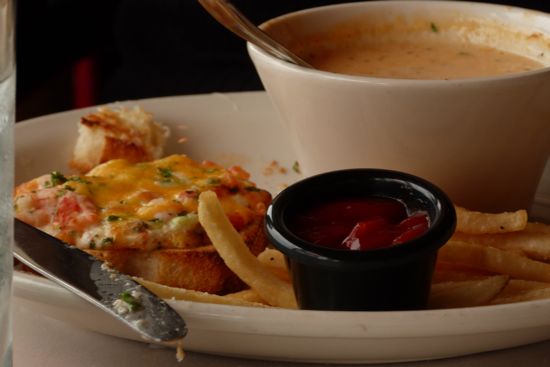
I have the Seafood Bisque – it really is good – and the Seafood Louis. This Louis even has a small salmon steak topping it, and I love salmon. Pensacola has all the fresh seafood in the world, but you don’t see Crab or Shrimp Louis on the menu . . . LOL, maybe it is another one of those generational things.
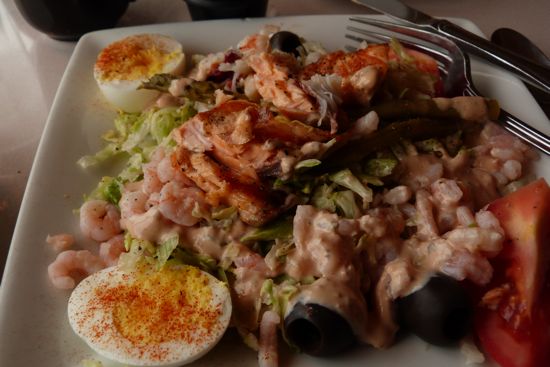
It rained while we were there, but as we were readying to brave the rain, it stopped, just enough of a window to get back into the car and to get her back home. Did I mention it rained the entire time I was in Seattle? 😉
Lunch at Boss Oyster, Apalachicola


A quick drive down the road to our favorite place, Apalachicola, FL, home of some of the loveliest oysters in the world. There are other restaurants, good restaurants, but we gravitate toward Boss Oyster, where we can sit outside by the water. It is a brisk day, we sit outside, but I notice the pelicans are huddled down on their perch:

A little later he started to warm up and groomed a little:

As usual, we ordered too much food. We don’t mean to, we mean to be sensible, but the portions are bigger than we remembered. I love their seafood gumbo to start:
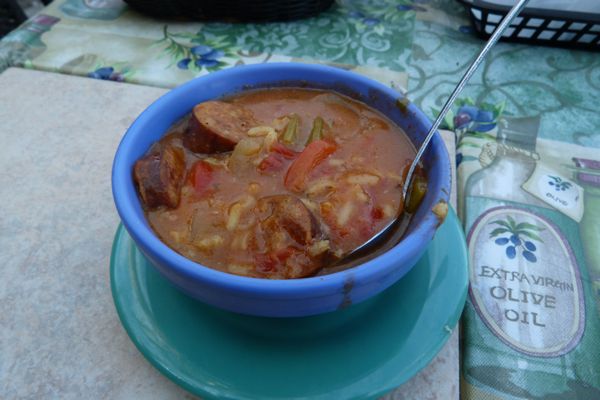
AdventureMan can’t resist a starter plate of the oysters for which Apalachicola is famous:
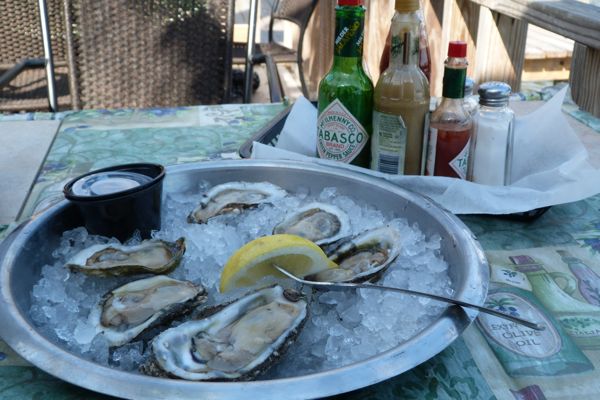
I didn’t know the Crab Cake basket would be so huge . . .
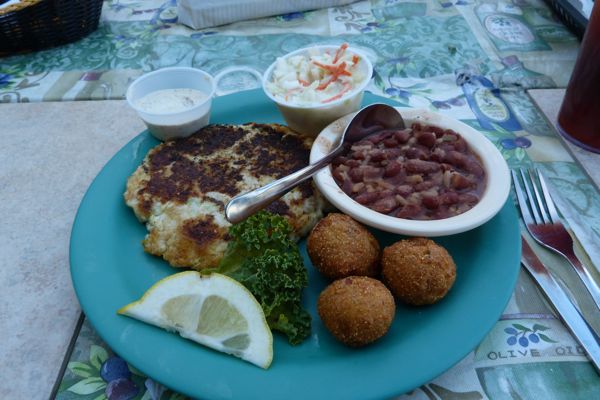
AdventureMan had the Shrimp Basket – it’s cool, now you can get baskets that aren’t fried (some might say ‘so why bother?’, but we are trying not to eat too much fried food):
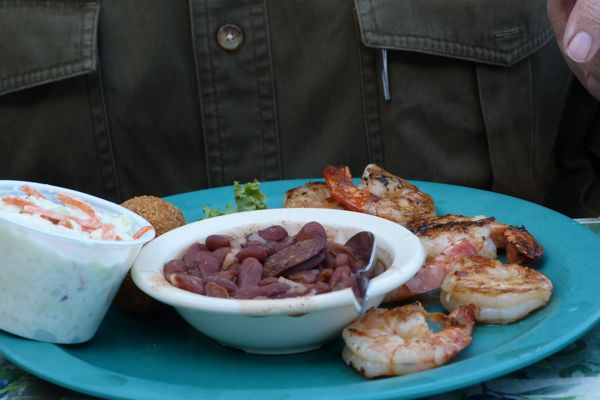
Here is a little friend who offered to help me eat:

Here is one of the things we love the most about non-chain restaurants. . . this one has custom made high chairs from a local wood – how cool is that?
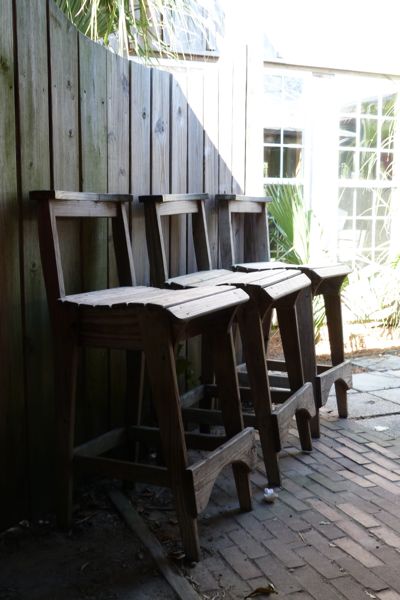
Or maybe, now that I look closer, those are extra bar stools, LOL!
Foods a la Louisiane: Jambalaya
Did I tell you I collect cookbooks? One of the guidelines I use is that the cookbook have the name of a person attached to each recipe; if your name is on a recipe going into a book, you know you are going to be very careful that this recipe is really, really good.
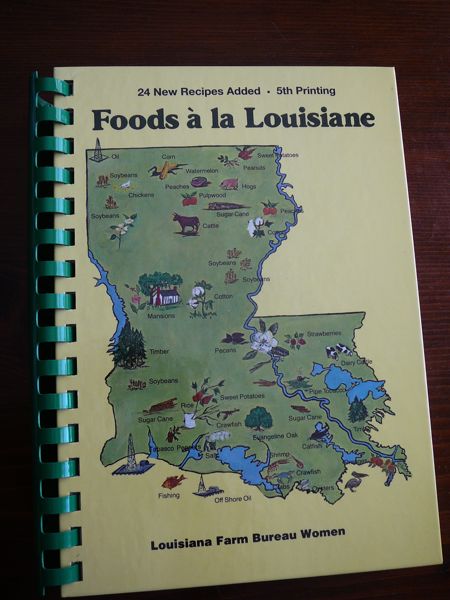
I don’t remember buying this cookbook, but it is a gem. On the other hand, there have been some surprises . . . there is a recipe for making boudin, that ubiquitous Cajun sausage, and it starts off with “1 large hoghead.” The directions state that you boil the hog’s head until tender, let it cool, remove meat from bones, then grind hoghead meat with heart, kidney, onions, parsley, etc. in a meat grinder.
Thank goodness boudin is not a favorite of mine. Andouille, a spicier sausage, IS a favorite of mine and if I see a recipe for andouille, I am NOT going to look at it.
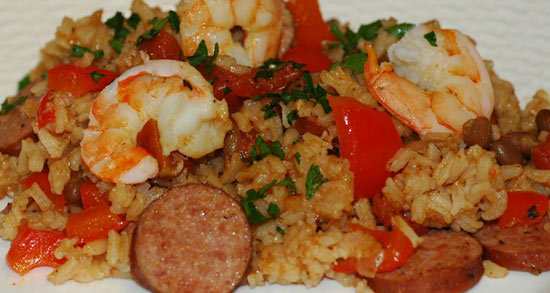
I love making jambalaya – and here is a genuine Louisiana recipe:
JAMBALAYA
1/2 cup vegetable oil or drippings
2 medium onions, chopped
2 stalks celery, chopped
1 cup fresh parsley, chopped
1 medium green pepper, seeded and chopped
1/2 cup chopped green onion tops
Water
2 1/2 teaspoons salt
1 teaspoon garlic powder
Red Pepper to taste
Pepper to taste
Browning agent or 2 teaspoons Kitchen Bouquet
2 lbs peeled raw shrimp
4 cups long grain rice
Heat oil over low heat in a heavy 6 quart Dutch oven until warmed. Add vegetables; saute until lightly browned. Add enough water to cover vegetables; add seasoning and browning agent. Bring to a boil; add shrimp. Cook over medium heat for 10 minutes. Stir in rice; cook 10 minutes. Cover and cook until rice is tender, stirring occasionally. Yield 10 – 12 servings.
I do jambalaya all the time (DISCLAIMER: I am neither a Louisiana native nor of Cajun descent, so what I do cannot be taken as authentic, even if it is tasty 🙂 ) and I use more spices, chopped tomatoes and I don’t add the shrimp until the rice is cooked; I add it at the end and give it five minutes for the heat of the rice and cooked ingredients to cook the shrimp. We also use andouille sausage (or a turkey sausage if we are entertaining Moslem friends) and some cut artichoke hearts, maybe a small jar of pimentos, maybe some leftover peas. Sort of like a jambalaya/paella 🙂
“That’s Just Not Right”
We are talking about taking in the new “ferociously exciting” movie Argo today, and having a bite to eat afterwards at Mellow Mushroom. AdventureMan likes their pizzas (you can watch them toss the dough in the air for the crusts) and I like their Portobello Reuben sandwich or sometimes their spinach salad.
“Law and Order Man always has pineapple on his pizza” AdventureMan said, “and every time he does, he says ‘I know there are people who think pineapple doesn’t go on pizza, but I like it.'”
We laugh. We know who he is talking about. It’s us. We have our ideas of what pizza is supposed to be based on our pizza experiences in Germany and Italy and France. Not a lot of sauce, not a lot of cheese, and a sprinkling of toppings – our very favorite being a seafood pizza we ate in Dinard, France, where they threw and handful of tiny still-in-the-shell creatures on and put it in the big, hot wood-burning oven and minutes later we had this thin crust pizza saturated with briny tiny sea creatures, cooked exactly right.
Pineapple on pizza – it just doesn’t seem right to us. I’m glad our son has the gumption to stick to his guns and have pineapple on his pizza if that is what he likes, but . . . not me. Never!
So we were laughing about our preferences this morning and AdventureMan says “that would be like putting pineapple on a peanut-butter sandwich” at which point . . . I stopped agreeing with him.
“That sounds sort of good!” I said thoughtfully.
“No! That’s just not right!” he almost stomped his foot. He will mix peanut butter with jellies, but for some reason, the thought of pineapple in his peanut butter is unthinkable.
I’ve heard of a sandwich Elvis loved, something like peanut butter and banana and bacon, all grilled together between two slices of bread . . . that doesn’t sound good to me, but then again, I haven’t had the courage to try one. I guess it might be the calorie count that also holds me back – fat on fat on fat, LOL.
Do you have any irrational food preferences? Or combinations that, in your perspective, are just not right?
Mediterranean Plus Doors Closed and Driving and Texting
Sigh. We went for lunch at our favorite local ‘Mediterranean’ food restaurant, the Mediterranean Plus, only to see a big “This Space For Rent” sign on the door. So sad. The last time we were there, we talked with the owner, who said that Chow Time (a Chinese Food Buffet), which had opened near by, was killing him. It is just so sad. We are hoping he is only looking for a more propitious location. We’d love for him to find another location closer to downtown.
On our way to church last night, we looked over at the guy in the blue pick-up next to us, who was texting. He was only going about 20 mph, but when the car three cars up slowed to make a right turn, he didn’t notice, and crashed right into the much bigger pick-up in front of him. CRASH! It made a horrible crunching sound, and his hood got all crinkled up.
Even if Florida doesn’t have any laws against texting, his entire front-end is all smashed to pieces, glass and plastic everywhere, sharp shards. Having to pay for all that damage will be a big penalty. I wonder if it will make any difference in his behavior?
Donna Leon and Beastly Things Made Me Cry

I can always count on Donna Leon. She gives me a good read, a solid mystery, a social issue, the louche damp atmosphere of Venice and the Venetian aristocracy, and my good friend Guido Brunetti, police commissario, with his lovely wife and dear children and great Italian meals.
This time, she fooled me.
A barrel chested man is found floating in the canals with no identification. When identified, he is found to be a veterinarian, separated from his angry and hostile and broken-hearted wife.
Then Donna Leon pulls me way out of my comfort zone – TWICE. First, there are parts of the book I can scarcely read, as she talks about the meat industry. I’m reading this book, dealing with the meat industry, and I’ve just watched the movie GreY posted on the devastation meat eating causes in your metabolism and blood; the passages in Beastly Things sealed the deal – I don’t think I can eat red meat again. I’m not sure I can even be around red meat. Leon is fearless; she spotlights issues few dare to tackle. There are issues here that are not for the faint-hearted. Read at your own risk.
It’s a tricky mystery, and at the end, Leon catches me by surprise again, as she describes the funeral of the veterinarian, a very unusual funeral, where his patients are also in attendance. It was hard to read. My eyes were blurring. If you like mysteries, if you have pets you adore, this is the sweetest literary funeral you will ever attend.
Gasp! Look What Happens to Your Blood!
I am reblogging this from my friend GreY’s blog. He is a Kuwait blogger; we both started blogging at about the same time. He is, sadly, now battling cancer of the bowel, and has gone totally vegetarian. He posted this YouTube video that is horrifying, and shocking, and is going to make a big difference in the future choices I make:

The Hidden Dangers in Baking, Roasting, Grilling, Broiling
This is especially bad news for me; I love broiling and roasting to concentrate flavors. I love those crispy pieces of grilled foods . . . the latest from Bottom Line Publications.
How it’s cooked may increase your risk for chronic illness.
Some of the most serious chronic health problems in the US, including Alzheimer’s disease, cancer, diabetes and kidney and heart disease, have been linked to what we eat—processed foods, fast food, red meat, etc. What may surprise you is that the increased health risks from these foods may be due in large part to how they are cooked.
Dry-heat cooking, such as grilling, broiling, frying and even baking and roasting, greatly increases levels of advanced glycation end-products (AGEs), also known as glycotoxins. Small amounts of these chemical compounds are naturally present in all foods, but their levels rise dramatically when foods are subjected to dry heat, which frequently occurs both in home cooking and in commercial food preparation.
The danger: AGEs are oxidants that produce free radicals, damage DNA, trigger inflammation throughout the body and accelerate the aging process. They also make cholesterol more likely to cling to artery walls, the underlying cause of most heart attacks. Some researchers now believe that AGEs can be linked to most chronic diseases.
A NEW THREAT
A century ago, people mainly ate fresh, homemade foods, such as grains, vegetables, legumes and fruits, with relatively small amounts of meat. The processed food industry was still in its infancy.
However, in the following decades, meat portions grew larger, and Americans acquired a strong desire for the intense flavors, aromas and colors in commercially prepared “browned” foods, such as crackers, chips, cookies, grilled and broiled meats, french fries, pizza, etc. During this time, the rates of heart disease, diabetes and other chronic diseases started to rise. This wasn’t a coincidence—the rich taste, smell and appearance of these foods primarily come from AGEs.
Our bodies can neutralize the small amounts of AGEs that are naturally found in foods (and that we produce as a by-product of metabolism). But our defense mechanisms are overwhelmed with the high amounts that are now very common in the typical American diet.
HOW MUCH IS TOO MUCH?
AGEs are measured in kilounits (kU). We recommend consuming no more than 5,000 kU to 8,000 kU per day (see box for examples of kU levels in some common foods). Recent studies have shown that the average American typically consumes more than 15,000 kU daily, and many people eat well over 20,000 kU daily.
Reducing dietary AGEs may be especially important for people with diabetes because high blood sugar levels cause more AGEs to form. It’s also crucial for people with kidney disease because they are less able to remove AGEs from the body. AGEs also are elevated in patients with heart disease, obesity and dementia.
Researchers can measure the amounts of AGEs in the blood, but doctors don’t commonly use this test because it’s not currently available for commercial use. What your doctor can do is measure levels of C-reactive protein (CRP), a marker for inflammation. If your level is high (above 3 mg/dL), you may have excessive AGEs in your blood. If you eat a lot of grilled, broiled and roasted meats, for example, and/or heat-treated processed foods, this also means your AGE levels are likely too high.
AN “AGE-LESS” DIET
Our studies have shown that people who make simple dietary changes can reduce their levels of AGEs by more than 50% in four months. The reduction is accompanied by a similar decrease in CRP levels. Helpful strategies…
Eat less animal protein. Animal protein, especially red meat, is among the main sources of AGEs—and the levels can multiply tenfold when the meat is grilled, broiled, baked or roasted. Helpful: Eat beef no more than three times a week.
Because animal fat also contributes to AGE intake, eat lean meats. They have fewer AGEs than higher-fat meats. Animal fats such as butter also are higher in AGEs than plant fats such as olive oil.
Best approach: Fill three-quarters of your plate with plant foods, such as vegetables, whole grains, legumes and fruits, and leave no more than one-quarter of the plate for animal foods, such as meats and cheeses.
Soups and stews are tasty ways to serve small portions of meat. Also enjoy more meatless meals, such as vegetarian chili or veggie burgers. Nonfat milk and yogurt are low in AGEs and are a good way to add protein to meals and snacks.
Avoid dry-heat cooking, such as grilling, broiling, baking, roasting and frying. High, dry heat greatly increases AGEs. Example: A piece of raw meat might have 500 kU to 700 kU of AGEs. But after the meat is broiled, the level can rise to 5,000 kU to 8,000 kU.
Better approach: Cook with moist heat—stew, poach, steam, boil or microwave. A piece of chicken that’s poached or boiled, for example, will have about 1,000 kU. The same piece of chicken will have about 5,000 kU when it’s broiled.
If you have a desire for grilled or roasted foods, vegetables and fruits are better choices than meats. These foods have far fewer AGEs than meats and fats when cooked with dry heat.
If you do cook with dry heat, marinate first. The eventual formation of AGEs is reduced by about 50% when raw meats are marinated in acidic ingredients, such as vinegar or lemon juice. For each pound of meat, use the juice from two lemons or an equivalent amount of vinegar or lime juice plus enough water to cover the meat (about one cup). Add some garlic and/or herbs for extra flavor. Avoid commercial marinades since they’re usually high in sugar and/or oil, which will increase AGEs.
Reheat gently. Microwaving is a good method for reheating meats and other foods. Be sure to include plenty of liquid and reheat to a safe temperature to prevent the possibility of food-borne illness due, for example, to E. coli or salmonella.
Soups, sauces and gravies should be brought to a boil. Leftovers such as meats and casseroles should be reheated to 165°F.
Don’t eat certain foods together. Consuming meats with foods that are high in sugar—for example, having a slice of cake after eating a hamburger—allows existing AGEs in the meat to interact with the sugars in the cake, creating higher levels of AGEs.
Similarly, eating meats with very high-fat foods, such as a hamburger topped with bacon and cheese, will produce far more AGEs than consuming these foods by themselves.
Focus on fresh foods. Because processed foods have high levels of AGEs, fresh foods and foods that have been minimally processed are a much better choice.
A serving of rice, for example, will have almost no AGEs, but the same amount of crispy rice cereal will have 600 kU. Avoid takeout and convenience foods, such as fast-food burgers, fries and pizza.
Warning: Any food that has been browned or crisped, such as cookies, crackers, chips, etc., will be high in AGEs.
Sources: Sandra Woodruff, RD, a registered dietitian and nutrition consultant based in Tallahassee, Florida, and Helen Vlassara, MD, an endocrinologist and professor at Mount Sinai School of Medicine in New York City, where she directs the Experimental Diabetes and Aging Division. They are coauthors of The AGE-Less Way: Escape America’s Overeating Epidemic. (www.TheAGE-lessWay.com)
Smell More, Eat Less
This is another great find from Bottom Line Secrets; we often read things from them that haven’t yet hit the headlines or the TV news:

You probably associate delicious food aromas with wanting to eat more of whatever you’re smelling, whether it’s the scent of fresh-baked cookies or bacon sizzling in the skillet.
But a new study suggests that powerful food smells actually may help you eat less… and lose weight in the process.
SMELL MORE, EAT LESS
René de Wijk, PhD, is a Dutch sensory scientist who studies how people react to the look, feel, taste and smell of food.
He wanted to explore whether the smell of food influences how big a bite we take, because previous studies have shown that when we take smaller bites, we feel full on fewer calories than when we take bigger bites.
Dr. de Wijk hooked 10 volunteers to machines that pumped a custard dessert directly into their mouths. (I know—I wish that I could have participated in this study, too.)
At the same time, the subjects were randomly exposed to either a slightly detectable aroma of natural cream…or a moderately detectable aroma of natural cream…or no aroma at all. During the experiment, the participants could press a button whenever they wanted to stop the flow of custard, which determined their “bite” size. The key result? People pressed the button more quickly—in essence, took smaller bites—when the aroma was stronger.
What surprised Dr. de Wijk was the fact that it didn’t take an overly strong scent to influence his subjects’ bite size. “Even the relatively weak aroma was associated with a smaller bite size. Most of the subjects were not even aware that an aroma had been presented—the decision to take a smaller bite was largely subconscious,” he said.
Dr. de Wijk theorized why the smell may have worked. “A cream aroma is associated with calories, and we regulate calories via bite size,” he said. Or, it could also be that we have an innate tendency to try to moderate intense sensations of any kind, so we take smaller bites as a protective measure. (Dr. de Wijk’s work has also shown that we take smaller bites from highly textured foods.)
CHOOSE FRAGRANT FOODS
“I would think that any foods that have intense flavors—and therefore intense scents—would result in smaller bite size and, therefore, you’d need less food to feel full,” he told me. So creamy aromas aren’t the only ones that might help you eat less. For example, aromas that are strongly spicy, meaty, buttery, fishy, vinegary, lemony, garlicky or oniony—anything other than bland—might also do the trick. And whatever the aroma, eating your food warm or hot might help you eat less than eating it cold, since warmth brings out aromas more strongly. Heat up those leftovers!
Source: René A. de Wijk, PhD, senior sensory scientist in the department of food and biobased research at Wageningen University and Research Centre, The Netherlands, and lead author of a study published in Flavour.
Recent Comments
Kitchen on Isiais: Winding Down intlxpatr on Shampoo Ginger tigerbutterya0c5ff1d… on Shampoo Ginger intlxpatr on British Soldier Kidnapped, Esc… John on British Soldier Kidnapped, Esc… Wikipedia Donate Button

Amazina


Early Voting in Florida


