Peppermint Meringues
Last week, at the MegaMart, I saw some boxes of true peppermint candy canes. I grabbed three, did not even look at the price. There have been candy canes around, but weird – fruit flavored, even chocolate flavored. At Christmas, I am a purist when it comes to a candy cane. It has to be peppermint!
And then I look for recipes to make a little peppermint candy cane go a long way. This is one of them, from allrecipes.com:

Peppermint Meringues
Ingredients
• 2 egg whites
• 1/8 teaspoon salt
• 1/8 teaspoon cream of tartar
• 1/2 cup white sugar
• 2 peppermint candy canes, crushed
Directions
1. Preheat oven to 225 degrees F (110 degrees C). Line 2 cookie sheets with foil.
2. In a large glass or metal mixing bowl, beat egg whites, salt, and cream of tartar to soft peaks. Gradually add sugar, continuing to beat until whites form stiff peaks. Drop by spoonfuls 1 inch apart on the prepared cookie sheets. Sprinkle crushed peppermint candy over the cookies.
3. Bake for 1 1/2 hours in preheated oven. Meringues should be completely dry on the inside. Do not allow them to brown. Turn off oven. Keep oven door ajar, and let meringues sit in the oven until completely cool. Loosen from foil with metal spatula. Store loosely covered in cool dry place for up to 2 months.
A warning – meringues work a whole lot better if you DO NOT make them on a rainy day. The humidity in the air interferes with making a good dry meringue. You can make these and keep them a short while in an airtight container, but in humidity, they lose their crispness.
We are having our third full day of intermittent, drenching rain in Doha. Thanks be to God.
Doha Gets a Drenching
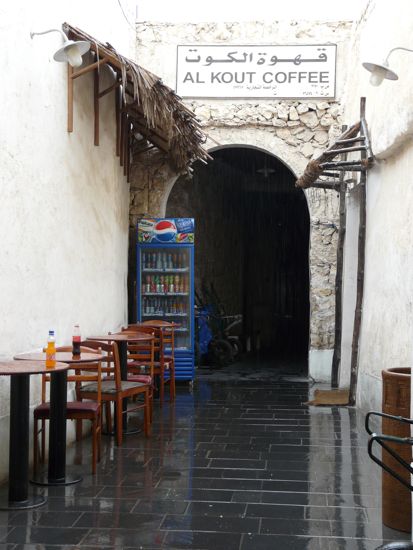
A wonderful day, a day that started with a downpour, and never cleared up the whole day, with intermittent showers continuing to give the soil the moisture it so desperately needs. I love the thought of Doha getting a good wash with Qatar National Day being celebrated this entire week. 🙂
Some Rainy Day photos from Doha:






For my Kuwait friends – you are WELCOME, see! There is even an Al Kout coffee shop!


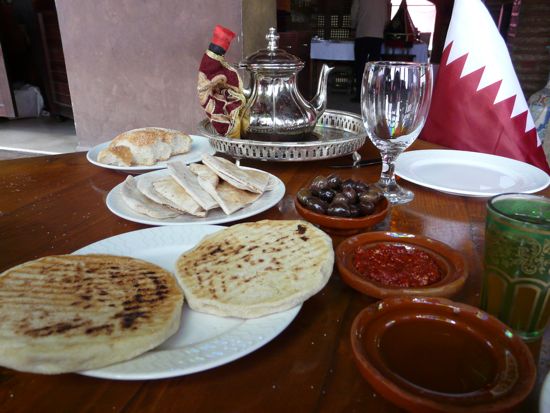
Snug and warm having breakfast at Tagine:
7 Foods Experts Won’t Eat and Why
Aaarrgh – some of my favorites. I had no idea. A friend sent this, a recent article in Prevention Magazine.
The 7 foods experts won’t eat
by Liz Vaccariello, Editor-in-Chief, PREVENTION, on Tue Nov 24, 2009 11:15am PST
How healthy (or not) certain foods are—for us, for the environment—is a hotly debated topic among experts and consumers alike, and there are no easy answers. But when Prevention talked to the people at the forefront of food safety and asked them one simple question—“What foods do you avoid?”—we got some pretty interesting answers. Although these foods don’t necessarily make up a “banned” list, as you head into the holidays—and all the grocery shopping that comes with it—their answers are, well, food for thought:
20 ways to feed your family for $100 a week.
1. Canned Tomatoes
The expert: Fredrick vom Saal, PhD, an endocrinologist at the University of Missouri who studies bisphenol-A
The problem: The resin linings of tin cans contain bisphenol-A, a synthetic estrogen that has been linked to ailments ranging from reproductive problems to heart disease, diabetes, and obesity. Unfortunately, acidity (a prominent characteristic of tomatoes) causes BPA to leach into your food. Studies show that the BPA in most people’s body exceeds the amount that suppresses sperm production or causes chromosomal damage to the eggs of animals. “You can get 50 mcg of BPA per liter out of a tomato can, and that’s a level that is going to impact people, particularly the young,” says vom Saal. “I won’t go near canned tomatoes.”
The solution: Choose tomatoes in glass bottles (which do not need resin linings), such as the brands Bionaturae and Coluccio. You can also get several types in Tetra Pak boxes, like Trader Joe’s and Pomi.
14 worst health mistakes even smart women make.
2. Corn-Fed Beef
The expert: Joel Salatin, co-owner of Polyface Farms and author of half a dozen books on sustainable farming
The problem: Cattle evolved to eat grass, not grains. But farmers today feed their animals corn and soybeans, which fatten up the animals faster for slaughter. More money for cattle farmers (and lower prices at the grocery store) means a lot less nutrition for us. A recent comprehensive study conducted by the USDA and researchers from Clemson University found that compared with corn-fed beef, grass-fed beef is higher in beta-carotene, vitamin E, omega-3s, conjugated linoleic acid (CLA), calcium, magnesium, and potassium; lower in inflammatory omega-6s; and lower in saturated fats that have been linked to heart disease. “We need to respect the fact that cows are herbivores, and that does not mean feeding them corn and chicken manure,” says Salatin.
The solution: Buy grass-fed beef, which can be found at specialty grocers, farmers’ markets, and nationally at Whole Foods. It’s usually labeled because it demands a premium, but if you don’t see it, ask your butcher.
25 ridiculously healthy foods you should be eating now.
3. Microwave Popcorn
The expert: Olga Naidenko, PhD, a senior scientist for the Environmental Working Group,
The problem: Chemicals, including perfluorooctanoic acid (PFOA), in the lining of the bag, are part of a class of compounds that may be linked to infertility in humans, according to a recent study from UCLA. In animal testing, the chemicals cause liver, testicular, and pancreatic cancer. Studies show that microwaving causes the chemicals to vaporize—and migrate into your popcorn. “They stay in your body for years and accumulate there,” says Naidenko, which is why researchers worry that levels in humans could approach the amounts causing cancers in laboratory animals. DuPont and other manufacturers have promised to phase out PFOA by 2015 under a voluntary EPA plan, but millions of bags of popcorn will be sold between now and then.
The solution: Pop natural kernels the old-fashioned way: in a skillet. For flavorings, you can add real butter or dried seasonings, such as dillweed, vegetable flakes, or soup mix.
Your nutritional guide to grocery shopping.
4. Nonorganic Potatoes
The expert: Jeffrey Moyer, chair of the National Organic Standards Board
The problem: Root vegetables absorb herbicides, pesticides, and fungicides that wind up in soil. In the case of potatoes—the nation’s most popular vegetable—they’re treated with fungicides during the growing season, then sprayed with herbicides to kill off the fibrous vines before harvesting. After they’re dug up, the potatoes are treated yet again to prevent them from sprouting. “Try this experiment: Buy a conventional potato in a store, and try to get it to sprout. It won’t,” says Moyer, who is also farm director of the Rodale Institute (also owned by Rodale Inc., the publisher of Prevention). “I’ve talked with potato growers who say point-blank they would never eat the potatoes they sell. They have separate plots where they grow potatoes for themselves without all the chemicals.”
The solution: Buy organic potatoes. Washing isn’t good enough if you’re trying to remove chemicals that have been absorbed into the flesh.
14 ways to make veggies less boring.
5. Farmed Salmon
The expert: David Carpenter, MD, director of the Institute for Health and the Environment at the University at Albany and publisher of a major study in the journal Science on contamination in fish.
The problem: Nature didn’t intend for salmon to be crammed into pens and fed soy, poultry litter, and hydrolyzed chicken feathers. As a result, farmed salmon is lower in vitamin D and higher in contaminants, including carcinogens, PCBs, brominated flame retardants, and pesticides such as dioxin and DDT. According to Carpenter, the most contaminated fish come from Northern Europe, which can be found on American menus. “You can only safely eat one of these salmon dinners every 5 months without increasing your risk of cancer,” says Carpenter, whose 2004 fish contamination study got broad media attention. “It’s that bad.” Preliminary science has also linked DDT to diabetes and obesity, but some nutritionists believe the benefits of omega-3s outweigh the risks. There is also concern about the high level of antibiotics and pesticides used to treat these fish. When you eat farmed salmon, you get dosed with the same drugs and chemicals.
The solution: Switch to wild-caught Alaska salmon. If the package says fresh Atlantic, it’s farmed. There are no commercial fisheries left for wild Atlantic salmon.
Delicious and easy fish recipes
6. Milk Produced with Artificial Hormones
The expert: Rick North, project director of the Campaign for Safe Food at the Oregon Physicians for Social Responsibility and former CEO of the Oregon division of the American Cancer Society
The problem: Milk producers treat their dairy cattle with recombinant bovine growth hormone (rBGH or rBST, as it is also known) to boost milk production. But rBGH also increases udder infections and even pus in the milk. It also leads to higher levels of a hormone called insulin-like growth factor in milk. In people, high levels of IGF-1 may contribute to breast, prostate, and colon cancers. “When the government approved rBGH, it was thought that IGF-1 from milk would be broken down in the human digestive tract,” says North. As it turns out, the casein in milk protects most of it, according to several independent studies. “There’s not 100% proof that this is increasing cancer in humans,” admits North. “However, it’s banned in most industrialized countries.”
The solution: Check labels for rBGH-free, rBST-free, produced without artificial hormones, or organic milk. These phrases indicate rBGH-free products.
Don’t be fooled by these 11 health food imposters.
7. Conventional Apples
The expert: Mark Kastel, former executive for agribusiness and codirector of the Cornucopia Institute, a farm-policy research group that supports organic foods
The problem: If fall fruits held a “most doused in pesticides contest,” apples would win. Why? They are individually grafted (descended from a single tree) so that each variety maintains its distinctive flavor. As such, apples don’t develop resistance to pests and are sprayed frequently. The industry maintains that these residues are not harmful. But Kastel counters that it’s just common sense to minimize exposure by avoiding the most doused produce, like apples. “Farm workers have higher rates of many cancers,” he says. And increasing numbers of studies are starting to link a higher body burden of pesticides (from all sources) with Parkinson’s disease.
The solution: Buy organic apples. If you can’t afford organic, be sure to wash and peel them first.
Turkey is Good For You
Last night, when I felt so bad, I wasn’t hungry. I know, go figure, surrounded by delicious food and the only thing that sounded good was a little turkey and gravy. Mostly, turkey is too dry for me, but the lady who cooked the turkey really knew what she was doing, and it was delicious. (I bet she used SALT!) And, actually, after eating a little turkey, I felt better.
So today, I know why. My health tip today – one of several, actually – from Real Age is about how good turkey is for you. Wooo HOO on me, patching up my DNA!
Who knew?
Feeling frazzled? Have another helping of the main course — if the main course is turkey.
Thankfully, skinless turkey is chock-full of B vitamins that help boost your energy and cinch stress — something many of us could probably use today. And every day.
Tallying the Talents
Think of the B vitamins in turkey — niacin, B6, and B12 — as your psyche’s little bodyguards. These nutrients also help patch up DNA and keep your cells in good repair. And best of all, with turkey, your B vitamins get served up in one of the leanest meat sources around. A 3-ounce portion of skinless turkey breast has just 0.2 grams of saturated fat. That’s nothing compared with the 4.5 grams found in the same amount of flank steak or the killer 5.5 grams found in 3 ounces of fresh ham.
How Good Normal Can Be
Oh no! Just when I need to be at my best, when I need to sparkle, I am struck low by a chest cold – the kind with a wracking tubercular cough accompanied by dizziness and sheer exhaustion. We have house guests, we have Thanksgiving – and I can barely drag myself out of bed. I am not myself! And I am so sick I don’t care!
Thanks be to God, AdventureMan to the rescue. He has taken time off to spend with our houseguests, and he takes over, allowing me to sleep the day away. I am up just in time to dress and head off to dinner, carrying dishes I had prepared days before, thank God. I try to keep a distance between me and anyone I might infect, and I leave early, heading back to bed.
Today I am a new woman. Not well, still coughing a little, but I know how good it feels not to feel rotten. I have some energy. My head is clear. Today, I am truly thankful.
Failproof Easy Pecan Pie From Quail Country
A long long time ago, in a country far away, we lived in one village and our friend lived in another, but we often visited back and forth. One day she called and said they were coming into town with her parents, and I said “oh, we won’t be here those dates, but I will leave the key with my friends down the street and you can stay here.”
Months later, a mysterious package arrived in the mail, from my friend’s parents, with a lovely, gracious note of thanks for letting us stay in our house, and one of the world’s greatest cookbooks, Quail Country, by the Junior League of Albany, Georgia. (Quail Country, Smith House Publications, 516 Flint Avenue, Albany, GA 31701)
One of my all time best recipes, Soused Apple Cake is from there.
Today, I am making pecan pies for Thanksgiving and giving thanks for the never fail Pecan Pie recipe, which I have printed before, but will print again because it is such a life saver.
Pecan Pie
3 eggs
1/2 cup sugar
1 cup light corn syrup
1/2 teaspoon salt
1 teaspoon vanilla extract
1/4 cup butter, melted
1 cup coarsely chopped pecans
1 9-inch deep dish pastryt shell, unbaked
Beat eggs slightly; add sugar, corn syrup, salt and vanilla. Blend well, but do not overbeat; add butter. Stir in pecans. Pour into pastry shell. Bake in preheated 350 F (180 C) oven about 50 minutes, or until a knife inserted in the center comes out clean. Six servings.
I actually cheat on pie crust. I use a Graham Cracker Crust, made with what are called digestive biscuits here in Qatar and in Kuwait. So a small package of digestive biscuits, crushed, add a little cinnamon and about 1/3 cup melted butter. Mix, and press into pie pan. Nothing could be easier. 🙂
And as I am making the pies, I also give thanks that our son found a wonderful woman to marry, and that his wife’s aunt has sent me some of the world’s best Texas pecans, which I hand carried when I moved from Kuwait to Qatar because I was NEVER going to leave them behind!
The Little Sailor in Najma
This is a story of good advertising and good luck. In a recent Peninsula magazine was a full page ad for a new restaurant, the Little Sailor. It looked clean, and interesting, so we decided to seek it out for a seafood dinner.
We are so glad we did. The Little Sailor is located on a not-that-easy to reach street – either you are coming from Airport Road on C-Ring and you turn right, I think at the third right turn from the light, or you go down Najma, from C-ring, turning right at the small roundabout just past the Commercial Bank on your right, go to the end of the road, turn right, go a short distance to the end of that road, turn left and then turn left again on the next street and you will see the Little Sailor on your left.

It’s small, but they are doing a steady and continuous business. At one point, every table was taken, people coming in and placing to-go orders. They don’t have a printed menu yet, which always makes me nervous, but we plunged in, hoping we had enough to cover the bill. 🙂
We started with the seafood soup, which was delicious – it tasted like good health as soon as we started eating, and was full of fish chunks. It is hearty and filling. They have two versions, a cream version and a clear version. We went with the clear version; we loved it.

I chose Fish and Chips for my entree, and AdventureMan chose grilled shrimp. We had more than enough, the portions were generous:
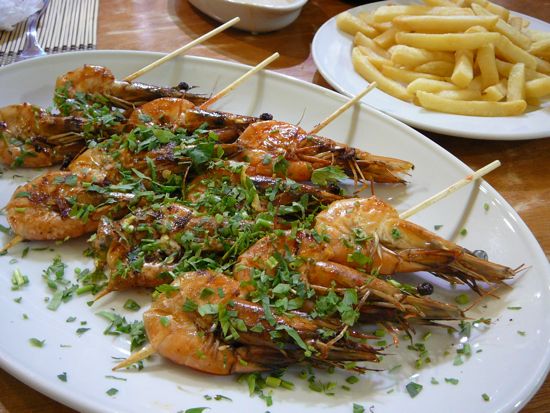
The batter on the fish was light and airy, like tempura batter. It allowed the flavor of the fish to shine!

As he was talking with the manager, AM learned that The Little Sailor is associated with the same company as Al Maharah, in the Suq al Waqif hotel. No wonder everything tastes so fresh and so delicious!
When our bill came, we got a happy surprise:

QR 104 comes to around $29. for this feast of fresh seafood. 🙂
Who Knew? Pumpkin Shortage, Pumpkin Pie
“Have you heard about the great pumpkin shortage?” asked my friend Grammy. I think I snorted. I thought she was kidding.
No. No, she was not kidding. Today I found this on AOL News where you can read the whole story by clicking on the blue type.
Pumpkin Shortage Means No Pie for Thanksgiving
Posted Nov 18th 2009 2:30PM by Susan Wagner
Planning on serving pumpkin pie next week for Thanksgiving? You might want to find a back up — maybe pecan pie, or some spicy gingerbread. What’s wrong with pumpkin pie? Nothing — except that there aren’t any pumpkins available this year.
Rainy conditions in the midwest this fall have washed out the pumpkin crop, leaving retailers at a loss for canned pie filling. This week, the LA Times reported that Nestlé, which controls 85% of the pumpkin crop for canning, was all out of pumpkins. The company issued a surprise apology, saying that the rain had destroyed the remains of an already-small crop. Nestlé plans to stop shipping canned pumpkin after Thanksgiving, and the company says that once this season’s supply is gone, there won’t be any more pumpkins available for canning until August 2010.
Don’t lose hope!
For one thing, here in Qatar, there doesn’t appear to be any shortage of pumpkin – or, well, squash. It tastes like pumpkin, but looks more like old fashioned pumpkins, not like the generic vanilla USA sugar pumpkin.
My beautiful French friend’s nose got that pinched French look when she heard about pumpkin pies made with canned pumpkin.
“Why would you do that?” she asked in genuine bewilderment. “All you have to do is to cook the pumpkin pieces until they are soft, then use them as you would canned pumpkin, except that it’s fresh, and has no added chemicals.”
HER pumpkin pie was out of this world, made with fresh pumpkins and her special spice mix:
2 tablespoon ground cinnamon
1 1/2 tablespoon ground ginger ( or1 tablespoon of grated fresh ginger)
1 teaspoon cloves
1 teaspoon mace (or ground nutmeg)
1 pinch anis seeds ground
1 cup dark brown sugar
Ground all the pieces together than add the sugar, keep it in a closed lid jar.
Her filling : 2 pounds fresh pumpkin flesh, steamed, mashed and cooled down, 1 cup of packed brown sugar, 3 eggs, 1 teaspoon of baking soda, half a cup of the spice mix.
Her pie was amazing. I would bake at 350F/180C for about an hour; it makes a big pie.
Corn Chowder
This used to be a recipe sent to me by Allrecipes.com, but I changed so much of it they probably wouldn’t recognize it. AdventureMan and I loved it! It’s great for winter days when the nights are getting longer, and the temperatures are dropping into the 80’s. Brrrrrrrrrr! 😉
Corn Chowder
Ingredients
• 1/2 cup diced bacon
• 4 medium potatoes, chopped into small cubes, maybe 1/2 – 3/4 inches
• 1 medium onion, chopped finely
• 2 cups water
• 3 cups frozen corn
• 1 teaspoon salt
• coarsely ground black pepper
• 2 cups light cream
1. Slice bacon across the top, so that you have lots of little bacon pieces, fry until cooked through. Save the grease (there is only like a tablespoon).
2. Mix potatoes and onion into the pot with the crumbled bacon and reserved drippings. Cook and stir 5 minutes. Pour in the water, and stir in corn. Season with salt and pepper. Bring to a boil, reduce heat to low, and cover pot. Simmer 20 minutes, stirring frequently, until potatoes are tender.
(You can prepare earlier in the day to this point, then add cream and heat just before serving)
3. Warm cream in a small saucepan until it bubbles. Remove from heat before it boils, and mix into the chowder just before serving.
Mom’s Fruit Cake in Qatar
Life has gotten busy, and somehow November is here and I haven’t made my fruitcakes. I need to fix that! For those of you who think fruitcakes are a joke – my Mom’s fruitcake has a secret ingredient – chocolate. Even people who don’t like fruitcake love this fruitcake.
I am in Qatar – I have brandy. I have rum. No, I don’t drink hard liquor, but oh, they do make my fruitcakes tastier. Today, I will soak the raisins in brandy overnight, so they will be ready to go tomorrow!
I am reprinting this recipe for those of you who would like to give fruitcake a try.
Mom’s Fruit Cake
This is the original recipe. I remember cutting the dates and prunes with scissors when I was little; now you can buy dates and prunes without pits and chop them in the food processor – a piece of cake!
1 cup boiling water
1 cup sugar
1/2 cup lard or butter
1 T. cinnamon
1 t. cloves
3 Tablespoons chocolate powder
1/4 cup jelly
1 cup seeded raisins
1 cup chopped walnuts
1/2 cup candied citron
1/2 cup cut prunes
1/2 cup cut dates
Put all in a pan on stove and bring to a boil. Boil for three minutes. Let cool. Add:
2 cups flour
1 teaspoon baking soda
Flavor with lemon
Bake at 350° in loaf pans for one hour. Makes 2 normal bread loaf sized cakes.
My variations: I put in about three times the fruit, the difference primarily in the candied citron – I prefer using whole candied cherries, because they are so pretty when the loafs are cut. This recipe doubles, or quadruples with no problems.
Pans: Mom used to line all the pans with brown paper and grease the paper. I grease the pans, then dust with more of the chocolate powder. Use a good quality chocolate, not cocoa. When the cakes come out of the oven, let them cool for ten minutes, loosen them with a knife, then they will shake out easily. Let continue to cool until they are totally cool, then wrap in plastic wrap, with several layers, then foil, then seal in a sealable plastic bag. Let them age a couple months in a corner of your refrigerator. I make mine around Halloween, and serve the first one at Thanksgiving.
I never make these the same any two years in a row.
You know how raisins get all dried out and taste yucky in fruitcakes? The night before you intend to make the fruitcakes, take all the raisins you intend to use (depending on how many fruitcakes you intend to make) and put them in a glass container. Pour brandy over them, to cover. Microwave just to the boiling point. Let stand in the microwave overnight.
The next day, you can drain that brandy and use it in a stew or something, and in the meanwhile, you now have plump, juicy raisins to use in your fruitcake, and just a hint of brandy flavor. Yummmm!
Recent Comments
intlxpatr on Shampoo Ginger tigerbutterya0c5ff1d… on Shampoo Ginger intlxpatr on British Soldier Kidnapped, Esc… John on British Soldier Kidnapped, Esc… intlxpatr on British Soldier Kidnapped, Esc… Wikipedia Donate Button

Amazina


Early Voting in Florida


 Here There and Everywhere