The Reciprocity Experiment
This is fascinating. I get these mailing labels every year from charities I’ve never heard of. I feel so GUILTY not sending them anything – they’ve spent their hard earned money sending me a gift! What to do? This man studied the phenomenon and discovered that we all find ourselves in this dilemma from time to time.
This is from National Public Radio, where I get the best news of things I might never hear about otherwise:
Give And Take: How The Rule Of Reciprocation Binds Us
by ALIX SPIEGEL
In 1974, Phillip Kunz and his family got a record number of Christmas cards. In the weeks before Christmas they came daily, sometimes by the dozen. Kunz still has them in his home, collected in an old photo album.
“Dear Phil, Joyce and family,” a typical card reads, “we received your holiday greeting with much joy and enthusiasm … Merry Christmas and Happy New Year’s. Love Lou, Bev and the children.”
The cards from that year came in all shapes and sizes, but the basic message was the same. The writers wanted Kunz to know that he and his family were cared for, and also they wanted to share their own news. They included pictures of family members and new homes and smiling graduates with freshly minted diplomas.
It all seems pretty normal, except for one thing: Kunz didn’t know any of them.
Kunz was a sociologist at Brigham Young University. Earlier that year he’d decided to do an experiment to see what would happen if he sent Christmas cards to total strangers.
And so he went out and collected directories for some nearby towns and picked out around 600 names. “I started out at a random number and then skipped so many and got to the next one,” he says.
To these 600 strangers, Kunz sent his Christmas greetings: handwritten notes or a card with a photo of him and his family. And then Kunz waited to see what would happen.

In 1974, Phillip Kunz, a sociologist at Brigham Young University, wanted to see what would happen if he sent Christmas cards to people he didn’t know.
Courtesy of the L. Tom Perry Special Collections at Brigham Young University
“It was just, you know, a shot in the dark,” he says. “I didn’t know what would happen.”
But about five days later, responses started filtering back — slowly at first and then more, until eventually they were coming 12, 15 at a time. Eventually Kunz got more than 200 replies. “I was really surprised by how many responses there were,” he says. “And I was surprised by the number of letters that were written, some of them three, four pages long.”
Why would someone send a three-page letter to a complete and total stranger?
Why did so many people write him back at all?
Following Rules
Robert Cialdini is an emeritus psychologist at Arizona State University who studies how our behavior is affected by social rules that we’re only vaguely aware of but which have incredible power over what we do. What happened to Kunz, he explains, is the direct result of one of the rules that most interest him: the rule of reciprocation. The rule, he says, is drilled into us as children.
“We are obligated to give back to others, the form of behavior that they have first given to us,” he says. “Essentially thou shall not take without giving in return.”
And so if someone passes you in the hall and says hello, you feel compelled to return their greeting. When you don’t, you notice it, it makes you uncomfortable, out of balance. That’s the rule of reciprocation.
“There’s not a single human culture that fails to train its members in this rule,” Cialdini says.
This is probably because there are some obvious benefits to the rule of reciprocation; it’s one of those rules that likely made it easier for us to survive as a species.
But what’s interesting about all this is how psychologists like Cialdini can actually measure the way the rule affects how we behave in all sorts of situations.
Exhibit A: those little pre-printed address labels that come to us in the mail this time of year along with letters asking for donations.
Those labels seem innocent enough, but they often trigger a small but very real dilemma. “I can’t send it back to them because it’s got my name on it,” Cialdini says. “But as soon as I’ve decided to keep that packet of labels, I’m in the jaws of the rule.”
The packet of labels costs roughly 9 cents, Cialdini says, but it dramatically increases the number of people who give to the charities that send them. “The hit rate goes from 18 to 35 percent,” he says. In other words, the number of people who donate almost doubles.
You can see the same thing when it comes to tipping.
If a server brings you a check and does not include a candy on the check tray, you will tip the server whatever it is that you feel the server deserves. “But if there’s a mint on the tray, tips go up 3.3 percent,” Cialdini says.
According to Cialdini, the researchers who did that study also discovered that if while delivering the tray with the mint the server paused, looked the customers in the eye, and then gave them a second mint while telling them the candy was specifically for them, “tips went through the roof.”
Servers who gave a second mint got a 20 percent increase over their normal tip.
Many decades ago Cialdini noticed a similar phenomenon when he studied Hare Krishnas in the U.S. He says that in the late 1960s the religion was really struggling financially; it seemed strange to many Americans, so it was hard for them to raise money.
But then they hit on a solution. In airports (and other public places), they would simply give the people passing by what they described as a gift: a flower, a book, a magazine. Then, after the person had the gift in his or her hand, they would ask for a small donation. Cialdini says he spent days in different airports observing these transactions, watching as recipients struggled to come up with the right solution.
“You would see many of them with frowns on their faces reach into a pocket or a purse, come up with a dollar or two, and then walk away angry at what had just occurred,” recalls Cialdini. But they would give, he believes, because of the rule of reciprocation. For years, he says, the Hare Krishna religion raised millions of dollars this way.
Reciprocating Influence
There are really dozens of ways that the rule of reciprocation affects us, some of them good, some of them bad. For example, politicians, like the rest of us, are subject to the rule of reciprocation. And so when organizations or interest groups give them money, though they might believe that money won’t influence their decisions, it’s sometimes hard for them, as it is for us, to be immune.
Cialdini believes you can also see the rule operate in the medical profession.
“You find doctors more willing to prescribe medication based on what gifts, favors and tips they have been given by one pharmaceutical company or another,” he says.
This doesn’t mean that the rule of reciprocation affects all of us all of the time. Cialdini says different situations trigger different people differently.
But it is powerful. One of those invisible powerful things that can subtly shape how we behave even years after someone has given us something.
Consider the case of Phillip Kunz, the sociologist who decided to send Christmas cards to random strangers.
For years his family got cards from the people he contacted in 1974.
“We got cards for maybe 15 years,” he says.
The Power of Kindness to Change Lives
This week AdventureMan and I have been blessed, greatly blessed. We have met some wonderful people and heard some amazing things. Two stories in particular have shaken the earth for me.
“How It Happened for Me”
The first story is about a friend we met from the newest country on earth, South Sudan. A group of us were sitting together when one woman turned to this man from the South Sudan and asked “How did you find Jesus?”
This was not a religious gathering, so it is an unusual question on a social evening. But this quiet, modest man responded “I will tell you. It is a long story. It starts when I was only five months, not a baby, five months in my mother’s womb.”
He told us of a life with no security. His parents and family fled to the forest, and were on the run continually most of his life – until recently. He told of a life trying to find safe places, sometimes being separated from his parents.

He told of a priest who, when he and his brothers and sisters were very young, taught them to say “God bless Mother and God bless Father and God bless my brothers and sisters and watch over us always.” He was kind to the children, and taught them that God loves them, that God is kind. He said they did not know who this God was, but he and his brothers and sisters said this prayer every night, to keep his family safe. He said they learned other simple prayers. There would be rare times when someone would teach them a letter, or some numbers, drawing in the sand, or the floor of the forest, simple, quick lessons.
“So I don’t know all the stories you do,” he said. “I don’t even know the bible very well, we never had educated priests, just simple men who taught us simple prayers. Only later did we become more educated.”
As we listened, we had huge lumps in our throats. I could hear Jesus’ voice saying that we must believe as little children, and this man had the pure simple faith of a child, a memory from his earliest years, as he prayed for his family to be safe in a world where life was continual chaos and a struggle to survive.
“When I understood about God,” he went on, “there wasn’t even a church or a pastor-man who could baptize me; I had to believe for many years before I could become a Christian.”
As a footnote, he told us that somehow, most of his village managed to survive, helping one another. His entire family made it through, his parents are still alive. The village children little by little gained education, becoming doctors, lawyers, professionals of all kinds. His village now has a church, a simple church, not always staffed, but a church. The war is ended. For him, the simplicity of peace is all he ever wanted.
We will never forget his, and his story. We have met an extraordinary human being.
Today, we went to a lunch, invited by a friend, to raise funds for public education. LOL, this is what I used to do; I worked for an education foundation and raised money for public education. I love this kind of thing. I knew just what to expect – lots of success stories, stellar achievements, and a gentle pitch.
Whoa! Wrong! Darling kids – check. Recognition of important guests – check. Gentle pitch – no way! They got right to business; you will see this form, please take your pens RIGHT NOW and fill it out and give what you can, education funds seem to get cut more every year and we are trying to do more with less and less. Give NOW. CHECK!
The final speaker was a local businessman and patron-of-just-about-everything, a man who also brought baseball to Pensacola. He talked about his own public education. He talked about his speech impediment, and his deafness, he talked about his short stature and his inability to sit still and concentrate. He talked about teachers who identified him and instead of treating him as an obstacle, made him believe they were glad to have him in their class. He talked about teachers who gave him special assignments, who taught him math by having him calculate baseball averages. He knew their names, these saints who kept him in school, no matter how discouraged he might be.
He graduated with a 1.9 grade point, and had no intention of going to college, but ended up astonishing everyone by doing well on the ACT test and having a guidance counselor who found him just exactly the right environment where he could flourish on the college level.
Important people usually enjoy telling you the great things they have done. This man focused on his disabilities, his humiliations and his weaknesses, and how the kindness of educators had pulled him out of a very dark place and set him on the road for the success he is today.
I am willing to bet that the education foundation gained a lot of donors today. We were caught by surprise. We can defend against the powerful and successful, but when the heart speaks from vulnerability and failure, our hearts respond. This man is a success, but he gives credit to those who looked at him with caring eyes, with caring hearts, who lifted him and helped him on his way to the incredible (wealthy) success he is today, with a flourishing business and innumerable local charities who are grateful for his support.
What a week! And it’s only Tuesday! I wonder what the rest of the week will bring?
International Intrigue, Electoral Ethics
Holy Smokes, advisor to the potential president of Ghana . . . and free money! (Yeh, right.) Another candidate in my fraud file:
Do accept my apologies if my message does not meet your personal ethics. I want
to introduce myself and this business opportunity to you. I am John
Mahama, Ghanaian Presidential aspirant. I wish to know if you can assist me, I
made a lots of deposit with a security company in the UK and Beguim during my
Business trip to United Kingdom.
I am considering running for the presidency in Ghana, I deposited Ј6, 500, 000,
00 GBP. (Six Million Five Hundred Thousand British Pounds Sterling).With
Security Company in London and Beguim.
What do you think if you assist me in transferring these fund to your country
and use it to support me during my Presidential campaigns and you become the
adviser to the potential president of Ghana?
I can’t transfer these funds to my personal or relatives account as it may
invoke the interest of the Government and lead to impeachment.
Upon your acceptance to assist me in repatriating these funds to your country, I
will give you letter to the security company authorizing you to conduct Banking
activities on my behalf and 30% of this total funds will be given to you for
your assistance.
Kindly respond to me so that I can give you comprehensive details on what you
are to do next.
If you are willing to assist me and want to be my advicer in the fucture,kindly
contact me on my private mailbox (johnmahama@ovi.com)
Regards,
John Dramani Mahama
The Winner!
You’d think, now that we are ‘retired’ that we would have a lot of time, but we have plugged in to our community, and we are busy and scheduled! Before I left for Seattle, I was preparing for, and then helping with the Pensacola Quilt Show, held only every two years.
It was a lot of fun. Pensacola has amazing quilters, people who hand-piece and hand quilt, people who are amazingly skilled at machine quilting, and I am honored to know some of them, and delighted when I get a chance to work alongside them.
Whether or not I had won a ribbon, I would be honored just hanging my quilts in the same room with these talented women. Nevertheless, I did win an honorable mention in the theme quilt catagory, which was Snail’s Trail. I am only telling you this because I want to show you the ribbon, which is whimisical, clever and delightful:

I smile every time I look at it.
In addition, I won one of the offerings at the Chinese Auction. I have seen these auctions run different ways, but in this one, you get 25 chances for $5, and I put all my chances in the jar for these fabrics, I wanted them so badly. I took a class from the lady who made them, and I love the work she does. Winning this is like winning a pot of gold for a quilter 🙂

When I look at these fabrics, I am ready to start quilting again!
The Rule of the Harvest
I was talking about this with a Mormon friend, who told me they call this ‘The Rule of the Harvest,’ that it is one of life’s great – and most obvious – secrets, that what you give comes back to you ten-fold and more.
Pastor Rick Warren is the pastor of Saddleback Church, and sends out these thoughts on a daily basis. The current theme is generosity in giving, as this is stewardship season.
Financial Fitness: Generosity Reaps Generosity
by Rick Warren
The world of the generous gets larger and larger; the world of the stingy gets smaller and smaller. Proverbs 11:24 (Msg)
If I sow generosity, it’s going to come back to me, and I’m going to reap generosity.
Every farmer knows this. A farmer has sacks of seed in his barn and he looks at his empty field. He doesn’t complain, “There’s no crop! I wish there was a crop!” He just goes out and starts planting seed. When you have a need, plant a seed.
It seems illogical that when I have a need, I should give.
Why did God set it up this way? Because God is a giver. He is the most generous giver in the universe, and God wants you to learn to be like him. He wants to build character in you.
The Bible says, “Honor the Lord with your wealth and with the best part of everything you produce” (Proverbs 3:9 NLT). This is the principle of tithing. It’s the principle that says every time I make $100 — the first $10 goes back to God.
Tithing is an act of worship. We’re giving to God. We’re saying, “All of it came from you anyway.” God says, “Put me first in your life and watch what I do.” You may think you can’t afford to tithe, but the reality is, you can’t afford not to tithe.
If you have an interest in receiving his daily message, you can subscribe here.
Non-Profits: Something From Nothing
Here is what I love – people who get an idea, and make the world a better place because they have a vision and make a plan so that the vision can become a reality.
The Gulf Coast Citizens Diplomacy Council
I volunteer for the Gulf Coast Citizens Diplomacy Council. The one in Pensacola was started from nothing by a young woman with a vision, Gina Melancon Gissendanner. Her organization, her Board of Directors, her members and her resources deep within the Pensacola community have welcomed several hundred of the US Department of States International Visitor’s Leadership program delegates, bringing awareness – and dollars – to Pensacola.
When the visitors come into town, they have activities, tours and visits with professional counterparts that give them new strategies and resources to take back with them to their home countries. While here, they meet local people, shop in local stores and dine in local homes.
I love this program. From nothing, this young woman has created an organization with a far-reaching legacy. Thanks to her innovative and relevant programs, the international delegates leave here with happy memories of their time in Pensacola, and they go home and tell their friends and neighbors about their time here.
This weekend, we crossed paths with three more organizations, creating a better world, each in their own way.
The Master Gardeners
“You have to come to the sale at the County Extension Office!” our aqua aerobics friends told us. “It is so much fun, and they have Florida-hardy plants available at really good prices.”
OK! Finding ourselves awake and ready to hit the road early on a Saturday morning, we headed for the County Extension office, and the Master Gardener’s Sale. Now, I may get some of the details in this story wrong, but this is what I think I have been told. . . Several years ago, county extension offices (who answer questions about soil and growing things) found themselves deluged with questions, with too few people to answer them. They started a program – and I believe it is nation wide – training people in all aspects of growing things in the local area.
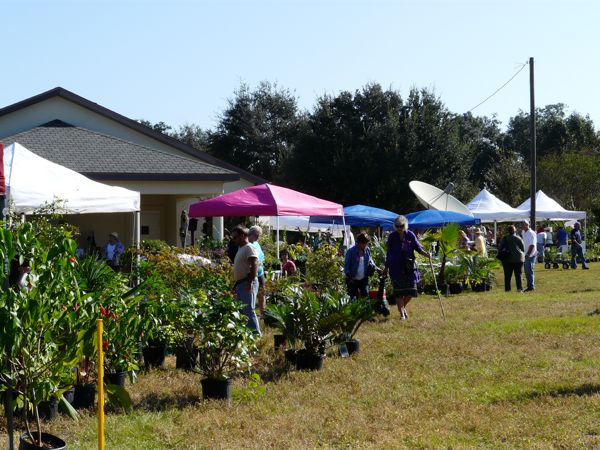
People who signed up for the training also signed up for a commitment to volunteer, and pass their knowledge along. Slowly, slowly, we have begun to know these people.
The sale was a lot of fun. While gardeners love a challenge, like growing flowers in Florida that aren’t supposed to grow here (like me, I am trying to grow bougainvillea, which isn’t really good at getting through cold winters, but maybe if I find the right protected spot, I can get it going and keep it going until it develops a deep root system and an ability to withstand the minimally cold winters we have in Pensacola) and they also love to share their knowledge.
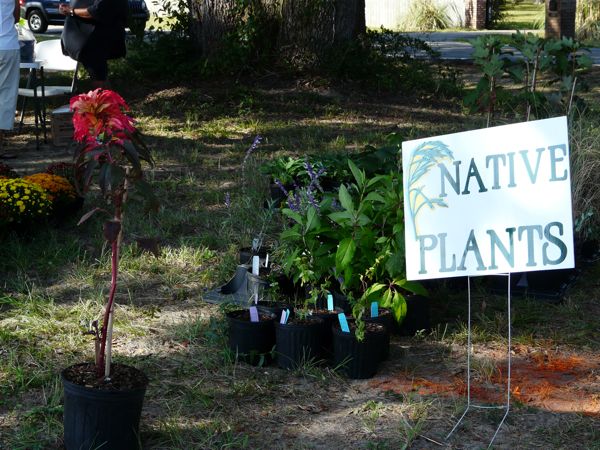
There was an experienced, knowledgeable and enthusiastic Master gardener about every ten steps at the sale, and we could ask all the questions we ever wanted, and they just loved talking with us and giving all the answers. Free! There was no admission charged, the plants were reasonably prices (and many were very cool plants) and it was just a great place to pass a Saturday morning.
We’ve been told the Spring Sale is THE best sale – we can hardly wait.
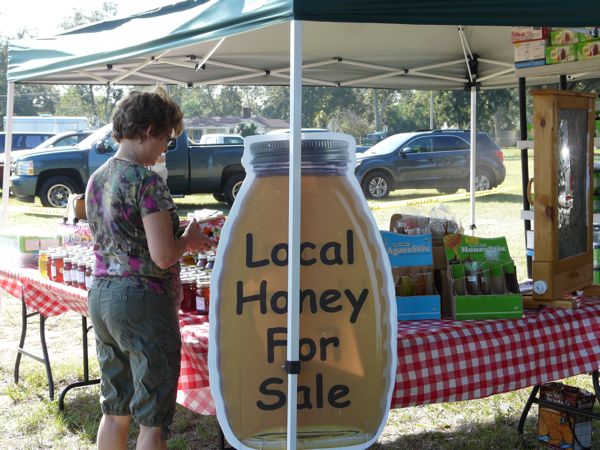
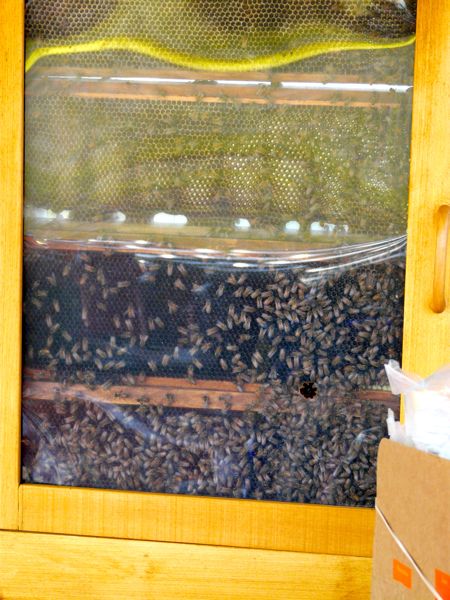

When we left, AdventureMan said “Every one of them seemed so comfortable in their own skin.” I think he is right. I think working in the earth with your hands helps ground you. 🙂
The Master Gardeners are those people you find in Home Depot and Lowes, giving information on gardening in Florida, and at special booths at Arts Fests, in the schools, and working the beds at the County Extension office. They are volunteers. They do this work for the love of making the world a more beautiful place.
The Butterfly House
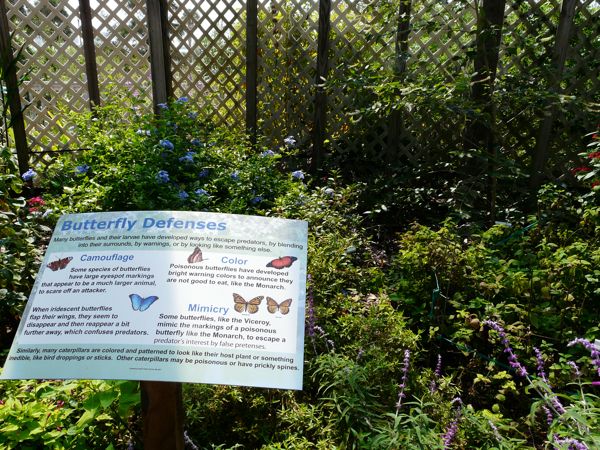
Our next stop was the Monarch Madness festival at the Panhandle Butterfly House in Navarre, where there was also an Arts Fest in progress. The volunteers at the Butterfly House all wore these terrific T-shirts with a caterpiller on the front and Monarch butterfly on the back. They had a great system, too, for getting a lot of people through the butterfly house in an organized and civil way, still giving people a lot of time to ask questions, and with lots of really cool activities for children to do, to help them understand the life cycle of these beautiful and short-lived creatures.





The Manna Food Pantries, Pensacola
I’m lucky. I work on a church committee where the chair brings in representatives from all the major charities in Pensacola to talk with us about what they do. The Manna Food Pantries is, in my humble opinion, a poster-child for how a non-profit should operate. Providing food for those who are hungry, for those going through tough times – and there are more than you might think – is truly part of God’s work for us here on earth. Manna Food Pantries collect and distribute food to the hungry. This morning, we had two Manna vans at the church and people were bringing in their full bags to donate.
It’s been a very tough year in Pensacola. The tough times just go on and on. You can prepare for tough times, save your money, gather your resources, but when tough times linger, sometimes those resources run dry. Manna has been faced with just such a time; resources are drying up, donations were down and the need is greater than ever. Manna hit the front page this week two days in a row, and is getting great coverage on radio, in the churches, in social groups – they are very very good at getting the message out, and the message is clear: We need your continued support, food, money, now more than ever.
They are brilliant at managing their volunteers, and many have been with them for years and years.
All these organizations are only able to exist because people believe in giving of their time and efforts in the hopes of making the world a little better, a little more beautiful, a little more peaceful, a little more hopeful – one person at a time.
Where are you going to put your efforts? What organizations do you support – and why?
Adaobi Tricia Nwaubani: I Do Not Come to You by Chance
This book, the first novel from Adaobi Tricia Nwaubani, is hilarious, with moments of pathos, and a fresh point of view.
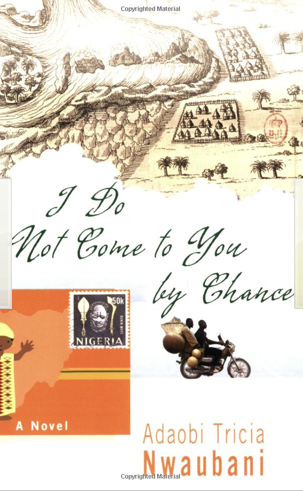
Amazon.com recommended it to me as I was busy buying books by author Chimamanda Ngozi Adichie; I thought ‘OK, I’ll read a series of Nigerian books as part of my summer reading.
Young Kingsley Ibe is the family’s first born male, and with that status goes many privileges – and responsibilities. After graduating with a Masters in Chemical Engineering, he has no success in his search for a job with an oil company in Nigeria, and consequently loses the love of his life, Ola, to another who has secure employment.
Worse, his retired father has a stroke, and the family discovers that with all the fees required, they haven’t enough for his continued care, so Kingsley must approach his uncle, Boniface Mbamalu, more familiarly known as Cash Daddy, for funds to transfer his father to a long term care facility, and, later, for his father’s funeral.
Serious Kingsley’s eyes nearly pop as he sees the life his uncle is living, cars, women, designer watches, shoes, suits and all the trappings of new wealth. Soon, his uncle makes a convincing case for Kingsley coming to work for him, the better to help out his family of mother, brothers and sister, now that he is the senior male in the family.
Kingsley discovers he has a gift for the work – which is writing 419s, those scam letters which I frequently publish in this column. I loved being on the inside, learning how strong possibility e-mail addresses are netted, how response e-mails are massaged – not unlike fund raising techniques by charitable organizations in the US. Kingsley’s education helps him achieve enormous financial success in a very short time – but he finds that all the cash and designer goods in the word do not solve his problems nor make him happy.
I learned a lot about how successful many of these scammers are, and how the money made is spread throughout the Nigerian communities. The author takes a balanced view, balancing the way the cash makes life easier for people – a lot of people, because the rich man has many obligations to his community, balanced against the disgust, and sick fear felt by his religious mother and aunt, and his one time girlfriend, when they learn the work he is doing. They are disappointed that a man of such promise has sunk to making so much money in a dishonest way. The book also does not deal sympathetically with those who have given or lost money to the scammers, nor, in my opinion, does the ending satisfy.
This is one of the funniest parts of the book – a group of Nigerian scammers is about to meet with a representative of a major US investment firm. He thinks he will be meeting with the Nigerian Minister of Transportation to discuss building a new airport; the reality is that Cash Daddy, in disguise, will be pretending to be the minister. Kingsley protests that Cash Daddy looks nothing like the minister, and Cash Daddy responds:
“Let me tell you something . . . Me, I really like these oyibo people. They’re very very nice people. See how they came and showed us that the ground where we’ve been dancing Atilogwu has crude oil under it. If not for them, we might never have found out. But Kings,” he dragged in his dangling foot and sat up in the tub, “white man doesn’t understand black man’s face. Do you know tht I can give you my passport to travel with . . . Even if your nose is ten times bigger than my own, they won’t even notice?”
It was a fascinating book. I understand better now why 419 scams work. (419 is the section of the Nigerian criminal code making scam e-mails a crime; thus the crime is called ‘a 419’) There are some very funny and very insightful moments in the book. It is no where near the level of literature that you experience with Chimamanda Ngozi Adichie, but there is more humor, and the book shows a more modern day Nigeria. Not a bad summer read, but not great literature.
Hilarious Qadaffi E-mail
Those who come by here regularly know that I have a niece who is not only a professor of Arabic culture and studies, but is also beautiful and funny and adventerous. I had no idea she was so well connected, LOL. Thank you, Little Diamond, for contributing this wonderful scam e-mail to the HT&E collection. Read and weep!
My name is Saif Al Islam Gaddafi, the son of the present president of Libya. I am contacting you for an urgent assistance.
As you can read and see in the media, my family is presently undergoing tough time in the hand of the masses due to his long stay in power as the president of Libya for over 40 years now. Although there is no way you can satisfy human being, my father has done so many things to better the life of our people unfortunately they never appreciated his effort instead it resulted in calling my family bad names.
The International community has reached a resolution for immediate seizure of our assets both in US and the UK which the have already done and many other sanctions but it can’t affect our financial statue in the world. But as you can not predict tomorrow the say that is while I decided to reach you for this assistant hoping it will be top secret and you should avoid the media
I want to request your humble assistance to receive a total sum of €22m.
I will not give you details of the fund now because of security reasons but just have in mind that the fund exit in one of the African countries.
You will receive this fund directly and keep it safe or invest it in any business of yours till this saga is over then I will get back to you on how the fund or profit will be shared. By the special grace of Allah nothing will happen to me.
If you are ready and will keep it top secret and avoid the media contact this email address (aarifqasif@hotmail.com ) the details of where the fund exit and how it will be transferred will be made known t
I know you may have little fear on you but it is risk free.
I know you will be in hurry to reply me but due to what my family is facing now and security reasons I will not be responding ! ! ! ! ! ! !.
All you need to do is to contact my representative with the email given to you and tell him that you received an email from Saif Al Islam Gaddafi and that you are willing to receive the fund.
Assalamu ‘alaikum
Saif Al Islam Gaddafi
Little Diamond, that’s the best laugh I’ve had all day. 😀
Dear DADDY Intlxpatr
I get the feeling he doesn’t really read my blog . . .
Dear DADDY,
I am Johnson Koroma, from the Ivory Coast (D.R.C) in Africa. I am the first son and the eldest child of my late father, Late Capt. Suleiman Koroma.
My late father was killed by the rebels in my country as he died in the hospital, two days after he was shot on his chest.
I am in Jakarta-Indonesia now; I was smuggled in here with the help of the United Nations (U.N.).
The U.N assisted me to convey my inherited fund($15,500,000.00) to Jakarta-Indonesia, as I told them that, the fund was supposed to be delivered to my late father foreign partner here in Jakarta-Indonesia according to my late father’s instruction before he died.
I did this arrangement, as my late father told me before he died in my country Ivory Coast; to make sure I convey this fund to his foreign partner here in Jakarta-Indonesia for investment purposes since there is instability of power in Africa.
But on my arriving here in Jakarta-Indonesia, I could not find my late father foreign partner as I was told he died in a bomb blast that occurred in J.W Marot hotel here in Jakarta-Indonesia two year ago.
In this regards, I seek your urgent assistance, for you to come down here in Jakarta-Indonesia, so that I will introduce you to the U.N as my late father’s foreign partner for them to release my fund to you. This is because, the U.N said they will not release my fund to me, until they see my late father foreign partner as I told them earlier, as the said fund is too big for only me to handle as the U.N. officials said, since I am just 24 years of age.
Note: You are not expected to make any upfront payment before you make this claim, all you are required to do is just to come down here in Jakarta-Indonesia, and I introduce you to the U.N as my late father’s foreign partner, who will make the claim of my inherited fund and invest it into any lucrative investment according to your directives… Also, 15% of this total sum shall be giving to you for your kind assistant.
The U.N will deduct 10% of the total sum, for their service charges etc after they hand over my inherited fund to you, hence you will not be expected to make any payment for this claim.
Thanks and remain blessed, as I await your urgent response and arrival schedule here in Jakarta-Indonesia.
Yours son,
Johnson Koroma.
Your Words Make all the Difference
Thank you, Kimberly, for sending me this great message:
Recent Comments
intlxpatr on Shampoo Ginger tigerbutterya0c5ff1d… on Shampoo Ginger intlxpatr on British Soldier Kidnapped, Esc… John on British Soldier Kidnapped, Esc… intlxpatr on British Soldier Kidnapped, Esc… Wikipedia Donate Button

Amazina


Early Voting in Florida


