It Gives Me Hope
You know who I am, I’m pretty consistent in what I have to say. I believe we all have a lot more in common than we have differences, and I want us to find ways to get along. We, as a species, spend so much time and energy and resources fighting over the pettiest differences. How will we ever call ourselves civilized until we can treat every fellow creature with respect?
I bet Cupertino has problems, too. I know for one thing it is incredibly expensive. Most of what I saw there, I really liked. Whole Foods. High Tech Engineering. A wide variety of people, all working together in peace.
At our hotel, there were five weddings taking place the same day as “our” wedding. I came down in the elevator with one couple and their parents, and I got a photo of them in the hotel garden area before their wedding:

The groom is from India, and the bride is Chinese. The parents, and all the relatives are gathered, and dressed in gorgeous, flowing silks, and the bride and groom are just amazingly in love with each other and it is so beautiful, they are all so happy.
Cupertino takes a lot of pride in being beautiful, and the buildings they build are beautiful and they have “campuses” where lots of related buildings are connected with winding garden paths and ponds full of ducks.
I particularly love this sculpture:

Which looks totally different from the side:

There were flowers and plants everywhere. Many I couldn’t even recognize. I would have to learn a whole new world of gardening in California:

Feedback
As I am chatting on the phone with AdventureMan, he brings up the blog.
“I don’t get it,” he says, “You get like fifty-seven comments on any article about the Qatteri Cat, and you get NO comments on a perfectly wonderful article like the Lemba and their DNA link to the lost tribes of Israel!”
I just laugh. I’ve gotten used to it.
“Months from now I will get a letter from some academic who has been looking for that article and can’t find it,” I tell AdventureMan. “And months from now, that article will still be getting hits while the Qatteri Cat entry is long forgotten.”
Chatting with my Mom on the phone, this morning, she mentioned how she was working out in the water these days, trying to build strength in her legs and knees and hips, and how when she gets discouraged she thinks of the entry on The Magic Bullet and how she really does feel better and have more energy when she finishes. I’m so proud of my Mom. She is 84, living on her own, and had one of her old best friends as a houseguest this weekend, and they attended a fashion show in which my sister Sparkle was modeling. They had a great time. I can only hope to be as fit and active as my Mom when I am her age, and, God willing, still living on my own.
This morning I got an e-mail from Kuwaiti Woman / Dirty Dinar letting her regular commenters know she is back in the blog world once again. I am so glad she wrote to us – I had deleted her from my list of favorites when so much time went by without an entry. Her blog is about the great adventure of learning to manage your own money. She is a very courageous woman, lets us in on all her failures as well as her successes, and because she does not spare herself, she is totally addictive. Who hasn’t had to make tough financial decisions from time to time that blow the budget?
These feedbacks – and the wonderful, additive feedback of your comments – are what keep this blogger going.
Yes, I am having fun. How cool is it knowing your own Mom copied out the recipe for Penny Carrot Salad? How cool is it learning that there are Arab wolves in the desert, and that they are in danger of extinction because they are interbreeding with feral dogs ( R’s comment on Total Crack Up) This blog has made me feel connected in Kuwait, and connected to like-minded people around the world.
I still protect my anonymity, and at the same time, I have a realistic fear that I am getting closer and closer to the day when one of my good friends will look at me sharply and say “I think you are blogging. Are you Intlxpatr?” I don’t know what I will do when that happens. I’m not a good liar, and why would I want to lie to a friend? I just don’t know how long I can expect to keep my identity a secret.
Feel Like Dancin’

Thanks for all your good thoughts as I – well, I didn’t prepare our taxes, I prepared the worksheet for our taxes. I used to do taxes, but taxes have gotten so complicated, now we have to pay someone else a bucket of money to do them for us. In the meantime, it takes a whole day just to fill out the sheets of preparation. It takes a year of saving receipts and records.
I discovered that in an increasingly paperless world, it is not so easy to document as it used to be. I used to dread filing, but I also knew where things were. A lot of my day yesterday was spent looking up accounts online, and printing off things. When we went more paperless, we also sacrificed easy access to good record keeping. AArrgh!
I remember my Dad always did the family taxes, and he would do them late in January, as soon as all the financial statements had arrived. We would give him hints about better ways of shielding his money from taxation, and he would say “I don’t mind paying taxes. I worked for the government, and the government put you kids through university by paying me a generous salary and health benefits and retirement.” We would shake our heads in wonderment – have you ever met someone who didn’t mind paying taxes? It must be generational.
We had a complicated year, financially, and in gathering all the records I noticed in my zeal to keep everything paid off and up to date, I actually OVERPAID our taxes. . . how often does that happen? AdventureMan and I have something to celebrate!
Those penguins are from a website called CafePress and they sell all kinds of adorable things, unique.
(At nine in the morning, it is still only 73°F / 23°C – wooo hoooooo! Gonna be a great Thursday!
No Whining!
The other day AdventureMan and I happened to be in the same room and the TV happened to be on and a woman on one of the morning shows (shown in the afternoon in Kuwait) was talking about how to make your kids stop whining.
“I don’t remember (our son) ever whining,” I said, “do you remember him whining?”
“When he was very little, sometimes he would get fussy,” AdventureMan replied.
“Yeh, but fussy is different, when you are little and overtired, or have an ear infection or are hungry – even we get fussy!” I laughed.
I do remember a few awful times when, after standing in a long line in the military commissary on a payday I finally got to the checkout stand just as my son was totally losing it, having to get a month’s worth of groceries paid for and packed while he was screaming bloody murder and the groceries are being packed and people are looking at me like I am a criminal because I can’t feed him there in front of everyone. As soon as I could get him to the car, I could nurse him, but meanwhile, I was hostage to his relentless desparate wailing. Is their any sound as compelling as a wailing baby?
But that is to be expected when you have a baby; babies sometimes have to wail.
But whining?
I was lucky, I was able to be a stay-at-home mom when my son was little. We spent a lot of time together. I could usually distract him, I could usually put him down for a nap if he was tired, I could usually schedule myself to be around to feed him when he needed feeding. I remember ear-infection fussing, and teething fussing, but I don’t remember any whining.
AdventureMan said I wouldn’t put up with whining, not from him, not from our son.
Our son had a lot of expectations on him. AdventureMan was an officer, and we had obligations. (What? You thought only Kuwaitis had expectations and obligations?) Sometimes, when our son would rather be playing, he had to attend an event, or an official function, and he had to behave, because he was his father’s son, and his behavior would reflect on his father. When he would rather be wearing a sweatsuit and trainers, he had to wear dress pants and a dress shirt and tie, and dress shoes. If he complained, I would say “you don’t have to like it, you just have to do it. I don’t like it either!”
I had two tools.
First, as soon as he could talk, I taught him to say “can we negotiate?”
Most of the time, we can find a way to make a bad situation better. Often, he had great suggestions, like “can we go to La Gondola and have a pizza afterwards, and can I invite Michael to go with us?” Whatever gets you through what you don’t want to do, I would think to myself, and agree. Occasionally, but not often, there were non-negotiables, like moves, and then, you just have to grit your teeth and get through it.
Second, I used incentives. Some people might call them bribes, but here is how it worked.
I knew it was in his best interest to get good grades, and that it was my responsibility to help him learn how to get those grades. On the first day of school, I would take him to the toy store and he could pick out what he wanted to work for. We would set goals for each class; we would write down those goals and post them on the refrigerator. At the end of the semester, when those goals were met, he got his prize. The hardest hardest part for me was NOT giving him a prize when the goal was not met, but encouraging him that I know he will get the prize next time. I think it was harder on me NOT giving in than on him, not getting the reward.
My Mother thought I was spoiling him because we would negociate. “You are the mother,” she would say. “You are the boss.”
“Yes, Mom,” I would respond, “but I NEED for him to cooperate. I need for him to feel like he has some choice.” It was just a generational difference.
Now I am getting to see a new generation having their babies. My niece taught her baby basic sign language, and continues to teach him more as time goes on. Even pre-verbal, he has ways of telling her he is hungry, thirsty, wants to be picked up, etc. What an amazing and wonderful idea, what control it gives a baby to be able to express these basic desires, to communicate needs and wants. I am in awe of these young mothers and the care with which they are raising their babies.
Kuwait is blessed to have a blog written by young mothers for other young mothers, full of great ideas. Many of the ideas I THINK are great, but because some are written in Arabic, and my vocabulary and grammar are not that strong, i can’t really read them. That blog is Organic Kuwait; they even have books published for children explaining Ramadan and Hajj in age-appropriate language. Makes me wish I were a young mother again! 🙂
Election Fever
I have a very dear friend who will say “I don’t have a dog in that fight” and that is the way I feel about your upcoming elections. You (Kuwait, Kuwait leadership, Kuwait people) are in our prayers for a fair election, and that you elect good leadership. You know what a mess it has been; it would be nice to elect people who can work with the government to get things done.
So I don’t have a clue who those people would be, but I know YOU do.
Here is what tickles me, what I can’t resist commenting on from this morning’s Kuwait Times:
ELECTION FEVER GRIPS STATE
Tribes, groups move to chose candidates • Eligible voters rise to 361,000 including 200,000 women
Holy Smokes! Almost FORTY THOUSAND more women voters than men voters??? Woooo HOOOOOO, Kuwaiti women!
History of Architecture in Old Kuwait City (3)
I am quoting so much from Saleh Abdulghani Al-Mutawa. Architect, that you may think you don’t need to run out and buy the book but I assure you, I am only sharing with you a few of the gems I found within. The author has done so much research with such loving attention that the book is full of treasure, every page offers something worthy.
The Year of Demolish
It is a sad memorial in Kuwait’s history. In Rajab 1289 A.H. (i.e. in the middle of the nineteenth century), heavy rains accompanied by severe winds hit the old Kuwait city, and demolished most of the mud houses. Sea waves went high and hit and wrecked ships. It was a disaster for Kuwaitis.
A second natural disaster took place in Kuwait on 30 November 1954 when heavy rains fell and demolished houses and forced 18,000 Kuwaitis to seek refuge in newly built schools. Houses built of mud and a little cement were severely affected, while houses built of rock were not affected.
My Kuwait friends – tonight, instead of going out in your cars, stay home! Sit with your grandparents and ask them about the house they grew up in. Ask them about the meals they cooked. Ask them about the heavy rains, so heavy that they could destroy houses and force 18,000 Kuwaitis to abandon their homes and go stay in schools. These are amazing stories – learn your stories from your grandparents . . . and then come tell us all the stories in your own blogs. If you don’t have a blog, or if you want to share here, you are welcome.
Some of my Kuwait friends ask why I care more about these things than the Kuwaitis. First – my Kuwaiti friends care. In my country, we call these people “the silent majority.” Every now and then the majority energizes and asserts itself. Kuwaitis care. Change is happening, it happens slowly. Keep the faith.
Second – I live here. I may not be Kuwaiti, but I care about the places where I live. If God has placed me here, I trust that he has his reasons, and it is my obligation to him to learn as much as I can and to serve – wherever he may place me. He placed me in Kuwait.
Tomorrow I will print my very favorite part of this book – where it describes family living. Meanwhile, run out and buy your own copy. There is so much I am not covering. This book is a part of your heritage.
Saudi Men Arrested for Flirting
This is in today’s BBC News.
Saudi men arrested for ‘flirting’
Relations between the sexes outside marriage is against the law
Prosecutors in Saudi Arabia have begun investigating 57 young men who were arrested on Thursday for flirting with girls at shopping centres in Mecca.
The men are accused of wearing indecent clothes, playing loud music and dancing in order to attract the attention of girls, the Saudi Gazette reported.
They were arrested following a request of the Commission for the Promotion of Virtue and Prevention of Vice.
The mutaween enforce Saudi Arabia’s conservative brand of Islam, Wahhabism.
Earlier in the month, the authorities enforced a ban on the sale of red roses and other symbols used in many countries to mark Valentine’s Day.
The ban is partly because of the connection with a “pagan Christian holiday”, and also because the festival itself is seen as encouraging relations between the sexes outside marriage, punishable by law in the kingdom.
You can read the whole article HERE.
I wonder . . . is this what is going to happen in Kuwait? So like they segregate the university. . . then they segregate all the schools, EVEN THE PRIVATE SCHOOLS, so there is no choice. . . then they start patrolling the malls?
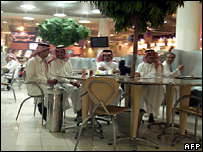
I lived in Saudi Arabia, and I remember the mutawaaeen were NOT police, but sometimes they took on the prerogatives of the police. So I have to wonder, like who made the arrest in the malls? Was it the police? Was it the mutawa hitting the boys with their little sticks? Did they call the boys parents? I have SO many questions!
Kuwaiti Women, Minors from Cradle to Grave
In an article in today’s Kuwait Times sure to raise discussions throughout Kuwait, staff writer Ahmad Al-Khaled brings up the laws requiring Kuwaiti women to have a husband /father/ guardian present to apply for a passport and other legal papers:
Published Date: January 15, 2008
By Ahmad Al-Khaled, Staff writer
KUWAIT: The issue of gender equality under the law has come under fire of late after an exasperated Kuwaiti woman wrote to a local Arabic newspaper telling the tale of her frustrated quest to renew her passport and was told the law required her to be accompanied by her male guardian. “It is frustrating that we are not considered equipped to act as our own guardians in 2008,” said a middle-aged Kuwaiti wife and mother of five, Um Talal, who read the woman’s letter describing how she was denied the right to renew her passport unless her husband accompanied her to the ministry.
While Kuwait is a Muslim nation, Kuwaiti law is not solely Sharia based, although it uses Sharia as a primary source of legislation according to the Constitution. Adult-aged Kuwaiti women are required under the law to be accompanied by their husband or father to renew their passports. If their father and husband are deceased or should they be divorced from their husband, they may be required to provide authorities with proof of their male guardian’s death or proof of their marital status.
“Why should we be required to offer such proof. It is insulting to be treated as if we Kuwaiti women are in need of guardianship. Shame on the government for continuing to allow such a law to remain in the books,” said a 30 something Fala Jassem. “It is not Islamic to treat women poorly, we are not children! Shame on anyone that calls this law Islamic,” said 65-year-old Bedour Bader.
While Kuwaiti women speaking to Kuwait Times were staunchly against the law, Kuwaiti men were divided with some going so far as to call the law a necessary requirement to keep their women protected. “It is a husband’s duty to act as a guardian for his wife. We must lead our families and this includes the wife,” said 53-year-old father of four Abdullah Nasser.
You can read the rest of the article HERE.
Favoring Co-ed Schools
Fascinating defense of integrated classrooms in today’s Arab Times, entitled Students Will Be Made More Comfortable under Co-ed written by Kuwait University student Dalal Nasser Al-Otaibi.
I learned how American Universities became co-ed, and why. (I had no idea; you grow up thinking these things are a given.) This article must have been used as a paper for a class, as it is well documented, cites sources, etc.
Inheritance of Loss

Most of the time, if I don’t like a book, I won’t even bother telling you about it. This book, The Inheritance of Loss, by Kiran Desai, is an exception for one reason – it IS worth reading.
Inheiritance of Loss showed up on the book club reading list for the year, and I ordered it. I read the cover when the book came, and it didn’t sound that good to me, so I read other books instead. The next time it came to mind was when a friend, reading the book, said she was having trouble with it, and asked me if I had started it. This friend is a READER, and a thinker. It caught my attention that she would have problems reading a book, so I decided to give it a try.
This is a very uncomfortable book. The characters live in the shadow of the Himalayan mountains. The most sympathetic character is a young orphaned girl, sent to live with her grandfather. With each chapter, we learn more about all the characters, how they came to be here, what they think, what their lives have looked like.
The author of this book has a very sour look on life. She has snotty things to say about every character. You can almost feel her peering around the corner, eyes slit with evil intent. She is that vicious neighbor who comes by and never says anything nice about anybody, and when you see her talking with your neighbor, you get the uneasy feeling she could be saying something mean about you, and she probably is.
The book covers a wide range of topics – Indian politics, Ghurka revolts, English colonization, Indian emigration to the US and UK, everyday vanities and pride in petty things, how people destroy their own lives, how people can be cruel to one another, oh it’s a great read (yes, that is sarcasm).
At the same time, this vicious unwelcome neighbor has a sharp eye for detail. You may not like what she is telling you, but you keep listening, because you can learn important tidbits of information from her. In my case, I learned a lot about how life is lived in a small mountain village in India, the struggles of illegals in America and how class lines are drawn, ever so finely, when people live together. I learned a lot about the legacy of colonialism, and the creep of globalization. This unwelcome neighbor has a sharp tongue, always complaining, and yet . . . some of her complaints have merit.
I don’t believe there was a single redeeming episode in the book. There was not a paragraph to feel good about. I am glad to be finished with the book – but, yes, I finished it, I didn’t just set it aside in disgust, or give it away without finishing.
Here is the reason I am telling you about this book – as uncomfortable as this book is to read, I have the feeling, upon finishing, that ideas and images from this book will stick with me for a long time. I have the feeling that it contributes to my greater understanding of how things work, how people think differently from other people, and on what levels we are very much the same.
Here is an excerpt from the book, at a time during which the Judge is a young Indian, studying in England:
The new boarding house boasted several rooms for rent, and here, among the other lodgers, he was to find his only friend in England: Bose.
They had similar inadequate clothes, similar forlornly empty rooms, similar poor native’s trunks. A look of recognition had passed between them at first sight, but also the assurance that they wouldn’t reveal one another’s secrets, not even to each other.
. . . Together they punted clumsily down the glaceed river to Grantchester and had tea among the jam sozzled wasps just as you were supposed to, enjoying themselves (but not really) as the heavy wasps fell from flight into their laps with a low battery buzz.
They had better luck in London, where they watched the changing of the guard at Buckingham Palace, avoided the other Indian students at Veeraswamy’s, ate shepherd’s pie instead, and agreed on the train home that Trafalgar Square was not quite up to British standards of hygiene – all those defecating pigeons, one of which had done a masala-colored doodle on Bose. It was Bose who showed Jemubhai what records to buy for his new gramophone: Caruso and Gigli. He also corrected his pronunciation: Jheelee, not Giggly. . . .
This it was that the judge eventually took revenge on his early confusions, his embarrassments gloved in something called “keeping up standards,” his accent behind a mask of a quiet. He found he began to be mistaken for something he wasn’t – a man of dignity. This accidental poise became more important than any other thing. He envied the English. He loathed Indians. He worked at being English with the passion of hatred and for what he would become, he would be despised by absolutely everyone, English and Indians both.
I consider this a review, and not particularly a recommendation. I read the book, I finished the book and I learned from the book. I didn’t like the book. I recommend it only as a challenge, for people who like to read and stretch their minds in new directions.
Recent Comments
Kitchen on Isiais: Winding Down intlxpatr on Shampoo Ginger tigerbutterya0c5ff1d… on Shampoo Ginger intlxpatr on British Soldier Kidnapped, Esc… John on British Soldier Kidnapped, Esc… Wikipedia Donate Button

Amazina


Early Voting in Florida


