Hotel at the Corner of Bitter and Sweet by Jamie Ford
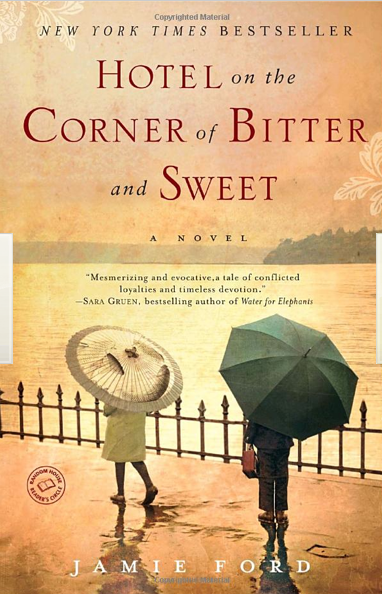
This book had everything going for it, and still I had a hard time getting into it. The book was given by Little Diamond to my Mom – Little Diamond often passes along the very best, thought-provoking books, and in our family we pass the best along, so I knew it would be good. I love the title. The book is set in a part of Seattle now called – euphemistically – The International District, but as I was growing up, and among older Seattle-ites, it is called Chinatown, even though that is not politically correct, or geographically correct. Chinatown was never Chinatown, it was a group of distinct populations – Chinese, Japanese, later Vietnamese, Korean, even later Ethiopian, Sudanese, Somali, Pakistan . . . you could call it immigrant-ville, I suppose, if you were really, really politically incorrect. My Chinese friends still call it Chinatown.
Last, but not least, Jamie Ford started this book as a short story at a camp run by Orson Scott Card, one of my favorite authors, especially to recommend to young people. Orson Scott Card knows how to capture the painful contradictions of being teens and young adults, the conflicts with parents, the loves, requited and un, and most of all, he understands how the young see things clearly as unfair; it’s only later when we start seeing shades of grey.
In spite of all those positives, I hated his voice. I hated the smug little Chinese boy he started as, a scholarship student, first generation born in the US, mocking his parents, fighting off bullies. . . Here is what I hated the most. He had a girlfriend, and he didn’t understand chivalry, like walking her home. He protected her, but he was a pretty self-absorbed little boy.
I kept reading because he had some interesting friends. I liked his friend the jazz player, and I liked the gruff lunchroom lady, and I liked his friend Keiko. I understood his parents pushing him to excel, and their not understanding the struggles this caused Henry; I liked his parents. Because the book jumps around in time, I also liked his wife, and felt annoyed that Henry was all caught up in this old romance when he had a perfectly good wife, but I kept reading.
I am so glad I did. About a third into the book, we begin to see Henry transform into the man he will become. He gets help, he gets mentoring from unexpected people, and he becomes more likable.
The book also deals with a terrible time in US history, a time when we turned on our own citizens and sent our citizens of Japanese descent to concentration camps right here in the USA. The Japanese were a class act; most of them were hurt and outraged, but compliant. Many men volunteered to fight in the war in spite of this slap in the face, this accusation of potential treason. It is a shameful time in our own history, and particularly so for Henry, who loves a Japanese girl, Keiko.
By the end, I loved this book. I hope you will, too.
Christmas Cookies – Check!
This is a time of the year when I count my blessings. And yes, yes, it isn’t the only time of the year, LOL, any opportunity will do, but of all the weeks in the year, the week before Christmas is my favorite.
You know me. I’m a front-loader; when there is something I need to have done, I do it right away so it doesn’t hang over me, growing daily because I am dreading doing it for having put it off. For me, just do it. Then it doesn’t have time to grow!
I will admit, I am still doing some small unavoidable wrapping, but the gifts are mostly bought and/or figured out.
Because I remember what it was to be a working wife and working mother, I volunteered to bake extra Christmas cookies, so my daughter-in law wouldn’t have to worry about it. When you don’t HAVE to do it, it’s fun!
Every year I learn something. This year – and trust me, there have been many many years of baking Christmas cookies – I (gasp) followed the instructions, and used a paintbrush to put the glaze on. Holy Smokes. HOLY Smokes. Had I known, had I trusted, my life would have been so much easier. Friends, if you are painting a glaze onto sugar cookies – use a paintbrush. It works like a charm.



Tiny Pecan Muffins:

I tried a new recipe for the Russian Teacakes; they taste delicious but I like them better when they are balls, not more like cookies:

These are new this year, and so easy I think I will do them every year. They are a sugar cookie, but you make them in rolls, chill them in the refrigerator, then slice and bake. Sooooo EASY! 🙂

These are the hardest, the Rosettes, which you make one by one, standing over hot oil with a metal rod and form, but they are everyone’s favorites, and they are a family tradition, so I do them every year:

For photos of the process, and for recipes for rosettes, you can click here.
What Women Did For Fun
Several weeks ago, AdventureMan presented me with two (large) piles of files, saying that they were mine and needed to be gone through. I spent the day today tossing out old term papers, old manuscripts, old resumes – lots and lots of things that were worth saving, and now, not so much.
One thing I came across was a file with copies of work my departed aunt Helen had done to gain entrance into the DAR, Daughters of the American Revolution (Revolutionary War for America’s Independence). It was like a game, only when she started playing, there was no e-mail, only snail mail. Long distance telephone calls were expensive, and she was a Navy wife, so it was all done by hand.
Genealogy work, too, was painstakingly done, and family histories, cemetery records, lists of people arriving and departing on ships and who married who – all lovingly compiled and typed on manual typewriters by people with a passion for making connections, solving the mysteries of who married whom and for how long:
(“no need to mention the divorce” one correspondent wrote, “it happened in my family, too, and it isn’t relevant so we just won’t mention it” she wrote about a marriage that ceased to exist over a hundred years before)
My aunt had a sure thing, and she had a unique entry, so she was tracking three entries at the same time, trying to prove a new connection, while knowing she had in her pocket an already proven entry.
I lost a couple hours of my life, reading through all the correspondence, trying to decipher her notes and the arcane charts of relationships stretching back to 1690, when one line of the family arrived on these shores. I grinned, thinking how we document our bloodlines, leaving out the pirates and the horse thieves, and (legend has it) the French aristocrat who left his first family in France and started our branch here, without having divorced his first family, LOL.
My aunt must have been a little younger than I am when she started on this search, and I know that she served proudly in the DAR for many years, along with several civic committees, library committees and planning commissions in Santa Barbara, California. I still miss her.
Only As Old as You Think You Are :-)
I found this great story in BBC Health News. The part that cracks me up is that they made these people carry their own bags, and they left all the uneven floors and throw carpets in place and forced them to pay attention to where they walked. . . and the result – they all did BETTER than they had been doing before!
Can You Trick Your Body into Feeling Younger?
Our volunteers were actors Liz Smith (88), Sylvia Syms (76) and Lionel Blair (78), cricket umpire Dickie Bird (77), newsreader Kenneth Kendall (86) and former Daily Mirror editor Derek Jameson (80).
They agreed to live in our time capsule house for a week, during which they dressed in 1970s clothes, slept in replicas of their very own 70s bedrooms, watched television from that era, and talked about 1975 in the present tense.
It proved to be a fascinating but draining experience – for both experimenters and experimentees.
From the beginning we made it clear to our volunteers that they would be expected to look after themselves. Research in nursing homes shows clearly that giving residents control over their own lives and their own choices has a hugely beneficial impact on health and happiness.
In one study, residents who were allowed to choose a plant to care for, and when and where to receive visitors, were found 18 months later to be significantly more cheerful, active and alert. They were also far more likely to be still alive.
Another thing about our 1970s house was that it was full of physical challenges. There were shag pile carpets to trip over, door ridges to step over and lots of slippery linoleum. Research on mice has shown that those who live in a challenging environment live nearly 30% longer than those who in a secure but boring environment.
In this spirit, on their arrival, our volunteers were asked to carry their bags up a flight of stairs to their bedrooms. It was the first time they’d been forced into such physical activity in many years, and they were not happy.
But they rose to the challenge. When they started at the bottom of the stairs, a couple were adamant it would be impossible to make it to the top. Watching from a laboratory close by, it was hard to resist going to their aid.
Slowly, step by step, they succeeded. We had made them question whether, perhaps, they were more physically capable than they had given themselves credit for.
It was a tough initiation, but a core element of Ellen’s original experiment was the idea that our prior beliefs play a huge part in how we perceive the world, and how we perceive ourselves. By immersing our volunteers in a 1970s world, we were hoping to make them think of themselves as younger, fitter and healthier.
For many of them, the 70s had been a golden decade, a highlight of their careers.
We took Dickie Bird back to Lords to relive the atmosphere. As he walked through the tunnel, onto the grounds, he blossomed before our eyes. Dickie had had a stroke, suffered 18 months of illness, lost confidence and come to think of himself as old. By the end of the week, his confidence was back and he showed remarkable improvement across a range of tests, including memory and stamina.
Over the week we gave all the celebrities tasks to do, but we also left them to fend for themselves. For up to 12 hours a day, we observed them through our surveillance cameras and, just as Ellen had discovered all those years before, we saw great changes.
Half way through the week, Liz Smith took 148 steps with the aid of just one stick. For someone who had not walked without both sticks since her stroke – and who often relied on a wheelchair – it was a real breakthrough. She was no longer willing to be limited by the physical constraints she had imposed on herself.
At the end of the week we put our guinea pigs through the same rigorous battery of physical and psychological tests we had at the beginning. Memory, mood, flexibility, stamina and even eye sight had improved in almost all of them.
The results were not uniform, but in some cases they shed up to 20 years in their apparent biological age.
It made a compelling case for Ellen Langer’s argument that opening our minds to what’s possible can lead to better health, whatever our age.
Just How Emirati Do You Have to Be? (Mixed Marriages)
Thank you, Little Diamond, for sending the article from The National. I totally love this article, and hats off to it’s author, Sultan Al Qassemi.
Mixed marriages bring strength upon strength to the UAE
Sultan Al Qassemi
Not too long ago, I boarded a plane in Dubai bound for the United States. There were a number of Emirati families on board, some of whom I recognised and greeted. After a 14-hour direct flight, we descended from the plane and made our way to passport control.
One Emirati family walked towards the line for US citizens and, in my naivety, I almost told them they were standing in the wrong queue. I hesitated, correctly it turned out. They were American citizens and obliged to stand in the US citizens section.
Many people who hear this story immediately assume that the mother was a foreigner. Not only is that incorrect – the mother is a true-blue Emirati – but she also works in the UAE government.
In the past week, I was reminded of this by an article in The National relating to mixed parentage. The Grand Mufti of Dubai, Dr Ahmed al Haddad, made controversial comments questioning whether there should be restrictions on Emiratis marrying outside their nationality.
In truth,a substantial number of talented Emiratis have been born to mixed marriages, a point that Dr al Haddad’s comments did not seem to take into consideration. According to one person who was present at the panel discussion, Emiratis from mixed marriages may have “mixed loyalties”. So are they Emirati enough?
Well, let us take a look at some of these Emiratis to find out. Ali Mostafa, the director behind City of Life, is the product of a mixed marriage. City of Life, which depicts contemporary life in Dubai in a powerful and realistic fashion, has become an international ambassador for the UAE after opening in Australia and Canada with a screening scheduled in Washington DC. Is its director Emirati enough?
Omar Saif Ghobash and Yousef al Otaiba, the UAE ambassadors to Russia and the United States respectively, both have foreign-born mothers and yet they serve the UAE with as much attention and dedication as any other Emirati ambassador. I have written before about how Mr al Otaiba has worked tirelessly on behalf of the country, in particular on the nuclear 123 agreement with the United States. Mr Ghobash speaks six languages and was heavily involved in bringing New York University to the UAE’s capital. Are they Emirati enough?
Razan al Mubarak is also a product of a mixed marriage. Her late father, like Ambassador Ghobash’s, gave his life for the country. Ms al Mubarak, in her roles as assistant secretary general of the Environment Agency – Abu Dhabi and managing director of the Emirates Wildlife Society, is busy protecting the country’s wildlife on both land and sea. Is she Emirati enough?
At Abu Dhabi’s strategic investment arm Mubadala, the chief operations officer, Waleed al Mokarrab al Muhairi, also happens to be chairman of Yahsat, Advance Technology Investment Company and Cleveland Clinic Abu Dhabi. But perhaps most importantly, he is credited with being “one of the principal architects behind the Abu Dhabi 2030 Economic vision”. And yes, Mr al Mokarrab comes from a mixed family.
Wael Al Sayegh is a writer, poet, translator and founder of the consultancy firm Al Ghaf, which delivers “inter-cultural induction programmes to multinational organisations serving the region”. Mr Al Sayegh has spoken to many multinational corporations about UAE culture and offered a Dubai perspective to foreign news outlets, including the BBC, during recent high-profile criminal cases. Is he Emirati enough?
Sarah Shaw, an Emirati whose biological father is English, currently works at the General Secretariat of the Abu Dhabi Executive Council and is a huge supporter of Emiratisation. Is she Emirati enough?
Other Emiratis from mixed families who have made substantial contributions include the director general of the Dubai World Trade Centre, Helal Saeed al Marri, the film director Nawaf Janahi and the columnist Mishaal al Gergawi, among many others.
There are examples in my immediate circle of Emirati friends who genuinely care about this country, not despite one of their parents being foreign born but perhaps because of it.
Should the UAE, and specifically Dubai, known for being hospitable and welcoming to people of all ethnicities, backgrounds and cultures, make our very own citizens feel unwelcome?
The truth is the UAE is a richer country because of these individuals of mixed backgrounds. What we should concentrate on is strengthening the ties that people have to this great nation. I have previously suggested military service for Emirati high school graduates, cultural immersion and social volunteering as ways to build civic participation.
Frankly, it would be insulting to question the loyalty of Emiratis who are born to a foreign parent. It is also unfair, un-Islamic and ultimately in this case un-Emirati to generalise about people of any background. The Emirates is a vibrant country of many colours – only seeing a single shade excludes too many of its strengths.
(The author, Sultan Sooud Al Qassemi is a non-resident fellow at the Dubai School of Government)
The Not-to-Do List
I love this meditation from Rick Warren, who sends these out daily from his Purpose Driven Life connection. I was at dinner last night with three well-connected (2 i-Phones, one something else) family members, and I remember thinking (with a grin) that we spent the entire dinner in conversation, and no one was occupied with their phone.
Choosing a simpler life
by Rick Warren
. . . a time to embrace and a time to refrain. Ecclesiastes 3:5 (NIV)
You’d think that living in Southern California means I’m surrounded by people who live a laid-back lifestyle. The truth is just the opposite: Most of the people I know are trying to cram more and more into each day.
For instance, a couple of years ago, I was with a group of friends driving down the interstate. At one point, I looked around and realized most of us were engaged in some activity other than talking to each other. Two people were on their cell phones; another was working on his BlackBerry; and a fourth was focused on his laptop computer.
As a joke, I declared I felt left out. I called the driver, who was sitting right next to me, and we chatted together on our cell phones for a few minutes! The point of our traveling together in the van was so we could grab time to talk face-to-face! Yet we felt pressed to get it all done.
That’s when I realized the truth – we couldn’t get it all done, and God never intended for us to make completing a to-do list the purpose of our lives.
The fact is, there are many things we think we must do that really are not worth doing. My point is this: You won’t simplify your life by getting an electronic organizer. You won’t even find it by convincing your neighbor, who makes Martha Stewart look like a sloth, to give you tips about coordinating your activities while still wearing a perfect dress and pearls like Beaver Cleaver’s mom.
Simplifying is really about choices – prioritizing what is important – and then sticking to those choices no matter how tempting it is to add more to your to-do list. In fact, take those tempting activities and put them on a list of things not to do.
You are the only one who can assume responsibility for your time and clarify what’s really important to you.
Now maybe you’re thinking, “But I have to take care of the kids,” or “I have to get this report done by Friday.” I’m not naïve about the pressures many people feel today, but it may be that those things – your children, your work – are the priorities you keep on your to-do list, and you move other things to the not-to-do list.
It’s Easy To Tell a Spy
This story interests me because I grew up in Cold War America, and when I was going to high school in Germany, we were surrounded by propaganda urging us always to be careful about anything we said, in public or even in private.
“It’s easy to tell a spy” the public service announcements would go, and show someone in a cafe, or in line waiting for a bus, or in the library giving out information on where her husband or father was deployed or when such and such a unit was going to the border, and a nefarious person writing it down to send back to their leaders, always the dreaded Russians.
They’re back. Did they ever go away?

NEW YORK -Nine people charged with operating as Russian spies entrenched in American suburbia were making long-shot bids to be released from jail pending trial Thursday, even as authorities scoured a Mediterranean island for an alleged co-conspirator who disappeared after he was granted bail.
Hearings were set for federal courts in Boston, New York and Alexandria, Va., for all but one of the 10 people arrested over the weekend by federal authorities in the United States.
Police searched airports, ports and yacht marinas Thursday to find an 11th person who was arrested in Cyprus but disappeared after a judge there freed him on $32,500 bail. The man, who had gone by the name Christopher Metsos, failed to show up Wednesday for a required meeting with police.
Authorities also examined surveillance video from crossing points on the war-divided island, fearing the suspect might have slipped into the breakaway north, a diplomatic no-man’s-land that’s recognized only by Turkey and has no extradition treaties.
In the U.S., Donald Heathfield and Tracey Foley, of Cambridge, Mass., were scheduled to appear Thursday at a federal court in Boston. Mikhail Semenko, Michael Zottoli and Patricia Mills, all of Arlington, Va., were set for a hearing before Magistrate Judge Theresa Buchanan in U.S. District Court in Alexandria. Defendants Richard Murphy, Cynthia Murphy, Juan Lazaro and Vicky Pelaez were to go before a judge in New York.
All have been charged with being foreign agents. Officials said the suspects will all eventually be transferred to New York, where the charges were filed.
Not due in court Thursday was Russian beauty Anna Chapman, the alleged spy whose heavy presence on the Internet and New York party scene has made her a tabloid sensation. She was previously ordered held without bail.
Eight of the suspects were accused by prosectuors of being foreign-born, husband-and-wife teams who were supposed to be Americanizing themselves and gradually developing ties to policymaking circles in the U.S.
Most were living under assumed identities, according to the FBI. Their true names and citizenship remain unknown, but several are suspected of being Russians by birth.
Heathfield claimed to be a Canadian but was using a birth certificate of a deceased Canadian boy, agents said in a court filing. His wife, Tracey Foley, purported to be from Canada, too, but investigators said they searched a family safe deposit box found photographs taken of her when she was in her 20s that had been developed by a Soviet film company.
Juan Lazaro had said he was born in Uraguay and was a citizen of Peru; he was secretly recorded by the FBI talking about a childhood in Siberia, according to court documents.
Two, Chapman and Mikhail Semenko, were Russians who didn’t attempt to hide their national origin, FBI agents said, but they had a similar mission: blend in, network and learn what they could.
Britain’s Foreign Secretary William Hague said the U.K. was investigating whether Foley might have used a forged British passport. The British spy agency MI5 is also investigating the extent to which Foley and Chapman had links to London, and will likely seek to find out whether either attempted to recruit British officials as informants.
There is evidence that at least some of the alleged agents had success cultivating contacts in the business, academic and political worlds.
The criminal complaint alleges that either Heathfield or Foley sent messages to Moscow talking about turnover at the CIA that was supposedly “received in private conversation” with a former congressional aide. Other messages described Heathfield establishing contact with a former high ranking U.S. national security official, and with a U.S. researcher who worked on bunker-busting nuclear warheads.
Moscow thanked Cynthia Murphy for having passed along “very useful” information about the global gold market and instructed her to strengthen ties with students and professors at Columbia University’s business school, where she was getting a degree, according to the FBI.
Among other things, the Russians wanted “detailed personal data and character traits w. preliminary conclusions about their potential to be recruited by Service,” according to one intercepted message.
Clare Lopez, senior fellow at the Center for Security Policy and a professor at the Centre for Counterintelligence and Security and a former operations officer for the CIA, said the alleged plotters might have someday been able to produce valuable information, if left in place long enough.
“Their value is not just in acquiring classified information,” she said. “There’s a lot that goes on that’s not simply stealing secrets and sending them back to Moscow.”
Metsos was charged with supplying funds to the other members of the ring.
Cypriot Justice Minister Loucas Louca on Thursday admitted that a judge’s decision to release him on bail “may have been mistaken” and said authorities were examining leads on his possible whereabouts.
“We have some information and we hope that we will arrest him soon,” Louca told reporters, without elaborating.
Cyprus has for decades been a hotbed of espionage intrigue as spies converge on the eastern Mediterranean island at the crossroads of Europe, Africa and Asia.
More recently, former CIA agent Harold Nicholson, in prison for espionage, recruited his 24-year-old son Nathaniel to meet with Russian agents in cities around the world from 2006 to 2008 to collect money owed by his former handlers. One of those cities was the Cypriot capital, Nicosia.
Sorting Through Our Lives
At lunch, on our anniversary, AdventureMan and I played a game, a game we call “the top three”. He started it. “What are your top three thrills in our life together?” he asked . . .
We came up with contenders, debated relative merits, but agreed on #1 – the birth of our son. Then there were the top three vacations, the top three surprises, etc. It’s always fun; and together remember things you wouldn’t remember on your own.
Every now and then you get a glimpse of what makes life worthwhile, and you are additionally blessed by knowing how happy you are at the time you are happy.
One of those days was today.
Yesterday, we went by to see our son and his wife and our little adorable grandson had a cough.
“Do you need for us to take care of him tomorrow?” we asked.
Oh! If we could take care of him in the morning, that would be wonderful! And so, promptly at 0730, we were at their doorstep, and our morning passed – oh, happily! – taking care of our adorable grandson. He has a bad cough, but he is on the mend, and we had some fun.
He loves his jumpy-thing, which we call a Johnny Jump-Up, but it isn’t, it’s like calling all tissues “Kleenex” or all copies a “Xerox”:

He has discovered his hands and feet; I love watching him, it’s pure motion, every leg and every arm going at once:

Well, he can’t talk yet, not clearly, so he blows bubbles to tell us how much he loves us:

“Oh!” exclaims AdventureMan, “You have to take a picture of him while he is sleeping, he is so beautiful.”

LOL! I had swaddled him, and he tried to tell me I had done it wrong, but I didn’t listen. When I went back 10 minutes later, he was still squalling AND he was no longer swaddled. I re-swaddled, this time, doing it right and tight, and before I even put him in his crib, he was sound asleep.
He did manage somehow to get one arm out:

On the way home, we picked up some roasting chickens for dinner, to roast with fresh rosemary and basil from our own garden. Yummm. AdventureMan will deliver one to our son and his wife around dinner time.
We are happy AND we know it. It’s a great day in Pensacola.
Kuwait Bans Blackberry?
I have always loved politics. I don’t love politick-ing, I love watching what politicians do. One of the first rules, in my book, is “Don’t pass laws you can’t enforce.”
It’s pretty basic. Have you ever watched parents who tell their children over and over “Don’t do (whatever)” but they are too lazy to get off their big bottoms to go over and distract the child or to enforce penalties for misbehavior? What happens? The child does – or continues to do – what he or she wants, while the parent either gives up or escalates to a punishment out of proportion to the infraction.
Governments are the same. Don’t make a big noise if you don’t intend – or can’t – follow through. Don’t create penalties you can’t or won’t enforce.
Trying to ban Blackberries in Kuwait – LLLLLOOOOOOLLLLLLLLL! Trying to ban message services? These tech-savvy young people can run circles around the politicians and bureaucrats who try. This is a total hoot.
BlackBerry Ban Eyed
KUWAIT CITY, May 23: The Ministry of Interior is planning to stop BlackBerry Messenger (BBM) service and a decision to this effect might be issued within the next few days, reports Al-Shahid daily. A security source said the service cannot be controlled by the Ministry of Communications or security authorities and hence, users of BlackBerry sets were taking advantage to spread rumors and call for strikes.
He added that the ministry came to the decision after conducting studies and holding several meetings in the last fortnight. The three telecommunication companies in Kuwait, however, said they had not received any official request from the Interior Ministry so far.
Arab Times Online
Tax Day Tea Party in Pensacola
We don’t really understand the Tea Party. It is clearly against Obama, but then again, it is clearly the party of “against” and it is hard to find anything it is for. This is a problem; it is easy to tear down, and it is a lot more difficult to create – to formulate solutions which will provide benefits for the majority of participants.
As we were approaching our hotel, we saw this huge crowd of ‘protesters’ who appeared to be partying. But every sign was different! As 15 April is Tax Day, the day our income taxes are due, maybe about 10% were carrying signs that had to do with taxes, preferably NO taxes. The rest of the signs protested other things – constitutional amendments (what – women voting? black people being counted as full people? the repeal of prohibition?), no abortion, putting God first – it was a total potluck of causes.
The weather was mild, the sun was shining, there was a breeze – great day for an incoherent protest, LOL. I took pictures from the safety of our car, although everyone seemed very friendly:






Here is what cracks us up. Pensacola is a highly military reliant community. There is a huge military presence here, from Eglin Air Force Base to the Pensacola Naval Air Station. Pensacola is glad to have the military business. So where do they think the money comes from that pays the military salaries, and thus, gets spent in their economy, at their businesses? Few Americans have saved enough to comfortably retire, who do they think is contributing to their Social Security support, and Medicare, and Medigap? Tax dollars! Who do they think supports public education, and guarantees law and order? Who do they think runs the justice system? Who do they think provides emergency fire and medical services? Tax dollars! Who builds and maintains the roads and bridges, insures safety in our food supplies, construction and medicines? Our government, supported by our tax dollars!
Do I like paying taxes? No! Not one bit! But in the interest of the greater good, we pay our taxes honestly, and thank God to live in a society with order, thanks to our tax dollars.
Recent Comments
Kitchen on Isiais: Winding Down intlxpatr on Shampoo Ginger tigerbutterya0c5ff1d… on Shampoo Ginger intlxpatr on British Soldier Kidnapped, Esc… John on British Soldier Kidnapped, Esc… Wikipedia Donate Button

Amazina


Early Voting in Florida


