Kuwait: Making a Difference
I want to share with you a comment on my environment day post from one of our local bloggers, NicoleB / Rainmountain. She is a professional photographer, and describes below her one-woman (successful!) effort to clean up, and keep clean, the Mangaf beach. Brava, Rainmountain! Because of her example, others are taking their own trash to the trash cans, rather than leaving it, the trash collectors are encouraged, and working harder, and the beach is visibly cleaner. Brava! Brava!
Here is her comment from my environmental blog day post:
I’ve started cleaning our small beach here in Mangaf and now, half a year later, it’s almost clean at any time.
The trash guys are doing more and some people seemed to have picked up and do some cleaning too.
Sad part is to come down there and see that someone had a party and left all their stuff there.
So, you just go and start all over again.
It makes me sometimes wonder if people a) have no common sense and b) no pride in their country.
I had various weird conversations about this topic.
Here’s a copy from my blog of one of them:
Man: Excuse me, do you speak English?
Me: Yes?!
Man: What are you doing there?
Me: Collecting trash….?!
Man: Why are you doing that? They (pointing at that poor guy still waiting) do THAT.
Me: And the beach is still dirty….
Man: But that is the way it is.
Me: No. It’s not.
Man: Since when are you here?
Me: Six weeks and since then the beach is much cleaner, don’t you think?
Man: How do you like it here?
Me: It’s beautiful, if everyone would pick up his trash.
End of conversation. It seems he didn’t know what to answer, or thought it would be useless, but maybe he got the idea
The Pier
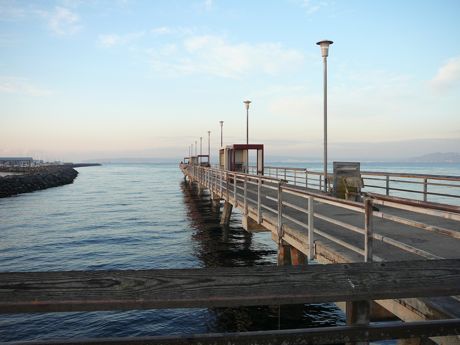
Walking out onto the great fishing pier, early in the morning, you see all kinds of things. It is brrrrrr, cold, and before we take another early morning walk, we will have to buy hats to cover our ears, and gloves, and maybe a scarf. The morning is brisk, there is only a light wind, but it is still cold, beyond refreshing, it is brrrr cold!
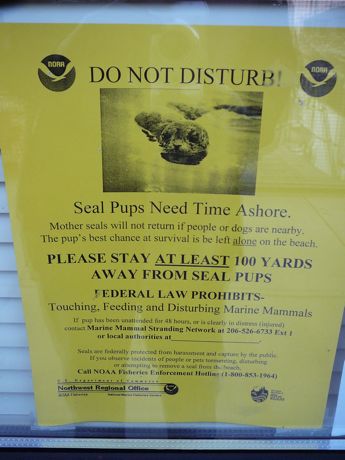
Seal pups are so vulnerable, and so cute, people have to be reminded to leave them alone:
This pier offers free fishing opportunities to hundreds of people – even on a chill morning, there are die-hard fishermen and women:
And as a courtesy, the city provides cleaning stations where your catch can be gutted and cleaned:

Jail Problems in Seattle
When I was blogging about the upsurge of antibiotic resistant infections springing up in more hospitals, our son sent an article about problems in the Pensacola Jails. Arriving in Seattle, the Seattle Times published a report of jail violations in this area, including rising rates of MRSA related infections.
The U.S. Department of Justice has issued a sweeping condemnation of the operation of the downtown King County Jail, saying inmates’ civil rights are being routinely violated through physical and sexual abuse by staff and inadequate medical care.
King County officials released a 27-page letter from the Department of Justice’s Civil rights Division which says that the department has notified county officials of “life-threatening deficiencies in medical care” for some inmates at the jail and alleges that inmates were routinely pepper-sprayed by staff and subjected to “degrading” physical abuse, including hair pulling to force inmates to comply with guards’ orders.
The DOJ says the county has failed to adequately train its staff and has inadequate policies and procedures in place to protect inmates.
The Department of Adult and Juvenile Corrections’ internal investigations unit is also inadequate and routinely fails to follow up on reports of inmates complaints, the DOJ alleges.
Jail Director Reed Holtgeerts said the jail is addressing many of the issues but that the county disagrees that inmates rights are being violated.
“We strive at all times to provide safe, secure and humane conditions for the over 50,000 inmates for whom we are responsible each year,” according to a written statement released today by the county. “We disagree that the constitutional rights are being violated, but we are in complete agreement with DOJ that there is room for improvement in the areas they evaluated.”
Holtgeerts said the county has and will cooperate completely with the DOJ.
The DOJ says a lawsuit could be filed if the county fails to address the issues.
The DOJ’s Office of Civil Rights opened an investigation into the King County Jail in November. Much of the investigation focused on jail health issues, including the spread of methicillin-resistant Staphylococcus aureus, or MRSA, a highly contagious bacteria that can lead to severe infections and even death. At least one jail inmate has died from a MRSA infection and hundreds of others are diagnosed every year.
Other issues the DOJ said it would look at included jail suicides and sexual abuse of inmates.
You can read the entire article HERE
Paying the Price
I had two wonderful days, Thursday and Friday, out and about all day in this wonderful Kuwait weather. Saturday was out again for a short time with Adventure Man and felt a tickle in my throat. No big deal, I figure it is just allergies, or the change in seasons; I drank some ginger tea and figured that would be the end of it.
Wrong!

Yesterday, it was hanging on, getting stronger. Here come the sneezes, the swollen sinuses, the watery bleary eyes, the sneezing and the coughing. Having a cold totally grosses me out. I’m not a person who gets dramatically and romantically ill, lying beautifully in bed while people bring me hot drinks and speak to me in soft voices. I look terrible! I want this cold gone now! I’ve upped the arsenel to Strepticils, Zinc tablets, Cranberry juice and antihistimines. It doesn’t matter; I am a wreck.
I’m better during the day, it’s night time that gets me – I wake up choking and coughing, my sinuses hurt, my nose is running. . . and I sleep fitfully, with weird dreams, so sometimes I can’t tell if I am dreaming or awake.
The Qatteri Cat faithfully follows me everywhere I go. I am sleeping in the guest bedroom so Adventure Man doesn’t have to suffer through this with me, but QC just makes comforting noises and snuggles up to me.
I have a lot to do this week. Please keep me in prayer for a speedy recovery!
Bedbug Renaissance Inn
We had just come back to Germany from our son’s graduation from law school, and woke up the next morning with welts – we didn’t know what they were. All we knew is suddenly, we had red itchy welts, and I was allergic to whatever they were.
We were lucky – we got in to see a doctor right away, and he told us what they were and what to do, and we did it and we never had another problem. He also told us that he was seeing this problem more and more – that many hotels have extra guests they never tell you about, even the very best hotels. (Our poor kitty – we had blamed her, we thought maybe she had brought in fleas, and it wasn’t her at all, it was hitch-hikers from Florida.)
What we learned from this truly awful experience is that bedbug infestations are happening everywhere. It’s something no one talks about out of shame, but with DDT off the market, and increasingly warm climates, they are on the increase.
To this day, I wash my sheets in hot hot water, and dry them on hot. And I think twice when I say to children, as is common in the USA “sleep tight, and don’t let the bed bugs bite!”
From AOL News:
(Nov. 7) – First come the bites, amazingly itchy, raised red welts that appear, literally, overnight. Then, you might notice scarlet spots on your sheets from smashed bugs or perhaps clusters of little black dots that you assume are dirt but are in fact constellations of fecal matter.
And one day, you might wake up in the wee hours of the morning, flip on the lights and find red bugs, slightly bigger than ticks, crawling on your sheets, pillows and legs.
Welcome to the most retro pest of the 21st century, the bedbug. The bugs, which were thought to be wiped out by powerful pesticides such as DDT 30 years ago, are back and infesting major urban areas, suburbia and the heartland.
You can read the entire horrifying story at AOL Health News.
USA Today’s List of How to Cope with a Bedbug Infestation:
Coping With Bedbugs: Advice From Experts
The best rule of thumb for dealing with bedbugs? Try not to get them in the first place.
Otherwise, read on:
Be careful where you put your suitcase when you travel. “These guys are fantastic hitchhikers,” says the University of Maryland’s Michael Raupp. “If you have a luggage rack with metal racks, put your suitcase on that.”
Check behind a hotel headboard. That’s one of their favorite spots, Raupp says. Pull back the comforter and sheets and look for the fecal stains on the mattress seams and ticking. Shine a penlight behind the headboard and look for dark fecal stains.
If you do wake up with red welts, assume the worst. “At that point, when you go home, all laundry goes into a trash bag outside, and then right into a washing machine on a hot cycle, and then a clothes dryer,” says the University of Kentucky’s Michael F. Potter. “As little as five or 10 minutes kills everything on high heat. Cold will not kill the eggs and not all the adults.”
Don’t pull mattresses and dressers off the street. Steer clear of yard sales or flea markets. And don’t ever buy used bedding.
If you do get them, don’t use a bomb or spray, which will only scatter them through your home. “Find a good pest-control company. This is not one where you buy bug spray and battle it yourself,” Potter says.
In many cases, pros suggest getting rid of your box spring and mattress, or if you can’t, using a bug-proof zippered mattress cover that traps the buggers inside for at least a year.
Source: USA Today
Cretan Olive Oil
This response is to a post I wrote October 25th on The Olive Oil scandal, that even when you buy a brand you have thought is reliable, you may not be getting what you paid for. For me, it was particularly horrifying to discover they were adulterating the olive oil with hazlenut oil – I don’t have a severe allergy to hazlenuts, but they make the insides of my ears itch. I avoid hazlenuts!
I keep getting such good responses to the post – and I have a partiality (disclaimer!) to small producers of anything, from olive oil to soap to pecans . . . I love buying from the entrepreneur.
Which is why I have taken this response from the comments page and made it an entry. Thank you, Mr. Sassone, for your thoughtful addition to this subject:
It is indeed a shame that the majority of the olive oil on the American and world market has been adulterated by unscrupulous sellers looking for enormous profits.
That is why I started growing olives on the island of Crete, making extra virgin olive oil-EVOO, and importing it to the US. I personally observe all steps in the process from the time the olive flowers bud on the tree until the EVOO goes in the can. I know it is the cleanest, freshest, highest quality, and most healthful EVOO you can buy at any price.
I also offer all customers copies of test reports from independent laboratories that show the exact quality. Acidity is 0.17%. Total polyphenols are 165ppm. Peroxide value is 6. Nothing can compare at any price.
When people buy EVOOs that are labeled as a mix of oil from several countries, they must take this into account: How clean was process to gather the olives? How clean was the factory that processed the oil? How clean were the trucks that transported the oil to the ship? How clean was the ship that transported the oil? You can see where this is going. At any one or more of dozens of steps in the process, contamination can occur. Some of the olive producing countries do not have food the safety standards like the European Union or US Food and Drug Administration.
My curiosity got the best of me. Recently, I sent samples of 13 EVOOs sold in the US for lab testing to find out just how good or bad they are. I dont have a web site just yet, but will publish the results as a comparison to my oil. So long as I keep complete control of the entire process, I can improve the quality of my oil each year.
My EVOO is now available in the US. It is the finest quality and most healthful EVOO you can buy at any price. Send me and email if interested. kretareserve@cox.net Thanks. Tony
Accident Aftermath
This time the crunch was different. This time, the initial BLAM crunch was followed by a heart-sickening series of crunches. I was on the phone dialing 777 even before I got to the window.
They have lovely women working for emergency services now, women who can stay calm and switch languages easily. Just hearing her voice calms me down as I report the accident, tell them to send an ambulance. The upside down car door is flipping open, and people are running to help the victim out. It’s a woman, and she is beautiful. She is also bleeding, and once they get her out, she is very still, too still.
The traffic police call me back and I tell them where the accident is, but thank God the woman is still on the phone and when he doesn’t understand, she fills in efficiently and accurately.
It takes them 21 minutes to arrive. The traffic police send one car, and on a busy street, they all gather around the woman and stare. The MOI also send a car. Not one of these police set up any kind of traffic control, cars on both sides of the road are stopping, people come running, just to look.
The ambulances take 22 minutes. When they leave, there are no sirens. I don’t think she survived. The medics appeared knowledgeable and efficient.
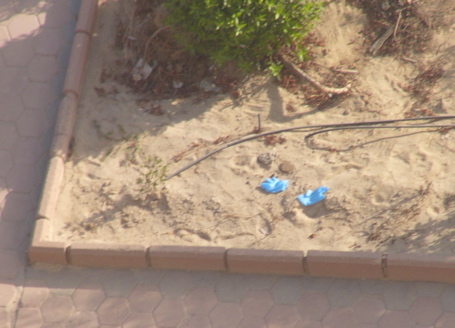
It’s the aftermath that bothers me now. On the ground, they left all the medical waste.

The last thing the medic did as he got into the ambulance was to throw his bloodied gloves on the ground:
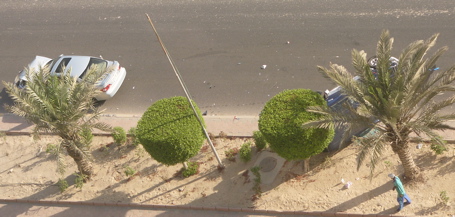
And then . . .the traffic cops left! There are two wrecks on one of the busiest thoroughfares in town, and no protection from the next speeding car! The wrecks are in the fast lane!
Don’t get me wrong. You know how I feel – police, ambulance medics, firemen – they are all heroes in my book. They risk their lives every day for the common good. The save lives, and they take pride in what they do.
They need a little training in accident management. When there is an accident, there needs to be a priority on getting there fast, and controlling the crowd, and routing traffic by efficiently. The medics need to pick up their waste.
There needs to be after-accident care, ensuring that someone stays until the wreckage is removed.
I had a house guest once who sat in my window and said “Oh my God. Oh my God! Oh! Oh! Oh!”
There are three separate u-turns we can see. Each one is another accident just waiting to happen. When the turn lanes back up, sometimes some people start honking, putting pressure on the lead person to make an unsafe turn. Please – resist the pressure. Take your time. Wait for a safe, truly safe interval.
Please, my friends, do one thing for me. Please, buckle your seat belts. And please, buckle up your children, put them in car-seats made to protect them, teach them from an early age to buckle-up, help it become so automatic they don’t even think about it.
Staph Fatalities Alarming
This is from AOL Health News but it is also featured on Good Morning America today. The government says there has been “an alarming increase” in staph infections, and the number of deaths due to these common infections could soon be overtake death from AIDs infection.
My own father spent a year dying, fighting of MRSA, which is common in many hospitals – even here in Kuwait. The old are particularly vulnerable, but so are all those with open wounds, recent hospitalizations, and compromised immune systems.
CHICAGO (Oct. 17) – More than 90,000 Americans get potentially deadly infections each year from a drug-resistant staph “superbug,” the government reported in its first overall estimate of invasive disease caused by the germ.
Deaths tied to these infections may exceed those caused by AIDS, said one public health expert commenting on the new study. Tuesdays report shows just how far one form of the staph germ has spread beyond its traditional hospital setting.
The overall incidence rate was about 32 invasive infections per 100,000 people. That’s an “astounding” figure, said an editorial in Wednesday’s Journal of the American Medical Association, which published the study.
Most drug-resistant staph cases are mild skin infections. But this study focused on invasive infections – those that enter the bloodstream or destroy flesh and can turn deadly.
Researchers found that only about one-quarter involved hospitalized patients. However, more than half were in the health care system – people who had recently had surgery or were on kidney dialysis, for example. Open wounds and exposure to medical equipment are major ways the bug spreads.
In recent years, the resistant germ has become more common in hospitals and it has been spreading through prisons, gyms and locker rooms, and in poor urban neighborhoods.
The new study offers the broadest look yet at the pervasiveness of the most severe infections caused by the bug, called methicillin-resistant Staphylococcus aureus, or MRSA. These bacteria can be carried by healthy people, living on their skin or in their noses.
Your best protection? Wash your hands frequently, and stay out of hospitals.
You can read the rest of the article HERE.
EnviroGirl on Tap Water
Welcome, EnviroGirl, our Guest Blogger on Blog Action Day, and thank you for being our Guest Blogger!
Thanks, Intlxpatr, for inviting me to be your guest blogger.
Intlxpatr knows that I am passionate about drinking tap water, as well as encouraging others to do the same. I’ve almost always chosen to drink tap water over bottled water, primarily because it’s cheaper that bottled water, and it’s readily available (just turn on the faucet!).
Over the last year I’ve learned that there are even more reasons to drink tap water (at least in the U.S.). So I’ll quickly share with you a few reasons why you should save your money and drink tap water. If you want to do more research on the topic, I’ve included a few links below.
Why you should choose tap water over bottled…
1) Tap water is tested stringently for chemical and microbiological contaminants. It is regulated by the Environmental Protection Agency (EPA) and must comply with the Safe Drinking Water Act. Bottled Water is often regulated by the Food and Drug Administration (FDA), and does not fall under the Safe Drinking Water Act. (All water in the U.S. falls under the Safe Drinking Water Act.) This means that it is not tested as rigorously as tap water. In addition, your community water provider is required to send you a Consumer Confidence Report (CCR) every year. The CCR should inform you of the quality of your tap water and if any contaminants have been detected. Try finding this information on the label of a bottle of water.
2) Bottled water is not only more expensive to purchase, the environment costs are greater too. Bottled water must be shipped to your location, which means more fossil-fuel emissions into the air. After the water is consumed, the plastic bottle must be disposed of. If the bottle is not recycled, it will be tossed in a landfill where it will take about 700 years (plastic bottle recycling facts) to decompose.
3) Clean drinking water is a valuable resource. Recently, droughts and pressures from population growth have created water shortages. In communities experiencing water shortages, bottling water has become a hot topic because it depletes local drinking water supplies. Water use restrictions may be imposed on the community, while the bottled water company is still packaging and selling the amount of water it was permitted to use (For example – http://www.orlandosentinel.com/orl-bottledwater1307oct13,0,6642058.story). This also leads into the importance of conserving drinking water resources and implementing creative strategies such as water reuse (Info on water reuse – http://www.epa.gov/region09/water/recycling/index.html ).
Again, the information above regarding water quality is for tap water in the U.S. In countries that do not have adequate sanitation it is not advisable to drink tap water. If you live outside of the U.S., the World Health Organization (WHO) and the European Commission are two organizations that have water quality standards that many countries choose to adopt. You can search online to determine if your country follows any of these standards and if your tap water is safe to drink.
Links:
U.S. Safe Drinking Water Act:
http://www.epa.gov/safewater/sdwa/basicinformation.html
U.S. Environmental Protection Agency – Drinking Water:
http://www.epa.gov/safewater/
World Health Organization – Drinking Water:
http://www.who.int/water_sanitation_health/dwq/en/
European Commission – Drinking Water:
http://ec.europa.eu/environment/water/water-drink/index_en.html
Website for Water in the Middle East:
http://www.al-bab.com/arab/env/water.htm
National Resource Defense Council – Bottled Water Q & A:
http://www.nrdc.org/water/drinking/qbw.asp
Plastic bottle recycling facts (U.S.):
http://earth911.org/recycling/plastic-bottle-recycling/plastic-bottle-recycling-facts/
Why The Appendix?
A few years ago, Adventure Man was getting all set to cross the Sahara with a camel caravan, until he read the disclaimers and warnings, including a small item that in one of the previous crossings, a traveller had a sudden bout of appendicitus and was left, alone in the desert, to die, because there was nothing else that could be done. He chose not to go!
CNN News has published an article on scientist’s discovering the use of the appendix:
WASHINGTON (AP) — Some scientists think they have figured out the real job of the troublesome and seemingly useless appendix: It produces and protects good germs for your gut.
That’s the theory from surgeons and immunologists at Duke University Medical School, published online in a scientific journal this week.
For generations the appendix has been dismissed as superfluous. Doctors figured it had no function. Surgeons removed them routinely. People live fine without them.
And when infected the appendix can turn deadly. It gets inflamed quickly and some people die if it isn’t removed in time. Two years ago, 321,000 Americans were hospitalized with appendicitis, according to the Centers for Disease Control and Prevention.
The function of the appendix seems related to the massive amount of bacteria populating the human digestive system, according to the study in the Journal of Theoretical Biology. There are more bacteria than human cells in the typical body. Most are good and help digest food.
But sometimes the flora of bacteria in the intestines die or are purged. Diseases such as cholera or amoebic dysentery would clear the gut of useful bacteria. The appendix’s job is to reboot the digestive system in that case.
You can read the rest of the article Here.
Recent Comments
ExpatAlien on What Country am I Living … intlxpatr on Yellowstone: Old Faithful to C… Michelle on Yellowstone: Old Faithful to C… Cathy on No Grown-Ups in Charge intlxpatr on Waiting for Snow Wikipedia Donate Button

Amazina


Early Voting in Florida


 Here There and Everywhere