One Thing I Really Like About Pensacola
As I was driving along an unfamiliar highway around 11 on a Friday night in Seattle, it occurred to me how tame the driving in Pensacola is. For some reason, the traffic lanes on the highway in Seattle are narrower than in other countries. You get used to it, but it’s like the whole personal space thing; when first invaded, the adrenalin starts rushing.
In Seattle, there are just too many cars for the roads to handle with grace. Same as Kuwait. When I first got to Qatar, the roads were adequate, but no longer.
Pesacola is sweet. You can get anywhere you need to be in under half an hour. From the airport to my house is like 8 minutes, max. My house to the shops, my house to the YMCA, my house to church – all about eight minutes. There are a lot of stop signs and a lot of stop lights, and I rarely see anyone run them. I never see traffic gridlock. There is one really dangerous intersection in town, and I rarely see a problem there.
It’s not that driving in Pensacola is so consciously mannerly, as in Seattle. It’s just more laid back. No one seems to be in that great a hurry to get anywhere. Every child is in a car seat. People are careful, even if they are driving while impaired.
You can get spoiled. When you get used to calm driving, then just about anywhere you go with real traffic seems chaotic. Once you have a large number of people on the road, you increase the chances of running into a cowboy (or cowgirl), or an inexperienced driver, or a half-blind older driver, etc.
Driving in Pensacola is just uneventful. 🙂
Kuwait 1990
Thank you, Little Diamond, for spreading the news. This should be an amazing program.
From the Al Jazeera site:
On August 2, 1990, the Iraqi army invaded the emirate of Kuwait, which Saddam Hussein, the then Iraqi president, had declared Iraq’s 19th province.
The occupation of Kuwait may have only lasted seven months, yet the memory of it remains strong, not least in the minds of the children of that conflict.
At the end of the school year of 1990, students in an international school in Kuwait said their final farewells as they headed off for the summer holidays. Many of them would never meet again.
Al Jazeera’s Nashwa Nasreldin was one of those whose family was forced to relocate following the invasion.
Twenty years on, she returns to Kuwait, the country of her birth, along with a group of her classmates as they organise a reunion to find out what happened to their friends – and their school – during the war that separated them.
Kuwait: The class of 1990 can be seen from Monday, August 2, 2010 at the following times GMT: Monday: 1900; Tuesday: 0600; Wednesday: 0300; Thursday: 1400; Friday: 0600; Saturday: 1900; Sunday: 0300.
Panhandle Politicians
One of the things I liked best about living in Kuwait was the lively press. When the press has freedom – and freedom is always relative – people have to be more careful about what they do. Here, on a daily basis, the Pensacola News Journal has a crime section where they run crime news AND they list the daily felony arrests – who, what and where. I love it that they name names.
When I opened the paper this week, I thought I was back in Kuwait. There is a race for an open seat in the House of Representatives, and one candidate has just been arrested for trafficking drugs. Another candidate and his wife were videotaped sneaking out and stealing their opponent’s campaign signs. LLLOOOLLL. This is hilarious:
People think there are such huge differences between our countries. . . and yet we breed the same politicians, the religious fundamentalists, the ‘get-rich-quicks-by-lining-my-pockets’ kind of guys, the developers . . . it’s almost as if when you run for office, there has to be something wrong with you. It’s a sad day for democracy when these are our candidates. What a difference technology is making – it can help keep us honest.
Good Enough
This is from Rick Warren’s Daily Hope send out for today, and for me, it really hits home. So many times I hesitate to step up to the plate, waiting until I am sure my skills are what is needed, when what is really needed is just for someone to have the courage to step up, to speak out.
The best ‘Christian’ person I know, who follows this Christian principle, was born Muslim. She is always the first to serve, and the last to take anything. She is the first to give and the first to start cleaning up after an event. She is never afraid to get her hands dirty, or to defend the dignity of ‘the least of these.’
Real servants do their best with what they have. Servants don’t make excuses, procrastinate, or wait for better circumstances. Servants never say, “One of these days” or “When the time is right.” They just do what needs to be done.
The Bible says, “If you wait for perfect conditions, you will never get anything done” (Ecclesiastes 11:4 NLT).
God expects you to do what you can, with what you have, wherever you are. Less-than-perfect service is always better than the best intention.
One reason many people never serve is that they fear they are not good enough to serve. They have believed the lie that serving God is only for superstars. Some churches have fostered this myth by making “excellence” an idol, which makes people of average talent hesitant to get involved.
You may have heard it said, “If it can’t be done with excellence, don’t do it.” Well, Jesus never said that! The truth is, almost everything we do is done poorly when we first start doing it — that’s how we learn.
At Saddleback Church, we practice the “good enough” principle: It doesn’t have to be perfect for God to use and bless it. We would rather involve thousands of regular folks in ministry than have a perfect church run by a few elites.
Before You Leave Doha – No Regrets
I was neither the first nor the last of my group to leave Doha. Well, yes, actually, I was the first, I left Doha for Kuwait, but it doesn’t count because I came back and then was no longer the first to leave. The next to leave are leaving soon, so I want to share something with you.
All my visitors from Kuwait bought these at the Museum of Islamic Art in Doha. I didn’t get it. It just doesn’t rain that much in Kuwait, but the umbrellas are only 100 QR, and that is a reasonable price for a big umbrella, well made.
My last visit to the Museum of Islamic Art, just before leaving, I broke down and bought one, too, and packed it immediately for moving to Pensacola. I was with a good friend, she bought one too. I kind of wondered if I would ever use it.

We are getting some serious rain in Pensacola, related to Hurricane Alex. Do you have any idea how BIG hurricanes are, even smaller ones? They whoosh around in a huge counter-clockwise circle, and if you look at a satellite photo, you will see that the circular whoosh can cover hundreds of miles – thus, pouring rain in Pensacola.
I had put my umbrella in the car, as a just in case. Yesterday, I had an opportunity to unfurl it for the first time.
It is gorgeous.
Some things don’t translate well. Some things you buy, you look at and wonder ‘Why did I buy this?” It looks so good in Doha, but you get it back to the USA and . . . sometimes, it doesn’t look so good.
This umbrella looks GREAT. It is so classic, in the ivory, and I love the silver and gold pattern; it is subtle and beautiful. It really covers well, too, and keeps the rain off you and one other. 🙂 This is a very good buy!
Sun in Ultra High Definition
You would never know my Kuwaiti friend is such a nerd. She is beautiful, she is gracious, and she is a lot of fun. She also sends me some of the most wonderful e-mail forwards, great stuff, stuff you can think about and go WOW. She knows I am a nerd, and she loves me anyway. 🙂
Today she sent me a link to Fox News where there is an article with new, ultra high definition series of sun shots – they are purely glorious:

At a second link, you can click on play and listen to the transliterated ‘sound of the sun.’ Give it a try. It is awesome.
Checking Out Pensacola Beach
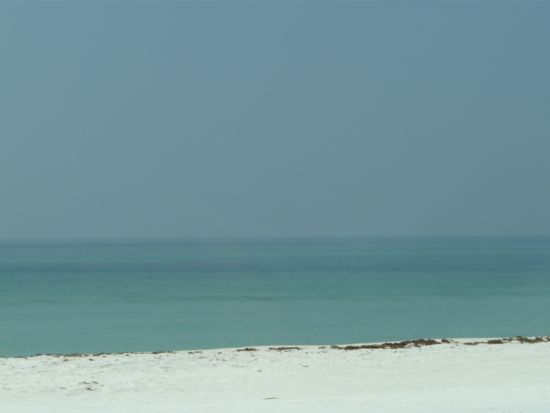
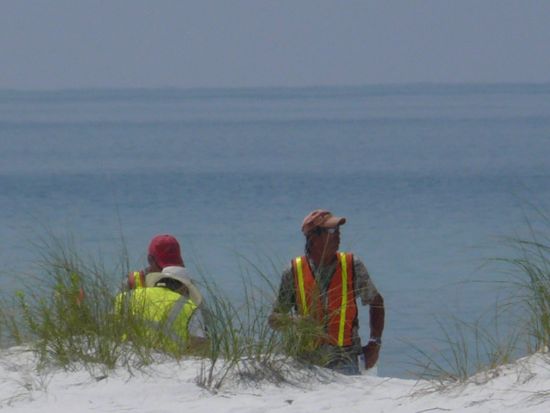
After our water aerobics class this morning, AdventureMan and I drove out to the beautiful sugar-white sandy beaches of Pensacola to check the damage. The clean up crews have been busy, and the beaches look gorgeous. People are sunning, swimming, and sharing the beaches with the clean up crews.
A big huge electronic sign announces that the road to the beach will be closed all day tomorrow. How can you close a major road? Is this Kuwait, or Qatar, where the will of the Amir says “Make it so!” and it is so? Oh. Wait. President Obama is coming, so the road will be his and his alone to go out to the beaches and see what we saw today.
The huge, gigantic glob of oil has only sent tendrils, so far, to the pristine white beaches, but doom impends as storms and winds blow the thick oily sludge toward the shores. God willing, President Obama will find a way to encourage British Petroleum to work with a little more conviction and energy to find a long term solution to this unthinkable TWO MONTHS and hundreds of thousands of gallons spewing into the Gulf.


Kuwait or Qatar or Pensacola?
Showering after my water-aerobics class, I could hear voices discussing a local political-social situation. A benefits agency has groups of families working in it, and they know all the tricks. They know how to insure more of their own family members hired, and they know how to help all their family members (and friends) take advantage of all the entitlements.
Expats abroad call it nepotism, and scorn it as a third-world corruption. In truth, it happens everywhere.
There is an ongoing schism taking place in Qatar and Kuwait, countries that have been gracious and welcoming to me. The nationals of Kuwait and Qatar control citizenship carefully. The citizen base is about 20% of the population, on a good day. The rest of the population are people who are in Kuwait and Qatar to work. Most there to work can never hope for citizenship. For many, the poverty in their home country is so brutal that no matter how hard the working conditions, at least it is a salary, and they can send something home so that, literally, their families can eat. They dream – like we do – of educating their children so that they will have a better, more secure life.
Here is the problem. When 80% of the population is NON-Kuwaiti, or NON-Qatari, your country starts to change. One way in which things have changes is that in a very short time, the highways have gone from very quiet to gridlock, due to a dramatic increase in drivers and cars. In Qatar, the situation is made worse by nationalization of the taxi service, resulting in so few taxis that hotels now use private limo services, because finding a taxi at peak times is near to impossible.
That’s one issue. The second issue is language. Imagine your elderly parents going into shops to buy something – in their own country – and the clerks don’t speak their language. As they are stumbling and bewildered, some noisy “workers” walk in, state their needs, are understood, conduct their business and exit before you even get served. This is happening in Kuwait and in Qatar; everyone is speaking English. In a country where the workers are Indian, Nepalese, Philipino, Saudi, Yemani, Omani, Lebanese, Syrian, French, Dutch, English, Australian, South African, American (and about thirty or forty others) the common language has evolved to be English, not Arabic.
How do you think you would feel if it were happening here? If the great majority of cars on the road were not “us” but “guests” in our country? If the clerks in stores couldn’t understand what you want, because although they are in your country, they don’t speak your language?
Another problem is what to do with the huge, disproportionate number of geographically single males brought in to work as builders, cleaners, heavy equipment operators, dishwashers, drivers, security guards and other fairly low-paid positions? In Kuwait and in Qatar, non-married sex is strictly forbidden, even holding hands in public is considered an affront to morality. These men are banned from malls where families might gather, and from other public places. Their existence is grim, and they often find themselves unpaid, or paid far less than they were promised for their labor.
Last, but not least, this very modest Gulf culture has people – foreign guest workers – parading themselves on their streets in various states of undress. Think about it – that’s how we look to them. We have no shame. We bare our faces. We flaunt the glory of our uncovered hair. Sometimes a shawl might drop and a glimpse of bare arm or even a hint of cleavage might shock the modest eyes of a believer.
In Pensacola, there are also fundamentalists who wear long skirts, long sleeves, and determinedly modest clothing. I wonder what these believers think about the skimpy clothing on the beaches, or in the malls?
Coming home has been a real eye opener. It was easy for me to be critical of things I saw in Qatar and in Kuwait. Coming home, we joke all the time about “Kuwaiti drivers” here in the US, but the real joke is – they sure look a lot like us.
Last week, we saw a man here make a U-turn right in the middle of the road, and rock as he tried to regain control of his truck, and almost blast right through a red light he didn’t see. The back of his truck was down, and items loose in the truck bed were heading toward the highway – fortunately he figured that out, and last we saw, he had stopped to fix his rear door. Maybe he wasn’t sober. Maybe he had had an argument with his wife or boss or someone and was not paying close attention to his driving. All I know is that we have seen a goodly number of inattentive drivers here, too.
When a bureaucracy gets corrupted, when the rules are not applied equally to all, when select groups get favored treatment – here in Pensacola, at the immigration department in Kuwait or in the traffic department in Qatar – everyone suffers. It’s a political problem, a social problem, and a systemic problem. God willing, if we are truly evolving as a species, we will find a way to create truly fair and transparent systems which will work as they are ideally intended to work.
It’s on us. We have to make it happen. We have to want it badly enough to make it happen, even making sacrifices for the greater good.
I don’t have any answers. I don’t know how to make us better people that we are, how to make ourselves make the right choices. I do know this – whether it is a tiny village in Germany, or an eagle’s aerie in Kuwait, or the lush life of Doha – we are all more alike, and share more similarities and problems, than we are different. If we could only learn to see through one another’s eyes, maybe we could find ways to resolve our differences and learn to cooperate.
Kuwait Bans Blackberry?
I have always loved politics. I don’t love politick-ing, I love watching what politicians do. One of the first rules, in my book, is “Don’t pass laws you can’t enforce.”
It’s pretty basic. Have you ever watched parents who tell their children over and over “Don’t do (whatever)” but they are too lazy to get off their big bottoms to go over and distract the child or to enforce penalties for misbehavior? What happens? The child does – or continues to do – what he or she wants, while the parent either gives up or escalates to a punishment out of proportion to the infraction.
Governments are the same. Don’t make a big noise if you don’t intend – or can’t – follow through. Don’t create penalties you can’t or won’t enforce.
Trying to ban Blackberries in Kuwait – LLLLLOOOOOOLLLLLLLLL! Trying to ban message services? These tech-savvy young people can run circles around the politicians and bureaucrats who try. This is a total hoot.
BlackBerry Ban Eyed
KUWAIT CITY, May 23: The Ministry of Interior is planning to stop BlackBerry Messenger (BBM) service and a decision to this effect might be issued within the next few days, reports Al-Shahid daily. A security source said the service cannot be controlled by the Ministry of Communications or security authorities and hence, users of BlackBerry sets were taking advantage to spread rumors and call for strikes.
He added that the ministry came to the decision after conducting studies and holding several meetings in the last fortnight. The three telecommunication companies in Kuwait, however, said they had not received any official request from the Interior Ministry so far.
Arab Times Online
Recent Comments
intlxpatr on Shampoo Ginger tigerbutterya0c5ff1d… on Shampoo Ginger intlxpatr on British Soldier Kidnapped, Esc… John on British Soldier Kidnapped, Esc… intlxpatr on British Soldier Kidnapped, Esc… Wikipedia Donate Button

Amazina


Early Voting in Florida


