Sharing Your Faith in Qatar Gets Leader Deported
I heard a very strange tale and while there is nothing in the paper about it, I wonder where the truth lies. This week, the leader of the local Phillipine evangelical church (I don’t know the exact name) and his wife and three daughters and grandson were visited by the CID one morning and told that they had to be out of the country by night, that they needed to go back to the Phillipines. The person who told me could not imagine what might have caused this.
These are good people, she told me, and we are just about to do a performance about Joseph and his dreams, and his wife was making the costumes.
I thought about it, and said that well, it is an evangelical church, meaning you seek actively to bring souls to Jesus, and it is forbidden by law, in Qatar, to share our faith with Moslems. Is there any chance he was trying to convert Moslems?
She told me that people attending the church were expected to bring visitors, and that when visitors came, they were welcomed to the front of the church, where they were baptized.
I was horrorified. “Do they have any understanding of what is happening?” I asked her, and she replied no, and that most of the baptized visitors never come back. But, she added, the director still gets credit for all those baptisms, and his statistics look pretty good when he reports back to the church in the Phillipines.
In addition to her tithe (Christians are supposed to give 10% of their income to the church and charities) she said members of the congretation were tasked extra monies to pay the rent on the villa, to pay for food and travel of visitors who stayed there, etc, and she said it put a great burden on those who didn’t have sufficient income to contribute the extra. She said it wasn’t a voluntary contribution; if you didn’t contribute the extra, it was like you weren’t really a part of the church.
Last weekend, among those baptized, was a new Nigerian Moslem family who had been invited to visit. I can only imagine how I would feel, visiting a church, invited to the front to be welcomed, and then receiving a baptism I neither asked for nor wanted. I would never come back, but if I were Moslem, I might be horrified enough – and angry enough – to report it to the authorities. To me, at the very least, it is disrespectful.
There may be more to this story than the few details I was given. I expect the entire story is fascinating.
Thai Airport Shoplifting Scam
Imagine – you’re heading home from a wonderful vacation, and out of the blue, you are arrested, accused of shoplifting, and threatened with jail until you cough up several thousand dollars. And it is happening repeatedly!
By Jonathan Head
BBC News, Bangkok
Bangkok’s showcase new international airport is no stranger to controversy.
Built between 2002 and 2006, under the governments of then-Prime Minister Thaksin Shinawatra, the opening date was repeatedly delayed.
It has been dogged by allegations of corruption, as well as criticism of the design and poor quality of construction.
Then, at the end of last year, the airport was shut down for a week after being occupied by anti-government protesters.
Now new allegations have been made that a number of passengers are being detained every month in the duty free area on suspicion of shoplifting, and then held by the police until they pay large sums of money to buy their freedom.
That is what happened to Stephen Ingram and Xi Lin, two IT experts from Cambridge, as they were about to board their flight to London on the night of 25 April this year.
They had been browsing in the duty free shop at the airport, and were later approached by security guards, who twice asked to search their bags.
Mr Ingram and Ms Xi were told they had to pay £8,000
They were told a wallet had gone missing, and that Ms Lin had been seen on a security camera taking it out of the shop.
The company that owns the duty free shop, King Power, has since put the CCTV video on its website, which does appear to show her putting something in her bag. However the security guards found no wallet on either of them.
Despite that, they were both taken from the departure gate, back through immigration, and held in an airport police office. That is when their ordeal started to become frightening.
Interpreter
“We were questioned in separate rooms,” Mr Ingram said. “We felt really intimidated. They went through our bags and demanded that we tell them where the wallet was.”
The two were then put in what Mr Ingram describes as a “hot, humid, smelly cell with graffiti and blood on the walls”.
Mr Ingram managed to phone a Foreign Office helpline he found in a travel guide, and was told someone in the Bangkok embassy would try to help them.
The next morning the two were given an interpreter, a Sri Lankan national called Tony, who works part-time for the police.
They were taken by Tony to meet the local police commander – but, says Mr Ingram, for three hours all they discussed was how much money they would have to pay to get out.
Mr Ingram and Ms Xi were taken to meet the local police commander
They were told the charge was very serious. If they did not pay, they would be transferred to the infamous Bangkok Hilton prison, and would have to wait two months for their case to be processed.
Mr Ingram says they wanted £8,000 ( about $13,000) – for that the police would try to get him back to the UK in time for his mother’s funeral on 28 April.
But he could not arrange to get that much money transferred in time.
‘Zig-zag’ scheme
Tony then took Ms Lin to an ATM machine and told her to withdraw as much as she could from her own account – £600. He then withdrew the equivalent of £3,400 from his own account.
According to Mr Ingram this was then handed over to the police, and they were both forced to sign a number of papers.
Later they were allowed to move to a squalid hotel within the airport perimeter, but their passports were held and they were warned not to leave or try to contact a lawyer or their embassy.
“I will be watching you,” Tony told them, adding that they would have to stay there until the £8,000 was transferred into Tony’s account.
On the Monday they managed to sneak out and get a taxi to Bangkok, and met an official at the British Embassy.
She gave the name of a Thai lawyer, and, says Mr Ingram, told them they were being subjected to a classic Thai scam called the “zig-zag”.
Their lawyer urged them to expose Tony – but also warned them that if they fought the case it could take months, and they risked a long prison sentence.
After five days the money was transferred to Tony’s account, and they were allowed to leave.
Mr Ingram had missed his mother’s funeral, but at least they were given a court document stating that there was insufficient evidence against them, and no charge.
“It was a harrowing, stressful experience,” he said.
The couple say they now want to take legal action to recover their money.
‘Typical’ scam
The BBC has spoken to Tony and the regional police commander, Colonel Teeradej Phanuphan.
They both say Tony was merely helping the couple with translation, and raising bail to keep them out of prison.
Tony says about half the £8,000 was for bail, while the rest were “fees” for the bail, for his work, and for a lawyer he says he consulted on their behalf.
In theory, he says, they could try to get the bail portion refunded.
Colonel Teeradej says he will investigate any possible irregularities in their treatment. But he said any arrangement between the couple and Tony was a private affair, which did not involve the police.
Letters of complaint to the papers here in Thailand make it clear that passengers are regularly detained at the airport for alleged shoplifting, and then made to pay middlemen to win their freedom.
The Danish Embassy says one of its nationals was recently subjected to a very similar scam, and earlier this month an Irish scientist managed to flee Thailand with her husband and one year-old son after being arrested at the airport and accused of stealing an eyeliner worth around £17.
Tony told the BBC that so far this year he has “helped” about 150 foreigners in trouble with the police. He says sometimes he does it for no charge.
The British Embassy has also warned passengers at Bangkok Airport to take care not to move items around in the duty free shopping area before paying for them, as this could result in arrest and imprisonment.
Kuwait – American Woman Abducted and Raped
I received this notification this morning from the American Women’s League of Kuwait, guidance from the US Embassy:
We received a report that the spouse of an American citizen was kidnapped and sexually assaulted by three men in Mahboula. The victim was forced in a vehicle, taken to a secluded location, sexually assaulted, and left in the desert. The authorities are working to solve this heinous crime.
As a reminder to all, it is very important to keep an eye on who may be observing your activities while in Kuwait. Surveillance is not something that is just done by terrorists – almost every criminal who commits a crime conducts some sort of surveillance on their target either seconds, minutes, or hours before trying to commit a crime or assault a person.
Keep the following in mind:
Surveillance – think about who may be watching you. If it feels wrong, it probably is. Alert the local security personnel or store management of anything you feel is suspicious – DO NOT KEEP THIS INFORMATION TO YOURSELF AND TRUST YOUR INSTINCTS.
If you think you are being followed, make every effort to stay in a very public place until you can either make contact with the local security personnel or have some sort of an escort. Do not proceed to your vehicle or restroom, thus giving the person following you an opportunity to get you alone so they can rob or assault you.
Exiting/returning to your vehicle – this is the time when all people are vulnerable because your mind is focused on getting out of the car, watching traffic, trying to control children, or placing packages in/out of the car. Especially when returning to your vehicle, a good practice is to look around the exterior of your vehicle for people or suspicious items. Once in the vehicle, lock your doors and make sure your windows are up at all times.
Travel in groups whenever possible. Tell others where/when you are going and when you plan to return.
If being picked up wait inside a public place as opposed to alone and outside.
Carry a cell phone with pre-programmed emergency numbers, Post One, Police, Home, etc.
Last, think about fighting your attacker, especially if the attacker wants to take you to another location. Do not let that happen and draw attention to yourself and situation.
James Lee Burke and Swan Peak
When I read the description of this book on Amazon.com, I thought “haven’t I read this before? Dave Robicheaux and his buddy Clete go to Montana for a vacation?” but the description sounded like it was probably a new book and the copyright date was recent. I’ve been burned before – especially with Donna Leon books, where I order a book and discover I have already read it – it was published in England under one title and then – years later – in America, under a different title. That is so frustrating!
It arrived just as all the household goods arrived, so I had something to look forward to reading after the long, grueling days of toting and unwrapping, and putting away.
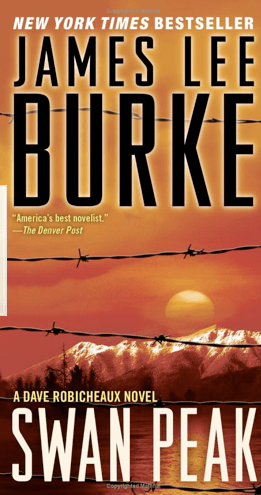
Some of the reviewers say it’s just another James Lee Burke, same story, different setting, and, to some extent, they are correct. I would counter with my opinion that no matter which James Lee Burke story you are reading, there are moments of pure poetry, and moments of keenly cynical insights that lift any book he writes out of the ordinary and puts it in the can’t-live-my-life-without-reading-this-book catagory.
Dave and Clete are vacationing in Montana (Dave’s wife is there, too, but barely appears in this book). As usual, they find themselves peripherally involved with a couple killings, and are interviewing a witness, Jamie Sue Wellstone, wife of a transplanted-from-Texas oil tycoon.
The garden was dissected by gravel pathways and surrounded by a gray stone will that was stippled with lichen in the shade. The flower beds were planted with pansies, English roses that were as big as grapefruit, forget-me-nots, violets, clematis vine and bottlebrush trees. I wondered if the eclectic nature of the ornamentals in the garden said something about the undefined and perhaps deceptive nature of the Wellstones and their ability to acquire an entire culture as easily as writing a check.
In the following section, he writes about the drifters, the people who end up in places like Montana, Alaska – wherever there is still a laxity in formal structures:
The waddies and drifters who worked for him were the kind of men who were out of sync with both history and themselves, pushed further and further by technology and convention into remote corners where the nineteenth century was still visible in the glimmer of the high-ceilinged saloon or an elevated sidewalk that had tethering rings inset in the concrete or an all-night cafe that served steaks and spuds to railroad workers in the lee of a mountain bigger than the sky.
Most of them were honest men. When they got into trouble, it was usually minor and alcohol or women or both. They didn’t file tax returns or waste money on dentists. Many of them didn’t have last names, or at least last names they always spelled the same way. Some had only initials, and even friends who had known them on the drift for years never knew what the initials stood for. If they weren’t paid to be wranglers and ranch workers, most of them would do the work for free. If the couldn’t do it for free, most of them would pay to do it. When one of them called himself a rodeo bum, he wasn’t being humble.
Their enemies were predictability, politic, geographical permanence, formal religion, and any conversation at all about the harmful effects of vice on one’s health. The average waddie woke in the morning with a cigarette cough from hell and considered the Big C an occupational hazard, on the same level as clap and cirrhosis and getting bull hooked or stirrup-drug or flung like a rag doll into the boards. It was just a part of the ride. Anybody who could stay on a sunfishing bolt of lightning eight seconds to the buzzer had already dispensed with questions about mortality.
There are many who object to the violence and brutality in every James Lee Burke novel. The problem is, he is writing about people who have to deal with violence and brutality and a way of life most of us never see. Burke writes about cops, about gangsters and organized crime, and about prisoners and prison life. It isn’t pretty. His main characters in this book, Dave and Clete, have seen too much. They are cynical as only deep-dyed idealists can be cynical. They are the guardians of our society; the enforcers of the codes. Without the police, and those who fight with them against crime, it is the rule of the jungle, where might makes right. The bullies rule, and as we have seen through history, unlimited power invites abuse.
What all predators hated most was to be made accountable. It wasn’t death that they feared. Death was what they sought, onstage, with the attention of the world focused upon them. But when you took away their weapons and their instruments of bondage and torture, when you pulled the gloves off their hands and the mask off their face, every one of them was a pathetic child. They were terrified of their mother and became sycophantic around uniformed men. The fact they were reviled by other felons and that cops would not touch them without wearing polyethylene gloves was not lost on them.
But how do you get your hands on a guy who has probably been killing people for years, in several states, leaving no viable clues, threading his way in and out of normal society? How do you find a sadist who probably looks and acts just like your next-door neighbor?
Much later in the book, he describes the kind of hero that crops up in each book the same way:
But if there is a greater lesson in what occurred inside that clearing, it’s probably the simple fact that the real gladiators of the world are so humble in their origins and unremarkable in appearance that when we stand next to them in a grocery-store line, we never guess how brightly their souls can burn in the dark.
There is only one Dave Robicheaux book I have kept – A Morning for Flamingos, the first one I ever read. I’m pretty sure it was in the late 1980’s, and I have been a James Lee Burke addict ever since. James Lee Burke hates organized crime, and he hates most of all those criminals who make themselves wealthy by bribery and corruption, who attend the society balls and events, whose photos appear in the paper looking like you and me – like respectable folk. People who get photographed making a donation to charity with wealth stolen from the common purse. His heros – and heroines – are modern day gladiators, they are the bureaucrat who refuses to hide the illegal wiretaps, the plodding cops and FBI officers who track down the slightest clue to bring down the Madhoff and the white-collar robbers, the prosecutors who risk their lives to put the bad guys away.
I guess for me, reading James Lee Burke is like reading a fairy-tale (If you have ever read the original fairy-tales, you will know what true gruesome violence and brutality is all about!) where those who flout the law, those who oppress the poor, those who use their ill-gotten wealth to isolate themselves high above the common man – get their justice. They think they are above the law. They are wrong.
Signs of the Times in Doha, Qatar
There are a whole series of these signs, carefully placed at eye-level at most stoplights. Here are two; it takes me a while to get in the right position at the right time and to have my camera ready, but I am learning to always have my camera ready:
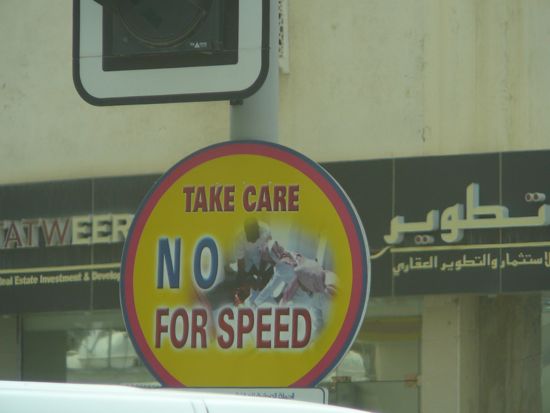

May God richly bless my husband for his patience; I am always calling out “Can you pull over so I can get a picture of that sign?” In Arabic, this one says “Bunshury al Rodoa”

I speak some Arabic, not a lot, like I can’t discuss politics with you, or anything complex, but I know shapes and colors and directions, and it all comes in handy. I took this sign because my favorite color is purple, and it is a very hard name to remember, when you are looking for something specific that is purple. 🙂

And see if you can guess why this is my very favorite photo of all 😉

The Appeal by John Grisham
One of the things I like about John Grisham is that he really likes the underdog. In his books, the person often the least likely to prevail does so, usually because he has a smart attorney, one who is paying attention and taking good care of the client. Warning – this book review contains a spoiler, so don’t go any further if you don’t want to know too much about the plot and resolution.
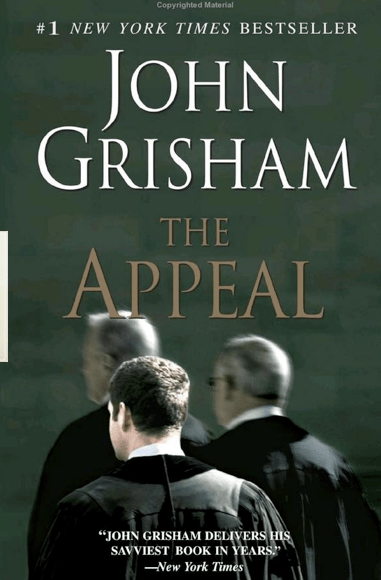
The Appeal is the exception. No one wins, not even the apparent winner, who sails off in the end with his empty, unsatisfying life. He schemes, he exploits, he lies, he buys elections, and he makes a fortune – and he isn’t satisfied. He is married to a woman who sounds more like a greyhound, all skin and bones and self-absorption.
The subject matter is a case where a chemical company has dumped toxic wastes into the ground in Mississippi, it has penetrated into the groundwater, and polluted the entire water system of a small fictional town. Two lawyers, married to one another, sacrifice everything and face bankruptcy to win a case for their client who has lost both husband and son to cancer caused by the toxic chemicals dumped. They win.
There is an appeal.
What this book is about isn’t just about groundwater contamination, or even about buying elections in Mississippi – it is an indictment of every state that elects judges. The core of the novel is about how big money, big corporations, pick candidates and fund them, legally and illegally, and insure that they win. They pack the courts with judges who are opposed to large settlements.
God bless John Grisham. With all his great legal thrillers, he has made a bundle and can take risks like writing a book like The Appeal, which should be an eye opener, and should be read by every caring citizen.
Judges should not be elected. When the judiciary are elected, they have to think about their next election, with every legal decision. It taints objectivity. It corrupts objectivity. It eliminates objectivity. Without an objective judiciary – why bother? They will always rule on the side whose interests are the most powerful and profitable.
Here are a couple quotes that tell you where the novel is going. My Kuwaiti friends are going to love this – I have taken so many shots at Kuwait corruption – so here it is, my friends, exposure of the institutionalized corruption in my country:
Barry laughed and crossed his legs. “We do campaigns. Have a look.” He picked up a remote and pushed the button, and a large white screen dropped from the ceiling and covered most of the wall, then the entire nation appeared. Most of the states were in green, the rest were in a soft yellow. “Thirty-one states are in the green. The yellow ones have the good sense to appoint their courts. We make our living in the green ones.”
“Judicial elections.”
“Yes. That’s all we do, and we do it very quietly. When our clients need help, we target a supreme court justice who is not particularly friendly, and we take him, or her, out of the picture.”
“Just like that.”
“Just like that.”
“Who are your clients?”
“I can’t give you the names, but they’re all on your side of the street. Big companies in energy, insurance, pharmaceuticals, chemicals, timber, all types of manufacturers, plus doctors, hospitals, nursing homes, banks. We raise tons of money and hire the people on the ground to run aggressive campaigns.”
* * * * * * * *
The Senator did not know who owned the jet, not had he ever met Mr. Trudeau, which in most cultures would seem odd since Rudd had taken so much money from the man. But in Washington, money arrives through a myriad of strange and nebulous conduits. Often those taking it have only a vague idea of where it’s coming from; often they have no clue. In most democracies, the transference of so much cash would be considered outright corruption, but in Washington the corruption has been legalized. Senator Rudd didn’t know and didn’t care that he was owned by other people. He had over $11 million in the bank, money he could eventually keep if not forced to waste it on some frivolous campaign. In return for such an investment, Rudd had a perfect voting record on all matters dealing with pharmaceuticals, chemicals, oil, energy, insurance, banks and on and on.
I like almost every book I read by John Grisham. He is a man with a conscience, and he is trying to raise our awareness of corruptive factors before our system goes entirely under. I couldn’t put this book down, and I can hardly wait to read the next one.
Serious About Traffic Regulation in Doha, Qatar
We were all at dinner, having a wonderful time when the traffic issue came up.
“There’s so much traffic now!” they were all saying.
To me, traffic in Doha is pretty tame. It’s been six years since we were here for the first time, and Doha was still “sleepy little Doha.” We took photos of the changing skyline almost monthly from the spit where the Bandar restaurants used to be (one day they just disappeared!) and gasped at how fast Doha was changing.
There are a lot of changes. Traffic on the ring roads has been greatly streamlined, although it seems they continue to engineer D ring, over and over again. I just hope one day they will get it right and it will be open, all the way from the road to the north to the airport.
There are traffic lights at the roundabouts, and the traffic flows so smoothly I am astounded. There is still a lot of traffic around the seven to nine at night shopping/dining/visiting time, but the traffic lights have regulated the formerly death-defying roundabouts.
“Go! Go!” I told AdventureMan as the light started flashing green, and he just looked at me as if I had grown a second head.
“Flashing green means STOP!” he informed me.
“Flashing YELLOW means stop,” I informed him right back.
“Not in Qatar,” he said with the tone of voice that says ‘don’t argue this point with me.’
At dinner I learned he was absolutely right. If you enter a traffic circle on a flashing green and the light changes, the cameras – they are everywhere – will take your photo. They will take your photo and you will have a fine, a whopper of a fine, QR6,0000. That translates to around $1,700 in US Dollars. Gasp. And – here’s the cruncher – it is ENFORCED.
There was a time when I lived in Qatar before when the huge SUV behind me pushed me into the roundabout when I wasn’t moving fast enough for him. You still see the cowboys drive up on the sidewalks to cut across an empty field, but there are fewer and fewer of those empty fields left in Qatar. There is none of the speeding and weaving along the ring roads we used to see – there are cameras EVERYWHERE. People get fines for waiting at the airport doors, instead of parking. People get significant fines for going even 10 km over the speed limit. Points are assessed for moving violations, and they add up fast.
I’m going to have to improve my driving skills. I developed some aggressive habits, driving in Kuwait, and I am going to have to tone it down to survive the cameras in Qatar.
I am very interested to see how rapidly behavior can change when penalties are enforced. I am truly (and happily) shocked an how effective it can be. I await with great interest the year-end statistics, to see how the accident rate has been brought down – I bet we all get a very good surprise.
Selling My Car
I have a darling little car, I bought it in Doha six years ago. Aye, there’s the rub. While the company agreed to ship the car for us, Qatar won’t accept a car older than 5 years old. My sweet car has less than 40K km on it, has been lovingly maintained, and I totally love it – I was outraged at Qatar. But being outraged at a bureaucracy is a loser’s game, it isn’t going to change, the rules aren’t going to be excepted for me. So I had to sell the car.
I looked up the blue book price, and I knew my car was better than that, but these are hard times for selling a used car. I just put it out word-of-mouth, and within a week, I had my buyer.
She came. She sat in the car. She said “I will take it.”
I said “but you haven’t even driven it!”
She said “I can look at you, and look at this car, and I know it is a good car.”
We talked about a price. We agreed to a price a little higher than the blue book price, a little lower than I wanted. We were both happy.
She paid me in cash.
When we went to transfer title – this is Kuwait – the administrative section was closed! It wasn’t supposed to be closed! The area was full of Kuwaitis, Jordanians, people like us, wanting to transfer title. Fortunately, the woman knew another administration place nearby, so we went there, and after the normal finagling, the title transferred and all was completed.
We really wanted this woman to have the car. It has so many good years left on it, and this is a good woman.
AdventureMan laughs at how quietly all the decisions were made, all the negotiations done. The day after we sold the car, we got an SMS from the buyer saying how happy she was, and asking God to bless us richly. We feel already blessed, having sold the car to a fine woman.
Investment in Africa
This was in the morning’s e-mail. Unlike the e-mails I post inviting me to get lots and lots of free money, this one seems to have some interesting information. Here is one excerpt from their opening page, The Conversation Behind Closed Doors:
To make itself more attractive for US investment, Africa should:
Invest in education , health and infrastructure
Ensure the rule of law and a business-friendly climate for all investing companies
Show it is serious about attracting foreign investment
Market itself as aggressively as other regions of the world
Demonstrate opportunity cost of not investing
I would have to say there is nothing I disagree with there. I have not explored the whole site, but it looks legitimate, and interesting, if you, like me, are interested in Africa, and future solutions.
Hi
I’m reaching out to you because I thought you and the readers of here there and Everywhere would be fascinated by what my firm has recently uncovered about the attitudes toward corporate investment in Africa among leading U.S. corporations — according to senior officers of 30 American Fortune 100 corporations we interviewed. Why has Africa not attracted more interest from the U.S. business community? We have collected all of the answers and case studies into a news release introducing a study that launched yesterday commissioned by the US Chamber of Commerce:
http://www.usafricainvestment.com
We’re very excited about the revelations in this paper and would love it if you could let your readers know about what we’ve uncovered through a post or a tweet. If you are able to post please let me know so that I can share it with the team. If you have any questions or would like to speak to the partners who wrote this paper, let me know and I will set it up.
Thank you so much,
Fabiane
—
Fabiane Dal-Ri
fabiane@usafricainvestment.com
Eliot Pattison: Prayer of the Dragon
As you can see, I am into some serious reading. Not heavy reading, but books like carrots – I am the donkey, plodding way, packing my boxes, sorting, weeding, throwing out – it is time consuming, and it is pitiless work. I need the promise of a great excape at the end of my day to keep me going.
Prayer of the Dragon was a GREAT carrot. I like all of Eliot Pattison’s Inspector Shan Tao Yun series, set in Tibet. In his very first book, we meet Shan as he is still in the Tibetan prison camp, imprisoned for exposing corrupt officials in China. He learns a huge appreciation, in prison, for a different way of thinking, and his treasured companions become the Bhuddist monks with whom he is imprisoned. If you want to read this series, you can read any book as a stand-alone, but it helps to read them in order, starting with The Skull Mantra. The Chinese eventually free Shan; they find him useful – as long as he is not exposing corruption in the Chinese bureaucracy. He is free on parole; he lives with the sword over his head. At any time, if he crosses an important person, he can be sent back to the merciless gulag.

In The Prayer of the Dragon Inspector Shan finds himself involved in a series of murders on the mountainside, in a small mining village. The village headman has a great scam going, skimming the miners take, charging passage on the mountain trails, and keeping his village hidden from the Chinese bureaucracy.
Here is what I learned that surprised me. There appears to be a connection between the American Navaho nation and the native Tibetans. They share some body-prototype similarities, and they share many symbols and earliest legends. An first-nation Navaho and his niece are exploring similarities, and commonalities, when two members of their party are murdered while sleeping. The Navaho is charged, by the headman, with the death, because he survived although he is covered in blood. It doesn’t make sense, but it doesn’t have to. The headman needs a scapegoat, and he chooses the Navaho.
It is a fascinating read. Here is an excerpt from a conversation Inspector Shan has with the local director of Public Security:
“I know your type so well, Shan, ” Bing said. “God, how well I know you. I was responsible for ten barracks of prisoners, like you – pathetic, morose creatures with no vision, only bitterness about the past. They would sit in reeducation classes and copy out slogans from the little red books like robots, praising the Chairman, reading aloud apologies printed in other books, using someone else’s words. Never a one among them with the balls to stand up and say Fuck the Chairman, screw the Party secretaries, and screw the limo drivers who brought them to town.”
“I tried at first,” Shan replied in a weary voice. “They sent me to a special hospital for the criminally insane.”
“Unfortunately,” Bing said soberly, “you are the sanest person I have ever met.”
AdventureMan knows I love these books. “Do you want to go to Tibet?” he asks me, and I say “No, if I went I would want to hang around with Inspector Shan and his gang of monks, not do tourist things allowed by the Chinese.” These are great reads, Pattison is doing a great job of bringing the plight of the Tibetans to the conscience of his readers, depicting, in graphic, horrorific detail how the Chinese are systematically crushing and obliterating every shred of Tibetan culture, while claiming they are not. I think one of the very worst things they have done is taking over the Tibetan monastery system and corrupting it into something it was never meant to be, a cruel, ugly deformity.
I can hardly wait for the next book to come out. I am on the waiting list for The Lord of Death, yet another book about Chinese bureaucratic corruption and the adventures Inspector Shan has in Tibet confronting and evading all its manifestations.
Recent Comments
ExpatAlien on What Country am I Living … intlxpatr on Yellowstone: Old Faithful to C… Michelle on Yellowstone: Old Faithful to C… Cathy on No Grown-Ups in Charge intlxpatr on Waiting for Snow Wikipedia Donate Button

Amazina


Early Voting in Florida


 Here There and Everywhere