Record Traffic Violations Recorded
Cameras capture record traffic violations
Staff Writer – From today’s Al Watan
Wooo HOOOO! Cameras are impartial; they catch the violators, no matter who. I love it.
KUWAIT: The relocation of radar cameras on major roads has led to a sharp increase in the number of violations registered during an entire month. According to security sources; they reported that around 2,000 cars have been photographed by the relocated cameras during last January as compared to 900 cars prior to the relocation.
Earlier on, the Assistant Undersecretary for Traffic Affairs Major General Mahmoud AlـDousari had recommended the relocation of the radar cameras, particularly since motorists had become too familiar with the previous locations. Drivers who have been involved in violations have been contacted through official channels to either pay their fines or get referred to the concerned authorities. It has been gathered that fines have been already collected from 400 errant motorists.
Last updated on Friday 27/3/2009
Here is an extra one for you, General Al-Dousari, one of those special kind of people who travel in the emergency lane while the rest of us obey the rules and crawl along the freeway. I could not resist this particular photo – with the sign right there.

PS – We were not moving. I wasn’t driving when I took the photo. 🙂
First Kuwaiti Policewomen Graduate
Wooo HOOO on you, Kuwaiti policewomen! It is always hard to be in the vanguard, you take the criticisms, you take the disbelieving stares, and you handle questions, even from your own families. It’s always tough to be out front – to be a leader.
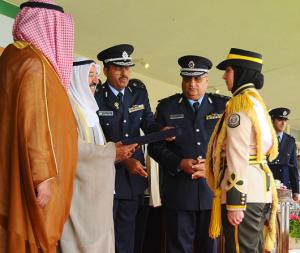
First group of policewomen graduate
From today’s Al Watan
KUWAIT: His Highness the Amir and Supreme Commander of the Armed Forces Sheikh Sabah AlـAhmad AlـSabah has attended on Wednesday the graduation ceremony of the 35th batch of military cadets, the 20th batch of specialized officers and the first batch of female cadets at the Support Authority Institute of the Saad AlـAbdullah Academy for Security Sciences.
The ceremony witnessed the graduation of the first batch of policewomen in the country. His Highness the Amir who arrived at the academy at 10:30 a.m. was warmly received by the Minister of Interior Lieutenant General Sheikh Jaber AlـKhalid AlـSabah, as well as other senior police officers.
The ceremony was also attended by His Highness the Crown Prince Sheikh Nawaf AlـAhmad AlـSabah, Vice President of the National Guards Corps Sheikh Mishaal
AlـAhmad AlـSabah, His Highness the Prime Minister Sheikh Nasser AlـMohammed AlـSabah, First Deputy Prime Minister and Minister of State for Defense Sheikh Jaber AlـMubarak AlـSabah, as well as other members of the ruling family, senior statesmen and members of the families of the graduating cadets.
Representatives of the 35th batch of military cadets then handed over the national flag to the representatives of the 36th batch. The Assistant Director General of the Academy for Education and Training Affairs Brigadier Dr. Waleed Khalaf BinـSalama read the ministerial decrees before inducting the new male and female police officers into the police force.
His Highness the Amir handed the graduates awards and certificates in appreciation for their efforts and then received the shield of the academy, that is dedicated to him, from Major General Yousef Mubarak AlـMedhahka. ـKUNA
Last updated on Thursday 26/3/2009
Another Martyr For Olde Ireland
Thanks be to God, the brutal, ceaseless battles in Ireland have ended and peace prevails. So many innocent were lost – and for what? The recent bombing is thought to be a hiccup left over from those desperate, sad days. We can only hope that is true, and that peace can also break out in places like Gaza, like Dharfur, where entire peoples are oppressed and dealt with brutally by those in power.
For blogger Mathai; one of the songs the Irish sing in the pubs on St. Patrick’s day – and others. Whenever the beer is flowing, you’ll hear Kevin Barry. They know all the words.
This is the version I used to hear; the one above has slightly different words.
In Mountjoy jail one Monday morning
High upon the gallows tree,
Kevin Barry gave his young life
For the cause of liberty.
But a lad of eighteen summers,
Still there’s no one can deny,
As he walked to death that morning,
He proudly held his head on high.
2. Just before he faced the hangman,
In his dreary prison cell,
The Black and Tans tortured Barry,
Just because he wouldn’t tell.
The names of his brave comrades,
And other things they wished to know.
“Turn informer and we’ll free you”
Kevin Barry answered, “no”.
3. “Shoot me like a soldier.
Do not hang me like a dog,
For I fought to free old Ireland
On that still September morn.
“All around the little bakery
Where we fought them hand to hand,
Shoot me like a brave soldier,
For I fought for Ireland.”
4. “Kevin Barry, do not leave us,
On the scaffold you must die!”
Cried his broken-hearted mother
As she bade her son good-bye.
Kevin turned to her in silence
Saying, “Mother, do not weep,
For it’s all for dear old Ireland
And it’s all for freedom’s sake.”
5. Calmly standing to attention
While he bade his last farewell
To his broken hearted mother
Whose grief no one can tell.
For the cause he proudly cherished
This sad parting had to be
Then to death walked softly smiling
That old Ireland might be free.
6. Another martyr for old Ireland;
Another murder for the crown,
Whose brutal laws to crush the Irish,
Could not keep their spirit down.
Lads like Barry are no cowards.
From the foe they will not fly.
Lads like Barry will free Ireland,
For her sake they’ll live and die.
Don’t Call, Text, or Sign on to Internet . . .
until you arrive”

From today’s Kuwait Times
‘Avoid cell talk, SMS, life you save maybe your own’
KUWAIT, March 15, (KUNA): Ninety percent of road accidents are coupled with lack of attention while driving, Assistant Undersecretary for Traffic Affairs at the Ministry of Interior Major General Mahmoud Al-Dousari said Sunday.
His remarks came on the occasion of hoisting flags of Gulf Cooperation Council (GCC) countries, announcing the commencement of the unified GCC traffic week; themed “Don’t Call Until You Arrive”. The ceremony was attended by traffic directors and their deputies of all six governorates, as well as a host of senior officials in Kuwait and the Gulf. This year’s theme aim at conveying an awareness message, cautioning from the use of mobile phones while driving, and depending on other means such as hands’ free and Bluetooth in order to stay focused on road and steer clear of accidents, Al-Dousari noted, pointing out that more studies had proven the theory suggesting the association of lack of attention with using mobile phones while driving.
The issue was not limited to speaking on phone, it went beyond that to include text messaging, or even logging on to the Internet while driving; which would turn them into major distracters, Al-Dousari said, adding that consequences of such behavior would eventually lead to tragic endings.
Al-Dousari advised that the best way to remain focused on road was to divert all incoming calls to voice mail, as well as receiving and sending SMS messages after pulling off the road. Some 18,773 violations were registered since the law that prohibited the use of mobile phones while driving was implemented last year, he noted.
“The Traffic Week aims to raise awareness, as it includes a host of various educational programs. It is not a week of firmness, stake out and issuing tickets like some might think,” Al-Dousari said, pointing out that injuries resulting from accidents had significantly decreased in the past two years. There are strict orders to deport any expatriate who commits serious traffic violations such as reckless driving, driving on the wrong side of the road, speeding, violating the red signal and assaulting security men, Al-Dousari concluded.

General al-Dousari, how many expatriates have you exported for serious traffic violations?
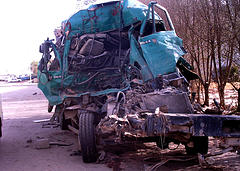
If you want to see fewer people on mobile phones, texting, signing on the the internet, running red lights, weaving while overspeeding, and assaulting security men, enforce your laws, enforce them all the time, and enforce them equally against every offender. If you enforce your laws, equally, against all offenders, traffic violations will decrease, traffic deaths will decrease, and all our lives, and those of our children, will be much safer.
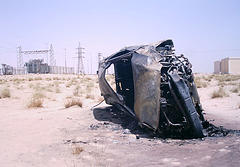
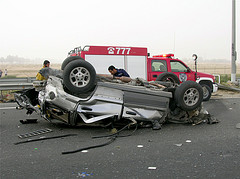
These photos are from a Flikr search for car wreck/Kuwait and, unfortunately, it is just a random selection among many. many. many.
Citizens?
Here is what I don’t understand. Sometimes, it is very clear who did what to whom, and sometimes it is not. In the first paragraph, they talk about a serious car accident with six injured citizens, two Sudanese parents and their son and an Iranian female. OK, that’s four people. Who are the other two citizens? A citizen lost control? Which citizen?
I thought a citizen was one who had citizenship, and all the rest of us are Sudanese, Iranian, British, Irish, American, etc. etc. etc. These accident and crime reports are ambiguous, at best. Why so oblique?
From today’s Al Watan:
KUWAIT: Due to a serious car accident which occurred on the Fifth Ring Road heading to Jahra near the Surra area, six citizens, two Sudanese parents and their son, as well as an Iranian female, sustained serious injuries. It was reported that a citizen lost control of his speeding car and hit another other car which overturned. The injured were rushed to Mubarak Hospital by ambulance to seek medical assistance.
Meanwhile, in a separate incident, a citizen suffered serious injuries after his car overturned near a roundabout located in the Abdullah AlـMubarak area. After the operation room received a phone call informing them that a citizen had a car accident and was trapped within his vehicle, police officers and fire brigades rushed to the scene. Firefighters from the Jleeb AlـShuyoukh Fire Station, lead by First Lieutenants Mishari AlـTourah and Bader AlـKandari, managed to rescue the man from the wreckage. The man was taken to Farwaniya Hospital by paramedics to seek medical assistance.
General Traffic Department: Don’t Call Till You Reach Your Destination
God Bless ’em. GCC Traffic week will start on March 14 and they have chosen for their theme: Don’t Call Until You Reach Your Destination.
From today’s Arab Times:
GTD completes all preparations for GCC Traffic Week
KUWAIT CITY, March 6: The General Traffic Department (GTD) has completed all the necessary preparations for the GCC Traffic Week, which will be hosted by Kuwait on March 14 under the slogan “Don’t call until you reach your destination”, GTD General Manager General Mohmoud Al-Dousari said in a press release recently. Al-Dousari pointed out “mobile phones are vital communications gadgets, considering the additional services such as the Internet and camera, but there are also disadvantages.”
He said using the mobile phone by hand while driving is one of the major causes of road accidents in the country. Drivers might get distracted while talking over the phone, endangering not only their lives but also that of other road users, he added.
Minister of Interior Sheikh Jaber Al-Khalid Al-Sabah had earlier issued a decision banning the use of mobile phone by hand while driving to protect the lives of motorists, which was implemented since last year, said Al-Dousari. The GCC Traffic Week is aimed at conveying a clear message to the public on the dangers of using mobile phones by hand while driving, as well as encourage the use of other technologies like earphones and Bluetooth.
Al-Dousari revealed the department issued 18,773 citations for using mobile phone while driving. He added Kuwait is one of the most developed countries in the world in terms of traffic regulations, but some drivers are disregarding these rules. Al-Dousari warned the GTD will not tolerate those violating the traffic regulations and advised the public to drive safely and strictly comply with the traffic laws.
I admire General Al-Dousari. God bless him; he gallantly fights a battle for traffic safety in Kuwait. No kidding some drivers are disregarding these rules. Some policemen are disregarding these rules. Some policemen aren’t enforcing these rules. I wonder when the majority of those citations were issued? My bet would be that around 18,000 were issued more than six months ago. Until there is enforcement, this is a losing battle.
Eliot Pattison: Beautiful Ghosts
It almost always takes me a little while to get into Eliot Pattison’s books, and I can figure out why. He sets you down right in the middle of something going on, so you start off a little confused. You can read each of his Inspector Shan Tao Yun books as a stand-alone, but it helps to have read them in order – as I have.

Even though I have read them in order, I still find myself disoriented each time I start a new book. New names, a new situation, and it takes a few pages to get back in the rhythm of thinking about things in a new way. Within thirty pages, I am in a new world, and I am totally addicted. When I am reading one of the Inspector Shan Tao Yun books, I can hardly wait to get back to the book. My household chores suffer, my projects suffer – even AdventureMan suffers, as I seek to return to Tibet, the Tibetan Monks and the world of Chinese bureaucracy.
One of the things I love in this book – we saw a hint of it in the last book I reviewed, Bone Mountain – is that the worst of the bad characters can have a hint of humanity, and develop a full-blown redemption, as we are watching happen with the prison warden, Captain Tan. The process continues in Beautiful Ghosts. In this book, Pattison strikes several additional chords – he combines a good mystery with art, art thefts, public art and a little bit of history, a family reunion, father-son problems, and a lot of action. I’m a happy reader.
In Beautiful Ghosts, a murder happens, but it is hard to understand, at first, who was murdered, why the murder was committed, where the murder was committed as well as who committed the murder. One answer leads to another, and ultimately, to long buried treasures and long kept secrets.
A great tickle, for me, is that in this book Inspector Shan Tao Yun goes to my home town, Seattle, which he finds very strange, and grey and rainy. Pattison describes Chan’s bewilderment at how Americans live, and as Chan leaves Seattle, he comments on how he has not seen the sunshine in his entire time visiting there, working in co-ordination with an FBI office trying to track down some missing and stolen Tibetan art pieces, stolen from the hidden monasteries by corrupt Chinese bureaucrats.
Shan still stood, studying the strange buildings and the dozens of people who were wandering in and out of the open doorways off the huge main hall. There were shops, he realized, dozens of shops, two floors of shops. When he looked toward Corbett, the American was already ten feet in front of him. Shan followed slowly, puzzling over everything in his path. Adolescents walked by, engaged in casual conversation, seemingly relaxed despite the brass rings and balls that for some reason pierced their faces. He looked away, his face flushing, as he saw several women standing in a window clothed only in underwear. He saw more, nearly identical women, in another window adorned in sweaters and realized they were remarkably lifelike mannequins. One of the sweaters was marked at a few cents less than three hundred dollars, more than most Tibetans made in a year.
“Why did you bring me here?” Shan asked, as Crobett led him into a coffee shop and ordered drinks for both of them. “This place of merchants.”
“I thought you’d want to see America,” Corbett said with an odd, awkward grin, gesturing to a table, then sobored. “And this is where Abigail worked, before getting the governess job. People here knew her, told me stories about her, made her real for me.”
. . . .
Shan began to marvel at the rain itself. Beijing was a dry place, most of Tibet a near desert. He had not experienced so much rain since he was a boy, living near the sea. There were many qualities of American rain, and many types of rain clouds. One moment they were in a driving rain, like a storm, the next in a shower, the next in a drizzle that was little more than a thick fog. Once the water came down so violently, in such a sudden wind, that it struck at the car horizontally. . . .
You learn so much reading Eliot Pattison, more than I can absorb! There are detailed art works, there are geographic features, there are Buddhist customs, there are bureaucratic networks, there are mysteries of Chinese history and dynasties. There are tribal customs and learning to think like Tibetan monks.
Eliot Pattison is a gifted and poetic writer. If you like mysteries that turn out to be very complicated and which teach you a lot about a culture you have never experienced (or would like to learn more about) I would suggest you start at the beginning. These are the books about Inspector Chan in chronological order:
Skull Mantra
Water Touching Stone
Bone Mountain
Beautiful Ghosts
LOL Catz Funny for Today

more animals
There is nothing so aggravating . . .
My son was telling me that I Can Has Cheezburger started with a bunch of people who once a week would publish funny cat photos, and they called it “Caturday.” Look at it now – an idea that lives on and on and on. It must be me, but I check it about once a week, and it always makes me laugh.
Recently, in the US, a kid posted a video of himself beating up the family cat. Bloggers were able to track him down, even though he had posted under a bogus name, and report him to the authorities in his home town. The cat (who is fine, by the way) has been taken from the home and is with a vet, looking to rehome him. My son says he is sure that cat will have many many offers. The kid, meanwhile, is meeting with the district attorneys.
Mistreating animals is a classic symptom of a person who will later abuse people. I wonder if there is hope that this young man can be rehabilitated? Who would think torturing a helpless animal is fun???
This is one hodgepodge of a post, isn’t it?
Some days, it just makes me happy to think there is a blogging community with a sense of community and responsibility.
Kuwait Attorneys Defend Constitution
From today’s Al Watan:
Attorneys defend the Constitution
A group of young attorneys gather in front of the Palace of Justice on Tuesday to declare a new movement to defend the Constitution and its values. Nearly 100 female and male lawyers took part in the gathering. (Al Watan)
Last updated on Wednesday 18/2/2009
That’s it. That’s all there is. This photo, and the above two-sentence article:

It feels significant, but the significance is opaque to me. Can someone give me an idea why this group formed, and against what encroachments are they are defending the Kuwait Constitution?
Thoughtful Opposition to proposed new Labor Law
”Segregating between women, men against human values”
Ghenwah Jabouri
Staff Writer
KUWAIT: There have been recent debates about the new Labor Law that is expected to go into motion soon. One aspect of the law, which 43 MPs voted in favour of during its first session, will prevent women working between the hours of 10 p.m. till 7 a.m. Many experts and individuals are questioning this law and challenging it, arguing that such a law goes against basic human rights. This topic is a contentious one and is seen by many as a setـback to women rights in Kuwait. Imposing this law will be difficult and unfeasible, argued many experts.
Labeed Abdal, attorney at law, Constitutional expert, and Head of the International Committee at the Kuwait Bar Association, said that the new draft law was a result of the Parliament, which still included some members who were “against women’s rights and the prevention from working at night, was related to some cases against some clubs and cafes depended in their services on ladies at night. However, this restriction was not realistic, especially when there are many female doctors or journalists and other women professionals that need to do their job in any time of the day.”
The expert went on to explain reactions about the new amendments related to the draft law. “So far, the new draft has received criticism from the local unions, women’s societies and above all the International Labor Organization (ILO), especially on the areas of canceling the sponsorship system, protecting the low paid and house workers, unions for foreign workers and the need to allow group cases.”
In regard to women workers, the law was criticized because it imposed new restrictions on women working at night, where the new law prevented women from working from 10 p.m. till 7 a.m. excluding hospitals.
“This restriction historically, was related to some restaurants, entertainment clubs and shisha cafes, where they depended on some women workers in late hours to attract customers and there were few incidents of women abuse and harassment that took place and was brought to the local/international media and the Parliament discussions,” Abdal explained.
He further said the matter could be organized by administrative measures to regulate those shops and oblige them to make necessary changes; for example, requesting the commercial license to provide the needed security and protection for women workers during the night. And providing safe transportation and to make sure that work in that area of business came after the consent of the worker.
“There is no need to prevent women from working at night in general as there are many professions that requires women to work during the night. These jobs include the professions of: doctors, lawyers, journalists, etc. Any generalization in that case is considered against the principles of equality which were mentioned in the constitution of Kuwait and can be considered as sexual discrimination between men and women which were prevented by the international conventions of civil and human rights and Kuwait has already signed,” the lawyer pointed out.
Abdal added that the new draft came closer to the ILO requirements to protect the working women’s rights. Moreover, it added some benefits which were not previously mentioned especially the benefits and holidays after pregnancy that would elevate equality in the workplace. The new law included some new changes, after the old law which was issued in 1964. The new law was approved in the first debate in the Parliament and will be reـdiscussed by the Parliament in the coming session.
“The new law has some new benefits, like improving the minimum wage, fighting visa traders, and providing more benefits to the working women after pregnancy,” he added however.
“The new Labor Law was long been awaited by labor unions and even from expatriates, especially the minimum wage issue, and we can say that it amended 70 percent of the old law which was released in 1964.”
Maryam AlـKandari, a Political Science Professor at Kuwait University said: “We need to think beyond the law; one cannot practice it as it is. We need to go beyond how much it will affect women and not only the nonـKuwaiti women but also Kuwaiti women.”
“NonـKuwaiti women are living in this society and there is a lot of misbehaviour towards these women and we should care about these women whether or not she is a Kuwaiti or a nonـKuwaiti,” she explained.
The political scientist pointed out that first, people needed to understand whom are they applying this law on; the Kuwaitis or the expats and the reasons behind applying the law and most importantly, “how are you going to apply this law? It is not achievable,” the expert stated.
“I have heard comments from some of the women say that they do not want to work after 7:00 p.m. Unfortunately, the majority of women are very shortـsighted because they are looking for their own interests. This law may work for them but not our daughters. In other words, the law is not practical, and even if it were to go with today”s society it may not necessarily suit future generations,” the academic explained.
“Restricting women”s duties according to time is absurd, and we need to fight for our rights. What we need is some organisations to hold a seminar, and undertake research such as an NGO organisation, socioـeconomic society where not only women but men too will undertake study to determine how such a law will affect our lives in the future and now,” she pointed out.
“Women who practice law, women who are political professors such as myself need to look into this issue more thoroughly, by looking at the weakness of this law and have a conference whereby we make a symposium relevant to the law,” the academic lamented.
AlـKandari emphasised that she was a human being before being a woman. “When you view yourself as a human being before being a woman, you will become more neutral and objective rather than being subjective and shortـsighted.”
The academic further pointed out that society today was very fortunate because the Amir of the Kingdom of Saudi Arabia announced recently that he would appoint a woman as Deputy Minister at the Ministry of Higher Education. “That offers us a beautiful relief for us Kuwaitis. We used to be pressured by other societies, whereas now we have been given a wonderful opportunity to move forward; other societies are changing and so should we,” the academic pointed out.
“Ultimately, we need to debate this law through a wider perspective and the new media. We need to address the younger generation by publicising the issue on facebook and other mediums that the younger generation use and not only through television and newspapers. Finding ways to engage the younger generation on this issue is important, this law does not only concern experts and academics, rather it concerns a society at large and everyone should have their say in this topic,” AlـKandari noted strongly.
Thabet AlـHaroun, Head of the International Labor Organization (ILO) highlighted issues dealing with the new Labor Law, saying that issuing it in the private sector became an inevitable necessity after its delay for more than thirty years. “Therefore we are pushing towards its adoption in its final form, even though we have comments on it,” he said.
“In respect to women’s work, definitely the rights as enclosed in the new Labor Law are better than the current applied law, it also carries in its articles more rights for the working women that were missing, and it regulates the work of women at night.”
He added: “The work of women at night is subject to regulatory decisions from the concerned Minister, and I hope that it will not be an obstacle for women in the workforce.”
“Furthermore, the law came to achieve justice and equality and it is in favour of all parties (government, employers and workers). It is a qualitative step towards the application of international labor standards and conventions. Thus, all parties will benefit from issuing this new Labor Law, whereby Kuwait will be able to achieve a main component of sustainable development where women play an important part,” AlـHaroun pointed out.
AlـHaroun pointed out that under the current law, women were not being given their full rights, whereas the new Labor Law considered the fact that women play a significant role in the labor market. “Therefore urging women to engage in the private sector instead of depending on work in the public sector; the new proposed law ensures many rights that might not be flawless, but is an important development for women,” he added.
“In my opinion, and according to my reading of the law, it does not constitute any hindrance to women’s work and does not diminish women’s rights. Even though we have some comments on the new law, this does not call us or women to reject the adoption of this evolving law in comparison to the previous one.
Women could effectively participate in the workers” organizations and prove her ability to challenge and therefore emphasizes that she is an important partner in the social and economic development process. Rights are not granted but it is a right to be seized. No matter how many articles we put either for women or men, if they don”t prove their abilities and commitment in their work and face the challenges and difficulties that cross their paths, then they will not be able to reach their goals,” he explained.
“I would like here to refer to the role of the employers” and workers” organizations in engaging women in various activities and events and opening the way for women to prove their presence enable women to resist the campaigns aimed to distance her and diminish her role as an essential partner of the community,” the official stressed.
The expert further stressed that “real development cannot be attained if women are absent from decision making and taking.”
AlـHaroun further emphasized that the proposed law supported women”s rights and enhanced her presence to a large extent. He remarked: “Moreover, women have to benefit from this significant achievement, and not await any grants, but to work and persevere and strive side by side with the male figure.”
AlـHaroun explained that “The ILO”s theme for International Women”s Day this year is “Work and Family,” and we want a working woman productive and capable of effectively participating in the economic growth. But at the same time, we need women to surround their families, caring for them and be the core of the advanced society. She should be able to combine her responsibilities at work and her role in a happy successful family.”
Brian Katulis, an editor at Freedom House, a United Statesـbased international nonـgovernmental organization, stated in a study entitled “Women”s Rights In Focus: Kuwait, Findings From Focus Groups With Kuwaitis On Women”s Rights,” that the need to “control” women and their sexuality is a frequent part of Kuwaiti men”s discussions about societal change.
“It is at this complex nexus of societal change, with all of the pushes of modernity and globalisation and the tugs of religion and tribe, where much of the debate in Kuwait on women”s rights takes place.”
This article is the first in a two part series which examines a proposed amendment to the Labor Law which would restrict women working between 10 p.m. and 7 a.m. ـ Editor
Last updated on Wednesday 18/2/2009
Recent Comments
ExpatAlien on What Country am I Living … intlxpatr on Yellowstone: Old Faithful to C… Michelle on Yellowstone: Old Faithful to C… Cathy on No Grown-Ups in Charge intlxpatr on Waiting for Snow Wikipedia Donate Button

Amazina


Early Voting in Florida


 Here There and Everywhere