More Radar on Qatar Roads to Trap Violators
Qatar makes some great laws – like fining those who go through red lights, or who drive near the speed of light. . . but when the violators turn out to be mostly young Qattari men, who pays the fines? Does anyone pay the fines?
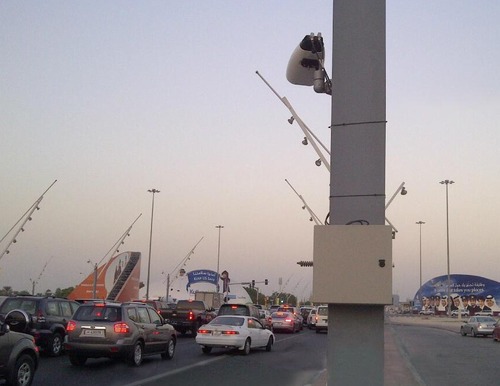
From Doha News:
In an effort to tackle bad driving in Qatar, the Ministry of Interior plans to set up speed radars every two to four kilometers on major roads, Traffic Department Director Brig. Mohamed Saad Al Kharji has said.
Additionally, some 120 radars are being installed to catch drivers who overtake others from the right lane, the Qatar Tribune reports Al Kharji as saying.
He added that the software of speed radars that are already installed on the roads would be updated so that they could also catch such violators.
No timeline for when the cameras would be installed was disclosed. But last fall, the MOI announced it would be rolling out radars to catch queue-jumpers.
Using the “slow” right lane to overtake vehicles in the left lane is a traffic violation punishable by a QR500 ticket, but among one of several rules flouted by motorists here.
Enforcement
In Qatar, traffic violators are rarely pulled over by police officers, despite brief campaigns to step up enforcement. In 2012, plainclothes police officers began ticketing drivers who overtook other vehicles on the right.
And at the end of last year, the traffic department began a three-month campaign to ticket those who violate road rules, including drivers who hadn’t fastened their seat belts, used their phones while driving, and rode without a license.
Both initiatives were lauded by many residents who said enforcement is key to improving safety on the roads, but neither seem to have lasted.
Rape Goes Unpunished in US Military
This is disgusting. We’ve all known it’s true. The warrior culture protects those cowards who impose themselves sexually on both men and women. God willing, things will change. It’s already started, with the relieving of those in power who have imposed themselves on women who came forward with their complaints. Let there be more, until this culture is wiped clean of their disgrace.
Rape isn’t about sex. It’s about power. Rape is a personal violation.
It’s time for the good men and women in the military to police this up, to stop the outrage. Expose those bullies and cowards who prey on others.
Military Sex Abuse Investigation: Documents Reveal Chaotic Punishment Record
AP
by RICHARD LARDNER and YURI KAGEYAMA
TOKYO (AP) — At U.S. military bases in Japan, most service members found culpable in sex crimes in recent years did not go to prison, according to internal Department of Defense documents. Instead, in a review of hundreds of cases filed in America’s largest overseas military installation, offenders were fined, demoted, restricted to their bases or removed from the military.
In about 30 cases, a letter of reprimand was the only punishment.
More than 1,000 records, obtained by The Associated Press through the Freedom of Information Act, describe hundreds of cases in graphic detail, painting a disturbing picture of how senior American officers prosecute and punish troops accused of sex crimes. The handling of allegations verged on the chaotic, with seemingly strong cases often reduced to lesser charges. In two rape cases, commanders overruled recommendations to court-martial and dropped the charges instead.
Even when military authorities agreed a crime had been committed, the suspect was unlikely to serve time. Of 244 service members whose punishments were detailed in the records, only a third of them were incarcerated.
The analysis of the reported sex crimes, filed between 2005 and early 2013, shows a pattern of random and inconsistent judgments:
—The Marines were far more likely than other branches to send offenders to prison, with 53 prison sentences out of 270 cases. By contrast, of the Navy’s 203 cases, more than 70 were court-martialed or punished in some way. Only 15 were sentenced to time behind bars.
—The Air Force was the most lenient. Of 124 sex crimes, the only punishment for 21 offenders was a letter of reprimand.
—Victims increasingly declined to cooperate with investigators or recanted, a sign they may have been losing confidence in the system. In 2006, the Naval Criminal Investigative Service, which handles the Navy and Marine Corps, reported 13 such cases; in 2012, it was 28.
In two cases, both adjudicated by the 1st Marine Aircraft Wing, the accusers said they were sexually abused after nights of heavy drinking, and both had some evidence to support their cases. One suspect was sentenced to six years in prison, but the other was confined to his base for 30 days instead of getting jail time.
Taken together, the cases illustrate how far military leaders have to go to reverse a spiraling number of sexual assault reports. The records also may give weight to members of Congress pushing to strip senior officers of their authority to decide whether serious crimes, including sexual assault cases, go to trial.
“How many more rapes do we have to endure to wait and see what reforms are needed?” asked Sen. Kirsten Gillibrand, D-N.Y., chair of the Senate Armed Services personnel subcommittee. She leads a vocal group of lawmakers from both political parties who argue that further reforms to the military’s legal system are needed.
Air Force Col. Alan Metzler, deputy director of the Defense Department’s Sexual Assault Prevention and Response Office, said the department “has been very transparent that we do have a problem.” He said a raft of changes in military law is creating a culture where victims trust that their allegations will be taken seriously and perpetrators will be punished.
The number of sexual assault cases taken to courts-martial has grown steadily — from 42 percent in 2009 to 68 percent in 2012, according to DOD figures. In 2012, of the 238 service members convicted, 74 percent served time.
That trend is not reflected in the Japan cases. Out of 473 sexual assault allegations within Navy and Marine Corps units, just 116, or 24 percent, ended up in courts-martial. In the Navy, one case in 2012 led to court-martial, compared to 13 in which commanders used non-judicial penalties instead.
The authority to decide how to prosecute serious criminal allegations would be taken away from senior officers under a bill crafted by Gillibrand that is expected to come before the Senate this week. The bill would place that responsibility with the trial counsel who has prosecutorial experience.
Senior U.S. military leaders oppose the plan.
“Taking the commander out of the loop never solved any problem,” said Sen. Lindsey Graham, R-S.C., the personnel subcommittee’s top Republican. “It would dismantle the military justice system beyond sexual assaults. It would take commanders off the hook for their responsibility to fix this problem.”
Gillibrand and her supporters argue that the cultural shift the military needs won’t happen if commanders retain their current role in the legal system.
“Skippers have had this authority since the days of John Paul Jones and sexual assaults still occur,” said Lory Manning, a retired Navy captain and senior fellow at the Women in the Military Project. “And this is where we are.”
___
Lardner reported from Washington. Associated Press writer Leon Drouin-Keith in Bangkok and AP researcher Rhonda Shafner in New York contributed to this report.
Headlight Flashing to Warn of Police is Free Speech
This is big news for people in my area, because they often flash lights to warn of speed traps ahead.
Warning Drivers Of Speed Traps With Flashing Headlights Is Free Speech
A federal judge in St. Louis has set the benchmark
A federal judge in St. Louis ruled Monday that a driver flashing their lights to warn other drivers of an impending speed trap is protected free speech.
On November 22, 2012 Michael Elli received a ticket for flashing his lights to warn fellow drivers of a speed trap, according to Fox 2. The American Civil Liberties Union helped Elli fight the $1,000 ticket all the way to federal court.
Judge Henry Autrey of St. Louis ruled a driver has the right to flash their lights under the First Amendment. Autrey issued an injunction to stop Ellisville Police from enforcing the policy.
“If you’re at the gas station on the corner and someone says ‘Hey be careful over there, there’s a speed trap,’ that’s protected speech. You can’t be ticketed for that. This is no different,” Tony Rothert, an attorney for the American Civil Liberties Union, told Fox 2.
A lawyer for the police in Ellisville said the department isn’t affected by the ruling, as this kind of ticket has only been issued five or so times in the last decade. Across the country, however, the ruling will be considered the benchmark for such cases.
Driving While Incapacitated
Today we had one of those adrenalin experiences I haven’t had since leaving Kuwait. As we turned left onto a major thoroughfare, we were almost side-swiped on the left by a car turning left and driving the wrong way down the lane into which we were turning.
Fortunately, AdventureMan saw him in plenty of time, and made room. So we were behind this guy. Normally we just assume people are inattentive, or arrogant. For us, it’s not that important; just let ’em go their way.
Today, our eyes were as wide as saucers. This same driver kept driving over into the left hand lane. At first, I thought he was going to turn, but he made no turn. AdventureMan honked, to alert him to the fact that he was in the lane where cars were coming his way, headed right into him, we thought maybe he was texting.
Then he shifted all the way over headed into the parking lane, then wove back into the oncoming traffic. Fortunately, all the traffic – and this driver – were all going relatively slowly and the oncoming traffic pulled over. Everyone could see something was not normal.

AdventureMan spotted a police car, just behind us, and pulled over so that the police car would be directly behind this driver. The police car put on the flashers and this driver was oblivious, just continued weaving from the oncoming traffic to the parking lane, until after a very long 30 – 45 seconds, the siren sounded. It was as if the driver woke up – and maybe he did. He pulled over.
AdventureMan and I had one of those conversations where we look for the right word. This driver was more than impaired. Truly, this driver was totally incapacitated in some way. Maybe he had just come from the hospital where he had been up for several nights with his terminally ill wife, in which case he was driving-while-sleep-deprived, a condition that happens more than you would like to think. Maybe he had the flu, and his medication had knocked him for a loop? Maybe he was falling down drunk? Maybe he was on some kind of drug? Maybe he was just driving-while-oblivious, texting?
We will never know. A couple hours later, we passed along the same stretch of road and watched a tow truck haul the car away as the police watched. We hope that whoever the driver was has been hospitalized, or taken somewhere he cannot harm himself. We are also very thankful that we were behind this driver, not in front of him or coming from the other direction. It was one of life’s little adventures.
Florida Crazy: Killed for Texting in a Movie Theatre
The man who killed the texting man was a retired police captain. I suspect he had a permit to carry a weapon. Lord have mercy.
WESLEY CHAPEL, Fla. (AP) — An argument over texting in a Florida movie theater ended with a retired Tampa police captain fatally shooting a man sitting in front of him, authorities said.
The former police captain, Curtis Reeves, 71, has been charged with second-degree murder. It’s not immediately clear whether he has retained an attorney.
“Somebody throws popcorn. I’m not sure who threw the popcorn,” said Charles Cummings, who, as a birthday treat, was about to watch the movie “Lone Survivor” at The Grove 16 Theater on Monday.
“And then bang, he was shot.”
Pasco County Sheriff’s officials said the shooting happened when Reeves asked 43-year-old Chad Oulson to stop texting at the theater in Wesley Chapel, a suburb about a half hour north of downtown Tampa.
Reeves and his wife were sitting behind Oulson and his wife. Oulson told Reeves he was texting with his 3-year-old daughter, Cummings said.
“It ended almost as quickly as it started,” said sheriff’s spokesman Doug Tobin. The sheriff’s office says an off-duty Sumter County deputy detained Reeves until police arrived.
Cummings and his son Alex – who both had blood on their clothes as they walked out of the theater – told a group of reporters Monday afternoon the show was still in previews when the two couples started arguing.
Cummings said the man in the back row – later identified as Reeves – got up and left the auditorium, presumably to get a manager. But he came back after a few minutes, without a manager and appearing upset. Moments later, the argument between the two men resumed, and the man in the front row stood up.
Officials said Oulson asked Reeves if he reported him to management for using his phone.
Cummings said the men started raising their voices and popcorn was thrown. Authorities said Reeves took out a gun, and Oulson’s wife put her hand over her husband, and that’s when Reeves fired his weapon, striking Nichole Oulson in the hand and her husband in the chest.
“I can’t believe people would bring a pistol, a gun, to a movie,” Cummings said. “I can’t believe they would argue and fight and shoot one another over popcorn. Over a cellphone.”
Cummings, who said he was a combat Marine in Vietnam, said Oulson fell onto him and his son.
“Blood started coming out of his mouth,” said Alex Cummings. “It was just a very bad scene.”
Charles Cummings said his son went to call 911, while Cummings and another patron who claimed to a nurse began performing CPR on the victim.
A man sitting next to the shooter grabbed the gun out of his hand, and the suspect did not attempt to get away, Cummings said.
Oulson and his wife were taken by ambulance to a Tampa-area hospital, where the Chad Oulson died, Tobin said. His wife’s injuries were not considered life-threatening.
Tampa Police spokeswoman Laura McElroy said in a news release that Reeves was a captain when he retired from the department in 1993. She added that he was instrumental in establishing the agency’s first tactical response team. After he retired, Reeves worked security for the Busch Gardens theme park and was on the board of a neighboring county’s Crime Stoppers organization. Reeves’ son also is a Tampa officer, police said.


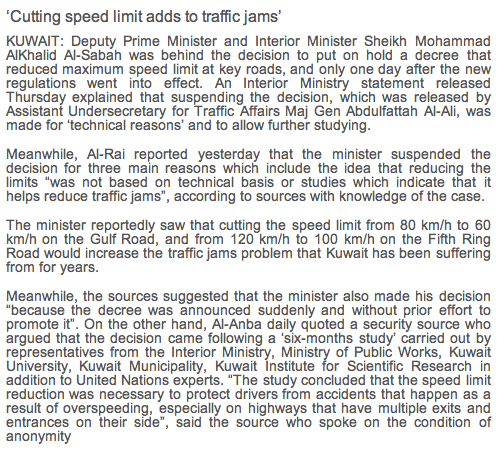
David, and Where is Yambio, South Sudan?
A year ago, we had an extraordinary experience. We often entertain delegates visiting from other countries, and this time we had three African journalists, and, strictly by chance, they all turned out to be Christian. Most of our gatherings are strictly ecumenical, but these were joyful, praying Christians, and the evening took a turn we never anticipated.
“So how did you find Jesus?” one woman asked David, from the newest country in the world, South Sudan. Inside, I was shocked, and when I am shocked, my tendency is to laugh, I don’t know why, it is just the way I am wired. Every culture is so different. In the South, people might ask that of one another, particularly if you worship in a fundamental sect, but our sect is more formal, and to inquire into another’s spiritual life can be perceived as intrusive.
David, however, was not taken aback. “It’s a long story,” he said, and we all settled into comfortable chairs to listen better. It was Christmas, the decorations were up, the lights all twinkling and we had eaten. A good time for a story.
It was a long story. It started with a little boy in a happy family, who one day was told to run! Run! Run into the forest and hide! The riders were coming! His family grabbed a very few things and ran.
His family ran for years. His family ran into forests, across borders, into dry arid spaces. Sometimes some of the children would get separated from their parents for a while, but they would keep asking, and eventually meet up again, only to face separation again. Their whole lives were running, from the Janjaween, from border police, from robbers.
At one point, he and a brother stayed in a church, and a priest taught them about Jesus. Simple stories, simple songs, and he drew letters and numbers in the dirt – that was his early schooling. It was a haven of peace for him.
Many years later, the family was reunited in their village in the new country of South Sudan. Miraculously, every member of his family survived, indeed, most of his village survived. They had maintained lines of communication through all those years of running and separation, and were so thankful. Most of all, now, they were thankful – they had a church in their village. David had learned to love learning, and had completed his education and had found a wonderful job.
“I don’t know the book like you do,” he told us, “I only know it like a little child sitting at the feet of that priest, but I am learning.”
I can’t help but think that David knows more than he thinks. David holds his belief in Jesus like a child, simple and direct. His testimony is powerful and unforgettable. I am in awe, even a year later, of his story and testimony.
Today the church prays for the diocese of Yambio, in the South Sudan:
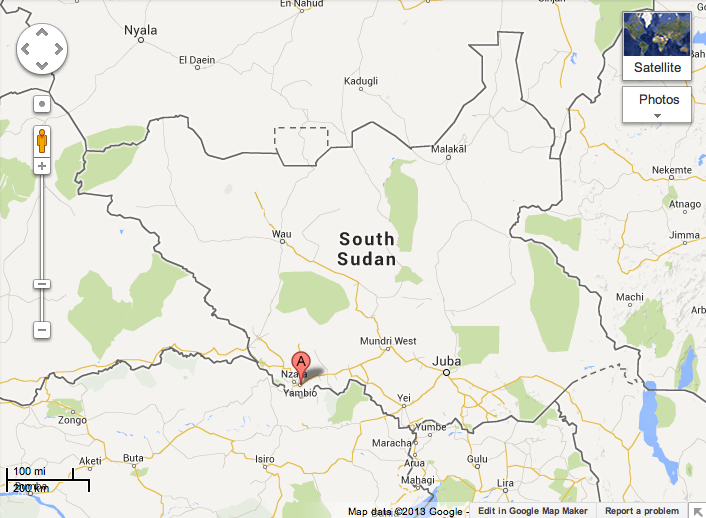
Qatar Fields Huge New Traffic Force
This is from ILoveQatar.net, reprinted from Gulf News. I think I loveQatar.net is a very cool website, and I am thankful they continue to send me updates: 🙂
A BIG Wooo HOOOOO on Qatar for training and implementing a PROFESSIONAL traffic force. Woooo HOOOOO! I can only hope the laws they will enforce include children in the back seats in car seats and seat belts for every passenger. I pray that part of the training included instructions that traffic rules are to be applied equally and fairly against all nationalities, including citizens.
A new highway patrol police force that will augment the efforts of the Ministry of Interior (MoI) in improving road safety will start work in 2014, it was announced at the graduation of the first batch of the force.
Consisting of 50 officers and cadets, the graduation ceremony of the first batch was held at the headquarters of the Traffic Department. The training programme was implemented by the Northwestern University, Chicago.
The team has received specialised training in enforcing traffic laws and booking common violations like tailgating, use of mobile phones, exceeding speed limits and not wearing seat belts.
The officers also acquired advanced skills in investigation of accidents, modern methods to interrogate drivers, preservation of evidence and making specialised reports on accidents.
According to Traffic Department officials, the new force will use both radar and lidar, a device used to monitor speed using laser.
The officers were also trained on skills needed to manually control traffic flow and its mechanisms in addition to the use of tools and methods for data collection.
The initiative was organised in collaboration between the Ministry of Interior and RasGas in the context of the priority given by the MoI and the National Committee for Traffic Safety (NCTS) to ensure responsible and safe driving.
The graduation ceremony was attended by Traffic Department director Brig Mohamed Saad al-Kharji, NCTS secretary Brig Mohamed Abdullah al-Maliki, traffic safety adviser at MoI Ademola Ilori and Brett Doherty, safety, health, environment & quality chief officer, RasGas.
Speaking on the occasion, al-Kharji said that the new force would support the MoI’s efforts in road safety.
“The new force will monitor and enforce road safety measures on highways. It includes monitoring speed limit, keeping space between vehicles and handling accidents and emergency situations.”
He added that the trainees got theoretical and practical lessons on controlling traffic movement on highways, safe parking and stopping of vehicles on highways as well as training on dealing with the public.
Speaking on the sidelines, al-Kharji said that there was a plan to equip traffic police vehicles with speed radars so they could catch violators while on the move.
He thanked RasGas for its collaboration with the MoI in this initiative and said the move would play a proactive role in reducing traffic accidents.
Al-Maliki said that the initiative came as part of NCTS and thanked RasGas and Northwestern University for their support for the initiative.
He awarded trainees with certificates and exchanged mementos with RasGas and Northwestern University. Gifts and appreciation certificates were awarded for lecturers and translators.
Others present on the occasion were RasGas public affairs manager Abdulla Hashim, Security & Emergency services manager Faisal al-Hajiri, road safety adviser John Cling, safety systems head Jive Price, road safety training head at Northwestern University, Antony Patila.
Kuwait to Limit Auto Ownership to Solve Traffic Gridlock?
Limit Kuwaitis to two cars per citizen?
Limiting expats to one car will also limit the people willing to take contracts in Kuwait, and family willing to accompany them . . .
Or is this another of those unenforceable laws to put on the books?
Restrictions on automobile ownership in the offing – Bid to solve traffic problems
KUWAIT: According to a report published yesterday in a local Arab daily, the government is planning to limit the number of vehicles a person is allowed to own at two for citizens and one for expats. This proposal may be announced at the beginning of the next year. The proposal also calls to stop renewing registrations of old vehicles without specifying the period, which could be between 8 to 12 years.
The Ministry of Interior hasn’t received any official instructions to take action in this matter. “We are an executive department that applies the law and executes decisions. It’s possible that there are committees at the ministry studying this proposal, but we are not aware of it yet,” Maj Naser Buslaib, Head of the Media Department at the Ministry of Interior told Kuwait Times. Economic analyst Hajaj Bukhadour thinks such a proposal is not realistic and doesn’t believe it may be applied. “Such rules do not exist in any country, even the poor ones or those suffering from traffic woes. Through such unreal proposals, the officials in charge are trying to shirk the problem.
The officials pin the blame and responsibility on expats as they are not qualified and creative enough to find a solution for the traffic problem in Kuwait,” he pointed out. Development and improvement in administration is important to solve major problems. “We should improve the performance of the officials who are in charge of issuing decisions.
There are mistakes in any institution, but we need to improve and this is a great part of solving the problem. Such a proposal proves that officials in charge at the Ministry of Public Works, Ministry of Interior and other institutions didn’t study the problem correctly,” stressed Bukhadour. There are various solutions according to him.
“Different public institutions should cooperate to organize the movement of people in streets through different timings of public employees, schools and others. Also, the government should provide modern and clean public transportation such as a metro or new modern buses that will respect the time and have stops near residential areas that are shaded to suit the hot weather when passengers are waiting for the bus,” he explained.
He mentioned additional solutions. “Developing roads and the infrastructure is very important in solving the traffic problem. Also, the development of the Traffic Department will help in this matter. I think that such suggestions may bring better results in solving the traffic problem rather that coming up with unreal proposals,” concluded Bukhadour.
By Nawara Fattahova
“if You Can’t Prevent Rape, You Enjoy It”: Ranjit Sinha
The Chief of India’s Central Bureau of Investigation said this! Was he snorting cocaine in a drunken stupor? Of course he is apologizing, but his careless remark demonstrates the sentiments buried deep in his culture’s heart – it’s only women. Not worth much, not like us men. Outrageous.
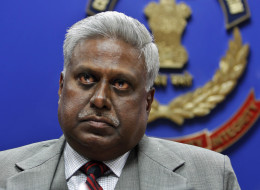
NEW DELHI (AP) — India’s top police official apologized Wednesday for saying, “If you can’t prevent rape, you enjoy it,” a remark that has outraged women across the country.
Central Bureau of Investigation chief Ranjit Sinha made the remark Tuesday during a conference about illegal sports betting and the need to legalize gambling. The CBI, the country’s premier investigative agency, is India’s equivalent of the FBI.
Sinha said at the conference that if the state could not stop gambling, it could at least make some revenue by legalizing it.
“If you cannot enforce the ban on betting, it is like saying, ‘If you can’t prevent rape, you enjoy it,'” he said.
The remarks have caused outrage across India, which in the past year has been roiled by widespread protests following the fatal gang rape of a 23-year-old woman on a bus in New Delhi.
On Wednesday, Sinha said that his comments had been taken out of context and misinterpreted, and that he was sorry if he had caused hurt.
Angry activists, however, called for his resignation.
Communist Party of India (Marxist) leader Brinda Karat said Sinha’s comments were offensive to women everywhere.
“It is sickening that a man who is in charge of several rape investigations should use such an analogy,” Karat told reporters. “He should be prosecuted for degrading and insulting women.”
The New Delhi attack on the young woman last December caused nationwide outrage and forced the government to change rape laws and create fast-track courts for rape cases. New laws introduced after the attack make stalking, voyeurism and sexual harassment a crime. They also provide for the death penalty for repeat offenders or for rape attacks that lead to the victim’s death.
Recent Comments
intlxpatr on Shampoo Ginger tigerbutterya0c5ff1d… on Shampoo Ginger intlxpatr on British Soldier Kidnapped, Esc… John on British Soldier Kidnapped, Esc… intlxpatr on British Soldier Kidnapped, Esc… Wikipedia Donate Button

Amazina


Early Voting in Florida


