Sarah Palin and Hillary Clinton
If you missed Saturday Night Live’s spoof of Sarah Palin and Hillary Clinton (Tina Fey & Amy Poehler), see it now:
Watch it now, before they take it off!
Moroccan Blogger Jailed
You can read the entire story, which appeared today, on BBC News Africa:

A Moroccan blogger has been jailed for two years for showing disrespect to the monarchy, say the man’s family.
Mohammed Erraji, 29, was convicted after writing an article claiming King Mohammed VI’s charitable habits were encouraging a culture of dependency.
There has been no official comment on the case, but rights groups claim Erraji did not have a fair trial.
A BBC reporter says criticising the king is an offence in Morocco and the royal family remains a taboo subject.
Morocco has previously caused international outrage with its treatment of internet users.
Earlier this year, Fouad Mortada was sentenced to three years in prison for creating a false profile on the internet site Facebook using the identity of the king’s brother.
He received a royal pardon following protests from internet users around the world.
‘Disastrous’
Erraji claimed in an internet article that the king’s charity towards Moroccans was stifling development by encouraging people to be lazy.
“This has made the Moroccans a people without dignity, who live by donations and gifts,” he wrote.
The BBC’s James Copnall in the capital, Rabat, says he was particularly critical of the practice known as grima – giving lucrative licences to run taxis and other transport in exchange for begging letters.
Erraji said this did not happen in developed countries, where hard work rather than begging is rewarded.
He was arrested by the authorities last Friday and accused of “lacking the respect due to the king”.
In court on Monday, he was given a two-year prison sentence and fined 5,000 Dirham ($630:£356).
Building 7 Collapse Solved, No Mystery
Feds Say They’ve Solved 9/11 Mystery
By DEVLIN BARRETT, AP
GAITHERSBURG, Md. (Aug. 21) – Federal investigators said Thursday they have solved a mystery of the Sept. 11, 2001, attacks: the collapse of World Trade Center building 7, a source of long-running conspiracy theories.
The 47-story trapezoid-shaped building sat north of the World Trade Center towers, across Vesey Street in lower Manhattan. On Sept. 11, it was set on fire by falling debris from the burning towers, but skeptics have long argued that fire and debris alone should not have brought down such a big steel-and-concrete structure.
Federal investigators said Thursday they have resolved a lingering question from the Sept. 11, 2001, terror attacks: What caused World Trade Center 7 to collapse? They determined the building, which sat north of the World Trade Center towers, was brought down by fire started by debris from the twin towers.
Scientists with the National Institute of Standards and Technology say their three-year investigation of the collapse determined the demise of WTC 7 was actually the first time in the world a fire caused the total failure of a skyscraper.
“The reason for the collapse of World Trade Center 7 is no longer a mystery,” said Dr. Shyam Sunder, the lead investigator on the NIST team.
Investigators also concluded that the collapse of the nearby towers broke the city water main, leaving the sprinkler system in the bottom half of the building without water.
The building has been the subject of a wide range of conspiracy theories for the last seven years, partly because the collapse occurred about seven hours after the twin towers came down. That fueled suspicion that someone intentionally blew up the building in a controlled demolition.
Critics like Mike Berger of the group 9/11 Truth said he wasn’t buying the government’s explanation.
“Their explanation simply isn’t sufficient. We’re being lied to,” he said, arguing that there is other evidence suggesting explosives were used on the building.
Sunder said his team investigated the possibility that an explosion inside the building brought it down, but found there was no large boom or other noise that would have occurred with such a detonation. Investigators also created a giant computer model of the collapse, based partly on news footage from CBS News, that they say shows internal column failure brought down the building.
Investigators also ruled out the possibility that the collapse was caused by fires from a substantial amount of diesel fuel that was stored in the building, most of it for generators for the city’s emergency operations command center.
The 77-page report concluded that the fatal blow to the building came when the 13th floor collapsed, weakening a critical steel support column that led to catastrophic failure.
“When this critical column buckled due to lack of floor supports, it was the first domino in the chain,” said Sunder.
The NIST investigators issued more than a dozen building recommendations as a result of their inquiry, most of which repeat earlier recommendations from their investigation into the collapse of the two large towers.
In both instances, investigators concluded that extreme heat caused some steel beams to lose strength, causing further failures throughout the buildings until the entire structure succumbed.
The recommendations include building skyscrapers with stronger connections and framing systems to resist the effects of thermal expansion, and structural systems designed to prevent damage to one part of a building from spreading to other parts.
A spokeswoman for the leaseholder of the World Trade Center, developer Larry Silverstein, praised the government’s work.
“Hopefully this thorough report puts to rest the various 9/11 conspiracy theories, which dishonor the men and women who lost their lives on that terrible day,” said Silverstein spokeswoman Dara McQuillen.
In discussing the findings, the investigator Sunder acknowledged that some may still not be convinced, but insisted the science behind their findings is “incredibly conclusive.”
“The public should really recognize the science is really behind what we have said,” he said, adding: “The obvious stares you in the face.”
Copyright 2008 The Associated Press. The information contained in the AP news report may not be published, broadcast, rewritten or otherwise distributed without the prior written authority of The Associated Press. Active hyperlinks have been inserted by AOL.
Bush Tours America To Survey Damage Caused By His Presidency
Hilarious video from The Onion.
The Wire, Season 4
This show, The Wire, is one of our all time favorites, all the more so because our son also loves this show and passes along the entire season when he has finished watching.
Season 4 is the very best so far. The major theme is a subject near and dear to my heart – the schools, keeping kids in school, and trying to find ways to help them learn. Two former policemen end up in Tilghman Middle School, working with the poorest kids in the Baltimore school system.
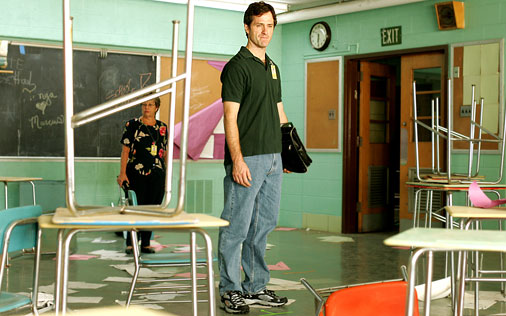
First, you need to know that teaching middle school is the stuff of heroes. At very best, middle school kids are dealing with those raging hormones of adolescence. They can’t sit still. They are so full of energy, and sitting and reading is the last thing they want to do.
New teacher “Prez” suffers total loss of control over his class on his first day, but slowly finds ways to engage their attention – such as teaching them to use math to figure odds rolling dice. Once they understand the value of the new information, they are enthusiastic learners . . . or at least, they co-operate with the boring stuff because he finds ways to reward them with interesting information, relevant to helping them cope with their lives. The teachers learn from the students – to keep it real, keep it relevant.
The teachers in Tilghman Middle School are HEROES. Most of the children they deal with have huge problems outside the school, poverty being the smallest of the problems. For many, their parents are their worst problems, literally stealing the food out of their mouths for another fix. The kids bring their baggage into the schools every day, their anger, their acting out. The teachers have to be a mix of tough, compassionate and flexible. They know they are going to lose some of them, and they have to keep on, hoping a few will make it. It is truly a war zone, and the teachers are the stand-up soldiers in this season.

We follow a tough race for the Mayor’s office, the rise of a drug lord, two stone-cold killers who figure out how to “disappear” their victims, and one very clever schemer who manages to pull off a major drug heist, and then sells the product back to his victims. It’s an amazing show.
If you follow this season via DVD, choose to use the subtitles. A lot of the language is slang, much of it is street talk, mumbled, garbled – real speech. It helps to use the subtitles.
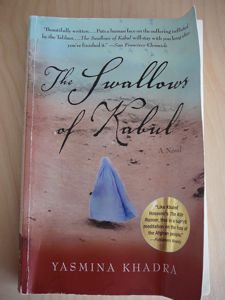
Khadra and The Swallows of Kabul
While waiting for our luggage to be offloaded, we were passing time, visiting with our greeter / expediter, asking about his family, his life in Zambia.
“How does this work, travelling with your son and your daughter-in-law?” he asked us. “Do you like her?”
Nothing on earth could disguise the delight on our faces as we both said “Yes!” We truly adore her.
When our son was only seven years old, a Christian speaker passing through said that if you have children, it is likely that their mates have also been born, so to start praying now for the unknown mate your child would choose, and we did.
When our son called us from university, and told us there was someone he wanted us to meet at graduation, and graduation was still months away, we knew, we just knew, that this might be THE ONE.
We were so delighted when we met her, we liked her immediately. What parent isn’t happy to see his/her son/daughter happy, and choosing well?
“But!” our meeter/greeter added, “how do you like her family?”
And we laughed again! We love her family! Her father is smart and very funny, and her mother is kind and practical, and we all share the same values on family and friends and living our lives. She comes from a large rowdy family that gathers when they can, and so do we.
And YOU are thinking “what does all this have to do with The Swallows of Kabul?” but I am getting there.
On the trip, we all had books for our quiet time, and I could see EnviroGirl deeply engrossed in this book. When I asked her, she said she had gotten it from her father’s wife, a woman with whom I often talk books, and that she (EnviroGirl) was trying to finish it so that she could leave it with me.
And thank goodness that she did! I couldn’t put it down!
First, you think it is written by Yasmina Khadra, but that is a pseudonym. The real author, Mohammed Moulessehoul, was Algerian army officer, and he used the pseudonym to avoid having to submit the manuscript for approval by military authorities. That got my attention right away.
The book is about Taleban era Afghanistan, and starts out with utter hopelessness, describing the deterioration in life brought about by the arbitrary imposition of religious rule, as interpreted by men who have memorized the Qur’an, but have a poor understanding of what they have memorized. Women lead a dismal, limited life, at the mercy of men who treat them as detestable if they are seen in public, even totally cloaked.
His language is beautiful, poetic and compelling, even describing despair and desolation.
We meet two couples, Atiq, a jailer, and his wife, Musarrat, who risked her own life to save his life back when he was seriously wounded and left for dead, and Mohsen, former member of a moderately successful merchant family, married to the love of his life, Zunaira, who is beautiful, educated and from a wealthy background. These men love their wives, and have a strong, genuine connection to them. Their ability to maintain that connection, and to stay connected to their own values, withers in the dry, dusty context of fundamentalist rule.
Their lives and relationships have been changing gradually, increasingly limited and undignified under the stress of Taleban rule, and the novel follows a rapid spiral of deterioration and folly. The steady decline of their lives speeds when Mohsen makes a terrible impulsive decision, has to live with the consequences, and confesses to his wife.
Atiq, too, faces dismal consequences. Even though we know he is limited, he becomes a sympathetic character. His hardness of heart covers a genuine grief that his wife is dying, and he can do nothing to stop it, nor to alleviate her pain.
We all face hard times. In our family, when someone lashes out unjustly, we often ask “is it something I have done, or am I just the nearest dog to kick?” It always gets a laugh, and it puts things back in perspective, puts us on the same side. Sometimes we can’t always vent our frustrations against those people or events creating the frustration, so we take it out on those we love – and who love us. It’s not right, it’s not fair or just, but it is very human, and once you get that out on the table, it is easier to discuss the real issue.
When Zunaira ends up in jail, Atiq’s world is shattered as if by an earthquake – the earth moves under his feet, all his understanding of life is shaken.
“As he cleans up, he cautiously lifts his eyes to the roof beam looming over the cell like a bird of evil augury, and his gaze lingers on the anemic little lightbulb, growing steadily dimmer in its ceiling socket. Screwing his courage to the sticking point, he walks back to the lone occupied cell, and there, in the very middle of the cage, the magical vision: the prisoner has removed her burqa! She’s sitting cross-legged on the floor. Her elbows are on her knees, her hands are joined under her chin. She’s praying. Atiq is thunderstruck. Never before has he seen such splendor. With her godess’s profile, her long hair spread across her back, and her enormous eyes, like horizons, the condemned woman is beautiful beyond imagination. She’s like a dawn, gathering brightness in the heart of this poisonour, squalid, fatal dungeon.
Except for his wife’s, Atiq hasn’t seen a woman’s face for many years. He’s even learned to live without such sights. For him, women are only ghosts, voiceless, charmless ghosts that pass practically unnoticed along the streets; flocks of infirm swallows – blue, yellow, often faded, several seasons behind – that make a mournful sound when they come into the proximity of men.
And all at once, a veil falls and a miracle appears. Atiq can’t get over it. A complete, solid woman? A genuine tangible woman’s face, also complete, right here in front of him? He’s been cut off from such a forbidden sight for so long that he believed it had been banished even from people’s imaginations. . . ”
Atiq has a friend, Mirza, who thrives under Taleban rule, as a soldier, and also running illegal businesses highly profitable under the current regime. He encourages Atiq to abandon his cancer-striken wife, to get rid of her and to find a fresh, young wife. He offers Atiq shady business opportunities, and tells him a wise man bends with the wind. Ignorance and chaos benefit Mirza, and he has no wish to see the good old days return.
In spite of the bleakness, the desolation, the crushing arbitrariness and inhumanity, there is hope, love, and compassion in a thin, steady stream throughout the book.
Once I started reading, I had to finish. It was a great book for the long trip back to Kuwait, one I am eager to pass along to the next avid reader.

NBK Shines
We complain about our banks and we write about all the goofs and stupid policies, so it is only fair, when a bank does something right, to share that side of the story, too.
I was invited yesterday to the Mother’s Day celebration benefitting Operation Hope and the Animal Friends League. I used to do fundraising, so I am always interested in just how much of the ticket price will actually benefit the charity.
It was a glorious event, from start to finish. More than 160 gathered to celebrate Motherhood and to support Operation Hope and Animal Friends. During the meal, hostess Sheryl Mairza from Operation Hope announced that because NBK had stepped up to the plate and covered the cost of the breakfast, the entire cost of every ticket would go to benefit the two charities.
WAY TO GO! It is every fundraiser’s dream to find generous corporate sponsors, so that not a penny is wasted and every – oops – fils can go toward the intended charity. Bravo,NBK! I don’t know if banks get tax incentives in Kuwait, as they do in the US. In the US, we know that most major corporations have designated charitable funds and it is our job to encourage them to donate those funds our way. It is by far more difficult to get corporate sponsorship in a country where there may not be such significant tax benefits. Again, Bravo NBK. Thank you for sponsoring Operation Hope and Animal Friends, and for covering the cost of the breakfasts.

Fireboat Practice
Who knew? Who knew the Kuwait Coast Guard – or the Kuwait Fire Department – now has fire boats? These look pretty new, and we are guessing they are having a practice, out in the Gulf on this beautiful Friday:


Fire boats are fairly specialized pieces of equipment. Once you buy them, you have to learn how to operate them. You don’t want them learning when YOUR boat is on fire, you want them to have had some exercises learning how to use their equipment efficiently. Bravo, Kuwait fire department.
Who Will Tell the People?
This was the #5 e-mailed article from this week’s New York Times. It is a hard-hitting warning to Americans in an election year, and it has some analogies to election time in Kuwait.
By THOMAS L. FRIEDMAN
Published: May 4, 2008
Traveling the country these past five months while writing a book, I’ve had my own opportunity to take the pulse, far from the campaign crowds. My own totally unscientific polling has left me feeling that if there is one overwhelming hunger in our country today it’s this: People want to do nation-building. They really do. But they want to do nation-building in America.
They are not only tired of nation-building in Iraq and in Afghanistan, with so little to show for it. They sense something deeper — that we’re just not that strong anymore. We’re borrowing money to shore up our banks from city-states called Dubai and Singapore. Our generals regularly tell us that Iran is subverting our efforts in Iraq, but they do nothing about it because we have no leverage — as long as our forces are pinned down in Baghdad and our economy is pinned to Middle East oil.
Our president’s latest energy initiative was to go to Saudi Arabia and beg King Abdullah to give us a little relief on gasoline prices. I guess there was some justice in that. When you, the president, after 9/11, tell the country to go shopping instead of buckling down to break our addiction to oil, it ends with you, the president, shopping the world for discount gasoline.
We are not as powerful as we used to be because over the past three decades, the Asian values of our parents’ generation — work hard, study, save, invest, live within your means — have given way to subprime values: “You can have the American dream — a house — with no money down and no payments for two years.”
That’s why Donald Rumsfeld’s infamous defense of why he did not originally send more troops to Iraq is the mantra of our times: “You go to war with the army you have.” Hey, you march into the future with the country you have — not the one that you need, not the one you want, not the best you could have.
A few weeks ago, my wife and I flew from New York’s Kennedy Airport to Singapore. In J.F.K.’s waiting lounge we could barely find a place to sit. Eighteen hours later, we landed at Singapore’s ultramodern airport, with free Internet portals and children’s play zones throughout. We felt, as we have before, like we had just flown from the Flintstones to the Jetsons. If all Americans could compare Berlin’s luxurious central train station today with the grimy, decrepit Penn Station in New York City, they would swear we were the ones who lost World War II.
How could this be? We are a great power. How could we be borrowing money from Singapore? Maybe it’s because Singapore is investing billions of dollars, from its own savings, into infrastructure and scientific research to attract the world’s best talent — including Americans.
And us? Harvard’s president, Drew Faust, just told a Senate hearing that cutbacks in government research funds were resulting in “downsized labs, layoffs of post docs, slipping morale and more conservative science that shies away from the big research questions.” Today, she added, “China, India, Singapore … have adopted biomedical research and the building of biotechnology clusters as national goals. Suddenly, those who train in America have significant options elsewhere.”
Much nonsense has been written about how Hillary Clinton is “toughening up” Barack Obama so he’ll be tough enough to withstand Republican attacks. Sorry, we don’t need a president who is tough enough to withstand the lies of his opponents. We need a president who is tough enough to tell the truth to the American people. Any one of the candidates can answer the Red Phone at 3 a.m. in the White House bedroom. I’m voting for the one who can talk straight to the American people on national TV — at 8 p.m. — from the White House East Room.
Who will tell the people? We are not who we think we are. We are living on borrowed time and borrowed dimes. We still have all the potential for greatness, but only if we get back to work on our country.
I don’t know if Barack Obama can lead that, but the notion that the idealism he has inspired in so many young people doesn’t matter is dead wrong. “Of course, hope alone is not enough,” says Tim Shriver, chairman of Special Olympics, “but it’s not trivial. It’s not trivial to inspire people to want to get up and do something with someone else.”
It is especially not trivial now, because millions of Americans are dying to be enlisted — enlisted to fix education, enlisted to research renewable energy, enlisted to repair our infrastructure, enlisted to help others. Look at the kids lining up to join Teach for America. They want our country to matter again. They want it to be about building wealth and dignity — big profits and big purposes. When we just do one, we are less than the sum of our parts. When we do both, said Shriver, “no one can touch us.”
Recent Comments
ExpatAlien on What Country am I Living … intlxpatr on Yellowstone: Old Faithful to C… Michelle on Yellowstone: Old Faithful to C… Cathy on No Grown-Ups in Charge intlxpatr on Waiting for Snow Wikipedia Donate Button

Amazina


Early Voting in Florida


 Here There and Everywhere