You Can’t Take it With You
I awoke this morning from the most horrible dream, and it’s a dream I have had often, but this time, there is no reason. I am packing boxes. I have a deadline. I have a lot to pack, I am feeling very anxious, and I keep getting distracted from my packing. Soon I will have to go, and I haven’t accomplished what I meant to accomplish.
This dream is a very common dream for someone who has moved 31 times in her life, who had packed boxes and suitcases and never missed a deadline. Never once have I left a box with someone else to mail for me. I’ve had these anxiety dreams so many times, but never when I am not facing a move.
So I felt depressed, and I felt anxious this morning, wondering what my dream means. Does it mean that I am thinking about my mortality, and distracted by my attachment to things? Does it mean that I need to be clearing up and organizing my life so I can depart? Or is it just a remnant anxiety, like those leftover dreams about having to take a college exam you haven’t prepared for?
For me, the cure for depression, anxiety and morbidity is action. We hit the water aerobics class this morning and she worked us so hard we both fell asleep this afternoon. I got some tomatoes (not the Black Krim, which I have not yet found) and basil potted, and some weeding done. Depression gone. Anxiety gone. Inklings drift across my consciousness, but I sweep them away like cobwebs.
In Search of the Seminole Pumpkin and the Black Krim
The big box stores are full of plants, some of which will grow in Florida, and some of which are nothing but heartache. They SAY these plants are all zone specific to our area – it’s a big fat lie. Many of the plants they sell will last a short while, but were never meant to grow here.
I planted a lot of seeds last year, and got tomato plants of many varieties, but only one actually produced fruit, a golden drop tomato. I bought plants, and one plant, bought from a local gardener at an annual gardener’s fest, produced copiously – the Black Krim. We tried growing crook neck squash and zuccini, but one day our plants looked healthy and fabulous, and the next, they would be withered and broken, eaten from the inside by some boring insect. Literally boring, not figuratively speaking.
At a meeting this week (which I am so glad I attended) the director of the local Manna Food Pantry program was telling us about the Manna community gardens, and he mentioned a squash that will grow, the Seminole squash or pumpkin.

I’ve spent two days touring nurseries and open markets to see if I can fine one. One nursery had heard of it but said you usually see it later in the season, you plant it like in July so that you will have first fruits in September.
The rules for gardening are so different in Florida. I am learning, but it is all counter intuitive, except that in Kuwait gardening was similar – people yearned for October, when you could set out plantings and hope they would not be destroyed by the heat.
Bougainvillea is an exception. You would think it would grow beautifully in this heat and humidity, but I am told that the cool winters kill it off. It doesn’t really get that cold for that long, but it seems it is cold enough and long enough to kill bougainvillea, which breaks my heart. I love the flamboyant lushness of bougainvillea.
Meanwhile, we will be planting other zone-hardy plants, and we will see what works. If you see a Seminole Pumpkin / Squash plant for sale, let me know, will you?
Tonight the full moon will be closer to the earth than at any other time for many years to come. AdventureMan and I are heading out with a little picnic to watch the moon rise from a tiny park we know. 🙂
You Must Not Be From Around Here
When I got back to Kuwait, I had to regain my driving courage all over again. I remember growing up, when we would go to fairs and carnivals, where I loved to ride the bumper cars. We were all aggressive; we wanted to win. It never occurred to me that there would be countries where people would drive real cars that way. Touch wood, I never had an accident in Kuwait, and I learned how to drive aggressively but somehow stayed safe.
Driving in Pensacola is a piece of cake – most of the time. Suddenly, we have some TRAFFIC. There are cars on the road from all over, never fewer than two or three in every car, usually dressed in beach gear, and full of high spirits. It is Spring Break. People are flocking to the gorgeous white beaches of Pensacola, spilling out of the lively beach restaurants, and even some of the restaurants in downtown Pensacola. College students, families (local schools are also on spring break) and the snow birds are filling our roads, not entirely sure where they are going.
In one of our favorite nearby restaurants, we saw some college age kids come in, and then another group, all greeted familiarly by the owners, and then their tables were joined so they could all sit together – locals, back home from university for Spring Break.
It’s a sweet time of the year. The weather is in the high 70’s, cooling down at night. We have the a/c off, we keep it off as long as we can.
Beirut Knows How to Have Fun
I’m sure most of you have seen this, but it just rocks my heart! Beirut Airport duty free! Rafic Hariri International Airport! They are having so much fun! I would love to see this on the catwalk in the Kuwait airport or Qatar airport, LOL, I am guessing in the Gulf it would have to be just men, but some of these Lebanese girls are amazing dancers!
All this dancing is so good for your health! Look, there isn’t a fat person on the floor! They have all danced themselves skinny!
Cutting for Stone by Abraham Verghese

Someone in my book club in Qatar mentioned this book, Cutting for Stone, a while back, and I bought it, but it has sat for months on my to-read shelf (LOL, there are actually several, but one with the most important books, and another with the ‘guilty pleasures,’ the ones I am addicted to and save as a reward for good behavior, like vacuuming.)
When a good friend said she was reading it, and that it was good, I decided to move it up in priority, sort of like taking medicine, read a book that is good for you.
Oh WOW.
First, it is a great, absorbing story. Twin boys are born, totally unexpected, to an Indian Catholic nun and an English surgeon, working in Addis Ababa. How they were conceived is a mystery. The mother dies in childbirth, the father flees in horror, the children are born conjoined at the head and must be separated. The boys are adopted by an Indian couple, doctors at the hospital, and are raised with love and happiness.
That’s just the beginning!
I’ve always wanted to go to Ethiopia and Eritrea. I want to visit Lalibela, and some of the oldest Christian churches in the world. When my father was sick, he had a home health aid from Ethiopia, Esaiahs, who told me about the customs in his church, and how Ethiopian Christianity is very close to Judaism, with men and women separated in the church, and eating pork forbidden.
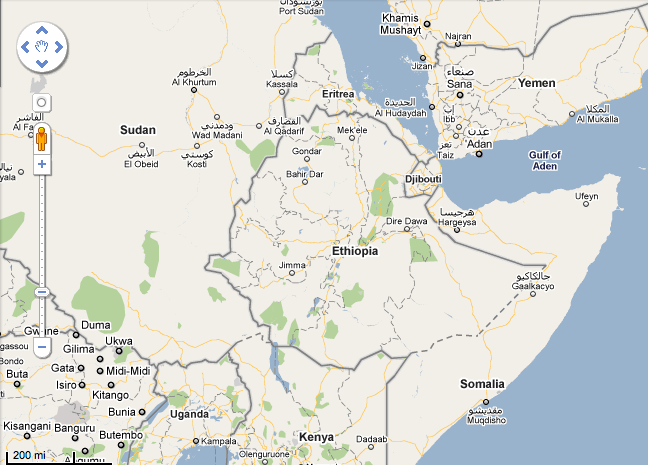
Reading this book, I felt like I had lived there, and I want to go back. The author captures the feelings, the smells, the visuals, the sounds, and if I awoke in a bungalow at the MIssing (Mission) Hospital, I would say “Ah yes! I remember this!”
I kept marking sections of this book that I loved. Here is one:
They parked at Ghosh’s bungalow and walked to the rear or Missing, where the bottlebrush was so laden with flowers that it looked as if it had caught fire. The property edge was marked by the acacias, their flat tops forming a jagged line against the sky. Missing’s far west corner was a promontory looking over a vast valley. That acreage as far as the eye could see belonged to a ras – a duke – who was relative of His Majesty, Haile Selassie.
A brook, hidden by boulders, burbled; sheep grazed under the eye of a boy who sat polishing his teeth with a twig, his staff near by. He squinted at Matron and Ghosh and then waved. Just like in the days of David, he carried a slingshot. It was a goatherd like him, centuries before, who had noticed how frisky his animals became after chewing a particuar red berry. From that serendipitous discovery, the coffee habit and trade spread to Yemen, Amsterdam, the Caribbean, South America, and the world, but it had all begun in Ethiopia, in a field like this.
We live inside the hearts and minds of doctors, some practicing under the worst possible conditions, and learn how they make their decisions and why. Verghese is a compassionate author; while his characters may be flawed, they are forgivable and forgiven.
Another section I loved, the man speaking is Ghosh, the man who adopted the twins with Hema, another doctor:
“My genius was to know long ago that money alone wouldn’t make me happy. Or maybe that’s my excuse for not leaving you a huge fortune! I certainly could have made more money if that had been my goal. But one thing I won’t have is regrets. My VIP patients often regret so many things on their deathbeds. They regret the bitterness they’ll leave in people’s hearts. They realize that no money, no church service, no eulogy, no funeral procession no matter how elaborate, can remove the legacy of a mean spirit.”
Things in Ethiopia get sticky, politically, and one of the twins is forced to flee, implicated in an airplane hijacking only because he was raised with a young woman involved. He is spirited into Eritrea, where he awaits his ride out to Kenya, and he helps the Eritrean rebels when large numbers of wounded are brought into his area. When the time comes to leave, his thoughts will strike a chord in anyone who has ever been an expat:
Two days later I took leave of Solomon. There were dark rings under his eyes and he looked ready to fall over. There was no questioning his purpose or dedication. Solomon said “Go and good luck to you. This isn’t your fight. I’d go if I were in your shoes. Tell the world about us.”
This isn’t your fight. I thought about that as I trekked to the border with two escorts. What did Solomon mean? Did he see me as being on the Ethiopian side, on the side of the occupiers? No, I think he saw me as an expatriate, someone without a stake in this war. Despite being born in the same compound as Genet, despite speaking Amharic like a native, and going to medical school with him, to Solomon I was a ferengi – a foreigner. Perhaps he was right, even though I was loath to admit it. If I were a patriotic Ethiopian, would I not have gone underground and joined the royalists, or others who were trying to topple Sergeant Mengistu? If I cared about my country, shouldn’t I have been willing to die for it?
The book has a lot of observations about coming to America; some of which made me laugh, some which made me groan. Coming back is always a shock to people who have lived abroad for a time, but it is a huge shock to those coming for the first time:
The black suited drivers led their passengers to sleek black cars, but myman led me to a big yellow taxi. In no time we were driving out of Kennedy Airport, heading to the Bronx. We merged at what I thought was a dangerous speed onto a freeway and into the slipstream of racing vehicles. “Marion, jet travel has damaged your eardrums,” I said to myself, because the silence was unreal. In Africa, cars ran not on petrol but on the squawk and blare of their horns. Not so here; the cars were near silent, like a school of fish. All I heard was the whish of rubber on concrete or asphalt.
As I neared the end, I read more slowly, unwilling for this book to end. It is one of the most vivid and moving books I have ever read. AdventureMan has gone online to find the nearest Ethiopian restaurant so we can have some injera and wot.
“You Seem Happy Here – Are You?”
The landscape designer and I met last year as she toured our garden and helped us identify the plants we have in our garden. She had great ideas, and gave us a lot of help caring for a mature garden. She suggested we live with our yard for a year, and then decide how we want to move forward.
It was the best advice. What looked like a wreck of a garden after last year’s very cold winter came back back with a vengeance. We had fabulous plants, plants the birds and bees and butterflies and hummingbirds all loved to visit. We had a chance to visit other gardens and to see what we like. This year, we have more of a plan, and this lovely lady who has been gardening in Pensacola all her life, helps us fine tune our plans.
We’ve been going around the yard, figuring out where to put a pomegranate tree, a lime tree, a couple hydrangea bushes.
“You seem happy here,” she starts, “Are you?”
“You sound surprised!” I laughed, thinking how many moves I’ve made, and how I really like living near our son, his wife and son. We’ve been here a year now. I make friends slowly, but I actually have a few now.
“I wasn’t sure you would be able to handle the heat,” she confided.
I laughed. “I can’t. There is this wonderful thing called air conditioning. When it gets too hot, I don’t spent much time outside. I’m doing fine.”
It’s been almost a year since we bought the house here. It seems like so much longer, so much has happened. Last night, AdventureMan made a fabulous Bermuda Fish Chowder. Our son’s wife and little Baby Q came by for dinner while our son waited in line at Best Buy for a new iPad2, wooo hooo. He came by as soon as finished the purchase. Life is sweet, and yes, I think I am happy.
Avoid US Embassy
Kuwait City, Kuwait
March 11, 2011
To: All American Wardens
From: Consular Section
Subject: Warden Notice 2011 – 7
Please circulate the following message without additions or omissions
immediately to all U.S. citizens within your area of responsibility.
According to the Kuwait Ministry of the Interior, demonstrations may take place
today, March 11, at the U.S. Embassy in Kuwait City. The embassy therefore
recommends that the Bayan neighborhood be avoided.
Spontaneous and/or planned demonstrations take place in Kuwait from time to time
in response to world events or local developments. At times, even
demonstrations intended to be peaceful can turn confrontational and possibly
escalate into violence. Avoid the areas of demonstrations if possible, and
exercise caution if within the vicinity of any demonstrations. Please stay
current with media coverage of local events, be aware of your surroundings and
practice personal security awareness at all times.
For the latest security information, U.S. citizens living and traveling abroad
should regularly monitor the Department of State’s Bureau of Consular Affairs
Internet website, where the current Worldwide Caution, Travel Warnings, Travel
Alerts, as well as the Country Specific Information for Kuwait can be found.
Up-to-date information on security can also be obtained by calling
1-888-407-4747 toll-free in the United States and Canada or, for callers outside
the United States and Canada, a regular toll line at 1-202-501-4444. These
numbers are available from 8:00 a.m. to 8:00 p.m. Eastern Time, Monday through
Friday (except U.S. federal holidays).
If you are a U.S. citizen in need of emergency assistance in Kuwait, you may
reach the U.S. Embassy by calling +965-2259-1001 and requesting the duty
officer.
U.S. citizens living or traveling in Kuwait are encouraged to enroll in the
Department’s Smart Traveler Enrollment Program (STEP) so that they can obtain
updated information on travel and security. U.S. citizens without internet
access may enroll directly with the nearest U.S. Embassy or Consulate. By
enrolling, U.S. citizens make it easier for the Embassy or Consulate to contact
them in case of emergency. For additional information, please refer to “A Safe
Trip Abroad”.
This message may be accessed on the Embassy website, http://kuwait.usembassy.gov
Please note that the Consular Section is closed for U.S. and most local
holidays. The current holiday schedule for 2011 is posted on
http://kuwait.usembassy.gov/holidays.html.
The Dressmaker by Posie Graeme-Evans
When I wrote up this book for another site, I could not even remember the main character’s name. (Ellen Gowan) I found the book annoying, and most of the time, when a book annoys me, I don’t even tell you about it, I just don’t bother reviewing it at all.

I find the plot thin. I find the characters unmotivated. I find many of the choices of the characters unbelievable. We haven’t been given enough back-story to make the characters truly live.
Ellen has a real streak of bad luck. On her 13th birthday, a well-born young man gets fresh with her and in rural Victorian England, it becomes her problem – her reputation is damaged by a callow young man from a wealthy family. On the same day, an earthquake strikes her village, killing her father, and she and her mother subsequently lose their home.
They take up residence with Ellen’s aunt, her mother’s sister, and it is a happy time, all except for her aunt’s husband, a cruel man who isolates and beats his wife, who can do nothing about it. A wife is property. Her marriage was arranged; she has no where to go if she were to leave. She works hard at keeping her husband happy, so he won’t beat her or take it out on anyone she loves.
When you are dealing with an abusive manipulator, however, there is no pleasing, right? Ellen and her mother are thrown out, but also thrown a lifeline, and take up residence with a dressmaker, where Ellen hones and develops a talent for costume design (meaning evening dress, calling clothes, mourning clothes – wealthy Victorian women had huge wardrobes of ever-changing fashionable clothes.)
Ellen makes some really bad choices – in my opinion. I’m not going to tell you what those choices are, because I don’t want to give you too much of the story, in case you want to read it yourself.
Long story short, she ends up a very successful fashion designer/producer in London, only to face ruinous blackmail because of her past.
OK, here is what I really liked about the book. While I found the characters, descriptions, plotlines and dialogues pretty awful, I loved reading about the fashions, and I found reading about the social status of women – not all that long ago – where women in England had few choices and fewer opportunities – fascinating. I have friends in Kuwait and Qatar who face some of the same limitations. How soon we forget; it wasn’t that long ago that we faced the same challenges, the same limitations.
The freedom to live on our own. The freedom to earn and manage our own money. The rights to our children. All these issues are fresh in The Dressmaker, and too easily taken for granted in our own.
Ash Wednesday in Pensacola 2011
Luke 18:9-14
9 He also told this parable to some who trusted in themselves that they were righteous and regarded others with contempt: 10‘Two men went up to the temple to pray, one a Pharisee and the other a tax-collector. 11The Pharisee, standing by himself, was praying thus, “God, I thank you that I am not like other people: thieves, rogues, adulterers, or even like this tax-collector. 12I fast twice a week; I give a tenth of all my income.” 13But the tax-collector, standing far off, would not even look up to heaven, but was beating his breast and saying, “God, be merciful to me, a sinner!” 14I tell you, this man went down to his home justified rather than the other; for all who exalt themselves will be humbled, but all who humble themselves will be exalted.’
(From the Lectionary readings for today)
“I forgot to set my alarm” AdventureMan said, coming down the stairs, “we missed the first service.”
Today is Ash Wednesday, the day Lent begins for Christians. We go to church, the priest puts a cross on our forehead in ash, to remind us “ashes to ashes, dust to dust”, that our life here on earth is only temporary, and that our true home is heaven.
It’s easier to believe that in your gut when you are an expat.
My cousin wrote to me, and in his email, he wrote that I write about my own culture the same way I wrote about Germany, about Qatar, about Kuwait – as an expat, as an outside observer. Pensacola is like my foreign assignments; I could live here for twenty years (God willing) and I will never be a native, I will always be from somewhere else, the kind of person about whom others will say “she must not be from around here.” I am guessing I will get more comfortable, more confident, but I will always be not-quite-right among the natives.
And that is how we are supposed to be living here on earth – as people not-quite-right, as people eager to return to our true heavenly home.
Lent in my own country is odd to me, now. In a foreign country, you are accustomed to thinking of yourself as a minority; your differentness makes you more aware or who you are, and what you value. There is a part of me that thinks Lent would be a lot easier if, like Qatar, and like Kuwait, and like Saudi Arabia, religious practices were state enforced, like everyone in the USA fasted at the same time, maybe nobody would sell meat or chocolate or alcohol. And then, I think “but what is the point?” The point is our own sacrifice. Is it a sacrifice if it is enforced from the outside?
I can’t sacrifice cussing in traffic this year. Pensacola traffic, by the grace of God, is nearly non-existent, and it is mellow. I’m not even tempted. I’m trying to figure out what I will sacrifice.
Father Neal Goldsborough at Christ Church Episcopal told us on Sunday how all the children come in from the Episcopal Day School to have the ashes imposed, and how poignant it is for him, and I can’t help but think of all the soldiers he has been with at their death, mere children, children of God, and how he must see the faces of these soldiers in the faces of these tiny children. My heart would weep, even knowing they are on their way home.
Chamber Music Concerts at Old Christ Church
AdventureMan and I have discovered a concert series we really like. The University of West Florida Music Department has a chamber music series, giving students a chance to play publicly, and offering chamber music lovers (moi) a chance to see and hear them perform in a delightfully intimate setting, old Christ Church in downtown Pensacola. It’s so far downtown that it’s almost on the waterfront.
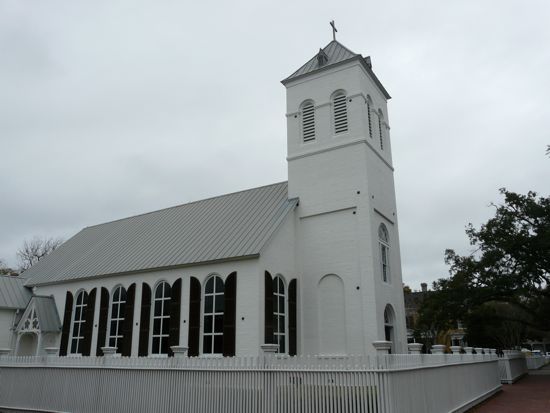

The concerts take place once a month, Wednesdays at noon, and are FREE. There is a donation container in the entry at Christ Church but there is no one shaking it or looking at you meaningfully. If you can’t make a donation, the donation police are not going to hunt you down.
Meanwhile, if you show up for these concerts, you are in for a treat. The Director of the chamber music program, Hedi Salanki-Rubardt, gives her students a lot of leeway, and a lot of inspiration, and you can see they truly love what they are doing, and enjoy being a part of the program.
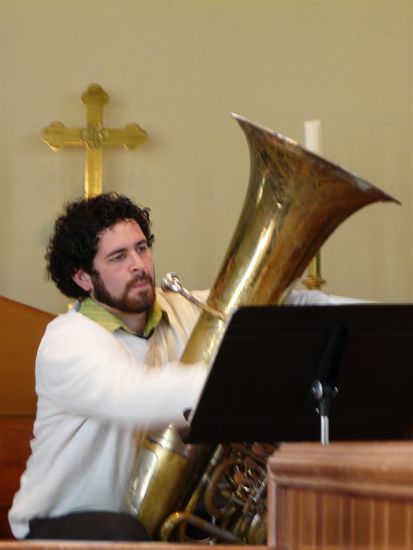
Giustino Carrano – tuba
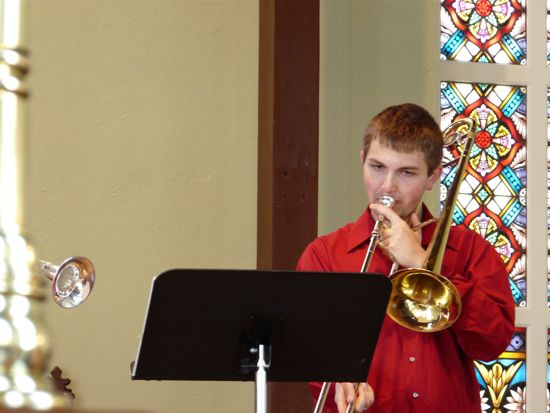
Matthew DeDowell – trombone
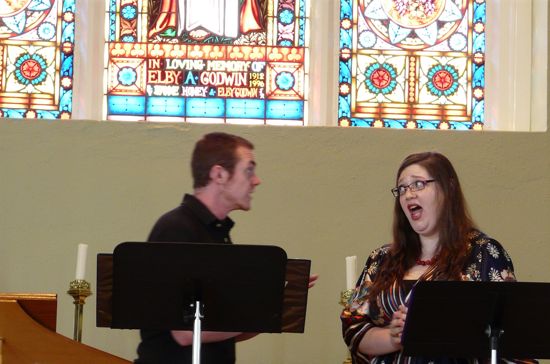
Allison Gilliard- soprano Marshall Corzette – baritone
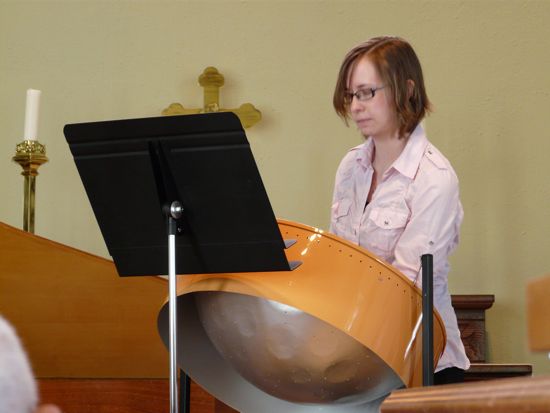
Lynsey Boothe – steel drum
You don’t usually think of a steel drum as a traditional chamber music instrument, but Hedi Salanki played the harpsichord, and Lynsey Boothe played the steel drum and they rocked Vivaldi. It was a lot of fun.
Recent Comments
intlxpatr on Shampoo Ginger tigerbutterya0c5ff1d… on Shampoo Ginger intlxpatr on British Soldier Kidnapped, Esc… John on British Soldier Kidnapped, Esc… intlxpatr on British Soldier Kidnapped, Esc… Wikipedia Donate Button

Amazina


Early Voting in Florida


