They sign up for Hunger Games and get domestic drudgery and uber-control:
From Associated Press via Huffpost
PARIS (AP) — When three British schoolgirls trundled across the Syrian border; when a pregnant 14-year-old ran away from her Alpine home for the second time; when a sheltered girl from the south of France booked her first trip abroad — they were going to a place of no return.
Only two of the approximately 600 Western girls and young women who have joined extremists in Syria are known to have made it out of the war zone. By comparison, as many as 30 percent of the male foreign fighters have left or are on their way out, according to figures from European governments that monitor the returns.
In interviews, court documents and public records, The Associated Press has compiled a detailed picture of European girls and young women who join extremists such as the Islamic State group — a decision that is far more final than most may realize.
The girls are married off almost immediately, either in Turkey or just after crossing into Syria. With an estimated 20,000 foreign fighters — among them 5,000 Europeans — in Syria, there is no shortage of men looking for wives. That number is expected to double by the end of the year. Once among the jihadis, the women are not permitted to travel without a male chaperone or a group of other women and must remain fully covered outside, according to material published by Islamic State and researchers who follow the group. Otherwise, they risk a lashing or worse.
European women who blog about their lives under Islamic State tend to be chipper about the experience, but reading between the lines of an e-book of travel advice shows a life that will be radically circumscribed, with limited electricity, lack of even the most basic medicine, and practically no autonomy. Women do not fight, researchers say, despite the Hunger Games-like promises of recruiters.
“The lives of those teenage girls are very much controlled,” said Sara Khan, a British Muslim whose group Inspire campaigns against the dangers of extremist recruiters. “I don’t think that discussion ever comes up. It’s so romanticized, the idea of this utopia. I don’t even think those young girls have necessarily considered that there’s no way back now.”
The two exceptions to the rule of no return are perhaps most revealing in the very paucity of details about their journey — driving home how murky life is behind the Islamic State curtain.
Sterlina Petalo is a Dutch teenager who converted to Islam, and came to be known by the name Aicha. She traveled to Syria in 2014 to marry a Dutch jihadi fighter there and managed to return months later — apparently making her way to the border with Turkey, where her mother reportedly picked her up and brought her back to the Netherlands. Back home, she was immediately arrested on suspicion of joining a terror organization.
Her family, lawyers and prosecutors refuse to discuss the case. She was released from custody last November and has not been formally charged.
The second woman known to have made it out of the grip of Islamic State reconsidered after just a few weeks. The 25-year-old Briton, whom police have not named, had taken her toddler son all the way to Raqqa, the group’s stronghold, when she decided she had made a mistake and called home. She made her way back into Turkey and her father met her there. How she was able to travel the 250 kilometers (150 miles) from Raqqa to the Turkish border city of Gaziantep is not clear. Back in Britain, she was detained and is now free on bail pending formal charges.
Without knowing how the two escaped, it is difficult to say whether other girls and women could follow their path out of Syria, said Joana Cook, a researcher at King’s College London who studies the links between women and jihad.
“There are clearly many human smugglers working within Syria right now, helping Syrian civilians escape the violence, and I wonder if there is a similar, perhaps even growing market, for those trying to escape after joining ISIL,” Cook told The Associated Press in an email, using one of the acronyms for the Islamic State group. “There is great disillusionment for many who have traveled to Syria to join ISIL and you’ll find many stories of those who went abroad noting ‘this isn’t what we signed up for.'”
The question is whether the girls understood from the beginning how limited their choices would be once they crossed the frontier.
The case of a 15-year-old Avignon girl exemplifies such doubts. The girl hid her second Facebook account and Islamic veil from her moderate Muslim family, thereby managing to join a jihadi network, according to the family’s lawyer. Once within a unit of the al-Qaida offshoot Nusra Front, she was not permitted to leave, according to her brother, who went into Syria to fetch her and was turned away by the extremists. A French boy who joined the group around the same time was allowed to go home.
“I think they understand the premise of that, but not that they understand it in reality,” said Melanie Smith, another researcher at King’s College ICSR.
The networks that bring the women into Syria are increasingly organized around the extremists’ dream of building a nation of multinational jihadis, meaning European girls are particularly prized. Each new Facebook post, each new cheerleading Twitter account — and they pop up by the hour — helps them subvert government efforts to prevent young people from radicalizing and leaving.
The doggedness of jihadi methods for recruiting girls can be seen in the case of Amelia, a 14-year-old girl from France’s Alpine Isere region.
Amelia was first contacted on Facebook by a French fighter on Jan. 14, 2014 and within a month agreed to go to Syria and marry the man, who identified himself as “Tony Toxiko.” After she was turned back by airport border police in Lyon on her first attempt, “Tony Toxiko” persuaded another French adolescent girl to join him in Syria.
Amelia, meanwhile, ran away from home to Belgium, where an imam performed a religious ceremony that wed her to a different man, an Algerian jihadi. She returned to France homesick and pregnant, just long enough to speak to investigators building a case against a middleman who helped her run away. This winter, Amelia managed to deceive her family and left again — making it to Syria with the Algerian fighter, who is more than twice her age.
“It’s particularly difficult for these families. For them, radicalization is happening on the Internet and outside the family sphere,” said Sebastien Pietrasanta, a French lawmaker working on a program to de-radicalize young people. “For a girl of 14, I believe we can clearly save her from herself and save her from these barbarians.”
A French journalist got dangerously close to jihadi recruitment methods by creating a fake Facebook account that attracted a marriage proposal from a fighter in Syria.
Under the pseudonym Melodie, the journalist shared a video on the account, almost immediately getting a message from a man identified as Bilel, who asked how she’d liked the montage of him showing off in a 4X4 and with his weapons.
“I passed myself off as a 20-something, not stupid but a little lost, who suddenly found a huge response from a man in Syria,” said the journalist, who wrote a book “In the Skin of a Jihadist” under a pseudonym.
Bilel’s doubts about her began to grow as her reluctance to join him became clear. She ended up getting threats that she said would likely frighten a bewildered young woman into submission. As it was, the journalist, who never met Bilal in person, remains under constant police protection a year later.
“We’ll find you, we have the best operators here, you don’t know what you’re getting into, you’re messing with a terrorist group, you and your family will pay,” the woman said, recounting the litany of threats she received after returning to France. “If they were speaking to a 20-year-old, it would be very hard for her.”
___
Associated Press writer Mike Corder in Amsterdam contributed.
There is a huge problem with the Cabrillo Lighthouse hike, and it is obvious from the very beginning. It is only a half mile, and it is downhill all the way.
What’s the problem, you might ask?
Well, if it is downhill all the way getting there, then coming back, it will be a half mile all . . . . What? You fill in the blank.
But it is another gorgeous day on the California sea coast, and it is a glorious day for a hike, even uphill.
There is a wonderful story about a man who came to take the lighthouse keeper position, but he wasn’t married and only married keepers were allowed to live in the lighthouse keeper’s house. So a local girl – maybe the daughter of the previous lighthouse keeper – volunteered to marry him, and they stayed married the rest of their lives.
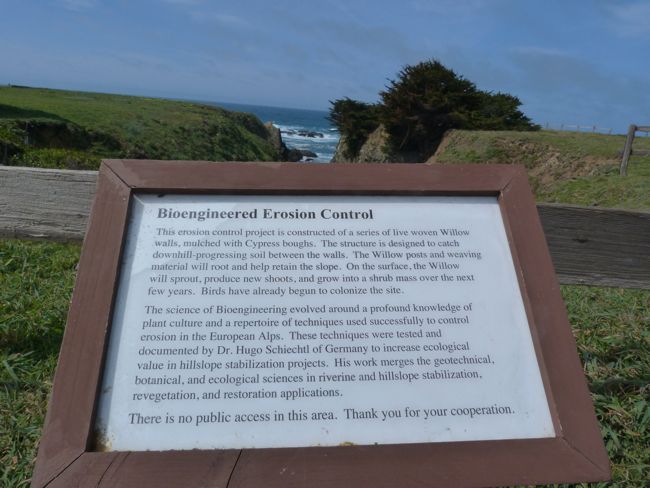
I love using natural means to bioengineer against erosion loss:
And, on the way back, yes, uphill all the way, we come across some very calm deer, not worried in the slightest by the steady trickle of visitors on the nearby path:
. . . says AdventureMan, as he takes me to lunch and to a movie on Valentine’s Day.
It’s a perfect stretch, from my birthday to Valentine’s Day. AdventureMan bought the beautiful white roses at Celebrations, a wonderful shop in Pensacola. What I love the most is that the flowers they use last and last. My flowers, more than a week old now, are just beginning to droop, just a tiny bit. They are still unspotted and unstained, glorious in their pristine whiteness, glowing in our foyer. I still feel the glow. 🙂
My sweet son and daughter-in-law invited us for a shared birthday dinner and we had a wonderful, laughter-filled time, talking books, talking kids, laughing, laughing, and the 1 1/2 year old is starting to really talk and to get the convenience of oral communication. She wants to be a part of everything! The birthday boy and I had a wonderful time, tickling and laughing and sharing jokes. It was a great evening.
Lunch was in Gulf Breeze, at Rotolo’s, where they have great salads and thin crust pizzas, and then we went to see the spellbinding (if you are a nerd and love complex thinking) Imitation Game, which we both enjoyed thoroughly. We are so totally geeks; this was the perfect Valentine’s Day movie for us.
Who knew that growing older could have so many joys? I sure didn’t. I dreaded growing old, leaving a life of adventures behind. I had NO idea.
I recently had a birthday. On my birthday, I had a new group in town, and I was taking them around to their appointments. It’s always hard, the first day, connecting with a group who has been together for a while, but the structure carries it, and the day went smoothly.
When my itinerary and biographies were delivered, I also got a birthday gift from the best boss, ever. I’ve been with them as a volunteer for almost five years now, and they gave me a silver name tag – beautiful! with a magnetic back, so it doesn’t ruin my silk blouses. They also gave me a box of my own business cards, even though I am “just” a volunteer.
The biggest gift, though, was the gift of their trust.
In my innermost mind, I sometimes hear voices. These voices are harsh. They say things like this:
“What do YOU know about government and politics and how they work?”
“Who do you think you are?”
“What makes you think you’re so special?”
These are the malicious voices that will make me cower in fear, will make me turn down opportunities, voices that make me doubt myself.
My boss asked me in December to take this particular group. I’ve taken several groups before, often enough that it’s not a big deal, but this time had a twist – she would be out of town, so would her deputy; I would be “it.”
I heard the voices. I hesitated, but only briefly. They trust me to do a good job, in their eyes, I can do it. In my most rational mind, I know better than to listen to those voices that would tear me down and undermine my confidence, and it really helps to have the trust of those with whom I work on a regular basis to counter those voices who would have me keep my head down, stay in my place. I am in my place. I am doing what I was created to do.
So it was more than the beautiful silver name-tag and the cards, it was the expression of trust that I would handle any problems that came up (I did) and that trust was a wonderful confirmation of who I am and of what I am capable.
We had a very good day, this group and I. When I got home, there was a huge bouquet of white roses waiting for me; my sweet husband knows what I love. I was over the moon, and he said “I really really wanted to throw in a red rose or two because I love them, but I know YOU love white roses” and that was the second wonderful gift of the day, that he would buy me beautiful roses, the kind I like, not the kind he though I should like. 🙂
He also took me out for Chinese take-out, not his favorite thing, but one of my favorite comfort food kind of things, and it turned out to be surprisingly good, especially for Pensacola where we all bemoan the lack of really really good Chinese food. Every dish was really good, exceeding our expectations.
Then, we got a call from our son and his family, off on their own grand adventure, and my little just-five-year-old grandson sang to me “Happy Birthday to you,” and totally made my day.
The next night we went to Seville Quarter and had this wonderful steak they serve, on top of a crusted mashed potato-garlic-cheese combination, with a fabulous sauce that reminded us of France, and grilled asparagus. Still my birthday 🙂
There are things that matter, and things that don’t. I suspect I will hear those harsh voices as long as I live, and I thank God for all the countering experiences and voices which have shown those demeaning voices to be false – and meaningless. Living my life in the best way I know – that is a gift. Being surrounded by those who value me and encourage me and love me and who lift me when I stumble and say “You CAN do it!” That’s a gift. Having a sweet family who love me genuinely, and value me – that is a gift. Having work to do that is worth doing – that is a gift. Having a husband who cares what I like, who encourages and supports me and makes me laugh – I am so blessed.
Every now and then, after all these years, I can still crack my husband up by saying something unexpected.
Retirement carries some unexpected adjustments. There was a time, when he was managing a major contract in Germany, where over dinner, I once told AdventureMan I needed him to look at me and to listen. He looked at me in horror; he told me later he thought I was leaving him. No. No. I just looked at him and told him that I am very independent, but that at least once, every single day of our lives together, I need five minutes of his undivided attention.
“Five minutes isn’t much,” he said to me.
“Five minutes is more than I am getting now,” I responded. I knew he was busy, and under a lot of stress, but relationships require nurturing, and I knew I could get by on five minutes, as long as I could count on that five minutes to stay connected.
Now, years later, the shoe is on the other foot. AdventureMan LOVES retirement, and he comes into my office all the time to tell me about a new Tiger Swallowtail in his garden, or to update me on our financial worth, or to use me as a sounding board for a political item that has come up in his garden club.
There are times I need focus. All the years we were married, I had that time, and more, I had all this time to myself, and I learned how to fill and manage my time. I rarely had to coordinate anything with AdventureMan, he just trusted me to manage the house and finances and making sure everything was in its place.
Once he had time, I had to learn how to share my time. I also had to let go of a lot of control. The first time he organized and cleaned out the garage, I almost had a heart attack. He was so proud! And I was so horrified! I am very logical, and more than a little compulsive, and I knew where everything was, in its logical place, and now . . . things were, very literally, out of control. A part of me wanted to kill him, and another part of me said “hey, cool, now you don’t have to clean out the garage, he he he” but making that gain meant giving up control over where things were!
AdventureMan started cooking, and suddenly pots and pans and measuring spoons were not where they were “supposed” to be. AdventureMan took over the garden, and I danced for joy at not having to go out and water in the heat, but I lost control over what was planted out there.
It’s hard. We are both managers, and both very good at it. We’ve had to draw some lines. I’ve had to share territory I always thought of as mine, and he has had to consult with me, when he would much rather carry out his plans directly.
We’ve both had to draw some lines. We don’t touch stuff in one another’s offices. We consult. When I clean out the pantry, the first thing I do is show him the logic, even put little signs so he will know where to find things when he is cooking. I put up with things ending up in the wrong place, except for the spice drawers, where all the normal cooking herbs and in spices are in the left drawer and all the chilis and peppers and exotic herbs are in the right drawer, with all the teas. It can be irrational, but sometimes it is the smallest things that matter.
From time to time, I need a pocket of silence.
I welcome my sweet husband into my office; he is always welcome. From time to time, however, if I am working on paying bills or a blog post or designing a quilt, or trying to get my readings done for my bible study, I tell him I can listen for five minutes, and then I need a pocket of silence.
The first time I said it, he looked at me in horrified disbelief, what I was saying was so astonishing to him that he couldn’t even take it in. Once he comprehended, he started laughing, and now he tells his friends he has a wife who needs her “pockets of silence” – and I do. As he has become more relaxed and stress free, he has become chattier. As I live a life of commitments and connections in retirement, I need some times with no talking.
I need silence in my life the way some people need to be around other people hanging out. Silence refreshes me. Silence helps me focus, helps me think things through and develop a strategy. I am never bored with silence; for me silence is a resource I use with great respect and gratitude. I love my family and my friends, and then – I need a pocket of silence.
We’ve had an unconventional road, AdventureMan and I, with all our moves, and most of our lives spent outside our own country. We celebrate 41 years this weekend, and AdventureMan asked me where I wanted to go.
“How about Alaska?” I joked, since we have a trip planned there, and we will be going to lots of fun places. He’s used to my answers, my non-sequitors. He asked me if I wanted a diamond, and I laughed and said, “no, just let me buy houses.” We’ve done well.
“No! To eat on our anniversary!” AdventureMan protests, knowing I can draw a celebration out for days or even weeks.
He named off a couple really nice restaurants and I said “I want to go out to Nine Mile Road.”
He just laughed. We both love this little seafood restaurant he discovered, the Seafood Platter Deli, sometimes called the Gulf Coast Seafood Deli. It is unique, the food is fantastic, it’s this genuine little place not like any other place I have ever been. It has a podium by the huge chalkboard menu on the wall, and on the podium is a book where clients write their prayer requests. Every morning, before they open the restaurant, the staff prays together.
I am awed by this. It blows me away. We live in such earthly times; few people are really focused on practicing their faith. We are all so tempted by the bread and circuses offered by our consumer-driven culture.
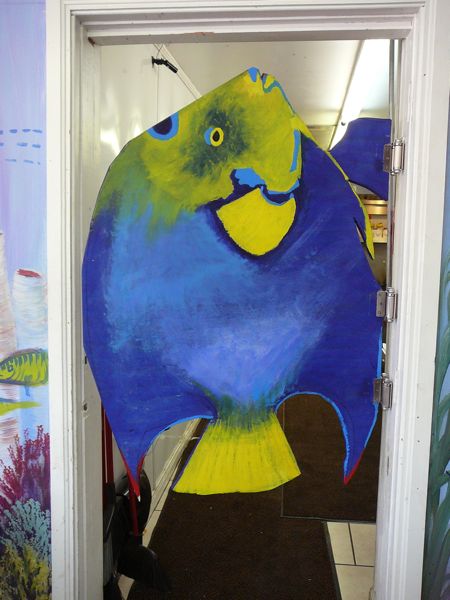
The last time we were there, they had added new doors to the kitchen. No, I wouldn’t want them in my house, but for a seafood restaurant? They are perfect, somebody went to a lot of trouble to make these doors.
“I was hoping you would want to go there,” AdventureMan admitted, and we grinned. There’s a reason we’ve been married this long; we take the road less travelled – together.
Pregnant Pakistani woman stoned to death by family
May 27th 2014 3:29PM
Pakistan
Mohammad Iqbal, right, husband of Farzana Parveen, 25, sits in an ambulance next to the body of his pregnant wife who was stoned to death by her own family, in Lahore, Pakistan, Tuesday, May 27, 2014. Nearly 20 members of the woman’s family, including her father and brothers, attacked her and her husband with batons and bricks in broad daylight before a crowd of onlookers in front of the high court of Lahore, police investigator Rana Mujahid said. (AP Photo/K.M. Chaudary)
LAHORE, Pakistan (AP) – A pregnant woman was stoned to death Tuesday by her own family outside a courthouse in the Pakistani city of Lahore for marrying the man she loved.
The woman was killed while on her way to court to contest an abduction case her family had filed against her husband. Her father was promptly arrested on murder charges, police investigator Rana Mujahid said, adding that police were working to apprehend all those who participated in this “heinous crime.”
Arranged marriages are the norm among conservative Pakistanis, and hundreds of women are murdered every year in so-called honor killings carried out by husbands or relatives as a punishment for alleged adultery or other illicit sexual behavior.
Stonings in public settings, however, are extremely rare. Tuesday’s attack took place in front of a crowd of onlookers in broad daylight. The courthouse is located on a main downtown thoroughfare.
A police officer, Naseem Butt, identified the slain woman as Farzana Parveen, 25, and said she had married Mohammad Iqbal, 45, against her family’s wishes after being engaged to him for years.
Her father, Mohammad Azeem, had filed an abduction case against Iqbal, which the couple was contesting, said her lawyer, Mustafa Kharal. He said she was three months pregnant.
Nearly 20 members of Parveen’s extended family, including her father and brothers, had waited outside the building that houses the high court of Lahore. As the couple walked up to the main gate, the relatives fired shots in the air and tried to snatch her from Iqbal, her lawyer said.
When she resisted, her father, brothers and other relatives started beating her, eventually pelting her with bricks from a nearby construction site, according to Mujahid and Iqbal, the slain woman’s husband.
Iqbal said he started seeing Parveen after the death of his first wife, with whom he had five children.
“We were in love,” he told The Associated Press. He alleged that the woman’s family wanted to fleece money from him before marrying her off.
“I simply took her to court and registered a marriage,” infuriating the family, he said.
Parveen’s father surrendered after the attack and called his daughter’s murder an “honor killing,” Butt said.
“I killed my daughter as she had insulted all of our family by marrying a man without our consent, and I have no regret over it,” Mujahid, the police investigator, quoted the father as saying.
Mujahid said the woman’s body was handed over to her husband for burial.
The Human Rights Commission of Pakistan, a private group, said in a report last month that some 869 women were murdered in honor killings in 2013.
But even Pakistanis who have tracked violence against women expressed shock at the brutal and public nature of Tuesday’s slaying.
“I have not heard of any such case in which a woman was stoned to death, and the most shameful and worrying thing is that this woman was killed outside a courthouse,” said Zia Awan, a prominent lawyer and human rights activist.
He said Pakistanis who commit violence against women are often acquitted or handed light sentences because of poor police work and faulty prosecutions.
“Either the family does not pursue such cases or police don’t properly investigate. As a result, the courts either award light sentences to the attackers, or they are acquitted,” he said.
Sudanese woman may face death for choosing Christianity over Islam
KHARTOUM: A Sudanese court gave a 27- year-old woman until today to abandon her newly adopted Christian faith and return to Islam or face a death sentence, judicial sources said on Monday. Mariam Yahya Ibrahim was charged with apostasy as well as adultery for marrying a Christian man, something prohibited for Muslim women to do and which makes the marriage void. The final ruling will be announced today.
Ibrahim’s case was the first of its kind to be heard in Sudan. Young Sudanese university students have mounted a series of protests near Khartoum University in recent weeks asking for an end to human rights abuses, more freedoms and better social and economic conditions.
The authorities decided on Sunday to close the university indefinitely. Western embassies and Sudanese activists sharply condemned the accusations and called on the Sudanese Islamist-led government to respect freedom of faith. “The details of this case expose the regime’s blatant interference in the personal life of Sudanese citizens,” Sudan Change Now Movement, a youth group, said in a statement.
President Omar Hassan Al-Bashir’s government is facing a huge economic and political challenge after the 2011 secession of South Sudan, which was Sudan’s main source of oil. A decision by Bashir last year to cut subsidies and impose austerity measures prompted violent protests in which dozens were killed and hundreds were injured. — Reuters
This is what I love about New Yorker magazine: they print stories no one prints, they follow stories that need following. They lead, and they do their job, alerting us to issues that matter. My heart goes out to the families, Christian and Muslim, of these girls who were abducted because they were being educated. Boko Haram believes educating women goes against Islam. Someone should read them a Quran.
“I thought it was the end of my life,” Deborah Sanya told me by phone on Monday from Chibok, a tiny town of farmers in northeastern Nigeria. “There were many, many of them.” Boko Haram, an Islamist terrorist group, kidnapped Sanya and at least two hundred of her classmates from a girls’ secondary school in Chibok more than two weeks ago. Sanya, along with two friends, escaped. So did forty others. The rest have vanished, and their families have not heard any word of them since.
Sanya is eighteen years old and was taking her final exams before graduation. Many of the schools in towns around Chibok, in the state of Borno, had been shuttered. Boko Haram attacks at other schools—like a recent massacre of fifty-nine schoolboys in neighboring Yobe state—had prompted the mass closure. But local education officials decided to briefly reopen the Chibok school for exams. On the night of the abduction, militants showed up at the boarding school dressed in Nigerian military uniforms. They told the girls that they were there to take them to safety. “They said, ‘Don’t worry. Nothing will happen to you,’ ” Sanya told me. The men took food and other supplies from the school and then set the building on fire. They herded the girls into trucks and onto motorcycles. At first, the girls, while alarmed and nervous, believed that they were in safe hands. When the men started shooting their guns into the air and shouting “Allahu Akbar,” Sanya told me, she realized that the men were not who they said they were. She started begging God for help; she watched several girls jump out of the truck that they were in.
It was noon when her group reached the terrorists’ camp. She had been taken not far from Chibok, a couple of remote villages away in the bush. The militants forced her classmates to cook; Sanya couldn’t eat. Two hours later, she pulled two friends close and told them that they should run. One of them hesitated, and said that they should wait to escape at night. Sanya insisted, and they fled behind some trees. The guards spotted them and called out for them to return, but the girls kept running. They reached a village late at night, slept at a friendly stranger’s home, and, the next day, called their families.
Sanya could not tell me more after that. She is not well. Her cousins and her close friends are still missing, and she is trying to understand how she is alive and back home. All she can do now, she said, is pray and fast, then pray and fast again.
The day after the abduction, the Nigerian military claimed that it had rescued nearly all of the girls. A day later, the military retracted its claim; it had not actually rescued any of the girls. And the number that the government said was missing, just over a hundred, was less than half the number that parents and school officials counted: according to their tally, two hundred and thirty-four girls were taken.
In the wake of the military’s failure, parents banded together and raised money to send several of their number into the forest to search for the girls. The group came across villagers who persuaded the parents to turn back. They told the parents that they had seen the girls nearby, but the insurgents were too well armed. Many of the parents had just bows and arrows.
***
The circumstances of the kidnapping, and the military’s deception, especially, have exposed a deeply troubling aspect of Nigeria’s leadership: when it comes to Boko Haram, the government cannot be trusted. Children have been killed, along with their families, in numerous Boko Haram bombings and massacres over the past five years. (More than fifteen hundred people have been killed so far this year.) State schools and remote villages in the north have borne the brunt of Boko Haram’s violence this year. The group is believed to be at least partly waging a campaign against secular values. The kidnapped girls were both Christian and Muslim; their only offense, it seems, was attending school.
Last June, I visited Maiduguri, the capital of Borno state and the birthplace of Boko Haram, to report on the insurgency and the Nigerian government’s counteroffensive, a security operation that placed three northeastern states, including Borno and Yobe, under a state of emergency as troops launched attacks on terrorist hideouts and camps. The military cut phone lines and Internet access, and, while residents were glad for the intervention, there was a sense of living in the dark. Gunshots, a bomb blast: was it Boko Haram or a military attack? Were the hundreds of men disappeared by the military actually terrorists—even the young boys? And was the government, as it claimed, really winning the war?
The military has restored phone lines in Borno. But the sole airline that flew to Maiduguri cancelled the route at the end of last year. The road to Chibok is so hazardous that Borno’s governor visited the town with a heavy military escort. Much of the northeast is now physically isolated. What is happening there that we cannot see?
Nigerians in the rest of the country had, until recently, been able to ignore the deaths. The general mood has been one of weary apathy—from a government waging a heavy-handed crackdown on northerners to civilians far removed from the chaos. That mood may finally change.
***
Sanya’s father, a primary-school teacher named Ishaya Sanya, is struggling with conflicting emotions: gratitude that his daughter has returned to him; guilt that the daughters of his siblings, friends, and neighbors are still somewhere in the bush; and an angry frustration that there seemed to be no effort to rescue the girls.
“We don’t know where they are up until now, and we have not heard anything from the government,” he told me. “Every house in Chibok has been affected by the kidnapping.” The only information that the families had been able to gather about the kidnapped girls, he went on, was from the girls who had escaped.
He remembers the exact time that Deborah appeared in front of him after her escape—4:30P.M.—and how he felt: “very happy.” But his despair soon returned. “Our area has been affected very seriously,” he told me. Parents had fallen physically ill, and some were “going mad.”
The military’s current plans are unclear; the Chibok parents hope that it is acting swiftly and cautiously. There is worry, too, that a rescue operation could result in the deaths of many of the girls; this happened during a previous attempted rescue, of two Western engineers kidnapped by Boko Haram. Last week, a military spokesman, Brigadier-General Chris Olukolade, said only that the search for the girls had “intensified.”
In the meantime, as in so many other ways in Nigeria, each community has to fend for itself. For a while after the abduction, girls trickled back into town—some rolled off trucks, some snuck away while fetching water. That trickle has stopped. “Nobody rescued them,” a government official in Chibok said of the girls who made it back. “I want you to stress this point. Nobody rescued them. They escaped on their accord. This is painful.”
A pastor in Chibok whose daughter is missing told me that he set out with friends on the morning after the abduction to find the girls. “I was forced to come home empty-handed,” he told me by phone. “I just don’t know what the federal government is doing about it. And there is no security here that will defend us. You have to do what you can do to escape for your life.”
I asked the pastor about rumors that Boko Haram has taken the girls outside of Nigeria’s borders, into Cameroon and Chad, and forcibly married them. He paused, and then said, “How will I be happy? How will I be happy?”
Four students walk in Chibok following their escape from Boko Haram. Photograph by Haruna Umar/AP.










 “I thought it was the end of my life,” Deborah Sanya told me by phone on Monday from Chibok, a tiny town of farmers in northeastern Nigeria. “There were many, many of them.” Boko Haram, an Islamist terrorist group, kidnapped Sanya and at least two hundred of her classmates from a girls’ secondary school in Chibok more than two weeks ago. Sanya, along with two friends, escaped. So did forty others. The rest have vanished, and their families have not heard any word of them since.


 Here There and Everywhere