The Macaroni Grill in Pensacola, FL
For the most part, AdventureMan and I stay away from national chains. One time in the last couple of years we tried Olive Garden, and, like many of the chains, they had gone to using “pre-formed” meats – how do you think they got all those dishes to look so uniform?
But Macaroni Grill is – or was, it’s all unclear now – a part of the Outback Chain, and Outback will always have a place in my heart because of their open-handed support when I worked for an educational foundation, raising money for scholarships. They were a joy to work with, and so generous to our scholarship recipients.
So we decided to give the Macaroni Grill a try. Here is what the entry at the Cordova Mall looks like.

I had the Caesar Salad, which was very good, fresh, great dressing:

I also had the Chicken Marsala, which had three chicken cutlets, real chicken, not pre-formed, not identical, with angel hair pasta. The Marsala sauce had barely a hint of Marsala, but it was pretty good. I’d prefer a little more Marsala taste. It was plentiful, and I had enough left over for dinner, too.

AdventureMan had the lasagna, which he said was really good! His portion was so huge, he also had enough for dinner and I don’t think he was able to finish it, there was so much.

Service was prompt and efficient. We asked the server if all the food was prepared here, or prepared elsewhere and sent semi-prepared, and she said, with great pride, that all the food was prepared daily, on-site. You could see into the open kitchen, and chefs and assistants were back there busily preparing meals – all a good sign.
We probably won’t go back, just because there are two or three other Italian places in town we like better, but it is a perfectly decent restaurant with above average food, very clean, good service and convenient if you are at the Cordova Mall.
“Give Me Your Tired, Your Poor . . . “
Who are we?
I’m listening to a heartbreaking discussion on National Public Radio’s Diane Rehm show about the masses of children heading toward the southern border of the United States.

Anti-immigration is nothing new, not in the United States, not in newer countries. It is shocking to me, however, that people who came from somewhere else are so strongly opposed to allowing these desperate children in. If they are running for our border – and they are – they are desperate. They are desperate to escape violent death, and death by starvation, death of the spirit eeking out a living day to day.
“They come here for a hand-out!” is the most common complaint.
Read your American history. Very few immigrants – your ancestors, American citizens – arrived with money. Most relied on friends, family, the immigrant community, social services – whatever they needed to survive until they could get on their feet.
And get on their feet they did. Immigrants to America come here to work hard, believing that working hard will give them a chance at a better life. Your ancestors and mine – they came and worked hard, scraping together the money to build a business and/or to send their kids to schools. If you’ve ever attended a citizenship ceremony, you will love the jubilation. They don’t want a handout. They want a chance at building a decent life.
So now it’s “I’ve got mine, go back where YOU belong?”
When I grew up, not even in the United States proper, but in a U.S. territory, we sang a wonderful song, from a poem by Emma Lazarus, The New Colossus, which is on a plaque on the Statue of Liberty:

Not like the brazen giant of Greek fame,
With conquering limbs astride from land to land;
Here at our sea-washed, sunset gates shall stand
A mighty woman with a torch, whose flame
Is the imprisoned lightning, and her name
Mother of Exiles. From her beacon-hand
Glows world-wide welcome; her mild eyes command
The air-bridged harbor that twin cities frame.
“Keep, ancient lands, your storied pomp!” cries she
With silent lips. “Give me your tired, your poor,
Your huddled masses yearning to breathe free,
The wretched refuse of your teeming shore.
Send these, the homeless, tempest-tost to me,
I lift my lamp beside the golden door!”
I’ve never forgotten those words we all sang as children. The immigrant flows into America are our life-blood. You can keep your stale traditions and meaningless pomp, she cries, send me those willing to work hard and yearning for freedom.
How can we refuse CHILDREN seeking asylum? Each child we feed, house and educate will have a chance to become contributing citizens. The face of our nation is changing, has already changed greatly and will continue to change, and what we choose today will have a critical effect on what our society will look like tomorrow.
Do we still yearn for liberty for all? Do we want a highly stratified society where some are born to high paying jobs and others relegated to trades (I’ve seen how this works in another country; it’s stultifying.) Restricting access to all that we enjoy will create a wholly different society, a zero-sum-game society, where your loss is my gain, instead of an everyone wins society, where my success lifts you, too. Our country thrives on the creation of wealth; ideas are generated, resources and labor pools are created, they are not finite, they transition. Immigrants fuel the kind of innovation and population flow that keeps the lifeblood of our country flowing.
My family has been in the US a long time. We qualify as daughters-of-just-about-everything. We were immigrants; we were not native-born. The entire United States, other than the First People, are immigrants. We are immigrants, all of us. It makes us strong.
Springhill Suites University Lake in Anchorage, AK
Who knows why we book a hotel we do? Most of the time, I go to TripAdvisor, and see what other people like. Normally, we eliminate larger hotels and look for something smaller and more private. If we are going to stay in a chain we usually go to a Marriott Residence Inn. This Springhill Suites was one of the top rated, and while it was not near the airport, we knew it was an easy drive to the airport, so we booked.
When we arrived, we found we really like Anchorage. AdventureMan said it reminds him a lot of Seattle; it still has a lot of buildings that look about a hundred years old, and then a lot of sprawling growth, with mountains in the distance and a great shoreline and harbor.
The hotel room they had given us was on the first floor, so we asked for something higher. The room they gave us was lovely, but right by the elevator, so we went in to give it a try before we accepted. It was silent. The rooms are SO well insulated we didn’t even hear other doors opening and closing. It was QUIET.
It was also uncluttered, beautiful and serene. We had wifi and we had a working area and a small kitchen area with a fridge, microwave and even paper plates and utensils supplied, along with, thank God, a coffee maker.
The toilet had its own separate compartment, and the washbasin and beautiful huge shower were in another separate room. We overlooked a small lake where people were walking around, running around and walking their dogs. It was lovely. Off in the near distance, we had mountains. We really liked the room.


As we were leaving for dinner that night, I noticed that the bus had an interesting marking:


We don’t know if the bus was owned by the Inupiat people, or they own this Marriott hotel franchise, which is very near the Alaska Native Hospital, but many of the workers were Alaska Natives. (There is a difference; I am a Native Alaskan, i.e. I was born there, but I am not an Alaska Native, who are the original inhabitants. Sometimes, on government forms, I am tempted to check the block for Alaska Native, but . . . I resist. I overcome that little mischevous demon who leads me into temptation.)
“The Love of Many Will Grow Cold”
Towards the end, as Jesus talks about the end-of-times, he says that because of lawlessness, the love of many will grow cold. (Deep sigh) We even have a name for it now, compassion fatigue, where good people get tired of trying and giving in the face of so much need. In Pensacola, we have children dying from negligence, young men dying from street violence, many dying from car accidents, and many suicides. It is stunning and it is discouraging.
Jesus tells us to hang in there, not to give up. Only with his help can we hope to do this.
This is from our Lectionary Readings for today:
Matthew 24:1-14
24As Jesus came out of the temple and was going away, his disciples came to point out to him the buildings of the temple. 2Then he asked them, ‘You see all these, do you not? Truly I tell you, not one stone will be left here upon another; all will be thrown down.’
3 When he was sitting on the Mount of Olives, the disciples came to him privately, saying, ‘Tell us, when will this be, and what will be the sign of your coming and of the end of the age?’ 4Jesus answered them, ‘Beware that no one leads you astray. 5For many will come in my name, saying, “I am the Messiah!”* and they will lead many astray. 6And you will hear of wars and rumours of wars; see that you are not alarmed; for this must take place, but the end is not yet. 7For nation will rise against nation, and kingdom against kingdom, and there will be famines* and earthquakes in various places: 8all this is but the beginning of the birth pangs.
9 ‘Then they will hand you over to be tortured and will put you to death, and you will be hated by all nations because of my name. 10Then many will fall away,* and they will betray one another and hate one another. 11And many false prophets will arise and lead many astray. 12And because of the increase of lawlessness, the love of many will grow cold. 13But anyone who endures to the end will be saved. 14And this good news* of the kingdom will be proclaimed throughout the world, as a testimony to all the nations; and then the end will come.
The Qatari Cat Gets a New Knee
******* WARNING ********* WARNING **********
If you are squeamish at all, do not read this blog post or look at the last photo, which is graphic.
****** END WARNING *********************
Qatari Cat Before

The Qatari Cat is home now, quiet and relaxed, stretched out in his favorite area. The Vet told us, as he scratched his head, that they would really like to keep him for another day, but he wasn’t acting normally. He’s all groaning and moaning and biting anything around him. They were at their wit’s end, and hated to see him so unhappy. Did we want to leave him or did we think he might be better at home?
We didn’t hesitate.
“We’ll take him home,” we said, knowing home is a quiet, safe place where the Qatari Cat can calm down and focus on healing.
Who knew? Who knew cats could bust their anterior crucial ligament? Who knew that it doesn’t repair itself, and that it would put stress on the other leg and that one would eventually tear, too?
We are learning all the time. In the old days, cats didn’t live long enough to get diabetes, to need a knee replacement. Cats went outdoors and had fatal run ins with cars, or racoons, or bad dogs, or mean people, or poisons. We’ve had five other cats in our lives together, and the Qatari Cat is the one we expected would not live so long, a tiny little street-cat with an infection when adopted.
We’ve kept him indoors (except for the rare instances, in Qatar, when he escaped, but not for long). Once, when he escaped, he climbed a tree. It was a very skinny tree, and as the wind blew and he got frightened, he kept climbing higher, until he was swaying back and forth, back and forth, and yowling at the top of his voice in pure panic.
Good thing he had that set of lungs, so I could find him. It took me another hour to talk him down out of that tree. “Qatari Cat” I said, over and over, “You are OK. You can come down,” and I would pat the tree. Over and over – you have to keep it simple for a scared cat. At long last, we locked eyes, he turned around and slowly edged his way down the tree, head first. I think that was a very scary thing for him, but he trusted me, and he came down. When he would hesitate, I would pat the tree and say “Qatari Cat, come.” He still comes when I call him and pat.
While we were still living in Qatar, he jumped from somewhere and developed a limp. From time to time, especially when the weather is cold, the limp, always the same leg, would become more pronounced. Recently, as he was trying to make a sharp turn, he screeeeeeched in pain, and after that, he had a serious limp.
The vet showed us his x-rays; his knee was totally torn. We waited until we were back from Alaska, so we could be here exactly for his reason – the Qatari Cat does best at home. He also does well at We Tuck ‘Em Inn, but he does not do well when he can smell fear and when he is fearful. When he is fearful, he is a fearful and awesome creature, spitting, hissing, biting and twisting. He instills fear in the most stalwart heart.
When we first saw him, at the vet’s office, (they were SO glad to get rid of him) he was growling and snarling, and he settled down in the car, a little, growling only now and then.
As soon as we got him home, we opened the carrier door and left him alone. Then the moaning began in earnest. He wanted to come out, but when he would turn to get in leaving position, his leg hurt, his wound hurt – a LOT, and he would let out a long, low, pitiful GROOOO-AAAAAAAA-AAAANNNNNNNNN. We had to leave him be. We had to let him do it himself.

AdventureMan had a special treat for him, canned catfood with SALMON. It helped him move himself out of the carrier:

And this is what his leg looks like. The instructions say it should heal in 10 to 14 days. We’re hoping he feels a lot better before then.

Dawn Sunrise in Homer, Alaska
Our first morning in Homer is a flashback to the perfect weather we had there last August, a total change from the previous drizzly day. This is what sunrise looks like in Homer:
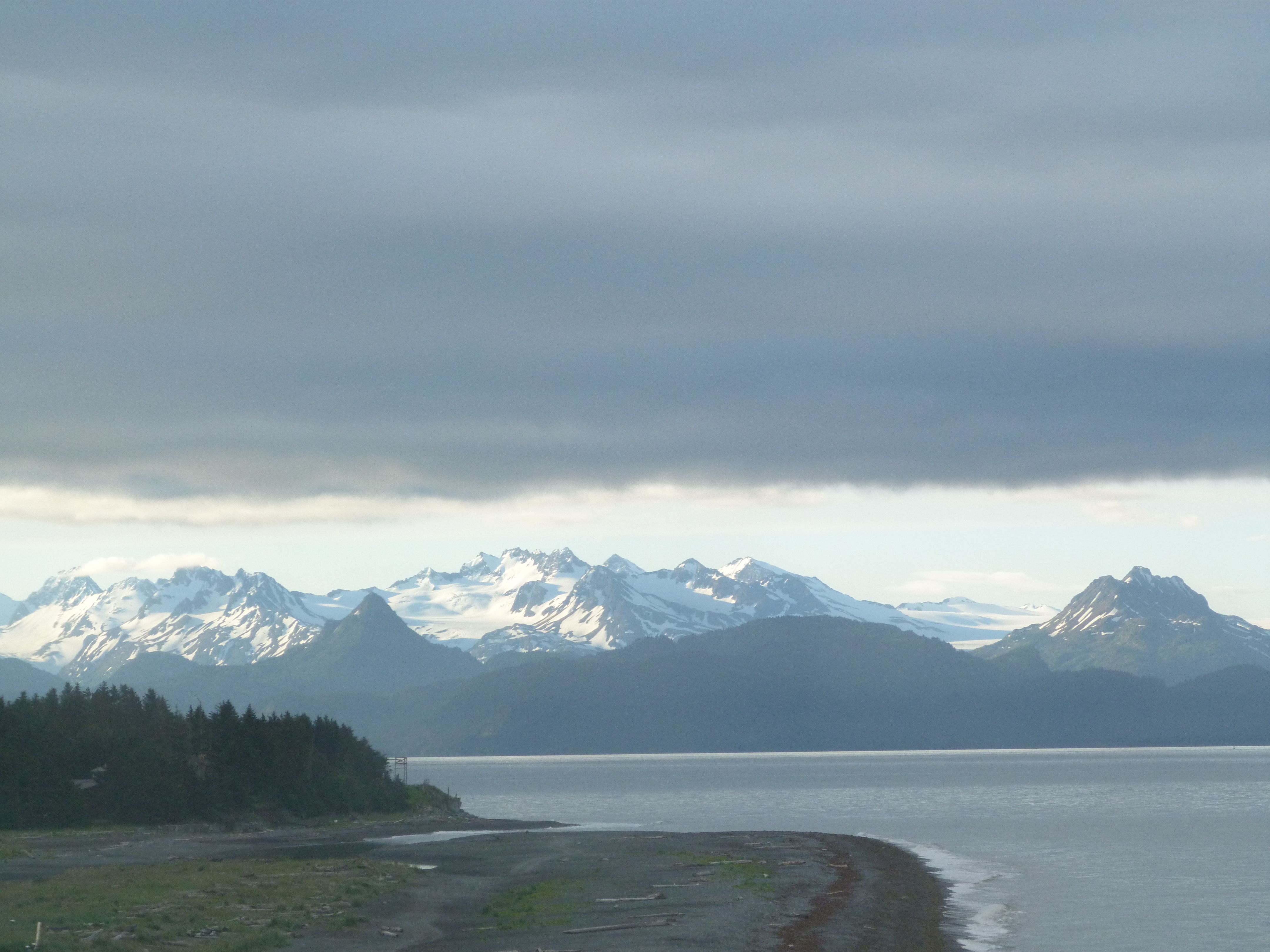
Those mountains and glaciers thrill my heart.
AdventureMan was instructed to have a good breakfast; they won’t be back until late afternoon, so we head to Dunken Inn, where we had such a good breakfast last year. We get there just in time – there is no line, and there is a table waiting for us, but five minutes later, there is a line.

AdventureMan has stick-to-your-ribs-while-bear-hunting biscuits and gravy:
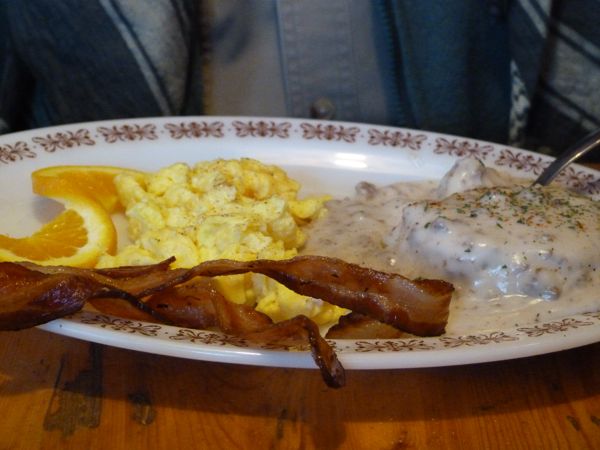
And I have the 2 – 2 – 1, which is two eggs, two slices bacon and one blueberry pancake. I don’t even really like pancakes, but these blueberry pancakes are SO good 🙂

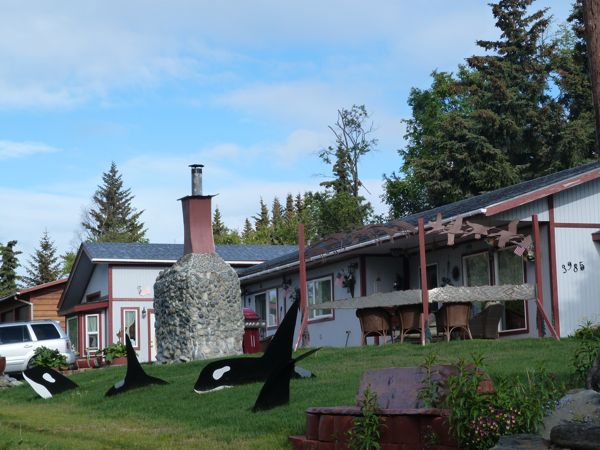
We drove around a little until drop off time; AdventureMan spotted a Sandhill Crane and this wonderful local yard art:

When Salmon Jerky and Japanese Crackers are Fine Dining
It’s a small thing, but just goes to show how much faith we put in planning, and how little control we really have. We’ve just settled in to our nice room at the Driftwood Inn, and a little after four, we get a call from the nice lady at Captain Patti’s, the restaurant where we have reservations for dinner.
We have no power, she tells us, and adds that the power is out on the entire Homer spit. They are closing for the night. Hmmm. We will have to find someplace else. We have some ideas, so we get in the car and head out, but it gets worse. The stoplights are out. The stores are all closing because they can’t run their cash registers, or run a credit card. The restaurants aren’t opening for dinner at all. The electricity is not just out on the spit, it is out in Homer, too. We briefly consider driving up to Soldatna to see if we can get a bite to eat there, but AdventureMan checks in the office at the Inn, and is told that the electricity is down on the entire Kenai peninsula. Holy tamole!
No food available, no food for sale. We have a package of Japanese crackers, which we love, and some salmon jerky, which AdventureMan is surprised to find that he likes, too. We have some breakfast cereal if we really need it, and milk in the refrigerator downstairs, so it’s not like we’re going to starve.
AdventureMan gets a call now that his flight will be departing for the bear hunt at 11 the next morning. I guess you can’t gas up planes without electricity these days, either.
The power came back some time close to nine, but by that time, we didn’t care to go out; crackers and jerky had done the trick.
An Ice Cream Break and Totem Cones in Juneau
“Are you from the Philippines?” AdventureMan asked the man behind the counter as he dished me up a cone of Huckleberry (Blueberry) ice cream.
“Yes, there are many of us here,” the man answered, and told us how one of the fastest growing demographics in Alaska is the Philippine community.
“At home, we are so poor,” he explained. We are lucky to have a one room shack for a family, and for water we have to walk a long way for running water. It is very bad.” He looked serious.
“How do you like it here?” AdventureMan asked, and the man grinned. “Life is good!” he said, with enthusiasm. He also mentioned the Mexican population in Alaska is growing almost as fast as the Philippine population. Who knew?
Normally, I don’t eat ice cream, but I have been craving something with either blueberries or rhubarb, two fruits that grew in Alaska when I was a kid, fruits we ate, jellied, froze, stored for later use. I had seen neither. Some might argue that huckleberries and blueberries are not the same. I don’t care. It is close enough for me. I also love that the cones are so extraordinary, artistic even, with their Alaskan Haida-esque sculptural quality:

And here is the proud cone-maker, also from the Philippines, who has a view to die for, the same view as from The Hanger on the Wharf, as she makes her specialty cones:

They insisted on giving us a 10% discount when they spotted my husband’s retired military ID card as he pulled out his wallet. They also shook his hand and thanked him for his service, a sweet and unexpected kindness in faraway Alaska.
Dancers, Costumes, Transmitting Culture at Celebration 2014
I am getting questions about the clans and tribes. I can’t answer your questions. I know there are the Ravens, and the Eagles, and I know they are not hostile but two halves of a whole. I know the raven legend; raven steals the sun – knowledge – and shares it with everyone. He is often shown with a long beak and/or curled around a ball. Eagles have short curved sharp beaks. But, with dispensation, an Eagle may marry a Raven. There are also subgroups, so you can be at once a Raven and a Bear, or a Killer Whale, or maybe a Wolf.
I try to understand, but it is a lot to absorb, and sort of complicated and flexible. As I look at my photos, I can see I was most interested in focusing on the costumes / textiles and less interested in the story. I wish I could tell you more, but you will have to read it for yourselves!
Here is a mural in downtown Juneau that demonstrates some of the artistic traditions of some of the various clans:
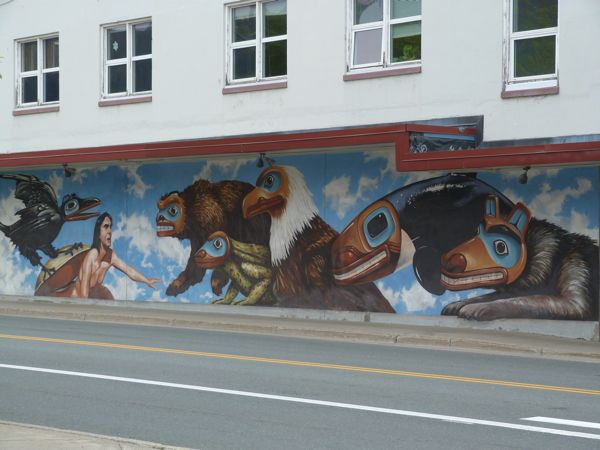
It’s important to remember – this is about them. It’s about holding on to traditional values and core beliefs, and transmitting knowledge of the culture to children and grandchildren. It’s not about us. As I said, we are there to witness and observe and celebrate, but they are there to celebrate who they are. Meanwhile, you can share the experience with these photos:


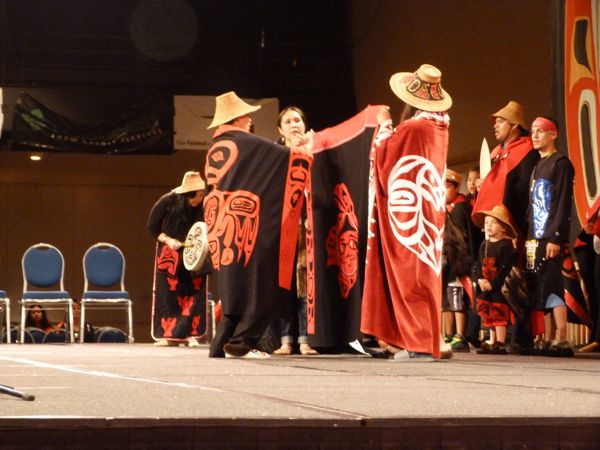


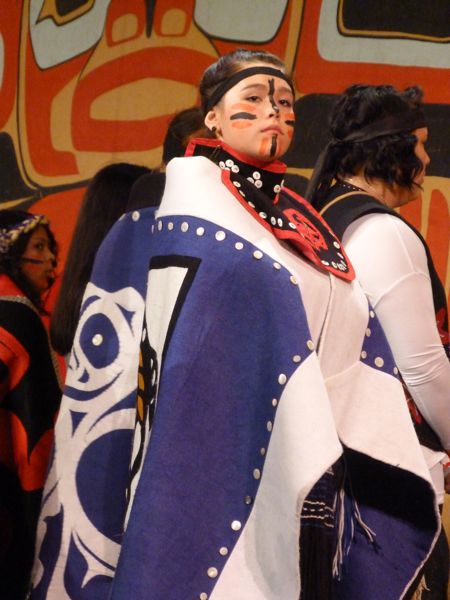




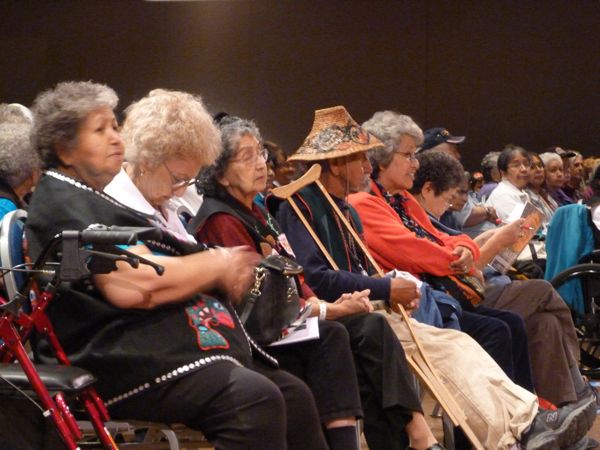
The front and center rows were reserved for the elders, and once the dancers started, every seat was filled. There were wet eyes, and open weeping. There were joyful moments, too, when the dancers would invite ‘all the Eagles’ or (something I didn’t understand) to rise and join them in their dance. My own heart swelled to witness their joy.

Study Highlights Health Risks Specific to Women
This was fascinating to me because most of the research on aging has been done on males. Most medicinal dosages are based on male tests, and males respond differently to medications than females. Here are some results from a study done on only females. From AOL EveryDay Health:

For most of medical history, scientific research had largely been conducted on white men, which makes it pretty difficult to know how to treat conditions that affect other populations, particularly women. Take menopause: For years, doctors prescribed long-term use of hormones estrogen and progestin to help women manage symptoms during and after menopause because it helped women feel better. But in 1991, researchers wanted a definitive answer as to whether hormones used to ease menopause’s symptoms were helping women more than they were hurting them. So, the National Institutes of Health launched the largest study ever focused exclusively on women to answer that question.
Dubbed the Women’s Health Initiative (WHI), the research project recruited 68,132 postmenopausal women to participate. They were divided into groups, some taking just estrogen, some taking estrogen and progestin, and some taking placebos. After over a decade of observation, the researchers stopped the trials early, in 2002 and 2004, because it was so clear that hormones posed serious health risks to the women. However, researchers have continued to follow up with these women in the years since, and have also tested other health interventions on the group, including low-fat diets and taking vitamin D and calcium. In 1998, an observational component of the WHI launched, with another 93,676 participants, to study even more aspects of women’s health. Much of the data collected over the years is now accessible to other researchers, too.
This has created a glut of women-specific health information that has paid off in big ways. In fact, the findings from the WHI have prompted a net economic return of $37.1 billion dollars, or $140 for each dollar that was spent on the trial itself, according to a new paper published in the Annals of Internal Medicine. That’s because the results have led to better treatment and care for millions of women, decreasing healthcare spending and increasing quality of life.
Here are some of the most important WHI findings:
1. You probably shouldn’t take hormones for longer than you have to. Long-term use of estrogen and progestin increases the risk of breast cancer, heart attack, stroke, and blood clots, though it decreased the risk of hip fractures and colon cancer in the main WHI trial. While these results have caused doctors to largely stop prescribing long-term hormone replacement, individuals are encouraged to make a personal decision based on their own risk factors. For example, if a woman has a very low family history of breast cancer and cardiovascular disease, but a high risk of colon cancer and osteoporosis, she may choose to take the hormones, which are thought to be safe when prescribed for just a short time around menopause, to manage symptoms. They may also extend the life expectancy for women who have had hysterectomies, the data revealed, so be sure to talk to your doctor about your specific needs.
2. Low-fat diets are good, but not enough to reduce your risk of some cancers or cardiovascular disease. The researchers asked some of the participants to eat a low-fat diet, and then compared how this affected their risk of various diseases. They found that a low-fat diet alone was not enough to significantly impact women’s risk of cardiovascular disease, breast cancer, orcolorectal cancer, according to the results published in JAMA. The researchers concluded that more dramatic lifestyle changes, including increased exercise, might be necessary to affect risk of developing these diseases.
3. Taking vitamin D and calcium may not be worth it. Some of the women in the study were given calcium and vitamin D supplements, while others were not. The results showed that the supplements did increase the bone density in the hip, but they didn’t significantly decrease the number of hip fractures the women experienced. Nor did taking the supplements lower the risk of colorectal cancer, according to the paper published in the New England Journal of Medicine. They did, however, increase the risk of kidney stones.
4. Ditch diet soda. Post-menopausal women who reported drinking two or more diet sodas per day had a higher risk of heart attack, stroke, and other heart problems, research from the WHI showed. While the researchers couldn’t show a direct connection, there are plenty of other reasons to avoid fake sugar.
5. If you’re at high risk for melanoma, aspirin might help. Researchers analyzed the data from the WHI observational study, and found that women who took aspirin regularly had a 20 percent lower risk of melanoma than women who did not. The correlation was strong — the longer the women took the drug, the lower their risk. Aspirin comes with its own benefits (preventing subsequent heart problems) and harms (increased risk of bleeding), so talk to your doctor before adding it to your routine.
Recent Comments
intlxpatr on Shampoo Ginger tigerbutterya0c5ff1d… on Shampoo Ginger intlxpatr on British Soldier Kidnapped, Esc… John on British Soldier Kidnapped, Esc… intlxpatr on British Soldier Kidnapped, Esc… Wikipedia Donate Button

Amazina


Early Voting in Florida


