Wooo HOOO, Saudi Arabia Allowing Female Olympic Athletes
It hasn’t been so long in our own country since Title IX made it possible for more and more women to participate in athletic events, making funding possible, giving women in the United States an opportunity to participate in healthy athletic activities.
RIYADH, June 25 (Reuters) – Saudi Arabia will allow its women athletes to compete in the Olympic Games for the first time ever in London this summer, the Islamic kingdom’s London embassy said on its website.
Human rights groups had called on the International Olympic Committee to bar Saudi Arabia from competing in London, citing its failure ever to send a woman athlete to the Olympics and its ban on sports in girls’ state schools.
Powerful Muslim clerics in the ultra-conservative state have repeatedly spoken out against the participation of girls and women in sports.
“I think this is a victory for Saudi sportswomen and hopefully it will promote sports and women’s health awareness for the Saudi society,” said Lina al-Maeena, co-founder of Jeddah United Sports Company, a rare women’s exercise club that runs a female basketball team.
In Saudi Arabia women have a lower legal status than men, are banned from driving and need a male guardian’s permission to work, travel or open a bank account.
Under King Abdullah, however, the government has pushed for them to have better education and work opportunities and will allow them to vote in future municipal elections, the only public polls held in the kingdom.
Saudi women will be able to compete in the London Olympics only if they reach the qualifying standard for their event, and the Games opens in just over one month, on July 27.
“The kingdom of Saudi Arabia is looking forward to its complete participation in the London 2012 Olympic Games through the Saudi Arabian Olympic Committee, which will oversee the participation of women athletes who can qualify for the Games,” said a statement published on the embassy website.
The woman most likely to compete under the Saudi flag in London, show jumper Dalma Malhas, was ruled out on Monday when the World Equestrian Federation (FEI) said the 20-year-old’s mare Caramell KS had been sidelined by injury for a month during the qualifying period and had missed a June 17 deadline.
“Regretfully the Saudi Arabian rider Dalma Rushdi Malhas has not attained the minimum eligibility standards and … will not be competing” at the London Olympics, FEI secretary general Ingmar De Vos told the FEI website (www.fei.org).
Malhas won individual bronze at the junior Olympics in Singapore in 2010, but without official support or recognition.
In April the head of the General Presidency of Youth Welfare, which regulates sport in Saudi Arabia, said it would not prevent women from competing but they would not have official government endorsement.
The government’s role would be limited to ensuring that Saudi women’s participation “is in the proper framework and in conformity with sharia”, he said.
The IOC said on Monday that talks with the Saudis were “ongoing” and that “we are working to ensure the participation of Saudi women at the Games in London”.
The head of the kingdom’s Olympic mission, Khalid al-Dakheel, told Reuters on Sunday that he was unaware of any developments allowing women to participate.
Top Saudi clerics, who hold government positions and have always constituted an important support base for the ruling al-Saud royal family, have spoken against female participation in sports.
In 2009 a senior cleric said girls risked losing their virginity by tearing their hymen if they took part in energetic sport.
Physical education is banned in girls’ state schools in the kingdom, but Saudi Arabia’s only female deputy minister, Noura al-Fayez, has written to Human Rights Watch saying there is a plan to introduce it. (Reporting by Angus McDowall and Asma Alsharif; editing by Tim Pearce)
When Does Ramadan Start in 2012?
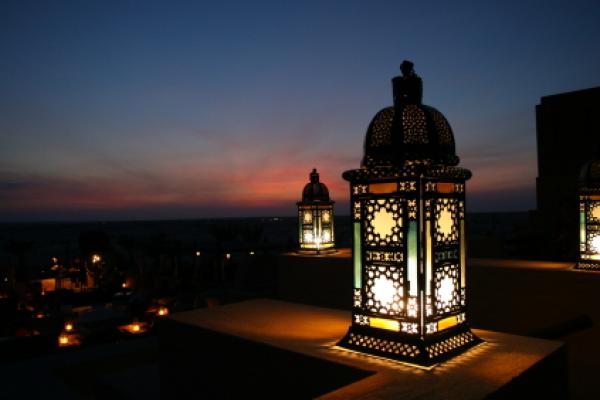
The Islamic Calendar website Godweb says Ramadan in 2012 will start July 20th. Time and Date (which is where I found this beautiful photo) agrees.
Sometimes it depends on the country where you are living. Wikipedia tells us this:
Many Muslims insist on the local physical sighting of the moon to mark the beginning of Ramadan, but others use the calculated time of the new moon or the Saudi Arabian declaration to determine the start of the month. Since the new moon is not in the same state at the same time globally, the beginning and ending dates of Ramadan depend on what lunar sightings are received in each respective location. As a result, Ramadan dates vary in different countries, but usually only by a day. This is due to the cycle of the moon. When one country sees the moon, mainly Saudi Arabia, the moon travels the same path all year round and that same moon seen in the east is then seen traveling towards the west. All the countries around the world see the moon within a 24 hour period once spotted by one country in the east.
Each year, Ramadan begins about eleven days earlier than in the previous year.[3] Astronomical projections that approximate the start of Ramadan are available.[4] It takes about 33 years for Ramadan to complete a twelve month move across the yearly calendar plus 5 days. As Ramadan March 28, 1990 to Ramadan March 22, 2023.
Saudi – Bahrain “Merge?”
Thank you, John Mueller for this article from The Press:
http://www.presstv.ir/detail/2012/05/14/241177/iran-raps-saudi-plans-bahrain-merger/
PressTV – Iran Majlis condemns merger of KSA, Bahrain
The Iranian Majlis (parliament) has condemned the Saudi proposal for merger with Bahrain, saying the “unwise” measure will further destabilize the region and multiply its problems.
The Saudi plans to annex Bahrain “will extend the Bahraini crisis to Saudi Arabia and push the region toward further unrest,” a statement, signed by 190 Iranian lawmakers, read on Monday.
The statement asserted that political force and pressure cannot silence the frustrated Bahraini people who have been holding anti-government demonstrations since mid-February 2011 and calling on the US-backed Al Khalifa family to leave power.
On March 14, 2011, more than 1,000 Saudi troops entered Bahrain to assist the Manama government in suppressing the peaceful popular protests in the Persian Gulf Island.
According to local sources, scores of people have been killed and hundreds have been arrested in the Saudi-backed regime crackdown.
In a report released on April 17, Amnesty International criticized the Bahraini regime for continuing the violation of human rights and the excessive use of force against the anti-regime protesters.
“The authorities are trying to portray the country as being on the road to reform, but we continue to receive reports of torture and use of unnecessary and excessive force against protests. Their reforms have only scratched the surface,” said Hassiba Hadj Sahraoui, Amnesty International’s Middle East and North Africa deputy director.
The Iranian lawmakers concluded by expressing their “all-out support for the brave nation of Bahrain as well as the independence and territorial integrity of the country.”
Saudi Arabia is reportedly seeking to merge with Bahrain in line with plans to unify the six Arab member states of the [Persian] Gulf Cooperation Council ([P]GCC).
The council members, Saudi Arabia, Kuwait, Bahrain, Qatar, the United Arab Emirates and Oman, are expected to meet and discuss closer union among the six countries on Monday.
In December 2011, Saudi King Abdullah called on the council member states to move “beyond the stage of cooperation and into the stage of unity in a single entity.”
However, some members of the council have expressed concern about Saudi Arabia’s possible dominance over the other five countries if the [P]GCC becomes unified.
HMV/HGH/AZ
Petroglyphs in the Petrified Forest
So here we segue back to the Petrified Forest, and it may not seem logical in a linear, chronological sense, like time-as-pearls-strung-together-on-a-string sort of thing, but in terms of like things, the next chronological entry is going to be on 700 years of culture, the Ancestral Puebloans who used to be called the Anasazi, but before I go there, I want to show you some petroglyphs.
(I’m putting in a lot of links in case you are as big a petroglyph nerd as I am, and want to read more)
I always imagine the problems with being early man. Imagine they are smart, and spend a lot of their days figuring things out, most important being 1. What are we going to eat? 2. How are we going to keep dry/warm? 3. How do we protect ourselves from our enemies? They have the same problems we have, only on a much more basic level, and with fewer resources.
Have you ever thought about how easy it is to get information now? (The hard part being sifting through so you get the most reliable, most relevant information). Imagine a world where you have to figure it out for yourself, every day.
Early civilizations fascinate me. I am always interested in little tiny things that can be very important, like how did they fasten skins together to keep themselves warm? How do you poke a hole in a sharp bone so you can use it as a needle? How do you make a button, or make strips that can be used to tie clothing together?
How do you fasten a spear head onto a spear, or an arrowhead onto an arrow?
Early man was a problem solver, and I am fascinated by petroglyphs, which are either early attempts at documentation, or early attempts at communication, or maybe both? The first petroglyphs and cave paintings I ever visited were the Font de Gaume Caves near Les Eyzies-de-Tayac-Sireuil, and they took my breath away. I didn’t even hesitate because it was a cave, I wanted to see them so badly.
I want you to look at this photo of a fairly early dwelling in Les Eyzies de Tayac-Sireuil and hold it in your mind before we move on:

Later, living in Saudi Arabia, one of the most fun day trips ever was to a rock formation called Graffiti Rock, which had no protection, so very old petroglyphs mingled with modern carvings, but some of the older carvings were so interesting, so intriguing.
Coming across petroglyphs in the Petrified Forest was a delight.
Here is part of what the national parks website has to say about petroglyphs found in the Petrified Forest:
In 1977 a spiral petroglyph at Chaco Canyon National Monument was discovered which displayed a precise interaction with sunlight at the time of summer solstice by means of a narrow shaft of sunlight that moved down a shadowed rock face to bisect the center of a large spiral petroglyph. Subsequent observations found that on winter solstice and equinoxes there were intriguing interactions of sunlit shafts with the large spiral and a smaller spiral nearby. No other example of a sunlight interaction with prehistoric or historic petroglyphs was known at this time. However, there was a tradition of Pueblo sun watching in historic times, particularly of the varying sunrise and sunset positions throughout the year, to set the dates for ceremonies.
As a result of the Chaco Canyon find, Bob Preston initiated a research project to determine whether other petroglyph sites in the Southwest functioned as solar “observatories.” Over the last 16 years he has identified about 120 examples of similar solstice events at more than 50 petroglyph sites in Arizona, New Mexico and southern Utah. Evidence indicates that the phenomenon may have been spread over as much as a 1000-km region. These findings show clearly that certain petroglyphs were used by early pueblo cultures to function as calendrical markers for the winter and summer solstices. Petrified Forest National Park contains the greatest known concentration of solar calendars, with 16 of the sites being in or immediately adjacent to the park, and has been key to understanding their nature.
Shadows and sunlit images are found to move across petroglyphs due to other rocks being in the path of the sun’s rays. As the sun’s path across the sky changes throughout the year, the positions of the shadows and sunlit images change on the petroglyph panels. In many cases the petroglyphs have been placed on the rock faces in just the right position so that specific interactions occur on the solstices. The most common types of petroglyphs on which solsitial interactions have been identified are spirals and circles. The key to determining that these were intended and not by chance is that interactions are seen from site to site, and occur on the solstices more frequently than on other days of the year. These consistent interactions may involve a point of sunlight or shadow piercing the center or tracing the edge of a spiral or circular petroglyph; or shadow lines may suddenly appear or disappear at the center or edges of the petroglyph; or they may move up to the center or edge and then retreat. It is not uncommon for a single petroglyph to display multiple interactions of this type, either on the same solstice or on each of the solstices. In fact, at one site, there are five circular and spiral petroglyphs that show 15 interactions on the both solstices.
An intriguing question is whether types of petroglyph images were involved with specific dates. In several cases similar sunlight and shadow interactions occur on spiral and circular petroglyphs on the equinox, and distinctive interactions occur with other petroglyphs on the solstices and other dates. Clearly much of the puzzle remains to be unraveled.
There was a WEALTH of petroglyphs. I’m just going to show you a few of those we found:
This one makes me laugh; it looks so much like our modern day stork-who-brings-babies (LOL, where did that legend/story start anyway??)

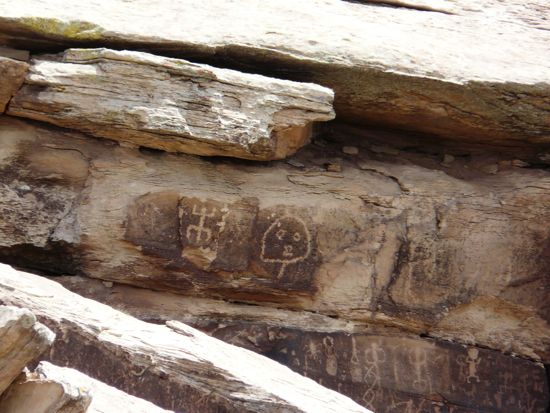
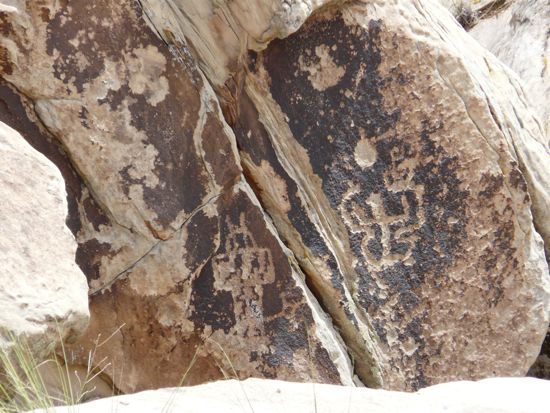

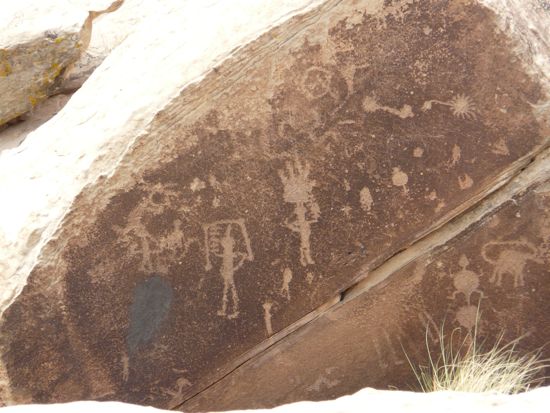
LOL, these feet are larger than life, or else they were made by giants!


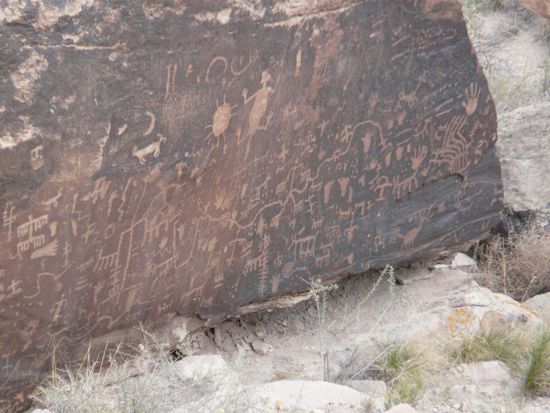
Early people in widely separated parts of the world carved and painted on rock, probably for a number of reasons, maybe keeping track of solar activity and seasons, maybe magical/religious thinking for a good hunt or nostalgia for a good hunt, maybe just someone who, like today’s blogger, just has to document in some way . . . 😉
Saudi Disinformation on Qatar Coup
Thank you, John Mueller, for contributing this fascinating piece on the reported – and then unreported – ‘coup attempt in Qatar’. We were there when this happened the last time. It was bizarre – there was nothing. No increased military or police presence, just the same quiet and relaxed day-by-day. It was all a lie, created to stir the pot, and to create a perception – based on nothing.
BREAKING; Qatar Military Coup “Rumours” Stir Bad Blood With House of Saud
by Finian Cunningham, April 17, 2012
The rumour mill is churning in the Persian Gulf with unconfirmed reports of a failed military coup against the Qatari ruler.
There were even media reports that American military helicopters had whisked the Emir and his wife to a safe unknown destination in the aftermath of the failed putsch, said to be have been attempted by high-ranking officers.
Saudi news channel Al Arabiya reported earlier today a coup bid against Qatari Emir Hamad Bin Khalifa Al Thani. However, by midday, the story appeared to have been removed from Al Arabiya’s English-language website.
Iranian news channel Press TV toned down its early headlines of a coup and later speculated that Saudi-owned Al Arabiya may have been engaging in disinformation to undermine the Qatari regime, indicating a power struggle between the Houses of Saud and Thani.
The FARS semi-official Iranian news channel, however, insisted that sources within the Qatari royal entourage had confirmed earlier this week that there was a foiled coup in Doha.
Not surprisingly, Qatari-owned Al Jazeera news site ran no information on the alleged plot.
Whether the reports of this week’s failed coup turn out to be rumour or something more sinister, there is nevertheless no disguising the fact of underlying bad blood in the Gulf Arab enclave, both between and within the Gulf monarchies.
That may at first seem at odds with the “thick as thieves” appearance of the six states that form the Gulf Co-operation Council: Saudi Arabia, Kuwait, Bahrain, Qatar, United Arab Emirates and Oman. All are Sunni monarchies that have aligned with the US-led NATO powers’ aggressive policy of isolating Shia Iran.
Saudi Arabia and Qatar have emerged in particular as militant allies of US/NATO geopolitics across the Middle East. They played instrumental roles in paving the way for NATO’s aerial bombardment and regime change in Libya; and they have been most strident in denouncing the Syrian government of Bashar Al Assad, calling for his overthrow and arming mercenary forces that are accused of committing atrocities and sabotage.
But herein lies the potential for rivalry and enmity. Saudi Arabia, the world’s largest oil exporter, and Qatar, the number one exporter of liquefied natural gas, are bankrolling mercenaries and jihadis from Iraq, Libya, Lebanon and elsewhere in a bid to be top dog in a fissile region. The region is being inflamed with sectarian tensions precisely because of self-serving Saudi and Qatari power politicking.
The Gulf monarchs have also been funding election campaigns of Islamist parties in Egypt and Tunisia, aligned to the conservative Muslim Brotherhood, in line with Western powers using these same parties to shunt and blunt popular calls for greater democracy.
The rapid growth of Saudi-backed satellite TV channels broadcasting across the region – several of them spouting Saudi theocratic rhetoric – is indicative of a rivalry for influence with Qatar, which originally pioneered the Arab medium with the Al Jazeera station.
While on the surface, Riyadh and Doha may appear joined at the hip in terms of advancing the US-led Western imperialist agenda for hegemony, that service generates tensions between and within the royal houses.
In Qatar, there are reported tensions within the Al Thani ruling family and other powerful clans over what critics of the Emir call “his excessive alignment with US foreign policy and breaking of Arab ranks”. There are also domestic problems of corruption owing to the Al Thanis monopolising Qatar’s lucrative property market.
And despite the apparent alliance with Saudi Arabia, the present Qatari Emir will be mindful that the Saudi rulers have been implicated in previous suspected coup attempts against him in February 2011, 2009, 2002 and 1996.
The present Qatari ruler came to power after he led a coup against his own father in 1995 while the latter was holidaying in Europe. The following year, the Saudi and Bahraini rulers backed a failed counter-coup to reinstall the older Emir.
In 2010, the coup plotters were released from jail by Emir Hamad after a request was made by Saudi King Abdullah.
So in the Arab enclave of the NATO camp, all is not as cosy as it may seem. Washington and the other Western powers no doubt think they have a clever Arab cover from the Gulf autocrats to redraw the Middle East political map according to their imperialist designs. But in all such intrigues of deception and power lust, the band of thieves have to watch their backs.
Finian Cunningham is Global Research’s Middle East and East Africa Correspondent
cunninghamfinian@gmail.com
Saudis Investigate Dancing Nurses
Unfortunately, I can no longer find the video sent me by John Mueller on U-Tube; it has been removed, but you can see it for yourself here:
What the Saudis are investigating – and yes, there were men and women present – is a game of musical chairs, a game even children play at birthday parties.
Hospitals are a high stress environment – and these are sweet young people having a good time. Lord have mercy, and “investigation.”
Saudi health authorities have opened an investigation into three films published on U-Tube showing Asian nurses dancing at a mixed-gender birthday party inside a government hospital.
The three separate films showed several male and female nurses were involved in the concert that included music and dances, which are strictly banned at Saudi hospitals and other public facilities.
The films showed the party was held at King Fahd Hospital in the eastern town of Hofouf and the participants were apparently from the Philippines and Indonesia, according to Saudi newspapers.
One film was titled in Arabic “a scandal at King Fahd Hospital in Hofouf” while the heading of another video read “in the absence of supervision at King Fahd Hospital”. The third read “a dancing party for a nurse’s birthday.”
“We have been instructed to open an investigation into these films to determine whether this party was really held at King Fahd Hospital,” said Ibrahim Al Hajji, information director at the Health Department.
Hajji, who was quoted by Sharq newspaper, did not elaborate on what measures would be taken against those involved in the party.
Saudi Arabia: Women Driving Will Have Sex, Report Says
I am sorry, but if this were a joke, it would be hilarious. It IS hilarious, or it would be, if it didn’t impact so darkly on the lives of so many women.
So my friends in Saudi Arabia, here is the solution. Let the women drive. Tell the men not to have sex with these driving women, not until they are married. Tell the men that no matter how much the women beg, to keep themselves pure, and not to let these women tempt them away from their purity. Teach the men that it is a CHOICE, and that they can behave themselves honorably, and withhold themselves from these driving women who want to have sex with them.
That’ll teach those women 🙂
From the Huffington Post
Saudi Arabia: Women Driving Will Have Sex, Report Says
RIYADH, Saudi Arabia — A report given to a high-level advisory group in Saudi Arabia claims that allowing women in the kingdom to drive could encourage premarital sex, a rights activist said Saturday.
The ultraconservative stance suggests increasing pressure on King Abdullah to retain the kingdom’s male-only driving rules despite international criticism.
Rights activist Waleed Abu Alkhair said the document by a well-known academic was sent to the all-male Shura Council, which advises the monarchy. The report by Kamal Subhi claims that allowing women to drive will threaten the country’s traditions of virgin brides, he said. The suggestion is that driving will allow greater mixing of genders and could promote sex.
Saudi women have staged several protests defying the driving ban. The king has already promised some reforms, including allowing women to vote in municipal elections in 2015.
There was no official criticism or commentary on the scholar’s views, and it was unclear whether they were solicited by the Shura Council or submitted independently. But social media sites were flooded with speculation that Saudi’s traditional-minded clerics and others will fight hard against social changes suggested by the 87-year-old Abdullah.
Saudi’s ruling family, which oversees Islam’s holiest sites, draws its legitimacy from the backing of the kingdom’s religious establishment, which follows a strict brand of Islam known as Wahhabism. While Abdullah has pushed for some changes on women’s rights, he is cautious not to push too hard against the clerics.
In October, Saudi Arabia named a new heir to the throne, Prince Nayef, who is a former interior minister and considered to hold traditionalist views, although he had led crackdowns against suspected Islamic extremists. His selection appeared to embolden the ultraconservative clerics to challenge any sweeping social reforms.
Prince Nayef was picked following the death of Crown Prince Sultan.
My Saudi Shoes
“I love your shoes!” my friend cried. “Where did you find them?”
“It was thirteen years ago, in Saudi Arabia” I told her.
“Thirteen years? They look brand new!”
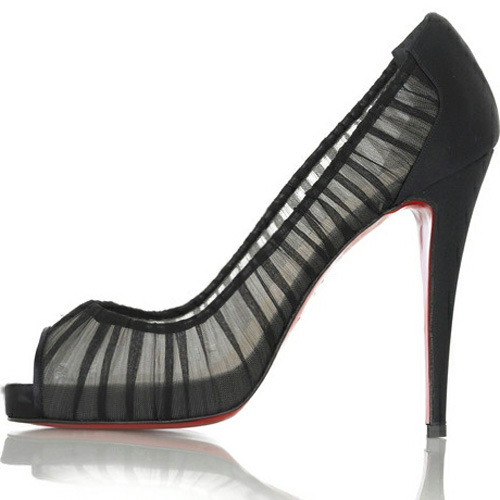
(These are not my shoes. These are shoes Saudi women can buy in Saudi Arabia.)
Ummm, well . . . when you live in super hot countries during those thirteen years, you don’t often wear closed toed shoes. It’s more comfortable to wear sandal style shoes, and more hygienic – when you live in the dry heat, your feet can get hard and cracked, and are vulnerable to feet fungus. Your feet need to breathe. Most of my shoes are open, but we are starting to have occasional chill weather in Pensacola. The flowers of the South have all pulled out their heavy sweaters and are wrapping wool scarves around their necks, even wearing winter coats.
Since the current cold snap features daily highs that are normal for Seattle or Germany in the summer, and since I thrive in the cold and suffer in the heat, I am in long sleeve lightweight t-shirts and sweaters, and – closed toed shoes.
I dread close-toe shoe season. My feet no longer like to be confined in shoes or boots. My toes hurt when I walk too much in them. So I have only a few pair of winter shoes, but really good ones. 🙂
Saudi Arabia was one of the best places for buying shoes I have ever lived, with entire floors of malls devoted entirely to shoe shops. Prices were reasonable; French and Italian shoes were cheaper in Saudi Arabia than they were in France and Italy, maybe because of the taxes imposed by the Eurozone.
Think about it. When you live in a country where women are all covered, wearing abayas, and they are supposed to keep their hair covered (most of us shameless westerners carried a scarf but did not wear it unless ordered to do so by the religious police / Muttawa) and the most modest women even cover their face, what is there to wear that people will notice? And women ARE women . . . Yes! Shoes!
The Saudi women wore fabulous shoes, and they wore delicate black lace gloves, and they wore scent. They bought Berkin bags and Hermes headscarves, and fabulous Chopard watches. When a group of Saudi women would walk by, you would be enveloped by a cloud of the headiest, most seductive scents in the world. And oh, holy smokes, the shoes . . . Saudi women were just beginning to experiment with a little embellishment when I left – a little Swarovski crystal leaf on a scarf, or a sprinkling of crystals on the neckline of an abaya, some embroidery on a hem, a dark green abaya instead of severe black . . . women are women, no matter where we are. We like a little sparkle, and we buy things that make us feel special.

The shoes my friend liked are Italian, navy leather heels with a kind of leather lace around the toe area. They are lovely, and I wear them happily (for a short while) during closed-toe season. They are classic, and I am hoping I can wear them another twenty years or so, which is entirely possible if I only wear them during cold snaps in Pensacola. 🙂
Wooo Hoooo! Saudi Women to Have Right To Vote!
I found this today on Huffpost World; hey four years is not such a long time compared to forever. Getting the vote makes it more and more illogical for them not to be driving . . . think about it. Does choosing national leaders take less brains than driving? Ummm. . . . well . . . (LOL)
RIYADH, Saudi Arabia — Saudi Arabia’s King Abdullah, considered a reformer by the standards of his own ultraconservative kingdom, decreed on Sunday that women will for the first time have the right to vote and run in local elections due in 2015.
It is a “Saudi Spring” of sorts.
For the nation’s women, it is a giant leap forward, though they remain unable to serve as Cabinet ministers, drive or travel abroad without permission from a male guardian.
Saudi women bear the brunt of their nation’s deeply conservative values, often finding themselves the target of the unwanted attention of the kingdom’s intrusive religious police, who enforce a rigid interpretation of Islamic Shariah law on the streets and public places like shopping malls and university campuses.
In itself, Sunday’s decision to give the women the right to vote and run in municipal elections may not be enough to satisfy the growing ambition of the kingdom’s women who, after years of lavish state spending on education and vocational training, significantly improved their standing but could not secure the same place in society as that of their male compatriots.
That women must wait four more years to exercise their newly acquired right to vote adds insult to injury since Sunday’s announcement was already a long time coming – and the next local elections are in fact scheduled for this Thursday.
“Why not tomorrow?” asked prominent Saudi feminist Wajeha al-Hawaidar. “I think the king doesn’t want to shake the country, but we look around us and we think it is a shame … when we are still pondering how to meet simple women’s rights.”
The announcement by King Abdullah came in an annual speech before his advisory assembly, or Shura Council. It was made after he consulted with the nation’s top religious clerics, whose advice carries great weight in the kingdom.
It is an attempt at “Saudi style” reform, moves that avoid antagonizing the powerful clergy and a conservative segment of the population. Additionally, it seems to be part of the king’s drive to insulate his vast, oil-rich country from the upheavals sweeping other Arab nations, with popular uprisings toppling regimes that once looked as secure as his own.
Fearing unrest at home, the king in March announced a staggering $93 billion package of incentives, jobs and services to ease the hardships experienced by some Saudis. In the meantime, he sent troops to neighbor and close ally Bahrain to help the tiny nation’s Sunni ruling family crush an uprising by majority Shiites pressing for equal rights and far-reaching reforms.
In contrast, King Abdullah in August withdrew the Saudi ambassador from Syria to protest President Bashar Assad’s brutal crackdown on a seven-month uprising that calls for his ouster and the establishment of a democratic government.
“We didn’t ask for politics, we asked for our basic rights. We demanded that we be treated as equal citizens and lift the male guardianship over us,” said Saudi activist Maha al-Qahtani, an Education Ministry employee who defied the ban on women driving earlier this year. “We have many problems that need to be addressed immediately.”
The United States, Saudi Arabia’s closest Western ally, praised the king’s move.
In Washington, National Security Council spokesman Tommy Vietor said it recognized the “significant contributions” women have been making in Saudi Arabia. The move, he continued, would give Saudi women more ways to participate “in the decisions that affect their lives and communities.”
The king, in his own remarks, seemed to acknowledge that the Arab world’s season of change and the yearning for greater social freedoms by a large segment of Saudi society demanded decisive action.
“Balanced modernization, which falls within our Islamic values, is an important demand in an era where there is no place for defeatist or hesitant people,” he said.
“Muslim women in our Islamic history have demonstrated positions that expressed correct opinions and advice,” said the king.
Abdullah became the country’s de facto ruler in 1995 because of the illness of King Fahd and formally ascended to the throne upon Fahd’s death in August 2005.
The king on Sunday also announced that women would be appointed to the Shura Council, a currently all-male body established in 1993 to offer counsel on general policies in the kingdom and to debate economic and social development plans and agreements signed between the kingdom with other nations.
The question of women’s rights in Saudi Arabia is a touchy one. In a country where no social or political force is strong enough to affect change in women’s rights, it is up to the king to do it. Even then, the king must find consensus before he takes a step in that direction.
Prominent columnist Jamal Khashoggi said that giving women the right to vote in local elections and their inclusion in the Shura council means they will be part of the legislative and executive branches of the state. Winning the right to drive and travel without permission from male guardians can only be the next move.
“It will be odd that women who enjoy parliamentary immunity as members of the council are unable to drive their cars or travel without permission,” he said. “The climate is more suited for these changes now – the force of history, moral pressure and the changes taking place around us.”
___
Hendawi reported from Cairo. Associated Press writer Maggie Michael contributed to this report from Cairo.
Recent Comments
intlxpatr on Yellowstone: Old Faithful to C… Michelle on Yellowstone: Old Faithful to C… Cathy on No Grown-Ups in Charge intlxpatr on Waiting for Snow intlxpatr on Waiting for Snow Wikipedia Donate Button

Amazina


Early Voting in Florida


 Here There and Everywhere