One Step Down
It was a real eye opener, being back in the USA. AdventureMan had an interesting observation, something he learned a long time ago in a sociology class. It has to do with dining in restaurants. When a guy eats his lunch out every day, he goes to one kind of place, and then when he takes his family out for a meal on Sunday, he goes one step up, takes them to a better restaurant than he would go to every day.
As we travelled in different parts of the United States, what we saw was just the opposite – one step down. People we know still have jobs, still make their house payments, still have the same income. The PERCEPTIONS however, are very different. People are nervous, maybe even a little worried about their jobs. They are not FEELING as prosperous as they felt last year, or the year before. They are spending less. They are going to eat out, but will eat out at that one-step-down restaurant, and not the higher priced restaurant.

As we Christmas shopped, we saw HUGE differences. The Macy’s and the Dillard’s and the big delightfully fancy stores are like ghost towns, and for good reason. They have drastically cut back on their inventory. Where you had to fight your way through the crowded racks a couple years ago, there is a lot of space this year. I didn’t see anything very exciting in terms of fashions or shoes. The Targets and the Fred Meyers (a Pacific Northwest chain) were packed with shoppers, prices were cut, and products were flying off the shelves.
A newspaper article said that what people are buying are . . . appliances. Things people really use – toasters, mixers, etc. The big difference is, they are insisting on appliances in COLOR – carmine reds, blueberrys, greens – chartreuse seems to be big this year, for Christmas, for clothing, and for decorations. Even for Christmas cookies. Chartreuse and pink are this year’s Christmasy red and green. Total hoot. But when people start drawing back from spending, they buy practical things – in fanciful colors. I remember reading once that when times get tough, lipstick sales soar. Women will spend on something small to make themselves feel good, and lipstick does the trick.
The trip was a real eye opener. AdventureMan has sticker shock. I just laugh. I think Kuwait is expensive! AdventureMan doesn’t buy groceries. I remember one time we were together at the Co-op and he couldn’t believe what we were spending on milk – but what are you going to do? Not buy milk? I have always used powdered milk for baking, but with the Chinese thing, I even worry about powdered milk.
Are you going through sticker shock? Are your spending habits changing? Do you eat in restaurants, or are you eating more at home?
Trinity Collection in Pensacola
We were talking about low sales-resistance . . . this is not about being in Kuwait. This is about my lack of resistance to buying beautiful jewelry!

As we were driving around in Pensacola, I spotted The Trinity Collection. There is a lot of very mediocre jewelry out there, but I had seen the Trinity ads earlier, and they had caught my eye.
“AdventureMan! Pull over! Pull over! It’s the Trinity Collection!” and I’m fighting him for the wheel so he can turn right and park and I can run into the store.
VERY smart store. So many beautiful things, AND a seating area for guys like AdventureMan.
I can’t blame Kuwait. I have found beautiful pieces in Kuwait. (Hint to any blogging friends who want to honor me with jewelry – look in your grandmother’s old collections! I love the old stuff, and the original Gulf pearls, and those tiny tiny pearls and gem pieces that the Qatteris are buying up for their museums.)
(Just kidding, by the way. DO NOT bring me jewelry! I can’t accept it!)
Anyway, I also found wonderful pieces in this beautiful shop, full of gems, and employing several original jewelers, who specialize particularly in religious jewelry, but also other beautiful pieces.
If you get to Pensacola – this shop has a lot of variety, in goods and in prices, and many exquisitely crafted jewelry pieces. This shop is worth a special trip.
Re-Entry
When I first arrive back in the United States, I always have to transition slowly. I have no sales-resistance. I usually have a list for Target, supplies I will need immediately while I am traveling; not glamorous things, but things like shampoo and underwear and scotch tape and wrappings, that sort of thing, useful things. We always come out with way more than our list. No resistance.
I won’t even let myself go into the Apple Market until I have been back for a while. When I get to their spices aisle, my heart just starts going pitty-pat:
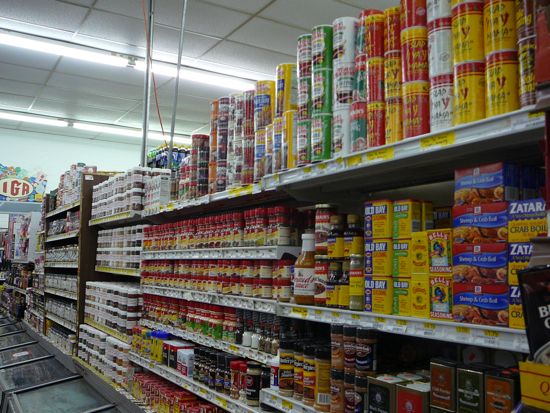
One entire aisle, entirely devoted to seasonings – and so many things we never see in Kuwait – poppy seeds! File’! A variety of Chili mixes, seasoned shrimp boils . . . It’s all I can do not to buy one of everything.

And the irony? What do I bring back for my friends in the US from Kuwait? Kuwaiti spices – that biriyani mix, pine nuts, saffron, and those little red dried pomegranate seeds. They are always a huge hit – it’s always about what you can’t get your hands on, isn’t it?
Books Behind the Counter
“Hey Mom, take a look” said Law and Order Man as we were about to walk out of the local Barnes and Noble. He was pointing to the selection of books by Chuck Palahniuk, all on shelves behind the counter.

I had noticed he has a collection of Chuck Palahniuk books, and I have read reviews by Kuwait bloggers, so I had asked him about the books, would he recommend them.
“You wouldn’t like them” he said. He knows me pretty well, and often recommends authors I might like. I do the same with him. If he says not to bother, I won’t bother.
“I asked the clerk why all the Chuck Palahniuk books were behind the counter, if people steal them,” my son went on, “and she wouldn’t exactly say that people walk off without paying for them, but she said that they are VERY popular books, so I assume that’s what she meant.”




Merchants Struggle for Survival
This is from today’s New York Times. You can read the rest of the article by clicking HERE.
By STEPHANIE ROSENBLOOM
Published: November 27, 2008
Black Friday, long the Super Bowl of shopping, is at hand, but it may have become nearly irrelevant. Check out the deals that were already on offer earlier this week:
Diamond earrings at Macy’s were chopped to $249 from $700. A Marc Jacobs bag at Saks, originally $995, fell to $248.45. And for men, a Ted Baker suit at Lord & Taylor was selling not for the usual $895, but for $399.99.
Such crazy prices are a sign of the times, and analysts expect many more such deals during one of the toughest holiday seasons in decades.
Laden with excess inventory, hungry for sales and worried because of five fewer shopping days between Thanksgiving and Christmas this year, the nation’s retailers went into a price-cutting frenzy long before the day after Thanksgiving, the traditional start of the holiday shopping season. For weeks, they have been trying to outdo one another to capture the attention of consumers who have become numb to run-of-the-mill discounts. As the latest T. J. Maxx slogan goes: “Every day is Black Friday.”
In fact, retailers have had so many early “doorbusters” — jaw-dropping deals usually reserved for Black Friday — that “it’s almost not necessary to get up at 5 in the morning,” said Bill Dreher, a senior retailing analyst with Deutsche Bank Securities.
But the retailers are just getting warmed up.
The Toys “R” Us chain is planning the deepest discounts in its history on Friday, with 50 percent more doorbusters than last year. Other retailers are promising that their deals will be even more striking than the sales they have already unveiled — with Wal-Mart, for instance, promising large flat-panel televisions for less than $400.
Such bargains are likely to set the tone for the shopping season to come.
“There’s no reason to suspect this will end,” said Dan de Grandpre, editor in chief of Dealnews.com, which has been tracking Black Friday deals for about a decade. “This kind of heavy discounting will continue until we see some retailers start to fail, until they start to go out of business.”
Indeed, the intense competition could erode profits at many chains. Some retailing analysts even fear it could condition consumers to shop only when merchandise is deeply discounted.
Still, stores plan to pull out all the stops on Friday and through the weekend. After all, November and December sales make up 25 to 40 percent of many retailers’ annual sales, according to the National Retail Federation, an industry group. (The day after Thanksgiving is called Black Friday because it was, historically, the day that many retailers moved into the black, or became profitable for the year.)
The deals were laid out in circulars tucked into newspapers on Thanksgiving Day, on retailers’ Web sites and on sites dedicated to sales and shopping strategies, like bfads.net and gottadeal.com. Many stores planned to open just after midnight Friday morning, and others — including Wal-Mart, Sears, Macy’s, Best Buy, Circuit City, Toys “R” Us and Old Navy — set their openings for 5 a.m. Target will open at 6 a.m. and BJ’s Wholesale Club at 7 a.m.
Read the entire article HERE.
St. Francis and Animal Friends Bazaar
Good Morning, Kuwait! Today is the Feast of Saint Francis, the patron saint of animals, and kindness to all living creatures. In his honor, we are posting an announcement for a bazaar benefitting the Animal Friends League in Kuwait. One-of-a-kind items, beautifully made, and many unique and high quality vendors will be there, all to help out Animal Friends.

Sharks and Underwear
Two things happened yesterday that caught my attention – and I wonder if everyone knows about these things except for me, or if others are also caught by surprise.
First, on the way to go shopping, my good friend told me that shark is no longer available in the fish souks. We don’t eat a lot of shark, but we often buy it to fill in a good bouillabaisse (if you are superstitious and believe there must be seven different fish in your bouillabaisse) or to cook up to feed the feral cats in the neighborhood. Even the heads make a big hit with the local cats. 🙂
“No, a recent religious decision says that shark is ‘haram’, ” she said, as I gaped in disbelief. “Their skin has no scales.”
“But the Kuwaitis eat shrimp!” I responded, “and shrimp are also haram according to some Muslims. Who is going to tell Kuwaitis not to eat shrimp?”
“I don’t make the rules,” she responded. “I am just letting you know. The fishman said that because sharks have no scales and something about the male sexual organ, I don’t know, but now they can’t sell shark anymore.”
She paused, thoughtfully.
“What will the poor people do?” she asked. “Most of the people who buy shark can’t afford anything better.”
Later, our marketing accomplished, our goods safely in cupboards and refrigerators, I read the news. This is from yesterday’s Kuwait Times:
Shops Banned from Displaying Lingerie
Kuwait: The Minister of Commerce and Trade and Minister of State for National Assembly Affairs Ahmad Baqer last week issued decision No. 430/2008 which bans any display of women’s underwear in shop windows or at the front of shops.
It is permissible, however, to display such garments inside outlets.
The decision also banned any unclothed display of mannequins used for modeling underwear in order to protect the moral well being of passersby, with legal penalties to be taken against shops which violate the new regulations.
I’m sorry if this offends you, but it just made me laugh. Even Saudi Arabia, the most traditional of the traditional, allows underwear to be displayed. Even Qatar, more conservative than Kuwait, allows underwear to be displayed. Some of my very favorite images are those of abaya’d, veiled, ladies looking at a particularly luscious set of fabulous under-garments.
Changes are occurring in Kuwait, small changes, incremental changes, and little by little, as they aggregate, the face of Kuwait is changing.
Ramadan for Non Muslims

I am repeating this post from September 13, 2007 because it found so much interest among my non-Muslim friends. We are all so ignorant of one another’s customs, why we do what we do and why we believe what we believe. There is a blessing that comes with learning more about one another – that blessing, for me, is that when I learn about other, my own life is illuminated.

(I didn’t take this photo; it is from TourEgypt.net. If you want to see an astonishing variety of Ramadan lanterns/ fanous, Google “Image Ramadan lanterns” and you will find pages of them! I didn’t want to lift someone else’s photo from Flicker or Picasa (although people do that to me all the time!) but the variety is amazing.)
Ramadan will start soon; it means that the very thinnest of crescent moons was sighted by official astronomers, and the lunar month of Ramadan might begin. You might think it odd that people wait, with eager anticipation, for a month of daytime fasting, but the Muslims do – they wait for it eagerly.
A friend explained to me that it is a time of purification, when your prayers and supplications are doubly powerful, and when God takes extra consideration of the good that you do and the intentions of your heart. It is also a time when the devil cannot be present, so if you are tempted, it is coming from your own heart, and you battle against the temptations of your own heart. Forgiveness flows in this month, and blessings, too.
We have similar beliefs – think about it. Our holy people fast when asking a particular boon of God. We try to keep ourselves particularly holy at certain times of the year.
In Muslim countries, the state supports Ramadan, so things are a little different. Schools start later. Offices are open fewer hours. The two most dangerous times of the day are the times when schools dismiss and parents are picking up kids, and just before sunset, as everyone rushes to be home for the breaking of the fast, which occurs as the sun goes down. In olden days, there was a cannon that everyone in the town could hear, that signalled the end of the fast. There may still be a cannon today – in Doha there was, and we could hear it, but if there is a cannon in Kuwait, we are too far away, and can’t hear it.
When the fast is broken, traditionally after the evening prayer, you take two or three dates, and water or special milk drink, a meal which helps restore normal blood sugar levels and takes the edge off the fast. Shortly, you will eat a larger meal, full of special dishes eaten only during Ramadan. Families visit one another, and you will see maids carrying covered dishes to sisters houses and friends houses – everyone makes a lot of food, and shares it with one another. When we lived in Tunisia, we would get a food delivery maybe once a week – it is a holy thing to share, especially with the poor and we always wondered if we were being shared with as neighbors, or shared with as poor people! I always tried to watch what they particularly liked when they would visit me, so I could sent plates to their houses during Ramadan.
Just before the sun comes up, there is another meal, Suhoor, and for that meal, people usually eat something that will stick to your ribs, and drink extra water, because you will not eat again until the sun goes down. People who can, usually go back to bed after the Suhoor meal and morning prayers. People who can, sleep a lot during the day, during Ramadan. Especially as Ramadan moves into the hotter months, the fasting, especially from water, becomes a heavier responsibility.
And because it is a Muslim state, and to avoid burdening our brothers and sisters who are fasting, even non-Muslims refrain from eating, drinking, touching someone of the opposite sex in public, even your own husband (not having sex in the daytime is also a part of fasting), smoking is forbidden, and if you are in a car accident and you might be at fault, the person might say “I am fasting, I am fasting” which means they cannot argue with you because they are trying to maintain a purity of soul. Even chewing gum is an offense. And these offenses are punishable by a heavy fine – nearly $400 – or a stay in the local jail.
Because I am not Muslim, there may be other things of which I am not aware, and my local readers are welcome to help fill in here. As for me, I find it not such a burden; I like that there is a whole month with a focus on God. You get used to NOT drinking or eating in public during the day, it’s not that difficult. The traffic just before (sunset) Ftoor can be deadly, but during Ftoor, traffic lightens dramatically (as all the Muslims are breaking their fast) and you can get places very quickly! Stores have special foods, restaurants have special offerings, and the feeling in the air is a lot like Christmas. People are joyful!
There were many comments on the original post, and, as usual in the history of Here There and Everywhere, the commenters taught us all more about Ramadan than the original post. If you want to read the original post and comments, you can click HERE.
WOOO HOOO! Hope in a Bottle That Works!
Fresh from The New York Times: An Article on Wrinkle Removers, Backed by Science. You can read the entire article by clicking on the blue type.
By NICHOLAS BAKALAR
Published: August 18, 2008
Nostrums that promise to smooth wrinkled skin are a staple of snake-oil salesmen everywhere, but now there is strong evidence that certain kinds of treatment are effective. Over the past decade, researchers have been learning which treatments work, and why.
The key is a growing understanding of the skin’s connective tissue, called the dermal collagen, and a recognition that damage to the mechanical properties of the collagen outside the skin cells, and not necessarily genetic damage to the cells themselves, causes wrinkled skin.
A recent review in The Archives of Dermatology concludes that three anti-aging treatments are proven clinically effective: the topical application of retinol; carbon dioxide laser resurfacing; and injection of hyaluronic acid, a moisture-retaining acid that occurs naturally in the skin. Each depends on the same mechanism, the interaction of skin cells called fibroblasts with the collagen they produce.
“This is an area where there’s a lot of hype and not much substance,” said David J. Leffell, a professor of dermatology and surgery at Yale who was not involved in the review. But, he said, this study is “good science.”
Theory and experiment back these treatments, the authors write. Fibroblasts — connective tissue cells — secrete a complex group of polysaccharides and proteins that creates collagen, which gives the skin shape and elasticity and supports the blood vessels that permeate it. The network of collagen tissue is maintained by its mechanical tension with these skin cells.
Skin deteriorates as it ages, but its exposure to sunlight inhibits the ability of fibroblasts to produce collagen. The hands, face, neck and upper chest all suffer more than unexposed skin, and light-pigmented people wrinkle more readily than others. This damage, the authors write, is essentially an accelerated version of chronological aging. Ultraviolet radiation induces production of the same enzymes that degrade collagen with age.
Collagen fibers last as long as 30 years. But with age and ultraviolet exposure, they deteriorate and fragment, and fragmented collagen impairs the collagen-producing function of the fibroblasts that created it. As the fragmented collagen accumulates, new collagen production declines, the connections between the fibroblasts and the collagen weaken, and the skin, now lacking support, begins to wrinkle.
But there are treatments that counter this process. Topical application of retinol, a form of vitamin A, was the first to be proved useful. Although the molecular pathways are not well understood, retinol causes new collagen to form in chronologically aged skin and in skin damaged by ultraviolet light.
Recent Comments
Kitchen on Isiais: Winding Down intlxpatr on Shampoo Ginger tigerbutterya0c5ff1d… on Shampoo Ginger intlxpatr on British Soldier Kidnapped, Esc… John on British Soldier Kidnapped, Esc… Wikipedia Donate Button

Amazina


Early Voting in Florida


