Not Your Kuwait Gas Station
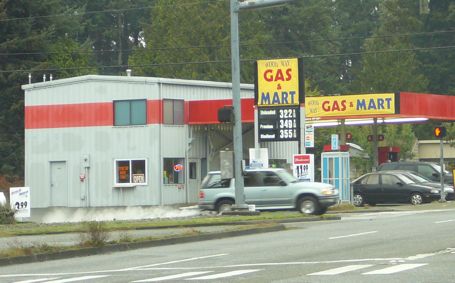
Yesterday I took my Mom (and my Mom’s car) to the COSTCO gas station, where people are lined up to fill the tank at prices slightly less than the normal gas station prices in preparation for the upcoming long Thanksgiving holiday weekend.
I shivered as I stood out in the cool windy weather, filling the tank. I thought about Kuwait, where there is always a friendly face waiting to fill your tank – “Supreme or Premium, madam?” – at about 80 cents a gallon. I always have a smile when I leave the gas station in Kuwait.
Not so, here. Thought you in Kuwait might like to see what Seattleites are paying for gas:
Stroller Brigade
People laugh – or worse, look like I am crazy – when I tell them living in Kuwait is not unlike living in Alaska in terms of climate. When the climate gets extreme – too cold has the same impact as too hot – people stay at home more, going from their heated/chilled homes to their heated/chilled cars to the heated/chilled stores and malls or theatres. When the milder weather comes, everyone spends every minute they can outside.
In Kuwait, there are groups that head for the malls early in the morning for some serious walking when it is too hot to walk outside.
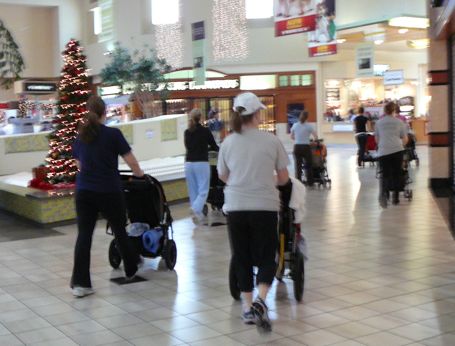
In Seattle, I ran into another group of serious walkers, but here, they are avoiding the rain and cold. When you see the stroller brigade – and there were between fifteen and twenty women with their babies – you had better get out of the way! These are some serious strollers!
Lack of Resistance
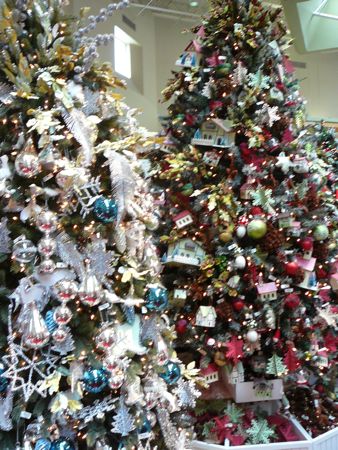
I can feel it starting. I walk into the Mall and my senses go into overload. The colors, the lights, the decorations, the window displays – I am starting to pant with eagerness.
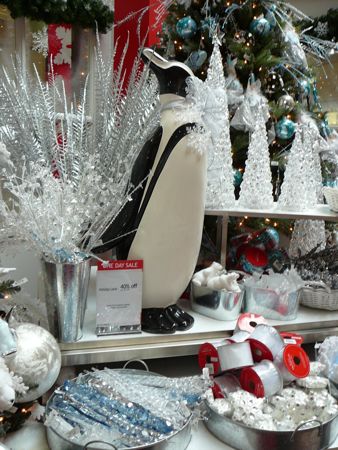
I’m not even a mall shopper! I am just killing time waiting for the Apple shop to open . . . but oh! Look! The Macy’s Christmas shop is open. And oh my! They are having a two hour sale, 40% off!
I have no resistance. I am like a moth to the flame.

I had to take this one for Purg:
I can’t stop taking photos! I’m in sensory overload!
Amsterdam Sights
Walking into the airport in Amsterdam was – for a change – fun. They have Christmas decorations up, and my eyes are starved for Christmas. Well . . . . looking now, I see the huge Camels banner through the decorations. Bah! Humbug! These are “holiday” decorations.


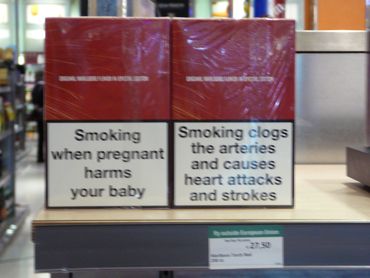
And then these! I have never seen such large packets, nor such enormous warnings:
Cretan Olive Oil
This response is to a post I wrote October 25th on The Olive Oil scandal, that even when you buy a brand you have thought is reliable, you may not be getting what you paid for. For me, it was particularly horrifying to discover they were adulterating the olive oil with hazlenut oil – I don’t have a severe allergy to hazlenuts, but they make the insides of my ears itch. I avoid hazlenuts!
I keep getting such good responses to the post – and I have a partiality (disclaimer!) to small producers of anything, from olive oil to soap to pecans . . . I love buying from the entrepreneur.
Which is why I have taken this response from the comments page and made it an entry. Thank you, Mr. Sassone, for your thoughtful addition to this subject:
It is indeed a shame that the majority of the olive oil on the American and world market has been adulterated by unscrupulous sellers looking for enormous profits.
That is why I started growing olives on the island of Crete, making extra virgin olive oil-EVOO, and importing it to the US. I personally observe all steps in the process from the time the olive flowers bud on the tree until the EVOO goes in the can. I know it is the cleanest, freshest, highest quality, and most healthful EVOO you can buy at any price.
I also offer all customers copies of test reports from independent laboratories that show the exact quality. Acidity is 0.17%. Total polyphenols are 165ppm. Peroxide value is 6. Nothing can compare at any price.
When people buy EVOOs that are labeled as a mix of oil from several countries, they must take this into account: How clean was process to gather the olives? How clean was the factory that processed the oil? How clean were the trucks that transported the oil to the ship? How clean was the ship that transported the oil? You can see where this is going. At any one or more of dozens of steps in the process, contamination can occur. Some of the olive producing countries do not have food the safety standards like the European Union or US Food and Drug Administration.
My curiosity got the best of me. Recently, I sent samples of 13 EVOOs sold in the US for lab testing to find out just how good or bad they are. I dont have a web site just yet, but will publish the results as a comparison to my oil. So long as I keep complete control of the entire process, I can improve the quality of my oil each year.
My EVOO is now available in the US. It is the finest quality and most healthful EVOO you can buy at any price. Send me and email if interested. kretareserve@cox.net Thanks. Tony
More Mubarakiya Art
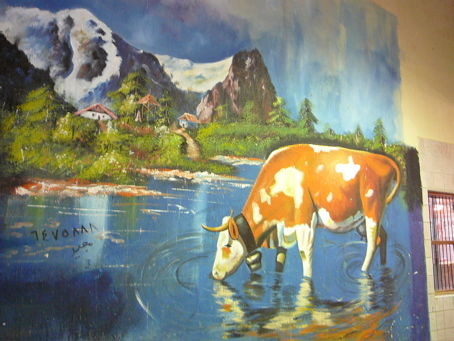
I think this is a total hoot! Along with the Pacific Coast scenery and fish, we have a Swiss Cow, with a bell, and Alpine scenery.
Here is one I love, a genuine Kuwaiti butcher – I love the glasses! Faces and hands are hard to do, and this artist caught his individuality. I wonder if he is still in one of the smaller meat market shops? Also note the bloodstains on the cutting table!

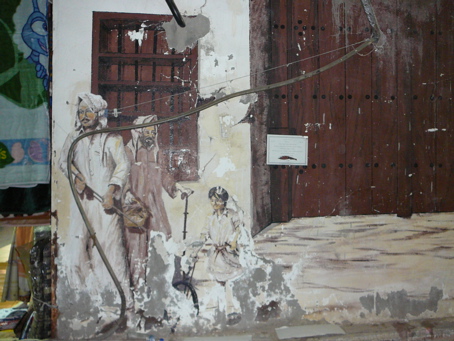
And here is a treasure, just outside the older section, near the date souk, badly damaged, and someone has strung a power cord across it, but one of the best pieces in the market. Love the colors, and look at the stone entry – the artist truly captured the feeling of stone. Look at the depths in the door and the window, the shadows and highlights. Look at the folds in the men’s thobes. This artist had some training.
Fish Market Public Art
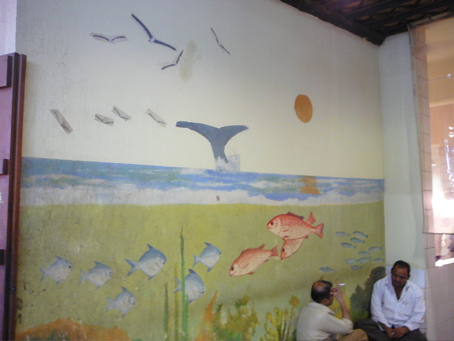
There are so many things I like about the Mubarakiya market. I believe it suffered enormous damage during the Iraqi invasion, and was substantially rebuilt. They did it nicely. The ceilings are high and spacious, and there are beautiful decorations in unlikely places. I found some Fish Market paintings I hadn’t photographed before.
One thing is kind of funny – wouldn’t you think in Kuwait you would have dhows or showies, the Arab Gulf fishing boats? To me, this looks like the Oregon Coast, with the big boulders and rocky coastline! I am thinking those look like Pacific Coast fish, and isn’t that a whale with the seagulls? Are there whales in the Gulf?

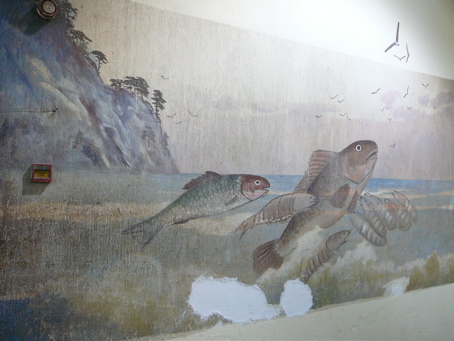
I couldn’t take this one without the two guys taking a break, so I just included them – they ARE part of the Mubarikiya scenery:
Mubarakiya Evening
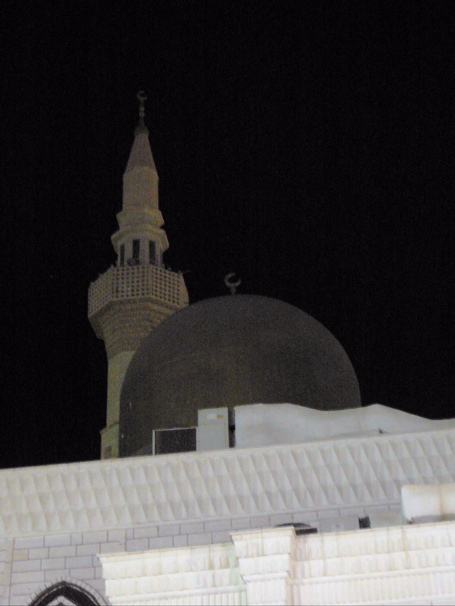
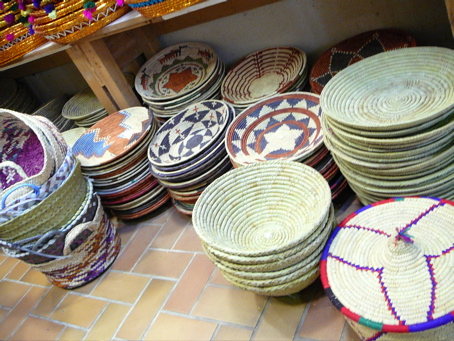
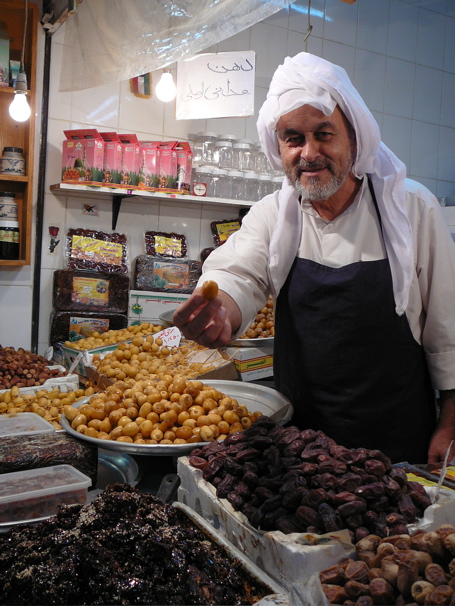
The weather has definitely cooled. We grab out friends and head for one of our very favorite places, the Mubarakiya market downtown, one of the few places still in existence with a flavor of old Kuwait.
We’ve visited in recent months, but the heat defeated us. Last night, our closest 4,000 friends were down there with us, shopping in the markets, having a bite to eat in the outdoor restaurant area (you can only tell which restaurants are which by the different colors of the chairs and tables) relaxing, visiting, just enjoying a beautiful mild weekend evening.
And it was beautful. We have eaten there in the heat, with cooling fans to keep things bearable, we have eaten there in the cold of winter, with little stoves on the table to keep the tea hot and to warm our hands (a little) but this night was utterly perfect. Warm enough, cool enough, and fresh, well prepared local food – it was a perfect evening.
Some new Mubarakiya photos:

The Olive Oil Scandal

A good friend gave me a subscription several years ago to The New Yorker, and at the time I didn’t know how lucky I was. First, I loved the cartoons. A couple magazines later, I got pulled in by some of their excellent travel and political writing. Later, the fiction issues pulled me in and introduced me to authors I had never read before. In no time at all, I was totally addicted.
Now, when The New Yorker arrives, Adventure Man and I fight to see who gets to read it first! Often he wins; he skims it. He knows I will take too long getting through it.
It was the New Yorker magazine who informed me about the great olive oil scandal.
I love olive oil. I only use other oils in baked goods, where the olive oil might give an odd taste, we use olive oil almost exclusively. Or so I thought.
In the August 13 Issue of the New Yorker, Tom Meuller starts like this:
On August 10, 1991, a rusty tanker called the Mazal I docked at the industrial port of Ordu, in Turkey, and pumped twenty-two hundred tons of hazelnut oil into its hold. The ship then embarked on a meandering voyage through the Mediterranean and the North Sea. By September 21st, when the Mazal II reached Barletta, a port in Puglia, in southern Italy, its cargo had become, on the ship’s official documents, Greek olive oil. It slipped through customs, possibly with the connivance of an official, was piped into tanker trucks, and was delivered to the refinery of Riolio, an Italian olive-oil produce based in Barletta. There it was sold—in some instances blended with real olive oil—to Riolio customers
Between August and November of 1991, the Mazal II and another tanker, the Katerina T., delivered nearly ten thousand tons of Turkish hazelnut oil and Argentinean sunflower-seed oil to Riolio, all identified as Greek olive oil.
Riolio’s owner, Domenico Ribatti, grew rich from the bogus oil, assembling substantial real-estate holdings, including a former department store in Bari. He bribed two officials, one with cash, the other with cartons of olive oil, and made trips to Rome, where he stayed at the Grand Hotel, and met with other unscrupulous olive-oil producers from Italy and abroad. As one of Italy’s leading importers of olive oil, Ribatti’s company was a member of ASSITOL, the country’s powerful olive-oil trade association, and Ribatti had enough clout in Rome to ask a favor—preferential treatment of an associate’s nephew, who was seeking admission to a military officers’ school—of a high-ranking official at the Finance Ministry, a fellow-pugliese.
However, by early 1992 Ribatti and his associates were under investigation by the Guardia di Finanza, the Finance Ministry’s military-police force. One officer, wearing a miniature video camera on his tie, posed as a waiter at a lunch hosted by Ribatti at the Grand Hotel. Others, eavesdropping on telephone calls among Riolio executives, heard the rustle of bribe money being counted out. During the next two years, the Guardia di Finanza team, working closely with agents of the European Union’s anti-fraud office, pieced together the details of Ribatti’s crime, identifying Swiss bank accounts and Caribbean shell companies that Ribatti had used to buy the ersatz olive oil.
The investigators discovered that seed and hazelnut oil had reached Riolio’s refinery by tanker truck and by train, as well as by ship, and they found stocks of hazelnut oil waiting in Rotterdam for delivery to Riolio and other olive-oil companies.
The investigators also discovered where Ribatti’s adulterated oil had gone: to some of the largest producers of Italian olive oil, among them Nestlé, Unilever, Bertolli, and Oleifici Fasanesi, who sold it to consumers as olive oil, and collected about twelve million dollars in E.U. subsidies intended to support the olive-oil industry. (These companies claimed that they had been swindled by Ribatti, and prosecutors were unable to prove complicity on their part.)
You can read this entire fascinating article here: Tom Meuller: Slippery BusinessGive yourself plenty of time. It is an article well worth reading.
There is another good reference here: The Great Olive Oil Scandal from PalestinianOliveOil.org
Investigators have gathered evidence indicating that the biggest olive oil brands in Italy — Bertolli, Sasso, and Cirio — have for years been systematically diluting their extra-virgin olive oil with cheap, highly-refined hazelnut oil imported from Turkey. [1]
A 1996 study by the FDA found that 96 percent of the olive oils they tested, while being labeled 100 percent olive oil, had been diluted with other oils. A study in Italy found that only 40 percent of the olive oil brands labeled “extra-virgin” actually met those standards. Italy produces 400,000 tons of olive oil for domestic consumption, but 750,000 tons are sold. The difference is made up with highly refined nut and seed oils. [2]
EVEN THE BIGGEST OF THEM WILL MISLEAD THE PUBLIC…
“In 1998, the New York law firm Rabin and Peckel, LLP, took on the olive oil labeling misnomer and filed a class action suit in the New York Supreme Court against Unilever, the English-Dutch manufacturer of Bertolli olive oil. The firm argued that Bertolli’s labels, which read “Imported from Italy,” did not meet full disclosure laws because, even though the oil had passed through Italian ports, most of it had originated in Tunisia, Turkey, Spain or Greece. “Bertolli olive oil is imported from Italy, but contains no measurable quantity of Italian oil,” according to court documents.”
Curezone lists manufacturers of adulterated olive oil and marketers of the same oil. It is disgusting. We pay high prices for junk-olive oil. From Curezone.com/forums
The Guilty
Below is a list of known adulterated brands and dishonest distributors with links to information about their cases.
Adulterated brands of extra virgin olive oil
with country of origin
Andy’s Pure Olive Oil (Italy)
Bertolli (Italy)
Castel Tiziano (Italy)
Cirio (Italy)
Cornelia (Italy)
Italico (Italy)
Ligaro (Italy)
Olivio (Greece)
Petrou Bros. Olive Oil (California)
Primi (Italy)
Regale (Italy)
Ricetta Antica (Italy)
Rubino (Italy)
San Paolo (Italy)
Sasso (Italy)
Terra Mia (Italy)
Distributors caught selling adulterated olive oil
Altapac Trading
AMT Fine Foods
Bella International Food Brokers
Cher-Mor Foods International
D&G Foods
Deluca Brothers International
Gestion Trorico Inc.
Itaical Trading
Kalamata Foods
Les Ailments MIA Food Distributing
Lonath International
Mario Sardo Sales, Inc.
Petrou Foods, Inc.
Rubino USA Inc.
Siena Foods Ltd.
Vernon Foods
So who do we trust? How do we know that we are getting a quality, unadulterated product? This is fraud in an international scale!
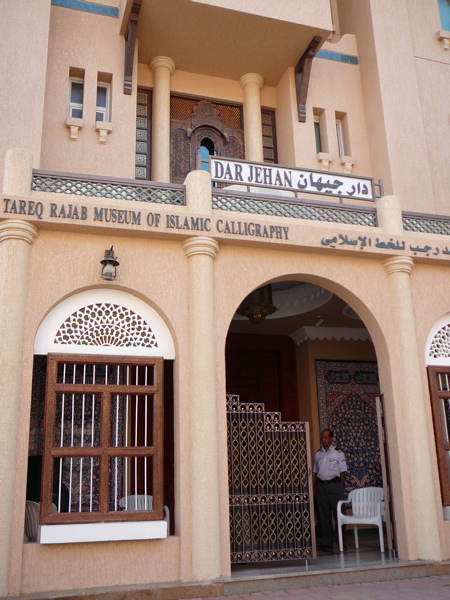
Tareq Rajab Museum of Islamic Calligraphy
One of the most beautiful buildings in Kuwait is the new – open only since March – Museum of Islamic Calligraphy in Kuwait. I am in total awe of this family, who have an eye for the history and culture of this area, collect it lovingly, and then display it – free of cost – to all who wish to visit.
The TR Museum of Islamic Calligraphy is on the same street as the Dar al Cid, where many art exhibits are held, also under the auspices of the Tareq Rajab family. It is around the corner from the Tareq Rejab Museum.
It is open every day:
Mornings 9 am – 12 noon
Afternoon 4 pm – 7 pm
Friday 9am – 12 noon
We visited recently. The museum is beautiful, and well organized. We wished only that more of the exhibits had explanations; sometimes we would be looking at something very beautiful, but we didn’t know the significance of what we were seeing.
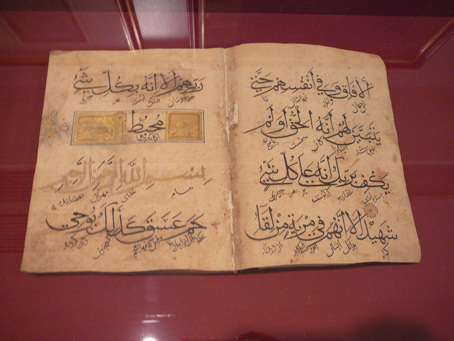
The calligraphy is manifest in hangings, ancient Qurans, quiltings, posters and carved wood. Each item is a work of art. We were fascinated by some of the Chinese calligraphy, and by the video they run showing how calligraphic quills are made, how the paper is prepared, even how the calligrapher prepares for work.
This is the entry to the Museum of Islamic Calligraphy:
Some examples of the beautiful works on display:


If you are looking for books about Kuwait, and/or Islamic Arts, the Tareq Rajab Museum has a well stocked little shop with books, cards, postcards, etc. for reasonable prices.
We take all our houseguests to these museums, and every time we go, we are moved by the generous hearts that create these museums and then offer them to the public – free of charge. They give so much to their community. It’s like a little piece of heaven. Visit soon!
Recent Comments
ExpatAlien on What Country am I Living … intlxpatr on Yellowstone: Old Faithful to C… Michelle on Yellowstone: Old Faithful to C… Cathy on No Grown-Ups in Charge intlxpatr on Waiting for Snow Wikipedia Donate Button

Amazina


Early Voting in Florida


 Here There and Everywhere