Cultures Collide
Maybe “culture clash” is too strong, maybe it’s more like huge continents that kind of bump into each other and send a reverberation through both continents, more a slow grinding than a crash? And maybe, like rough stones tumbling in a barrel, as we rub our rough edges against one another over time, maybe we become smooth, polished gems?
I have a dear friend, one of those friends that when you can grab some time together you never run out of topics, and when they leave, you remember “Oh! I forgot the point of that story was . . . and I never got to it!” or “Oh! she was starting to tell me about the . . .. and then we segued off into something else!” This friend delights my heart; when you see her face, you can see her lively soul in her sparkling eyes.
Those eyes were looking at me in utter puzzlement.
“What do you mean you couldn’t find any celery?” she asked. “Didn’t you go to the grocery store?”
“Yes! I spent hours there! Big mistake, shopping just before Ramadan, me and everyone else in the village.”
“So why didn’t you just buy some celery?” she persisted.
“There wasn’t any celery! It was all gone!” i responded.
“How could it be gone?” she asked, incredulity in her voice, “Don’t they always have celery?”
Something is wrong with this conversation. We look at each other.
“Have you ever been grocery shopping just before Ramadan?” I asked her.
“I never go grocery shopping!” she replied.
(Can you hear those continents grinding?)
I sat down. I looked at her. I believed her; I don’t think this woman is capable of lying, she is innocent and straight-forward.
“You’ve never been grocery shopping?” I asked her, knowing that if she said it, it is true, but trying to figure out how this could even be possible.
“Well, a couple times, like when I was making that pie, but only for a few little things, not like food to feed the family.”
She has staff. They’ve always had staff.
So I explained to her that just before Ramadan, like in western countries just before Christmas, some items just disappear.
“One time, in Tunisia, olive oil disappeared! And eggs! And even tomato sauce, and these are all products made in Tunisia!” I explained. “Here,” I went on, “you know how it is, sometimes even when it is not Ramadan, things will disappear, but when Ramadan is coming, if you know you might need something, you have to plan way in advance. Your Mom probably has taken care of all that. ”
“I don’t think so,” she said, two little tiny worry lines creasing her brow.
“Your Mom doesn’t shop, either?” I asked.
“Not for groceries.” And she’s looking at me like I am from another world.
And I am. This friend is so patient with me, with my little ignorances. When you are a stranger in a strange land, you expect some of the big differences. Like Ramadan, that is a big difference, when the whole country becomes more religious and for a whole month the focus is on God, on fasting during daylight and gathering with family and friends and feasting at night, reading the Qur’an, submitting your sins and begging forgiveness. . .
It’s the little things that catch you up. You kind of assume that everyone lives life a lot like you do, and it can be a real shock to discover that in small, everyday things you take for granted, you do things very differently.
Some of my earliest memories are in the kitchen, cutting dates and prunes to help my Mom make fruit cake. I can remember stirring chocolate pudding as it cooked on the stove, making jello, simple things before I graduated to chopping nuts and onions, etc. And I wrongly assumed this is everyone’s experience.
I know I have shocked my friend, too, sometimes. I asked what I thought was a very simple question once, and watched her face become a mask of horror at the very thought. God bless her for her patience with me!
I bless all my friends today, my Tunisian friends, my Kuwaiti friends, my Saudi friends, my German friends, my French friends, my Qatteri friends – all the friends who have endured my chauvinistic mistakes, assuming all the world thinks as I do. I bless my American friends, because even though we are from the same nation, we, too, are from different areas and different family cultures (tribes!) and we don’t see through the same eyes, our views are colored by the culture through which we observe the world. Today I am thankfully amazed that we manage to get along as well as we do!
Ramadan Supplies
Oh! It’s a perfect day to be out shopping. Stores are putting out all the special Ramadan things – and now is the time you can find all the things that have been missing all summer. It’s a lush, wealthy time, anticipating the joys of the coming month of Ramadan.
And look what I found! Straight from the Street of Lanterns?

No! Made in China!
The Street of Ramadan Lanterns
Over 15 years ago, this article appeared in the March/April edition of SaudiAramco World.
Blessed is He who made constellations in the skies and placed therein a lamp and a moon giving light; and it is He who made the night and day to follow each other: For such as have the will to celebrate His praises or to show their gratitude.
The Qu’ran, Chapter XXV (Al-Funqan, The Criterion), Verses 61-62
Written and photographed by John Feeney
No one knows for certain when the use of children’s Ramadan lanterns began, but it is a very old Egyptian tradition. Indeed, lanterns and lamps of various kinds, of many hues and degrees of brightness, and even both real and imaginary, have always been special to Egypt. For centuries before the coming of electricity, Cairo itself was noted for its spectacular use of lanterns to illuminate the city, especially during the holy month of Ramadan.
Ramadan, the ninth month of the Muslim lunar year, is a time of fasting, blessings and prayers. It also commemorates the revelation of the first verses of the Qur’an to the Prophet Muhammad.
As a way of giving thanks to God during this holy month, and as a way of unifying the worldwide community of believers, Muslims – with special exceptions for the sick, nursing mothers, pregnant women and travelers – spend the daylight hours fasting. The hours of the night, until dawn, are marked by prayers, ceremonial meals and celebration of the day’s spiritual victory over human desires. After sunset, streets and squares all over the Muslim world are thronged with people out buying food after the long day’s fast, or visiting friends, or preparing for sahur, the last meal of the night, which will be taken before dawn. It is then that young Cairenes, allowed to stay up late because of Ramadan, traditionally gather in groups of three or four to go out among the crowds, swinging their glowing lanterns and chanting their ancient song of Ramadan – just as children in other lands go caroling – hoping to receive in return a few nuts or sweets for their vocal efforts.
Passed on by children from generation to generation, the traditional song, in colloquial Egyptian Arabic, accompanies the swinging of the lanterns in the little ones’ hands. It goes like this:
Wahawi, ya wahawi
iyyahah
You have gone, O Sha’ban,
You have come, O Ramadan,
iyyahah
The daughter of the Sultan
is wearing her caftan,
iyyahah
For God the forgiver
Give us this season’s gift.
Some believe that the children’s lantern song comes all the way from Pharaonic times, like the ancient Egyptian song called O-Faleh in the Pharaonic tongue and al-Bahr Sa’id in Arabic (meaning “The River Has Risen”). In the days before the Aswan Dam was built, that song was sung by groups out in small boats on the night the Nile reached the peak of its annual flood. Certainly, the lantern song is very old, and very Egyptian.
The opening lines – “Wahawi ya, wahawi iyyahah” – have no known meaning. “You have gone, O Sha’ban” refers to the month that comes before Ramadan in the Muslims’ lunar hijri calendar, and “the daughter of the Sultan is wearing her caftan” means she is dressed in the garment worn when going out, maybe to the mosque. “Give us this season’s gift” refers to the small presents children receive from family and friends at the time of the ‘Id or holiday that follows the month of fasting.
In the days leading up to Ramadan, children become more insistent about having a lantern; many can hardly wait to start swinging and singing – for what child, from its earliest years, is not attracted by a glowing, magical lantern? Yet Cairo children may be the most “lantern-struck” of all: Recent research by Dr. Marsin Mahdi of Harvard University indicates that Scheherezade’s ‘Alaa’ al-Din (Aladdin) of the magic lamp may well have been a Cairo boy.
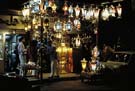
One week before Ramadan begins, part of Ahmad Maher Street, for most of the year a humble thoroughfare in the old medieval quarter of Cairo, is transformed. Usually home to tinsmiths, marble-cutters and makers of mousetraps, for one glorious month it becomes “The Street of the Lanterns.”
Filmmaker John Feeney, who has lived in Cairo for a quarter century, is a long-time contributor toAramco World. He wishes to thank Laila Ibrahim, renowned authority on Mamluk Egypt, for her help with this article.
This article appeared on pages 14-23 of the March/April 1992 print edition of Saudi Aramco World.
You can read the rest of this fascinating article HERE.
I love the Ramadan lanterns. I’ve been to Cairo, and found the heat and the teeming population, the gridlocked traffic and all the begging a little scary. But I would go back in a heartbeat to see this street of lanterns!
For my non-Muslim readers, I found a wonderful site while researching Ramadan lanterns that gives a simple overview of Ramadan: Hamad El Afandi’s Ramadan Kareem. It is heavily illustrated with photos.
Where are Hussein and Ali?
Ten days ago I was taking a new friend around the old souks and I showed her Hussein and Ali, on the corner across from the main entrance to the Heritage Souk area, where a lot of expats buy carpets.
One week later, downtown with Adventure Man – Hussein and Ali’s shop is gone. The sign is down, the shutters are closed and it looks like they are never coming back.
Have they moved? Does anyone know what happened? Did they lose their lease?
I Thought I’d Never See You Again
I thought I saw you from across the room. My heart leapt into my throat – I didn’t dare believe my eyes.
I thought I would never see you again. When you disappeared from my life, life lost a little of it’s savor. I looked for you, I searched for you, always disappointed. I had become so addicted, without even knowing it. You made such a difference in my life. Without you, there is only darkness.
I woke up each morning yearning for you, and sad because of your absence. Oh yes, I moved on, I found others, but I was never satisfied. I never found a substitute for you.
So you understand why I appeared so wild-eyed with happiness? Why I grabbed at you so greedily? I want you in my life! Please, don’t desert me again!

Summer Fruit Crisps
If you haven’t cooked before, and are interested in beginning, Crisps are a good place to start. They are easy, don’t take a lot of time, and you get instant – and delicious! – gratification. Now, while fresh fruit is abundant in Kuwait (and elsewhere) is a great time to try a crisp.
These recipes are from Mary Cullen’s Northwest Cook Book, 1946. My aunt gave it to me before she died, and some of my best cooking efforts have been based on recipes from this book. They are simple, but . . . simply GOOD!
Apple Crisp
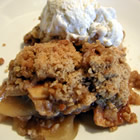
Crisps are wonderful when made with fresh fruit, and not so much trouble as a pie requiring crusts. Here, the topping is delicious, and easy.
5 cups apples
1/2 cup butter
1 cup sugar
3/4 cups all purpose flour
1 teaspoon cinnamon or nutmeg
Peel, core and slice apples and place in a greased baking dish or cassarole (a ceramic pie dish is perfect, but you can also use a ramekin, or something not too deep, not too shallow).
Using a pastry blender, or a metal whisk, or an electric mixer, work together the butter, sugar, salt, flour and spices.
Pack closely around apples.
Bake in 425 degree oven for 45 – 50 minutes. Serve with whipped cream or ice cream.
Berry Crisp or Peach / Apricot / Plum Crisp
Substitute berries (peaches or apricots or plums) for apples. If berries are very tart, sprinkle with 1/2 cup sugar mixed with 1/2 cup flour before covering with crumb mixture.
Rhubarb Crisp
Use diced rhubarb in place of apples. Mix 1/2 to 1 cup sugar and 1/2 cup flour with rhubarb before placing in baking dish.
Kuwait Fish Market Artistry
They’re in! The first of the season’s Kuwait shrimp! Did I buy any – you bet! Shrimp for dinner tonight. Yummmmmmm.

As I was having the shrimp cleaned, we noticed that someone had gone to a lot of trouble to put the fish out attractively. Doesn’t it make all the difference?
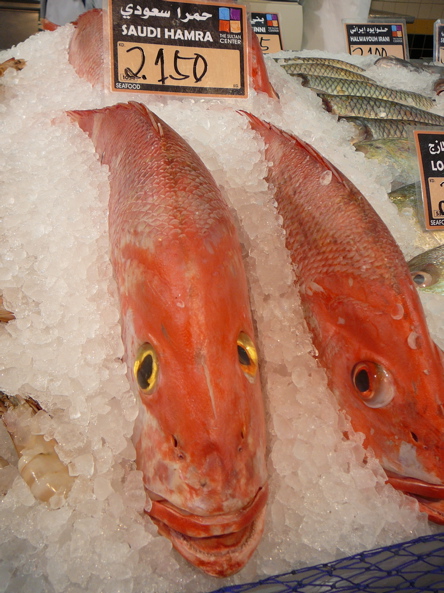
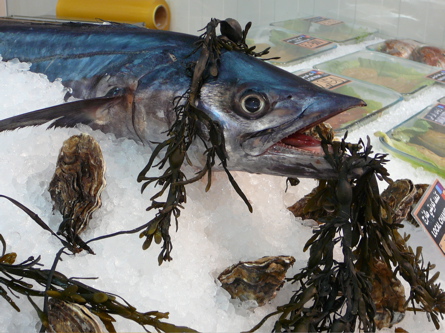
(Photos taken at the Sultan Center)
Shrimping Season Begins
Did you miss it? The Public Authority for Agricultural Affairs and Fish Resources announced the beginning of the shrimp fishing season August 15th, upon the expiry of the seven month ban, from January 15 – August 15.
I checked the fish markets yesterday, and didn’t see any Kuwaiti shrimp, only Saudi farmed shrimp (which is also good, but farmed); I expect we will be seeing the good Kuwaiti shrimp soon. Oh, I have been missing Kuwaiti shrimp!
The Avenues Mall in Kuwait
This if for my outside-Kuwait readers; most of the Kuwait readers have already been to The Avenues.
The Avenues is the newest mall in Kuwait, and has the greatest variety so far of shops with names familiar to most malls – Banana Republic, Starbucks, etc. But it has a couple stores with unusual things – one is a Moroccan design store, but everything I liked inside it said “this item not for sale!” Excuse me? What’s the point?
There is an IKEA attached, lots of coffee places, a few places to eat, mostly places you find in Malls – Paul’s, etc., but nothing outstanding. The coffee places are nice for sitting and waiting for friends who are shopping when you are bored or tired, but if you are interested in GOOD food, I think you can do better eating outside the mall.
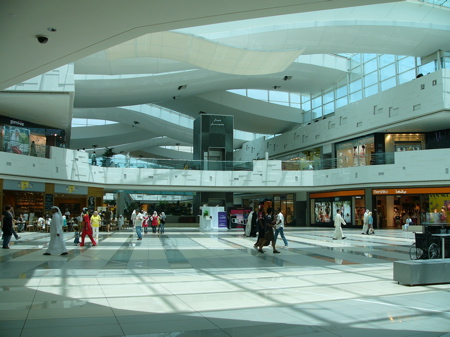
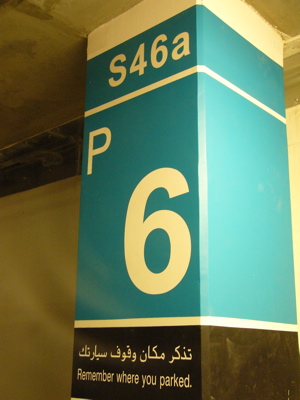
The mall is vast. The good news is, there is lots of parking, so you only have to think about where you want to be. We were really lucky, as we pulled in, a car was just leaving a really nice spot. You know how you always THINK you are going to remember your spot? At The Avenues, you need to remember the letter, the number AND the color. Probably the S46a comes in handy, too. We took a photo, and it was a good thing, because we thought we remembered very clearly where the car was, and we were mistaken.
Going to a mall in Kuwait is one of the major summer pastimes. When the heat outside is 118 degrees F (48C), you look for places that are well air-conditioned. We found places in the mall where the air conditioning was working so hard it sounded like being in a wind tunnel!
As for shopping – the quality of the clothing is not the same as you find in the same stores elsewhere. Prices are high, and even when they mark them down, it is hard to think of most of this clothing as a good value for the money. There are no bookstores.
It IS full of light, and a great place for walking – groups meet up at the Avenues purely for walking, and then usually for a cup of coffee afterwards.
So, in conclusion – it’s huge. Positives: It’s light and airy. It’s great for fitness walking in Kuwait’s heat. It’s a good place to meet up with friends, great central location. Negatives: it’s just another mall, just bigger. Not a destination.
What would make a mall that interested me more? A Sephora that truly had the entire range of make-up products that European and USA Sephoras carry. A really good household department with high quality sheets and towels, and well made clothing in beautiful fabrics. An Eddie Bauer. A Clearwater Creek. A Barnes and Nobles. A couple Indian furniture shops. A L’escharpe. A jewelers/gold souk with ALL the major jewelers in Kuwait. A perfumers souk. Some really good local food places.
What about you? What would you like to see in a mall?
Recent Comments
Kitchen on Isiais: Winding Down intlxpatr on Shampoo Ginger tigerbutterya0c5ff1d… on Shampoo Ginger intlxpatr on British Soldier Kidnapped, Esc… John on British Soldier Kidnapped, Esc… Wikipedia Donate Button

Amazina


Early Voting in Florida


