Peter Bowen and Nails
Three men trundle a naked woman through the desert to a remote place, where she was placed in a container, 6 x 6 x 6 with only a candle, a cot, water and a holy book, until she could come to her senses and behave.
Four girls were strangled, one each day, for refusing the sexual advances of their father and his brother. The two youngest girls, their older sisters dead, complied.
Women with inconvenient views, women who start having thoughts of their own disappear. Many in this tribe are home-birthed and home-schooled, so there aren’t records of their existence, and when they disappear, no-one is the wiser.
Saudi Arabia, you ask? Pakistan? Afghanistan? Where on earth are women treated this vilely?

Peter Bowen, in Nails, gives vent to his frustration of minor fundamentalist Christian cults roaming the American West, many of them ending up in Montana where they believe they will have the privacy to practice their beliefs without interference, and where those who are well-funded can influence poverty-stricken school districts to toss out Science classes and incorporate Intelligent Design. Bowen has utter contempt for their studied ignorance, their need to be the sole authority on what the scriptures say, and their insistence on the utter submission of women.
His worst scorn is for their treatment of women – he attributes it to their fears about their own sexuality. Women are often the victims, Bowen states, when men worry about their size, worry about how to keep women faithful, tractable, and docile. (And let’s face it, who can successfully control a woman? 😉 )
This is the latest Gabriel du Pre novel, or at least the latest I have read. Gabriel du Pre is a retired brand inspector (he goes back every now and then when needed, when the brand inspector is overstretched, insuring that the cows sold are from the herds they are being sold from), Metis (French and Indian mix), a renowned fiddler, and a deputy sheriff when the sheriff – or the FBI – needs help solving a particularly tricky murder. It takes a while to get your ear used to his dialect, and he spends a lot of time in bars, but the man has a real knack for figuring things out.
Gabriel du Pre is everything a straight-living woman like myself shouldn’t like. He drinks, morning to night, keeps his flask of whisky under the driver’s seat in his car. He drives way over the speed limit. He doesn’t go to church, he goes to an ancient Indian spiritualist / medicine man when he needs guidance. He isn’t married to the wry, very smart woman with whom he lives. He breaks the rules, he goes outside the boundaries.
For all his flaws, du Pre has a deep down, rock solid core of decency, and a way of looking at life and situations that is practical and . . . forgiving. He is charitable toward his brothers and sisters. He detests cruelty, especially when the strong take advantage of the weak or the arrogant walk all over the humble. There is something about this flawed hero that keeps the reader coming back for more.
His Gabriel du Pre novels are not heavy reading. You can toss one off in about half a day, but they are not so simple as they appear. You find yourself thinking about the issues he raises, and you find yourself looking to see when the next Gabriel du Pre mystery will appear.
You can find this on Amazon.com for $16. new or from $3.07 used, plus shipping of course. (Yes, I own stock in Amazon.com.) 🙂
Saving the Lives of Malnourished Children
I received this e-mail this morning:
Hi there,
My organization, International Medical Corps, has the ability to save the lives
of malnourished children around the world and we just received some very
exciting news. We have been nominated to be one of the Top 25 in American
Express’ Projects, “Saving the Lives of Malnourished Children.” Our project was
chosen out of 1,190 projects and is now eligible to receive up to $1.5 million
to help feed hungry children. Because your blog, here there and Everywhere, has
a loyal following, I thought this would be an issue you would want to share with
your readers. I’ve put together this microsite explaining everything.
http://internationalmedicalcorps.smnr.us/
If you could post about this on your blog it would really help to spread the
message and potentially could save many lives. At the minimum, please vote for
“Saving the Lives of Malnourished Children.” Please let me know either way.
Thanks.
Chessia
—
Chessia Kelley, International Medical Corps
ckelley@imcworldwide.org
http://imcworldwide.org
I googled the organization and it is legitimate. Here is what Wikipedia has to say:
International Medical Corps (known also as IMC) is a global humanitarian nonprofit organization established by volunteer doctors and nurses. The organization provides disaster relief, delivers health care to underserved regions, builds clinics, and trains local health care workers with the goal of creating self-reliant, self-sustaining medical services and infrastructure in places where that had previously been lacking.
IMC’s focuses include primary and secondary health care, prevention and treatment of infectious diseases such as malaria, cholera, dysentery, and HIV/AIDS, supplemental food for malnourished children, clean water and hygiene education, mental health and psychosocial care, and microfinance programs that allow people to earn their own income.
International Medical Corps is a founding member of the ONE Campaign and a member of the Clinton Global Initiative.
Rapists Arrested
From today’s Arab Times:
2 wanted Bedouns involved in ‘rape’ case held
Kuwait : Personnel from the Law Enforcement Department have arrested two Bedouns who had been sentenced in absentia for life imprisonment with hard labor for their involvement in kidnapping and raping an unidentified expatriate woman, reports Al-Anba daily.
The daily did not give more details.
I don’t know how the system works here, but it is a great step forward when rapists are arrested and jailed. These two have already been convicted, so we can hope they will be off the streets for a while.
Streaky Sunrise
Circumstances had me up and about just before the sun was rising this morning, but I was filled with despair – how can I shoot the sunrise through these streaky windows? The men will be coming soon to wash the outside – more than 200 square feet of glass in our living room – the windows make up almost an entire wall.
The humidity of the last week made them damp and sticky, and then the sand storm blew in. The results are a disaster for my windows, now caked with burned on dust and grit, all streaked as the windows shed the day’s humidity.
This is what the windows look like:

This is what the sunrise looked like at 0h-dark-thirty this morning, through my streaky windows:

Here is what is going to happen. The men will come and wash my windows – but not until the day before the next humid day followed upon by another sandstorm. I will have about six hours to enjoy my beautiful diamond-sparkling-clear windows before they streak again. 😦
There is not a cloud in the sky. Weather Underground: Kuwait forecasts that today will reach 111°F / 44° C this afternoon. For my non-Moslem friends, try eating breakfast while it is still dark, early in the day, and then trying to get through a day like today without eating, drinking, smoking or coffee. God willing, there will be no humidity, which just saps the energy right out of everyone. God willing, because it is Saturday, most people will be able to stay at home and off the roads while they are fasting.
I had a man almost drift right into me yesterday in downtown Kuwait; I think he fell asleep as he was driving. Of course when I tapped my horn lightly to let him know he was drifting, he woke up and was all embarrassed and drove off with a roar, maybe to show me he hadn’t been sleeping, I don’t know, LOL. Mostly I try to stay off the roads myself.
Romance and Money Matters
I found this article in today’s New York Times Business. So here is my question to you – is it different in Kuwait than in the USA? I remember when we wanted a joint checking account here ( Adventures in Banking), one man looked at my husband in disbelief and said “Why? Just give her some money!” We never did get a joint account; it isn’t possible, but I was given a PAO on the account. It seemed bizarre to me, but it makes perfect sense if couples keep their moneys separately.
What do you think? Does this article apply to marriage in Kuwait?
The Key to Wedded Bliss? Money Matters
By TARA SIEGEL BERNARD
Published: September 10, 2008
IF you ask married people why their marriage works, they are probably not going to say it’s because they found their financial soul mate.
But if they are lucky, they have. Marrying a person who shares your attitudes about money might just be the smartest financial decision you will ever make. In fact, when it comes to finances, your marriage is likely to be your most valuable asset — or your largest liability.
Marrying for love is a relatively recent phenomenon. For centuries, marriages were arranged affairs, aligning families for economic or political purposes or simply pooling the resources of those scraping by.
Today, while most of us marry for romantic reasons, marriage at its core is still a financial union. So much of what we want — or don’t want — out of life boils down to dollars and cents, whether it’s how hard we choose to work, how much we consume or how much we save. For some people, it’s working 80-hour weeks to finance a third home and country club membership; for others, it means cutting back on office hours to spend more time with the family.
“A lot of the debates people have about money are code for how we want to live our lives,” said Betsey Stevenson, assistant professor of business and public policy at the University of Pennsylvania’s Wharton School, who researches the economics of marriage and divorce. “A lot of the choices we make in how we want to live our lives involve how we spend our money.”
Making those choices as a team is one of the most important ways to preserve your marital assets, and your union, experts say. But it’s that much easier when you already share similar outlooks on money matters — or when you can, at the very least, find some middle ground.
The economies achieved by pairing up are fairly obvious. However, the costs of divorce can be financially devastating, especially when children are involved. And, not surprisingly, money manages to force a wide wedge between many couples.
“Most people think people break up over sex issues and children issues — and those are issues — but money is a huge factor in breaking up marriages,” said Susan Reach Winters, a divorce lawyer in Short Hills, N.J.
Not everyone is married to a financial twin, and that’s not necessarily a problem. There are several ways that you and your significant other can become more compatible, and ultimately more prosperous, when it comes to money.
These guidelines are compiled from the successfully married and from experts on psychology, divorce and finance:
TALK AND SHARE GOALS Before walking down the aisle, couples should have a talk about their financial health and goals. They should ask each other tough questions: Do we want children? When? Who will care for them? Will they go to public or private school? What kind of life do we want? When will we retire?
This is a fascinating article – read the rest of it HERE.
Moroccan Blogger Jailed
You can read the entire story, which appeared today, on BBC News Africa:

A Moroccan blogger has been jailed for two years for showing disrespect to the monarchy, say the man’s family.
Mohammed Erraji, 29, was convicted after writing an article claiming King Mohammed VI’s charitable habits were encouraging a culture of dependency.
There has been no official comment on the case, but rights groups claim Erraji did not have a fair trial.
A BBC reporter says criticising the king is an offence in Morocco and the royal family remains a taboo subject.
Morocco has previously caused international outrage with its treatment of internet users.
Earlier this year, Fouad Mortada was sentenced to three years in prison for creating a false profile on the internet site Facebook using the identity of the king’s brother.
He received a royal pardon following protests from internet users around the world.
‘Disastrous’
Erraji claimed in an internet article that the king’s charity towards Moroccans was stifling development by encouraging people to be lazy.
“This has made the Moroccans a people without dignity, who live by donations and gifts,” he wrote.
The BBC’s James Copnall in the capital, Rabat, says he was particularly critical of the practice known as grima – giving lucrative licences to run taxis and other transport in exchange for begging letters.
Erraji said this did not happen in developed countries, where hard work rather than begging is rewarded.
He was arrested by the authorities last Friday and accused of “lacking the respect due to the king”.
In court on Monday, he was given a two-year prison sentence and fined 5,000 Dirham ($630:£356).
The Scourge of Poverty
For the last several years I have tried to start my day by reading my daily readings in the Lectionary (which is also listed in my blogroll there at the right, so you can click on it any time to see what I am reading) and the daily reading from Forward Day by Day (also on the blogroll list).
I think my days go better when I do. I’m human; there are days when I have forgotten, or gotten caught up in the frenzy of daily life and neglected my readings, but it is my commitment and my habit, and I am fairly faithful to it.
Today’s reading in Forward Day by Day (oops, I can see that it is actually Monday’s reading, but as I write, it is still Monday in the USA where it is homed) has to do with poverty.
I thought I would share it with you because I know from what you share with me that during Ramadan, as you grow closer to Allah/God, that part of the expression of that closeness is giving to the poor. I have read of many different ways in which this is expressed – medical expenses paid, food given in Iftar meals, eyeglasses purchased for the needy, a year’s rent paid for a widow with children – what generosity!
I have worked with the poor. I have known what agony it is to have to choose between making an expensive car repair and getting a dental exam. We kept a pantry full of food for those who could barely make the rent, and had nothing left over for food. These were the working poor, the can-we-make-it-from-month-to-month poor. There is a whole other level, the street poor, with their worldly possessions in a garbage sack, or shredding backpack, who never know if they will get food for the day.
I see people here in Kuwait scouring the beaches for something to throw in the soup to make it nourishing, people who beg just for a little bread.
The problems can be overwhelming.
In Kuwait, one group refuses to be overwhelmed. Every month of the year is devoted to alleviating the suffering of the poor. That group is Operation Hope Kuwait. While you are considering where to make an impact this Ramadan – or any other time of the year when you are feeling thankful and generous – please consider Operation Hope Kuwait. They gather all kinds of resources and distribute them to the poor. They faithfully act as God’s hands here on earth, serving the needs of the most desperately poor and needy. Whatever you give them will be stretched to the maximum; they don’t waste a penny, not a fil. Please, give generously.
Psalm 41. Happy are they who consider the poor and needy! the LORD will deliver them in the time of trouble.
The scourge of poverty can be viewed as a sociological problem, an economic problem, a political problem, or in other ways. The scriptures offer no grand economic theories other than to tell those who have much to share with those who have little. Christ told his disciples that they would always have the poor among them. Given human sin and limitations, the problem will always be somewhat intractable.
But the problem of my heart and how it regards the poor-the problem of my own generosity to the world around me – is not intractable. Economic theory and political allegiance are not the crucial questions before us. How I regard the poor is a matter of deep importance in the relationship of my heart with God. The psalm could not be clearer: happy are those who consider [do good to] the poor. It offers a promise to us as well that God will deliver us when we find ourselves in the day of trouble.
Damages, Glen Close and Paradise Road
AdventureMan and I could hardly wait to get home – we started Glen Close’s Damages, a critically acclaimed, award winning legal drama that hit the screen in 2007, but only recently came out in DVD form. As I am always on the watch for series that will grip us – and give us hours of speculation and conversation over dinner – I snapped this one up en route back to Kuwait, knowing with Ramadan here, we would have quiet hours we could spend watching.
Holy. Smokes. Damages is gripping. Damages is amazing. Damages has you sitting on the edge of your chair, and panting for more!
You have to get used to the cinematic style – we start in the present and throughout the entire 13 episodes, we go back into the past – from years ago to months ago to weeks ago, as we get closer to the end – days ago – to follow the career of new lawyer Ellen Parsons, as she goes to work for the top-of-the-heap firm Hewes and Associates. Hewes, played by Glen Close, is simply breathtaking.

Hewes and Associates are in the process of going after Arthur Frobisher, an egomaniacal developer who, similar to other big rich crooks in the US, took his funds out of his company when he had inside information it was about to tank, leaving his 500 employees unemployed, pension fund bankrupt and without the financial security they had invested in for so long. We know there is more going on here, and from week to week, we learn a little more of the puzzle. The puzzle is intricate and complex, and with each episode – man, the hook is set. We are addicted.
We hurried through the last three episodes to share it with some good friends who appreciate the same kinds of shows we do. We look forward to sharing it with our son, who shared Deadwood with us – it’s that good. It’s Deadwood level.
Glen close plays Patty Hewes as a driven, hard working woman, feared, admired and hated in a field which allows little room for mistakes. Part of what keeps you coming back is the revealing of all the different layers of her personality – the vulnerable mother, the trophy wife, the tough-minded head of her firm, the manipulator of all around her. Her motto (reminiscent of the old X-files) is Trust No One. We certainly have questions about how far we can trust her.
Did she try to have her protegee murdered?
We can hardly wait for Season 2.
UPDATE: 22 Sep 08 Last night Glen Close won Best Actress in a Drama (Emmy Awards) for her role as Patty Hewes.
Did you ever see Glen Close in Fatal Attraction? Did you see her as the police chief in The Shield? She is the most amazing actress, such subtlety in her expression, such vulnerability, such toughness.
My very favorite movie with her in it is Paradise Road.
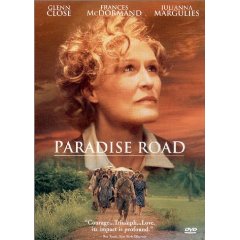
It has to do with a boatload of women and children, and how they survive in a Japanese prison camp during World War II. I don’t buy a lot of movies, but I bought this one – it’s that good. You can watch it once a year and feel equally inspired every time you watch it.
This is from Wikipedia and is a summary of the movie Paradise Road:
Singapore falls to the Japanese in 1942 and the women and children are put on boats to be shipped to safety. Japanese fighters, however, sink one boat and those on board must swim for their lives. Landing on the Japanese controlled island of Sumatra, the women, including Adrienne Pargiter (Glenn Close), a British graduate of the Royal Academy of Music, Susan Macarthy (Cate Blanchett), an Australian nursing student, Topsy Merrit (Julianna Margulies), a pessimistic American, and “Margaret” Drummond (Pauline Collins), a sweet missionary, are captured and imprisoned in a Japanese POW camp. Suffering from cruel and inhumane treatment, tropical diseases and the uncertainty of their future, the women band together for moral support. Others, including Dr. Verstak (Frances McDormand) and Sister Wilhelminia (Johanna Ter Steege) do what they can to tend to the physical and spiritual needs of the group. As the years pass, the women, led by Adrienne, form a “vocal orchestra” that not only softens the guards’ demeanor, but also lifts the women’s spirits as it provides a purpose in their lives.[1]
Paradise Road announces itself in large print to be “based on a true story”. The film is said to be centred on a group of women who are on a ship fleeing Singapore. Having survived the bombing and sinking of the ship they think that “the worst is over”, but they find that the tough times are in the prison camp, and that is when they face their harshest test of survival. However, when introducing viewers to setting and characters, and getting the characters into a prison camp, Paradise Road makes an obvious change from true incidents.
Marriage Improves With Age
This is from AOL News, and you can read the rest of the interview/ article by clicking here:
Couples Improve With Age, Book Says
By Nanci Hellmich, USA Today
(Sept. 3) – Married couples in their later years often show a great deal of affection, says best-selling author Maggie Scarf, 77, who has spent more than 30 years studying relationships.
“There’s intimacy. There is pleasure in each other’s company. They say to each other, ‘I love you more than ever.’ ” Scarf’s new book is ‘September Songs: The Good News About Marriage in the Later Years,’ released Sept. 3. She has been married for 55 years to Herb Scarf, 78, a Yale professor.
They have three daughters. Scarf shares her insights with USA TODAY.
Q: How would you describe your marriage?
A: Like any other couple, we’ve had our ups and downs at times. We haven’t ridden through 55 years on a cloud of bliss. But the fact is we have always remained committed to each other. We have a lot of fun. My husband has a tremendous sense of humor, and we laugh a lot. He is my best buddy.
Herb is the person who knows everything about me. And I know everything about him. At least we think we do.
Q: What is the U-shaped curve in marriage that you describe in the book?
A: There have been pretty influential studies over the past 40 years that show a couple’s contentment is at its highest in the earliest phase of marriage.
Then you get to know the other person’s foibles and faults. Kids come along and you lose sleep and you want the other person to do more than they are doing. Then you are negotiating on a daily basis with your adolescents, and your sense of contentment and well-being go down during that time.
But as the nest starts to empty, your sense of well-being, contentment and time for intimacy go up. The U-curve begins to rise. You rediscover the person you knew early on.
I like it that she shoots straight that her marriage was not always a bed of roses. Couples whose marriages survive have to work hard to keep a marriage alive. When the kids start coming along, there are so many demands on your time, so many distractions, it is hard to keep a marriage fresh and thriving. The good news is that all the good times come back.
Read the rest of the article HERE.
ExPat Labor Force Statistics Kuwait
(For your good laugh of the day, visit NQ’s / L’s Brain very original take on the blogging scene in Kuwait . . . I mention it because they have me reading aloud from the newspaper, which I do! LOL!)
1.15 million expats working in private sector
From today’s Al Watan:
KUWAIT: An official census published on Thursday showed that around 1.15 million expatriates worked in the Kuwaiti private sector until June of this year.
The census, prepared by the Central Census Department, showed that males made up 93.5 percent of the expatriates, while 6.5 percent were female.
The study said that around 67.7 percent of the expatriates got salaries lower than 180 Kuwaiti dinars. About 63 percent of the expats were nonـArabs, while 37 percent were Arabs, the study added. ـKUNA
Recent Comments
intlxpatr on Shampoo Ginger tigerbutterya0c5ff1d… on Shampoo Ginger intlxpatr on British Soldier Kidnapped, Esc… John on British Soldier Kidnapped, Esc… intlxpatr on British Soldier Kidnapped, Esc… Wikipedia Donate Button

Amazina


Early Voting in Florida


