The Lord Looks on the Heart
From today’s Lectionary reading:
It’s a common failing, when we study scriptures, to believe we get it right. The more you study, the more surprises you get, and the less sure you become about dogma, i.e. what your tribe believes is true. One of the things that comforts me is that the Lord loved Moses, who murdered a man on an uncontrolled impulse, and David, who had another man killed in battle so he could marry his wife, carrying his illegitimate child.
The Lord sees things differently.
We make things more complicated than they need to be. Jesus told us to believe simply, as a child. Jesus told us to love God with all our being, and to love our neighbor. He did not say love your fellow Christian and hate the Moslem, or love those who love you and don’t worry about the others. He pretty much said that we are to love – and serve – those with whom we come into contact.
To me, the good news is that the Lord loves sinners, even though we grieve him. If we confess, if we are truly sorry, if we ask for his forgiveness, he gives it to us. The great gift of grace – it’s a comfort to me.
1 Samuel 16:1-13
16The Lord said to Samuel, ‘How long will you grieve over Saul? I have rejected him from being king over Israel. Fill your horn with oil and set out; I will send you to Jesse the Bethlehemite, for I have provided for myself a king among his sons.’ 2Samuel said, ‘How can I go? If Saul hears of it, he will kill me.’ And the Lord said, ‘Take a heifer with you, and say, “I have come to sacrifice to the Lord.” 3Invite Jesse to the sacrifice, and I will show you what you shall do; and you shall anoint for me the one whom I name to you.’ 4Samuel did what the Lord commanded, and came to Bethlehem. The elders of the city came to meet him trembling, and said, ‘Do you come peaceably?’ 5He said, ‘Peaceably; I have come to sacrifice to the Lord; sanctify yourselves and come with me to the sacrifice.’ And he sanctified Jesse and his sons and invited them to the sacrifice.
6 When they came, he looked on Eliab and thought, ‘Surely the Lord’s anointed is now before the Lord.’* 7But the Lord said to Samuel, ‘Do not look on his appearance or on the height of his stature, because I have rejected him; for the Lord does not see as mortals see; they look on the outward appearance, but the Lord looks on the heart.’ 8Then Jesse called Abinadab, and made him pass before Samuel. He said, ‘Neither has the Lord chosen this one.’ 9Then Jesse made Shammah pass by. And he said, ‘Neither has the Lord chosen this one.’ 10Jesse made seven of his sons pass before Samuel, and Samuel said to Jesse, ‘The Lord has not chosen any of these.’ 11Samuel said to Jesse, ‘Are all your sons here?’ And he said, ‘There remains yet the youngest, but he is keeping the sheep.’ And Samuel said to Jesse, ‘Send and bring him; for we will not sit down until he comes here.’ 12He sent and brought him in. Now he was ruddy, and had beautiful eyes, and was handsome. The Lord said, ‘Rise and anoint him; for this is the one.’ 13Then Samuel took the horn of oil, and anointed him in the presence of his brothers; and the spirit of the Lord came mightily upon David from that day forward. Samuel then set out and went to Ramah.
Hardest Day of the Year
Today is beautiful, after endless days of clouds and rain, clear, sunny, not quite so hot, yes, the pollen is flying about, but all in all, not such a bad day.
And yet, the hardest day of the year, the church year.
Our Gospel reading for today, from The Lectionary:
John 13:36-38
36 Simon Peter said to him, ‘Lord, where are you going?’ Jesus answered, ‘Where I am going, you cannot follow me now; but you will follow afterwards.’ 37Peter said to him, ‘Lord, why can I not follow you now? I will lay down my life for you.’ 38Jesus answered, ‘Will you lay down your life for me? Very truly, I tell you, before the cock crows, you will have denied me three times.
In my walk as a Christian, I am struck at how often his disciples, those who walked with Jesus, lived with Jesus, believed in Jesus and served Jesus with all their hearts – how often they misunderstood Jesus. He often had to correct their idea of what he was trying to tell them about life, about the kingdom of heaven. Peter, one of his earliest disciples, one who loves Jesus utterly, is about to deny his Lord and Master three times.
On Good Friday, we are all Peter.
Jesus Declares All Foods Clean
This is one of my favorite passages from the Gospels, (found in today’s Lectionary reading) that it is not what we put into ourselves that makes us unclean, but what comes out of us:
Mark 7:1-23
Now when the Pharisees and some of the scribes who had come from Jerusalem gathered around him, 2 they noticed that some of his disciples were eating with defiled hands, that is, without washing them. 3 (For the Pharisees, and all the Jews, do not eat unless they thoroughly wash their hands,* thus observing the tradition of the elders; 4 and they do not eat anything from the market unless they wash it;* and there are also many other traditions that they observe, the washing of cups, pots, and bronze kettles.*) 5 So the Pharisees and the scribes asked him, ‘Why do your disciples not live* according to the tradition of the elders, but eat with defiled hands?’ 6 He said to them, ‘Isaiah prophesied rightly about you hypocrites, as it is written,
“This people honours me with their lips,
but their hearts are far from me;
7 in vain do they worship me,
teaching human precepts as doctrines.”
8 You abandon the commandment of God and hold to human tradition.’
9 Then he said to them, ‘You have a fine way of rejecting the commandment of God in order to keep your tradition! 10 For Moses said, “Honour your father and your mother”; and, “Whoever speaks evil of father or mother must surely die.” 11 But you say that if anyone tells father or mother, “Whatever support you might have had from me is Corban” (that is, an offering to God*)— 12 then you no longer permit doing anything for a father or mother, 13 thus making void the word of God through your tradition that you have handed on. And you do many things like this.’
14 Then he called the crowd again and said to them, ‘Listen to me, all of you, and understand: 15 there is nothing outside a person that by going in can defile, but the things that come out are what defile.’*
17 When he had left the crowd and entered the house, his disciples asked him about the parable. 18 He said to them, ‘Then do you also fail to understand? Do you not see that whatever goes into a person from outside cannot defile, 19 since it enters, not the heart but the stomach, and goes out into the sewer?’ (Thus he declared all foods clean.) 20 And he said, ‘It is what comes out of a person that defiles. 21 For it is from within, from the human heart, that evil intentions come: fornication, theft, murder, 22 adultery, avarice, wickedness, deceit, licentiousness, envy, slander, pride, folly. 23All these evil things come from within, and they defile a person.’
Making Way for the Devil
Today’s reading sounds like it could have been written yesterday, about the climate of self-indulgence we face today. Then I have to laugh, and to remember, that I am one of those Gentiles!
All our feuding about who has a piece of doctrine ‘right.’ God looks at our hearts, and does not say “You are saved because you are a good Catholic/Sunni/Mormon/Klingon . . . No. He looks at our heart and sees the darkness there. If we seek his forgiveness, and repent our wrong-headed misdoings, he forgives us and welcomes us home. Thanks be to God; he is merciful. From the Lectionary:
Ephesians 4:17-32
17 Now this I affirm and insist on in the Lord: you must no longer live as the Gentiles live, in the futility of their minds. 18 They are darkened in their understanding, alienated from the life of God because of their ignorance and hardness of heart. 19 They have lost all sensitivity and have abandoned themselves to licentiousness, greedy to practise every kind of impurity. 20 That is not the way you learned Christ! 21 For surely you have heard about him and were taught in him, as truth is in Jesus. 22 You were taught to put away your former way of life, your old self, corrupt and deluded by its lusts, 23 and to be renewed in the spirit of your minds, 24 and to clothe yourselves with the new self, created according to the likeness of God in true righteousness and holiness.
25 So then, putting away falsehood, let all of us speak the truth to our neighbours, for we are members of one another. 26 Be angry but do not sin; do not let the sun go down on your anger, 27 and do not make room for the devil. 28 Thieves must give up stealing; rather let them labour and work honestly with their own hands, so as to have something to share with the needy. 29 Let no evil talk come out of your mouths, but only what is useful for building up,* as there is need, so that your words may give grace to those who hear. 30 And do not grieve the Holy Spirit of God, with which you were marked with a seal for the day of redemption. 31 Put away from you all bitterness and wrath and anger and wrangling and slander, together with all malice, 32 and be kind to one another, tender-hearted, forgiving one another, as God in Christ has forgiven you.*
It’s All ‘Insh’allah’
(Forgive me if I ramble a little bit; New Year’s Eve day is always something of a day of reflection for me. It’s not something I plan, it’s something I just find myself compelled to do; I do it whether I want to or not.)
I joke with my friends that the Lord kept sending me back to the Middle East until I learned that it was less my mission to share, than to learn. Once I shut up and watched and listened, I began learning, and what I learned contradicted many of my ignorant prejudices. In learning about my friends in the countries of the Middle East, I learned a lot about our Christian culture, and about myself.
When Westerners first get to the Middle East, the phrase ‘Insh’allah’ (God willing, or ‘if God wills it’) makes them want to tear their hair out. When your heat breaks down in the midst of a cold winter (and yes, there are very cold patches in many Middle Eastern countries) and the heat people tell you ‘Insh’allah’ they will be there ‘in the afternoon’ but won’t give you an exact time, it makes us want to slam the phone down. When you make plans to meet up with a friend for coffee, set a time, and then she says she will see us ‘insh’allah’, we don’t know whether she is going to show up or not.
It was only after many many years in the Middle East that we relaxed and accepted ‘insh’allah.’ Now, living back in the USA, we laugh, because life here is insh’allah, too, it’s just that people don’t know it. We’ve had several things done with our house, and whether or not the workers show up – it’s all insh’allah. When making plans with our family, a lot depends on when the baby is awake or sleeping, insh’allah. How much money our investments are worth? It’s all insh’allah. The same factor is there, it’s just cultural as to whether you acknowledge it or not.
Today’s New Testament reading from The Lectionary is all about insh’allah:
James 4:13-17, 5:7-11
13 Come now, you who say, ‘Today or tomorrow we will go to such and such a town and spend a year there, doing business and making money.’ 14Yet you do not even know what tomorrow will bring. What is your life? For you are a mist that appears for a little while and then vanishes. 15Instead you ought to say, ‘If the Lord wishes, we will live and do this or that.’ 16As it is, you boast in your arrogance; all such boasting is evil. 17Anyone, then, who knows the right thing to do and fails to do it, commits sin.
7 Be patient, therefore, beloved,* until the coming of the Lord. The farmer waits for the precious crop from the earth, being patient with it until it receives the early and the late rains. 8You also must be patient. Strengthen your hearts, for the coming of the Lord is near.* 9Beloved,* do not grumble against one another, so that you may not be judged. See, the Judge is standing at the doors! 10As an example of suffering and patience, beloved,* take the prophets who spoke in the name of the Lord. 11Indeed we call blessed those who showed endurance. You have heard of the endurance of Job, and you have seen the purpose of the Lord, how the Lord is compassionate and merciful.
And I think my New Year’s resolution is clear: Not to grumble against one another. 🙂
Moslems and John the Baptist
In Damascus, in one of the most famous mosques, in the very center of the ancient city, is a special area of worship devoted to John the Baptist (in Arabic, Yahyah). As I was reading the readings for today in The Lectionary, I wondered, once again, why such reverence from our Islamic brothers and sisters?

I went looking, and found this in the SoundVision website, a religious website for English speaking Moslems:
John: A Prophet of Islam
Amongst the 25 Prophets mentioned by God in the Quran, one name is Prophet John (peace be upon him). In Arabic, his name is Yahya. He is also a Prophet who figures prominently in Christianity, where he is known as John the Baptist. His story in the Christian tradition is described in Bible Luke 1:5-22.
In Islam, belief in all of Allah’s Prophets is a fundamental article of faith. A person who denies belief in any of the Prophets, be it Jesus (peace be upon him) Moses (peace be upon him), or any of the others leaves the fold of Islam.
His miraculous birth
Prophet Jesus was not the only Prophet who was born miraculously. By miraculous, we mean outside of the normal process of human reproduction Allah has ordained which requires a man and a woman to conceive a child. In the case of Jesus, this meant being born of a mother but no father.
But Prophet Adam (peace be upon him)’s birth was even more miraculous in this sense since he was created with no mother or father. Similarly, Hawwa or Eve (may Allah be pleased with her) was created from a man, her husband, and no parents.
The birth of Prophet John is miraculous because he is the offspring of a barren mother and an elderly father. His father, it should be noted, was also a Prophet named Zecheriah.
“‘Zecheriah, We bring you the good news of the birth of a son whose name shall be John, one whose namesake We never created before.’ He said: ‘My Lord! How can I have a boy when my wife is barren and I have reached an extremely old age?’ He answered: ‘So shall it be.’ Your Lord says: ‘It is easy for Me’, and then added: ‘For beyond doubt, I created you earlier when you were nothing’ (Quran 19:7-9).
“Zecheriah exclaimed: ‘My Lord! How shall I have a son when old age has overtaken me and my wife is barren?’ He said: ‘Thus shall it be; Allah does what He wills'”(Quran 3:40).
With the birth of John, Allah granted Zecheriah his desire for an heir.
“And We bestowed favor upon Zecheriah, when he cried to his Lord: ‘Lord! Leave me not solitary [without any issue]. You are the best Inheritor.’ So We accepted his prayer and bestowed upon him John, and We made his wife fit (to bear a child). Verily they hastened in doing good works and called upon Us with longing and fear, and humbled themselves to Us” (Quran 21:89-90).
The beautiful qualities of John
Allah did not just miraculously grant Zecheriah a son. He made this child a blessing for his parents and beautiful in character. Prophet John is described in the Quran as chaste and righteous.
“Then Zecheriah prayed to his Lord: ‘O Lord! Grant me from Yourself out of Your grace the gift of a goodly offspring, for indeed You alone heed all Prayers. As he stood praying in the sanctuary, the angels called out to him: ‘Allah gives you good tidings of John, who shall confirm a command of Allah, shall be outstanding among men, utterly chaste, and a Prophet from among the righteous” (Quran 3:38-39).
“‘O John! Hold fast the Book with all your strength. We had bestowed wisdom upon him while he was still a child; and We also endowed him with tenderness and purity; and he was exceedingly pious and cherishing to his parents. Never was he insolent or rebellious. Peace be upon him, the day he was born, and the day he will die, and the day he will be raised up alive. (Quran 19: 12-15).
Part of a line of honored Prophets
Finally, as mentioned above, Prophet John is one of the Prophets Muslims must believe in. He is one of the 25 mentioned in the Quran.
“And We bestowed upon Abraham (offspring) Isaac and Jacob and each of them did We guide to the right way as We had earlier guided Noah to the right way; and (of his descendants We guided) David and Solomon, Job, Joseph, Moses and Aaron. Thus do We reward those who do good. (And of his descendants We guided) Zecheriah, John, Jesus and Elias: each one of them was of the righteous.” (Quran 6:84-85).
The following section is from Wikipedia:
John is also honored as a prophet in Islam as Yaḥyā ibn Zakarīyā (Arabic: يحيى بن زكريا), translated literally as “John, son of Zechariah”. He is believed by Muslims to have been a witness to the word of God, and a prophet who would herald the coming of Jesus.[64] His father Zechariah was also an Islamic prophet. Islamic tradition maintains that John was one of the prophets that Muhammad met on the night of the Mi’raj,[65] his ascension through the Seven Heavens. It is said that he met John and Jesus in the second heaven, where Muhammad greeted his two ‘brothers’ before ascending with archangel Gabriel to the third heaven. John’s story was also told to the Abyssinian king during the Muslim refugees’ Migration to Abyssinia.[66] According to the Qur’an, John was one on whom God sent peace on the day that he was born and the day that he died.[67]
[edit]Name
John’s name in Arabic, Yahya, was present in Arabia before the Qur’an was revealed.[68]Muslim exegetes frequently connected the name with the meaning of “to quicken” or “to make alive” in reference to John’s mother’s barrenness, which was cured by God, as well as John’s preaching, which, as Muslims believe, “made alive” the faith of Israel.[69] The Qur’an accords the significance of John’s name to the fact that it was a new name for mankind, in that no one previously had been named “John”.[70] Other scholars hold that John’s name, which they state connects with the meaning of “He shall live”, referred to his legacy, in that his memory will remain in the mind of the faithful for the generations to come.[71]
[edit]John in the Qur’an
In the Qur’an, God frequently mentions Zechariah’s continuous praying for the birth of son. Zechariah’s wife, mentioned in the New Testament as Elizabeth, was barren and therefore the birth of a child seemed impossible.[72] As a gift from God, Zechariah was given a son by the name of “John”, a name specially chosen for this child alone. In accordance with Zechariah’s prayer, God made John and Jesus, who according to exegesis was born six months later,[73] renew the message of God, which had been corrupted and lost by the Israelites. As the Qur’an says:
(His prayer was answered): “O Zakariya! We give thee good news of a son: His name shall be Yahya: on none by that name have We conferred distinction before.”
He said: “O my Lord! How shall I have a son, when my wife is barren and I have grown quite decrepit from old age?”
He said: “So (it will be) thy Lord saith, ‘that is easy for Me: I did indeed create thee before, when thou hadst been nothing!'”
(Zakariya) said: “O my Lord! give me a Sign.” “Thy Sign,” was the answer, “Shall be that thou shalt speak to no man for three nights.”
—Qur’an, sura 19 (Maryam), verse 7[74]
John was exhorted to hold fast to the Scripture and was given wisdom by God while still a child.[75] He was pure and devout, and walked well in the presence of God. He was dutiful towards his parents and he was not arrogant or rebellious. John’s reading and understanding of the scriptures, when only a child, surpassed even that of the greatest scholars of the time.[72] Muslim exegesis narrates that Jesus sent John out with twelve disciples,[76] who preached the message before Jesus called his own disciples.[73] The Qur’an says of John:
(To Zachariah’s son came the command): “O John! take hold of the Book with might”: and We gave him Wisdom even as a youth,
—Qur’an, sura 19 (Maryam), ayah 12[75]
John was a classical prophet,[77] who was exalted high by God, for his bold denouncing of all things sinful. Furthermore, the Qur’an speaks of John’s gentle pity and love for all creatures and his humble attitude towards life, for which he was granted the Purity of Life:
And piety (for all creatures) as from Us, and purity: He was devout,
And kind to his parents, and he was not overbearing or rebellious.
So Peace on him the day he was born, the day that he dies, and the day that he will be raised up to life (again)!
—Qur’an, sura 19 (Maryam), ayah 13-15[67]
John is also honored highly in Sufism as well as Islamic mysticism, primarily because of the Qur’an’s description of John’s chastity and kindness.[78] Sufis have frequently applied commentaries on John’s passages on the Qur’an, primarily concerning God-given gift of “Wisdom” which he acquired in youth as well as his parallels with Jesus. Although several phrases used to describe John and Jesus are virtually identical in the Qur’an, the manner in which they are expressed is different.[79]
Lessons and Carols December 18th, 5:00 pm at Christ Church, Pensacola
Here is the write-up from the Christ Church website about the annual Lessons and Carols festival, a tradition in most Anglican and Episcopal churches, and an exhilarating treat during a busy season:
A FESTIVAL OF NINE LESSONS AND CAROLS
December 18, 2011, 5:00 pm, in the Church.
Each year, the Christ Church Parish Choir presents A Festival of Nine Lessons and Carols, a uniquely Anglican Christmas celebration. The Festival at Christ Church is notable because the Choir devotes itself to cultivating the carol literature that is at the heart of the most notable celebration in the world, that of King’s College Cambridge. The fine readers in the choir share scripture readings between the carols, and prayers open and close the service. Several congregational hymns are also included. The service is free and open to the public.
The Festival of Nine Lessons and Carols is a format for a service of Christian worship celebrating the birth of Jesus that is traditionally followed at Christmas. The story of the fall of humanity, the promise of the Messiah, and the birth of Jesus is told in nine short Bible readings from Genesis, the prophetic books and the Gospels, interspersed with the singing of Christmas carols, hymns and choir music.
The format was based on an Order drawn up by Edward White Benson, later Archbishop of Canterbury but at that time Bishop of Truro, in Cornwall, for use on Christmas Eve] and that a key purpose of the service was to keep men out of pubs on Christmas Eve. (24 December) 1880. Tradition says that he organized a 10 pm service on Christmas Eve in a temporary wooden shed serving as his cathedral
The original liturgy has since been adapted and used by other churches all over the world. Lessons and Carols most often occur in Anglican churches, but also in some Roman Catholic, Lutheran parishes, and Presbyterian institutions. However numerous Christian churches have adopted this service, or a variation on this service, as part of their Christmas celebrations. In the UK, the service has become the standard format for schools’ Christmas carol services.
The best-known version is broadcast annually from King’s College, Cambridge, on Christmas Eve. It features carols sung by the famous Choir of King’s College, Cambridge. Groton School of Groton, Massachusetts, has performed the festival longer than any institution other than King’s, holding its first Lessons and Carols in 1928.
LOL @ for keeping men out of the bars on Christmas Eve! Holy Smokes!
“The Great Day of their Wrath has Come, and Who is Able to Stand?”
It is my very favorite church season of the year, Advent. I’ve always loved the waiting and the hoping, the preparations, the joy of imagining the coming of this little baby. You’d think that our readings would reflect this ummm. . . errr . .. reflective season, but no! It’s all Zachariah and Amos and Revelations with their horrific visions.
When I read today’s reading from Revelations, I wonder if the horses are not already loosed? We know that our time and God’s time are very different, and it seems to me that those fearsome horses have been hanging around for quite a while.
Revelation 6:1-17
6Then I saw the Lamb open one of the seven seals, and I heard one of the four living creatures call out, as with a voice of thunder, ‘Come!’* 2I looked, and there was a white horse! Its rider had a bow; a crown was given to him, and he came out conquering and to conquer.
3 When he opened the second seal, I heard the second living creature call out, ‘Come!’* 4And out came* another horse, bright red; its rider was permitted to take peace from the earth, so that people would slaughter one another; and he was given a great sword.
5 When he opened the third seal, I heard the third living creature call out, ‘Come!’* I looked, and there was a black horse! Its rider held a pair of scales in his hand, 6and I heard what seemed to be a voice in the midst of the four living creatures saying, ‘A quart of wheat for a day’s pay,* and three quarts of barley for a day’s pay,* but do not damage the olive oil and the wine!’
7 When he opened the fourth seal, I heard the voice of the fourth living creature call out, ‘Come!’* 8I looked and there was a pale green horse! Its rider’s name was Death, and Hades followed with him; they were given authority over a fourth of the earth, to kill with sword, famine, and pestilence, and by the wild animals of the earth.
9 When he opened the fifth seal, I saw under the altar the souls of those who had been slaughtered for the word of God and for the testimony they had given; 10they cried out with a loud voice, ‘Sovereign Lord, holy and true, how long will it be before you judge and avenge our blood on the inhabitants of the earth?’ 11They were each given a white robe and told to rest a little longer, until the number would be complete both of their fellow-servants* and of their brothers and sisters,* who were soon to be killed as they themselves had been killed.
12 When he opened the sixth seal, I looked, and there came a great earthquake; the sun became black as sackcloth, the full moon became like blood, 13and the stars of the sky fell to the earth as the fig tree drops its winter fruit when shaken by a gale. 14The sky vanished like a scroll rolling itself up, and every mountain and island was removed from its place. 15Then the kings of the earth and the magnates and the generals and the rich and the powerful, and everyone, slave and free, hid in the caves and among the rocks of the mountains, 16calling to the mountains and rocks, ‘Fall on us and hide us from the face of the one seated on the throne and from the wrath of the Lamb; 17for the great day of their wrath has come, and who is able to stand?’
Who Gets Into Heaven?
Today at Christ Church in Pensacola, when Father Neal Goldsborough gave the sermon, I had a very un-churchlike urge to get up and dance for joy. He was preaching on Matthew 25: 31 – 46, where Christ the King sits in majesty and judges who will have the kingdom of heaven, and who will burn in the lake of fire.
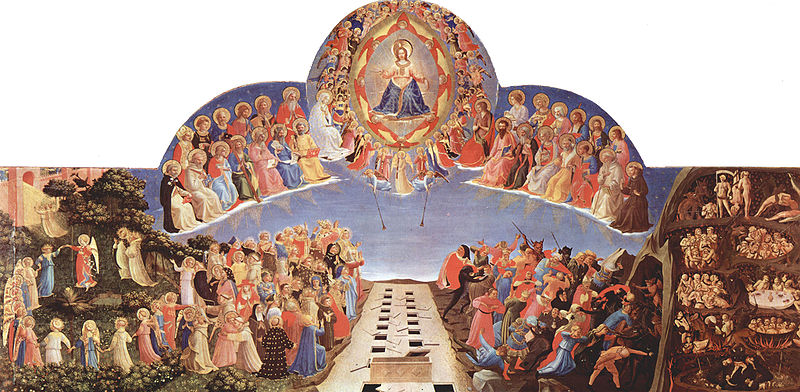
Here was today’s reading:
Matthew 25:31-46
New International Version (NIV)
The Sheep and the Goats
31 “When the Son of Man comes in his glory, and all the angels with him, he will sit on his glorious throne. 32 All the nations will be gathered before him, and he will separate the people one from another as a shepherd separates the sheep from the goats. 33 He will put the sheep on his right and the goats on his left.
34 “Then the King will say to those on his right, ‘Come, you who are blessed by my Father; take your inheritance, the kingdom prepared for you since the creation of the world. 35 For I was hungry and you gave me something to eat, I was thirsty and you gave me something to drink, I was a stranger and you invited me in, 36 I needed clothes and you clothed me, I was sick and you looked after me, I was in prison and you came to visit me.’
37 “Then the righteous will answer him, ‘Lord, when did we see you hungry and feed you, or thirsty and give you something to drink? 38 When did we see you a stranger and invite you in, or needing clothes and clothe you? 39 When did we see you sick or in prison and go to visit you?’
40 “The King will reply, ‘Truly I tell you, whatever you did for one of the least of these brothers and sisters of mine, you did for me.’
41 “Then he will say to those on his left, ‘Depart from me, you who are cursed, into the eternal fire prepared for the devil and his angels. 42 For I was hungry and you gave me nothing to eat, I was thirsty and you gave me nothing to drink, 43 I was a stranger and you did not invite me in, I needed clothes and you did not clothe me, I was sick and in prison and you did not look after me.’
44 “They also will answer, ‘Lord, when did we see you hungry or thirsty or a stranger or needing clothes or sick or in prison, and did not help you?’
45 “He will reply, ‘Truly I tell you, whatever you did not do for one of the least of these, you did not do for me.’
46 “Then they will go away to eternal punishment, but the righteous to eternal life.”
When he started out, I was a little nervous, because I was afraid he was going to talk about the fat sheep and the thin sheep, but that was the reading from Ezekiel:
(Ezekiel 34:11-16
New International Version (NIV)
11 “‘For this is what the Sovereign LORD says: I myself will search for my sheep and look after them. 12 As a shepherd looks after his scattered flock when he is with them, so will I look after my sheep. I will rescue them from all the places where they were scattered on a day of clouds and darkness. 13 I will bring them out from the nations and gather them from the countries, and I will bring them into their own land. I will pasture them on the mountains of Israel, in the ravines and in all the settlements in the land. 14 I will tend them in a good pasture, and the mountain heights of Israel will be their grazing land. There they will lie down in good grazing land, and there they will feed in a rich pasture on the mountains of Israel. 15 I myself will tend my sheep and have them lie down, declares the Sovereign LORD. 16 I will search for the lost and bring back the strays. I will bind up the injured and strengthen the weak, but the sleek and the strong I will destroy. I will shepherd the flock with justice.
20 “‘Therefore this is what the Sovereign LORD says to them: See, I myself will judge between the fat sheep and the lean sheep. 21 Because you shove with flank and shoulder, butting all the weak sheep with your horns until you have driven them away, 22 I will save my flock, and they will no longer be plundered. I will judge between one sheep and another. 23 I will place over them one shepherd, my servant David, and he will tend them; he will tend them and be their shepherd. 24 I the LORD will be their God, and my servant David will be prince among them. I the LORD have spoken.
Since I might be mistaken for one of the fatter sheep, you can understand why I was a little nervous. Also, I had a huge “AHA!” moment living in Jordan, as the shepherd and his sheep and goats passed by my house daily. The sheep were incredibly stupid, but they trusted their shepherd, and the shepherd took good care of them. While they were excavating channels to put in underground pipes in our area, I watched the shepherd carry each sheep across the little wooden walk way, because they were too afraid to do it on their own. The goats would do it, but I still wouldn’t want to be a goat. I don’t really want to be a sheep either.
And I digress.
Here’s what Father Neal said about our gospel reading. He said Jesus doesn’t say you have to have invited him into your heart. He said that if you feed the hungry, give some water to the thirsty, welcome the stranger, clothe the needy, look after the sick and visit those in prison, ypu’re in. You’re righteous.
It’s exactly what I’ve been looking for, something scriptural to support what my heart knows – that there are those who are not Christians who are going to be in the kingdom of heaven, too. It’s not a matter of saying these words or those words, or believing exactly as “they” tell us we must believe, it is a matter of serving the king by tending to and serving his sheep. He LOVES the least of these. It gives me hope; even I might have a chance of inclusion.
Jesus Loves the Little Children
There are many times Jesus speaks obliquely, using an analogy to convey the message, and his disciples have trouble understanding. This time, Jesus speaks very clearly, telling his disciples that the most humble child will enter heaven, and that anyone who causes that child to lose innocence and belief is in big trouble.
I think of my little grandson. Since he was born, I have been singing to him a song I learned in my childhood, “Jesus Loves the Little Children, all the little children of the world, red and yellow, black and white, we are precious in his sight, Jesus loves the little children of the world.”
Matthew 18:1-9
18 At that time the disciples came to Jesus and asked, ‘Who is the greatest in the kingdom of heaven?’ 2 He called a child, whom he put among them, 3 and said, ‘Truly I tell you, unless you change and become like children, you will never enter the kingdom of heaven. 4 Whoever becomes humble like this child is the greatest in the kingdom of heaven. 5 Whoever welcomes one such child in my name welcomes me.
6 ‘If any of you put a stumbling-block before one of these little ones who believe in me, it would be better for you if a great millstone were fastened around your neck and you were drowned in the depth of the sea. 7 Woe to the world because of stumbling-blocks! Occasions for stumbling are bound to come, but woe to the one by whom the stumbling-block comes!
8 ‘If your hand or your foot causes you to stumble, cut it off and throw it away; it is better for you to enter life maimed or lame than to have two hands or two feet and to be thrown into the eternal fire. 9 And if your eye causes you to stumble, tear it out and throw it away; it is better for you to enter life with one eye than to have two eyes and to be thrown into the hell of fire.
Recent Comments
ExpatAlien on What Country am I Living … intlxpatr on Yellowstone: Old Faithful to C… Michelle on Yellowstone: Old Faithful to C… Cathy on No Grown-Ups in Charge intlxpatr on Waiting for Snow Wikipedia Donate Button

Amazina


Early Voting in Florida


 Here There and Everywhere