Who Has the Disability?
My good friend sent me this today, and I want to share it with you, on this, hopefully the last day of Ramadan:
Prosper the Work of Our Hands
This is from today’s Psalm 90, the very last verse:
17Let the favour of the Lord our God be upon us,
and prosper for us the work of our hands—
O prosper the work of our hands!
My wish for you today is that Mightly God prosper the work of your hands, and mine. 🙂
For my non-Islamic friends, in this culture there is a greeting I love – God bless the work of your hands! (Sounds like: Allah ya teek’ ala fee ah) (If that is not quite right, I welcome correction; that is how it sounds to me.)
This verse reminds me so much of that.
Hildegard of Bingen
I don’t often do this, reprint an entire article. I usually leave it to you to click on the blue type and read it for yourself. I am guessing very few people would make any effort to read this article, so for the few who have the interest, I am making it easy for you.
The article is written by James Kiefer, who writes many of the articles on saints in The Lectionary. He makes them human; his articles are so readable.
I like Hildegard of Bingen because she was a woman ahead of her time. She followed the yearnings of her soul to become a religious person, a nun, but rather than escaping from life, she engaged in it fully, as an administrator and as a musician. She engaged fully – and capably. She would probably be a remarkable woman in any age.

(This photo is from Geocities where there is another extensive article on Hildegard von Bingen and her life and times, with additonal information.)
“Listen: there was once a king sitting on his throne. Around him stood great and wonderfully beautiful columns ornamented with ivory, bearing the banners of the king with great honor. Then it pleased the king to raise a small feather from the ground, and he commanded it to fly. The feather flew, not because of anything in itself but because the air bore it along. Thus am I, a feather on the breath of God.”
Hildegard of Bingen has been called by her admirers “one of the most important figures in the history of the Middle Ages,” and “the greatest woman of her time.” Her time was the 1100’s (she was born in 1098), the century of Eleanor of Aquitaine, of Peter Abelard and Bernard of Clairvaux, of the rise of the great universities and the building of Chartres cathedral. She was the daughter of a knight, and when she was eight years old she went to the Benedictine monastery at Mount St Disibode to be educated.
The monastery was in the Celtic tradition, and housed both men and women (in separate quarters). When Hildegard was eighteen, she became a nun. Twenty years later, she was made the head of the female community at the monastery. Within the next four years, she had a series of visions, and devoted the ten years from 1140 to 1150 to writing them down, describing them (this included drawing pictures of what she had seen), and commenting on their interpretation and significance. During this period, Pope Eugenius III sent a commission to inquire into her work. The commission found her teaching orthodox and her insights authentic, and reported so to the Pope, who sent her a letter of approval. (He was probably encouraged to do so by his friend and former teacher, Bernard of Clairvaux.) She wrote back urging the Pope to work harder for reform of the Church.
The community of nuns at Mount St. Disibode was growing rapidly, and they did not have adequate room. Hildegard accordingly moved her nuns to a location near Bingen, and founded a monastery for them completely independent of the double monastery they had left. She oversaw its construction, which included such features (not routine in her day) as water pumped in through pipes. The abbot they had left opposed their departure, and the resulting tensions took a long time to heal.
Hildegard travelled throughout southern Germany and into Switzerland and as far as Paris, preaching. Her sermons deeply moved the hearers, and she was asked to provide written copies. In the last year of her life, she was briefly in trouble because she provided Christian burial for a young man who had been excommunicated. Her defense was that he had repented on his deathbed, and received the sacraments. Her convent was subjected to an interdict, but she protested eloquently, and the interdict was revoked. She died on 17 September 1179. Her surviving works include more than a hundred letters to emperors and popes, bishops, nuns, and nobility.
(Many persons of all classes wrote to her, asking for advice, and one biographer calls her “the Dear Abby of the twelfth century.”)
She wrote 72 songs including a play set to music. Musical notation had only shortly before developed to the point where her music was recorded in a way that we can read today. Accordingly, some of her work is now available on compact disk, and presumably sounds the way she intended. My former room-mate, a non-Christian and a professional musician, is an enthusiastic admirer of her work and considers her a musical genius. Certainly her compositional style is like nothing else we have from the twelfth century. The play set to music is called the Ordo Virtutum and show us a human soul who listens to the Virtues, turns aside to follow the Devil, and finally returns to the Virtues, having found that following the Devil does not make one happy.
She left us about seventy poems and nine books. Two of them are books of medical and pharmaceutical advice, dealing with the workings of the human body and the properties of various herbs. (These books are based on her observations and those of others, not on her visions.) I am told that some modern researchers are now checking her statements in the hope of finding some medicinal properties of some plant that has been overlooked till now by modern medicine.
She also wrote a commentary on the Gospels and another on the Athanasian Creed. Much of her work has recently been translated into English, part in series like Classics of Western Spirituality, and part in other collections or separately. If your university library or bookstore cannot help you, try a Christian bookstore. If they do not have it, try a trendy (feminist, New Age, ecology) bookstore.
But her major works are three books on theology: Scivias (“Know the paths!”), Liber Vitae Meritorum (on ethics), and De Operatione Dei. They deal (or at least the first and third do) with the material of her visions. The visions, as she describes them, are often enigmatic but deeply moving, and many who have studied them believe that they have learned something from the visions that is not easily put into words.
On the other hand, we have the recent best-seller, The Man Who Mistook His Wife for a Hat, by Oliver Sacks, Professor of Clinical Neurology at Albert Einstein College of Medicine, and author of Migraine and various other books. Professor Sacks is concerned with the relation of the brain to the mind, and ways in which the phsical state of the nervous system can affect our ways of perceiving reality. He views the pictures in Hildegard’s books of what she saw in her visions, and says, “The style of the pictures is a clear indication that the seer suffered regularly from migraine attacks. Migraine sufferers tend to see things in this manner.” And indeed, it is true that Hildegard suffered throughout her life from painful attacks of what may have been migraine. Professor Sacks hastens to add that this has nothing to do with whether her visions are authentic insights into the nature of God and His relation to the Universe.
Hildegard has undergone a remarkable rise in popularity in the last thirty years, since many readers have found in her visions, or read into them, themes that seem to speak to many modern concerns.
For example:
Although she would have rejected much of the rhetoric of women’s liberation, she never hesitated to say what she thought needed to be said, or to do what she thought needed to be done, simply because she was a woman. When Pope or Emperor needed a rebuke, she rebuked them.
Her writings bring science, art, and religion together. She is deeply involved in all three, and looks to each for insights that will enrich her understanding of the others.
Her use of parable and metaphor, of symbols, visual imagery, and non-verbal means to communicate makes her work reach out to many who are totally deaf to more standard approaches.
In particular, non-Western peoples are often accustomed to expressing their views of the world in visionary language, and find that Hildegard’s use of similar language to express a Christian view of reality produces instant rapport, if not necessarily instant agreement.
Hildegard wrote and spoke extensively about social justice, about freeing the downtrodden, about the duty of seeing to it that every human being, made in the image of God, has the opportunity to develop and use the talents that God has given him, and to realize his God-given potential. This strikes a chord today.
Hildegard wrote explicitly about the natural world as God’s creation, charged through and through with His beauty and His energy; entrusted to our care, to be used by us for our benefit, but not to be mangled or destroyed.
You can listen to some of her extraordinary and ethereal music of worship by clicking on the YouTube video below:
Sunrise Meditation
Good morning, Kuwait!
I had to go out on the balcony this morning to take the sunrise photo; my windows are so streaked with dust and humidity that I can’t find a place clean enough to shoot through! I got a delightful surprise – the morning was comfortable! For a brief time, as brief as it may be, there is no humidity, and the temperatures are falling. “Falling” in this case means maybe down in the 80’s F., LOL, but comfortable!
Actually . . . it was lovely!

You can see, we have that suspicious dark layer hanging over the horizon, hmmm. . . . .looks suspiciously like pollution. Anyone having trouble breathing?
The verses for today’s meditation are from the Psalm for today, Psalm 62:
Those of low estate are but a breath,
those of high estate are a delusion;
in the balances they go up;
they are together lighter than a breath.
10Put no confidence in extortion,
and set no vain hopes on robbery;
if riches increase, do not set your heart on them.
11Once God has spoken;
twice have I heard this:
that power belongs to God,
12 and steadfast love belongs to you, O Lord.
For you repay to all
according to their work.
Have a great day, Kuwait.
Psalm 37: Do Not Fret Because of Evil Men
I think I have published this Psalm before, but I am going to post it again because it answers that question we all ask – why is it that the evil ones appear to prosper and bad things happen to those who seek to do God’s will?
This is a Psalm of David / Daoud, and something to think about in this Ramadan time of contemplation, and seeking closeness to The Almighty One.
Psalm 37
Of David.
1 [a] Do not fret because of evil men
or be envious of those who do wrong;
2 for like the grass they will soon wither,
like green plants they will soon die away.
3 Trust in the LORD and do good;
dwell in the land and enjoy safe pasture.
4 Delight yourself in the LORD
and he will give you the desires of your heart.
5 Commit your way to the LORD;
trust in him and he will do this:
6 He will make your righteousness shine like the dawn,
the justice of your cause like the noonday sun.
7 Be still before the LORD and wait patiently for him;
do not fret when men succeed in their ways,
when they carry out their wicked schemes.
8 Refrain from anger and turn from wrath;
do not fret—it leads only to evil.
9 For evil men will be cut off,
but those who hope in the LORD will inherit the land.
10 A little while, and the wicked will be no more;
though you look for them, they will not be found.
11 But the meek will inherit the land
and enjoy great peace.
12 The wicked plot against the righteous
and gnash their teeth at them;
13 but the Lord laughs at the wicked,
for he knows their day is coming.
14 The wicked draw the sword
and bend the bow
to bring down the poor and needy,
to slay those whose ways are upright.
15 But their swords will pierce their own hearts,
and their bows will be broken.
16 Better the little that the righteous have
than the wealth of many wicked;
17 for the power of the wicked will be broken,
but the LORD upholds the righteous.
18 The days of the blameless are known to the LORD,
and their inheritance will endure forever.
19 In times of disaster they will not wither;
in days of famine they will enjoy plenty.
20 But the wicked will perish:
The LORD’s enemies will be like the beauty of the fields,
they will vanish—vanish like smoke.
21 The wicked borrow and do not repay,
but the righteous give generously;
22 those the LORD blesses will inherit the land,
but those he curses will be cut off.
23 If the LORD delights in a man’s way,
he makes his steps firm;
24 though he stumble, he will not fall,
for the LORD upholds him with his hand.
25 I was young and now I am old,
yet I have never seen the righteous forsaken
or their children begging bread.
26 They are always generous and lend freely;
their children will be blessed.
27 Turn from evil and do good;
then you will dwell in the land forever.
28 For the LORD loves the just
and will not forsake his faithful ones.
They will be protected forever,
but the offspring of the wicked will be cut off;
29 the righteous will inherit the land
and dwell in it forever.
30 The mouth of the righteous man utters wisdom,
and his tongue speaks what is just.
31 The law of his God is in his heart;
his feet do not slip.
32 The wicked lie in wait for the righteous,
seeking their very lives;
33 but the LORD will not leave them in their power
or let them be condemned when brought to trial.
34 Wait for the LORD
and keep his way.
He will exalt you to inherit the land;
when the wicked are cut off, you will see it.
35 I have seen a wicked and ruthless man
flourishing like a green tree in its native soil,
36 but he soon passed away and was no more;
though I looked for him, he could not be found.
37 Consider the blameless, observe the upright;
there is a future [b] for the man of peace.
38 But all sinners will be destroyed;
the future [c] of the wicked will be cut off.
39 The salvation of the righteous comes from the LORD;
he is their stronghold in time of trouble.
40 The LORD helps them and delivers them;
he delivers them from the wicked and saves them,
because they take refuge in him.
Footnotes:
Psalm 37:1 This psalm is an acrostic poem, the stanzas of which begin with the successive letters of the Hebrew alphabet.
Psalm 37:37 Or there will be posterity
Psalm 37:38 Or posterity
Ramadan Mubarak!
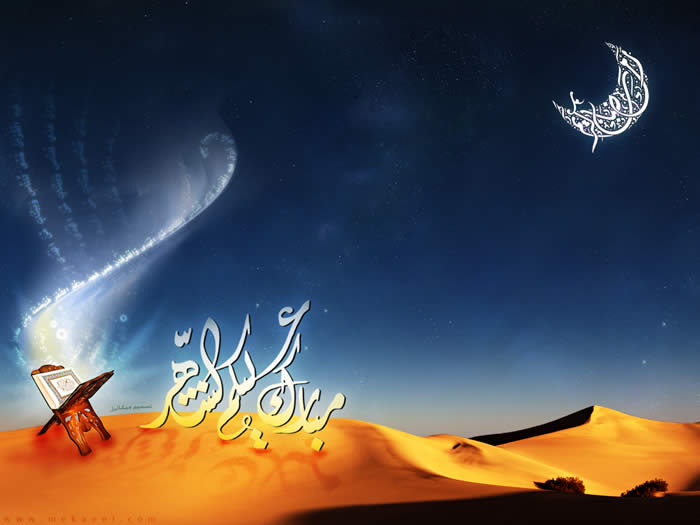
Welcome, Ramadan!
I looked, early this morning, to see if I could spot that thin thin sliver of a crescent moon. The sky – at 4:45 a.m. was clear and there were twinkling stars, but if there was a thin crescent moon, I couldn’t find it.
Wishing you all, my brothers and sisters, a blessed month of contemplation and spiritual enhancement, of family time and time for reading the Qur’an, of sacrifice and joy.
Moonsighting

This is what I find so exciting about blogging. This morning I found a comment in my moderation stack from blogger Fahad (His blog is Salmiya) recommending a website Moonsighting, which has all kinds of wonderful photos made of the new Ramadan moon.
I had never known how very very thin this crescent is, and how difficult it can be to spot. In some of the photos, it takes a few seconds to find it at all – and you have to know what you are looking for.
Meanwhile – some of the photos are simply breathtaking.
There is also something that makes me LOL. There are a large number of topics at the top of the page, the last one says “Do Not Click.” I didn’t click it. I resisted. But I am also willing to bet that there are a lot of people who cannot resist. If you are one of them, come back and let me know what happens! LLOOLLLL!
Ramadan for Non Muslims

I am repeating this post from September 13, 2007 because it found so much interest among my non-Muslim friends. We are all so ignorant of one another’s customs, why we do what we do and why we believe what we believe. There is a blessing that comes with learning more about one another – that blessing, for me, is that when I learn about other, my own life is illuminated.

(I didn’t take this photo; it is from TourEgypt.net. If you want to see an astonishing variety of Ramadan lanterns/ fanous, Google “Image Ramadan lanterns” and you will find pages of them! I didn’t want to lift someone else’s photo from Flicker or Picasa (although people do that to me all the time!) but the variety is amazing.)
Ramadan will start soon; it means that the very thinnest of crescent moons was sighted by official astronomers, and the lunar month of Ramadan might begin. You might think it odd that people wait, with eager anticipation, for a month of daytime fasting, but the Muslims do – they wait for it eagerly.
A friend explained to me that it is a time of purification, when your prayers and supplications are doubly powerful, and when God takes extra consideration of the good that you do and the intentions of your heart. It is also a time when the devil cannot be present, so if you are tempted, it is coming from your own heart, and you battle against the temptations of your own heart. Forgiveness flows in this month, and blessings, too.
We have similar beliefs – think about it. Our holy people fast when asking a particular boon of God. We try to keep ourselves particularly holy at certain times of the year.
In Muslim countries, the state supports Ramadan, so things are a little different. Schools start later. Offices are open fewer hours. The two most dangerous times of the day are the times when schools dismiss and parents are picking up kids, and just before sunset, as everyone rushes to be home for the breaking of the fast, which occurs as the sun goes down. In olden days, there was a cannon that everyone in the town could hear, that signalled the end of the fast. There may still be a cannon today – in Doha there was, and we could hear it, but if there is a cannon in Kuwait, we are too far away, and can’t hear it.
When the fast is broken, traditionally after the evening prayer, you take two or three dates, and water or special milk drink, a meal which helps restore normal blood sugar levels and takes the edge off the fast. Shortly, you will eat a larger meal, full of special dishes eaten only during Ramadan. Families visit one another, and you will see maids carrying covered dishes to sisters houses and friends houses – everyone makes a lot of food, and shares it with one another. When we lived in Tunisia, we would get a food delivery maybe once a week – it is a holy thing to share, especially with the poor and we always wondered if we were being shared with as neighbors, or shared with as poor people! I always tried to watch what they particularly liked when they would visit me, so I could sent plates to their houses during Ramadan.
Just before the sun comes up, there is another meal, Suhoor, and for that meal, people usually eat something that will stick to your ribs, and drink extra water, because you will not eat again until the sun goes down. People who can, usually go back to bed after the Suhoor meal and morning prayers. People who can, sleep a lot during the day, during Ramadan. Especially as Ramadan moves into the hotter months, the fasting, especially from water, becomes a heavier responsibility.
And because it is a Muslim state, and to avoid burdening our brothers and sisters who are fasting, even non-Muslims refrain from eating, drinking, touching someone of the opposite sex in public, even your own husband (not having sex in the daytime is also a part of fasting), smoking is forbidden, and if you are in a car accident and you might be at fault, the person might say “I am fasting, I am fasting” which means they cannot argue with you because they are trying to maintain a purity of soul. Even chewing gum is an offense. And these offenses are punishable by a heavy fine – nearly $400 – or a stay in the local jail.
Because I am not Muslim, there may be other things of which I am not aware, and my local readers are welcome to help fill in here. As for me, I find it not such a burden; I like that there is a whole month with a focus on God. You get used to NOT drinking or eating in public during the day, it’s not that difficult. The traffic just before (sunset) Ftoor can be deadly, but during Ftoor, traffic lightens dramatically (as all the Muslims are breaking their fast) and you can get places very quickly! Stores have special foods, restaurants have special offerings, and the feeling in the air is a lot like Christmas. People are joyful!
There were many comments on the original post, and, as usual in the history of Here There and Everywhere, the commenters taught us all more about Ramadan than the original post. If you want to read the original post and comments, you can click HERE.
Streets of Gold
Because it is a time to be considering holy things, and because I was sent this in the mail this morning, and because we have been talking about the prophet Job/Ayoub, I will share this morning devotion with you:
Job 22:24-25. Assign your nuggets to the dust, your gold of Ophir to the rocks in the ravines, then the Almighty will be your gold, the choicest silver for you.
A story tells about a rich man who pleaded with God to let him bring into eternity one suitcase full of his most valuable possessions. God finally conceded, and the man packed as much gold as he could into his biggest suitcase. When he arrived at heaven’s gates he was met by St. Peter, who opened the suitcase, curious to see what the man valued most.
“What!” St. Peter was incredulous; “You brought pavement?”
(For my Moslem readers: I don’t know why, it doesn’t say this anywhere in the Bible, except that Peter is given the responsibility for the building of the church and is often shown holding keys – like in the keys to the kingdom. Peter is often pictured in cartoons as the keeper of the gate into Paradise; he is portrayed as an old, bearded man with a long list in front of him, like who is naughty and who is allowed in. I know it might seem strange to you, but this is not considered offensive; it is an affectionate portrayal.)
Job and Islamic Tradition
One of the things I learned later in life, like when I lived in Doha, is that you (my Gulf and Moslem readers) have many of the same characters and stories in the Qur’an that we have in the Bible. Interesting, to me, the stories are not always exactly the same. Today’s reading in our lectionary (Old Testament) is from Job (you call him Ayoub, I think.)
First – if you read this, will you tell me if the story in Islam is similar to our story – that Satan is allowed to torment Job, because God believes him to be a faithful servant who will not turn away from him in times of hardship? Satan believes he can demonstrate that Job will be faithless?
Second – why is Satan called “the accuser?” I know Arabic is very close to the old Aramaic; is Satan always called Sheitan? Do you have other names for Satan? (These are not rhetorical questions; these are things I really don’t know) For example, Satan, in our tradition, is called The Father of Lies, The Great Deceiver, etc. But I don’t understand him being called The Accuser.
Third, toward the end of this reading his wife says essentially, give it up, Job, curse God and die. But the little asterisk says “bless”. This is a great puzzlement to me – a curse is the absolute 180° opposite of a blessing, I think. And then again, sometimes what appears to be a curse can be a blessing, and what appears to be a blessing can end up really being a curse. I just don’t understand why, in this context, the word curse could also mean bless? Do you?
Job 2:1-13
2 One day the heavenly beings* came to present themselves before the Lord, and Satan (*Heb the accuser) also came among them to present himself before the Lord. 2 The Lord said to Satan,* ‘Where have you come from?’ Satan* answered the Lord, ‘From going to and fro on the earth, and from walking up and down on it.’ 3 The Lord said to Satan,* ‘Have you considered my servant Job? There is no one like him on the earth, a blameless and upright man who fears God and turns away from evil. He still persists in his integrity, although you incited me against him, to destroy him for no reason.’ 4 Then Satan* answered the Lord, ‘Skin for skin! All that people have they will give to save their lives.* 5But stretch out your hand now and touch his bone and his flesh, and he will curse you to your face.’ 6 The Lord said to Satan,* ‘Very well, he is in your power; only spare his life.’
7 So Satan* went out from the presence of the Lord, and inflicted loathsome sores on Job from the sole of his foot to the crown of his head. 8Job* took a potsherd with which to scrape himself, and sat among the ashes.
9 Then his wife said to him, ‘Do you still persist in your integrity? Curse* (bless) God, and die.’ 10 But he said to her, ‘You speak as any foolish woman would speak. Shall we receive the good at the hand of God, and not receive the bad?’ In all this Job did not sin with his lips.
11 Now when Job’s three friends heard of all these troubles that had come upon him, each of them set out from his home—Eliphaz the Temanite, Bildad the Shuhite, and Zophar the Naamathite. They met together to go and console and comfort him. 12 When they saw him from a distance, they did not recognize him, and they raised their voices and wept aloud; they tore their robes and threw dust in the air upon their heads. 13 They sat with him on the ground for seven days and seven nights, and no one spoke a word to him, for they saw that his suffering was very great.
Recent Comments
ExpatAlien on What Country am I Living … intlxpatr on Yellowstone: Old Faithful to C… Michelle on Yellowstone: Old Faithful to C… Cathy on No Grown-Ups in Charge intlxpatr on Waiting for Snow Wikipedia Donate Button

Amazina


Early Voting in Florida


 Here There and Everywhere