Ramadan for Non Muslims

I am repeating this post from September 13, 2007 because it found so much interest among my non-Muslim friends. We are all so ignorant of one another’s customs, why we do what we do and why we believe what we believe. There is a blessing that comes with learning more about one another – that blessing, for me, is that when I learn about other, my own life is illuminated.

(I didn’t take this photo; it is from TourEgypt.net. If you want to see an astonishing variety of Ramadan lanterns/ fanous, Google “Image Ramadan lanterns” and you will find pages of them! I didn’t want to lift someone else’s photo from Flicker or Picasa (although people do that to me all the time!) but the variety is amazing.)
Ramadan will start soon; it means that the very thinnest of crescent moons was sighted by official astronomers, and the lunar month of Ramadan might begin. You might think it odd that people wait, with eager anticipation, for a month of daytime fasting, but the Muslims do – they wait for it eagerly.
A friend explained to me that it is a time of purification, when your prayers and supplications are doubly powerful, and when God takes extra consideration of the good that you do and the intentions of your heart. It is also a time when the devil cannot be present, so if you are tempted, it is coming from your own heart, and you battle against the temptations of your own heart. Forgiveness flows in this month, and blessings, too.
We have similar beliefs – think about it. Our holy people fast when asking a particular boon of God. We try to keep ourselves particularly holy at certain times of the year.
In Muslim countries, the state supports Ramadan, so things are a little different. Schools start later. Offices are open fewer hours. The two most dangerous times of the day are the times when schools dismiss and parents are picking up kids, and just before sunset, as everyone rushes to be home for the breaking of the fast, which occurs as the sun goes down. In olden days, there was a cannon that everyone in the town could hear, that signalled the end of the fast. There may still be a cannon today – in Doha there was, and we could hear it, but if there is a cannon in Kuwait, we are too far away, and can’t hear it.
When the fast is broken, traditionally after the evening prayer, you take two or three dates, and water or special milk drink, a meal which helps restore normal blood sugar levels and takes the edge off the fast. Shortly, you will eat a larger meal, full of special dishes eaten only during Ramadan. Families visit one another, and you will see maids carrying covered dishes to sisters houses and friends houses – everyone makes a lot of food, and shares it with one another. When we lived in Tunisia, we would get a food delivery maybe once a week – it is a holy thing to share, especially with the poor and we always wondered if we were being shared with as neighbors, or shared with as poor people! I always tried to watch what they particularly liked when they would visit me, so I could sent plates to their houses during Ramadan.
Just before the sun comes up, there is another meal, Suhoor, and for that meal, people usually eat something that will stick to your ribs, and drink extra water, because you will not eat again until the sun goes down. People who can, usually go back to bed after the Suhoor meal and morning prayers. People who can, sleep a lot during the day, during Ramadan. Especially as Ramadan moves into the hotter months, the fasting, especially from water, becomes a heavier responsibility.
And because it is a Muslim state, and to avoid burdening our brothers and sisters who are fasting, even non-Muslims refrain from eating, drinking, touching someone of the opposite sex in public, even your own husband (not having sex in the daytime is also a part of fasting), smoking is forbidden, and if you are in a car accident and you might be at fault, the person might say “I am fasting, I am fasting” which means they cannot argue with you because they are trying to maintain a purity of soul. Even chewing gum is an offense. And these offenses are punishable by a heavy fine – nearly $400 – or a stay in the local jail.
Because I am not Muslim, there may be other things of which I am not aware, and my local readers are welcome to help fill in here. As for me, I find it not such a burden; I like that there is a whole month with a focus on God. You get used to NOT drinking or eating in public during the day, it’s not that difficult. The traffic just before (sunset) Ftoor can be deadly, but during Ftoor, traffic lightens dramatically (as all the Muslims are breaking their fast) and you can get places very quickly! Stores have special foods, restaurants have special offerings, and the feeling in the air is a lot like Christmas. People are joyful!
There were many comments on the original post, and, as usual in the history of Here There and Everywhere, the commenters taught us all more about Ramadan than the original post. If you want to read the original post and comments, you can click HERE.
Streets of Gold
Because it is a time to be considering holy things, and because I was sent this in the mail this morning, and because we have been talking about the prophet Job/Ayoub, I will share this morning devotion with you:
Job 22:24-25. Assign your nuggets to the dust, your gold of Ophir to the rocks in the ravines, then the Almighty will be your gold, the choicest silver for you.
A story tells about a rich man who pleaded with God to let him bring into eternity one suitcase full of his most valuable possessions. God finally conceded, and the man packed as much gold as he could into his biggest suitcase. When he arrived at heaven’s gates he was met by St. Peter, who opened the suitcase, curious to see what the man valued most.
“What!” St. Peter was incredulous; “You brought pavement?”
(For my Moslem readers: I don’t know why, it doesn’t say this anywhere in the Bible, except that Peter is given the responsibility for the building of the church and is often shown holding keys – like in the keys to the kingdom. Peter is often pictured in cartoons as the keeper of the gate into Paradise; he is portrayed as an old, bearded man with a long list in front of him, like who is naughty and who is allowed in. I know it might seem strange to you, but this is not considered offensive; it is an affectionate portrayal.)
Job and Islamic Tradition
One of the things I learned later in life, like when I lived in Doha, is that you (my Gulf and Moslem readers) have many of the same characters and stories in the Qur’an that we have in the Bible. Interesting, to me, the stories are not always exactly the same. Today’s reading in our lectionary (Old Testament) is from Job (you call him Ayoub, I think.)
First – if you read this, will you tell me if the story in Islam is similar to our story – that Satan is allowed to torment Job, because God believes him to be a faithful servant who will not turn away from him in times of hardship? Satan believes he can demonstrate that Job will be faithless?
Second – why is Satan called “the accuser?” I know Arabic is very close to the old Aramaic; is Satan always called Sheitan? Do you have other names for Satan? (These are not rhetorical questions; these are things I really don’t know) For example, Satan, in our tradition, is called The Father of Lies, The Great Deceiver, etc. But I don’t understand him being called The Accuser.
Third, toward the end of this reading his wife says essentially, give it up, Job, curse God and die. But the little asterisk says “bless”. This is a great puzzlement to me – a curse is the absolute 180° opposite of a blessing, I think. And then again, sometimes what appears to be a curse can be a blessing, and what appears to be a blessing can end up really being a curse. I just don’t understand why, in this context, the word curse could also mean bless? Do you?
Job 2:1-13
2 One day the heavenly beings* came to present themselves before the Lord, and Satan (*Heb the accuser) also came among them to present himself before the Lord. 2 The Lord said to Satan,* ‘Where have you come from?’ Satan* answered the Lord, ‘From going to and fro on the earth, and from walking up and down on it.’ 3 The Lord said to Satan,* ‘Have you considered my servant Job? There is no one like him on the earth, a blameless and upright man who fears God and turns away from evil. He still persists in his integrity, although you incited me against him, to destroy him for no reason.’ 4 Then Satan* answered the Lord, ‘Skin for skin! All that people have they will give to save their lives.* 5But stretch out your hand now and touch his bone and his flesh, and he will curse you to your face.’ 6 The Lord said to Satan,* ‘Very well, he is in your power; only spare his life.’
7 So Satan* went out from the presence of the Lord, and inflicted loathsome sores on Job from the sole of his foot to the crown of his head. 8Job* took a potsherd with which to scrape himself, and sat among the ashes.
9 Then his wife said to him, ‘Do you still persist in your integrity? Curse* (bless) God, and die.’ 10 But he said to her, ‘You speak as any foolish woman would speak. Shall we receive the good at the hand of God, and not receive the bad?’ In all this Job did not sin with his lips.
11 Now when Job’s three friends heard of all these troubles that had come upon him, each of them set out from his home—Eliphaz the Temanite, Bildad the Shuhite, and Zophar the Naamathite. They met together to go and console and comfort him. 12 When they saw him from a distance, they did not recognize him, and they raised their voices and wept aloud; they tore their robes and threw dust in the air upon their heads. 13 They sat with him on the ground for seven days and seven nights, and no one spoke a word to him, for they saw that his suffering was very great.
Your Last Breath
You never know. These people are just like us, renting a vacation house up the road a village or two, right on the ocean. And while they are sleeping, a plane crashes into their vacation house. You never know when you might be taking your last breath.

4 Die After Plane Crashes Into Home
GEARHART, Ore. (Aug. 4) – A small plane crashed into a seaside house in heavy fog early Monday, killing two people aboard and two children in the vacation home it struck, authorities said.
A small plane flying through heavy fog clipped a tree and then slammed into a house in Gearhart, Ore., Monday. Authorities said two people aboard the plane and two children in the seaside vacation home were killed. Here, a deputy fire marshal stands outside what is left of the home.
A third child was unaccounted for after the crash, which apparently occurred soon after the plane took off from nearby Seaside in northwest Oregon.
The single-engine plane clipped a tree and then plowed into the house, followed by explosions. A second, vacant home nearby was heavily damaged.
The pilot and his only passenger were also killed. Their identities were not immediately released.
The four-seat Cessna was owned by Aviation Aventures in Seaside. The company had rented it to the pilot, city officials said.
The impact shook homes a half-mile away in this resort town.
You can read the entire article on AOL News.
River Jordan Parts
Today’s reading, from Joshua, concerns a second river crossing when the river stops flowing to allow the Israelites to cross, carrying the Arc of the Covenant. According to this reading, there should be a stone memorial somewhere in that area – I wonder if any remnants have ever been found? I wonder if the river has changed course (rivers do) and whether the memorial (assuming it exists, recognized or unrecognized) is now in Israel, or in Jordan?
Joshua 3:14-4:7
14 When the people set out from their tents to cross over the Jordan, the priests bearing the ark of the covenant were in front of the people. 15Now the Jordan overflows all its banks throughout the time of harvest. So when those who bore the ark had come to the Jordan, and the feet of the priests bearing the ark were dipped in the edge of the water, 16the waters flowing from above stood still, rising up in a single heap far off at Adam, the city that is beside Zarethan, while those flowing towards the sea of the Arabah, the Dead Sea,* were wholly cut off. Then the people crossed over opposite Jericho. 17While all Israel were crossing over on dry ground, the priests who bore the ark of the covenant of the Lord stood on dry ground in the middle of the Jordan, until the entire nation finished crossing over the Jordan.
4When the entire nation had finished crossing over the Jordan, the Lord said to Joshua: 2‘Select twelve men from the people, one from each tribe, 3and command them, “Take twelve stones from here out of the middle of the Jordan, from the place where the priests’ feet stood, carry them over with you, and lay them down in the place where you camp tonight.” ’ 4Then Joshua summoned the twelve men from the Israelites, whom he had appointed, one from each tribe. 5Joshua said to them, ‘Pass on before the ark of the Lord your God into the middle of the Jordan, and each of you take up a stone on his shoulder, one for each of the tribes of the Israelites, 6so that this may be a sign among you. When your children ask in time to come, “What do those stones mean to you?” 7then you shall tell them that the waters of the Jordan were cut off in front of the ark of the covenant of the Lord. When it crossed over the Jordan, the waters of the Jordan were cut off. So these stones shall be to the Israelites a memorial for ever.’
If You Have the Eyes to See
I have a dinner party coming up, and I always have to keep my menus flexible – I am never entirely sure what I will find in the stores. The most unlikely things will show up, and then, just when you really need them, disappear.
I usually keep a little corn syrup on hand, but I also use it a lot – remember that Pecan-Date Pie?
First step, check the cupboards. Nope, no corn syrup. I can make something else, but one of my guests has a real sweet tooth, and this pie disappears in a heartbeat where people love sweets.
Second step – scour the stores. Nope, no corn syrup. They sometimes have it. Not today when I need it.
Third step – pray. Actually, I started this step while I was still in the store. I didn’t used to believe in prayers for selfish things, but I discovered that sometimes God delights in answering small prayers. I was in a bible study, where they told us to keep a prayer journal, and when we prayed for a person or something, to write it down, that a lot of times when prayers are answered, we don’t even say thank-you, we just move on.
I was astonished. They were right. When you write down what you’ve prayed for, especially for long, complicated situations, and then you go back and see the prayers that have been answered, prayers you forgot you even prayed, it is astonishing. God is so Good! And imagine answering prayers and the person praying doesn’t even say “thank you!”
When I got home, I put the cold things in the refrigerator or freezer, washed off all the vegetables, put away the other groceries, and then got the stepping stool, still praying that somewhere in my kitchen was a bottle of corn syrup that was misplaced.
I checked the baking cupboard – again. Moved everything so I could see even in the darkest corners. No corn syrup. Checked my “spares” cupboard. Nope, not there. Checked my back-up spares cupboard, sigh, no not there. Checked the breakfast / snack cupboard, can’t see anything, but I’ll check Little Diamond’s shelf, where the breakfast cereal and Canderelle are kept – and oh my! It’s a genuine miracle! When did I put the corn syrup on that shelf?
This is what a miracle looks like in my life this morning:

Thanks be to God! He takes care of our smallest needs!
Sacred Spaces in Kuwait
As I was on my way home from picking up milk and vegetables, I passed another local mosque undergoing renovation. Or at least, that is my best guess; it has been gutted and partially destroyed. I am guessing it is about to be reconstructed, but I don’t know for sure. I am only guessing because I have seen it happen to other mosques since we arrived.
And it got me thinking, and I am going to ask a question, but I will tell you before I ask it, that if you asked me the same question about Christian spaces, I would have to ask an expert; it is not a question I can answer about my own culture.
Do Moslems have sacred spaces? How are they made sacred? Is there a ceremony? If you are going to destroy parts of a building on a sacred space, does it have to be de-consecrated (made no-longer-sacred) while it is undergoing renovation? If a mosque is destroyed/no longer used is there a ceremony that makes it no longer a holy spot?
I know that in my religion, churches are consecrated, made officially holy, and that there is a ceremony. I know that in some places, churches that are no longer needed are deconsecrated, not made UNholy, but made not a sacred place of worship any more, and they become restaurants, housing, etc.
In my specific branch of Christianity, which is Episcopalian, there is a service for blessing a new house, which I love, and it is called a House Blessing. The priest comes, usually at dusk, you can have friends there, you carry candles and he blesses every room in the house. When we buy and move into a new house, we always have it blessed. The priest tells me that it is really a mis-nomer, it is not the house being blessed, but those who live within in. To me, that is a distinction that hardly matters, all I know is that I feel more secure in a house that has been blessed.
And no, there is no un-blessing ceremony when we leave a house. The blessing does not create a holy space, a place of worship, a sacred place, but only blesses a humble dwelling.
No, I don’t understand exactly how this all works.
I remember travelling in Syria with an archaeology group one time, and we went to see the site of St. Simeon the Stylite. In my cynical heart, I was not wild about the visit – a saint who sat atop a huge rock for several years to show his devotion to God? When I got there, however, my heart changed – it felt like a holy place. It felt like Saint Simeon had done a holy act, demonstrating his faith so . . . faithfully. If you know Syria, you know how bitterly cold it can be in winter, and how bone-breakingly hot it can be in summer. The pure grit and devotion it took to stay atop the pillar of stone was an amazingly faithful act. It felt like a sacred place, a holy place, to me.
So my question is not just for the Moslem readers, but also for Christian readers – what makes a space holy? Does it need a ceremony to be holy? Does it need a ceremony if it will no longer be used for sacred purposes?
Khadra and The Swallows of Kabul
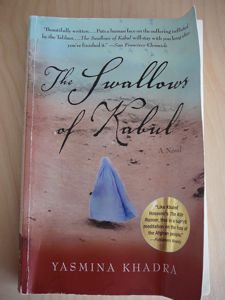
While waiting for our luggage to be offloaded, we were passing time, visiting with our greeter / expediter, asking about his family, his life in Zambia.
“How does this work, travelling with your son and your daughter-in-law?” he asked us. “Do you like her?”
Nothing on earth could disguise the delight on our faces as we both said “Yes!” We truly adore her.
When our son was only seven years old, a Christian speaker passing through said that if you have children, it is likely that their mates have also been born, so to start praying now for the unknown mate your child would choose, and we did.
When our son called us from university, and told us there was someone he wanted us to meet at graduation, and graduation was still months away, we knew, we just knew, that this might be THE ONE.
We were so delighted when we met her, we liked her immediately. What parent isn’t happy to see his/her son/daughter happy, and choosing well?
“But!” our meeter/greeter added, “how do you like her family?”
And we laughed again! We love her family! Her father is smart and very funny, and her mother is kind and practical, and we all share the same values on family and friends and living our lives. She comes from a large rowdy family that gathers when they can, and so do we.
And YOU are thinking “what does all this have to do with The Swallows of Kabul?” but I am getting there.
On the trip, we all had books for our quiet time, and I could see EnviroGirl deeply engrossed in this book. When I asked her, she said she had gotten it from her father’s wife, a woman with whom I often talk books, and that she (EnviroGirl) was trying to finish it so that she could leave it with me.
And thank goodness that she did! I couldn’t put it down!
First, you think it is written by Yasmina Khadra, but that is a pseudonym. The real author, Mohammed Moulessehoul, was Algerian army officer, and he used the pseudonym to avoid having to submit the manuscript for approval by military authorities. That got my attention right away.
The book is about Taleban era Afghanistan, and starts out with utter hopelessness, describing the deterioration in life brought about by the arbitrary imposition of religious rule, as interpreted by men who have memorized the Qur’an, but have a poor understanding of what they have memorized. Women lead a dismal, limited life, at the mercy of men who treat them as detestable if they are seen in public, even totally cloaked.
His language is beautiful, poetic and compelling, even describing despair and desolation.
We meet two couples, Atiq, a jailer, and his wife, Musarrat, who risked her own life to save his life back when he was seriously wounded and left for dead, and Mohsen, former member of a moderately successful merchant family, married to the love of his life, Zunaira, who is beautiful, educated and from a wealthy background. These men love their wives, and have a strong, genuine connection to them. Their ability to maintain that connection, and to stay connected to their own values, withers in the dry, dusty context of fundamentalist rule.
Their lives and relationships have been changing gradually, increasingly limited and undignified under the stress of Taleban rule, and the novel follows a rapid spiral of deterioration and folly. The steady decline of their lives speeds when Mohsen makes a terrible impulsive decision, has to live with the consequences, and confesses to his wife.
Atiq, too, faces dismal consequences. Even though we know he is limited, he becomes a sympathetic character. His hardness of heart covers a genuine grief that his wife is dying, and he can do nothing to stop it, nor to alleviate her pain.
We all face hard times. In our family, when someone lashes out unjustly, we often ask “is it something I have done, or am I just the nearest dog to kick?” It always gets a laugh, and it puts things back in perspective, puts us on the same side. Sometimes we can’t always vent our frustrations against those people or events creating the frustration, so we take it out on those we love – and who love us. It’s not right, it’s not fair or just, but it is very human, and once you get that out on the table, it is easier to discuss the real issue.
When Zunaira ends up in jail, Atiq’s world is shattered as if by an earthquake – the earth moves under his feet, all his understanding of life is shaken.
“As he cleans up, he cautiously lifts his eyes to the roof beam looming over the cell like a bird of evil augury, and his gaze lingers on the anemic little lightbulb, growing steadily dimmer in its ceiling socket. Screwing his courage to the sticking point, he walks back to the lone occupied cell, and there, in the very middle of the cage, the magical vision: the prisoner has removed her burqa! She’s sitting cross-legged on the floor. Her elbows are on her knees, her hands are joined under her chin. She’s praying. Atiq is thunderstruck. Never before has he seen such splendor. With her godess’s profile, her long hair spread across her back, and her enormous eyes, like horizons, the condemned woman is beautiful beyond imagination. She’s like a dawn, gathering brightness in the heart of this poisonour, squalid, fatal dungeon.
Except for his wife’s, Atiq hasn’t seen a woman’s face for many years. He’s even learned to live without such sights. For him, women are only ghosts, voiceless, charmless ghosts that pass practically unnoticed along the streets; flocks of infirm swallows – blue, yellow, often faded, several seasons behind – that make a mournful sound when they come into the proximity of men.
And all at once, a veil falls and a miracle appears. Atiq can’t get over it. A complete, solid woman? A genuine tangible woman’s face, also complete, right here in front of him? He’s been cut off from such a forbidden sight for so long that he believed it had been banished even from people’s imaginations. . . ”
Atiq has a friend, Mirza, who thrives under Taleban rule, as a soldier, and also running illegal businesses highly profitable under the current regime. He encourages Atiq to abandon his cancer-striken wife, to get rid of her and to find a fresh, young wife. He offers Atiq shady business opportunities, and tells him a wise man bends with the wind. Ignorance and chaos benefit Mirza, and he has no wish to see the good old days return.
In spite of the bleakness, the desolation, the crushing arbitrariness and inhumanity, there is hope, love, and compassion in a thin, steady stream throughout the book.
Once I started reading, I had to finish. It was a great book for the long trip back to Kuwait, one I am eager to pass along to the next avid reader.
Even the Dogs
Today’s Gospel reading is one of my very favorites; Jesus was infinitely kind to women.
Here is a desperate woman, shouting for Jesus’ help. She is not a Jew, she is not even one of his followers. She is a mother with a very sick daughter. She will not be put aside. Jesus’ closest followers tell him to “make her go away.” She argues with Jesus, telling him even his smallest crumb of mercy will be enough, and he has mercy on her.
Matthew 15:21-28
21 Jesus left that place and went away to the district of Tyre and Sidon. 22Just then a Canaanite woman from that region came out and started shouting, ‘Have mercy on me, Lord, Son of David; my daughter is tormented by a demon.’ 23 But he did not answer her at all. And his disciples came and urged him, saying, ‘Send her away, for she keeps shouting after us.’ 24 He answered, ‘I was sent only to the lost sheep of the house of Israel.’ 25 But she came and knelt before him, saying, ‘Lord, help me.’ 26 He answered, ‘It is not fair to take the children’s food and throw it to the dogs.’ 27 She said, ‘Yes, Lord, yet even the dogs eat the crumbs that fall from their masters’ table.’ 28 Then Jesus answered her, ‘Woman, great is your faith! Let it be done for you as you wish.’ And her daughter was healed instantly.
The Great Adventure
This week AdventureMan and I are celebrating our wedding anniversary. He kids me – when we were married, we had a goal. We wanted to go to Africa, so we saved our money for a whole year. We didn’t eat meat – or not often. We didn’t go to movies; we went to the library. We did buy cameras, and we saved and saved and saved, and when we had been married a year, we went to Kenya for a month – three weeks on safari and then one week on the beach.
Life has been so good to us, has blessed us so richly. Today we give thanks for the good times, and even the bad times – it takes both to glue a marriage together. We thank God for his abundant mercy on our foolishness and our pride, for our mistakes, and for our good intentions gone wrong. We give thanks for all his blessings and we pray for many more years together.
May the great adventure continue!
Recent Comments
Kitchen on Isiais: Winding Down intlxpatr on Shampoo Ginger tigerbutterya0c5ff1d… on Shampoo Ginger intlxpatr on British Soldier Kidnapped, Esc… John on British Soldier Kidnapped, Esc… Wikipedia Donate Button

Amazina


Early Voting in Florida


