Jesus Gets Tough With Believers

Today’s readings in the Lectionary readings is from Matthew are some of the hardest for believers. We all like to think we are excelling in doing good, we focus on the outward appearances, and he outlines where we fail – and where we need him, desperately, if we want to enter the Kingdom:
Matthew 23:13-26
13 ‘But woe to you, scribes and Pharisees, hypocrites! For you lock people out of the kingdom of heaven. For you do not go in yourselves, and when others are going in, you stop them.*
15Woe to you, scribes and Pharisees, hypocrites! For you cross sea and land to make a single convert, and you make the new convert twice as much a child of hell* as yourselves.
16 ‘Woe to you, blind guides, who say, “Whoever swears by the sanctuary is bound by nothing, but whoever swears by the gold of the sanctuary is bound by the oath.” 17You blind fools! For which is greater, the gold or the sanctuary that has made the gold sacred? 18And you say, “Whoever swears by the altar is bound by nothing, but whoever swears by the gift that is on the altar is bound by the oath.” 19How blind you are! For which is greater, the gift or the altar that makes the gift sacred?20So whoever swears by the altar, swears by it and by everything on it;21and whoever swears by the sanctuary, swears by it and by the one who dwells in it; 22and whoever swears by heaven, swears by the throne of God and by the one who is seated upon it.
23 ‘Woe to you, scribes and Pharisees, hypocrites! For you tithe mint, dill, and cummin, and have neglected the weightier matters of the law: justice and mercy and faith. It is these you ought to have practised without neglecting the others. 24You blind guides! You strain out a gnat but swallow a camel!
25 ‘Woe to you, scribes and Pharisees, hypocrites! For you clean the outside of the cup and of the plate, but inside they are full of greed and self-indulgence. 26You blind Pharisee! First clean the inside of the cup,*so that the outside also may become clean.
If You Lived Here, I’d Know Your Name: Heather Lende

“You have to read this!” said my book friend, “You’re from Alaska! It’s about a woman who lives in some small town and writes obituaries!”
I grinned politely and put the book in my bag. Some books sound more interesting than other books – I’ve always loved adventures and mysteries and murders – add a little drama to the day-to-day-ness of everyday life. A woman who writes obituaries? Hmmm, not so much.
But spending my afternoons tending to my sweet little 3-month-old granddaughter means I often sit, anchored by the soundly sleeping baby who I don’t want to disturb, even by twitching. I have one hand free – and you can only play so much iPhone Sudoku.
An Alaskan friend had also recommended this book, so early this week I picked it up and started reading.
Oh. my. goodness. Yes, Haines is a small town, but oh the drama of writing obituaries. Oh, the things you learn about your neighbors and the surprises you get learning about their earlier lives. I love the way Heather Lende weaves the writing of the town obituaries with the current ongoing dramas in her own life and in the lives of her friends and makes it work.
It’s not unlike where I grew up, although my hometown had a hospital. We also had moose and bear and elk in our back yards, and learned to treat wildlife with respect, and that the best option was to back away slowly. There are the same senseless deaths from auto accidents, fishing boat accidents and unexpected changes in weather. There is the same feeling of wonder, almost every day of your life, knowing how very lucky you are to live in the midst of such awe-inspiring beauty. It’s hard for me to imagine being an unbeliever living in Alaska.
It’s also a great book to read before going to bed. Some of the books I read are too exciting or too disturbing to read before bed; books that infiltrate your dreams with images and situations that give you a restless night. While Lende deals with death and sadness and drama, there is an underlying message of hope in the neighborliness of your neighbors, the security of living in a town where everybody knows everybody else, in the civility even of people who strongly disagree with one another. If You Lived Here, I’d Know Your Name gives you peaceful sleep. She ties it all together with an ending that rips your heart out; you will never forget this book once you read it. After reading, you will feel like you have lived in Haines, Alaska.
The paperback version is available from Amazon.com for $9.73. No, I no longer own stock in Amazon.com.
“Great is Your Faith!”
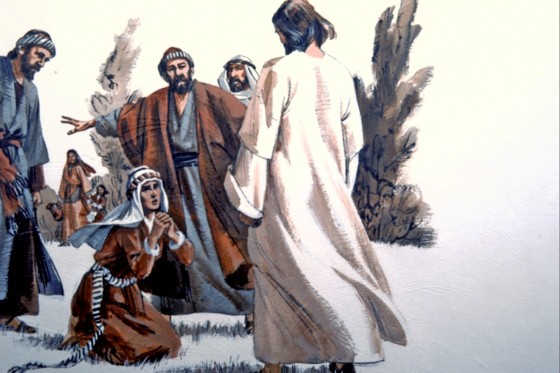
Jesus only commented positively on a person’s faith three times, and two of those times the supplicant was not Jewish, but other, in this case, a Canaanite woman. All she cared about was her daughter. He even says no, he won’t help her, he is there for the Jews. As she persists, as she argues with Jesus and makes her case, he relents, he feels enormous compassion for this woman in her plight, and as he heals her daughter, he makes this extraordinary statement calling attention to her belief. No legalistic requirements, he just heals.
Matthew 15:21-28
21 Jesus left that place and went away to the district of Tyre and Sidon.22Just then a Canaanite woman from that region came out and started shouting, ‘Have mercy on me, Lord, Son of David; my daughter is tormented by a demon.’ 23But he did not answer her at all. And his disciples came and urged him, saying, ‘Send her away, for she keeps shouting after us.’ 24He answered, ‘I was sent only to the lost sheep of the house of Israel.’ 25But she came and knelt before him, saying, ‘Lord, help me.’ 26He answered, ‘It is not fair to take the children’s food and throw it to the dogs.’ 27She said, ‘Yes, Lord, yet even the dogs eat the crumbs that fall from their masters’ table.’ 28Then Jesus answered her, ‘Woman, great is your faith! Let it be done for you as you wish.’ And her daughter was healed instantly.
Clean or Unclean?
This is one of my favorite readings in the Lectionary. People often ask where it is that Jesus declared all foods “clean” and this is one of the scriptures. To me, it is the why of it that makes it interesting – and convicting. There is enough in my heart to make me unclean without worrying about food rules.
Matthew 15:1-20
15 Then Pharisees and scribes came to Jesus from Jerusalem and said,2 ‘Why do your disciples break the tradition of the elders? For they do not wash their hands before they eat.’ 3 He answered them, ‘And why do you break the commandment of God for the sake of your tradition?4 For God said,* “Honour your father and your mother,” and, “Whoever speaks evil of father or mother must surely die.” 5 But you say that whoever tells father or mother, “Whatever support you might have had from me is given to God”,* then that person need not honour the father.* 6 So, for the sake of your tradition, you make void the word* of God. 7You hypocrites! Isaiah prophesied rightly about you when he said:
8 “This people honours me with their lips,
but their hearts are far from me;
9 in vain do they worship me,
teaching human precepts as doctrines.” ’
10 Then he called the crowd to him and said to them, ‘Listen and understand: 11 it is not what goes into the mouth that defiles a person, but it is what comes out of the mouth that defiles.’ 12 Then the disciples approached and said to him, ‘Do you know that the Pharisees took offence when they heard what you said?’ 13 He answered, ‘Every plant that my heavenly Father has not planted will be uprooted. 14 Let them alone; they are blind guides of the blind.* And if one blind person guides another, both will fall into a pit.’ 15 But Peter said to him, ‘Explain this parable to us.’ 16 Then he said, ‘Are you also still without understanding?17 Do you not see that whatever goes into the mouth enters the stomach, and goes out into the sewer? 18 But what comes out of the mouth proceeds from the heart, and this is what defiles. 19 For out of the heart come evil intentions, murder, adultery, fornication, theft, false witness, slander. 20 These are what defile a person, but to eat with unwashed hands does not defile.’
God Vs. Worry; God Wins
One of the things that adds texture to my life, and helps keep me on the straight and narrow (and that takes a LOT) is reading the daily lectionary every single morning of the year, before I do anything else. Normal days, I access it from my computer, traveling or appointment days, I can access it from my iPad or iPhone. It’s like a little extra fence that helps keep me safe from myself and my own creativity when it comes to evil.
There is another side, the blessing side. In one of the bible studies I attend, we learn, over and over that God blesses the believer. You don’t have to be perfect – and it’s a good thing, because none of us are. If you want to see how much God can love a sinner, just read your bible. Sin is one of the main characters, right along side Abraham and Sarah, Job, Lot, and especially King David.
But in my life, I have seen wondrous things, and I have had some totally WOW moments when God has blessed me beyond any prayer I could have raised. One of those moments was showering under a waterfall near an oasis in the Tunisian desert. Two others happened this year, and these were blessings that stopped me in my tracks with their timing and aptness. First, we got an unexpected tax refund which arrived in our account just in time to cover the big expensive air conditioning system on the main floor when it broke and had to be replaced.
Second, when we were looking for the last few thousand dollars to help us buy a new car (we prefer to pay cash) we got another tax refund – we had asked that they re-look taxes for a move, and they allowed the moving expenses. We had waited almost a year for that decision; we had waited so long we had pretty much forgotten and given up on it. I mean tax refunds – it’s a never-never land, it all seems so arbitrary. You can have a perfect case, and it can be denied for a reason you’ve never heard of.
God’s timing is perfect. His sense of humor is breath-taking. The funds we needed poured into our hands just when we needed them, in just the right amount.
Matthew 6:25-34
25 ‘Therefore I tell you, do not worry about your life, what you will eat or what you will drink,* or about your body, what you will wear. Is not life more than food, and the body more than clothing? 26Look at the birds of the air; they neither sow nor reap nor gather into barns, and yet your heavenly Father feeds them. Are you not of more value than they? 27And can any of you by worrying add a single hour to your span of life?* 28And why do you worry about clothing? Consider the lilies of the field, how they grow; they neither toil nor spin, 29yet I tell you, even Solomon in all his glory was not clothed like one of these.
30But if God so clothes the grass of the field, which is alive today and tomorrow is thrown into the oven, will he not much more clothe you—you of little faith? 31Therefore do not worry, saying, “What will we eat?” or “What will we drink?” or “What will we wear?” 32For it is the Gentiles who strive for all these things; and indeed your heavenly Father knows that you need all these things. 33But strive first for the kingdom of God* and his* righteousness, and all these things will be given to you as well.
34 ‘So do not worry about tomorrow, for tomorrow will bring worries of its own. Today’s trouble is enough for today.
Gospel for 9/11

Are we who we say we are?
Do we follow the spirit of The Word? Do we as believers pick and choose from our holy book(s) or do we humble ourselves, as Christ did, and do as he commands?
The Lord Jesus Christ commanded a very difficult life style. I have met holy people among all religions; I am forced to believe that “the way and the truth and the light” are behavioral, and that there will be many surprises when we get to the last days.
September 11th is a difficult day. This is a difficult Gospel reading for a difficult day:
Matthew 5: 38 – 47
Eye for Eye
38 “You have heard that it was said, ‘Eye for eye, and tooth for tooth.’h 39 But I tell you, do not resist an evil person. If anyone slaps you on the right cheek, turn to them the other cheek also. 40 And if anyone wants to sue you and take your shirt, hand over your coat as well. 41 If anyone forces you to go one mile, go with them two miles. 42 Give to the one who asks you, and do not turn away from the one who wants to borrow from you.
Love for Enemies
43 “You have heard that it was said, ‘Love your neighbori and hate your enemy.’ 44 But I tell you, love your enemies and pray for those who persecute you, 45 that you may be children of your Father in heaven. He causes his sun to rise on the evil and the good, and sends rain on the righteous and the unrighteous. 46 If you love those who love you, what reward will you get? Are not even the tax collectors doing that? 47 And if you greet only your own people, what are you doing more than others? Do not even pagans do that? 48 Be perfect, therefore, as your heavenly Father is perfect.
Touched the Hem of His Garment
Today’s meditation from Forward Day by Day touches on one of my very favorite stories – and its opposite. It’s all about the power of belief. The woman, suffering from bleeding, would have lived a terrible life, considered unclean, untouchable, and trying everything to be cured without success. Just a touch – one touch – and her illness is gone. Jesus is astonished and tells her that her faith has made her well.
In contrast, the people in his own village are skeptical. How can good ole Jesus, son of Mary and that carpenter, how can he be anything special? In the face of such callous disbelief, Jesus can do little.
SATURDAY, July 27
Mark 6:1-13. And he could do no deed of power there, except that he laid his hands on a few sick people and cured them.
What a contrast, in just a few verses. Yesterday the bleeding woman merely touched Jesus’ garment, and Jesus’ power streamed into her. Today he is home, and those who watched him grow up ask, “Just who do you think you are?” and the Son of God is stopped in his tracks, like Superman when he is exposed to kryptonite.
My field education rector preached on this passage a year ago, and I was spellbound by his ending. He asked, “If Jesus came to All Saints, would he be able to do deeds of power?” Then the rector got even more personal, asking, “If Jesus came to you, would he be able to deeds of power?”
Oh, how I hope so. I’m not sure how to have the faith that allows Jesus to perform deeds of power, but I can see what kind of behavior does. It is hopeful, brave actions that seem to open the way for Jesus to work; and it is arrogant, fear-based behavior that seems to block the way.
Lord, teach us not to fear the change you bring. Teach us to reach out to touch your garment.
When my Mother was still living on her own, there was a revolving guest room, and my sister left a CD for me there, as she departed and I arrived, which contained the song above. I want it sung at my funeral. It is a succinct statement of faith; it is the song of the bleeding woman who believes and is cured, and nothing is ever the same.
Saudis Say MERS Virus Not Following SARS Path
What do you think? While ministers in Saudi Arabia seem unconcerned, this virus, which appears to have originated among an as yet unidentified animal in Saudi Arabia, kills about half the people infected with it. And soon, with the Hajj, the Moslem pilgrimage to Mecca, thousands will travel to Saudi Arabia, testing the theory that this virus does not spread easily. . .
Mers: New virus ‘not following Sars’ path’
By James Gallagher
Health and science reporter, BBC News
The new Mers virus, which has killed half of those infected, is “unlikely” to reach the same scale as Sars, ministers in Saudi Arabia say.
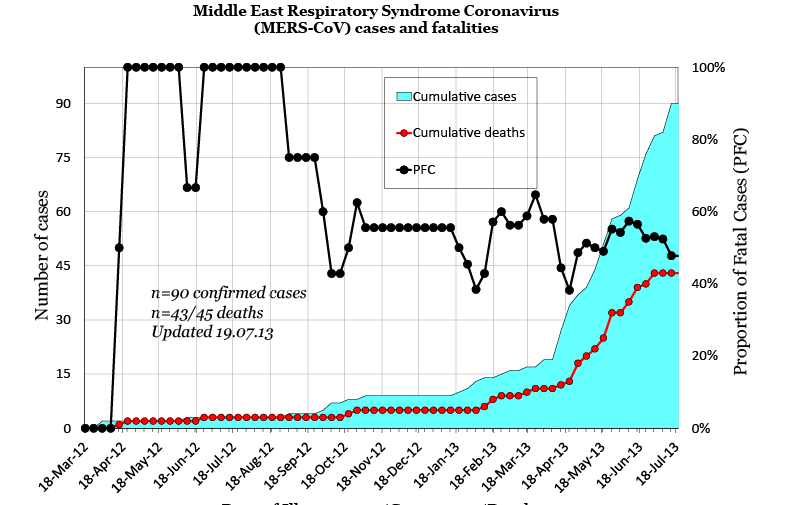
Most of the 90 Mers cases reported so far have been in Saudi Arabia.
Mers is from the same group of viruses as the common cold and Sars, which killed 774 people.
However, a detailed analysis of the Saudi cases, published in Lancet Infectious Diseases, did warn of “major gaps” in understanding of the virus.
The Middle East respiratory-syndrome coronavirus (Mers) emerged in 2012 and has infected 90 people worldwide, 45 of them have died.
The global concern is that cases could spread much further, echoing the Sars outbreak.
Cases have been centred on the Middle East – with patients in Jordan, Qatar, Saudi Arabia and the United Arab Emirates. Additional cases in France, Germany, Italy, Tunisia and the UK have all been linked to travel to the Middle East.
Researchers in Saudi Arabia have published details of the 47 cases reported in the country.
They suggest a pattern of mostly older men being infected. Most cases were also in people with other medical problems, more than two-thirds of the reported cases also had diabetes.
Low threat
The lead researcher and Deputy Minister for Public Health, Prof Ziad Memish, said: “Despite sharing some clinical similarities with Sars, there are also some important differences.
“In contrast to Sars, which was much more infectious especially in healthcare settings and affected the healthier and the younger age group, Mers appears to be more deadly, with 60% of patients with co-existing chronic illnesses dying, compared with the 1% toll of Sars.
“Although this high mortality rate with Mers is probably spurious due to the fact that we are only picking up severe cases and missing a significant number of milder or asymptomatic cases.
“So far there is little to indicate that Mers will follow a similar path to Sars.”
A report earlier this month showed that the virus struggled to spread in people.
However, it and the latest Saudi investigation both highlighted the need to find where the virus was coming from.
Prof Memish’s report said: “Reducing the rate of introduction of Mers coronavirus into human beings is unpredictable because the source of the virus is not yet known.
“We are searching vigorously for the source.”
Here is a graph from a private report called Virology Down Under, a fascinating read on the identification and development of the MERS Virus by Middle East Respiratory Syndrome Coronavirus (MERS-CoV)..
Last Updated 19-Jul-2013
Written by Ian M. Mackay, PhD on his personal time.
All opinions are his own and do not represent medical advice or the views of any institution.:
St. John the Baptist and the Holy Spirit

This entry is a totally Here There and Everywhere moment; the impetus of which is today’s reading from Luke about the birth of John the Baptist, or as he is known in the Moslem world, the Prophet Yahya. We visited his tomb in Damascus; at our church in Kuwait on the Feast of the Nativity of St. John the Baptist, one of the readings was from the Quran. I love it when our worlds intersect and we can discover what we can learn from one another, to the advantage of all.
I also love it that each meditation from Forward Day by Day lists at the bottom the area of the world we are to include in our daily prayers. I love praying for Nigeria. I have old friends from my Kuwait church living there, and also a neighbor from Doha, a sweet book-club friend who lived across the street, who now lives in Lagos.
When I pray for Nigeria, I see the tiny flame of the holy spirit entering into each heart, and then I see God blowing lightly on each person, so that the flame grows. The flame helps them reach out and encourage one another, and others see, and are attracted, and thus the holy spirit spreads. I imagine it covering Nigeria, all believers, seeing one another as fellow believers, not as Ibo or Christian or village or . . . you get the drill. I pray that the light spreads through all Africa, and tiny embers spread out to join, and then further, so that sparks unite all over the world.
I pray, too, for Damascus, and for Syria, and all our friends there; I think of all the wonderful adventures and times we have shared in Syria, and I know and trust with all my heart that our good and loving God can bring good out of this horror. I pray for it to happen sooner rather than to allow this suffering to endure.
. . . And that was just ONE synapse connecting early on a Monday morning, LOL. Have a great day. 🙂
MONDAY, June 24 The Nativity of Saint John the Baptist
Luke 1:57-80.
On the eighth day they came to circumcise the child, and they were going to name him Zechariah after his father. But his mother said, “No; he is to be called John.”
Most of us don’t receive such pointed visions that show us the fork in the road—“this way, not that way”—but all of us are constantly cultivating either a disposition of “my will be done” or of “thy will be done” that will suddenly show up in those crossroads moments. It may appear like divine intervention, but it is long-term divine cultivation.
Living into a larger pattern is both exciting and terrifying, because it means letting go of convention and stepping into new territory. Like Elizabeth and Zechariah, we do not step forward blind but with a promise: God remembers, and God is gracious.
The Widow’s Mite
Today’s meditation is on the Gospel reading from the Lectionary found in Forward Day by Day. I’ve always loved this image, this humble, poor woman who gives what little she has.

THURSDAY, June 20
Luke 20:41—21:4. Jesus looked up and saw rich people putting their gifts into the treasury; he also saw a poor widow put in two small copper coins. He said, “Truly I tell you, this poor widow has put in more than all of them; for all of them have contributed out of their abundance, but she out of her poverty has put in all she had to live on.”
There is something about generosity that is compelling. Jesus says that the poor widow has given out of her poverty, but in reality it is only she who has given out of her abundance—an inner abundance of the heart that allows her to behave almost recklessly, as if she had more than enough.
I was taught to save those pennies, to save them for a rainy day, and it can still keep me looking to the horizon for any sign of clouds. My spouse, admittedly, has a much better relationship to money: it’s not about having or not having, but about knowing the relative value of wealth; it is energy to be moved around, rather than bankable power or security. Above all, it is a potent way to extend and manifest generosity.
As we see in the widow’s mite, it’s not the amount, but the heart’s intention behind it that matters. That is where the real power lies.
Recent Comments
ExpatAlien on What Country am I Living … intlxpatr on Yellowstone: Old Faithful to C… Michelle on Yellowstone: Old Faithful to C… Cathy on No Grown-Ups in Charge intlxpatr on Waiting for Snow Wikipedia Donate Button

Amazina


Early Voting in Florida


 Here There and Everywhere
