Sunsets at the Sunset Inn, Panama City Beach, Florida
“I love this place,” I sighed, as AdventureMan and I sat out on our balcony at the Sunset Inn, a little Mom and Pop motel hidden between the towering condos of Panama City Beach. We were watching the sun go down. Little does it matter that as I sat out on the balcony watching the sun go down, or watching the pelicans in the morning, I was probably increasing my quota of mosquito bites, mais tant pis.

“I know you do,” AdventureMan replied, sipping on a cup of hot Christmas punch and sharing the moment with me. We’ve always loved sunsets. Or sunrises. We think of them as one of those great gifts, so wonderful that it is hard to believe they are free.
For some reason, some of the best sunsets we’ve ever seen have been from this motel. Here is the first sunset, the day we got there, Tuesday:
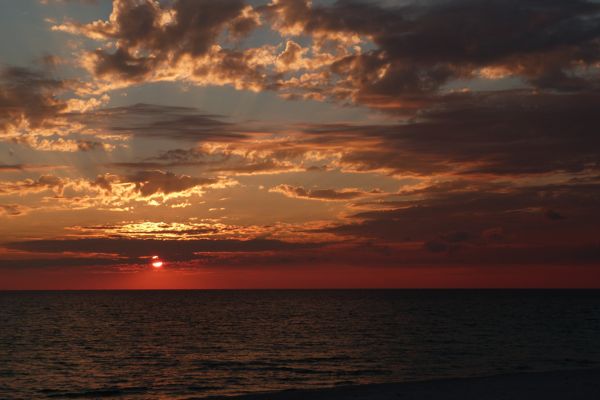
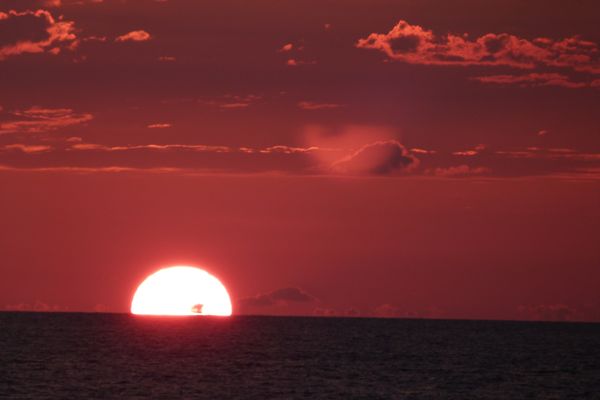
I am not kidding, I haven’t done a thing to that photo. I haven’t cropped it or enhanced it in any way. Who can improve on a sunset like that? I liked it so much I will show you another, again, untouched. This is using the telephoto, but no enhancements:
The next morning, we were greeted by pelicans. I adore pelicans, those throwbacks to prehistoric times, so primitive, and so dramatic, plunging beak first down into the waters and then flying back up with a fish in their beak. These ones aren’t plunging, just floating around letting breakfast come to them:

We missed one sunset, and here is what we caught on Thanksgiving after the feast:
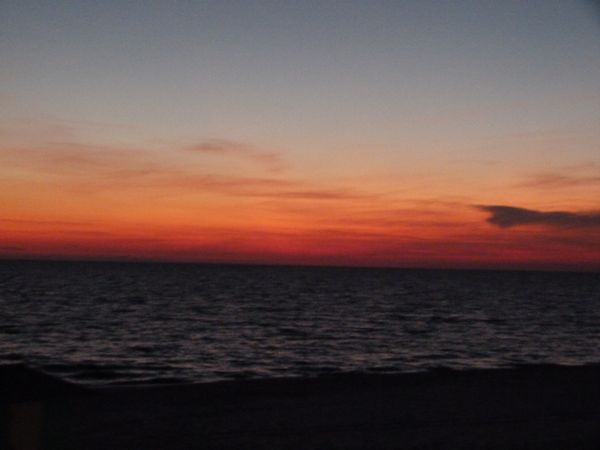
Here in sunset on Friday night, our last night at the beach:
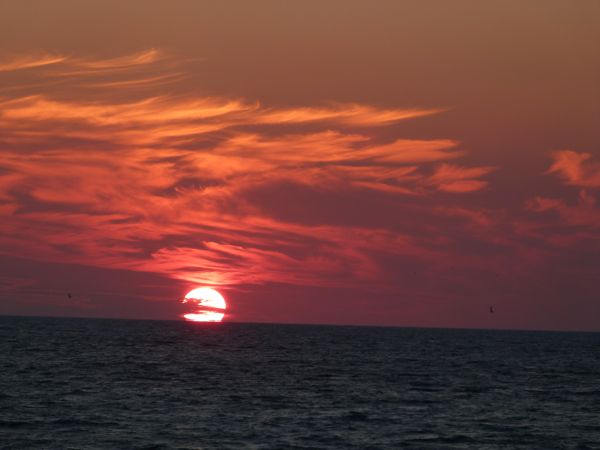
Drama drama drama!

All quiet at the Sunset Inn . . . .
Discover Relaxing Riyadh
I still get ads from Jazeera airlines, although I no longer live in Kuwait and have asked them for three years to take my name off their mailing list. I have unsuccessfully unsubscribed like fifteen times; now I just have it all sent to spam.
But today, as I was looking over the spam to be sure I wasn’t emptying my box of anything important, I saw this:
Discover Relaxing Riyadh – استمتع بعطلتك في الرياض

LOL – Relaxing Riyadh. A group of the ad guys must have been rolling on the floor when they created that one . . . Or maybe they meant that apart from the spine-tingling traffic, there isn’t a whole lot going on in Riyadh, especially on the social scene . . .
Things to Love about Pensacola
1. The temperature this morning is 57°F. 🙂
2. Pensacola Ballet does wonderfully innovative and lively ballets.
3. Pensacola Symphony Orchestra has a fanatically and warmly loyal audience.
4. Sunday Brunch at Jaco’s.
5. Great international population.
6. Good restaurants of many varieties (only no Ethiopian restaurants)
7. Great festivals – Barktoberfest, Seafood Fest, DeLuna Fest are finished, but the Great Pensacola Arts Festival is coming!
8. Sugar white sandy beaches and Gulf waters all blues, greens and purples.
9. Wonderful bird life as they migrate south this time of year.
10. Also butterflies 🙂
11. Traffic so mild it hardly qualifies as traffic.
12. Christmas and Mardi Gras parades right around the corner.
More?
Leopard Kill; I Wish This Were My Video
I found this on AOL News this morning; it’s not mine. I wish it were! I am so impressed. Right place, right time and WOW.
Watch this well-hidden leopard fiercely attack an unsuspecting impala. Cowering low amidst the rocks, the leopard silently waits as a herd of impalas comes racing across the landscape. Right as the impala jumps over it, the leopard catches it mid-air bringing it down to Earth.
The video of this event was caught on camera by Martha van Rensburg who was on a photographic safari in South Africa at MalaMala Game Reserve with her husband, Marius van Tonder, wildlife photographer Greg du Toit, and guest Ian Weatherburn.
“It happened so fast but I was lucky enough to get this video and a still photo of the leopard and impala in the air,” Van Rensburg told Grind TV.
According to the American Wildlife Foundation, leopards are known for being secretive, elusive, and shrewd, having the ability to kill prey much larger than themselves. They are currently listed as “near threatened” by the International Union for Conservation of Nature.
Dauphin Island and BBQ!
We got up early, remember? We worked up an appetite walking through the bird sanctuary and exploring the park and environs. One last stop to see those butterflies and we really need to get something to eat.
Fortunately, we passed just the place on the way in . . . Dauphin Island BBQ 🙂

My friends, this is not a fancy place. There is no indoor seating. You order at a window, and grab your plastic utensils, and then you wait for your name to be called. You can fill little cups with condiments, including, of course, Tony Chachere’s special spices, and then you sit at a picnic table and eat out of a styrofoam container. This may not be your style. We like all kinds of styles 🙂


By the time we decided, cars loaded with grandparents, children, lots and lots of children, parents, aunts and uncles, cars and trucks and big RV’s started pulling up and people crowding into Dauphin Island BBQ eager to eat. Clientele lining up:

We got there just in time. We got a good picnic table in the shade. I tried to order oysters, but since Isaac, oysters have been hard to come by. I had fried fish. It was hot and it was delicious.

AdventureMan ordered the pulled pork and said it was delicious:

Not elegant, but tasty, filling, and delicious. As you drive onto Dauphin Island, turn left and watch for this . . . umm . . .lighthouse. Dauphin Island BBQ is located just past this lighthouse-looking building.

If you want to stay on Dauphin Island, there is one Motel, several condominiums, and many rentals. One place to look for beach rentals is Trip Advisor. Trip Advisor also has a few hotel/B&B listings here, but be sure to tell TA to arrange by distance, or you may end up in Gulf Shores or Fairhope, LOL!
The one motel, Gulf Breeze Motel, is nothing fancy, but it is the best there is. Reviewers on Trip Advisor say ‘it’s not the Ritz’ but the prices are reasonable, and people seem to like it.
Dauphin Island: Fort Gaines
Imagine you are a retired military man who likes birds and butterflies and gardens and photography and military history . . .
Now, imagine you can find all of the above on one island. Dauphin Island is a paradise for AdventureMan.
Imagine you are a woman who loves road trips, beautiful beaches, taking pictures, taking walks, beautiful scenery, especially beaches and wading birds . . .
And that is also all on the same island.
We can’t wait to go back to Dauphin Island. Birding season is just kicking up again, after the heat of the summer and the threat of hurricane season. The birds migrating south have their final rest on Dauphin Island, before heading out across the big Gulf of Mexico to warmer climates for the winter.
And there’s an old fort, too!
These forts were built to protect the American southern coast from a variety of enemies, including at one time, our fellow Americans. They are built solidly, with great big cannons.
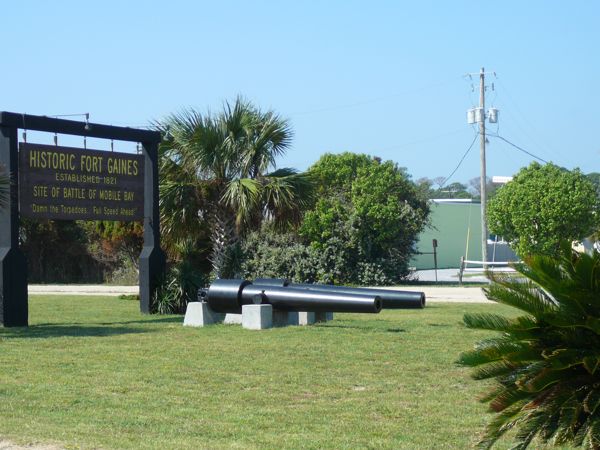


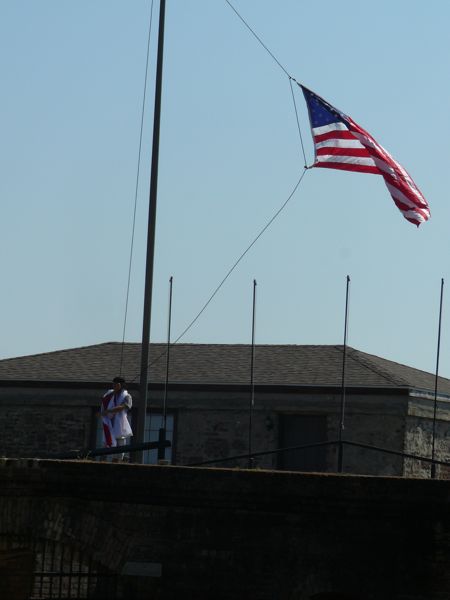


So what is the fort defending against now?


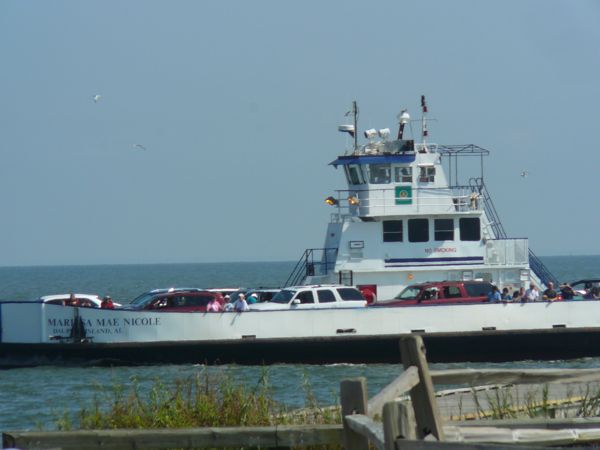
There is another way to get to Dauphin Island from Pensacola, if you get there at the right time and there isn’t much of a line, because this little ferry can’t take a lot of cars. It goes to Fort Morgan, still in Alabama, but across Mobile Bay:
AdventureMan says the forts are built in the style influenced by Marc René, marquis de Montalembert, who is said to want to do for defense what Vauban had done for the attack.
Dauphin Island: Audubon Bird Sanctuary and Shell Mound
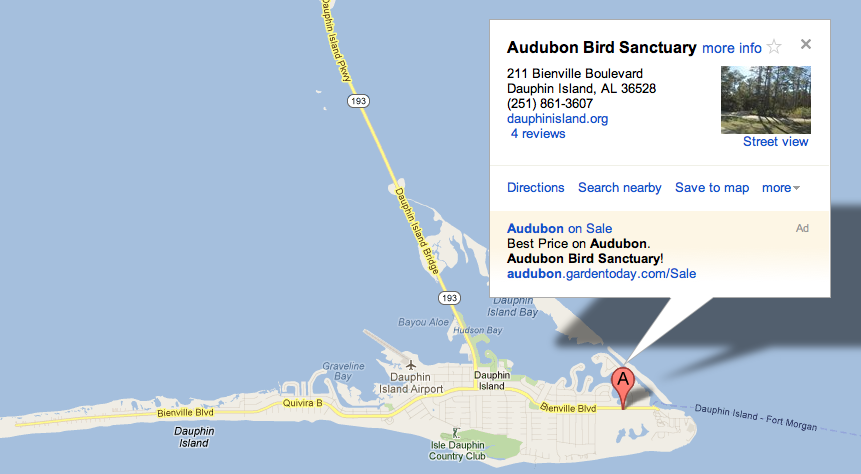
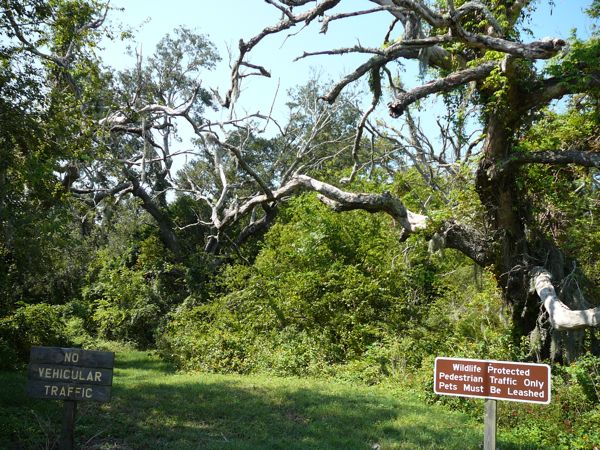
After exploring the west end of Dauphin Island, we explored further, and found what we were really looking for – the Audubon Bird Sanctuary. It was even better than we had imagined. You drive in and park, open your doors, and it smells good, like salty sea fresh air and pine trees together. They have walking trails that are beautifully done; even ramps and areas for people in wheelchairs, special areas for picnics out just a short walk.
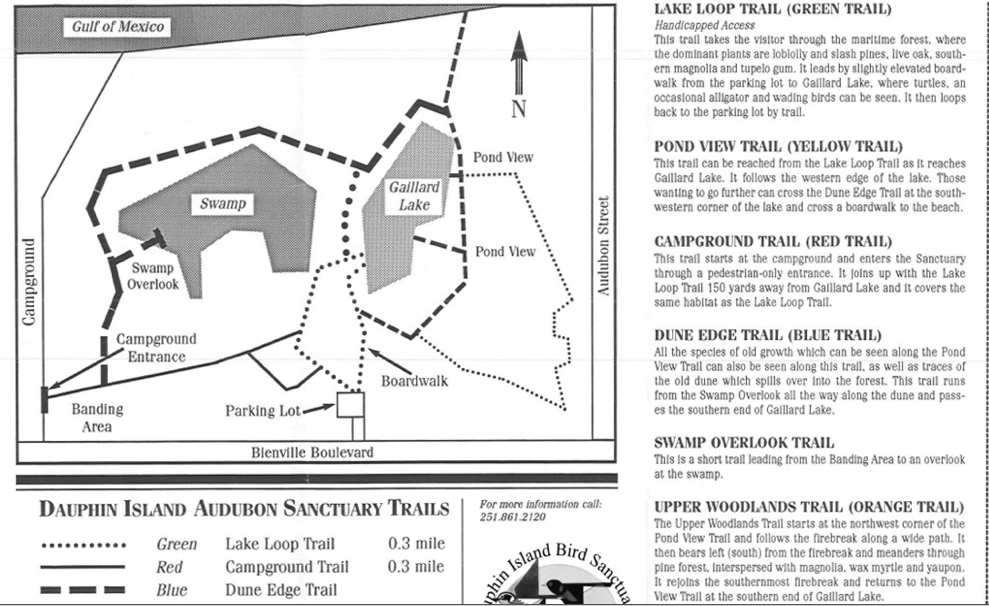
The trails are clearly marked, and have great signage.

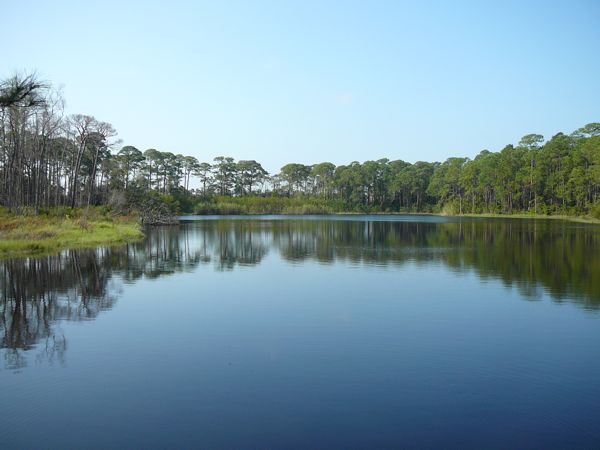
A very short walk takes you to a lake area, with an overlook and lots of soft shell turtles poking their heads out curiously:
At one point, AdventureMan laughed and said the long needle pine has decorated this smaller tree for Christmas:

We know we will be coming back, so we saved the longer hikes for another, cooler trip. 🙂
Dauphin Islanders have put a high priority on protecting their sea and bird life. They have bought up several parcels where the wildlife is protected and free.

We found the Shell Mound park, and it is magnificent. There is a road lined with trees dripping with Spanish Moss, and there is more wild lantana than I’ve ever seen in one place before. The butterflies are crazy about lantana, especially this orangey kind, and there must have been a thousand butterflies, just in this one small area; it was like butterfly heaven. Most of the butterflies we saw were Gulf Fritillaries or Sulphers, but AdventureMan says he also spotted a BuckEye. It was magical, just watching them flit so happily from blossom to blossom.

We are already thrilled we came to Dauphin Island, but . . . there is more to come!
Hotel Stay? Where to Use Your Sanitizing Wipes
Found this morning in the Bottom Line Newsletter:
As a person who stays in hotels, it never occurred to me to wipe down the main light switch (DUH!) or the bedside light, or that the most bacteria filled objects of all would be the sponges and rags used to clean them. Oh UGH! I think carrying sanitizing wipes sounds like a really good idea!

The Four Dirtiest Surfaces in a Hotel Room
When you enter a hotel room, you already know that it’s probably teeming with germs from the many strangers who stayed there before you.
But, realistically, what are you going to do about it? Spend hours cleaning every corner? Cover yourself in plastic wrap? Not travel?
Well, there’s a new (and much more realistic) strategy that you can try, because a recent study has identified the areas in hotel rooms that have the most bacteria.
And they’re not all spots that you would commonly think to avoid or to wipe clean.
So instead of worrying or just feeling uncomfortable, I’m going to focus on sanitizing these few hot spots—and you can, too. It doesn’t take long (there are only four!).
FOUR GROSSEST AREAS
Researchers collected samples from various surfaces in three freshly cleaned hotel rooms in three different states (a total of nine rooms), and then, back at the lab, detected how many bacteria were on each surface by conducting something called aerobic plate counts. The higher the surface’s “count,” the more bacteria it contained. The top four dirtiest surfaces (outside of housekeepers’ cleaning equipment, the toilet, and the bathroom sink and floor—all of which scored over 117 “counts”) turned out to be:
Main light switch: 113
TV remote control: 68
Bedside lamp switch: 22
Telephone keypad: 20
Most items (including the toilet paper holder, mug, bathroom faucet, room door handle, shower floor and bathroom door handle) had relatively moderate amounts of bacteria, with scores between 4 and 11. The two cleanest surfaces, both of which scored only 0.5, were the bed headboard and the curtain rod.
Yuck! Some of these top hot spots, such as the remote control, don’t surprise me, but I never would have thought about the bedside lamp! This news is definitely going to make me rethink the way I always turn on the bedside lamp (without disinfecting it first) while reading before bed. I’m also stunned that the bathroom faucet, the shower floor and the two doorknobs weren’t higher on the list!
You might be wondering which types of bacteria were identified. Unfortunately, the aerobic plate counts measured only how many bacteria there were on the surfaces, not which kinds.
WILL YOU GET SICK?
When I called study coauthor Jay Neal, PhD, a food microbiologist and assistant professor at the Conrad N. Hilton College of Hotel and Restaurant Management within the University of Houston, he wasn’t overly concerned by the findings, because not all germs will make you sick. But exposure to any pathogens (germs that carry diseases) raises your risk for getting sick, especially if you are immunocompromised. For example, if you’re undergoing chemo…if you’re pregnant…or if you have HIV, you’re more susceptible to infection.
Of course, there’s no way to completely avoid germs, but, in my opinion, it doesn’t hurt to take the following basic precautions—whether you’re immunocompromised or not—to help reduce your risk of getting sick.
A TRAVELER’S BEST FRIEND: SANITIZING WIPES
While Dr. Neal does not believe that sanitizing wipes are necessary, I pack them whenever I travel. You, too, can slip a container of them into your suitcase to disinfect the bacteria-laden surfaces mentioned above the moment that you walk into your hotel room.
Don’t assume that a housekeeper cleaned those areas. Even if a housekeeper did, he or she likely wiped it down with a sponge or mop that was filled with bacteria. Of all the different surfaces that the researchers examined, sponges and mops were the most contaminated items of all!
And, of course, wash your hands when you’re in a hotel room as often as possible with soap and hot water (or use hand sanitizer)—especially before eating or touching your face.
Source(s): Jay Neal, PhD, assistant professor, Conrad N. Hilton College of Hotel and Restaurant Management, University of Houston. Researchers reported these findings at the June 2012 General Meeting of the American Society for Microbiology. Until the results are published in a peer-reviewed journal, they should be viewed as preliminary.
Dust Storms and Diseases
I found this on AOL News/Huffpost this morning, and thought of the awe-inspiring dust storms in Kuwait and Qatar. Living on the tenth floor and watching the enormity of a dust storm rolling into Kuwait City was like being in the middle of a thunder-storm – there is nothing you can do to stop it. It can be terrifying. You realize your true importance in the larger scheme of things (miniscule) and the enormous power of God. You also realize that what you are seeing is just a tiny fraction of his true power.
We also all knew that the dust storms of any size carried contaminants and allergens that could trigger allergic reactions for weeks. This story claims the dust storms in Kuwait and Iraq are the most lethal of all.
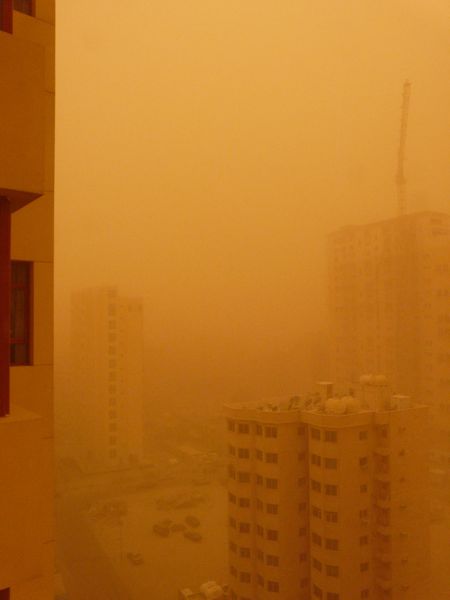
Dust Storms’ Health Risks: Asthma Triggers, Chemicals, Bacteria May Be In The Wind
Posted: 08/11/2012 10:44 am
Lynne PeeplesBecome a fan
lynne.peeples@huffingtonpost.com
Scientists are predicting that the frequency of dust storms, on the rise in the last few years, will continue to increase. Some have also suggested that these storms might well be carrying a more hazardous payload than meets the eye. Among the dangers that experts say are blowing in the wind: asthma triggers, toxic chemicals and infectious disease.
“We are experiencing heat waves and drought across the country. And we anticipate more dust being blown into the air,” said William Sprigg, a dust storm expert at Chapman University in Orange, Calif. “Anything that is loose on the soil is going to be picked up by these storms.”
A look back 80 years to the Dust Bowl could offer a hint of what’s to come. According to a scientific study published in October 1935, Kansas experienced its “most severe measles epidemic,” as well as abnormally high rates of strep throat, respiratory problems, eye infections and infant mortality during the intense dust storms that struck from February to May of that year. The researchers highlighted the potential for both short- and long-term health troubles associated with the dust, but stated that they couldn’t find any pathogens in their dust samples.
The same regions that were affected then — from New Mexico to the Dakotas — may be at greatest risk from dust storms in the future, said Dale Griffin, an environmental health microbiologist with the U.S. Geological Survey. Griffin points to the unsustainable strip farming methods of the 1920s and ’30s, and consecutive years of desiccating heat and high winds that combined to devastate a large swath of the country. And he agrees with Sprigg that conditions today could favor more of the same. This July was the hottest month on record, which has worsened an already devastating drought that experts say has been exacerbated by poor farming practices.
“Because of climate change, it looks like we’re possibly shifting into a phase similar to what occurred in the 1930s, or worse,” said Griffin. “We may be seeing an increase in dust storms that could affect human health.”
Texas and Oregon are among the regions already seeing a rise in such events. Haboobs — severe thunderstorms that kick up massive amounts of dust — have blanketed Phoenix more frequently in recent years, including one headline-grabber last July.
The most well-understood health threat from these storms is the dust particles themselves. If small enough, they can slip past a body’s natural defenses — nose hairs, for example — to infiltrate and damage one’s respiratory system. Now scientists are learning about an array of harmful substances that may also hitch a ride: arsenic and other heavy metals, agricultural fertilizers and pesticides, as well as a laundry list of bacteria, fungi and viruses.
In the southwest, one airborne hazard gaining significant attention is valley fever. A debilitating and sometimes fatal infection, it is contracted from fungal spores naturally present in the region’s soil. Could dust storms send these spores into the air and into the lungs of residents? Sprigg is currently investigating a possible connection between last year’s haboobs and subsequent infections. Such links haven’t been well studied, he said, because people had assumed that the sun’s ultraviolet rays would kill any airborne microbes. But it seems that the dust particles themselves provide a shield for their passengers, explained Sprigg, who is collaborating on a system to predict when dust storms will occur in order to alert area residents, schools and traffic cops.
Other parts of the world are even more familiar with dust storms and their dangers.
The region of Africa between Senegal and Ethiopia has long been subject to severe meningitis epidemics, which research now suggests is at least partially linked to dust storms. In Asia, asthma and other children’s respiratory problems have been found to be more common the week after dust storms.
Perhaps most notorious for pestilent dust is the Middle East.
Navy Capt. Mark Lyles, of the Center for Naval Warfare Studies at the Naval War College in Newport, R.I., found high levels of aluminum, heavy metals, as well as bacteria, fungi and viruses in samples of the ultrafine, and therefore lung-penetrable, Kuwaiti and Iraqi dust. He suggested that parts of this cocktail may be responsible for the mysterious Gulf War Syndrome suffered by veterans of the Iraq War, as well as the high rates of health problems among soldiers returning from the dusty theater of war today.
Hemingway and A Movable Feast

After reading The Paris Wife, I had to read Hemingway’s A Movable Feast. I wanted to see how he saw his Paris years, and how his version integrated with the fiction version of Hadley’s. I was prepared to not like the book.
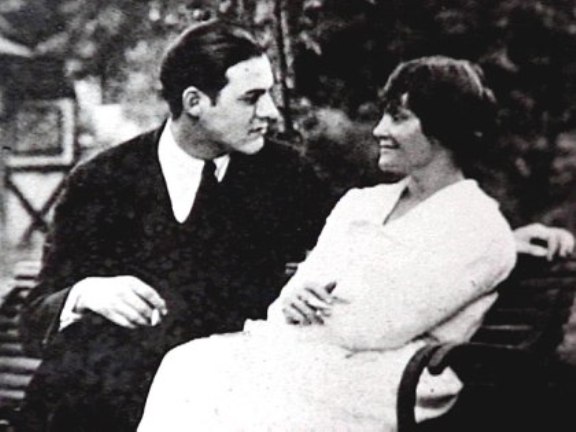
I was not prepared to like it as much as I did. Hemingway writes of the years when he was young, newly married and wildly happy, living a stimulating and lively life with lively friends. They were poor, but he was following his dream. They had a lot of fun.
Hemingway wrote this book, full of stories of their Paris life, full of names you know – Ezra Pound, Scott and Zelda Fitzgerald, Picasso, Closerie des Lilas, Les Deux Magots, Brasserie Lipp, the Louvre . . . and as you read it, you are there. He writes in the moment; you are right there experiencing it along with him. He writes of people he likes, and people he doesn’t like. He writes about his own vices – an addiction to horse racing, for example – and he writes with enormous sadness about how he came to be distracted from his marriage and lost the most wonderful relationship that ever happened to him. He blames it on the careless rich. He takes some responsibility.

He also writes very frankly and openly about people he doesn’t like and why. I couldn’t help but think it is a heady thing, being an acclaimed author, where you can take revenge by putting people you dislike in your books. Hemingway uses real names and real people and often portrays them in a distinctly unflattering light. It made me wonder if he was planning to commit suicide all along; that or he just didn’t care what people think, and it seems he might have been the kind just not to care.
Just after finishing this book, and talking one last time with his first wife, Hadly, Hemingway committed suicide. It leaves me wondering if he was driven to suicide by regret, or by fears that his bigger-than-life life of adventure, travel, high life and travel was over, or if he had serious bouts of depression all his life, and this was just another, deeper depression?
It is a great read, especially paired with Paula McLain’s book, The Paris Wife. I thought it might be “he said – she said,” but Hemingway and the fictional Hadley in The Paris Wife both agree that they had a love and marriage that was very special, that Paris was a wonderful stimulating, alive environment, and that it was a great tragedy when the marriage ended. A Movable Feast seems to say that destroying his marriage to Hadley was one of a cocktail of self-destructive behaviors over which he tried to ride herd (gambling on the horse races, drinking, drugs, a coterie of star-struck sex partners outside of marriage, inability to focus on his work, a curmudgeonly nature . . .)

It’s also an easy read. I particularly enjoyed reading it on the iPad because you can do that swirly-finger-thing and find out what words mean or see the street locations as he walks Paris, see whether a cafe or restaurant in Paris still exist. It would be a good airline read – keeps your attention and finishes quickly.
As little as I like Woody Allen, it was fun to see Midnight in Paris, and to have some visuals of this go-go inter-war era.
Two things that stuck out for me: Hemingway loved walking in Paris, as do I. He also talks here and there about the benefits of being hungry. There were times when money was tight; they wore old shabby clothes, and there were times they didn’t have much food. He talks about hunger sharpening your other senses. On the other hand, very quickly when he has money, he has a great meal and a drink – or two – or three.
Bottom line, I’m glad I read this book. It’s given me a lot to think about.
Recent Comments
intlxpatr on Shampoo Ginger tigerbutterya0c5ff1d… on Shampoo Ginger intlxpatr on British Soldier Kidnapped, Esc… John on British Soldier Kidnapped, Esc… intlxpatr on British Soldier Kidnapped, Esc… Wikipedia Donate Button

Amazina


Early Voting in Florida


