Jazeera: Istanbul 9 KD
e-mail from Jazeera airlines – sale on now!
Istanbul from KD 9!
Considered the gateway of Europe, Istanbul quintessentially eastern city, with glittering mosques and decorative splendor. The city has a rich history to explore, with beautiful wooden Byzantine architecture, fascinating museums, and the most glorious mosques. Sample the delicious mezze and kebobs, stroll around the markets and bazaars, enjoy a cup of apple tea and absorb the lively atmosphere.
The jewel of Turkey now has a special place in our website. Check out jazeeraairways.com/istanbul, and explore the most amazing photos, get hold of the latest accommodation, restaurants, currency, and weather information. Fly to Istanbul…even without leaving your house.
Flight schedule:
Kuwait – Istanbul Istanbul – Kuwait
Thursdays DEP: 07:55 / ARR: 11.30 DEP: 12.15 / ARR 15.45
Saturdays DEP: 18.15 / ARR: 21:50 DEP: 22.35 / ARR: 02.05
Mondays DEP: 18.15 / ARR: 21:50 DEP: 22.35 / ARR: 02.05
MacDonalds MacKrisby
This is for my stateside readers. Wherever you go, except for Syria, there seems to be a MacDonalds. The funny thing is, in different countries, they have different specialties, things you never see in the USA. For example, while we lived in Qatar, they had a special called the MacArabia, which was kind of like a local fast food, but on a more Western bun. It was no where near as tasty as the local equivalent, but I think they add things to the menu to appeal to people forced to eat there when the kids insist. I am only guessing; I can’t even remember the last time I had anything from MacDonalds.
In Kuwait, they have added a new sandwich, the MacKrispy, a breaded fried chicken thing, sort of like a great big dry chicken nugget. Because Arabic does not have a “p”, the literal translation of the word (you can see it down by the little golden arches) is MacKrisby.

A Case of Two Cities with Inspector Chen: Qiu Xiaolong
When my sister Sparkle recommends a book, I have learned to listen. I think I ordered this book about six months ago, but never cared enough to actually read it. After reading a recent Donna Leon (like dessert, I use it as a reward for reading something more challenging) I decided it was time to tackle Qiu Xiaolong.
I believe A Case of Two Cities is the first in the series; I tried very hard to make sure it was. When I first started reading it, it was difficult, but it didn’t take long to adjust. When you read a detective story written in a foreign culture, you have to park your old way of thinking, and quickly adapt to a new way of thinking. First, you have to learn what that new way of thinking is. They don’t just tell you at the beginning of the book “Here are the differences in values – you will notice . . .” no, but Qiu Xiaolong is courteous enough to take us by the hand and lead us gently into the Chinese way of thinking, the Chinese way of getting things done, and the technicalities of Chinese detective work.
As we meet Inspector Chen, a published poet, and a detective, ten pages into the book, a new anti-corruption campaign is starting in Shanghai, and Inspector Chen has been given a special assignment – a qinchai dacheng – as “Emperor’s Special Envoy with an Imperial Sword.” Even though imperial days are long gone, this warrant gives him emergency powers to search and arrest without reporting to anyone – and without a warrant. He is to seek and find Xing, a corrupt businessman who has caused huge loss to the national economy and is in danger of tarnishing the Chinese national image, and Xing’s associates.
Just as in the Donna Leon books about Commissario Guido Brunetti, and the Bowen books about Gabriel duPre, and James Lee Burke’s books about New Orleans, and Cara Black’s books about Aimee LeDuc, the detectives and investigators have to walk a fine line between going after the criminal and overstepping their warrant – stepping on the toes of those also engaged in corruption so entrenched that it has become a way of life. Each of these detectives has to maneuver that treacherously fine line – who determines when corruption has become too much? It usually puts their own lives in danger at some point, as those manipulating the system and making a fortune out of it do not want to be caught, do not want to be exposed, and will go to great lengths to protect their ill-gotten gains.
And just as in the above books, the book is more about the actual process than the crime itself. Inspector Chen must go about his task indirectly, having chats here and there, gathering threads of information with which he tries to weave a plausible tapestry of events.
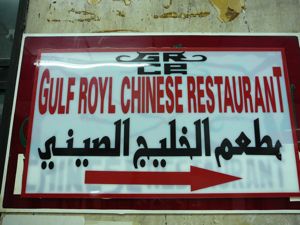
As I was reading A Case of Two Cities, I kept making AdventureMan take me out for Chinese food! The meetings are often held over food, and the descriptions are mouth-watering.


Best of all, when you read these books, you get a tiny little glimpse into another way of thinking, another way of doing business. We are all human, we all have the same needs, and we differ in how we go about getting those needs met. We differ in the way we think. It helps to enter another way of living, another way of thinking, it helps to visit through these books so that we can increase our own understanding that our way of doing things is not the only way, maybe (gasp!) not even the “right” way! Maybe (crunching those brain cells really hard to output this thought) there is more than one “right” way?
Pirates!
BBC has been running a radio series on pirates, how we came to see pirates mostly deriving from Treasure Island, and romantic literature. Here is a recent article, however, on modern day piracy, which is alive and well, particular off the Horn of Africa / Somalia. Scary stuff. Did you know that 90% of the world’s cargo is moved by sea? And I recently heard that for Kuwait, the percentage of goods delivered by sea was 99%. This article begins a three part series on modern day piracy:
No vessel is safe from modern pirates
By Nick Rankin
BBC World Service
Pirates are not just mythological characters with peg legs, parrots and pistols. They now carry AK-47s and use speedboats to rule the high seas of the world.
Robbery of the high seas is not confined to 18th-Century history and literature or Hollywood films – it is still very much alive today.
Ninety percent of the world’s trade is still moved by sea, so it is not surprising that piracy against cargo vessels remains a significant issue.
It is estimated that seaborne piracy amounts to worldwide losses of between $13bn and $16bn a year.
Piracy peaked in 2003 with 445 attacks around the world and since then, they have more or less steadily come down.
In 2006, there were 239 attacks. Last year, the number increased slightly to 249.
Although attacks have decreased from the early 1990s, Rupert Herbert-Burns, a maritime security expert at Lloyd’s Intelligence Unit, says piracy is still a worrying problem.
“Attacks rose by 14% towards the end of last year, largely due to attacks off the Horn of Africa, specifically in Somali waters or in the territorial waters off Somalia,” he said.
You can read the rest of the article HERE.
Jazeera to Istanbul
We have almost as much fun in Turkey as we have in Damascus, for all the same reasons. So this morning, when Jazeera announced a new route starting March 29, they got a big Wooo Hooooo from me!
NEW ROUTE! Kuwait Istanbul From March 29!
Considered the gateway to Europe, Istanbul is a quintessentially eastern city, with glittering mosques and decorative splendor. The city has a rich history to explore, with beautiful wooden Byzantine architecture, fascinating museums, and the most glorious mosques. Sample the delicious mezze and kebobs, stroll around the markets and bazaars, enjoy a cup of apple tea and absorb the lively atmosphere.
Flight schedule:
Kuwait – Istanbul Istanbul – Kuwait
Thursdays DEP: 07:55 / ARR: 11.30 DEP: 12.15 / ARR 15.45
Saturdays DEP: 18.15 / ARR: 21:50 DEP: 22.35 / ARR: 02.05
Mondays DEP: 18.15 / ARR: 21:50 DEP: 22.35 / ARR: 02.05
Kuwaiti Women, Minors from Cradle to Grave
In an article in today’s Kuwait Times sure to raise discussions throughout Kuwait, staff writer Ahmad Al-Khaled brings up the laws requiring Kuwaiti women to have a husband /father/ guardian present to apply for a passport and other legal papers:
Published Date: January 15, 2008
By Ahmad Al-Khaled, Staff writer
KUWAIT: The issue of gender equality under the law has come under fire of late after an exasperated Kuwaiti woman wrote to a local Arabic newspaper telling the tale of her frustrated quest to renew her passport and was told the law required her to be accompanied by her male guardian. “It is frustrating that we are not considered equipped to act as our own guardians in 2008,” said a middle-aged Kuwaiti wife and mother of five, Um Talal, who read the woman’s letter describing how she was denied the right to renew her passport unless her husband accompanied her to the ministry.
While Kuwait is a Muslim nation, Kuwaiti law is not solely Sharia based, although it uses Sharia as a primary source of legislation according to the Constitution. Adult-aged Kuwaiti women are required under the law to be accompanied by their husband or father to renew their passports. If their father and husband are deceased or should they be divorced from their husband, they may be required to provide authorities with proof of their male guardian’s death or proof of their marital status.
“Why should we be required to offer such proof. It is insulting to be treated as if we Kuwaiti women are in need of guardianship. Shame on the government for continuing to allow such a law to remain in the books,” said a 30 something Fala Jassem. “It is not Islamic to treat women poorly, we are not children! Shame on anyone that calls this law Islamic,” said 65-year-old Bedour Bader.
While Kuwaiti women speaking to Kuwait Times were staunchly against the law, Kuwaiti men were divided with some going so far as to call the law a necessary requirement to keep their women protected. “It is a husband’s duty to act as a guardian for his wife. We must lead our families and this includes the wife,” said 53-year-old father of four Abdullah Nasser.
You can read the rest of the article HERE.
Walking Old Damascus (4)
I’ve really saved the best for last. I am about to take you into our very favorite restaurant in Damascus, Naranj. It is very close to The Talisman, at the Roman Arch on the Street called Straight, and just across from the Greek Patriarchate. We were lucky to eat there when we did – and to have a table where we could watch all the high Syrian Poo-Bahs come to dine. The food was – hands down – the best food we ate in Damascus, and we ate some truly fine food there. Unfortunately, we could only eat there once – all the other times, every table was reserved!
We don’t know why, but Naranj was also the only place we saw females working in a restaurant – one as a hostess and one as our waitress and one as the bread girl (bringing around baskets of fragrant freshly baked flat breads). We saw very few women working anywhere, in fact the only other women I can remember were running the ONAT – the very fine handicraft shop down near Bab Sharqi.
Naranj:
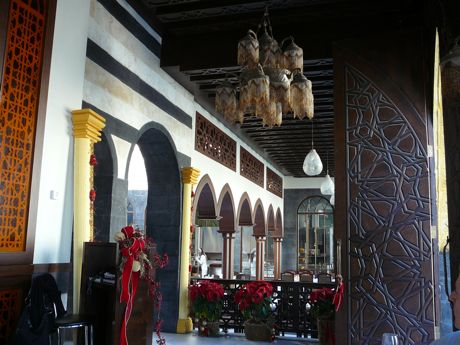
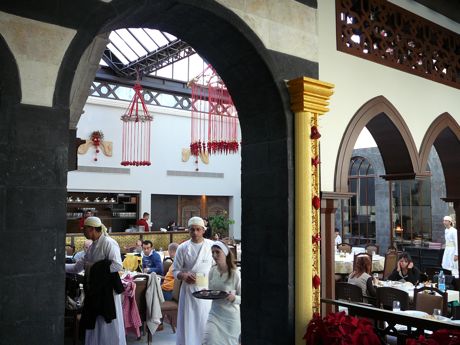
In the heavy black stone container (HOT!) is a dish called Hommos wa Burghul, or Garbanzos and Wheat. It must have had a ton of butter in it, to be so rich and so delicious, and with such simple ingredients. If any of you make this dish, I would love the recipe.


Along the Street Called Straight:

Silly me. I love copper and brass, and would have bought more, but I thought we were limited on Jazeera to 20 kg – that’s what the ticket said! It seems everyone else knows that it just isn’t so.

I loved the spaces in this building at the mosque end of the Hamadiyya Souk – and here is a view of the souk from one of the upstairs stores:

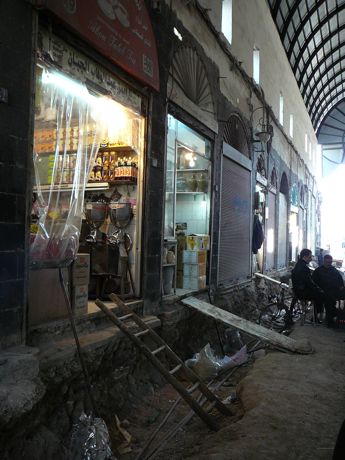
As the street lining the souks at the beginning of the Street Called Straight is under renovation, the shops still open, but people have to negotiate their way up ramps:
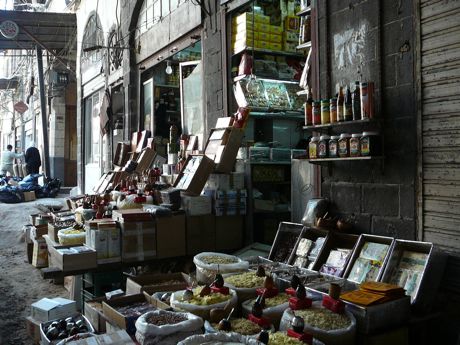
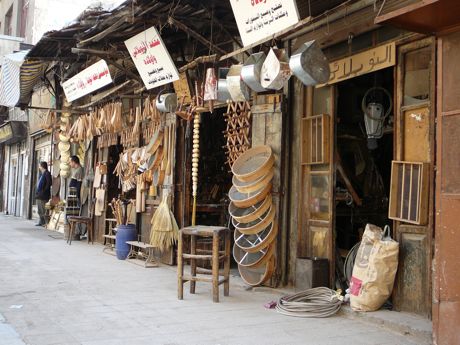
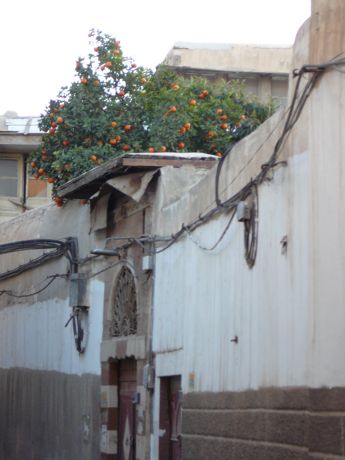
We discovered we are in Damascus just as all the oranges are ripening, and oh, the juice is so sweet and so delicious:
This beautiful statue is on the grounds of the Damascus Museum. You can’t take photos inside. We actually like the grounds of the museum better than we like the inside, currently. We think we remember a lot more stuff formerly, but it seems very spare now.

You know me, I can’t resist a good sunrise or sunset. This is the mosque behind the Talisman, at sunset:

And I saved my very favorite photo for the last – Damascus DOES have modern trucks that deliver fuel in the more modern part of the city, but in the tiny narrow streets of the old city, they still use a cart with a horse, who can get into the smaller spaces. This card delivers fuel oil, and as he goes along, he sounds a two-toned horn – not a loud horn, but a distinctive horn – so that if anyone needs coal oil, they run out and he gives it to them.

I have had responses that tell me Damascus is not for everybody. Even while I was there, I could imagine friends who would not love it as we do, might find it too old-fashioned, maybe too dirty, too inconvenient, lacking in up-to-date conveniences.
We also went knowing that as Americans, we might have problems. We never had a problem. We never met a single Syrian who wasn’t gracious and welcoming, and we were well treated at every turn.
We like adventure. We like history. We like walking, and we like good food. We like architectural details, we like fusion cultures, and we LOVE small, personal, charming hotels like the Talisman, with their excellent service. For us, this trip to Damascus was a supurb vacation.
Walking Old Damascus (3)
I can never get enough of Old Damascus, but for those of you who are bored already, I will only do one more after this one. And my friends, I am only skimming the surface – Damascus can keep you busy and happy for a long time. Along one of our favorite streets, Al Qamariyya, we saw a sign that said Calligraphy and Lute instruction, and we looked at each other with a grin – we could be happy for weeks learning lute and calligraphy!
We had met up with an old friend who loves Damascus as we do, and he suggested a walk OUTSIDE the walls, from Bab Thouma (Thomas’ gate) to the Bab Es Salaam, which we did. The Bab Thouma is only a five minute walk from our hotel, straight up al Hijari, crossing Street Called Straight where it becomes Sharia Bab Thouma – how easy can it be?
The walk along the northern outside walls in this section is spectacular. For one thing, look at the differing levels of construction in this, one of the remaining walls of Old Damascus:


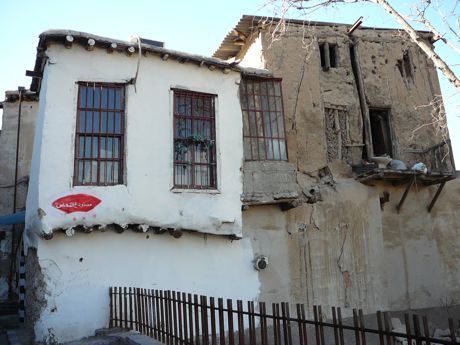
From outside the northern wall, looking north toward the mountains:
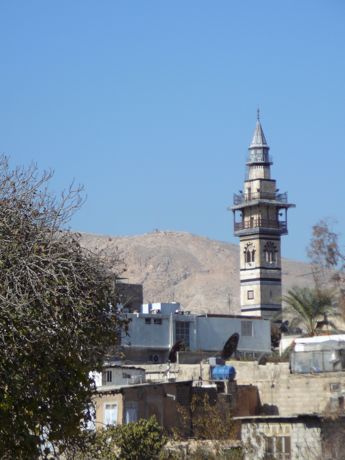
Then you come to the Gate of Peace/ Bab es Salaam:
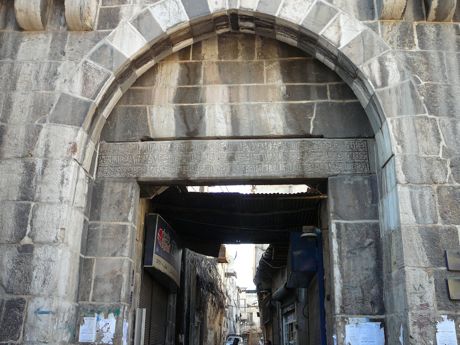
There is a whirl of reconstruction going on in the old city. Some fear modernizations which will change the character of the old town, but others say that the restrictions won’t allow that to happen – we shall see:


Here is what we love – in every country, you will find volunteer supervisors where construction or reconstruction are going on:

One of the highlights of our trip was a visit to Ananias’ chapel. This is not the actual spot where Ananias baptized Paul, a mosque has been built over that site (It is called the Jakmak Mosque and you can see it in the long covered souk at the beginning of the Street Called Straight) but this is the church/chapel which commemorates that baptism, and it is very beautiful.
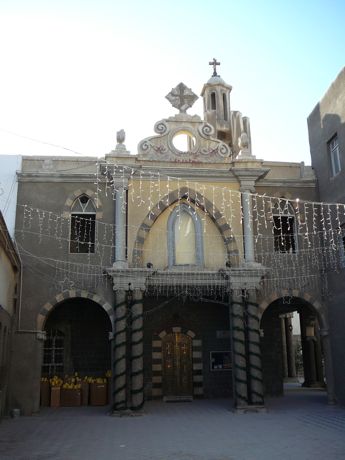

Time for a cup of coffee, and to plan the next walking expedition, and we find this wonderful cafe next to the church at Bab Sharqi:

We think there is a museum for the Hijaz Railway, which fascinates AdventureMan, but this is all we can find:

At our friend’s recommendation, we also try the Old Town restaurant, and we like it so much we go there twice:
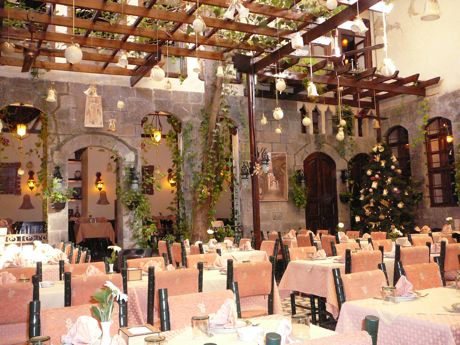
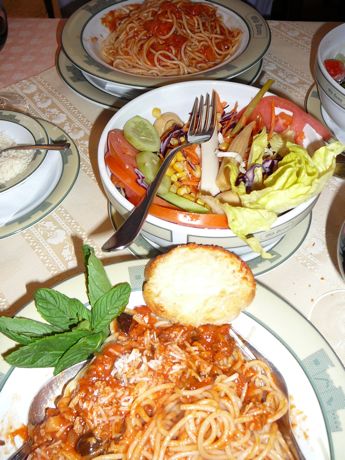
Nice to have some pasta for a change, and the pasta here is really good!
Interesting old balcony:

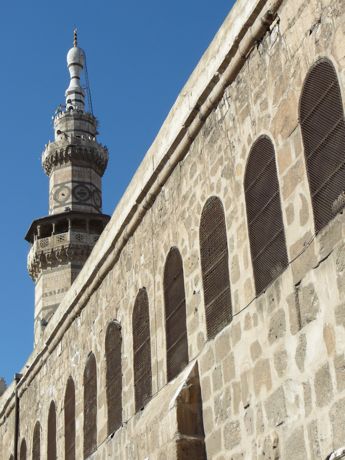
I keep looking for the Issa/Jesus spire of the Umayyad mosque, and I think this might be it, but I am not sure. Legend has it that this is where Jesus will prevail over the forces of darkness and evil on the Last Day.
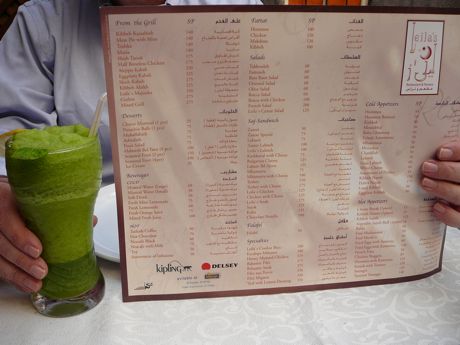
We are told you MUST make a stop at Leila’s, near the Ummayad Mosque, near the Hamadiyya Souks, and so we do. It is very conveniently located when you are shopping for visiting the mosque:
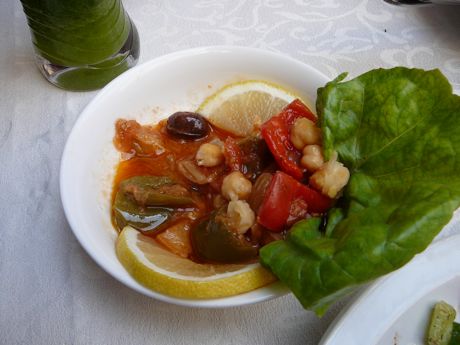
They had a Baba Ghannoush there unlike any I have had before, but very much like something we used to eat in Tunisia, called mechoia – grilled eggplant and peppers and garlic, with a very smokey taste. Yummmmy!
You know me and light fixtures – this is one of the Leila lamps:
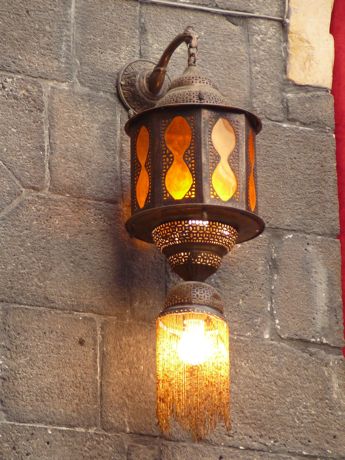
Tomorrow I will take you to our absolute favorite restaurant in Damascus, and finish up the trip, I promise, as much as I hate to leave!
(Happy Islamic New Year!)
Walking Old Damascus (2)
You know how it is, when you are flat-out totally in love, you can’t see the flaws. In moments of clarity, I can understand that there could be hardships to living in Damascus. There could be problems meeting the codes for historical preservation while trying to install modern plumbing. There could be bureaucrats to bribe, there could be problems with labor, I don’t know any of this, I am just guessing.
None of it matters to me, I am so head-over-heels happy. Thanks be to God, AdventureMan shares my insanity, and we are having a wonderful time walking, walking, walking. He is SO patient with me, and all the photos I have to stop to take.
Today we visit the Ummayyad Mosque which also contains the tomb of John the Baptist. I think this is one of the reasons we love Damascus so much – the co-existence of Islam and Christianity, and the sharing of sacred spaces.
The parking area in front of the mosque is full of vendors. My favorite are the bread carts:
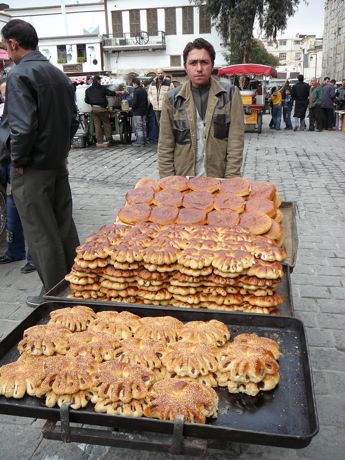
Non-Muslims have to go to the entrance where you can rent an abaya with a hood, so that you can visit the mosque. All visitors are welcome; entire tour groups are going through, French, German. You also have to take off your shoes, and the beautiful marble flooring is VERY cold! In some places, there is carpeting.
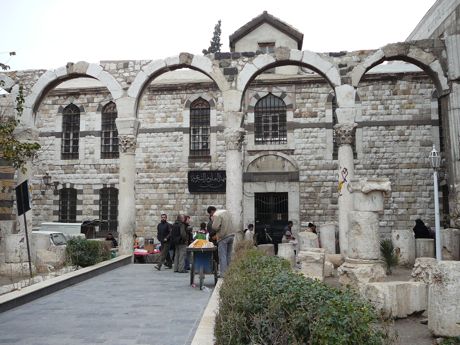
This is a tree-of-life detail from the treasury:

Once inside the Ummayad Mosque, they have that in-floor heating, so you can warm your tootsies back up while experiencing the magnificence of the mosque interior (please note the horseshoe arches):

The tomb of John the Baptist:

A funny story: as we are leaving the Mosque, AdventureMan says “where is this tomb of John the Baptist you wanted to visit?” and I looked at his in puzzlement. We had finished touring the whole mosque, and I had photographed the tomb.
“We already visited it!” I told him.
“When?” he asked.
“It was that beautiful tomb in the main mosque area surrounded by people praying!” I replied.
“No, that was somebody named Yahyah,” he corrected me.
“Yahyah is the name for John the Baptist,” I told him. Guess he would have appreciated it more if he had known at the time. I just assumed he knew.
I must have been a magpie in another life. I don’t know why, but I love these glittery Chinese decorations. AdventureMan bought one for me, a golden crown with big red “jewels”. The shops always catch my eye:
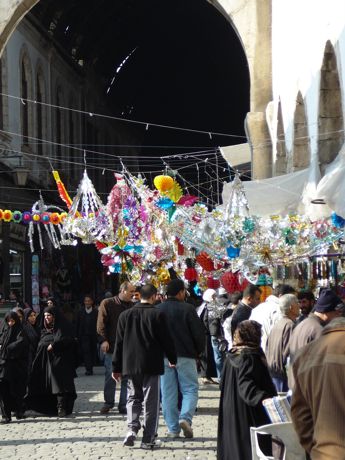
This is a famous ice cream place in the Souk Hammadiyya:

This shop was on the traditional medicine shop street. It had herbs, and dried creatures which can be used in healing, and unusual soaps, and also seashells:

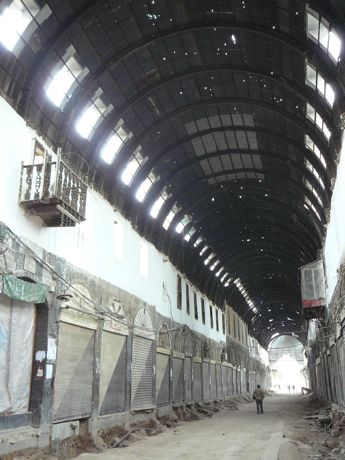
This is the traditional souk at the beginning of the Street Called Straight (al Mustaqeen) which is undergoing renovation. Just wanted you to see the bulletholes through the roof:
I don’t know if you could find a truly bad meal in Damascus. I think you would really have to try! We found this wonderful restaurant, Al Kawali, not too far from our hotel, and we loved their food and we loved the atmosphere, and we loved having the bread baked right under our noses:
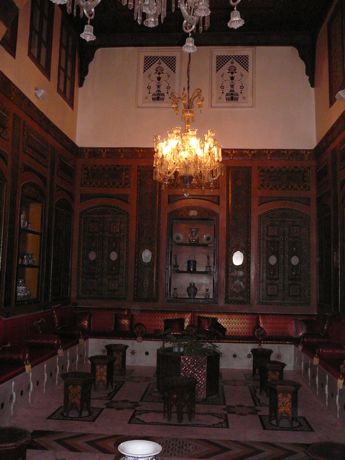

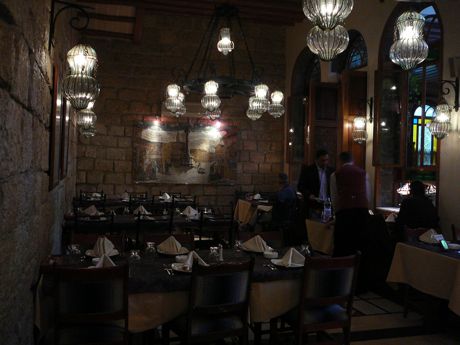
For those of you who, like me, are addicted to spaces and details – look at these gorgeous light fixtures, Damascene glass:

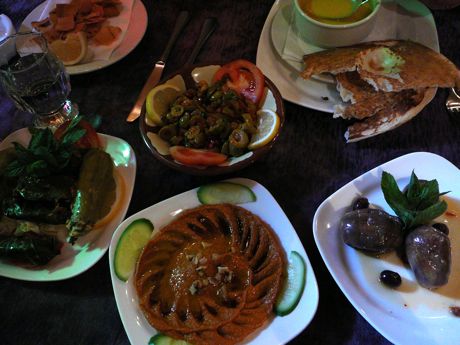
And last, but not least – we find the food so fabulous that we are eating too much. Our first time at Al Kawali, we order just some favorite mezze dishes and soup. When the tastes are so perfect, it takes less to fill you up, and this food is perfection.
We found this old house as we were leaving Al Kawali to walk back to the hotel:
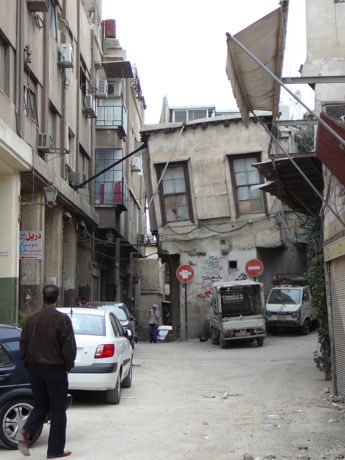
The Talisman Hotel, Damascus
We have always loved Damascus. We used to hang out there a lot when we were with the embassy in Amman. Weekends we would drive up and stay with friends at the embassy there, or they might drive down and stay with us. I remember shopping at one time, and in a shop along the Street Called Straight when I caught a glimpse of the shopkeeper and his friends, drinking tea, not oblivious to us, but also not attentive to us, and all of a sudden, I could see through the centuries, I could feel the weight of the history of this city, that the citizens of Damascus have seen so much of civilization and we were mere mists, appearing for a short time and disappearing again, nothing of substance, nothing of importance in a city which endures and endures.
You really have to love Damascus to go through what we had to go through to get to Damascus – it took months for us to get visas. Our government publishes advisories telling us NOT to go there, and we in our arrogance, figure we will be OK. We also know that when we re-enter our own country, we will get additional scrutiny for having put Syria in that little block where they ask where you have travelled between your last visit and this visit.
When the blogger Gastronomica was blogging, he wrote about staying in the same hotel in Sidi bou Said, Tunisia that we had stayed in and thoroughly enjoyed, (the Dar Said for anyone going to Tunisia, is just minutes from the Tunis airport in the beautiful hillside village of Sidi bou Said, minutes up the road from the old city of Carthage). He wrote about a hotel in Damascus called The Talisman which I immediately looked up online, and immediately bookmarked.
The Talisman was formerly a family palace, fallen on hard times, gutted and renovated with enormous care. No matter where you set your eyes, there is something of beauty. The furnishings are beautiful, chosen with taste and restraint. The colors are both traditional – and modern – and very exciting.
The entrance to the Talisman is on a tiny little hard-to-find street, barely big enough for a taxi:

We would never have heard of The Talisman without Gastronomica’s recommendation, but on our very first morning there, we met a woman with the December 2007 Conde Nast Traveller featuring Damascus, and recommending The Talisman if you couldn’t get into Dar al Mamluk, a much smaller hotel not too far from The Talisman. We saw the Dar al Mamluk, and a nearby merchant said the rooms are much smaller than the Talisman, and not so exquisitely furnished. We have not seen the rooms for ourselves.

From the moment we arrived, we loved The Talisman. You are located a mere minute’s walk from the Street Called Straight. You can get anywhere in the old city in ten – fifteen minutes walk. You are one minute from a nearby Amin Street where you can catch a taxi anywhere in the city. What we loved the most about the location was that we could walk and walk and walk – and we did. Every day, we walked the city.
The service you get at the Talisman is personal and attentive, without being intrusive. Breakfast is cheerful and plentiful, served buffet-style in a rosy-red room filled with antiques and two bustling, good-humored waiters who keep your coffee and tea cups full.

The rooms are huge. We only reserved a regular room; you just never know looking at pictures on the internet what a place is really going to look like, so we had thought that if the room was too small we would ask if any suites were available.
When we got to our room, we were blown away by their concept of “regular”. It was spacious. Compared to most hotels, the “regular” rooms were HUGE! The bathroom had both a huge bathtub and a modern shower, and they both worked and had plenty of hot water. We had space enough to invite an old friend to our room; we had our own seating area.
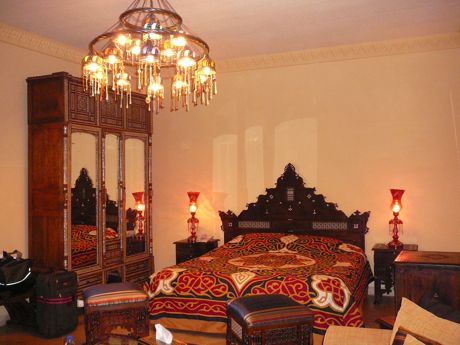
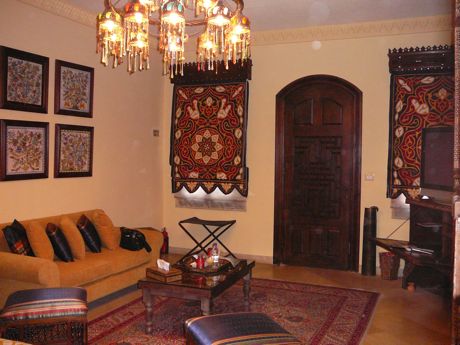

We loved the attention to detail, the room furnishings, even the light fixtures:
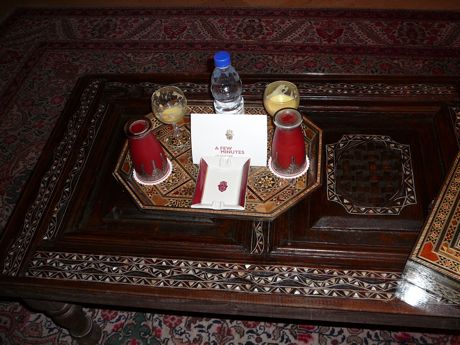
There are also two lounges, one outside, one inside, and tables around the pool where you can sit and soak up some sunshine, even in the midst of winter.
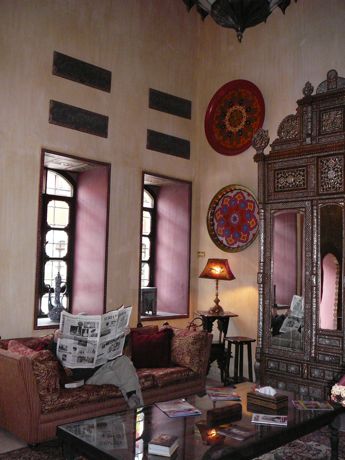
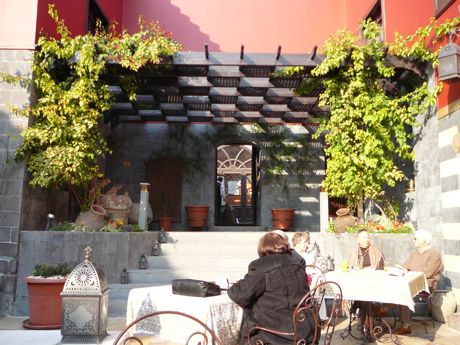
The Talisman is a treasure, with its attention to detail and to cheerful, attentive service. One of the things we liked the very best about the Talisman is the pride the Damascus citizens take in its restoration. One shop, where we had bought from the current owner’s father, told us with pride that his shop had provided many of the lamp fixtures for the hotel. Most shopkeepers and restaurant people had visited the Talisman at some time or other; they all spoke of it with pride. Who can blame them? The place is a gem.
There were many families staying there. There were many English and French, and even . . . yes, Kuwaitis. If there were one drawback, it would be that there is a mosque nearby whose muezzin at 4 in the morning is purely awful; the call to prayer is flat, and garbled, and awfully loud in addition, but the hotel can’t be faulted for that which it cannot control.
We would stay there again in a heartbeat – and hope to.
Recent Comments
intlxpatr on Shampoo Ginger tigerbutterya0c5ff1d… on Shampoo Ginger intlxpatr on British Soldier Kidnapped, Esc… John on British Soldier Kidnapped, Esc… intlxpatr on British Soldier Kidnapped, Esc… Wikipedia Donate Button

Amazina


Early Voting in Florida


