Community Police Graduate
Community policing is necessary when we neglect to police ourselves. . . if, for example, we find ourselves throwing a tissue out of our car window as we drive along, littering the pristine streets of Doha. If we bully someone because we want that parking spot he is driving into, if we disrupt the peace and quality of life of others by our behavior.
I notice, in this story from the Gulf Times, that women are a part of this program, and that they are wearing uniforms, and hijab, and that those uniforms are very modest and also that they are wearing pants. Please see the previous article.
I commend Qatar for this visionary program, helping the community police itself, and for including women from the very first class.
46 take part in community policing basic course
Graduates with officials at the convocation ceremony
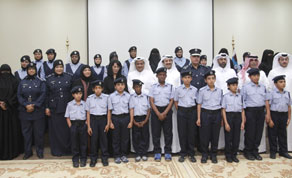
The Police Training Institute (PTI) recently held a ceremony to mark the graduation of participants in the first batch of the Community Policing Basic Course, under the auspices of Minister of State for Interior Affairs HE Sheikh Abdullah bin Nasser bin Khalifa al-Thani.
Some 46 students from various security departments took part in the course, which lasted seven weeks, said a spokesperson.
The ceremony was attended by the chairman on the Central Municipal Council, HE Nasser al-Kaabi; director of the PTI, Brigadier Mohamed Hassan Youssef al-Saei as well as other ministry officials.
Brigadier al-Saei explained that the course has been conducted to “enhance the role and mechanisms of community policing,” as well as helping to create partnerships with various social institutions to help with national security.
The PTI director added that the graduates of this course will be able to translate the Ministry of Interior’s aims and strategies to encourage understanding between various communities and to help the police to be able to prevent crimes before they are committed.
Brigadier Rashid Shaheen al-Atheeque, chairman of the steering committee of community policing, said: “The graduation of the first course of community policing is one of the stages of qualifying the national cadres at the Ministry of Interior to work in the national project.”
“Qatar is currently witnessing progress in all aspects of development in economic and social fields – this increases the role of all sectors in the country to face all kinds of challenges brought with this development,” he said, adding: “These factors require the improvement of capabilities to keep pace with development.”
Brigadier al-Atheeq explained that the ministry had pursued the initiative of community policing to help reduce crime throughout all institutions, and said that they had pursued the objective with the co-operation of the Supreme Council for Family Affairs as well as other ministries and companies, working towards the National Vision 2030.
He explained that the concept will initially be employed in the North Security Department from April 2010, with plans to apply it across the board from 2011.
Representing the director of the Ummul Qura Independent School for Boys, teacher Areezah al-Yami described the noticeable benefits of introducing the community policing programme in the school over the past year.
“Cross-Dressing” in Qatar – Girls in Thobes? Gutras? Egals?
When I read “Cross Dressing ‘on the rise in Qatar’ in today’s Gulf Times, the article below was totally not what I expected.
What do you think this ‘abnormal behavior’ might be? Girls wearing white thobes, with gutras and egals? Or girls wearing jeans? Girls wearing pants? Maybe girls wearing t-shirts, or pantsuits?
This article would be hilarious were it not so sad. The ‘abnormal’ girls are to be secretively counseled. That sounds very very scary to me.
Cross dressing ‘on the rise in Qatar’
As much as 70% of girls who have taken to cross dressing remain adamant and refuse to give up their abnormal behaviour, says a report published in the local Arabic daily Arrayah.
Quoting the director of the Abdullah Abdul Ghani centre for Social Rehabilitation in Wakrah, Buthaina Abdullah Abdul Ghani, the report says that the phenomenon of cross dressing seems to be on the rise in Qatar and other countries in the Arab world and abroad.
However, in Qatar it is not an alarming situation but efforts to redeem this misguided lot should continue persistently, she said.
The problem has to be tackled carefully and secretively since many of these girls refuse to come out of their closely knit circle. The centre had announced a programme of counselling for these girls.
Highlighting the reasons for the spread of this phenomenon she mentioned lack of parental control, programmes on the satellite channel that seek to encourage wrong values in life and the illusion of being independent in life.
This problem was the subject of a debate in the monthly Lakom al-Qarar TV programme a few months ago. The deputy chairman of the Qatar Foundation for Education, Science and Community Development said in his concluding remarks that this problem is a serious menace to society.
Qatar Divorce Rate 12th Highest in the World
Today’s story in The Peninsula examines the increasing number of divorces this year, in relation to the number of marriages.
Not a single expert quoted mentions that perhaps many of these marriages were bad alliances in the first place. One expert continually mentions the problem being women having greater access to divorce.
It is no surprise that women who have access to divorce get out of bad marriages.
She is supposed to stay with a man addicted to pornography?
With a man who cannot complete the sexual act?
With a man with a drug problem?
With a man who is openly gay, and she is to provide cover?
With a man who has a fatal sexually transmitted disease which he neglected to disclose?
With a man who is still emotionally attached to his long-time girlfriend and was forced to marry another woman?
With a man who hits her?
With a man who ignores her and goes off with his friends all the time in preference to spending time with her? (Yes, expectations for marriage are higher now than they used to be. Times change. Expectatons change.)
(These are all stories told to me by local women about failed marriages.)
I’m not a big fan of divorce. I think marriage is serious business, and a lot of hard work. And I strongly believe that women need to have the exact same access to divorce that men have. I don’t see any of the experts citing male behavior as a possible cause of this divorce rate.
Divorce rate to reach new high this year
Web posted at: 12/30/2009 5:38:55
Source ::: The Peninsula / BY SATISH KANADY
DOHA: Qatar’s divorce rate is steadily going up. Crossing last year’s figure of 939 divorces, a total of 982 couples split in the country during the first 11 months of this year.
Going by the latest data released by the Qatar Statistics Authority (QSA), more than 80 divorces take place every month in the country. The 2009 figure is expected to cross the 1,000 mark once the figures for December come in.
According to the QSA, of the 982 divorce cases this year, 655 involved Qatari women. The number of non-Qatari women who split with their spouse during the period was 327.
The months of April, May and June witnessed a large number of divorces. While 127 women got divorced during the month of May, 107 and 101 women got divorced in June and April, respectively.
It may be noted that a recent international study identified Qatar as the country with the 12th highest divorce rate in the world. The country has 0.97 divorces per thousand people, it said.
The total number of divorces in the country in 1999 was 496. However, the number has grown steadily over the past decade and touched 997 in 2007, with a total of 721 Qataris and 276 non-Qataris getting estranged. Though the rate went down in 2008 (939), this year’s figures are expected to break the 2007 record.
The QSA’s figures are disturbing against the backdrop of the fact that the total number of marriages held this year in Qatar until November 2009 was 2,917, against which the number of divorces was 982.
Against the 266 marriages that took place last month, 90 couples got divorced. Of them, 57 included Qatari women. In the month of May, which witnessed the largest number of divorces — 127 — the number of marriages was 323.
Opinions are divided among Qatari social scientists on the data revealed by the QSA. While a section of them sees the divorces as a direct consequence of Qatar’s “culture shock”, others say QSA’s methodology in collecting the data is not foolproof and the figures do not seem realistic.
“The data collected from the courts need not necessarily reflect the exact divorce rate in Qatar. For, there are a large number of cases where the couples re-join after obtaining a divorce from the court”, said a Qatari woman scholar who is doing research on Qatar’s broken families and divorces.
However, Moza Al Malki, a prominent Qatari psychologist, said: “Qatari women’s exposure to the changing world and their growing self-reliant nature are the prime reasons for this social problem.”
Al Kula, a system that encourages women to approach a court if they are not comfortable with their partner, is also contributing to the growing number of divorces, she added.
Stieg Larsson and The Girl With the Dragon Tattoo
I needed some escape time, so I started The Girl With the Dragon Tattoo, a mystery by Stieg Larsson, set in Sweden. I love these detective stories set in other countries; I can learn something as I pass the time reading an exciting mystery. And part of my heritage is Swedish, so I thought this should really be fun.

It wasn’t, at least not at the beginning. At the beginning, I didn’t like any of the characters, and they were always eating sandwiches that sounded awful, like liverwurst and egg. I felt like the characters didn’t have any moral center, like they drifted from day to day without neither conscience nor a plan. The main character, Mikael Blomkvist, is about to go to prison for libel; he printed a story about a major industrialist which turned out to be false, and he protected his source. We don’t really know the whole story, not until the end, which makes it hard to evoke a lot of sympathy for Blomkvist.
He is contacted by another industrialist, and asked to solve a mystery, if possible, about the disappearance, 40 years ago, of his niece, Harriet Vanger. Blomkvist would investigate under the cover of writing an autobiography of his employer and his family. There are members of the family who object. In many ways, it isn’t a very nice family.
Blomkvist gets an assistant, a deeply troubled and flawed young woman, Lisbeth Salander, with a gift for investigation. There is a lot of violence, sexual violence, and mutilation of animals. One of the points I credit Larsson with making is the amount of violence against women in Sweden, which goes on under a seemingly civilized veneer. The truth, as I see it, is that there is violence against women in every society; in some it is better documented than in others. In some, it is better punished that others. It exists in all societies, in all countries.
Another think I ended up liking about the book was that the main character, Blomkvist, who writes financial analysis, takes the press to task for printing what passes for financial news without critically reading and evaluating, which he feels is a responsibility of the press. At one point, as people quail with fear that the stock exchange will drop dramatically, he is interviewed and explains that the stock market is based on perceptions, while the Swedish economy is based on production and services; that while the markets may fail, the economy can still be going strong.
Slowly, the book tightens up. Actually, by the end, I was hooked. The only question in my mind is – did I like it enough to read another?
The book is available, new, from Amazon.com at $6.00 plus shipping.
Saturday Night Live Does Tiger Woods
There are mixed reviews on this hilarious Saturday Night Live take-off of the Tiger Woods situation. Some people feel it is tasteless, and that if the batterer were a man, it would be seriously unfunny.
They are right. And who on earth expects Saturday Night Live to stay within the boundaries of good taste? Or any boundaries at all?
As for me – I find it tastelessly hilarious.
( I will try to keep posting ones that work until they get taken off)
Round 2, Why You Should Always Carry Your Camera in Doha
“HOLY COW!” I shouted at AdventureMan, as I am already digging for my camera. He hates it when I do that, he things maybe I have spotted some danger or something and it gets his adrenaline going. I couldn’t help it. I was shocked, and I said “There’s a CHEETAH in that car!”
We love cheetah. Anyone who has ever seen a cheetah in the wild knows the awesome measure of God’s creativity and wonder. The cheetah is a speed machine, a glorious hunter, born to run. The cheetah is a glorious creation.
AdventureMan didn’t believe me, not for two or three full seconds and then – he saw it, too:



The man with the very young cheetah on a leash under very loose control was having a ball. The cheetah looked very happy to be out in the car with him, even on a leash.
It is a shame, and it should be a crime.
A cheetah, even when snatched away from his mother early in life, is not a toy, not an accessory. A cheetah can eat your innocent babies. A cheetah can bite you or scratch you badly, and think it is just playing. Taking a cheetah out of the wild is probably not a really good thing for the cheetah. How long with this man find him novel and fun and pay attention to him? And then what?
This is what a cheetah is meant to do, and this is how a cheetah is meant to live:
My friends, if you love wildlife, no matter how rich you are, leave the wildlife in the wild. Please.
1 in 4 US Mortgages “Under Water”
1 in 4 mortgages ‘underwater’
Report shows 10.7 million borrowers are stuck with homes that are worth less than the mortgages they owe.
By Julianne Pepitone, CNNMoney.com staff reporter
Last Updated: November 24, 2009: 12:19 PM ET
Foreclosure plague: It’s spreading
NEW YORK (CNNMoney.com) — In a sign that more foreclosures could be on the horizon, 23% of people with mortgages owe more than their home is worth, according to a report released Tuesday.
Almost 10.7 million U.S. mortgages were “underwater” as of September, said research firm First American CoreLogic.
Another 2.3 million homeowners are within 5% of negative territory, the report said. The two figures combined comprise almost 28% of all residential properties with mortgages.
Negative equity, also called an “underwater” or “upside down” mortgage, has become more common as home values plummet. The report is closely watched because borrowers who are underwater are more likely to be foreclosed.
Would you walk away from your house?
Foreclosures have been rampant for some time, but lately the tide of decay had seemed to be slowing — so Tuesday’s report could dent optimism for the housing market over the next few months.
On the other hand, the trend that turned so many mortgages upside-down — falling home prices — has reversed the past six months. The S&P/Case-Shiller HomePrice Index has reported two consecutive quarters of increasing prices.
If home prices continue to go up or, at least stabilize, fewer mortgage borrowers will find themselves underwater in the coming months.
CoreLogic changed its methodology for the third quarter — now it accounts for payments that reduce principal, and it no longer assumes home equity credit lines have been maxed out. Using the old method, 33.8% of borrowers would have been underwater in the third quarter compared with 32.2% in the previous quarter, according to a CoreLogic spokeswoman.
State totals: The majority of underwater mortgages are heavily concentrated in five states that have particularly suffered from the housing bust: Nevada, at 65%; Arizona, at 48%; Florida, at 45%; Michigan, at 37%; and California, at 35%.
These five states have been especially beleaguered because of a high rate of prime loans that went bad. Many of those loans were option-adjustable rate mortgages, in which borrowers could choose to make minimum payments that were so low they did not even offset the interest being accumulated.
When that accumulated debt reaches a certain point — usually 10% to 25% more than the original principal — the option-ARMs loans are recast into fixed-rate mortgages. When that happens, many borrowers cannot afford the new payments.
Qatar Train Map
I found the paper with the map! How cool is this?

When I look at this, I think if the money ever runs out in Qatar, they will still have invested in a superior infrastructure – education, transportation, roads, parks, attractive public areas, effective policing and traffic control – way more important than luxury malls.
Recent Comments
ExpatAlien on What Country am I Living … intlxpatr on Yellowstone: Old Faithful to C… Michelle on Yellowstone: Old Faithful to C… Cathy on No Grown-Ups in Charge intlxpatr on Waiting for Snow Wikipedia Donate Button

Amazina


Early Voting in Florida


 Here There and Everywhere