Indian Gang Rape Case Goes to Trial
From today’s Huffpost

India Gang Rape Trial Begins In New Delhi
By ASHOK SHARMA
NEW DELHI — The trial of five men charged with the gang rape and murder of a 23-year-old student on a New Delhi bus began in a closed courtroom Thursday with opening arguments by the prosecution lawyers in a special fast-track court set up just weeks ago to handle sexual assault cases.
The brutal attack last month set off protests across India and opened a national debate about the epidemic of violence against women. A government committee established in the wake of the attack has called for a complete overhaul of the way the criminal justice system deals with rape, sexual assaults and crimes against women in general.
The five men on trial – who face a maximum sentence of death by hanging if convicted – covered their faces with woolen caps as they walked into the courtroom Thursday surrounded by a phalanx of armed police. Two hours later, after proceedings were over, they were whisked away by the police.
Details of the day’s proceedings were not available. The courtroom was closed to the public and the media – a routine move in Indian rape cases – even though defense lawyers had argued that since the victim is dead, the proceedings should be opened. There was also a gag order on the lawyers to not reveal what happened inside the court.
Judge Yogesh Khanna turned down requests by journalists Thursday that they be briefed on the day’s proceedings and said the gag order would remain.
Since Friday is a public holiday in India, the next hearing in the case was set for Monday, when the defense will present its opening arguments.
A sixth suspect in the case has claimed he is a juvenile and is expected to be tried in a juvenile court.
On Thursday, a magistrate separately rejected a petition by Subramanian Swamy, a prominent politician, that no leniency be shown toward the accused who claims to be a juvenile because of the brutal nature of the crime, said Jagdish Shetty, an aide to Swamy.
Documents presented by prosecution last week to the Juvenile Justice Board indicated that the defendant was a juvenile at the time of the attack, which would make him ineligible for the death penalty.
Magistrate Geetanjali Goel is expected to rule on the suspect’s age on Jan.28.
The suspect, who is not being identified by The Associated Press because he says he is 17, would face three years in a reform facility if convicted as a juvenile.
After the fast-track court hearing, M.L. Sharma, a defense lawyer for Mukesh Singh, one of the accused, said he had withdrawn from the case. V.K. Anand, who represents Mukesh’s brother Ram Singh, will now defend both brothers. The two lawyers had been arguing over who was Mukesh Singh’s real lawyer.
Sharma said he left the case to save his client from being tortured to fire him. He has long maintained that the other defense lawyers were planted by the police to ensure guilty verdicts.
Dozens of police were outside the sprawling court complex in south New Delhi where the trial is taking place. Inside the court, about 30 policemen blocked access to the room where Khanna heard the prosecution’s case.
Outside the courtroom scores of journalists and curious onlookers crowded the hallway.
Prosecutor Dayan Krishnan warned defense lawyers that if they spoke to journalists he would slap contempt of court notices on them, said V.K. Anand, a defense lawyer.
Police say the victim and a male friend were attacked after boarding a bus Dec. 16 as they tried to return home after an evening showing of the movie “Life of Pi.” The six men, the only occupants of the private bus, allegedly beat the man with a metal bar and raped the woman with it, inflicting massive internal injuries to her, police said. The victims were dumped naked on the roadside, and the woman died two weeks later in a Singapore hospital.
Abhilasha Kumari, a New Delhi-based sociologist, said the attack could end up having a large impact on the country.
`’This case has brought the violence against women center stage and it has, out of sheer public pressure, forced the government to sensitize itself to crimes against women,” she said.
The trial began a day after a government panel recommended India strictly enforce sexual assault laws, commit to holding speedy rape trials and change the antiquated penal code to protect women.
The panel appointed to examine the criminal justice system’s handling of violence against women, received a staggering 80,000 suggestions from women’s groups and thousands of ordinary citizens.
Among the panel’s suggestions were a ban on a traumatic vaginal exam of rape victims and an end to political interference in sex crime cases. It has also suggested the appointment of more judges to help speed up India’s sluggish judicial process and clear millions of pending cases.
Law Minister Ashwani Kumar said the government would take the recommendations to the Cabinet and Parliament.
“Procedural inadequacies that lead to inordinate delays need to be addressed,” he told reporters.
Although I have marked this with “Women’s Issues,” it is only a women’s issue when violence is directed against women and women have a limited access to justice in the system. Rape is a crime of power, inflicting unwanted and uninvited invasion of the very most personal nature. It happens to men, too. Men are far less likely to come forward. They live with the shame; many commit suicide or turn to drugs and alcohol to escape the pain. One day, with women leading the way, men, too, will be able to come forward and claim justice against those who violate them.
Morocco Rape Victims Will No Longer Be Required to Marry Rapist
Morocco To Change Law That Allowed Rapists To Avoid Punishment By Marrying Their Victims
By SMAIL BELLAOUALI 01/23/13 09:46 AM ET EST
RABAT, Morocco — Nearly a year after Morocco was shocked by the suicide of a 16-year-old girl who was forced to marry her alleged rapist, the government has announced plans to change the penal code to outlaw the traditional practice.
Women’s rights activists on Tuesday welcomed Justice Minister Mustapha Ramid’s announcement, but said it was only a first step in reforming a penal code that doesn’t do enough to stop violence against women in this North African kingdom.
A paragraph in Article 475 of the penal code allows those convicted of “corruption” or “kidnapping” of a minor to go free if they marry their victim and the practice was encouraged by judges to spare family shame.
Last March, 16-year-old Amina al-Filali poisoned herself to get out of a seven-month-old abusive marriage to a 23-year-old she said had raped her. Her parents and a judge had pushed the marriage to protect the family honor. The incident sparked calls for the law to be changed.
The traditional practice can be found across the Middle East and in places like India and Afghanistan where the loss of a woman’s virginity out of wedlock is a huge stain on the honor of the family or tribe.
While the marriage age is officially 18, judges routinely approve much younger unions in this deeply traditional country of 32 million with high illiteracy and poverty.
“Changing this article is a good thing but it doesn’t meet all of our demands,” said Khadija Ryadi, president of the Moroccan Association for Human Rights. “The penal code has to be totally reformed because it contains many provisions that discriminate against women and doesn’t protect women against violence.”
She singled out in particular outmoded parts of the law that distinguish between “rape resulting in deflowering and just plain rape.” The new article proposed Monday, for instance, gives a 10-year penalty for consensual sex following the corruption of a minor but doubles the sentence if the sex results in “deflowering.”
Fouzia Assouli, president of the Democratic League for Women’s Rights, echoed Ryadi’s concerns, explaining that the code only penalizes violence against women from a moral standpoint “and not because it is just violence.”
“The law doesn’t recognize certain forms of violence against women, such as conjugal rape, while it still penalizes other normal behavior like sex outside of marriage between adults,” she added. Recent government statistics reported that 50 percent of attacks against women occur within conjugal relations.
The change to the penal code has been a long time in coming and follows nearly a year of the Islamist-dominated government balking at reforming the law.
The Justice Ministry at the time argued that al-Filali hadn’t been raped and the sex, which took place when she was 15, had been consensual. The prime minister later argued in front of parliament that the marriage provision in the article was, in any case, rarely used.
“In 550 cases of the corruption of minors between 2009 and 2010, only seven were married under Article 475 of the penal code, the rest were pursued by justice,” Prime Minister Abdelilah Benkirane said on Dec. 24.
While Morocco updated its family code in 2004, a comprehensive law combating violence against women has been languishing in Parliament for the past eight years.
Social Development Minister Bassima Hakkaoui, the sole female minister in Cabinet, said in September she would try to get the law out of Parliament and passed.
Changing Face of the Worlds Families

I had always assumed a two parent family provided the best support for a child. It never occurred to me there may be situations where the single-parent model could focus more resources on the child . . . It doesn’t matter what we believe; the face of families around the world is changing, and we will need to be dealing with the realities.
Marriage is a struggle. Raising children is a struggle. The more help, the better, I think!
The structure of families is changing worldwide, and based on a new report, some children are better off living with one parent than two.
According to the 2013 World Family Map report by non-profit research centre Child Trends, children living in two-parent families did better in school in higher-income countries, but children in lower-income regions did better with one parent.
“In some single parenting examples, resources were controlled by the mother of the household, ensuring these resources went to the well-being of children,” says Laura Lippman, senior program area director, education, and co-investigator of the World Family Map. “It suggests that some single-parent families may not benefit from a second parent who might be taking these resources away.”
Using 10 different data sources and partnering with universities around the world, Child Trends looked at the well-being of families in both low-income and high-income countries and the outcome on their children’s education. Based on the research, two-parent families are becoming less common, marriage rates are falling and a majority of children under 17 still live at home.
Significant Statistics From The Study
Two Parents vs. Single Parent:
DID YOU KNOW? Children in Asia and the Middle East under the age of 18 are more likely to live in two-parent families, compared to other regions in the world. Also, children are more likely to live with one or no parent in the Americas, Europe, Oceania, and Sub-Saharan Africa than other regions, according to the report.
Extended Family:
DID YOU KNOW? Living with extended family, which includes parents and other relatives outside the immediate family, is more common in Asia, the Middle East, South America, Sub-Saharan Africa and not any other part of the world.
Marriage:
DID YOU KNOW? Marriage rates are declining in many regions. Adults are most likely to be married in Africa, Asia and the Middle East.
Childbearing:
DID YOU KNOW? Childbearing rates are also declining, according to the report. The highest fertility rates are in Sub-Saharan Africa — a woman in Nigeria gives birth to an average of 5.5 children.
Living Together:
DID YOU KNOW? There have also been dramatic increases in cohabitation, divorce, and non-marital childbearing in the Americas, Europe, and Oceania over the last four decades, according to the report.
Population:
DID YOU KNOW? In the Americas and Oceania countries, women in these regions were having enough children for the population to replace itself from one generation to the next, or were slightly below these “replacement levels,” according to the report.
Non-Martial Childbearing:
DID YOU KNOW? In South America, over half of all children were born to unmarried mothers — Colombia had the highest rate at 85 per cent.
Poverty:
DID YOU KNOW? The report also looked extensively at rates of children and absolute poverty around the world. Absolute poverty was measured as the percentage of the population living below $1.25 a day. The report found Nigeria had the highest absolute poverty rate at 64 per cent.
Employment:
DID YOU KNOW? Between 45 and 97 per cent of parents polled were employed worldwide, and the highest employment rate was in Asia.
Family Life:
DID YOU KNOW? Between 31 per cent (in Russia) and 74 per cent (in Chile) of adults around the world are completely or very satisfied with their family life.
Household Work:
DID YOU KNOW? Approximately 55 per cent of couples in Russia and 88 per cent of couples in Philippines reported low levels of disagreement around household work.
Eating Together:
DID YOU KNOW? In Italy, 94 per cent of 15-year-old kids eat meals with their families regularly.
Family Structure:
DID YOU KNOW? In a majority of countries polled, respondents felt children were more likely to flourish in a home with a mother and a father. However, in Sweden, only 47 per cent of adults shared this belief compared to 99 per cent in Egypt, suggesting to World Family Map surveyors a more liberal attitude to changing family structures in certain countries.
The Magic that is Us: From Conception to Birth
This is amazing and wonderful imagery From Conception to Birth:
Manohar Lal Sharma: “Until today I have not seen a single incident or example of rape with a respected lady”
If you are a follower of my blog, you know I am not a person of violent tendencies. This morning, however, I am so thankful to be half a world away from the scum lawyer who would make these statements about a woman so brutally raped by six men that she died of horrendous internal injuries.
I am fighting instincts which would wish him ill. When he accuses rape victims of being responsible for their attacks, it pushes me over the line.
A person should be free to take a bus without fear of assault. And I suspect that there are also male victims, too ashamed to come forward.

Manohar Lal Sharma, lawyer for one of the accused, speaks to journalists outside the Saket district court complex in New Delhi, India, on Jan. 10. Police badly beat the five suspects arrested in the brutal gang rape and killing of a young woman on a New Delhi bus, Sharma said Thursday, accusing authorities of tampering with evidence in the case that has transfixed India. (AP Photo/Saurabh Das)
As the trial of the men charged with the brutal gang rape and murder of a woman in New Delhi last month gets under way this week, a lawyer for some of the accused suggests the victim was partly to blame for the attack.
Lawyer Manohar Lal Sharma said his clients were innocent and implied that the 23-year-old student must have been in some way responsible for the horrific crime, Bloomberg reports.
“Until today I have not seen a single incident or example of rape with a respected lady,” Sharma said. “Even an underworld don would not like to touch a girl with respect.”
The lawyer’s controversial comments are sure to anger victim’s advocates, especially in light of somewhat similar sentiments proclaimed by Indian guru Asaram Bapu.
Last week Bapu said the victim should have “taken God’s name and could have held the hand of one of the men and said I consider you as my brother and should have said to the other two ‘Brother I am helpless, you are my brother, my religious brother,'” according to the Hindustan Times.
It is worth noting, however, that a representative for Bapu later said the media distorted the guru’s remarks.
“[He] never made such statements. He just asked his women followers to avoid such situation anyhow,” the rep told Asian News International. “He was only suggesting that women should try their level-best to come out from such situation by using diplomatic ways.”
News outlet The Week compiled a list of several other statements that seem to place blame on the rape victim. The compilation includes a comment from Andhra Pradesh Congress Committee president Botsa Satyanarayana, who suggested the victim stayed out too late.
“Do we roam in streets at midnight as we got Independence at midnight?” Satyanarayana said. “She should have assessed the situation before getting into the bus.”
The attack, which occurred on the evening of Dec. 16, has shocked Indian residents and prompted violent protests in cities across the country, CNN notes.
Sharma, who stepped in to help defend the suspects when many other lawyers refused to represent them, also claimed his clients had been tortured by police while in jail, Time reports.
The main suspect in the trial, the bus driver, will plead not guilty according to Reuters, as will the driver and a third suspect he represents.
“We will plead not guilty. We want this to go to trial,” Sharma said. “We are only hearing what the police are saying. This is manipulated evidence. It’s all on the basis of hearsay and presumption.
Six Arrested in Second Indian Gang Rape Case
This was on AOL News / Huffpost this morning. The author makes an interesting point, not only are societal mores at fault, blaming the victim and implying the rape was her fault, but also the problem is exacerbated by the growing imbalance between males and females in the population. Where are potential mates for the excess of men?
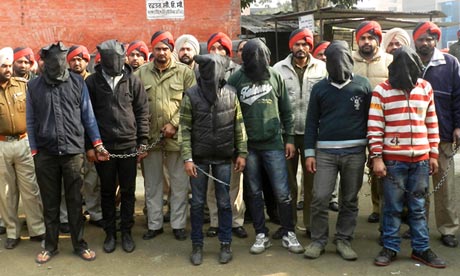
India Gang Rape: Woman Assaulted By Bus Driver, Conducter
By ASHOK SHARMA 01/13/13 07:49 AM ET EST
NEW DELHI — Police said Sunday they have arrested six suspects in another gang rape of a bus passenger in India, four weeks after a brutal attack on a student on a moving bus in the capital outraged Indians and led to calls for tougher rape laws.
Police officer Raj Jeet Singh said a 29-year-old woman was the only passenger on a bus as she was traveling to her village in northern Punjab state on Friday night. The driver refused to stop at her village despite her repeated pleas and drove her to a desolate location, he said.
There, the driver and the conductor took her to a building where they were joined by five friends and took turns raping her throughout the night, Singh said.
The driver dropped the woman off at her village early Saturday, he said.
Singh said police arrested six suspects on Saturday and were searching for another.
Gurmej Singh, deputy superintendent of police, said all six admitted involvement in the rape. He said the victim was recovering at home.
Also on Saturday, police arrested a 32-year-old man for allegedly raping and killing a 9-year-old girl two weeks ago in Ahmednagar district in western India, the Press Trust of India news agency reported. Her decomposed body was found Friday.
Police officer Sunita Thakare said the suspect committed the crime seven months after his release from prison after serving nine years for raping and murdering a girl in 2003, PTI reported Sunday.
The deadly rape of a 23-year-old student on a New Delhi bus in December led to the woman’s death and set off an impassioned debate about what India needs to do to prevent such tragedies. Protesters and politicians have called for tougher rape laws, police reforms and a transformation in the way the country treats women.
“It’s a very deep malaise. This aspect of gender justice hasn’t been dealt with in our nation-building task,” Seema Mustafa, a writer on social issues who heads the Center for Policy Analysis think tank, said Sunday.
“Police haven’t dealt with the issue severely in the past. The message that goes out is that the punishment doesn’t match the crime. Criminals think they can get away it,” she said.
In her first published comments, the mother of the deceased student in the New Delhi attack said Sunday that all six suspects in that case, including one believed to be a juvenile, deserve to die.
She was quoted by The Times of India newspaper as saying that her daughter, who died from massive internal injuries two weeks after the attack, told her that the youngest suspect had participated in the most brutal aspects of the rape.
Five men have been charged with the physiotherapy student’s rape and murder and face a possible death penalty if convicted. The sixth suspect, who says he is 17 years old, is likely to be tried in a juvenile court if medical tests confirm he is a minor. His maximum sentence would be three years in a reform facility.
“Now the only thing that will satisfy us is to see them punished. For what they did to her, they deserve to die,” the newspaper quoted the mother as saying.
Some activists have demanded a change in Indian laws so that juveniles committing heinous crimes can face the death penalty.
The names of the victim of the Dec. 16 attack and her family have not been released.
What is also troubling in these two cases is that the women were on public transportation, and the rapes were arranged and carried out by the bus drivers and bus personnel, people who should have been there to keep her safe. They treated the victims like pieces of meat; it seems excessively hostile and brutal – you have to wonder what is driving them.
You can read more on this in an article from The Guardian, from where I found the photo above of the perpetrators.
Study Suggests Women Wait to Have Children
Found this today in AOL News/Huffington Post:
Those bright eyes and chubby cheeks may be hard to resist, but researchers from the Fred Hutchinson Cancer Research Center in Seattle have good reason to believe you should.
In a study published online in Breast Cancer Research and Treatment, researchers found that the interval between starting menstruation and first giving birth is inversely associated with the risk of triple-negative breast cancer (TNBC), a subtype of the disease that does not depend on hormones such as estrogen to grow and spread, and therefore does not respond to hormone-blocking drugs such as Tamoxifen. To put it plainly, women who wait at least 15 years after their first menstrual period to give birth to their first child may reduce their risk of the aggressive form of breast cancer by up to 60 percent, the report states.
It’s a finding that researchers say African-American women want to consider especially, since they experience disproportionately high rates of triple-negative disease.
In fact, study author Christopher I. Li, M.D. says that his findings may actually explain why black women tend to develop triple-negative breast cancer more often than other groups. African-American women are more likely to start having children at a younger age and are less likely to breast-feed, Li said, pointing to several previous studies that have suggested that breast-feeding provides a protective effect against triple-negative disease.
Previous studies have also countered Li’s latest claim, however, showing that waiting to have children may actually increase your breast cancer risk. But, like Li, researchers note that the type of breast cancer key.
The risk of the most common subtype of breast cancer, ER positive, for example, has proven to be lower among women who’ve had a full-term pregnancy and have breast-fed. The reason, researchers believe, is that the hormones associated with pregnancy induce certain changes in the cellular structure of the breast that make the tissue less susceptible to this type of cancer.
And while prevention trumps having to fight off triple negative disease, researchers honed in on two successful ways to do it this year. In October, scientists pinpointed a new compound created from a rich source in vegetables, including broccoli and brussel sprouts, to combat TNBC, while researchers at Memorial Sloan-Kettering Cancer Center in New York discovered that a certain form of smallpox vaccine was able to kill 90 percent of cancer cells in four days of treatment.
Vitamin D Fights Auto-Immune Diseases
When we were living in Qatar, there was a study published in the Qatar Gulf Times about the increasing problem of Vitamin D deficiency among women who are covered. It suggested that just ten minutes a day, uncovered, in full sunshine, could help relieve this common deficiency.
Part of the problem may be a lack of private area where a covered woman will feel comfortable being outside, uncovered, free from prying eyes. Another problem is cultural, where whiter skin is valued more highly than darker skin, or freckled skin.
What cost beauty? There are long term ramifications of Vitamin D deficiency, and the consequences can be dire. The cure is so easy . . .
By Diana Rodriguez
Medically reviewed by Lindsey Marcellin, MD, MPH
Your body needs a wide range of nutrients so that each cell performs the way it’s supposed to and all your body functions run smoothly. One important source that’s been getting a lot of buzz? Vitamin D — this essential vitamin helps build strong bones and much more.
Now researchers are discovering that vitamin D may be a powerful tool in understanding, and perhaps even preventing, certain health problems, including a group of conditions that currently has no cure — autoimmune diseases.
Autoimmune diseases occur when your immune system turns against your own body instead of fighting harmful invaders like bacteria and viruses. Autoimmune diseases affect different areas of the body. For instance, psoriasis is an autoimmune disease that affects the skin, while Graves’ disease is an autoimmune disease that affects the thyroid gland.
Little is known about how and why autoimmune diseases occur, what can be done to prevent them, and how to reduce your autoimmune disease risk. But that could be about to change.
The Scoop on Vitamin D’s Benefits
One recent study discovered that people who are deficient in vitamin D, which comes from both food sources and sunlight, have an increased autoimmune disease risk. The study also found that vitamin D can affect how your genes function by binding to them in particular spots. These binding locations may help researchers better understand genes that trigger diseases related to vitamin D.
We know that vitamin D plays a role in protecting the immune system. And researchers found that not getting enough vitamin D increases your risk for rheumatoid arthritis, multiple sclerosis, and type 1 diabetes, among other autoimmune diseases. Unfortunately, researchers can’t yet pinpoint exactly how and why this is the case, or how getting enough vitamin D may help to ward off the onset of autoimmune disease symptoms.
5 Ways to Up Your Daily Dose of D
It’s clear that much more research needs to be done to better understand both autoimmune diseases and the impact of vitamin D on reducing autoimmune disease risk. But we already know that not getting enough vitamin D can be devastating to bones, leading to osteoporosis and fractures.
For overall good health, it’s essential to meet vitamin D requirements, up to 600 international units, or IU, each day. If your doctor tests your blood vitamin D level and finds a low level, you may be advised to get higher amounts. Where can you find this bone-building, immune-boosting vitamin? Here are some simple ways to get the recommended daily intake of vitamin D:
Feed on fish. Specifically, canned pink salmon, mackerel, and sardines offer the highest amounts of vitamin D.
Choose fortified beverages. Both soy and cow’s milk are available fortified with vitamin D. Some brands of orange juice also come with an added dose of D.
Eat egg yolks. Though they’re sometimes a concern because of cholesterol, egg yolks are a good source of vitamin D.
Start your day with cereal. Dry cereals and instant oatmeal that have been fortified with vitamin D are a great way to start your day.
Keep it simple with a supplement. Vitamin D supplements can make it easy to get all you need each day — just take one pill.
Exposure to the sun also helps your body to produce vitamin D. Relaxing in the sun for a brief period of time (just 5 to 10 minutes) a few days per week without sunscreen can help your body create enough vitamin D to ward off a deficiency. Just remember to guard against the potential damage of the sun — keep your exposure limited to reap the vitamin D benefits without harming your skin.
Jesus and the Woman to be Stoned for Adultery
I’ve always loved this passage, along with the woman at the well, and the woman who touched the hem of his garment to be healed from a bleeding disease – Jesus was kind to women, in a time and culture where a pious man would not speak to a woman.
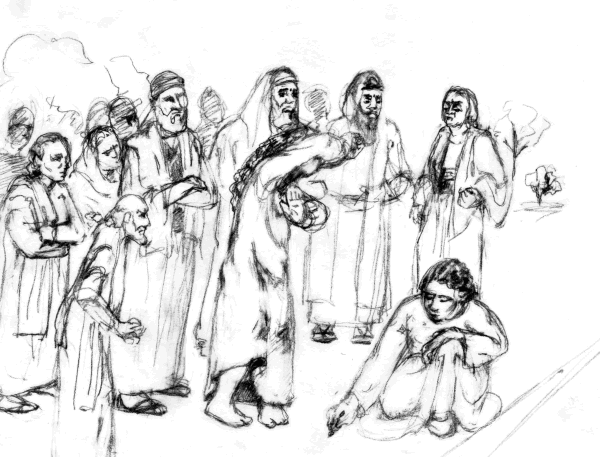
Hilary Mantel captures the stunning experience in Eight Months on Ghazzah Street, where she asks a man at a counter for an item and he looks right past her. She repeats her request and he acts as if she isn’t there. Her husband walks up, asks, and receives an answer. Cultural biases most often do not favor women. In this regard, Jesus – and the prophet Mohammed – changed everything, and treated women as equal people. It’s amazing to me how many of the Jesus anecdotes featuring females survived; it must have been astonishing in his time to treat females – property – with such compassion and humanity.
Footnote to this passage from The Lectionary: The most ancient authorities lack 7.53—8.11; other authorities add the passage here or after 7.36 or after 21.25 or after Luke 21.38, with variations of text; some mark the passage as doubtful.
John 7:53-8:11
53Then each of them went home, 81while Jesus went to the Mount of Olives. 2Early in the morning he came again to the temple. All the people came to him and he sat down and began to teach them. 3The scribes and the Pharisees brought a woman who had been caught in adultery; and making her stand before all of them, 4they said to him, ‘Teacher, this woman was caught in the very act of committing adultery. 5Now in the law Moses commanded us to stone such women. Now what do you say?’ 6They said this to test him, so that they might have some charge to bring against him. Jesus bent down and wrote with his finger on the ground. 7When they kept on questioning him, he straightened up and said to them, ‘Let anyone among you who is without sin be the first to throw a stone at her.’ 8And once again he bent down and wrote on the ground.* 9When they heard it, they went away, one by one, beginning with the elders; and Jesus was left alone with the woman standing before him. 10Jesus straightened up and said to her, ‘Woman, where are they? Has no one condemned you?’ 11She said, ‘No one, sir.’* And Jesus said, ‘Neither do I condemn you. Go your way, and from now on do not sin again.’]]*
Indian Village Bans Cell Phones – For Women
LOL – what about those cheating, eloping MEN? Ban only women from using cell phones? What about calls from mothers who need you to run an errand? What about calls from the children’s school? Women – and man – who are going to cheat are going to cheat, whether or not you take their cell phone away. Found this on AOL/Huffpost via Reuters:
PATNA, India – (Reuters) – A village council in the eastern Indian state of Bihar has banned the use of mobile phones by women, saying the phones were “debasing the social atmosphere” by leading to elopements – a move that set off outraged protests from activists.
In addition to the ban, the Sunderbari village council in a Muslim-dominated area some 385 kilometers (239 miles) east of Patna, the capital of Bihar, has also imposed a fine of 10,000 rupees ($180) if a girl is caught using a mobile phone on the streets.
Married women would have to pay 2,000 rupees ($36.60).
“It always gives us a lot of embarrassment when someone asks who has eloped this time,” said Manuwar Alam, who heads a newly-formed committee tasked with enforcing the ban, referring to queries from neighboring villages.
He said the number of elopements and extramarital love affairs had risen in the past few months, with at least six girls and women fleeing their homes.
“Even married women were deserting their husbands to elope with lovers. That was shameful for us,” Alam said. “So, we decided to tackle it firmly. Mobile phones are debasing the social atmosphere”.
Local officials have begun investigations, saying that such bans cannot be allowed in a healthy society, while women’s rights activists called it an assault on freedom that could potentially end up harming women by stripping them of one source of protection from trouble, such as unwanted advances by men.
“Girls and women are capable enough to protect themselves,” said activist Suman Lal during a debate on local television. “Technology is meant to be used, not to be banned…The order is nauseating.”
Fellow activist Mohammad Islam said it was “disappointing” that the village council ignored the many advantages of mobile phones before placing a ban on them for one reason.
“I want every girl to be given a mobile phone so that she could call up family members if she has a problem”, he said. ($1 = 54.6400 Indian rupees)
(Reporting by New Delhi newsroom, editing by Elaine Lies)
Recent Comments
Kitchen on Isiais: Winding Down intlxpatr on Shampoo Ginger tigerbutterya0c5ff1d… on Shampoo Ginger intlxpatr on British Soldier Kidnapped, Esc… John on British Soldier Kidnapped, Esc… Wikipedia Donate Button

Amazina


Early Voting in Florida


